Asymmetric nightside CO2 features, inefficient heat transport, and precise evolutionary constraints: Spectroscopic phase curves reveal the past and present of a white dwarf-brown dwarf binary
Pith reviewed 2026-06-30 04:13 UTC · model grok-4.3
The pith
Spectroscopic phase curves of a white dwarf-brown dwarf binary show day-to-night heat transport efficiency below 10%.
A machine-rendered reading of the paper's core claim, the machinery that carries it, and where it could break.
Core claim
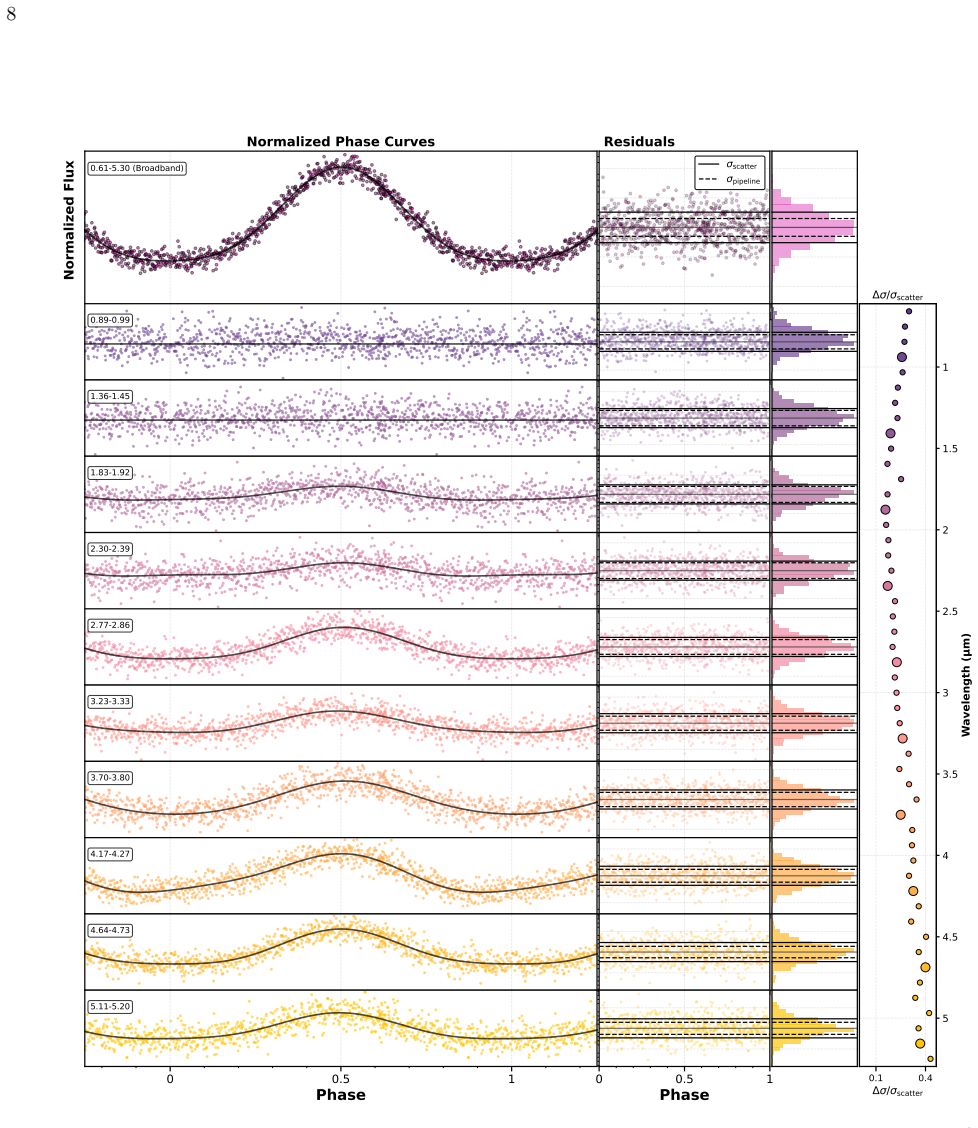
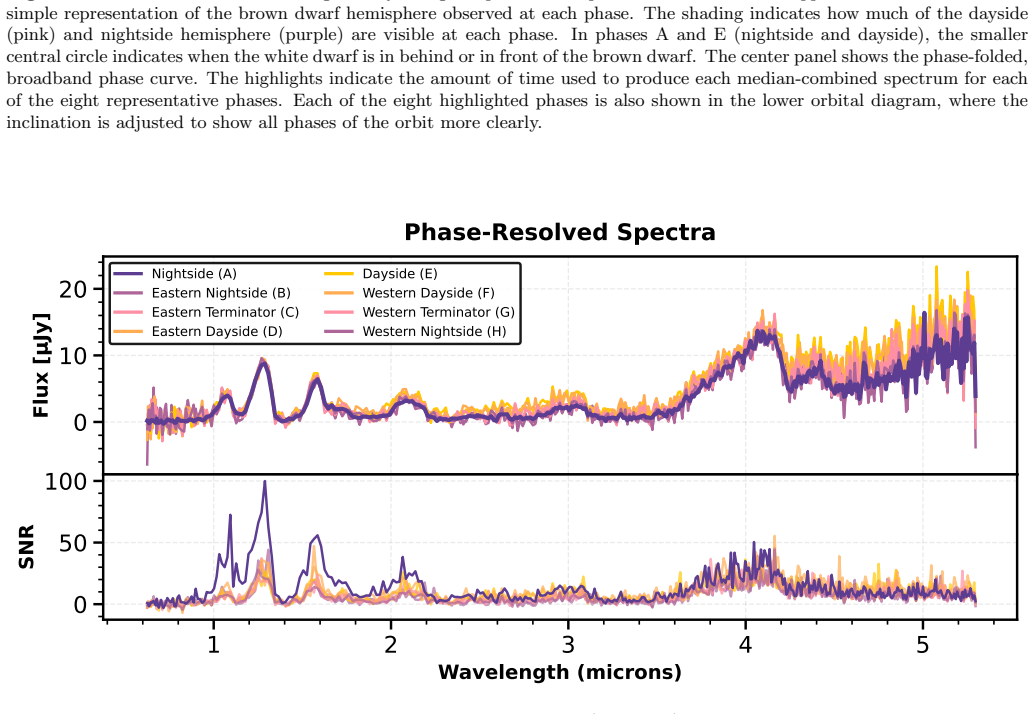
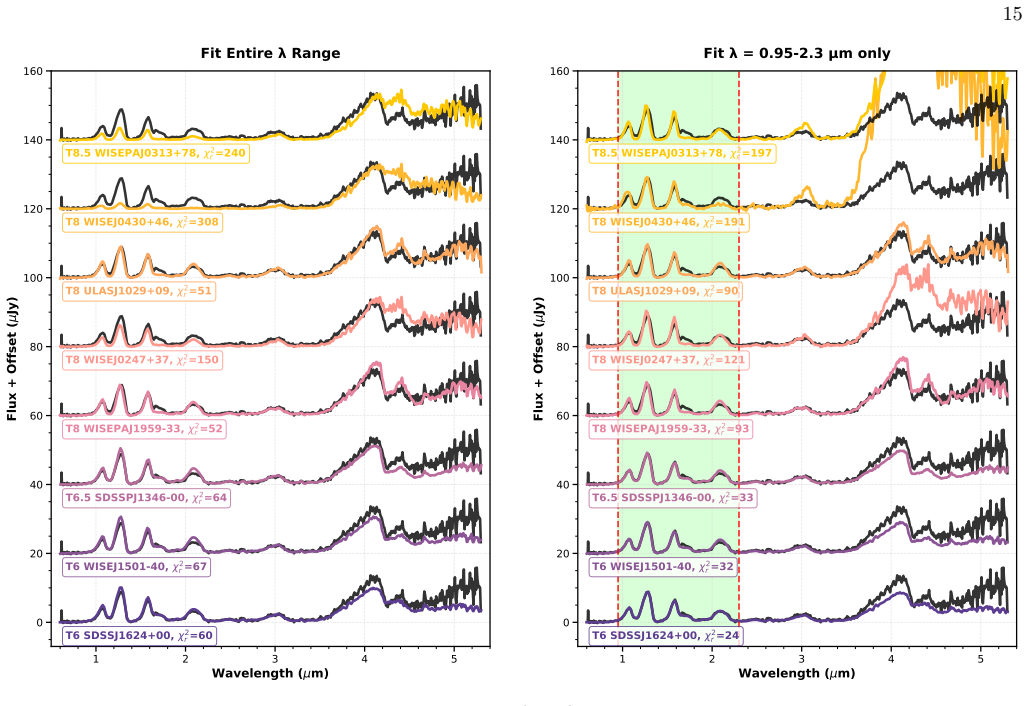
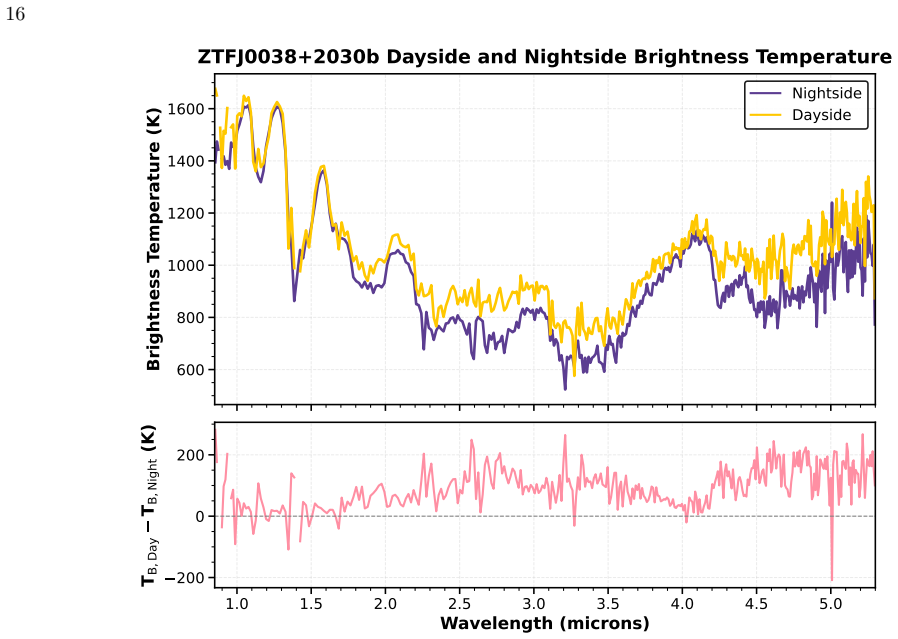
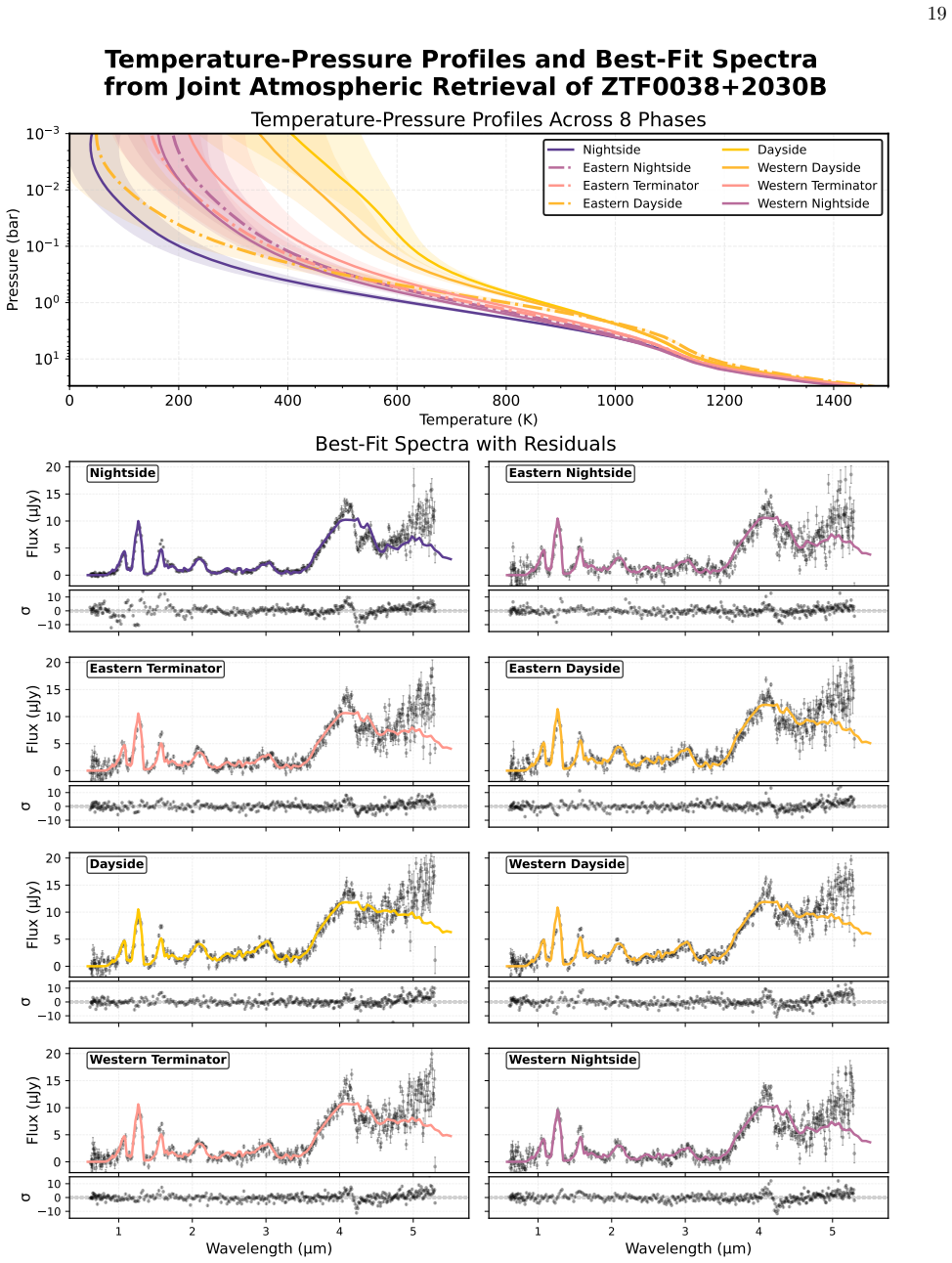
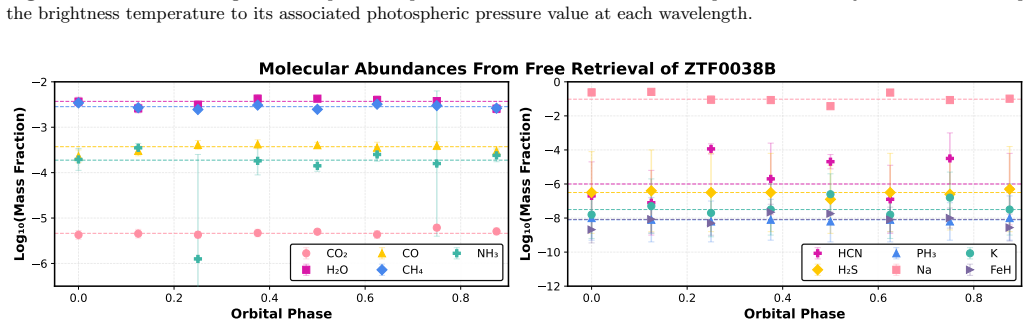
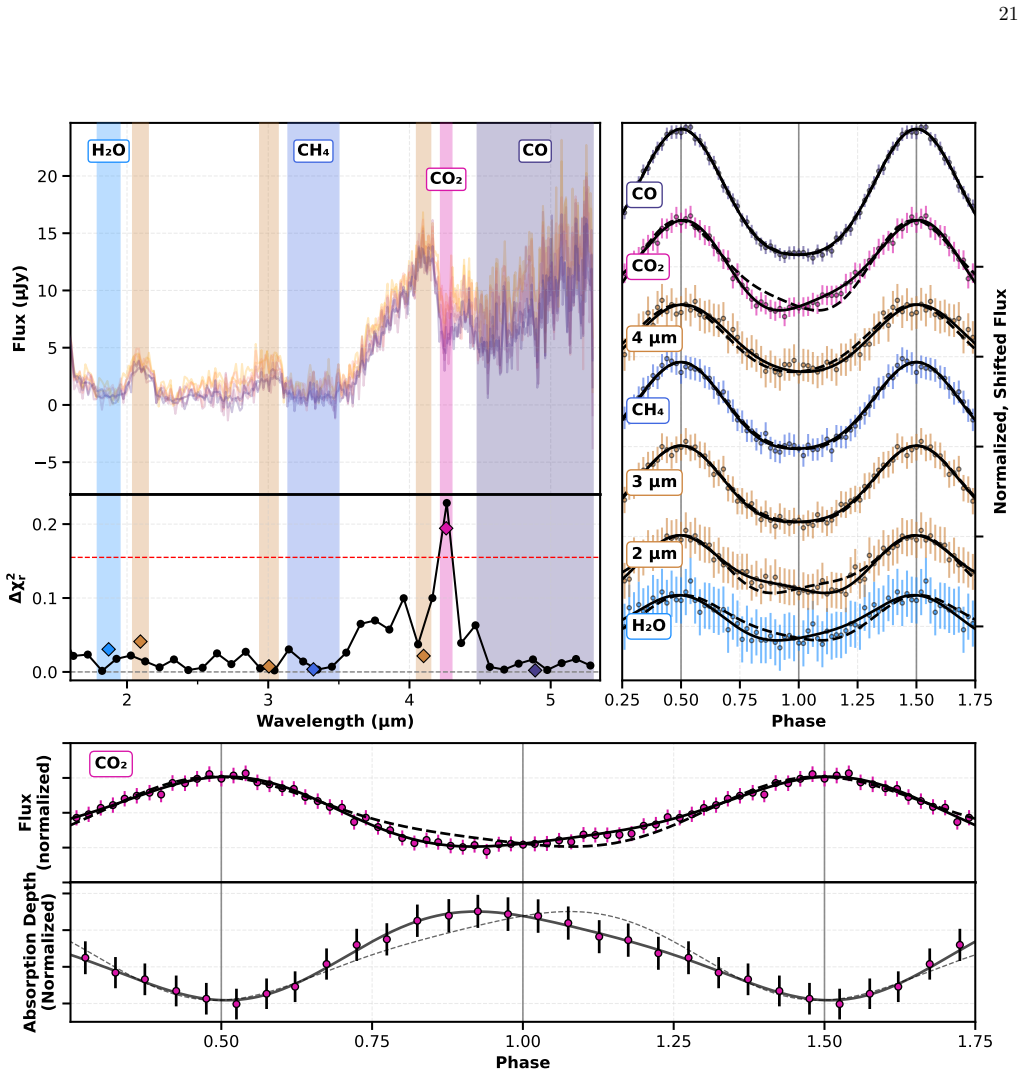
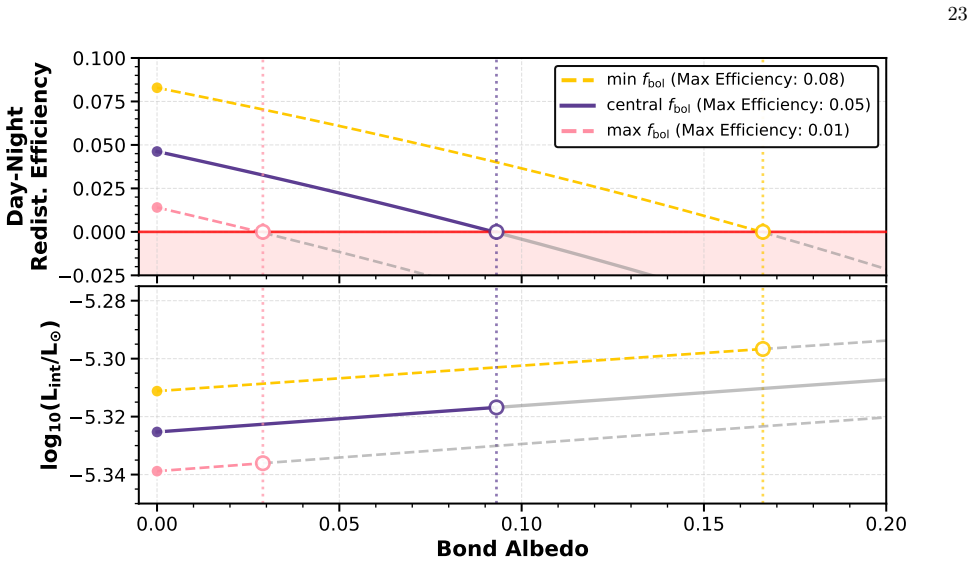
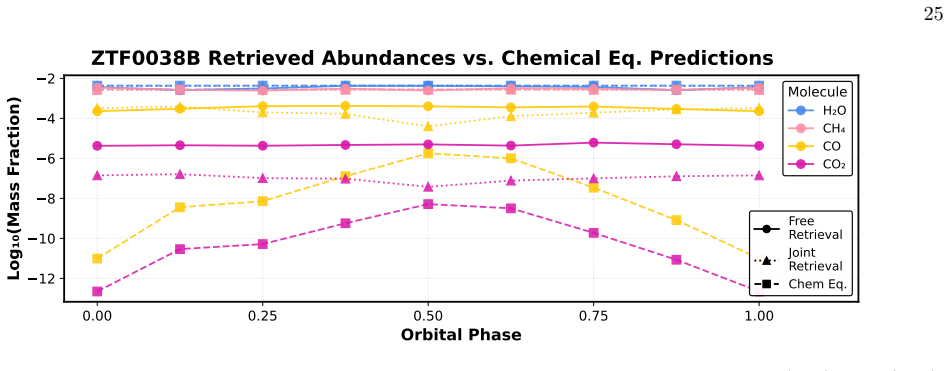
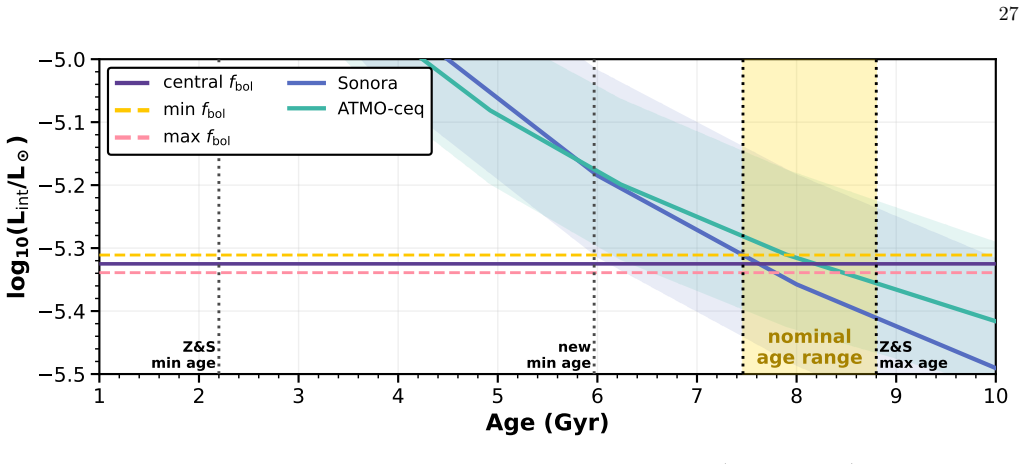
The spectroscopic phase curves reveal inefficient heat redistribution with day-to-nightside heat transport efficiency below 10%, derived from a nearly model-independent energy balance calculation using the PRISM spectrum covering ~80% of the brown dwarf's bolometric emission. Inefficient redistribution is further supported by the phase curve shape and the nightside spectrum closely resembling non-irradiated mid-to-late T dwarfs. The data show a stark nightside asymmetry tied to strong CO2 absorption at 4.2 um, while retrieved abundances indicate longitudinally homogeneous distributions of CO2 and other key species. The precise internal luminosity measurement informs both the age of the WD-BD
What carries the argument
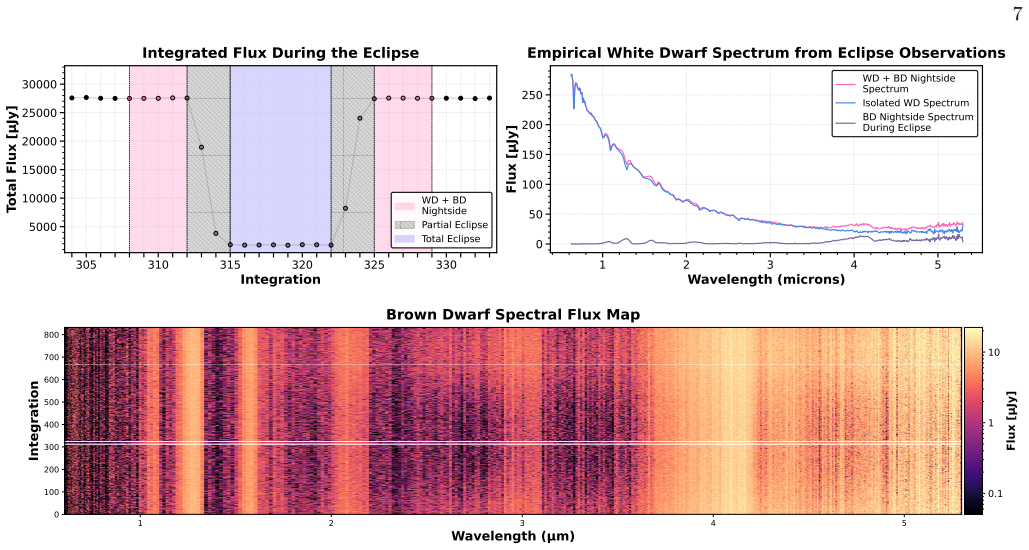
The NIRSpec PRISM full-orbit phase curve including total white dwarf eclipse, which separates the brown dwarf's phase-resolved emission spectra for energy balance and retrieval analysis.
If this is right
- Tidally locked brown dwarfs in short-period binaries exhibit hot Jupiter-like atmospheric dynamics with very inefficient day-to-night heat redistribution.
- Nightside CO2 absorption features and asymmetries serve as probes of three-dimensional processes in substellar atmospheres.
- Precise brown dwarf luminosity measurements tightly constrain system ages and common-envelope ejection efficiencies in post-main-sequence binaries.
- WD-BD binaries act as laboratories connecting substellar atmospheres to exoplanet atmospheres and probing planetary system evolution after the host star leaves the main sequence.
Where Pith is reading between the lines
- Additional WD-BD systems observed with similar full-orbit spectroscopy could test whether sub-10% heat transport efficiency is typical for tidally locked brown dwarf companions.
- The combination of nightside asymmetry with homogeneous abundances may indicate chemical or dynamical mechanisms that current forward models do not fully capture.
- The technique of using eclipses for component separation could extend to other irradiated substellar companions to map heat transport across a range of irradiation levels.
Load-bearing premise
The NIRSpec PRISM spectrum and eclipse geometry allow clean separation of the white dwarf and brown dwarf emission components throughout the orbit without significant contamination or model-dependent corrections.
What would settle it
A nightside spectrum measured independently at wavelengths where the white dwarf contribution is negligible that deviates substantially from a non-irradiated mid-to-late T dwarf spectrum, or an energy balance yielding heat transport efficiency well above 10%, would falsify the inefficient transport claim.
Figures
read the original abstract
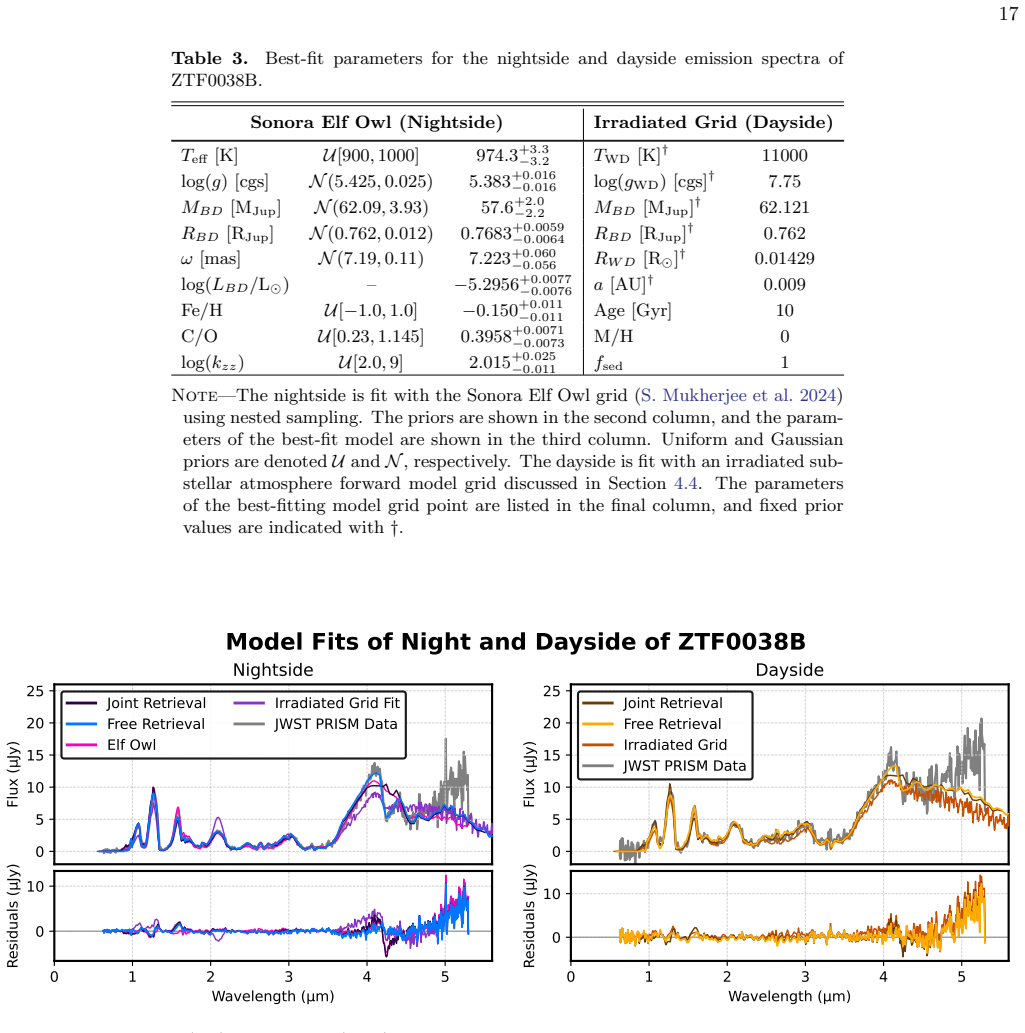
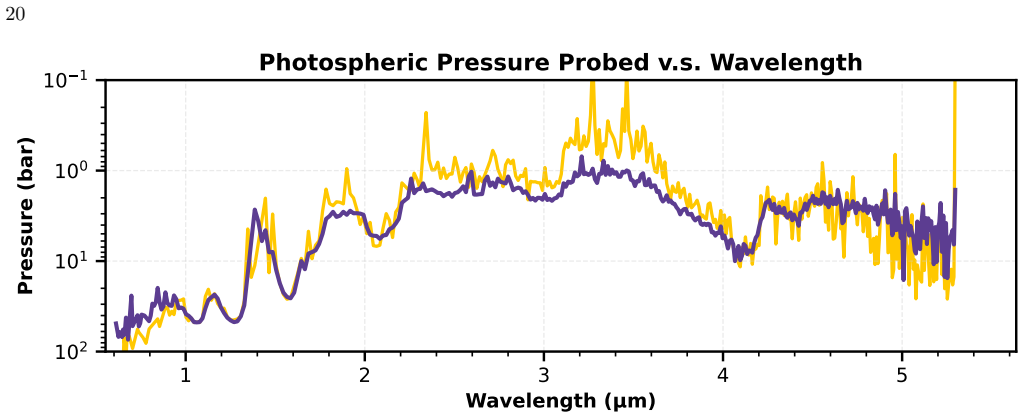
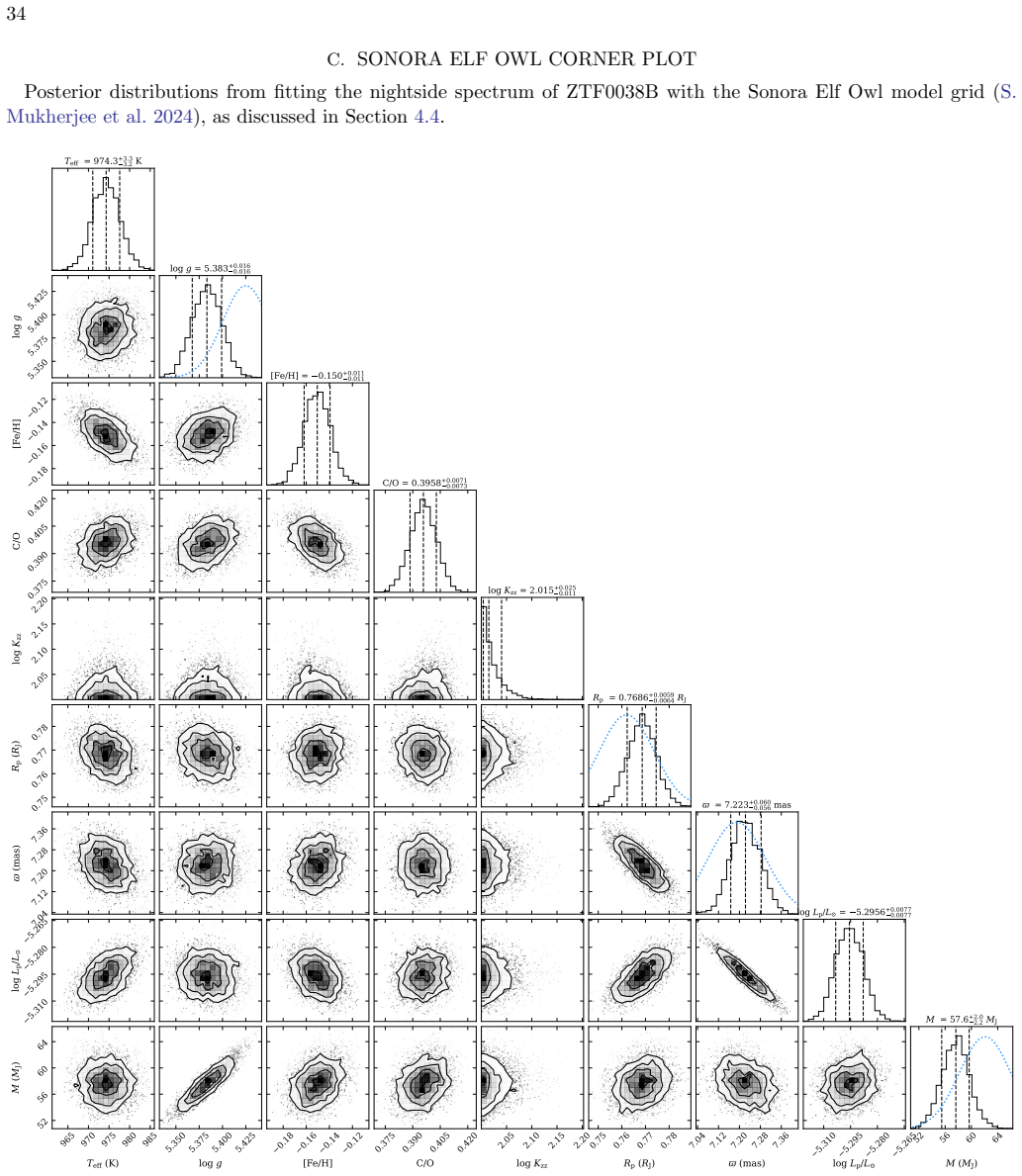
We present the first JWST phase curve of a white dwarf-brown dwarf binary, a NIRSpec PRISM observation of ZTFJ0038+2030. Short-period white dwarf-brown dwarf binaries provide unique laboratories to probe substellar atmospheres. Tidal locking drives hot Jupiter-like atmospheric dynamics in the brown dwarf. The system's formation history offers a window into planetary systems around post-main-sequence stars. We obtain a full-orbit phase curve of ZTF0038, including a total eclipse of the white dwarf, which enables us to separate the two components' emission throughout the entire orbit, and we model the brown dwarf's phase-resolved emission spectra using substellar atmosphere forward models and atmospheric retrievals. The PRISM spectrum covers ~80% of the brown dwarf's bolometric emission, enabling a nearly model-independent energy balance calculation, which yields a day-to-nightside heat transport efficiency of <10%. Inefficient heat redistribution is further supported by the phase curve shape and the nightside spectrum closely resembling non-irradiated mid-to-late T dwarfs. The spectroscopic phase curves reveal a stark nightside asymmetry associated with a strong CO2 absorption feature at 4.2 um, while the retrieved abundances indicate a longitudinally homogeneous distribution of CO2 as well as all other key species detected in the atmosphere. The precise internal luminosity measurement of the brown dwarf informs both the age of the WD-BD system (7.5-8.8 Gyr) and indicates a low common-envelope ejection efficiency. These data illustrate the exquisite opportunity to probe the three-dimensional processes of substellar atmospheres, connect substellar and exoplanet atmospheres, and probe the evolution of post-main-sequence planetary systems using WD-BDs.
Editorial analysis
A structured set of objections, weighed in public.
Referee Report
Summary. The manuscript reports the first JWST NIRSpec PRISM spectroscopic phase curve of the white dwarf-brown dwarf binary ZTF J0038+2030. Leveraging a total eclipse to separate the white dwarf and brown dwarf emission components throughout the orbit, the authors apply substellar atmosphere forward models and retrievals to the phase-resolved brown dwarf spectra. They perform a nearly model-independent energy balance calculation over the ~80% bolometric coverage of the PRISM spectrum to derive a day-to-nightside heat transport efficiency of <10%, corroborated by the phase curve shape and nightside spectrum resembling non-irradiated mid-to-late T dwarfs. Additional findings include a nightside asymmetry linked to a strong CO2 absorption feature at 4.2 μm (with longitudinally homogeneous retrieved abundances for CO2 and other species) and a precise internal luminosity that constrains the system age to 7.5-8.8 Gyr and implies low common-envelope ejection efficiency.
Significance. If the component separation and energy balance hold, the result supplies a rare, direct constraint on inefficient heat redistribution in a tidally locked substellar atmosphere, with clear connections to hot Jupiter dynamics and the evolution of post-main-sequence planetary systems. The broad spectral coverage enabling a nearly model-independent efficiency calculation is a methodological strength.
major comments (2)
- [Abstract] Abstract and energy-balance section: The <10% day-to-nightside heat transport efficiency is derived from integrated day- and nightside fluxes after subtracting a constant white dwarf contribution measured from the total eclipse depth. The manuscript must supply quantitative tests (e.g., wavelength-dependent eclipse depth residuals, checks for brown dwarf variability on the eclipse timescale, and PRISM systematic differences between in- and out-of-eclipse data) to demonstrate that residual contamination does not bias the nightside flux at a level that would alter the efficiency upper limit.
- [Abstract] The assumption that the NIRSpec PRISM spectrum and eclipse geometry permit clean separation of the two components without model-dependent corrections is load-bearing for both the efficiency claim and the nightside asymmetry interpretation; any non-constant white dwarf flux or incomplete totality at 4.2 μm would propagate directly into the reported CO2 feature and energy balance.
minor comments (1)
- Clarify in the methods whether the 80% bolometric coverage fraction is calculated from the observed spectrum alone or incorporates any model extrapolation, and state the precise wavelength range used for the integration.
Simulated Author's Rebuttal
We thank the referee for their thorough review and for highlighting the importance of rigorously validating the component separation. We address the major comments below and will revise the manuscript to incorporate the requested quantitative tests.
read point-by-point responses
-
Referee: [Abstract] Abstract and energy-balance section: The <10% day-to-nightside heat transport efficiency is derived from integrated day- and nightside fluxes after subtracting a constant white dwarf contribution measured from the total eclipse depth. The manuscript must supply quantitative tests (e.g., wavelength-dependent eclipse depth residuals, checks for brown dwarf variability on the eclipse timescale, and PRISM systematic differences between in- and out-of-eclipse data) to demonstrate that residual contamination does not bias the nightside flux at a level that would alter the efficiency upper limit.
Authors: We agree that explicit quantitative validation of the constant white dwarf subtraction is essential to support the efficiency upper limit. In the revised manuscript we will add: (1) wavelength-dependent eclipse depth residuals across the PRISM range, (2) an assessment of brown dwarf variability on the eclipse timescale using the out-of-eclipse baseline, and (3) a direct comparison of PRISM systematic trends inside versus outside eclipse. These tests will quantify any residual contamination and confirm it does not alter the reported <10% day-to-nightside heat transport efficiency. revision: yes
-
Referee: [Abstract] The assumption that the NIRSpec PRISM spectrum and eclipse geometry permit clean separation of the two components without model-dependent corrections is load-bearing for both the efficiency claim and the nightside asymmetry interpretation; any non-constant white dwarf flux or incomplete totality at 4.2 μm would propagate directly into the reported CO2 feature and energy balance.
Authors: The observation is of a total eclipse, which in principle enables direct, model-independent separation of the components. To address the referee's concern about possible non-constant white dwarf flux or wavelength-dependent incompleteness (particularly near 4.2 μm), the revision will include an explicit verification of eclipse totality across the full PRISM bandpass, including at the CO2 feature, together with any constraints on white dwarf variability. These additions will strengthen the justification for the clean separation used in both the energy-balance and nightside asymmetry analyses. revision: yes
Circularity Check
No circularity: heat transport efficiency derived directly from observed spectra and eclipse geometry
full rationale
The central result (day-to-nightside heat transport efficiency <10%) is obtained by integrating the PRISM spectra (~80% bolometric coverage) after separating WD and BD components via the total eclipse, then comparing emitted power on each side to the irradiation inferred from the WD eclipse depth. This is a direct observational energy balance with no equations reducing the output to a fitted input renamed as prediction, no self-definitional loop, and no load-bearing self-citation chain. The separation relies on eclipse geometry rather than an ansatz or prior result from the same authors. The derivation is self-contained against external benchmarks.
Axiom & Free-Parameter Ledger
free parameters (2)
- day-to-night heat transport efficiency
- atmospheric retrieval parameters (abundances, temperature profile)
axioms (2)
- domain assumption Tidal locking produces hot-Jupiter-like atmospheric dynamics in the brown dwarf
- domain assumption Substellar atmosphere forward models accurately represent the emission spectra
Reference graph
Works this paper leans on
-
[1]
Exoplanet Reflected Light Spectroscopy with PICASO
doi:10.3847/1538-4357/ab1b51 , eid =. arXiv , author =:1904.09355 , journal =
work page internal anchor Pith review Pith/arXiv arXiv doi:10.3847/1538-4357/ab1b51 1904
-
[2]
arXiv , author =:2110.10158 , journal =
doi:10.3847/1538-3881/ac3001 , eid =. arXiv , author =:2110.10158 , journal =
-
[3]
, keywords =. doi:10.1086/321540 , eprint =
-
[4]
arXiv , author =:2303.07420 , journal =
doi:10.3847/1538-4357/acbfb3 , eid =. arXiv , author =:2303.07420 , journal =
-
[5]
doi:10.1093/mnras/stae2121 , eprint =
, keywords =. doi:10.1093/mnras/stae2121 , eprint =
-
[6]
1999, ApJ, 513, 879, doi: 10.1086/306881
, keywords =. doi:10.1086/306881 , eprint =
-
[7]
Handbook of Exoplanets , doi =
-
[8]
arXiv , author =:2006.09394 , journal =
doi:10.1051/0004-6361/202038325 , eid =. arXiv , author =:2006.09394 , journal =
-
[9]
ascl , author =:1905.019 , howpublished =
1905
-
[10]
arXiv , author =:2105.08009 , journal =
doi:10.3847/1538-4357/abff50 , eid =. arXiv , author =:2105.08009 , journal =
-
[11]
arXiv , author =:2107.07434 , journal =
doi:10.3847/1538-4357/ac141d , eid =. arXiv , author =:2107.07434 , journal =
-
[12]
arXiv , author =:2402.00756 , journal =
doi:10.3847/1538-4357/ad18c2 , eid =. arXiv , author =:2402.00756 , journal =
-
[13]
arXiv , author =:2404.16813 , journal =
doi:10.3847/1538-4357/ad43da , eid =. arXiv , author =:2404.16813 , journal =
-
[14]
petitRADTRANS: a Python radiative transfer package for exoplanet characterization and retrieval
doi:10.1051/0004-6361/201935470 , eid =. arXiv , author =:1904.11504 , journal =
work page internal anchor Pith review Pith/arXiv arXiv doi:10.1051/0004-6361/201935470 1904
-
[15]
American Institute of Physics Conference Series , doi =
-
[16]
2009, MNRAS, 397, 985, doi: 10.1111/j.1365-2966.2009.15007.x
, keywords =. doi:10.1111/j.1365-2966.2009.14548.x , eprint =
-
[17]
, keywords =. doi:10.1086/683602 , eprint =
work page internal anchor Pith review doi:10.1086/683602
-
[18]
and Radica, Michael and Welbanks, Luis and Murray, Catriona A
Feinstein, Adina D. and Radica, Michael and Welbanks, Luis and Murray, Catriona A. and Ohno, Kazumasa and Coulombe, Louis P. and Espinoza, N. Early Release Science of the exoplanet. doi:10.1038/s41586-022-05674-1 , journal =
-
[19]
Carter, A. L. and May, E. M. and Espinoza, N. A benchmark. doi:10.1038/s41550-024-02292-x , journal =
-
[20]
JWST Calibration Pipeline , year =
Bushouse, Howard and Eisenhamer, Jonathan and Dencheva, Nadia and Davies, James and Greenfield, Perry and Morrison, Jane and Hodge, Phil and Simon, Bernie and Grumm, David and Droettboom, Michael and Slavich, Edward and Sosey, Megan and Pauly, Tyler and Miller, Todd and Jedrzejewski, Robert and Hack, Warren and Davis, David and Crawford, Steven and Law, D...
-
[21]
and Ahrer, Eva-Maria and Brande, Jonathan and Carter, Aarynn L
Bell, Taylor J. and Ahrer, Eva-Maria and Brande, Jonathan and Carter, Aarynn L. and Feinstein, Adina D. and Guzman Caloca, Giannina and Mansfield, Megan and Zieba, Sebastian and Piaulet, Caroline and Benneke, Björn and Filippazzo, Joseph and May, Erin M. and Roy, Pierre-Alexis and Kreidberg, Laura and Stevenson, Kevin B. , doi =. Journal of Open Source So...
-
[22]
doi:10.1038/nature04987 , journal =
Discovery of a brown dwarf companion to the white dwarf WD 0137-349 , volume =. doi:10.1038/nature04987 , journal =
-
[23]
A post-common-envelope binary with a brown dwarf companion: WD 0137-349 , volume =. doi:10.1111/j.1745-3933.2006.00248.x , journal =
-
[24]
doi:10.3847/1538-4357/aa855f , journal =
The Origin of White Dwarf–Brown Dwarf Binaries: CE Evolution, Survival Limits, and Formation Channels , volume =. doi:10.3847/1538-4357/aa855f , journal =
-
[25]
Close detached white dwarf + brown dwarf binaries: further evidence for low values of the common envelope efficiency , volume =
Zorotovic, Monica and Schreiber, MatthiasR , doi =. Close detached white dwarf + brown dwarf binaries: further evidence for low values of the common envelope efficiency , volume =. , keywords =
-
[26]
doi:10.1093/mnras/stu2660 , journal =
Orbital phase–dependent irradiation of the brown dwarf companion WD 0137-349B , volume =. doi:10.1093/mnras/stu2660 , journal =
-
[27]
doi:10.3847/1538-4357/abb3d4 , eid =
, pages =. doi:10.3847/1538-4357/abb3d4 , eid =
-
[28]
doi:10.1093/mnras/staa1882 , eprint =
, keywords =. doi:10.1093/mnras/staa1882 , eprint =
-
[29]
arXiv , author =:2010.14319 , journal =
doi:10.3847/1538-4357/abc5bc , eid =. arXiv , author =:2010.14319 , journal =
-
[30]
arXiv , author =:2007.15363 , journal =
doi:10.1007/s11214-020-00758-8 , eid =. arXiv , author =:2007.15363 , journal =
-
[31]
doi:10.1038/nature05782 , eprint =
, keywords =. doi:10.1038/nature05782 , eprint =
-
[32]
doi:10.1126/science.1256758 , eprint =
Science , keywords =. doi:10.1126/science.1256758 , eprint =
-
[33]
arXiv , author =:2501.05609 , journal =
doi:10.3847/1538-4357/ada295 , eid =. arXiv , author =:2501.05609 , journal =
-
[34]
and Lang, Dustin and Goodman, Jonathan , doi =
Foreman-Mackey, Daniel and Hogg, David W. and Lang, Dustin and Goodman, Jonathan , doi =. emcee:. , keywords =
-
[35]
Exoplanetary
Madhusudhan, Nikku , doi =. Exoplanetary. , keywords =
-
[36]
and Line, Michael R
Greene, Thomas P. and Line, Michael R. and Montero, Cezar and Fortney, Jonathan J. and Lustig-Yaeger, Jacob and Luther, Kyle , doi =. Characterizing. , keywords =
-
[37]
Atmospheric
Madhusudhan, Nikku , doi =. Atmospheric
-
[38]
and Rojo, P
Lira-Barria, A. and Rojo, P. M. and Mendez, R. A. , doi =. Characterization of exoplanetary atmospheres through a model-unbiased spectral survey methodology , volume =. Astronomy & Astrophysics , month =
-
[39]
and Lew, Ben W
Zhou, Yifan and Apai, Dániel and Tan, Xianyu and Lothringer, Joshua D. and Lew, Ben W. P. and Casewell, Sarah L. and Parmentier, Vivien and Marley, Mark S. and Xu, Siyi and Mayorga, L. C. , doi =. , keywords =
-
[40]
and Singh, H
Deb, S. and Singh, H. P. , doi =. Light curve analysis of variable stars using. Astronomy & Astrophysics , month =
-
[41]
Katherina and Line, Michael R
Feng, Y. Katherina and Line, Michael R. and Fortney, Jonathan J. , doi =. , keywords =
-
[42]
and Riedel, Adric R
Faherty, Jacqueline K. and Riedel, Adric R. and Cruz, Kelle L. and Gagne, Jonathan and Filippazzo, Joseph C. and Lambrides, Erini and Fica, Haley and Weinberger, Alycia and Thorstensen, John R. and Tinney, C. G. and Baldassare, Vivienne and Lemonier, Emily and Rice, Emily L. , doi =. Population. , keywords =
-
[43]
and Dong, Jiayin and Foreman-Mackey, Daniel and Kataria, Tiffany and Barstow, Joanna K
Mikal-Evans, Thomas and Sing, David K. and Dong, Jiayin and Foreman-Mackey, Daniel and Kataria, Tiffany and Barstow, Joanna K. and Goyal, Jayesh M. and Lewis, Nikole K. and Lothringer, Joshua D. and Mayne, Nathan J. and Wakeford, Hannah R. and Christie, Duncan A. and Rustamkulov, Zafar , doi =. A. , keywords =
-
[44]
Signs of accretion in the white dwarf + brown dwarf binary
Longstaff, E S and Casewell, S L and Wynn, G A and Page, K L and Williams, P K G and Braker, I and Maxted, P F L , doi =. Signs of accretion in the white dwarf + brown dwarf binary. , month =
-
[45]
and Bildsten, Lars and Cantiello, Matteo and Lai, Dong , doi =
O'Connor, Christopher E. and Bildsten, Lars and Cantiello, Matteo and Lai, Dong , doi =. Giant. , keywords =
-
[46]
Perets, Hagai B. , doi =. Second generation planets , year =
-
[47]
and Naoz, Smadar and Gaudi, B
Stephan, Alexander P. and Naoz, Smadar and Gaudi, B. Scott , doi =. Giant. , keywords =
-
[48]
, month =
Casewell, S L and Debes, J and Braker, I P and Cushing, M C and Mace, G and Marley, M S and Kirkpatrick, J Davy , doi =. , month =
-
[49]
and Cushing, Michael C
Beiler, Samuel A. and Cushing, Michael C. and Kirkpatrick, J. Davy and Schneider, Adam C. and Mukherjee, Sagnick and Marley, Mark S. and Marocco, Federico and Smart, Richard L. , doi =. Precise
-
[50]
and Cushing, Michael C
Beiler, Samuel A. and Cushing, Michael C. and Kirkpatrick, J. Davy and Schneider, Adam C. and Mukherjee, Sagnick and Marley, Mark S. and Marocco, Federico and Smart, Richard L. , doi =. Precise. , keywords =
-
[51]
and Burdge, Kevin and Mróz, Przemek and Prince, Thomas A
van Roestel, Jan and Kupfer, Thomas and Bell, Keaton J. and Burdge, Kevin and Mróz, Przemek and Prince, Thomas A. and Bellm, Eric C. and Drake, Andrew and Dekany, Richard and Mahabal, Ashish A. and Porter, Michael and Riddle, Reed and Shin, Kyung Min and Shupe, David L. and Kulkarni, S. R. , doi =. , keywords =
-
[52]
Exoplanet
Seager, Sara and Deming, Drake , doi =. Exoplanet. , keywords =
-
[53]
and Amundsen, D
Tremblin, P. and Amundsen, D. S. and Chabrier, G. and Baraffe, I. and Drummond, B. and Hinkley, S. and Mourier, P. and Venot, O. , doi =. Cloudless. , keywords =
-
[54]
and Bézard, B
Charnay, B. and Bézard, B. and Baudino, J. -L. and Bonnefoy, M. and Boccaletti, A. and Galicher, R. , doi =. A. , keywords =
-
[55]
Evolutionary models of cold and low-mass planets: cooling curves, magnitudes, and detectability -
-
[56]
and Vos, Johanna M
McCarthy, Allison M. and Vos, Johanna M. and Muirhead, Philip S. and Biller, Beth A. and Morley, Caroline V. and Faherty, Jacqueline and Burningham, Ben and Calamari, Emily and Cowan, Nicolas B. and Cruz, Kelle L. and Gonzales, Eileen and Limbach, Mary Anne and Liu, Pengyu and Nasedkin, Evert and Suarez, Genaro and Tan, Xianyu and O'Toole, Cian and Vissch...
-
[57]
and Muirhead, Philip S
McCarthy, Allison M. and Muirhead, Philip S. and Tamburo, Patrick and Vos, Johanna M. and Morley, Caroline V. and Faherty, Jacqueline and Bardalez Gagliuffi, Daniella C. and Agol, Eric and Theissen, Christopher , doi =. Multiple. , keywords =
-
[58]
Madhusudhan, Nikku , doi =. C/. , keywords =
-
[59]
Yang, Jingxuan and Hammond, Mark and Piette, Anjali A. A. and Blecic, Jasmina and Bell, Taylor J. and Irwin, Patrick G. J. and Parmentier, Vivien and Tsai, Shang-Min and Barstow, Joanna K. and Crouzet, Nicolas and Kreidberg, Laura and Mendonça, João M. and Taylor, Jake and Baeyens, Robin and Ohno, Kazumasa and Teinturier, Lucas and Nixon, Matthew C. , doi...
-
[60]
and Barman, Travis and Koskinen, Tommi , doi =
Lothringer, Joshua D. and Barman, Travis and Koskinen, Tommi , doi =. Extremely. , keywords =
-
[61]
and Mayorga, L
Jacobs, Bob and Désert, Jean-Michel and Lewis, Nikole and Challener, Ryan C. and Mayorga, L. C. and de Beurs, Zoë L. and Parmentier, Vivien and Stevenson, Kevin B. and de Wit, Julien and Barat, Saugata and Fortney, Jonathan and Kataria, Tiffany and Line, Michael , doi =. Spectroscopically. , keywords =
-
[62]
MacDonald, Ryan J. , doi =. The Journal of Open Source Software , keywords =
-
[63]
and Gillon, M
de Wit, J. and Gillon, M. and Demory, B. -O. and Seager, S. , doi =. Towards consistent mapping of distant worlds: secondary-eclipse scanning of the exoplanet. , keywords =
-
[64]
Majeau, Carl and Agol, Eric and Cowan, Nicolas B. , doi =. A. , keywords =
-
[65]
Mullens, Elijah and Challener, Ryan and Boehm, Victoria Abigail and Crossfield, Ian and Faherty, Jacqueline Kelly and Gonzales, Eileen and Huckabee, Isabela Grace and Kataria, Tiffany and Lacy, Brianna Irene and Lally, Maura and Lewis, Nikole and Suarez, Genaro and Visscher, Channon and Vos, Johanna , journal =. Brown
-
[66]
and Lewis, Nikole K
Lally, Maura and Challener, Ryan C. and Lewis, Nikole K. and Inglis, Julie and Kataria, Tiffany and Knutson, Heather A. and Kilpatrick, Brian M. and Batalha, Natasha E. and Bonney, Paul and Crossfield, Ian J. M. and Foote, Trevor and Henry, Gregory W. and Sing, David K. and Stevenson, Kevin B. and Wakeford, Hannah R. and Zellem, Robert T. , doi =. Eclipse...
-
[67]
and Schwartz, Joel C
Dang, Lisa and Cowan, Nicolas B. and Schwartz, Joel C. and Rauscher, Emily and Zhang, Michael and Knutson, Heather A. and Line, Michael and Dobbs-Dixon, Ian and Deming, Drake and Sundararajan, Sudarsan and Fortney, Jonathan J. and Zhao, Ming , doi =. Detection of a westward hotspot offset in the atmosphere of hot gas giant. Nature Astronomy , keywords =
-
[68]
and Aly, Hossam and Winter, Andrew and Longarini, Cristiano and Cuello, Nicolás and Veras, Dimitri and Alexander, Richard , doi =
Nealon, Rebecca and Smallwood, Jeremy L. and Aly, Hossam and Winter, Andrew and Longarini, Cristiano and Cuello, Nicolás and Veras, Dimitri and Alexander, Richard , doi =. Disc-planet misalignment from an unstable triple system:
-
[69]
Taylor, Jake and Parmentier, Vivien and Irwin, Patrick G. J. and Aigrain, Suzanne and Lee, Elspeth K. H. and Krissansen-Totton, Joshua , doi =. Understanding and mitigating biases when studying inhomogeneous emission spectra with. , keywords =
-
[70]
Parsons, S. G. and Brown, A. J. and Casewell, S. L. and Littlefair, S. P. and van Roestel, J. and Rebassa-Mansergas, A. and Murillo-Ojeda, R. and Hollands, M. A. and Zorotovic, M. and Castro Segura, N. and Dhillon, V. S. and Dyer, M. J. and Garbutt, J. A. and Green, M. J. and Jarvis, D. and Kennedy, M. R. and Kerry, P. and McCormac, J. and Munday, J. and ...
-
[71]
and Crouzet, Nicolas and Cubillos, Patricio E
Bell, Taylor J. and Crouzet, Nicolas and Cubillos, Patricio E. and Kreidberg, Laura and Piette, Anjali A. A. and Roman, Michael T. and Barstow, Joanna K. and Blecic, Jasmina and Carone, Ludmila and Coulombe, Louis-Philippe and Ducrot, Elsa and Hammond, Mark and Mendonça, João M. and Moses, Julianne I. and Parmentier, Vivien and Stevenson, Kevin B. and Tei...
-
[72]
and Biller, Beth A
Miles, Brittany E. and Biller, Beth A. and Patapis, Polychronis and Worthen, Kadin and Rickman, Emily and Hoch, Kielan K. W. and Skemer, Andrew and Perrin, Marshall D. and Whiteford, Niall and Chen, Christine H. and Sargent, B. and Mukherjee, Sagnick and Morley, Caroline V. and Moran, Sarah E. and Bonnefoy, Mickael and Petrus, Simon and Carter, Aarynn L. ...
-
[73]
Virtanen, Pauli and Gommers, Ralf and Oliphant, Travis E. and Haberland, Matt and Reddy, Tyler and Cournapeau, David and Burovski, Evgeni and Peterson, Pearu and Weckesser, Warren and Bright, Jonathan and. doi:10.1038/s41592-019-0686-2 , journal =
-
[74]
Zenodo , month =
Bushouse, Howard and Eisenhamer, Jonathan and Dencheva, Nadia and Davies, James and Greenfield, Perry and Morrison, Jane and Hodge, Phil and Simon, Bernie and Grumm, David and Droettboom, Michael and Slavich, Edward and Sosey, Megan and Pauly, Tyler and Miller, Todd and Jedrzejewski, Robert and Hack, Warren and Davis, David and Crawford, Steven and Law, D...
-
[75]
and Agol, Eric , doi =
Cowan, Nicolas B. and Agol, Eric , doi =. Inverting. , keywords =
-
[76]
and Chayes, Victoria and Bouffard, \'Elie and Meynig, Max and Haggard, Hal M
Cowan, Nicolas B. and Chayes, Victoria and Bouffard, \'Elie and Meynig, Max and Haggard, Hal M. , doi =. Odd. , keywords =
-
[77]
and Quanz, S
Stolker, T. and Quanz, S. P. and Todorov, K. O. and Kühn, J. and Mollière, P. and Meyer, M. R. and Currie, T. and Daemgen, S. and Lavie, B. , doi =. , keywords =
-
[78]
The Journal of Open Source Software , keywords =
Buchner, Johannes , doi =. The Journal of Open Source Software , keywords =
-
[79]
Phillips, M. W. and Tremblin, P. and Baraffe, I. and Chabrier, G. and Allard, N. F. and Spiegelman, F. and Goyal, J. M. and Drummond, B. and Hébrard, E. , doi =. A new set of atmosphere and evolution models for cool. , keywords =
-
[80]
, keywords =. doi:10.1111/j.1365-2966.2007.12481.x , eprint =
discussion (0)
Sign in with ORCID, Apple, or X to comment. Anyone can read and Pith papers without signing in.