REVIEW 1 major objections 4 minor 3 cited by
A lunar laser interferometer can directly measure the sound speed of dark energy by tracking the real-time evolution of horizon-scale gravitational potentials, opening a new observational window into cosmic acceleration.
Reviewed by Pith at T0; open to challenge. T0 means a machine referee read the full paper against a public rubric. the ladder, T0–T4 →
T0 review · deepseek-v4-flash
2026-08-03 06:43 UTC pith:EOXEEZIZ
load-bearing objection Novel proposal, but the frequency-to-wavenumber mapping puts LILA far inside the dark energy sound horizon, where perturbations are suppressed; the claimed sensitivity is built on that error. the 1 major comments →
Probing the Sound Speed of Dark Energy with a Lunar Laser Interferometer
The pith
A machine-rendered reading of the paper's core claim, the machinery that carries it, and where it could break.
Core claim
The central claim is that scalar metric perturbations sourced by dark energy fluctuations imprint on the strain measured by an ultralow-frequency lunar interferometer. The paper derives a transfer function T(k, cs^2) = 1 / (1 + (cs k / (aH))^2) that controls how the Newtonian potential is suppressed inside the dark-energy sound horizon; combined with k = 2πf/c, this predicts a strain power spectrum Ph(f) = T^2 P_prim(k). Small sound speeds push the Jeans scale to longer wavelengths, enhancing low-frequency strain power, while cs^2 = 1 leaves the dark energy smooth and the potentials decaying. In the paper's argument, measuring the frequency dependence of Ph(f) therefore constrains cs^2 direc
What carries the argument
The load-bearing object is the scale-dependent transfer function T_Phi(k, cs^2) = 1 / (1 + (cs k / (aH))^2), which encodes the sound-horizon (Jeans) suppression of scalar perturbations. This transfer function converts the microphysical sound speed into an observable frequency-dependent strain: with k = 2πf/c, the strain spectrum becomes Ph(f) = T_Phi^2 P_prim(k). The effective field theory machinery (with kinetic coefficient A_eff, gradient coefficient B_eff, and cs^2 = B_eff/A_eff) is used to argue that the measured signal reflects the propagation speed of scalar perturbations in a way that is insensitive to the background equation of state w.
Load-bearing premise
The entire sensitivity rests on identifying the band 10^-7 to 10^-3 Hz with horizon-scale dark-energy perturbations; at those frequencies the associated wavenumbers are far inside the dark-energy sound horizon, where pressure suppresses clustering.
What would settle it
Evaluate the transfer function T = 1 / (1 + (cs k / (aH))^2) at the band's lowest frequency: for f = 10^-7 Hz, k ≈ 2 × 10^-15 m^-1, while aH/c ≈ 7.5 × 10^-27 m^-1; for cs^2 = 10^-2, cs k / (aH) ≈ 10^10, so T^2 ≈ 10^-20. A Boltzmann code run at these wavenumbers would show that the strain power difference between cs^2 = 1 and cs^2 = 10^-2 is negligible, settling whether the claimed sensitivity is real.
If this is right
- A lunar laser interferometer operating at 10^-7 to 10^-3 Hz could distinguish smooth dark energy (cs^2 ~ 1) from clustering dark energy (cs^2 << 1) at high statistical significance, even after marginalizing over the equation of state.
- A null detection would exclude broad families of non-canonical dark energy models that predict cs^2 well below unity.
- Sound-speed constraints obtained this way would be orthogonal to existing w0-wa constraints, because cs^2 enters only in the perturbation sector and is invisible to the background expansion.
- The constraints would not rely on dark energy being unscreened or locally coupled to matter, since the observable is the horizon-scale gravitational potential evolution.
- Ultralow-frequency strain measurements could complement integrated effects such as the late-time Integrated Sachs-Wolfe effect, which currently provides only weak sound-speed constraints.
Where Pith is reading between the lines
- Beyond the paper's claim, the frequency-to-wavenumber mapping appears to place the signal far inside the dark-energy sound horizon: f = 10^-7 Hz corresponds to k ≈ 2 × 10^-15 m^-1, while the Hubble scale today is aH/c ≈ 7.5 × 10^-27 m^-1, so even for cs^2 = 10^-2 the suppression factor T^2 is roughly 10^-20, which would erase the claimed dark-energy imprint.
- A similar scalar-induced strain formalism could be applied to other ultralow-frequency gravitational observatories, but the same transfer-function check would need to be performed at their operating frequencies before claiming sensitivity to dark-energy microphysics.
- If the sound-speed signal is indeed unobservable at these scales, the framework could still be repurposed to constrain other horizon-scale scalar sources, such as ultralight scalar fields or primordial-potential relic fluctuations, where the k-to-f correspondence is better matched.
Editorial analysis
A structured set of objections, weighed in public.
Referee Report
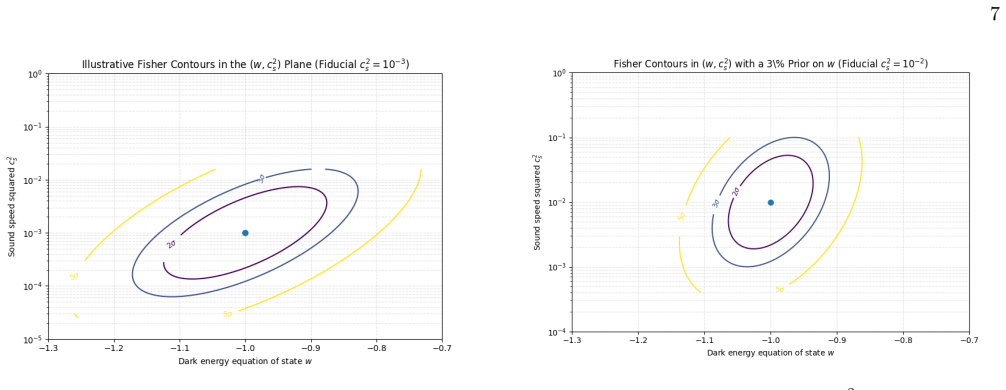
Summary. The paper proposes that a lunar laser interferometer (LILA) operating at f ~ 10^-7–10^-3 Hz could measure the real-time evolution of horizon-scale gravitational potentials and thereby constrain the sound speed of dark energy, c_s^2. It develops a fluid and EFT description of dark-energy perturbations, introduces a transfer function T_Phi = 1/(1 + (c_s k / aH)^2), constructs mock strain power spectra, and presents Fisher forecasts for (w, c_s^2). The central claim is that the low-frequency strain channel maps directly onto horizon-scale scalar perturbations through k ≈ 2π f / c.
Significance. The idea of using a lunar interferometer as a cosmological probe is creative, and the paper correctly emphasizes that background probes of w leave the dark-energy perturbation sector essentially unconstrained. The EFT framework and Fisher methodology are standard and, in isolation, well presented. However, the entire forecast rests on a mode-frequency mapping that is incorrect by roughly eleven orders of magnitude, and the proposed observable is further suppressed by the detector's response to long-wavelength scalar modes. These are not presentation issues; they invalidate the central claim. The paper also constructs its mock spectrum and noise model in a way that largely builds in the claimed sensitivity. If the mapping were corrected, the signal would be unmeasurably small, so the significance of the proposal as stated is not supported.
major comments (1)
- [Overview of the claimed sensitivity] The central physical claim that LILA can 'directly probe the sound speed of dark energy by measuring the real-time evolution of horizon-scale gravitational potentials' is unsupported. The frequencies to which LILA is sensitive correspond to wavenumbers k ~ 10^-15 m^-1, many orders of magnitude inside the Hubble radius. A comoving mode evolves on the Hubble timescale (~10^-18 Hz), not on the frequency ck/(2π) used in Eq. (6). The paper's own asymptotic analysis (Eqs. 13–15) shows that such modes are pressure-suppressed, so the strain spectrum reduces to the ΛCDM expectation. This error is load-bearing for all of the numerical results.
minor comments (4)
- [Conclusions] The sentence 'can LILA directly constrains the sound speed' contains a typo; it should read 'can LILA directly constrain the sound speed'.
- [Forecasts, Discovery, and Exclusion] The text states that the prior is included in 'FIG. 3 and 4', but the actual figures with the prior are Fig. 4 and Fig. 5; the cross-reference should be corrected.
- [Mock Strain Power Spectra, Eq. (19)] Equation (19) writes P_h(f) = T_Phi^2 P_prim(k), but the surrounding text defines the strain as h = R(f) Φ and sets P_h = |R|^2 P_Phi. The explicit factor |R(f)|^2 is missing from the equation, which makes the normalization of the mock spectra ambiguous.
- [Figures] Figure 1 would benefit from error bars or at least a statement of the assumed total observation time and effective number of modes per bin; the current horizontal axis and labels are otherwise clear.
Circularity Check
No significant circularity: the forecast is conditional on an explicit transfer-function ansatz, not a result that secretly re-imports its own conclusion.
full rationale
The claimed derivation chain is a standard conditional sensitivity forecast, not a circular reduction. The paper starts from the linear dark-energy perturbation equation (Eq. 1), defines the Jeans scale (Eq. 2), derives asymptotic solutions for Φ (Eqs. 13-15), and then explicitly introduces an interpolating transfer function TΦ(k,c_s^2)=1/[1+(c_s k/aH)^2] (Eq. 17) as "the simplest analytic function" matching those asymptotics. The mock strain spectrum (Eq. 19) is then defined as this transfer function squared times the primordial spectrum, and the Fisher matrix (Eq. 21) differentiates this same model. Thus the finding that LILA can constrain c_s^2 is a mathematical consequence of the assumed signal model, exactly as in any Fisher forecast; it is not a case of fitting a parameter to data and then predicting the same data, nor of importing a conclusion via self-citation. The absence of a specified detector noise normalization and the questionable k≈2πf/c mapping are serious physical/calibration concerns, but they are not circularity: the paper does not use its mock spectra as independent evidence for the model, and it transparently labels the spectra as "mock" and the forecasts as design-agnostic. No load-bearing step reduces, by the paper's own equations, to its inputs in the sense required for a circularity finding.
Axiom & Free-Parameter Ledger
free parameters (3)
- Transfer function functional form =
T_Φ = 1/(1+(c_s k/(aH))^2)
- Overall detector response normalization |R(f)|^2 =
unspecified
- Variance normalization σ_h(f) =
unspecified
axioms (4)
- domain assumption Scalar metric perturbations induce a strain h_eff ≈ ΔΦ/c^2 with P_h(f) ∝ P_Φ(k≈2πf/c)
- ad hoc to paper LILA's frequency band f∼10^-7–10^-3 Hz corresponds to horizon-scale scalar perturbations
- domain assumption Signal-dominated approximation with cosmic variance as the noise floor
- ad hoc to paper Late-time evolution of Φ follows the factorized form Φ = T_Φ Φ_prim with T_Φ depending only on k/k_J
read the original abstract
The sound speed of dark energy encodes fundamental information about the microphysics underlying cosmic acceleration, yet remains essentially unconstrained by existing observations. We demonstrate that a lunar-based laser interferometer, such as the proposed Laser Interferometer Lunar Antenna (LILA), can directly probe the sound speed of dark energy by measuring the real-time evolution of horizon-scale gravitational potentials. Operating in the ultra-low-frequency gravitational band inaccessible from Earth, LILA is sensitive to scalar metric perturbations sourced by dark energy dynamics. Using both fluid and effective field theory descriptions, we develop a complete framework linking dark energy sound speed to observable strain signatures. We construct a likelihood pipeline and Fisher forecasts, showing that LILA can either detect clustering dark energy or exclude broad classes of models with unprecedented sensitivity. This establishes lunar interferometry as a novel and powerful probe of the physics driving cosmic acceleration.
Figures



Forward citations
Cited by 3 Pith papers
-
Collider Probes of Dark Energy Microphysics
Derivative couplings of a k-essence dark-energy scalar to a 2HDM+a pseudoscalar make the mediator’s invisible width and kinematics depend on the dark-energy sound speed c_s².
-
Collider Probes of Dark Energy Microphysics
Collider observables of a pseudoscalar mediator resonance can become sensitive to the sound speed of dark energy fluctuations via modified propagation in a dark energy background.
-
Black Hole Binary Detection Landscape for the Laser Interferometer Lunar Antenna (LILA): Signal-to-Noise Calculations & Science Cases
LILA can detect IMBH binaries at redshifts 20-30, IMRIs, and provide months-to-years early warnings with high-SNR events for gravity tests.
Reference graph
Works this paper leans on
-
[1]
A. G. Riesset al.(Supernova Search Team), Observa- tional evidence from supernovae for an accelerating uni- verse and a cosmological constant, Astron. J.116, 1009 (1998), arXiv:astro-ph/9805201
Pith/arXiv arXiv 1998
-
[2]
M. Li, X.-D. Li, S. Wang, and Y. Wang, Dark Energy: A Brief Review, Front. Phys. (Beijing)8, 828 (2013), arXiv:1209.0922 [astro-ph.CO]
Pith/arXiv arXiv 2013
-
[3]
M. Li, X.-D. Li, S. Wang, and Y. Wang, Dark Energy, 9 Commun. Theor. Phys.56, 525 (2011), arXiv:1103.5870 [astro-ph.CO]
Pith/arXiv arXiv 2011
-
[4]
M. J. Mortonson, D. H. Weinberg, and M. White, Dark Energy: A Short Review, (2013), arXiv:1401.0046 [astro- ph.CO]
Pith/arXiv arXiv 2013
-
[5]
D. Huterer and D. L. Shafer, Dark energy two decades after: Observables, probes, consistency tests, Rept. Prog. Phys.81, 016901 (2018), arXiv:1709.01091 [astro- ph.CO]
Pith/arXiv arXiv 2018
-
[6]
S. Vagnozzi, L. Visinelli, P. Brax, A.-C. Davis, and J. Sakstein, Direct detection of dark energy: The XENON1T excess and future prospects, Phys. Rev. D 104, 063023 (2021), arXiv:2103.15834 [hep-ph]
Pith/arXiv arXiv 2021
-
[7]
S. A. Adil, U. Mukhopadhyay, A. A. Sen, and S. Vagnozzi, Dark energy in light of the early JWST ob- servations: case for a negative cosmological constant?, JCAP10, 072, arXiv:2307.12763 [astro-ph.CO]
-
[8]
E. Di Valentino, S. Gariazzo, O. Mena, and S. Vagnozzi, Soundness of Dark Energy properties, JCAP07(07), 045, arXiv:2005.02062 [astro-ph.CO]
Pith/arXiv arXiv 2005
-
[9]
S. Nojiri and S. D. Odintsov, Unified cosmic history in modified gravity: from F(R) theory to Lorentz non-invariant models, Phys. Rept.505, 59 (2011), arXiv:1011.0544 [gr-qc]
Pith/arXiv arXiv 2011
-
[10]
S. Nojiri and S. D. Odintsov, Introduction to modified gravity and gravitational alternative for dark energy, eConfC0602061, 06 (2006), arXiv:hep-th/0601213
Pith/arXiv arXiv 2006
-
[11]
Gumjudpai, T
B. Gumjudpai, T. Naskar, M. Sami, and S. Tsujikawa, Coupled dark energy: towards a general description of the dynamics, Journal of Cosmology and Astroparticle Physics2005(06), 007
-
[12]
G´ omez-Valent, V
A. G´ omez-Valent, V. Pettorino, and L. Amendola, Up- date on coupled dark energy and the h 0 tension, Physical Review D101, 123513 (2020)
2020
-
[13]
B. J. Barros, Kinetically coupled dark energy, Physical Review D99, 064051 (2019)
2019
-
[14]
Xia, Constraint on coupled dark energy models from observations, Physical Review D—Particles, Fields, Gravitation, and Cosmology80, 103514 (2009)
J.-Q. Xia, Constraint on coupled dark energy models from observations, Physical Review D—Particles, Fields, Gravitation, and Cosmology80, 103514 (2009)
2009
-
[15]
A. V. Macci` o, C. Quercellini, R. Mainini, L. Amendola, and S. A. Bonometto, Coupled dark energy: Parameter constraints from n-body simulations, Physical Review D 69, 123516 (2004)
2004
-
[16]
N. Frusciante and L. Perenon, Effective field theory of dark energy: A review, Phys. Rept.857, 1 (2020), arXiv:1907.03150 [astro-ph.CO]
Pith/arXiv arXiv 2020
-
[17]
Gubitosi, F
G. Gubitosi, F. Piazza, and F. Vernizzi, The effective field theory of dark energy, Journal of Cosmology and Astroparticle Physics2013(02), 032
-
[18]
E. V. Linder, G. Seng¨ or, and S. Watson, Is the effective field theory of dark energy effective?, Journal of Cosmol- ogy and Astroparticle Physics2016(05), 053
-
[19]
Bloomfield, ´E
J. Bloomfield, ´E. ´E. Flanagan, M. Park, and S. Watson, Dark energy or modified gravity? an effective field the- ory approach, Journal of Cosmology and Astroparticle Physics2013(08), 010
-
[20]
Liang, Y
J.-H. Liang, Y. Liao, X.-D. Ma, and H.-L. Wang, Dark sector effective field theory, Journal of High Energy Physics2023, 1 (2023)
2023
-
[21]
Frusciante, M
N. Frusciante, M. Raveri, and A. Silvestri, Effective field theory of dark energy: a dynamical analysis, Journal of Cosmology and Astroparticle Physics2014(02), 026
-
[22]
Armendariz-Picon, V
C. Armendariz-Picon, V. Mukhanov, and P. J. Stein- hardt, Essentials of k-essence, Physical Review D63, 103510 (2001)
2001
-
[23]
Malquarti, E
M. Malquarti, E. J. Copeland, A. R. Liddle, and M. Trod- den, A new view of k-essence, Physical Review D67, 123503 (2003)
2003
-
[24]
Armendariz-Picon and E
C. Armendariz-Picon and E. A. Lim, Haloes of k-essence, Journal of Cosmology and Astroparticle Physics2005 (08), 007
-
[25]
C. Ahn, C. Kim, and E. V. Linder, Dark energy proper- ties in dbi theory, Physical Review D—Particles, Fields, Gravitation, and Cosmology80, 123016 (2009)
2009
-
[26]
L. P. Chimento, R. Lazkoz, and I. Sendra, Dbi models for the unification of dark matter and dark energy, General Relativity and Gravitation42, 1189 (2010)
2010
-
[27]
Cai and S.-J
R.-G. Cai and S.-J. Wang, Dark matter superfluid and dbi dark energy, Physical Review D93, 023515 (2016)
2016
-
[28]
Chattopadhyay and U
S. Chattopadhyay and U. Debnath, Interaction between dbi-essence and other dark energies, International Jour- nal of Theoretical Physics49, 1465 (2010)
2010
-
[29]
Calcagni and A
G. Calcagni and A. R. Liddle, Tachyon dark energy models: Dynamics and constraints, Physical Review D—Particles, Fields, Gravitation, and Cosmology74, 043528 (2006)
2006
-
[30]
Bagla, H
J. Bagla, H. K. Jassal, and T. Padmanabhan, Cosmology with tachyon field as dark energy, Physical Review D67, 063504 (2003)
2003
-
[31]
E. J. Copeland, M. R. Garousi, M. Sami, and S. Tsu- jikawa, What is needed of a tachyon if it is to be the dark energy?, Physical Review D—Particles, Fields, Gravita- tion, and Cosmology71, 043003 (2005)
2005
-
[32]
S. M. Micheletti, Observational constraints on holo- graphic tachyonic dark energy in interaction with dark matter, Journal of Cosmology and Astroparticle Physics 2010(05), 009
2010
-
[33]
Sheykhi, M
A. Sheykhi, M. Sadegh Movahed, and E. Ebrahimi, Tachyon reconstruction of ghost dark energy, Astro- physics and Space Science339, 93 (2012)
2012
-
[34]
J. Kehayias and R. J. Scherrer, New generic evolution for k-essence dark energy withw≈ −1, Phys. Rev. D100, 023525 (2019), arXiv:1905.05628 [gr-qc]
Pith/arXiv arXiv 2019
-
[35]
T. Chiba, S. Dutta, and R. J. Scherrer, Slow-roll k- essence, Phys. Rev. D80, 043517 (2009), arXiv:0906.0628 [astro-ph.CO]
Pith/arXiv arXiv 2009
-
[36]
R. Das, T. W. Kephart, and R. J. Scherrer, Track- ing quintessence and k-essence in a general cosmological background, Phys. Rev. D74, 103515 (2006), arXiv:gr- qc/0609014
arXiv 2006
-
[37]
Hannestad, Constraints on the sound speed of dark energy, Phys
S. Hannestad, Constraints on the sound speed of dark energy, Phys. Rev. D71, 103519 (2005), arXiv:astro- ph/0504017
arXiv 2005
-
[38]
de Putter, D
R. de Putter, D. Huterer, and E. V. Linder, Measuring the speed of dark: Detecting dark energy perturbations, Physical Review D—Particles, Fields, Gravitation, and Cosmology81, 103513 (2010)
2010
-
[39]
Ballesteros and J
G. Ballesteros and J. Lesgourgues, Dark energy with non- adiabatic sound speed: initial conditions and detectabil- ity, Journal of Cosmology and Astroparticle Physics 2010(10), 014
2010
-
[40]
M. S. Linton, A. Pourtsidou, R. Crittenden, and R. Maartens, Variable sound speed in interacting dark energy models, Journal of Cosmology and Astroparticle Physics2018(04), 043
-
[41]
Bean and O
R. Bean and O. Dore, Probing dark energy perturbations: the dark energy equation of state and speed of sound 10 as measured by wmap, Physical Review D69, 083503 (2004)
2004
-
[42]
D. J. Eisenstein, Dark energy and cosmic sound, New Astronomy Reviews49, 360 (2005)
2005
-
[43]
Sergijenko and B
O. Sergijenko and B. Novosyadlyj, Sound speed of scalar field dark energy: weak effects and large uncertainties, Physical Review D91, 083007 (2015)
2015
-
[44]
K. Jani, M. Abernathy, E. Berti, V. Boschi, S. Chakrabarti, A. Cocoros, J. W. Conklin, T. Creighton, S. Dell’Agnello, J.-C. Diels,et al., Laser interferome- ter lunar antenna (lila): Advancing the us priorities in gravitational-wave and lunar science, arXiv preprint arXiv:2508.11631 (2025)
Pith/arXiv arXiv 2025
-
[45]
Mukhanov,Physical Foundations of Cosmology(Cam- bridge University Press, 2005)
V. Mukhanov,Physical Foundations of Cosmology(Cam- bridge University Press, 2005)
2005
- [46]
-
[47]
Hu, Structure Formation with Generalized Dark Matter, Astrophys
W. Hu, Structure Formation with Generalized Dark Matter, Astrophys. J.506, 485 (1998), arXiv:astro- ph/9801234
arXiv 1998
-
[48]
M. Tegmark, A. Taylor, and A. Heavens, Karhunen- Loeve eigenvalue problems in cosmology: How should we tackle large data sets?, Astrophys. J.480, 22 (1997), arXiv:astro-ph/9603021
Pith/arXiv arXiv 1997
-
[49]
J. R. Bond, A. H. Jaffe, and L. Knox, Estimating the power spectrum of the cosmic microwave background, Phys. Rev. D57, 2117 (1998), arXiv:astro-ph/9708203
Pith/arXiv arXiv 1998
-
[50]
S. Hamimeche and A. Lewis, Likelihood Analysis of CMB Temperature and Polarization Power Spectra, Phys. Rev. D77, 103013 (2008), arXiv:0801.0554 [astro-ph]
Pith/arXiv arXiv 2008
-
[51]
S. L. Larson, W. A. Hiscock, and R. W. Hellings, Sen- sitivity curves for spaceborne gravitational wave inter- ferometers, Phys. Rev. D62, 062001 (2000), arXiv:gr- qc/9909080
arXiv 2000
-
[52]
Cutler, Angular resolution of the LISA gravitational wave detector, Phys
C. Cutler, Angular resolution of the LISA gravitational wave detector, Phys. Rev. D57, 7089 (1998), arXiv:gr- qc/9703068
arXiv 1998
-
[53]
F. A. Jenet, G. B. Hobbs, K. J. Lee, and R. N. Manch- ester, Detecting the stochastic gravitational wave back- ground using pulsar timing, Astrophys. J. Lett.625, L123 (2005), arXiv:astro-ph/0504458
Pith/arXiv arXiv 2005
-
[54]
X. Siemens, J. Ellis, F. Jenet, and J. D. Romano, The stochastic background: scaling laws and time to detec- tion for pulsar timing arrays, Class. Quant. Grav.30, 224015 (2013), arXiv:1305.3196 [astro-ph.IM]
Pith/arXiv arXiv 2013
-
[55]
A. Sesana and A. Vecchio, Measuring the parameters of massive black hole binary systems with Pulsar Timing Array observations of gravitational waves, Phys. Rev. D 81, 104008 (2010), arXiv:1003.0677 [astro-ph.CO]
Pith/arXiv arXiv 2010
-
[56]
K. N. Abazajianet al.(CMB-S4),CMB-S4 Science Book, First Edition(2016) arXiv:1610.02743 [astro-ph.CO]
Pith/arXiv arXiv 2016
-
[57]
K. Abazajianet al., CMB-S4 Science Case, Reference De- sign, and Project Plan, (2019), arXiv:1907.04473 [astro- ph.IM]
Pith/arXiv arXiv 2019
-
[58]
K. Abazajianet al.(CMB-S4), CMB-S4: Forecasting Constraints on Primordial Gravitational Waves, Astro- phys. J.926, 54 (2022), arXiv:2008.12619 [astro-ph.CO]
Pith/arXiv arXiv 2022
-
[59]
A. Loeb and M. Zaldarriaga, Measuring the small - scale power spectrum of cosmic density fluctuations through 21 cm tomography prior to the epoch of structure for- mation, Phys. Rev. Lett.92, 211301 (2004), arXiv:astro- ph/0312134
arXiv 2004
-
[60]
J. R. Pritchard and A. Loeb, 21-cm cosmology, Rept. Prog. Phys.75, 086901 (2012), arXiv:1109.6012 [astro- ph.CO]
Pith/arXiv arXiv 2012
-
[61]
Aghanim, T
N. Aghanim, T. Ghosh, J. J. Bock, B. P. Crill, O. Dor´ e, S. R. Hildebrandt, G. Rocha, K. M. G´ orski, C. R. Lawrence, S. Mitra, G. Roudier, and P. Collaboration, Planck 2018 results. vi. cosmological parameters, Astron- omy and Astrophysics641, Art. No. A6 (2020)
2018
discussion (0)
Sign in with ORCID, Apple, or X to comment. Anyone can read and Pith papers without signing in.