REVIEW 1 major objections 10 minor 87 references
Cosmology can bound the neutrino mass sum without assuming a dark-energy model, via two complementary routes that trade tightness for independence.
Reviewed by Pith at T0; open to challenge. T0 means a machine referee read the full paper against a public rubric. the ladder, T0–T4 →
T0 review · grok-4.5
2026-07-31 06:19 UTC pith:ESWQX4NV
load-bearing objection Solid, careful deconstruction that gives two usable DE-robust ∑mν bounds; novelty is real but incremental, and the scope limit on smooth DE is honestly stated. the 1 major comments →
Measuring Cosmic Neutrino Masses Independently of Dark Energy
The pith
A machine-rendered reading of the paper's core claim, the machinery that carries it, and where it could break.
Core claim
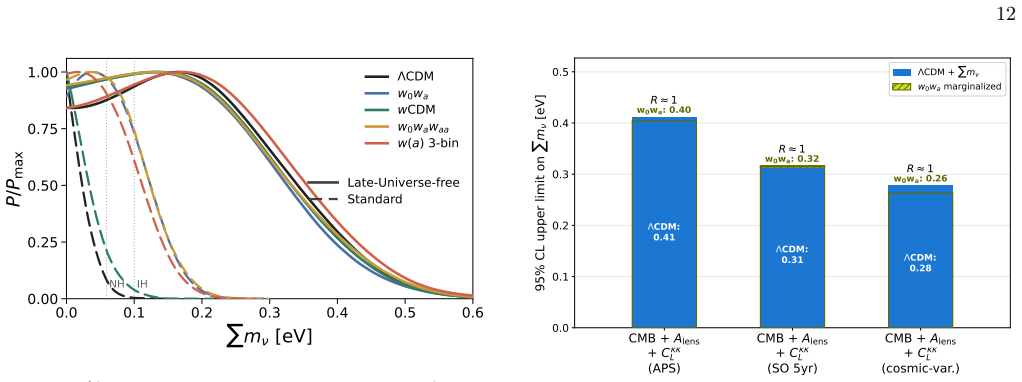
Two robust paths exist to a cosmic ∑mν bound that does not hinge on the late-time dark-energy model. Full-data marginalization over (w0, wa) already captures the dark-energy directions that affect ∑mν: the bound saturates at ∑mν < 0.152 eV under binned and cubic w(a) as well. Separately, a late-Universe-free combination—primary CMB with Alens free plus the four-point reconstructed lensing spectrum C_L^{κκ}—removes late-time expansion dependence by construction and gives ∑mν < 0.41 eV today, stable to a few percent across ΛCDM, wCDM, (w0, wa), and more flexible smooth histories, tightening toward ~0.31 eV and ~0.28 eV with next-generation and cosmic-variance-limited lensing while remaining da
What carries the argument
The late-Universe-free combination: primary CMB with the lensing-smoothing amplitude Alens marginalized, plus the four-point reconstructed convergence spectrum C_L^{κκ}. It isolates neutrino-mass information carried by early-universe physics and high-redshift lensing growth/geometry, so the low-redshift distance integral that couples ∑mν to dark energy is absent by design. The companion diagnostic is the degradation ratio R = σ(∑mν)_DE / σ(∑mν)_Λ, required to stay near unity across increasingly flexible smooth w(a).
Load-bearing premise
Dark energy is assumed to be a smooth, matter-conserving background with ordinary sound speed that only changes the late-time expansion—not something that clusters, swaps energy with matter, or shifts the sound horizon before recombination.
What would settle it
Re-run the late-Universe-free pipeline on the same CMB and four-point lensing data under a clustering dark-energy model or an energy-exchange dark sector; if the 0.41 eV bound moves by much more than the few-percent stability quoted for smooth w(a), the claimed model independence fails for physics outside that class.
If this is right
- The usual ΛCDM ∑mν < 0.056 eV tension with the inverted-ordering floor is partly an expansion-history assumption, not pure neutrino physics; the DE-marginalized floor is ~0.15 eV and the late-Universe-free floor is ~0.41 eV.
- With Simons Observatory-like lensing and Spec-S5-like BAO, the marginalized route reaches σ(∑mν) ≈ 0.043 eV while (w0, wa) remains sufficient; the late-Universe-free route reaches ~0.31 eV with R ≈ 1.
- A conservative cosmological bound ∑mν < 0.41 eV implies m_νe ≲ 0.13 eV per state, below ultimate KATRIN reach but overlapping Project 8’s target, so a lab detection or non-detection becomes a direct cosmology cross-check.
- Galaxy 3×2pt/6×2pt combinations can supply complementary ∑mν information with milder DE degradation than BAO-heavy analyses, especially when CMB-lensing cross-spectra weight high redshift.
- A direct measurement of the free-streaming step in the matter power spectrum would add another dark-energy-insensitive handle on ∑mν fixed deep in matter domination.
Where Pith is reading between the lines
- If future data keep preferring evolving dark energy while the late-Universe-free bound stays near 0.3–0.4 eV, the field’s default neutrino-mass headline should shift from the ΛCDM number to the saturated marginalized or late-Universe-free numbers.
- The saturation of the marginalized bound under extra w(a) modes suggests that adding still more smooth background parameters is unlikely to reopen the inverted-hierarchy window; only physics outside smooth DE would.
- Nulling the low-z piece of reconstructed CMB lensing with galaxy tracers, paired with ultra-high-z BAO, is a practical path to push the late-Universe-free bound below 0.4 eV without reintroducing the geometric DE degeneracy.
- A confirmed laboratory m_νe near 0.1 eV would force either a breakdown of the smooth-DE assumption or a serious rethink of how cosmology maps distances and growth onto ωm.
Editorial analysis
A structured set of objections, weighed in public.
Referee Report
Summary. The paper deconstructs, probe by probe, how much Σmν information current cosmological data carry and how much of it is entangled with the assumed late-time expansion history. Two routes to a bound are pursued. (i) The standard dark-energy-marginalized route (Planck NPIPE CMB + ACT DR6/SPT/Planck lensing + DESI DR2 BAO, w0wa marginalized) gives Σmν < 0.152 eV, and the bound is shown to saturate — binned (3-, 5-bin) and cubic w(a) leave it within a few percent — because the extra expansion modes are resolved by the data yet nearly orthogonal to the physical matter density ωm through which late-time data inform Σmν (App. E, Fig. 6). (ii) A new "late-Universe-free" combination — primary CMB with A_lens marginalized plus the four-point reconstructed lensing spectrum C_L^{κκ} (with differenced BAO distances adding nothing) — removes late-time distance information by construction and yields Σmν < 0.41 eV on both mock and real data, flat across ΛCDM, wCDM, (w0,wa), and binned/cubic w(a) (R ≃ 1), forecast to tighten to 0.31 eV (SO) and 0.28 eV (CVL) with R ≈ 1 retained. The different DE sensitivities of the two-point (peak smoothing, L~100) and four-point (reconstruction, L~300) lensing channels are traced to their multipole and source-redshift weighting (Fig. 3). The work is technically careful, the mock/real separation cleanly isolates the A_lens>1 fluctuation and the CMB–BAO distance tension, and the scope limits (smooth, matter-conserving DE with cs²=1; standard neutrino sector; s
Significance. If the results hold, this is the first controlled demonstration that (w0,wa) marginalization saturates the Σmν bound within smooth DE — a nested hierarchy of w(a) parametrizations on a common pipeline, with the additional modes shown to be resolved by the data and traced to their orthogonality to the ωm anchor — together with a genuinely DE-insensitive bound from current data. Strengths include the mock/real separation isolating the Planck A_lens>1 pull (App. D), dual-CAMB validation of α_DE (App. A), the 2pt/4pt Fisher decomposition by multipole and source redshift (App. B–C), the empirical σ(Σmν) = 63.1 eV × σ(ωm) scaling across ten chains (Fig. 6), and falsifiable forecasts showing R≈1 persists at SO/CVL noise, which directly addresses the necessity-not-sufficiency caveat on R. The scope boundary (smooth, matter-conserving, cs²=1 DE; standard neutrino sector; fixed τ) is stated explicitly rather than hidden, and the known clustering-DE failure mode biases the mass low, so the quoted 0.41 eV survives as an upper bound even in the failure direction. The principal gap is the absence of public chains or code.
major comments (1)
- [§III mock construction; §I ¶3; §IVB Eq. (5)] The headline late-Universe-free bound (0.41 eV, mock and real) is conditioned on the SRoll2/Commander low-ell likelihoods, which are retained in the mock pipeline explicitly 'so tau is fixed by the actual SRoll2 measurement' (§III). Yet the introduction (¶3) itself notes that tau ≃ 0.09 would relax the neutrino-mass bound, that data combinations can be built without tau knowledge [28], and that A_lens marginalization 'acts nearly identically to removing the low-ell tau information' [29]. Reionization is itself late-time physics, so the advertised number inherits an external tau pin that the paper elsewhere treats as uncertain. There is also a mild internal tension: if A_lens marginalization already removes the tau sensitivity, why does the robust combination still require the real low-ell EE likelihood? This is cheap to close: one chain with tau freed under a broad prior (or with low-ell
minor comments (10)
- [Abstract; §VI vs §IVA] Route (ii) is described as 'removing late-time expansion dependence by construction', but this is exact only for the distance information (A_lens marginalization, no absolute BAO). For C_L^{kappakappa} the DE enters through the low-z growth factor and lensing-kernel distances, and §IVA itself states the flatness 'is not fully guaranteed by construction' and is instead demonstrated empirically. The abstract and §VI should be softened to match the §IVA framing.
- [§IVB / Fig. 8 / abstract] The main text quotes stability 'by less than 4%' across three models (0.41, 0.41, 0.40 eV), while the Fig. 8 caption reports 0.40-0.43 eV across the full set including w0wawaa and 3-bin w(a) (a ~7% span). Please state the flatness range consistently for the full model list, and align the abstract's 'across all tested dark-energy models' with it.
- [References] References [36] and [61] are the same work (arXiv:2512.08752), listed with different first-author initials; [24] and [34] are also duplicates (Shao et al., PRD 111, 083535). Please merge.
- [§IIIA] A_lens marginalization rescales only the lensing amplitude and is not identical to excising the two-point lensing information (residual shape-level smoothing information remains in principle). The empirical R ≃ 1.00-1.02 and the alpha_DE test are the real evidence; a sentence clarifying this logical point would prevent misreading of 'unlensed CMB' as an exact construction.
- [Reproducibility] No public chains, likelihoods, or the modified CAMB module (Hz_template.f90) are currently available. Since the paper's deliverable is a specific data combination (and a phenomenological alpha_DE implementation), releasing the chain products, the Delta D_M/rd likelihood, and the CAMB patch would substantially aid verification and adoption.
- [§IVB, Eq. (5)] Eq. (5) includes Delta D_M/rd in the late-Universe-free combination even though §IIIC and footnote 7 show it adds nothing beyond the CMB+A_lens+C_L^{kappakappa} baseline. Please state explicitly that it is retained for completeness and costs no constraining power, to avoid confusion with the 'assembled from these alone' statement at the start of §IV.
- [Appendix B, Eq. (B7)] The approximate two-point Fisher density A(L) (Eq. B7) neglects cross-L interference by construction; the independent L_max-truncation check mentioned in App. B is the load-bearing validation and would be worth showing as a figure panel or table rather than only described.
- [§IIIA, Eq. (2); App. A] alpha_DE introduces a discontinuous rescaling of H(z) at z_DE = 0.706 (Eq. 2). The validation in App. A is thorough, but one sentence on whether a smoothed transition changes the alpha_DE posteriors would preempt an obvious question.
- [§III, R definition] R is defined on posterior widths sigma while headline numbers are 95th-percentile limits, with the UL ≃ (3.3-3.7)sigma mapping given only for the fiducial 0.06 eV mock (it is prior-truncation dependent). A compact table of sigma(Sigma m_nu) alongside each quoted limit would ease comparison with Fisher forecasts in the literature.
- [Typos/style] Minor language: stray comma in 'the angular diameter distance to last scattering D_A(z*), that sets'; 'the cosmological bounds constrains' in §I; and the acknowledgment sentence 'grateful to xc340 for all the memories shared' is informal for a journal version.
Circularity Check
No significant circularity: bounds are measured from external likelihoods; DE-robustness is an empirical outcome of MCMC/Fisher tests, not an identity forced by inputs.
full rationale
The paper’s two routes are standard inference constructions, not self-definitional derivations. The late-Universe-free combination (primary CMB with A_lens free + four-point C_L^{κκ}, absolute BAO dropped) is built to discard late-time distance channels; the claimed ∑m_ν < 0.41 eV and R≈1 are then read off external Planck/ACT/SPT/DESI likelihoods (and mocks) and re-checked under wCDM, (w0,wa), binned, and cubic w(a). That flatness is a measured posterior property, not forced by how A_lens or α_DE are defined. The dark-energy-marginalized route’s saturation near 0.152 eV under more flexible smooth w(a) is likewise an empirical result traced to the ω_m anchor (Appendix E), not a fitted parameter renamed as a prediction. A_lens and α_DE are nuisance marginalizations; R ≡ σ_DE/σ_Λ is a diagnostic ratio. The only mild self-touch is the in-preparation geometric/growth split [33] (overlapping authors), which supplies interpretive context and is not required to obtain the numerical limits. Forecasts reuse a coauthor Fisher setup [68] as methodology, not as a uniqueness theorem. Scope limits (smooth, matter-conserving DE with c_s²=1) are stated explicitly and do not make the quoted upper bounds circular within that class. Score 1 only for that non-load-bearing self-cite; central claims remain independently measured.
Axiom & Free-Parameter Ledger
free parameters (5)
- A_lens =
marginalized; Planck NPIPE prefers ~1.095 on real data
- α_DE =
≈0.997±0.015 (ΛCDM); ≈1.056±0.036 (w0wa)
- w0, wa and binned/cubic w(a) =
marginalized; real-data standard combo prefers (w0,wa) by Δχ²≈−5.5
- z_DE = z_ref = 0.706 =
0.706
- Standard cosmological parameters (ωb, ωc, θMC, As, ns, τ, H0, ∑mν) =
Planck NPIPE ΛCDM best-fit used for mocks
axioms (6)
- domain assumption Flat FLRW cosmology with standard pre-recombination physics fixing rd and acoustic peaks; neutrinos are three degenerate active states with Neff=3.044, interacting only gravitationally.
- domain assumption Dark energy is smooth, matter-conserving, cs²=1, modifying only late-time background expansion and growth through H(z)—no DE–DM exchange, no clustering DE, no early dark energy shifting rd.
- domain assumption Planck PR4/NPIPE, ACT DR6, SPT-3G lensing, and DESI DR2 BAO likelihoods are statistically adequate representations of the data (internal consistency of DESI DR2 accepted).
- domain assumption Marginalizing A_lens removes two-point lensing ∑mν information sufficiently that residual primary-CMB sensitivity is early-ISW/geometry and DE-insensitive (R≈1).
- standard math Standard Boltzmann/lensing theory (CAMB, quadratic estimators) and Fisher/MCMC inference correctly map parameters to observables.
- domain assumption ωm channel: late-time data inform ∑mν primarily via ∑mν/93.14 eV = ωm − ωcb with CMB fixing ωcb.
invented entities (2)
-
α_DE late-time expansion rescaling
no independent evidence
-
late-Universe-free data combination (CMB+A_lens+C_L^{κκ} [+ΔDM/rd])
independent evidence
read the original abstract
Neutrino oscillations establish that neutrinos are massive, providing the only laboratory detection of physics beyond the Standard Model. Direct kinematic experiments bound the electron-neutrino mass to $m_{\nu_e} < 0.45$ eV (KATRIN, 90% CL), implying $\sum m_\nu \lesssim 1.3$ eV. Conversely, cosmology within $\Lambda$CDM is highly constraining: Planck CMB, CMB lensing, and DESI DR2 BAO yield $\sum m_\nu < 0.056$ eV (95% CL), in 2-3$\sigma$ tension with the inverted-ordering floor (0.10 eV). However, this bound relies on $\Lambda$CDM, while data hint at an evolving dark energy. To determine the model dependence of cosmic neutrino mass bounds, we deconstruct each probe's sensitivity to late-time physics and pursue two robust routes to a $\sum m_\nu$ bound: (i) The existing dark-energy-marginalized route, retaining all data and marginalizing over $(w_0, w_a)$, is shown to also be immune to flexible binned and cubic $w(a)$ histories, yielding $\sum m_\nu < 0.152$ eV, sharpening to $\sigma(\sum m_\nu) \approx 0.043$ eV with Simons Observatory lensing and Spec-S5 BAO. (ii) A new late-Universe-free route combines primary CMB, marginalizing over acoustic-peak smoothing via $A_{\rm lens}$, with the reconstructed lensing spectrum $C_L^{\kappa\kappa}$, removing late-time expansion dependence by construction. This yields $\sum m_\nu < 0.41$ eV today, tightening to 0.31 eV (Simons Observatory) and 0.28 eV (cosmic-variance limit) across all tested dark-energy models. These relaxed bounds trade statistical power for model independence. Interestingly, they land in the sensitivity range targeted by next-generation laboratory experiments like Project 8 ($m_{\nu_e} \sim 0.1$ eV), motivating vital synergies between future cosmological and terrestrial neutrino measurements.
Figures




Reference graph
Works this paper leans on
-
[1]
K. Abeet al.(T2K), Eur. Phys. J. C83, 782 (2023), arXiv:2303.03222 [hep-ex]
arXiv 2023
-
[2]
S. Abubakaret al.(NOvA), Phys. Rev. Lett.136, 011802 (2026), arXiv:2509.04361 [hep-ex]
arXiv 2026
-
[3]
S. Abeet al.(KamLAND), Phys. Rev. Lett.100, 221803 (2008), arXiv:0801.4589 [hep-ex]
Pith/arXiv arXiv 2008
-
[4]
Abuslemeet al.(JUNO), Nature654, 343 (2026), arXiv:2511.14593 [hep-ex]
A. Abuslemeet al.(JUNO), Nature654, 343 (2026), arXiv:2511.14593 [hep-ex]
arXiv 2026
-
[5]
JUNO Experiment,
Y. Wang, “JUNO Experiment,”https:// indico.global/event/15740/contributions/ 155563/attachments/72452/141000/ JUNO-Neutrino2026-Vfinal.pdf, talk at NEUTRINO 2026
2026
-
[6]
Recent results and perspectives from the T2K experiment,
S. King, “Recent results and perspectives from the T2K experiment,”https://indico.global/event/ 15740/contributions/155587/attachments/72629/ 140807/2026_06_04_T2K_NEUTRINO_2026.pdf, talk at NEUTRINO 2026
2026
-
[7]
Abubakaret al.(T2K, NOvA), Nature646, 818 (2025), arXiv:2510.19888 [hep-ex]
S. Abubakaret al.(T2K, NOvA), Nature646, 818 (2025), arXiv:2510.19888 [hep-ex]
arXiv 2025
-
[8]
Abiet al.(DUNE), (2020), 10.2172/1599307, arXiv:2002.03005 [hep-ex]
B. Abiet al.(DUNE), (2020), 10.2172/1599307, arXiv:2002.03005 [hep-ex]
arXiv 2020
-
[9]
Akeret al.(KATRIN), Science388, adq9592 (2025), arXiv:2406.13516 [nucl-ex]
M. Akeret al.(KATRIN), Science388, adq9592 (2025), arXiv:2406.13516 [nucl-ex]
arXiv 2025
-
[10]
A. A. Esfahaniet al.(Project 8), inSnowmass 2021 (2022) arXiv:2203.07349 [nucl-ex]
Pith/arXiv arXiv 2021
-
[11]
Ashtari Esfahaniet al.(Project 8), Phys
A. Ashtari Esfahaniet al.(Project 8), Phys. Rev. Lett. 131, 102502 (2023), arXiv:2212.05048 [nucl-ex]
Pith/arXiv arXiv 2023
-
[12]
Abdul-Karimet al.(DESI Collaboration), (2025), arXiv:2503.14738 [astro-ph.CO]
Pith/arXiv arXiv 2025
-
[13]
F. J. Quet al.(ACT, SPT-3G), Phys. Rev. Lett.136, 021001 (2026), arXiv:2504.20038 [astro-ph.CO]
arXiv 2026
-
[14]
Garcia-Quinteroet al.(DESI), Phys
C. Garcia-Quinteroet al.(DESI), Phys. Rev. D112, 083529 (2025), arXiv:2504.18464 [astro-ph.CO]
Pith/arXiv arXiv 2025
-
[15]
R. Jimenez, C. Peña Garay, F. Simpson, and L. Verde, (2026), arXiv:2606.18987 [astro-ph.CO]
Pith/arXiv arXiv 2026
-
[16]
D. Green and J. Meyers, Phys. Rev. D111, 083507 (2025), arXiv:2407.07878 [astro-ph.CO]
Pith/arXiv arXiv 2025
-
[17]
G. P. Lynch and L. Knox, Phys. Rev. D112, 083543 (2025), arXiv:2503.14470 [astro-ph.CO]
Pith/arXiv arXiv 2025
-
[18]
N. Craig, D. Green, J. Meyers, and S. Rajendran, JHEP 09, 097 (2024), arXiv:2405.00836 [astro-ph.CO]
Pith/arXiv arXiv 2024
-
[19]
P. W. Graham, D. Green, and J. Meyers, Phys. Rev. D 113, 043514 (2026), arXiv:2508.20999 [astro-ph.CO]
arXiv 2026
-
[20]
Chebatet al., JCAP01, 041 (2026), arXiv:2507.12401 [astro-ph.CO]
D. Chebatet al., JCAP01, 041 (2026), arXiv:2507.12401 [astro-ph.CO]
Pith/arXiv arXiv 2026
-
[21]
W. Elberset al., Phys. Rev. D112, 083513 (2025), arXiv:2503.14744 [astro-ph.CO]
Pith/arXiv arXiv 2025
-
[22]
Feng, T.-N
L. Feng, T.-N. Li, G.-H. Du, J.-F. Zhang, and X. Zhang, Physics of the Dark Universe52, 102296 (2026)
2026
-
[23]
A. Ladeira, R. C. Nunes, S. Pan, and W. Yang, Phys. Rev. D113, 083503 (2026), arXiv:2601.02077 [astro-ph.CO]
Pith/arXiv arXiv 2026
-
[24]
H. Shao, J. J. Givans, J. Dunkley, M. Madhavacheril, F. J. Qu, G. Farren, and B. Sherwin, Phys. Rev. D111, 083535 (2025), arXiv:2409.02295 [astro-ph.CO]
Pith/arXiv arXiv 2025
- [25]
-
[26]
Raising the reionization optical depth with inflationary cmb features,
T. Jhaveri, W. Hu, and V. Miranda, “Raising the reionization optical depth with inflationary cmb features,” (2026), arXiv:2606.20795 [astro-ph.CO]
Pith/arXiv arXiv 2026
-
[27]
J. M. Sullivan, R. de Belsunce, and M. M. Ivanov, (2026), arXiv:2606.30903 [astro-ph.CO]
Pith/arXiv arXiv 2026
-
[28]
B. Yu, R. Z. Knight, B. D. Sherwin, S. Ferraro, L. Knox, and M. Schmittfull, Phys. Rev. D107, 123522 (2023)
2023
-
[29]
Z. J. Weiner, (2026), arXiv:2603.18131 [astro-ph.CO]. 17
arXiv 2026
-
[30]
H. Pulido-Hernández and J. L. Cervantes-Cota, arXiv e-prints , arXiv:2603.13208 (2026), arXiv:2603.13208 [astro-ph.CO]
arXiv 2026
-
[31]
S.-F. Chen and M. Zaldarriaga, J. Cosmology Astropart. Phys.2025, 014 (2025), arXiv:2505.00659 [astro-ph.CO]
Pith/arXiv arXiv 2025
-
[32]
M. Loverde and Z. J. Weiner, JCAP12, 048 (2024), arXiv:2410.00090 [astro-ph.CO]
Pith/arXiv arXiv 2024
-
[33]
F. Ge, F. J. Qu, H. Wang, E. Schaan, and W. L. K. Wu, (2026), in preparation
2026
-
[34]
H. Shao, J. J. Givans, J. Dunkley, M. Madhavacheril, F. J. Qu, G. Farren, and B. Sherwin, Phys. Rev. D111, 083535 (2025)
2025
-
[35]
R. K. Sharma and J. Lesgourgues, J. Cosmology Astropart. Phys.2026, 034 (2026), arXiv:2510.15835 [astro-ph.CO]
arXiv 2026
-
[37]
E. Rosenberg, S. Gratton, and G. Efstathiou, Mon. Not. Roy. Astron. Soc.517, 4620 (2022), arXiv:2205.10869 [astro-ph.CO]
Pith/arXiv arXiv 2022
-
[38]
A python compressed low- ℓplanck likelihood for temperature and polarization,
H. Prince and J. Dunkley, “A python compressed low- ℓplanck likelihood for temperature and polarization,” (2021), arXiv:2104.05715 [astro-ph.CO]
Pith/arXiv arXiv 2021
-
[39]
J. M. Delouis, L. Pagano, S. Mottet, J. L. Puget, and L. Vibert, Astron. Astrophys.629, A38 (2019), arXiv:1901.11386 [astro-ph.CO]
Pith/arXiv arXiv 2019
-
[40]
F. J. Quet al.(ACT), Astrophys. J.962, 112 (2024), arXiv:2304.05202 [astro-ph.CO]
Pith/arXiv arXiv 2024
-
[41]
M. S. Madhavacherilet al.(ACT), Astrophys. J.962, 113 (2024), arXiv:2304.05203 [astro-ph.CO]
Pith/arXiv arXiv 2024
-
[42]
N. MacCrann, B. D. Sherwin, F. J. Qu, T. Namikawa, M. S. Madhavacheril, I. Abril-Cabezas, R. An, J. E. Austermann, N. Battaglia, E. S. Battistelli, J. A. Beall, B. Bolliet, J. R. Bond, H. Cai, E. Calabrese, W. R. Coulton, O. Darwish, S. M. Duff, A. J. Duivenvoorden, J. Dunkley, G. S. Farren, S. Ferraro, J. E. Golec, Y. Guan, D. Han, C. Hervías-Caimapo, J....
Pith/arXiv arXiv 2024
-
[43]
F. Ge, M. Millea, E. Camphuis, C. Daley, N. Huang, Y. Omori, W. Quan, E. Anderes, A. Anderson, B. Ansarinejad, M. Archipley, L. Balkenhol, K. Benabed, A. Bender, B. Benson, F. Bianchini, L. Bleem, F. Bouchet, L. Bryant, J. Carlstrom, C. Chang, P. Chaubal, G. Chen, P. Chichura, A. Chokshi, T.- L. Chou, A. Coerver, T. Crawford, T. de Haan, K. Dibert, M. Dob...
2025
-
[44]
Abdul-Karimet al.(DESI Collaboration), (2025), arXiv:2503.14739 [astro-ph.CO]
Pith/arXiv arXiv 2025
-
[45]
I. J. Allali, L. Li, P. Singh, and J. Fan, Phys. Rev. D 113, 083515 (2026), arXiv:2509.09678 [astro-ph.CO]
Pith/arXiv arXiv 2026
-
[46]
Rosenberg, S
E. Rosenberg, S. Gratton, and G. Efstathiou, Monthly Notices of the Royal Astronomical Society517, 4620–4636 (2022)
2022
-
[47]
L. Pagano, J. M. Delouis, S. Mottet, J. L. Puget, and L. Vibert, A&A635, A99 (2020), arXiv:1908.09856 [astro-ph.CO]
Pith/arXiv arXiv 2020
-
[48]
Hu and S
W. Hu and S. Dodelson, Annual Review of Astronomy and Astrophysics40, 171–216 (2002)
2002
-
[49]
E. Calabrese, A. Slosar, A. Melchiorri, G. F. Smoot, and O. Zahn, Physical Review D77(2008), 10.1103/physrevd.77.123531
-
[50]
LESGOURGUES and S
J. LESGOURGUES and S. PASTOR, Physics Reports 429, 307–379 (2006)
2006
-
[51]
Archidiacono, T
M. Archidiacono, T. Brinckmann, J. Lesgourgues, and V. Poulin, Journal of Cosmology and Astroparticle Physics2017, 052–052 (2017)
2017
-
[52]
K. Ichikawa, M. Fukugita, and M. Kawasaki, Physical Review D71(2005), 10.1103/physrevd.71.043001
-
[53]
LEWIS and A
A. LEWIS and A. CHALLINOR, Physics Reports429, 1–65 (2006)
2006
-
[54]
T. Okamoto and W. Hu, Physical Review D67(2003), 10.1103/physrevd.67.083002
-
[55]
K. M. Smith, W. Hu, and M. Kaplinghat, Physical Review D74(2006), 10.1103/physrevd.74.123002
-
[56]
A. Benoit-Lévy, K. M. Smith, and W. Hu, Physical Review D86(2012), 10.1103/physrevd.86.123008
-
[57]
Loverde and Z
M. Loverde and Z. J. Weiner, Journal of Cosmology and Astroparticle Physics2024, 048 (2024)
2024
-
[58]
M. Zaldarriaga, “Universal distance modes from desi bao and type ia supernovae: what do cosmological rulers actually measure?” (2026), arXiv:2606.30527 [astro- ph.CO]
Pith/arXiv arXiv 2026
-
[59]
J. Rebouças, D. H. F. de Souza, K. Zhong, V. Miranda, and R. Rosenfeld, JCAP02, 024 (2025), arXiv:2408.14628 [astro-ph.CO]
Pith/arXiv arXiv 2025
-
[60]
P. Ghedini, R. Hajjar, and O. Mena, Phys. Dark Univ. 52, 102237 (2026), arXiv:2512.16781 [astro-ph.CO]
arXiv 2026
-
[61]
A. Nair, A. Chakraborty, L. Amendola, and S. Das, “Neutrino mass constraints in the context of 4- parameter dark energy equation of state and DESI DR2 observations,” (2025), arXiv:2512.08752 [astro-ph.CO]
arXiv 2025
-
[62]
S. Barua and S. Desai, Phys. Dark Univ.51, 102229 (2026), arXiv:2508.16238 [astro-ph.CO]
arXiv 2026
-
[63]
A. Chudaykin, M. M. Ivanov, and O. H. E. Philcox, Phys. Rev. D113, 123506 (2026), arXiv:2511.20757 [astro-ph.CO]
Pith/arXiv arXiv 2026
-
[64]
Dark energy perturbations and the robustness of cosmological neutrino-mass constraints,
Y.-H. Yang, E. N. Saridakis, Y.-F. Cai, and H.- R. Yu, “Dark energy perturbations and the robustness of cosmological neutrino-mass constraints,” (2026), arXiv:2606.28074 [astro-ph.CO]
Pith/arXiv arXiv 2026
-
[65]
P. Ade, J. Aguirre, Z. Ahmed, S. Aiola, A. Ali, D. Alonso, M. A. Alvarez, K. Arnold, P. Ashton, J. Austermann, et al., J. Cosmology Astropart. Phys.2019, 056 (2019), arXiv:1808.07445 [astro-ph.CO]. 18
Pith/arXiv arXiv 2019
-
[66]
S. Mishra-Sharma, D. Alonso, and J. Dunkley, Physical Review D97(2018), 10.1103/physrevd.97.123544
-
[67]
G. S. Farren, A. Krolewski, F. J. Qu, S. Ferraro, E. Calabrese, J. Dunkley, C. Embil Villagra, J. C. Hill, J. Kim, M. S. Madhavacheril, K. Moodley, L. A. Page, B. Partridge, N. Sehgal, B. D. Sherwin, C. Sifón, S. T. Staggs, A. Van Engelen, and E. J. Wollack, Phys. Rev. D111, 083516 (2025)
2025
-
[68]
Schaan, S
E. Schaan, S. Ferraro, and U. Seljak, Journal of Cosmology and Astroparticle Physics2020, 001–001 (2020)
2020
-
[69]
Lsst science book, version 2.0,
L. S. Collaboration, P. A. Abell, J. Allison, S. F. Anderson, J. R. Andrew, J. R. P. Angel, L. Armus, D. Arnett, S. J. Asztalos, T. S. Axelrod, S. Bailey, D. R. Ballantyne, J. R. Bankert, W. A. Barkhouse, J. D. Barr, L. F. Barrientos, A. J. Barth, J. G. Bartlett, A. C. Becker, J. Becla, T. C. Beers, J. P. Bernstein, R. Biswas, M. R. Blanton, J. S. Bloom, ...
Pith/arXiv arXiv 2009
-
[70]
F. J. Qu, B. D. Sherwin, O. Darwish, T. Namikawa, and M. S. Madhavacheril, Phys. Rev. D107, 123540 (2023), arXiv:2208.04253 [astro-ph.CO]
Pith/arXiv arXiv 2023
-
[71]
A. Baleato Lizancos and S. Ferraro, Physical Review D 107(2023), 10.1103/physrevd.107.123532
-
[72]
W. Hu, D. J. Eisenstein, and M. Tegmark, Physical Review Letters80, 5255–5258 (1998)
1998
-
[73]
Wang and P
L. Wang and P. J. Steinhardt, The Astrophysical Journal 508, 483–490 (1998)
1998
-
[74]
E. V. Linder, Phys. Rev. D72, 043529 (2005)
2005
-
[75]
S. M. Carroll, W. H. Press, and E. L. Turner, ARA&A 30, 499 (1992)
1992
-
[76]
M. Schmittfull and U. Seljak, Physical Review D97 (2018), 10.1103/physrevd.97.123540
-
[77]
M. M. Ivanov, J. M. Sullivan, S.-F. Chen, A. Chudaykin, M. Maus, and O. H. E. Philcox, “Reanalyzing desi dr1:
-
[78]
percent-level cosmological constraints from combined probes and robust evidence for the normal neutrino mass hierarchy,” (2026), arXiv:2601.16165 [astro-ph.CO]
Pith/arXiv arXiv 2026
-
[79]
Adame, J
A. Adame, J. Aguilar, S. Ahlen, S. Alam, D. Alexander, C. Allende Prieto, M. Alvarez, O. Alves, A. Anand, U. Andrade, E. Armengaud, S. Avila, A. Aviles, H. Awan, B. Bahr-Kalus, S. Bailey, C. Baltay, A. Bault, J. Behera, S. BenZvi, F. Beutler, D. Bianchi, C. Blake, R. Blum, M. Bonici, S. Brieden, A. Brodzeller, D. Brooks, E. Buckley-Geer, E. Burtin, R. Cal...
2025
-
[80]
A. Lewis, A. Challinor, and A. Lasenby, ApJ538, 473 (2000), arXiv:astro-ph/9911177 [astro-ph]
Pith/arXiv arXiv 2000
-
[81]
Bollietet al., EPJ Web Conf.293, 00008 (2024), arXiv:2310.18482 [astro-ph.IM]
B. Bollietet al., EPJ Web Conf.293, 00008 (2024), arXiv:2310.18482 [astro-ph.IM]
Pith/arXiv arXiv 2024
discussion (0)
Sign in with ORCID, Apple, or X to comment. Anyone can read and Pith papers without signing in.