REVIEW 2 major objections 4 minor 44 references
Progressive disclosure buys context, not intelligence, and one routing level is enough.
Reviewed by Pith at T0; open to challenge. T0 means a machine referee read the full paper against a public rubric. the ladder, T0–T4 →
T0 review · deepseek-v4-flash
2026-08-01 17:32 UTC pith:ETZRC73P
load-bearing objection Good controlled study of progressive disclosure; flat-default finding holds, but the 'deeper routing never helps' claim is contradicted by the paper's own Table 3 and needs qualification. the 2 major comments →
Is Progressive Disclosure All You Need for Long-Context Agents?
The pith
A machine-rendered reading of the paper's core claim, the machinery that carries it, and where it could break.
Core claim
The central claim is that progressive disclosure buys context, not intelligence. On single-book QA, a pre-built skill pack is redundant when the agent already reconstructs locate-then-read behavior by searching the raw document, and helpful only when native navigation is weak. At library scale, raw-document navigation collapses while the flat one-level pack degrades more slowly and pulls ahead on English open QA; a hierarchical pack with a second routing level fails to reproduce that gain and sometimes breaks accuracy outright. The paper therefore argues that one flat level is enough, and packages should keep per-chunk descriptions out of the always-loaded context, paying for them only when
What carries the argument
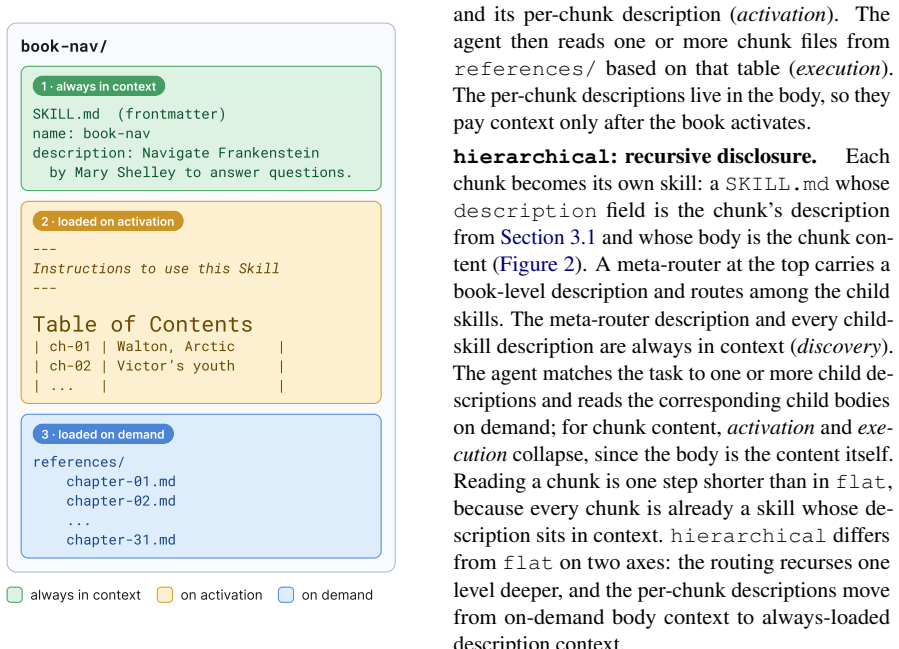
The load-bearing artifact is the Agent Skills pack built by a book-to-skill pipeline: a book is split along its structure into chunk files, each chunk gets a short LLM-written description, and the pack is rooted in a SKILL.md whose short description is always in context and whose body contains a table of contents indexing every chunk. Flat disclosure keeps only that single SKILL.md description always loaded; hierarchical disclosure promotes each chunk's description to its own always-loaded child skill and adds a meta-router. The comparison isolates routing depth and index location: both packs share one chunk set, so differences in accuracy trace to whether per-chunk descriptions pay an alway
Load-bearing premise
The conclusion that deeper routing never helps rests on a hierarchical design in which every chunk's description is always loaded into context; a deeper hierarchy that kept per-chunk summaries out of the always-on window could plausibly break the verdict.
What would settle it
Run a depth-2 pack whose child descriptions load only after the top-level summary matches, on 20-book English open QA; if it matches or beats the flat pack, the paper's 'one level is enough' claim fails. Alternatively, swap canonical novels for synthetic books to strip memorization: if flat no longer beats raw at K=20, the scaling result is confounded by pretraining.
If this is right
- For book-length material, the default should be a single flat skill pack with an in-skill index, not nested child skills with always-loaded descriptions.
- At library scale with tens of books, a flat skill pack is both more accurate and cheaper than letting the agent read the raw corpus: roughly double the open-QA accuracy at about half the tokens.
- Deep hierarchical routing should not be assumed to help; a second level can reduce accuracy by saturating the router's context with per-chunk descriptions.
- A strong agent that already searches by entity names needs no skill pack on a single book; the value of disclosure appears only when the corpus outgrows native navigation.
- Disclosure gains are concentrated in English open QA and on weaker navigators; multiple-choice subsets are blurred by memorization of canonical novels, so open QA is the cleaner test.
Where Pith is reading between the lines
- The paper conflates routing depth with index location: its hierarchical pack always loads every chunk summary, so 'one level is enough' may not hold for a tree design that keeps only top-level summaries in context and loads child summaries on demand.
- The per-trajectory reward the environment emits could support reinforcement-learning post-training of long-context agents, a use the paper notes but does not pursue.
- The cost–accuracy frontier suggests a tunable switch: for a given token budget, one could compute the corpus size at which flat disclosure overtakes raw navigation, and use such cost curves to set that threshold in deployment.
- The negative Chinese-QA results hint that the mechanism relies on exact named-entity matching; languages or corpora with different surface forms may need alternative routing metadata.
Editorial analysis
A structured set of objections, weighed in public.
Referee Report
Summary. The paper reports the first controlled comparison of agentic reading strategies for long-document QA: raw file navigation, a flat Agent Skills progressive-disclosure pack, and a hierarchical per-chunk skill pack, plus a hybrid-retriever baseline. The authors build LOONGDOC, a BenchFlow-based environment that turns InfiniteBench book-QA items into sandboxed file-system tasks with deterministic verifiers and full trajectory logs. Across three harnesses (Codex, Pi, Claude-Code) and three model families, they find that flat disclosure helps weak navigators on single books, is redundant for Codex, and degrades more slowly than raw navigation at library scale (K=5,10,20). The paper concludes that a flat single-level skill pack is the best default and that a second, deeper routing level never helps. The latter claim is internally contradicted by the paper's own Table 3.
Significance. If the claims are appropriately qualified, this is a useful empirical contribution. Strengths include the controlled design—fixed shared chunk sets, held instructions, deterministic scoring, three seeds with standard errors, and trajectory-based mechanism checks—as well as explicit cost accounting and a candid Limitations section. The practical recommendation that one flat skill index is a better default than raw navigation at library scale is well supported. The paper is less novel than its title suggests, as the main contribution is an empirical comparison plus a thin environment wrapper, but the question is timely and the evidence is reproducible in spirit.
major comments (2)
- [Abstract; §6; Table 3; §C.1] The claims "A second, deeper routing level never helps" (Abstract) and "A second routing level never reproduces this gain" (§6) are falsified by the paper's own Table 3. For Pi/gpt-5.4-mini at K=20 on Zh.QA, hierarchical = 0.330 ± 0.043 vs flat = 0.137 ± 0.037; at K=10 on En.QA, hierarchical = 0.310 ± 0.025 vs flat = 0.221 ± 0.037. Section C.1 itself states that "depth is a scale- and task-specific effect rather than a uniform cost," and §5.1's takeaway concedes that "only at library scale, on weak-navigator open-QA cells, does the extra level recover." The unconditional negative claim must be qualified to something like: flat is the best default; deeper routing helps only occasionally, on weak-navigator open-QA at library scale. As written, the headline misrepresents the reported evidence.
- [§3.2–3.3; Figure 2] The flat-vs-hierarchical contrast varies two design axes simultaneously: routing depth and whether per-chunk descriptions are always-loaded. In hierarchical, every child-skill description is always in context, whereas in flat those descriptions are in the parent body and load only upon activation. Consequently, the paper's conclusion that "a second routing level" does not help is not a conclusion about routing depth alone; it is a conclusion about this specific hierarchical implementation. A hierarchical design in which only top-level summaries are always-loaded might behave differently. The confound is acknowledged in §3.3, but the broader negative claim should be narrowed, or an additional condition testing depth without the always-loaded tax should be reported.
minor comments (4)
- [§C.3] The sentence "only at K=20 does hierarchical edge ahead in point estimate" is inaccurate for the Codex En.MC grid: Table 2 shows hierarchical = 0.746 vs flat = 0.760 at K=20. The statement holds only for the Claude-Code grid. Please clarify.
- [Table 2; Table 3] Sample sizes are not fully specified. Table 3 states n=30 only for En.QA and Zh.QA; please state the number of bundles/seeds for En.MC and for all cells in Table 2, so the standard errors can be interpreted.
- [Appendix A.2] The per-chunk description prompt instructs "no extra prose, no Markdown headers" but then requests an output format beginning with "SUMMARY:" and "KEY_ELEMENTS:". Consider aligning the wording so readers know these labeled fields are the required format, not added prose.
- [References] The reference "Xiangyi Li and 1 others" should list the full author list or use a consistent abbreviation style; the current form is nonstandard.
Circularity Check
No circularity: the paper's claims are empirical contrasts against an external benchmark; the 'never helps' overclaim is an internal-consistency issue, not a derivation from its own inputs.
full rationale
I walked the paper's derivation chain. The paper does not derive an effect from a definition, fit a parameter and then call it a prediction, or invoke an author-specific uniqueness theorem. The three conditions (raw, flat, hierarchical) are built over one fixed chunk set and fixed descriptions (Section 3.1: 'the chunk set and the descriptions are fixed inputs to both disclosure approaches, not variables'), and accuracy is scored by ∞Bench's deterministic verifier (Appendix A.1) against an external benchmark. The central claim 'A second, deeper routing level never helps' is an empirical generalization, and it is in fact contradicted by the paper's own Appendix C.1/Table 3 (e.g., Pi/gpt-5.4-mini Zh.QA K=20: hierarchical 0.330 ± 0.043 vs flat 0.137 ± 0.037; En.QA K=10: hierarchical 0.310 ± 0.025 vs flat 0.221 ± 0.037). That is a correctness/overclaim problem—the conclusion is not supported by the reported evidence—not circularity, because the numbers are not manufactured from the claim. The confound noted in Section 3.3 (hierarchical differs from flat on both routing depth and always-loaded descriptions) is a design-validity limitation and is acknowledged by the paper. No load-bearing step reduces to an equation equal to its inputs, and there are no self-citations used to force a conclusion. The limitations section is candid about scope (pre-training confound on En.MC, narrow K axis, fixed recipe, sample size), which further supports the absence of a hidden circular loop. Score 0.
Axiom & Free-Parameter Ledger
free parameters (3)
- fallback chunk size =
~4000 words
- chunk description generation model
- hybrid-RAG fusion/rerank budgets =
not stated
axioms (4)
- domain assumption The ∞Bench subsets (and LOONGDOC file-system environment) are valid operationalizations of long-document agentic QA.
- domain assumption En.QA and Zh.QA answers generally cannot be obtained from the model's parametric memory, while En.MC can.
- domain assumption The three harnesses (Codex, Pi, Claude-Code) and three model families bracket the space of agentic navigational ability.
- domain assumption The book-to-skill recipe (chapter-aligned chunking, LLM-written descriptions) is a fair and representative implementation of the progressive-disclosure pattern.
read the original abstract
Long-document question answering usually forces a choice between loading the whole document into the context window and bolting on a separate retriever. Agentic AI suggests a broader option, giving the agent the document path and letting it decide how and what to read. Agent Skills, a standard for packaging expertise into folders an agent loads on demand, supply a ready mechanism: progressive disclosure, which exposes only what a query needs, from a short description down to the specific passages. Practitioners rapidly adopted this pattern for book-length understanding tasks, but the evidence to support such choices has been anecdotal. We run the first controlled study of the pattern, comparing raw-document navigation and several designs of Agent Skills packs against a classical hybrid retriever across three agent harnesses and three model families on InfiniteBench. On a single book, the gain depends on the harness, running large when the agent navigates the raw document poorly but near zero when a strong agent harness already divides and retrieves on its own. When scaling up to tasks that span many books, raw-document navigation collapses while one-level progressive disclosure degrades more slowly and pulls ahead. A second, deeper routing level never helps and sometimes breaks accuracy outright, so one level is enough. Progressive disclosure buys context, not intelligence: it is redundant while a strong agent can locate the right passages itself, and decisive once the corpus grows too large to navigate by reading.
Figures




Reference graph
Works this paper leans on
-
[1]
Anthropic . 2025 a . https://www.anthropic.com/engineering/effective-context-engineering-for-ai-agents Effective context engineering for AI agents . Anthropic Engineering Blog
2025
-
[2]
Anthropic . 2025 b . https://www.anthropic.com/engineering/equipping-agents-for-the-real-world-with-agent-skills Equipping agents for the real world with agent skills . Anthropic Engineering Blog. Open standard published December 2025 at https://agentskills.io/
2025
-
[3]
Yushi Bai, Xin Lv, Jiajie Zhang, Hongchang Lyu, Jiankai Tang, Zhidian Huang, Zhengxiao Du, Xiao Liu, Aohan Zeng, Lei Hou, Yuxiao Dong, Jie Tang, and Juanzi Li. 2024. https://doi.org/10.18653/v1/2024.acl-long.172 LongBench : A bilingual, multitask benchmark for long context understanding . In Proceedings of the 62nd Annual Meeting of the Association for Co...
-
[4]
Yushi Bai, Shangqing Tu, Jiajie Zhang, Hao Peng, Xiaozhi Wang, Xin Lv, Shulin Cao, Jiazheng Xu, Lei Hou, Yuxiao Dong, Jie Tang, and Juanzi Li. 2025. https://doi.org/10.18653/v1/2025.acl-long.183 LongBench v2 : Towards deeper understanding and reasoning on realistic long-context multitasks . In Proceedings of the 63rd Annual Meeting of the Association for ...
-
[5]
Gal Bakal. 2026. https://arxiv.org/abs/2603.14805 Knowledge activation: AI skills as the institutional knowledge primitive for agentic software development . Preprint, arXiv:2603.14805
Pith/arXiv arXiv 2026
-
[6]
BenchFlow team . 2026. https://github.com/benchflow-ai/benchflow BenchFlow: framework for RL environments for LLM agents
2026
-
[7]
Howard Chen, Ramakanth Pasunuru, Jason Weston, and Asli Celikyilmaz. 2023. https://arxiv.org/abs/2310.05029 Walking down the memory maze: Beyond context limit through interactive reading . Preprint, arXiv:2310.05029
Pith/arXiv arXiv 2023
-
[8]
Xinyue Chen, Pengyu Gao, Jiangjiang Song, and Xiaoyang Tan. 2024. https://arxiv.org/abs/2402.01767 HiQA : A hierarchical contextual augmentation RAG for multi-documents QA . Preprint, arXiv:2402.01767
Pith/arXiv arXiv 2024
-
[9]
Boris Cherny and Cat Wu. 2025. Claude code: Anthropic's agent in your terminal. Interview on Latent Space, https://www.latent.space/p/claude-code. Boris Cherny on dropping RAG indexing for agentic search over the code base, reported on internal ``vibes'' rather than a controlled benchmark
2025
-
[10]
Darren Edge, Ha Trinh, Newman Cheng, Joshua Bradley, Alex Chao, Apurva Mody, Steven Truitt, and Jonathan Larson. 2024. https://arxiv.org/abs/2404.16130 From local to global: A GraphRAG approach to query-focused summarization . arXiv preprint arXiv:2404.16130
Pith/arXiv arXiv 2024
-
[11]
Alex Ewerl \"o f. 2026. RAG vs SKILL vs MCP vs RLM . Personal blog, https://blog.alexewerlof.com/p/rag-vs-skill-vs-mcp-vs-rlm
2026
-
[12]
Hacker News . 2025 a . Claude skills (816 points, 427 comments). Discussion thread, https://news.ycombinator.com/item?id=45607117
2025
-
[13]
Hacker News . 2025 b . Claude skills are awesome, maybe a bigger deal than MCP (738 points, 370 comments). Discussion thread, https://news.ycombinator.com/item?id=45619537
2025
-
[14]
Cheng-Ping Hsieh, Simeng Sun, Samuel Kriman, Shantanu Acharya, Dima Rekesh, Fei Jia, and Boris Ginsburg. 2024. https://arxiv.org/abs/2404.06654 RULER : What's the real context size of your long-context language models? In First Conference on Language Modeling (COLM)
Pith/arXiv arXiv 2024
-
[15]
Wei-Jung Huang. 2026. https://arxiv.org/abs/2607.07504 Do LLM -generated skills make better AI data scientists? a component ablation across data-science workflows . In KDD 2026 Workshop on AI Data Scientist
Pith/arXiv arXiv 2026
-
[16]
Yusuf Karaaslan. 2026. Skill\_seekers: Convert documentation, repositories, and PDFs into claude AI skills. GitHub repository https://github.com/yusufkaraaslan/Skill_Seekers
2026
-
[17]
Marzena Karpinska, Katherine Thai, Kyle Lo, Tanya Goyal, and Mohit Iyyer. 2024. https://doi.org/10.18653/v1/2024.emnlp-main.948 One thousand and one pairs: A ``novel'' challenge for long-context language models . In Proceedings of the 2024 Conference on Empirical Methods in Natural Language Processing (EMNLP), pages 17048--17085, Miami, Florida, USA. Asso...
-
[18]
Tom \'a s Ko c isk \'y , Jonathan Schwarz, Phil Blunsom, Chris Dyer, Karl Moritz Hermann, G \'a bor Melis, and Edward Grefenstette. 2018. https://doi.org/10.1162/tacl_a_00023 The NarrativeQA reading comprehension challenge . Transactions of the Association for Computational Linguistics, 6:317--328
-
[19]
Kuang-Huei Lee, Xinyun Chen, Hiroki Furuta, John Canny, and Ian Fischer. 2024. https://arxiv.org/abs/2402.09727 A human-inspired reading agent with gist memory of very long contexts . In Proceedings of the 41st International Conference on Machine Learning (ICML), volume 235 of Proceedings of Machine Learning Research, pages 26396--26415. PMLR
Pith/arXiv arXiv 2024
-
[20]
Xiangyi Li and 1 others. 2026. https://arxiv.org/abs/2602.12670 Skillsbench: Benchmarking how well agent skills work across diverse tasks . Preprint, arXiv:2602.12670
Pith/arXiv arXiv 2026
-
[21]
Xinze Li, Yixin Cao, Yubo Ma, and Aixin Sun. 2025. https://arxiv.org/abs/2501.01880 Long context vs. RAG for LLMs : An evaluation and revisits . arXiv preprint arXiv:2501.01880
Pith/arXiv arXiv 2025
-
[22]
Zhuowan Li, Cheng Li, Mingyang Zhang, Qiaozhu Mei, and Michael Bendersky. 2024. https://doi.org/10.18653/v1/2024.emnlp-industry.66 Retrieval augmented generation or long-context LLMs ? a comprehensive study and hybrid approach . In Proceedings of the 2024 Conference on Empirical Methods in Natural Language Processing: Industry Track, pages 881--893, Miami...
-
[23]
Liu, Kevin Lin, John Hewitt, Ashwin Paranjape, Michele Bevilacqua, Fabio Petroni, and Percy Liang
Nelson F. Liu, Kevin Lin, John Hewitt, Ashwin Paranjape, Michele Bevilacqua, Fabio Petroni, and Percy Liang. 2024. https://doi.org/10.1162/tacl_a_00638 Lost in the middle: How language models use long contexts . Transactions of the Association for Computational Linguistics, 12:157--173
-
[24]
Mike A Merrill, Alexander Glenn Shaw, Nicholas Carlini, Boxuan Li, Harsh Raj, Ivan Bercovich, Lin Shi, Jeong Yeon Shin, Thomas Walshe, E. Kelly Buchanan, Junhong Shen, Guanghao Ye, Haowei Lin, Jason Poulos, Maoyu Wang, Marianna Nezhurina, Di Lu, Orfeas Menis Mastromichalakis, Zhiwei Xu, and 65 others. 2026. https://arxiv.org/abs/2601.11868 Terminal-bench:...
Pith/arXiv arXiv 2026
-
[25]
Matt Pocock. 2026. Skills v1.0: A progressive disclosure guide. https://www.explainx.ai/blog/matt-pocock-typescript-skills-v1-progressive-disclosure-2026
2026
-
[26]
Mervin Praison. 2026. Turn a 400-page book into a claude code skill: The book-to-skill guide. Personal blog, https://mer.vin/2026/05/turn-a-400-page-book-into-a-claude-code-skill-book-to-skill-guide/
2026
-
[27]
PyShine . 2026. Book-to-skill: Convert book PDFs to claude code skills. Personal blog, https://pyshine.com/Book-to-Skill-Convert-Book-PDFs-to-Claude-Code-Skills/
2026
-
[28]
Qwen Team . 2026. Qwen3.6-35B-A3B . https://huggingface.co/Qwen/Qwen3.6-35B-A3B. Hugging Face model card; evaluates on SkillsBench
2026
-
[29]
Parth Sarthi, Salman Abdullah, Aditi Tuli, Shubh Khanna, Anna Goldie, and Christopher D. Manning. 2024. https://arxiv.org/abs/2401.18059 RAPTOR : Recursive abstractive processing for tree-organized retrieval . In The Twelfth International Conference on Learning Representations (ICLR)
Pith/arXiv arXiv 2024
-
[30]
Simeng Sun, Yang Liu, Shuohang Wang, Dan Iter, Chenguang Zhu, and Mohit Iyyer. 2024. https://doi.org/10.18653/v1/2024.eacl-long.29 PEARL : Prompting large language models to plan and execute actions over long documents . In Proceedings of the 18th Conference of the European Chapter of the Association for Computational Linguistics (EACL), pages 469--486, S...
-
[31]
Yiqun Sun, Pengfei Wei, and Lawrence B. Hsieh. 2026. https://arxiv.org/abs/2604.14572 Don't retrieve, navigate: Distilling enterprise knowledge into navigable agent skills for QA and RAG . In First Workshop on Agent Skills ( ACM CAIS 2026) . Non-archival
Pith/arXiv arXiv 2026
-
[32]
Tencent Hy Team . 2026. Hy3 . https://huggingface.co/tencent/Hy3. Hugging Face model card; evaluates on SkillsBench
2026
-
[33]
Thoughtworks . 2026. Progressive context disclosure. Technology Radar, https://www.thoughtworks.com/radar/techniques/progressive-context-disclosure
2026
-
[34]
Virgilio Jr. 2026. book-to-skill: Turn any technical book PDF into a claude code skill. GitHub repository https://github.com/virgiliojr94/book-to-skill
2026
-
[35]
Cunxiang Wang, Ruoxi Ning, Boqi Pan, Tonghui Wu, Qipeng Guo, Cheng Deng, Guangsheng Bao, Xiangkun Hu, Zheng Zhang, Qian Wang, and Yue Zhang. 2025. https://arxiv.org/abs/2403.12766 NovelQA : Benchmarking question answering on documents exceeding 200 K tokens . In The Thirteenth International Conference on Learning Representations (ICLR)
Pith/arXiv arXiv 2025
-
[36]
Demi Wang, Lintang Sutawika, and Graham Neubig. 2026. https://openreview.net/forum?id=GmCoFYNEIU Skill induction for code agents on web automation . In First Workshop on Agent Skills ( ACM CAIS 2026)
2026
-
[37]
Simon Willison. 2025. Claude skills are awesome, maybe a bigger deal than MCP . Personal blog, https://simonwillison.net/2025/Oct/16/claude-skills/
2025
-
[38]
Renjun Xu and Yang Yan. 2026. https://arxiv.org/abs/2602.12430 Agent skills for large language models: Architecture, acquisition, security, and the path forward . Preprint, arXiv:2602.12430
Pith/arXiv arXiv 2026
-
[39]
Zed Industries . 2025. Agent client protocol. https://agentclientprotocol.com. Protocol specification website
2025
-
[40]
Chi Zhang, Yimin Liu, Xinze Chen, and Ping Ji. 2026. https://openreview.net/forum?id=n0AIlfxDU0 What keeps agent skills from being reusable? evidence from 138 K SKILL.md files . In First Workshop on Agent Skills ( ACM CAIS 2026)
2026
-
[41]
Xinrong Zhang, Yingfa Chen, Shengding Hu, Zihang Xu, Junhao Chen, Moo Khai Hao, Xu Han, Zhen Leng Thai, Shuo Wang, Zhiyuan Liu, and Maosong Sun. 2024 a . https://doi.org/10.18653/v1/2024.acl-long.814 Bench : Extending long context evaluation beyond 100 K tokens . In Proceedings of the 62nd Annual Meeting of the Association for Computational Linguistics (V...
-
[42]
Yusen Zhang, Ruoxi Sun, Yanfei Chen, Tomas Pfister, Rui Zhang, and Sercan O. Arik. 2024 b . https://arxiv.org/abs/2406.02818 Chain of agents: Large language models collaborating on long-context tasks . In Advances in Neural Information Processing Systems 37 (NeurIPS)
Pith/arXiv arXiv 2024
-
[43]
Jun Zhao, Can Zu, Hao Xu, Yi Lu, Wei He, Yiwen Ding, Tao Gui, Qi Zhang, and Xuanjing Huang. 2024. https://doi.org/10.18653/v1/2024.emnlp-main.912 LongAgent : Scaling language models to 128k context through multi-agent collaboration . In Proceedings of the 2024 Conference on Empirical Methods in Natural Language Processing (EMNLP), pages 16310--16324, Miam...
-
[44]
Chenyu Zhou, Huacan Chai, Wenteng Chen, Zihan Guo, Rong Shan, Yuanyi Song, Tianyi Xu, Yingxuan Yang, Aofan Yu, Weiming Zhang, Congming Zheng, Jiachen Zhu, Zeyu Zheng, Zhuosheng Zhang, Xingyu Lou, Changwang Zhang, Zhihui Fu, Jun Wang, Weiwen Liu, and 2 others. 2026. https://arxiv.org/abs/2604.08224 Externalization in LLM agents: A unified review of memory,...
Pith/arXiv arXiv 2026
discussion (0)
Sign in with ORCID, Apple, or X to comment. Anyone can read and Pith papers without signing in.