REVIEW 5 major objections 6 minor 58 references
A pretrained depth estimator can be re-declared as a scene-level implicit field, and a single test-time pixel-wise objective unifies 3D geometry inpainting and reconstruction.
Reviewed by Pith at T0; open to challenge. T0 means a machine referee read the full paper against a public rubric. the ladder, T0–T4 →
T0 review · deepseek-v4-flash
2026-08-02 07:18 UTC pith:EYEHBZSW
load-bearing objection Useful test-time adaptation recipe for depth inpainting, but the headline cross-view consistency gain is measured on the same quantity the loss optimizes, and the paper never defines that loss. the 5 major comments →
Depth Estimators Are Implicit Neural Fields for 3D Scene Geometry Inpainting and Reconstruction
The pith
A machine-rendered reading of the paper's core claim, the machinery that carries it, and where it could break.
Core claim
The central discovery is the dual role of a depth estimator: as a one-shot predictor it supplies a domain prior, and as an implicit field F_θ = f_θ(I) it supplies a parameterizable geometry surface for the current scene. NDF's single optimization objective (Eq. 8) fits observed depth M·ρ(F_θ, D) while retaining the pretrained prior, and this same objective simultaneously fills missing regions and refines observed ones. On the Birmingham satellite scene and ScanNet, this test-time optimization improves both inpainting accuracy (AbsRel, MAE, δ) and cross-view consistency over the base estimator, with the 63.3% overlap-MAE reduction and 23.1% relative-depth heldout gain as headline numbers. The
What carries the argument
The key mechanism is parameterizing the scene field through the estimator itself: F_θ(u) = [f_θ(I)](u), so that θ is the only entity updated. The optimization objective is a single pixel-wise discrepancy loss (Eq. 8) fit to observed depth, augmented by an overlap-window loss that pushes overlapping inference windows to agree on shared pixels, transferred-mask augmentation that prevents the model from memorizing hole locations, and (on indoor scans) a surface-normal teacher loss. The overlap-window loss is the component that enforces global consistency; the transferred-mask augmentation is what forces genuine inpainting behavior rather than copying observed structure.
Load-bearing premise
The overlap-window loss, which asks overlapping inference windows to predict the same depth at the same pixel index, assumes that pixel-index equality corresponds to geometric 3D consistency; for different camera poses, the same index points along different rays, so the loss may be rewarding a training artifact rather than true cross-view coherence.
What would settle it
Evaluate the same NDF output on ScanNet by unprojecting predicted depths into 3D points using the known camera poses and measuring nearest-surface distance (or Chamfer distance) between overlapping windows, instead of the in-image overlap loss. If the 3D-consistency gap between NDF and the base estimator is small or zero while the pixel-space gap is large, the headline 63.3% reduction is an artifact of the pixel-index objective.
If this is right
- If NDF is right, any strong monocular depth estimator can be turned into a scene-completion system at test time without new training data or additional network modules.
- The unification means geometry inpainting and reconstruction improve together: better fitting of observed depth improves inpainting, and retaining the pretrained prior improves reconstruction (ablation: observed MAE drops 82.7% when the depth-prediction task is included).
- The method extends to out-of-distribution data (satellite height maps) where the pretrained prior is not directly usable, because per-scene adaptation realigns the prior to the target domain.
- Fine structural details (chimneys, wires, streetlamps) survive the completion, indicating the approach does not over-smooth missing regions.
- The cost, minutes to an hour per scene with per-scene optimization, is the current practical bottleneck.
Where Pith is reading between the lines
- If the dual-role view holds, other neural predictors (surface normals, occupancy, optical flow) could similarly be re-declared as implicit fields of the same scene, giving a general recipe: pick a pretrained predictor, optimize its parameters on the observed partial signal, and obtain both prediction and reconstruction from one field.
- The overlap-window consistency could be re-derived as true 3D consistency by reprojecting predicted depths into world coordinates using known poses; that would turn the current pixel-space agreement into a properly geometric constraint, and the reported 63.3% reduction might grow or shrink accordingly. The paper does not provide the overlap-loss equation or show that correspondences are computed i
- Testable extension: meta-learn an initialization for NDF across a dataset of scenes so that per-scene adaptation takes seconds rather than minutes, amortizing the optimization cost the paper itself identifies as the main limitation.
- The RGB inpainting agent described in the appendix suggests a two-stage pipeline where appearance completion precedes geometry completion; one could instead optimize appearance and depth jointly in the same field, which the current formulation does not yet do.
Editorial analysis
A structured set of objections, weighed in public.
Referee Report
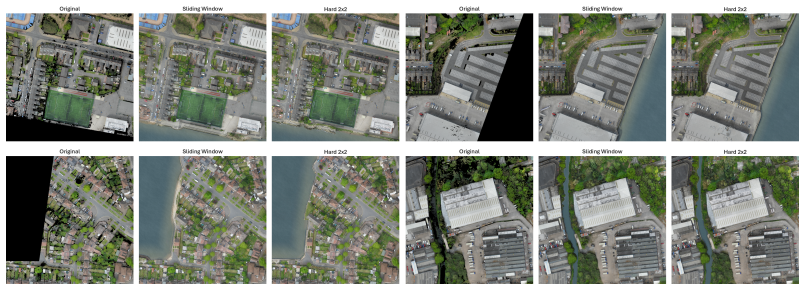
Summary. The paper proposes Neural Depth Field (NDF), a test-time optimization framework that treats a pretrained monocular depth estimator as a scene-level implicit field. For a fixed input image, the estimator's parameters define a depth field F_theta (Eq. 4), and the method optimizes these parameters to fit observed depth while retaining the pretrained prior (Eq. 8). This single objective is claimed to unify depth inpainting and geometry reconstruction. Experiments cover a large satellite height map (Birmingham) and 20 ScanNet indoor scenes, reporting improvements over the base InfiniDepth model in heldout inpainting accuracy, in an 'Overlap' inconsistency metric, and in observed-region accuracy. Ablations attribute gains to the pretrained prior, depth prompting, the depth-estimation role, and overlap/transfer-mask augmentation.
Significance. If the empirical claims hold, NDF offers a practical recipe for adapting a pretrained implicit depth estimator to a specific scene via test-time optimization, with consistent gains over its base model on two diverse scene types. The code availability is a strength, and the paper demonstrates that a simple objective can simultaneously fit observed geometry and improve inpainted depth relative to the base estimator. However, the formal contribution is weak: the 'implicit field' framing is true by construction, and the derivation in Eq. (7)-(8) is a heuristic objective rather than a proven generalization. The evaluation is also not yet sufficient to support 'state-of-the-art' claims, given the limited baselines and the unresolved geometric validity of the Overlap metric. The core idea is promising, but the evidence is incomplete.
major comments (5)
- [§3.2, Eqs. (7)-(8)] The formal section does not establish the paper's central claim. Eq. (7) replaces the unknown hidden-depth term with an arbitrary network g_lambda and a generic prior; the sentence 'g_lambda can be any optimizable neural network, including F_theta' is an assumption, not a derivation. No argument is given that minimizing the observed-depth loss plus a prior transfers to the hidden region in Eq. (6). The prior Pi is never specified in the method. The 'unified objective' is a chosen heuristic, not a derived property. The authors should either prove a generalization statement or explicitly frame Eq. (8) as an empirical design choice.
- [§4.1.1/§4.1.2, §4.2.1/§4.2.2, Tables 1 and 3] The Overlap metric appears to be fitted rather than predicted. The overlap-window loss 'encourages overlapping windows to predict the same height for the same pixels', and the Overlap metric measures 'discrepancy among predictions from overlapping windows in invalid regions'. No loss equation or correspondence rule is given. For Birmingham orthorectified crops this is coherent, but for ScanNet different frames have different poses, so the same pixel index indexes different rays and generally different 3D points. Enforcing image-space equality is not 3D consistency. The reported 63.3% (Birmingham) and 32.5–60.3% (ScanNet) reductions may be artifacts of optimizing the exact quantity being reported. Please provide the exact overlap-loss definition and metric computation, and show that ScanNet correspondences are established via 3D reprojection.
- [§4.1.3, §4.2.3, Tables 1-4] The claim of 'state-of-the-art' performance is unsupported. The comparison is only against InfiniDepth and a Navier-Stokes dummy baseline. No other depth-completion or scene-inpainting methods are compared (e.g., NeRFiller, 3DGIC, Splatfill, Infusion, depth-regularized Gaussian splatting), nor are test-time adaptation baselines. The abstract's '23.1% improvement' is not defined: it refers to the δ1.1 metric on the relative-depth heldout split, not to AbsRel or MAE. A broader comparison with agreed metrics is needed before any SOTA claim can be made.
- [§4.2.1] The ScanNet evaluation protocol is under-specified. For the 3D masks, depth pixels are removed across all frames; the paper must state what the ground-truth depth is for those regions (e.g., from raw depth before masking, from the reconstructed mesh). For the Overlap metric, it is unclear whether predictions from different views of the same surface are compared or whether per-frame errors are averaged. The exact computation should be described. The paper should also explain how the training-time transferred-mask augmentation avoids leakage into the heldout/Overlap masks.
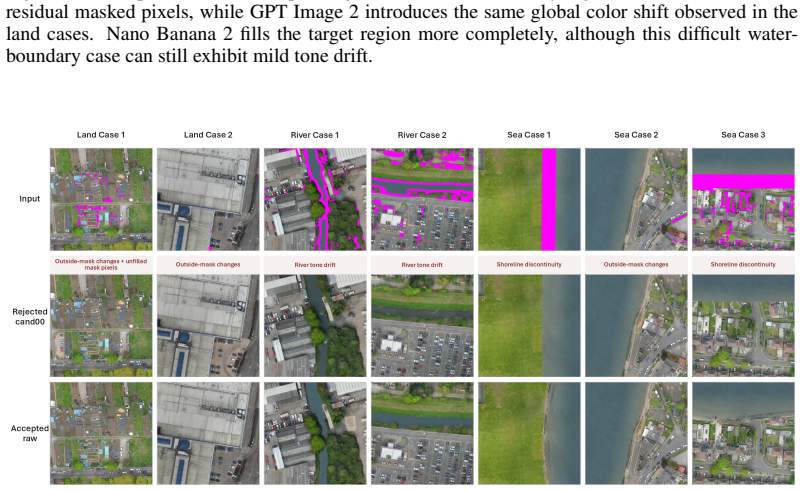
- [Appendix C] The RGB inpainting pipeline in Appendix C is necessary preprocessing for Birmingham but is not referenced in the main method or experiments. It introduces nonstandard components (GPT-5.5 reviewer, Nano Banana 2) without quantitative evaluation or citations. This makes the main experiments hard to reproduce and leaves open whether the depth results depend on the RGB inpainting quality. Either integrate this pipeline into the main evaluation and analyze its impact, or clearly separate it as an external preprocessing step with its own assessment.
minor comments (6)
- [Abstract] The '23.1% improvement' and '63.3% reduction' should specify which metric and which region they refer to. Currently the abstract is ambiguous; the numbers correspond to δ1.1 on relative-depth heldout and Overlap MAE on Birmingham, respectively.
- [§3.2, Eq. (4)] F_theta is a field on the image plane, not a 3D field. The distinction matters for the ScanNet discussion of overlap consistency; please make this explicit.
- [§4.1.2] The transferred-mask augmentation is described only verbally. Please specify how masks are selected from other windows and whether they can overlap with heldout evaluation pixels.
- [§4.2.2] The surface normal loss is mentioned but no equation or reference is provided. A precise definition (or a citation to Chung et al.) is needed for reproducibility.
- [Tables 1 and 3] The 'w/o augmentation' ablation removes both mask transfer and overlap loss. Since these are distinct components, separate ablations would clarify the contribution of each to the reported gains.
- [References] Several 2026 preprints are cited as baselines or prior work (e.g., InfiniDepth, Depth Anything 3). Please provide arXiv identifiers or stable links to allow verification.
Circularity Check
Overlap metric is trained-for by the overlap-window loss; Eq. (4) framing is definitional; heldout inpainting accuracy remains independent.
specific steps
-
self definitional
[§3.2, Eq. (4)]
"Let f θ be a mono-depth estimator with parameters θ. For the input image I, it gives a one-shot depth prediction f θ(I). Since I is fixed for a given observation, θ defines a scene-level implicit depth field Fθ : Ω→R, where: Fθ = f θ(I) =⇒ F θ(u) = [fθ(I)](u). (4) Therefore, the mono-depth model has two roles."
The 'key insight' is an identity: the field Fθ is defined to be the estimator output fθ(I). No independent field representation or geometric mapping is derived; the claimed dual role is a relabeling of Eq. (4). The framing is therefore true by construction rather than a derived property. This does not by itself invalidate the experiments, but the conceptual unification contributes no independent content.
-
fitted input called prediction
[§4.1.1 metrics vs §4.1.2 implementation; Table 1]
"Overlap measures the discrepancy among predictions from overlapping windows in invalid regions... During training, we use MAE as the reconstruction loss and additionally introduce an overlap-window loss, which encourages overlapping windows to predict the same height for the same pixels."
The headline 'reducing the Overlap MAE by 63.3%' is evaluated with exactly the quantity the overlap-window loss minimizes: cross-window prediction discrepancy at the same pixels. Optimizing that loss therefore forces the reported metric down by construction; it is a training objective measured post hoc, not an independent consistency prediction. The paper provides no equation for the loss and no 3D reprojection for ScanNet, where the same pixel index across different camera poses indexes different 3D points, so even the fitted quantity may not represent geometric cross-view consistency. The 'w/o augmentation' ablation reduces the gain, but the metric remains tied to the loss.
full rationale
The heldout inpainting results are substantially self-contained: Appendix B.3 states 'Pixels belonging to transferred invalid masks or held-out regions are removed from the prompt set, preventing target leakage,' so the 23.1% heldout accuracy gain is not directly optimized. The central Eq. (4) framing is definitional but harmless to the empirical comparisons. The main circular component is the Overlap/cross-view-consistency claim: the overlap-window loss optimizes the same quantity as the Overlap metric, so the 63.3% reduction is at least partly fitted; for ScanNet the image-space formulation is geometrically questionable. No load-bearing self-citation chain or imported uniqueness theorem appears. The independent heldout inpainting result keeps the paper from being wholly circular, hence a score of 5.
Axiom & Free-Parameter Ledger
free parameters (6)
- alpha prior weight (Eq. 8) =
unspecified
- overlap-window loss weight =
unspecified
- surface-normal loss weight (ScanNet) =
unspecified
- learning rates =
2e-5/1e-4 and 2e-6/1e-5
- prompt/query sampling budget =
50-2500 prompts, 100k queries per frame
- training epochs/batch size =
10/16 (Birmingham), 1/1 (ScanNet)
axioms (4)
- domain assumption Optimizing a pretrained depth estimator on observed depth pixels generalizes to missing pixels.
- domain assumption Depth values at the same pixel coordinate in overlapping windows should be equal.
- domain assumption A ground-view pretrained depth estimator provides a usable prior for satellite orthophotos.
- domain assumption The inpainted RGB canvas used as input for satellite depth estimation approximates the true appearance.
Cite this review
Pith. "Pith review of Depth Estimators Are Implicit Neural Fields for 3D Scene Geometry Inpainting and Reconstruction." pith.science (2026). https://pith.science/paper/EYEHBZSW
@misc{pith2026260716286,
  author       = {Pith},
  title        = {Pith review of: Depth Estimators Are Implicit Neural Fields for 3D Scene Geometry Inpainting and Reconstruction},
  year         = {2026},
  howpublished = {\url{https://pith.science/paper/EYEHBZSW}},
  note         = {Machine review of arXiv:2607.16286}
}
read the original abstract
The 3D geometry of real-world scene data is often incomplete. Mainstream methods use depth estimators to inpaint missing structure. However, their prediction results can be inconsistent with observed geometry, or unreliable on out-of-distribution data. To solve these problems, we propose Neural Depth Field (NDF). Our key insight is that a depth estimator can also be a scene-level implicit field. As an estimator, it adapts to the target domain by learning observed depth data. As an implicit field, it fits the existing geometry to maintain consistency. Under this view, NDF addresses both problems through a single test-time optimization. Experiments show that NDF produces high-fidelity and globally consistent geometry across diverse scene data, ranging from indoor scans to satellite imagery. It reduces cross-view inconsistency by 63.3\% and improves inpainting accuracy by 23.1\%, achieving state-of-the-art performance in 3D scene geometry inpainting. The code is available at: https://github.com/Shadow-Dream/Neural-Depth-Field.
Figures


Reference graph
Works this paper leans on
-
[1]
Advances in Neural Information Processing Systems , year=
Depth Map Prediction from a Single Image using a Multi-Scale Deep Network , author=. Advances in Neural Information Processing Systems , year=
-
[2]
and Savva, Manolis and Halber, Maciej and Funkhouser, Thomas and Nie
Dai, Angela and Chang, Angel X. and Savva, Manolis and Halber, Maciej and Funkhouser, Thomas and Nie. Proceedings of the IEEE Conference on Computer Vision and Pattern Recognition , year=
-
[3]
International Conference on 3D Vision , year=
Chang, Angel and Dai, Angela and Funkhouser, Thomas and Halber, Maciej and Nie. International Conference on 3D Vision , year=
-
[4]
Savva, Manolis and Kadian, Abhishek and Maksymets, Oleksandr and Zhao, Yili and Wijmans, Erik and Jain, Bhavana and Straub, Julian and Liu, Jia and Koltun, Vladlen and Malik, Jitendra and Parikh, Devi and Batra, Dhruv , booktitle=
-
[5]
Advances in Neural Information Processing Systems , year=
Depth Anything V2 , author=. Advances in Neural Information Processing Systems , year=
-
[6]
Proceedings of the IEEE/CVF Conference on Computer Vision and Pattern Recognition , year=
Depth Anything: Unleashing the Power of Large-Scale Unlabeled Data , author=. Proceedings of the IEEE/CVF Conference on Computer Vision and Pattern Recognition , year=
-
[7]
Proceedings of the IEEE Conference on Computer Vision and Pattern Recognition , year=
MegaDepth: Learning Single-View Depth Prediction from Internet Photos , author=. Proceedings of the IEEE Conference on Computer Vision and Pattern Recognition , year=
-
[8]
Proceedings of the IEEE/CVF International Conference on Computer Vision , year=
Hypersim: A Photorealistic Synthetic Dataset for Holistic Indoor Scene Understanding , author=. Proceedings of the IEEE/CVF International Conference on Computer Vision , year=
-
[9]
arXiv preprint arXiv:2001.10773 , year=
Virtual KITTI 2 , author=. arXiv preprint arXiv:2001.10773 , year=
Pith/arXiv arXiv 2001
-
[10]
arXiv preprint arXiv:2404.15506 , year=
Metric3D v2: A Versatile Monocular Geometric Foundation Model for Zero-shot Metric Depth and Surface Normal Estimation , author=. arXiv preprint arXiv:2404.15506 , year=
-
[11]
Proceedings of the IEEE/CVF Conference on Computer Vision and Pattern Recognition , year=
Repurposing Diffusion-Based Image Generators for Monocular Depth Estimation , author=. Proceedings of the IEEE/CVF Conference on Computer Vision and Pattern Recognition , year=
-
[12]
Proceedings of the IEEE/CVF Conference on Computer Vision and Pattern Recognition , year=
UniDepth: Universal Monocular Metric Depth Estimation , author=. Proceedings of the IEEE/CVF Conference on Computer Vision and Pattern Recognition , year=
-
[13]
arXiv preprint arXiv:2410.02073 , year=
Depth Pro: Sharp Monocular Metric Depth in Less Than a Second , author=. arXiv preprint arXiv:2410.02073 , year=
-
[14]
Proceedings of the European Conference on Computer Vision , year=
MVSNet: Depth Inference for Unstructured Multi-view Stereo , author=. Proceedings of the European Conference on Computer Vision , year=
-
[15]
Proceedings of the IEEE/CVF Conference on Computer Vision and Pattern Recognition , year=
Wang, Shuzhe and Leroy, Vincent and Cabon, Yohann and Chidlovskii, Boris and Revaud, J. Proceedings of the IEEE/CVF Conference on Computer Vision and Pattern Recognition , year=
-
[16]
Wang, Jianyuan and Chen, Minghao and Karaev, Nikita and Rupprecht, Christian and Novotny, David and Vedaldi, Andrea , booktitle=
-
[17]
arXiv preprint arXiv:2601.03252 , year=
InfiniDepth: Arbitrary-Resolution and Fine-Grained Depth Estimation with Neural Implicit Fields , author=. arXiv preprint arXiv:2601.03252 , year=
-
[18]
Proceedings of the IEEE International Conference on Robotics and Automation , year=
Sparse-to-Dense: Depth Prediction from Sparse Depth Samples and a Single Image , author=. Proceedings of the IEEE International Conference on Robotics and Automation , year=
-
[19]
Proceedings of the European Conference on Computer Vision , year=
Non-Local Spatial Propagation Network for Depth Completion , author=. Proceedings of the European Conference on Computer Vision , year=
-
[20]
Hu, Mu and Wang, Shuling and Li, Bin and Ning, Shiyu and Fan, Li and Gong, Xiaojin , booktitle=
-
[21]
Proceedings of the IEEE/CVF Conference on Computer Vision and Pattern Recognition , year=
Prompting Depth Anything for 4K Resolution Accurate Metric Depth Estimation , author=. Proceedings of the IEEE/CVF Conference on Computer Vision and Pattern Recognition , year=
-
[22]
IEEE International Symposium on Mixed and Augmented Reality , year=
KinectFusion: Real-Time Dense Surface Mapping and Tracking , author=. IEEE International Symposium on Mixed and Augmented Reality , year=
-
[23]
Robotics: Science and Systems , year=
ElasticFusion: Dense SLAM Without A Pose Graph , author=. Robotics: Science and Systems , year=
-
[24]
ACM Transactions on Graphics , year=
BundleFusion: Real-time Globally Consistent 3D Reconstruction using On-the-fly Surface Reintegration , author=. ACM Transactions on Graphics , year=
-
[25]
Proceedings of the IEEE/CVF Conference on Computer Vision and Pattern Recognition , year=
Sch. Proceedings of the IEEE/CVF Conference on Computer Vision and Pattern Recognition , year=
-
[26]
and Tancik, Matthew and Barron, Jonathan T
Mildenhall, Ben and Srinivasan, Pratul P. and Tancik, Matthew and Barron, Jonathan T. and Ramamoorthi, Ravi and Ng, Ren , booktitle=
-
[27]
ACM Transactions on Graphics , year=
3D Gaussian Splatting for Real-Time Radiance Field Rendering , author=. ACM Transactions on Graphics , year=
-
[28]
Proceedings of the IEEE/CVF Conference on Computer Vision and Pattern Recognition Workshops , year=
Sat-NeRF: Learning Multi-View Satellite Photogrammetry With Transient Objects and Shadow Modeling Using RPC Cameras , author=. Proceedings of the IEEE/CVF Conference on Computer Vision and Pattern Recognition Workshops , year=
-
[29]
Proceedings of the IEEE/CVF Conference on Computer Vision and Pattern Recognition , year=
Gaussian Splatting for Efficient Satellite Image Photogrammetry , author=. Proceedings of the IEEE/CVF Conference on Computer Vision and Pattern Recognition , year=
-
[30]
arXiv preprint arXiv:2508.09479 , year=
SkySplat: Generalizable 3D Gaussian Splatting from Sparse Multi-Temporal Satellite Images , author=. arXiv preprint arXiv:2508.09479 , year=
-
[31]
arXiv preprint arXiv:2512.07527 , year=
From Orbit to Ground: Generative City Photogrammetry from Extreme Off-Nadir Satellite Images , author=. arXiv preprint arXiv:2512.07527 , year=
-
[32]
arXiv preprint arXiv:2510.15869 , year=
Skyfall-GS: Synthesizing Immersive 3D Urban Scenes from Satellite Imagery , author=. arXiv preprint arXiv:2510.15869 , year=
-
[33]
Proceedings of the IEEE/CVF Conference on Computer Vision and Pattern Recognition , year=
Depth-supervised NeRF: Fewer Views and Faster Training for Free , author=. Proceedings of the IEEE/CVF Conference on Computer Vision and Pattern Recognition , year=
-
[34]
Proceedings of the IEEE/CVF International Conference on Computer Vision , year=
SparseNeRF: Distilling Depth Ranking for Few-shot Novel View Synthesis , author=. Proceedings of the IEEE/CVF International Conference on Computer Vision , year=
-
[35]
Yu, Zehao and Peng, Songyou and Niemeyer, Michael and Sattler, Torsten and Geiger, Andreas , booktitle=
-
[36]
arXiv preprint arXiv:2311.13398 , year=
Depth-Regularized Optimization for 3D Gaussian Splatting in Few-Shot Images , author=. arXiv preprint arXiv:2311.13398 , year=
-
[37]
Proceedings of the IEEE/CVF Conference on Computer Vision and Pattern Recognition , year=
DepthSplat: Connecting Gaussian Splatting and Depth , author=. Proceedings of the IEEE/CVF Conference on Computer Vision and Pattern Recognition , year=
-
[38]
Proceedings of the IEEE/CVF Conference on Computer Vision and Pattern Recognition , year=
NeRFiller: Completing Scenes via Generative 3D Inpainting , author=. Proceedings of the IEEE/CVF Conference on Computer Vision and Pattern Recognition , year=
-
[39]
arXiv preprint arXiv:2404.11613 , year=
InFusion: Inpainting 3D Gaussians via Learning Depth Completion from Diffusion Prior , author=. arXiv preprint arXiv:2404.11613 , year=
-
[40]
Huang, Sheng-Yu and Chou, Zi-Ting and Wang, Yu-Chiang Frank , journal=
-
[41]
arXiv preprint arXiv:2509.07809 , year=
SplatFill: 3D Scene Inpainting via Depth-Guided Gaussian Splatting , author=. arXiv preprint arXiv:2509.07809 , year=
-
[42]
Proceedings of the IEEE/CVF Winter Conference on Applications of Computer Vision , pages=
Inpaint360GS: Efficient Object-Aware 3D Inpainting via Gaussian Splatting for 360 Degree Scenes , author=. Proceedings of the IEEE/CVF Winter Conference on Applications of Computer Vision , pages=
-
[43]
arXiv preprint arXiv:2511.10647 , year=
Depth anything 3: Recovering the visual space from any views , author=. arXiv preprint arXiv:2511.10647 , year=
-
[44]
Hu, Qingyong and Yang, Bo and Xie, Linhai and Rosa, Stefano and Guo, Yulan and Wang, Zhihua and Trigoni, Niki and Markham, Andrew , journal=
-
[45]
Proceedings of the IEEE Conference on Computer Vision and Pattern Recognition , year=
Gibson Env: Real-World Perception for Embodied Agents , author=. Proceedings of the IEEE Conference on Computer Vision and Pattern Recognition , year=
-
[46]
Hong, Yining and Zhen, Haoyu and Chen, Peihao and Zheng, Shuhong and Du, Yilun and Chen, Zhenfang and Gan, Chuang , booktitle=
-
[47]
Majumdar, Arjun and Ajay, Anurag and Zhang, Xiaohan and Putta, Pranav and Yenamandra, Sriram and Henaff, Mikael and Silwal, Sneha and Mcvay, Paul and Maksymets, Oleksandr and Arnaud, Sergio and Yadav, Karmesh and Li, Qiyang and Newman, Ben and Sharma, Mohit and Berges, Vincent and Zhang, Shiqi and Agrawal, Pulkit and Bisk, Yonatan and Batra, Dhruv and Kal...
-
[48]
Advances in Neural Information Processing Systems , year=
Navigation World Models , author=. Advances in Neural Information Processing Systems , year=
-
[49]
Zheng, Wenzhao and Chen, Weiliang and Huang, Yuanhui and Zhang, Borui and Duan, Yueqi and Lu, Jiwen , booktitle=
-
[50]
European Conference on Computer Vision , year=
Beyond the Nav-Graph: Vision-and-Language Navigation in Continuous Environments , author=. European Conference on Computer Vision , year=
-
[51]
Frontiers in Robotics and AI , volume=
Incremental Learning of Humanoid Robot Behavior from Natural Interaction and Large Language Models , author=. Frontiers in Robotics and AI , volume=
-
[52]
Endowing
Jian, Yingzhao and Wang, Zhongan and Yang, Yi and Fan, Hehe , journal=. Endowing
-
[53]
Lin, Li and Liu, Yebin and Hu, Qingyong and Wang, Xiaoyang and Li, Ning and Wang, Yue and Yang, Bisheng and Li, Yujie , booktitle=
-
[54]
Chen, Meida and Hu, Qingyong and Yu, Zifan and Thomas, Hugues and Feng, Andrew and Hou, Yu and McCullough, Kyle and Ren, Fengbo and Soibelman, Lucio , booktitle=
-
[55]
Yin, Yihang and Xu, Yusheng and Li, Jonathan and Li, Wenkai and Shen, Jie and Liu, Min and Wang, Cheng and Yang, Bisheng , journal=
-
[56]
Nocerino, Erica and Menna, Fabio and Remondino, Fabio and Toschi, Isabella and Stathopoulou, Efstathia-Kalypso , journal=
-
[57]
Zeybek, Mustafa and Yakar, Murat and Yilmaz, Alper , booktitle=
-
[58]
Hansen, Lasse and Moradzadeh, Ali and Philips, Wilfried and Stilla, Uwe and Hoegner, Ludwig , booktitle=
discussion (0)
Sign in with ORCID, Apple, or X to comment. Anyone can read and Pith papers without signing in.