REVIEW 5 major objections 4 minor 37 references
A single-GPU diffusion model can generate short, temporally smooth sign-language clips from text prompts, though prompt-specific control remains weak.
Reviewed by Pith at T0; open to challenge. T0 means a machine referee read the full paper against a public rubric. the ladder, T0–T4 →
T0 review · deepseek-v4-flash
2026-08-02 06:00 UTC pith:F2EN7734
load-bearing objection Honest negative result undercuts the title claim; useful as a reproducible baseline, but the 'text-to-sign' label is not supported by the paper's own audit. the 5 major comments →
Text2Sign: A Single-GPU Diffusion Baseline for Text-to-Sign Language Video Generation
The pith
A machine-rendered reading of the paper's core claim, the machinery that carries it, and where it could break.
Core claim
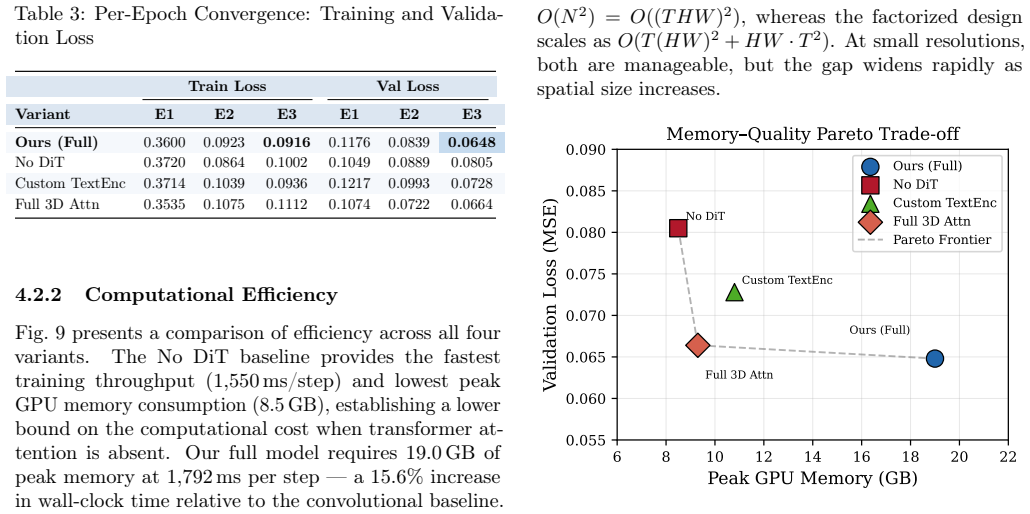
On the paper's own terms, the discovery is that a frozen vision-language text encoder plus factorized spatial-temporal attention in a 3D UNet provides a workable single-GPU recipe for text-conditioned sign-video diffusion. In short-budget ablations on a signer-disjoint How2Sign-derived split, the full variant reaches a validation loss of 0.0648, beating a convolution-only backbone by 19.5%, a custom-trained text encoder by 11.0%, and full 3D attention by 2.5%, while keeping training memory within 24 GB. A longer 100-epoch run reaches validation loss 0.00999 and produces 32-frame 64x64 clips at 2.54 frames/s with 3.12 GB peak inference memory. The author emphasizes that smooth motion and low
What carries the argument
The load-bearing components are (1) a frozen CLIP text encoder (ViT-B/32) whose fixed features enter the denoising network via cross-attention, (2) a 3D encoder-decoder UNet with DiT-style transformer blocks that use adaptive layer normalization for timestep conditioning, and (3) factorized spatio-temporal attention, which replaces full 3D attention over T×H×W tokens with per-frame spatial attention plus per-location temporal attention, cutting complexity from O((T·H·W)^2) to O(T·(H·W)^2 + H·W·T^2). This factorization is what makes the 24 GB single-GPU budget workable while preserving temporal coherence.
Load-bearing premise
The fragile premise is that the frozen CLIP text encoder and the cross-attention pathway actually inject prompt-specific information into the denoising network; the paper's own held-out audit (Table 10) found only a tiny null-text penalty and no separation between shuffled and intended prompts, so if this premise fails, the model reduces to unlabeled sign-like motion synthesis.
What would settle it
Run the held-out conditional denoising audit on at least 100 unique prompts: if the bootstrap 95% CI for the shuffled-vs-intended loss difference excludes zero and the 4-way ranking accuracy rises clearly above the reported 0.3125, the paper's weak-prompt-sensitivity conclusion is overturned; if the null result persists, the 'text-to-sign' claim is not supported.
If this is right
- Factorized attention is competitive with full 3D attention at 64x64 and 32 frames, while offering 32x lower pairwise token cost; the gap should widen at higher resolutions.
- Frozen CLIP conditioning beats a jointly trained custom text encoder under short training budgets, suggesting pretrained vision-language features are a cheap default for video diffusion.
- The main checkpoint generates temporally smooth clips (temporal consistency 1.0000) at 2.54 frames/s on one GPU, making this a practical starting point for small-scale sign-language generation research.
- The held-out audit shows text presence matters for denoising but prompt identity is barely expressed, so future work must couple generation with recognition backends or expert evaluation before claiming linguistic correctness.
Where Pith is reading between the lines
- The near-chance prompt-ranking result suggests that diffusion validation loss and pixel-space smoothness metrics can be satisfied while semantic conditioning is weak; prompt-ranking audits like the one in this paper could become a standard diagnostic for text-to-video models.
- If the weak text separation persists at higher resolutions and longer clips, the bottleneck is likely the frozen CLIP features or the cross-attention pathway rather than the UNet backbone—a testable hypothesis for follow-up work.
- The factorized-attention result may transfer beyond sign language: any single-GPU text-to-short-video diffusion system on low-resolution clips could adopt the same spatial/temporal decomposition.
- A natural extension is to replace the CLIP text encoder with a sign-aware pretrained language model or to add pose/gloss supervision; the paper's public code makes such variants directly comparable.
Editorial analysis
A structured set of objections, weighed in public.
Referee Report
Summary. The paper proposes Text2Sign, a diffusion-based model for generating short sign-language video clips from text prompts on a single NVIDIA L4 GPU. The architecture combines a frozen CLIP text encoder with a 3D UNet backbone augmented by DiT-style blocks and factorized spatio-temporal attention. The authors report a signer-disjoint How2Sign evaluation, ablations over DiT blocks, text-encoder strategy, and attention factorization, plus a 100-epoch checkpoint with pixel-space quality metrics, runtime, and a held-out conditional-denoising audit. The paper explicitly acknowledges that prompt-specific semantic control remains weak, but frames the contribution as a single-GPU text-to-sign baseline.
Significance. If the central claim were established, the paper would provide a useful resource-constrained baseline for sign-video generation, with public code and a signer-disjoint protocol. The held-out audit is a commendable attempt at negative-control evaluation, and the paper is transparent about many limitations. However, the core 'text-to-sign' claim is not supported by the paper's own decisive audit: the model only distinguishes the presence of text from its absence, not which prompt was given. The architectural comparisons and efficiency analysis are also undermined by single-run ablations and internal numerical contradictions. The contribution, as stated in the title and abstract, therefore does not hold.
major comments (5)
- [Section 5.4, Table 10] The paper's central claim is text-conditioned generation, but the held-out audit shows shuffled prompts are nearly tied with intended prompts (Δ=+0.00004, CI [-0.00017,0.00027]) and 4-way ranking top-1 is 0.3125, near chance. The model only distinguishes text presence from absence (Δ=+0.00161). This does not establish prompt-specific semantic control; the title 'Text2Sign' and the abstract's 'text-conditioned diffusion model' are therefore not supported. The paper acknowledges this, but the contribution is framed as a text-to-sign baseline, which is untenable.
- [Abstract; Section 5.3, Table 9; Conclusion] The validation loss for the long run is inconsistently reported: the abstract and conclusion say 0.00999, while Table 9 and Section 5.3 state best val loss 0.00578 (epoch 84) and final 0.00768. These are substantially different. The authors must identify which checkpoint and loss are used for the reported generation metrics; as written, the headline number is ambiguous.
- [Section 4.2.2 vs Section 5.4] The inference-time numbers are contradictory. Section 4.2.2 reports 15-step DDIM inference at 2,860 ms per 32-frame clip for Ours (Full), while Section 5.4 reports 12.60 s per clip for 8-step DDIM. This is implausible: fewer DDIM steps should reduce, not increase, latency by ~4.4x. Unless the settings differ in ways not described (e.g., batch size, warm-up, CFG implementation), this undermines the single-GPU efficiency claim.
- [Eq. (11); Table 8 vs Table 11; Section 5.4] The temporal consistency metric is inconsistent across the paper. Eq. (11) yields -0.3789 for Ours (Full) in Table 8, but Table 11 reports 0.999998 for the same model, and Section 5.4 reports 1.0000 ± 0.0000. The metric may be negative by design, but the sign flip and exact 1.0000 suggest either a different normalization or a degenerate evaluation. This makes the 'temporally consistent' claim unverifiable.
- [Section 4.2, Table 4] All ablation conclusions rest on single runs with a fixed seed and no error bars. The reported differences (DiT 19.5%, text encoder 11.0%, factorization 2.5%) could easily lie within run-to-run variance, especially with only 3 epochs and 50 steps/epoch. Additionally, the 'FVD-proxy' and 'compact evaluation slice' are not defined (no feature extractor, clip count, or selection criterion), so the quantitative comparisons cannot be reproduced or interpreted.
minor comments (4)
- [Eq. (3)] The cosine schedule uses offset s and an upper bound on β_t, but neither the value of s nor the bound is specified. This prevents exact reproduction.
- [Section 5.4] The text refers to 'Section V-C' (Roman numeral) instead of 'Section 5.3'; please fix the cross-reference.
- [Table 10] The 16 validation prompts are described only as 'unique prompts of at most five words.' The selection method and prompt list should be provided for interpretability and reproducibility.
- [Table 7] The contextual comparison table is placed after the quantitative ablation tables, which makes the narrative harder to follow. Consider moving it to Related Work or renumbering.
Circularity Check
No circular derivation: the paper's claims are standard empirical results with explicit limitations, not reductions to their inputs.
full rationale
The paper's derivation chain is self-contained and standard: a DDPM noise-prediction objective (Eq. 6), a 3D UNet with DiT-style blocks, and a frozen CLIP text encoder. The reported 'predictions'—validation loss, SSIM/PSNR, temporal consistency, and inference latency—are measured on held-out checkpoints under fixed configurations, not quantities that are equal to fitted inputs by construction. The frozen-CLIP advantage over the custom encoder is an empirical ablation on held-out validation loss, and the paper explicitly narrows the claim to a 'short-budget comparison' rather than claiming robust semantic control. The strongest potential concern is the weakness of prompt-specific conditioning, but the paper itself reports this in Table 10: shuffled prompts differ from intended prompts by only +0.00004 with a confidence interval spanning zero, and 4-way ranking is near chance. This is an honest internal limitation, not a circular step. Model-selection choices (CFG=5.0, best-validation checkpoint, compact evaluation slice) affect generalizability but are not circular reasoning; no fitted parameter is renamed as a prediction. There are no load-bearing self-citations, no imported uniqueness theorems, and no ansatz smuggled in via citation. The temporal-consistency metric is a self-defined heuristic, and the paper explicitly cautions that smoothness alone does not establish sign-linguistic fidelity, so it is not a renamed known result presented as unification. Overall, the derivation does not reduce to its inputs.
Axiom & Free-Parameter Ledger
free parameters (4)
- CFG guidance scale w =
5.0
- DDIM sampling steps =
8
- Compact evaluation slice =
unspecified
- Architecture hyperparameters (base channels=96, depth=2, heads=6, channel multipliers [1,2,4]) =
96/2/6/[1,2,4]
axioms (5)
- standard math DDPM/DDIM noise-perturbation and reverse-process equations hold as implemented
- domain assumption Metadata-defined identity groups in How2Sign proxy true signer identities for signer-disjoint generalization
- domain assumption 64x64, 32-frame clips extracted from How2Sign retain enough of the sign and its English alignment to train text-to-sign
- domain assumption CLIP text embeddings of short prompts carry the sign-relevant semantics
- ad hoc to paper The temporal-consistency metric (Eq. 11) with its normalization is a meaningful smoothness measure
Cite this review
Pith. "Pith review of Text2Sign: A Single-GPU Diffusion Baseline for Text-to-Sign Language Video Generation." pith.science (2026). https://pith.science/paper/F2EN7734
@misc{pith2026260713164,
  author       = {Pith},
  title        = {Pith review of: Text2Sign: A Single-GPU Diffusion Baseline for Text-to-Sign Language Video Generation},
  year         = {2026},
  howpublished = {\url{https://pith.science/paper/F2EN7734}},
  note         = {Machine review of arXiv:2607.13164}
}
read the original abstract
Sign language is a primary communication channel for millions of Deaf and hard-of-hearing people, yet text-to-signer video generation remains costly because video diffusion models are expensive to train and evaluate. This paper presents Text2Sign, a text-conditioned diffusion model for short sign-language clips that runs on a single NVIDIA L4 GPU. It combines a frozen vision-language text encoder with a 3D encoder-decoder and factorized spatiotemporal attention to reduce the cost of full-video attention while preserving motion coherence. We compare convolution-only and transformer-style backbones, frozen pretrained and task-specific text encoders, and factorized versus full attention. On a signer-disjoint How2Sign split, the best short-run ablation reaches a validation loss of 0.0648, while a longer-run checkpoint reaches 0.00999. On a compact evaluation slice, the latter achieves an SSIM of $0.2403 \pm 0.0238$, a PSNR of $15.11 \pm 0.42$ dB, and temporal consistency of $1.0000 \pm 0.0000$ using 8-step DDIM sampling with a guidance scale of 5.0. It generates a 32-frame, $64 \times 64$ clip in 12.60 seconds, or 2.54 frames per second, with peak inference memory of 3.12 GB. A held-out denoising audit shows only weak prompt sensitivity: removing text increases late-timestep loss from 0.9875 to 0.9891, while shuffled prompts perform similarly to correct prompts. Frozen text conditioning therefore improves short-budget validation loss, but prompt-specific separation remains limited. The system is restricted to low-resolution, short clips and lacks expert linguistic evaluation, so it should be viewed as a single-GPU research baseline rather than a complete sign-language production system. Code is available at https://github.com/xiaruize0911/text2sign.
Figures




Reference graph
Works this paper leans on
-
[1]
Deafness and hearing loss,
World Health Organization, “Deafness and hearing loss,” https://www.who.int/news-room/fact-sheet s/detail/deafness-and-hearing-loss, 2025, accessed: 2026-01-08
2025
-
[2]
Occupational outlook handbook: Interpreters and translators,
Bureau of Labor Statistics, U.S. Department of La- bor, “Occupational outlook handbook: Interpreters and translators,” https://www.bls.gov/ooh/media-a nd-communication/interpreters-and-translators.h tm, 2025, accessed: 2026-01-08
2025
-
[3]
Pro- gressive transformers for end-to-end sign language production,
B. Saunders, N. C. Camgoz, and R. Bowden, “Pro- gressive transformers for end-to-end sign language production,”arXiv preprint arXiv:2004.14874, 2020, arXiv:2004.14874
Pith/arXiv arXiv 2004
-
[4]
How2sign: A large-scale multimodal dataset for continuous american sign language,
A. Duarte, S. Palaskar, L. Ventura, D. Ghadiyaram, K. Dehghan, F. Metze, J. Torres, and X. Giro-i Nieto, “How2sign: A large-scale multimodal dataset for continuous american sign language,” inProceedings of the IEEE/CVF Conference on Computer Vision and Pattern Recognition (CVPR), 2021, pp. 2735– 2744
2021
-
[5]
Denoising diffu- sion probabilistic models,
J. Ho, A. Jain, and P. Abbeel, “Denoising diffu- sion probabilistic models,” inAdvances in Neural Information Processing Systems, vol. 33, 2020, pp. 6840–6851
2020
-
[6]
High-resolution image synthesis with latent diffusion models,
R. Rombach, A. Blattmann, D. Lorenz, P. Esser, and B. Ommer, “High-resolution image synthesis with latent diffusion models,” inProceedings of the IEEE/CVF Conference on Computer Vision and Pattern Recognition (CVPR), 2022
2022
-
[7]
J. Ho, T. Salimans, A. Gritsenko, W. Chan, M. Norouzi, and D. J. Fleet, “Video diffusion models,”arXiv preprint arXiv:2204.03458, 2022, arXiv:2204.03458
Pith/arXiv arXiv 2022
-
[8]
Scalable diffusion models with transformers,
W. Peebles and S. Xie, “Scalable diffusion models with transformers,”arXiv preprint arXiv:2212.09748, 2023, arXiv:2212.09748. 15
Pith/arXiv arXiv 2023
-
[9]
Neural sign language translation based on human keypoint estimation,
S.-K. Ko, C. J. Kim, H. Jung, and C. Cho, “Neural sign language translation based on human keypoint estimation,”Applied Sciences, vol. 9, no. 13, p. 2683, 2019
2019
-
[10]
Auto- matic sign language to text translation using medi- apipe and transformer architectures,
W. F. Maia, A. M. Lopes, and S. A. David, “Auto- matic sign language to text translation using medi- apipe and transformer architectures,”Neurocomput- ing, vol. 642, p. 130421, 2025
2025
-
[11]
Machine translation from text to sign language: A systematic review,
N. K. Kahlon and W. Singh, “Machine translation from text to sign language: A systematic review,” Universal Access in the Information Society, vol. 22, pp. 1–35, 2023
2023
-
[12]
Benefits and development of assistive tech- nologies for deaf people’s communication: A sys- tematic review,
P. A. Rodríguez-Correa, A. Valencia-Arias, O. N. Patiño-Toro, Y. Oblitas Díaz, and R. Teodori De la Puente, “Benefits and development of assistive tech- nologies for deaf people’s communication: A sys- tematic review,”Frontiers in Education, vol. 8, p. 1121597, 2023
2023
-
[13]
Idf-sign: Addressing inconsistent depth features for dynamic sign word recognition,
S. B. Abdullahi and K. Chamnongthai, “Idf-sign: Addressing inconsistent depth features for dynamic sign word recognition,”IEEE Access, vol. 11, pp. 88511–88526, 2023
2023
-
[14]
Fsign-Net: Depth sensor aggre- gated frame-based fourier network for sign word recognition,
S. B. Abdullahi, K. Chamnongthai, L. A. Gabralla, and H. Chiroma, “Fsign-Net: Depth sensor aggre- gated frame-based fourier network for sign word recognition,”IEEE Sensors Journal, vol. 24, no. 22, pp. 37630–37645, 2024
2024
-
[15]
Spatial–temporal feature- based end-to-end fourier network for 3d sign lan- guage recognition,
S. B. Abdullahi, K. Chamnongthai, V. Bolon- Canedo, and B. Cancela, “Spatial–temporal feature- based end-to-end fourier network for 3d sign lan- guage recognition,”Expert Systems with Applica- tions, vol. 240, p. 123258, 2024
2024
-
[16]
Ameri- can sign language words recognition using spatio- temporal prosodic and angle features: A sequential learning approach,
S. B. Abdullahi and K. Chamnongthai, “Ameri- can sign language words recognition using spatio- temporal prosodic and angle features: A sequential learning approach,”IEEE Access, vol. 10, pp. 15911– 15923, 2022
2022
-
[17]
Minimizing redundancy in hand dynamic features for enhanced sign language recognition,
S. B. Abdullahi and V. Bolon-Canedo, “Minimizing redundancy in hand dynamic features for enhanced sign language recognition,”Intelligent Data Analysis, p. 1088467X251367228, 2025
2025
-
[18]
Sign language video generation from text using generative adversarial networks,
R. Sreemathy, P. Chordiya, S. Khurana, and M. Tu- ruk, “Sign language video generation from text using generative adversarial networks,”Optical Memory and Neural Networks, vol. 33, no. 4, pp. 466–476, 2024
2024
-
[19]
Text- to-sign language video generation using gans, bert, and sora,
Y. Kumar, B. Niu, M. Lin, and N. Mudholker, “Text- to-sign language video generation using gans, bert, and sora,” in2025 IEEE Integrated STEM Education Conference (ISEC). IEEE, 2025, pp. 1–4
2025
-
[20]
Signgen: End-to-end sign language video generation with la- tent diffusion,
F. Qi, Y. Duan, H. Zhang, and C. Xu, “Signgen: End-to-end sign language video generation with la- tent diffusion,” inComputer Vision – ECCV 2024. Springer Nature Switzerland, 2024, pp. 252–270
2024
-
[21]
Diffusion models beat gans on image synthesis,
P. Dhariwal and A. Nichol, “Diffusion models beat gans on image synthesis,”arXiv preprint arXiv:2105.05233, 2021, arXiv:2105.05233
Pith/arXiv arXiv 2021
-
[22]
A rule triggering system for automatic text-to-sign transla- tion,
M. Filhol, M. N. Hadjadj, and B. Testu, “A rule triggering system for automatic text-to-sign transla- tion,”Universal Access in the Information Society, vol. 15, no. 4, pp. 487–498, 2016
2016
-
[23]
Improved denoising diffusion probabilistic models,
A. Q. Nichol and P. Dhariwal, “Improved denoising diffusion probabilistic models,” inProceedings of the 38th International Conference on Machine Learning (ICML), 2021
2021
-
[24]
Lavie: High- quality video generation with cascaded latent dif- fusion models,
Y. Wang, X. Chen, X. Maet al., “Lavie: High- quality video generation with cascaded latent dif- fusion models,”arXiv preprint arXiv:2309.15103, 2023, arXiv:2309.15103
Pith/arXiv arXiv 2023
-
[25]
Stable video diffusion: Scaling latent video diffusion models to large datasets,
A. Blattmann, T. Dockhorn, S. Kulal, D. Mendele- vitchet al., “Stable video diffusion: Scaling latent video diffusion models to large datasets,”arXiv preprint arXiv:2311.15127, 2023, arXiv:2311.15127
Pith/arXiv arXiv 2023
-
[26]
Tinyfu- sion: Diffusion transformers learned shallow,
G. Fang, K. Li, X. Ma, and X. Wang, “Tinyfu- sion: Diffusion transformers learned shallow,”arXiv preprint arXiv:2412.01199, 2024
Pith/arXiv arXiv 2024
-
[27]
Distilling the knowledge in a neural network,
G. Hinton, O. Vinyals, and J. Dean, “Distilling the knowledge in a neural network,”arXiv preprint arXiv:1503.02531, 2015, arXiv:1503.02531
Pith/arXiv arXiv 2015
-
[28]
Distilbert, a distilled version of bert: smaller, faster, cheaper and lighter,
V. Sanh, L. Debut, F. Dernoncourt, R. Louf et al., “Distilbert, a distilled version of bert: smaller, faster, cheaper and lighter,”arXiv preprint arXiv:1910.01108, 2020, arXiv:1910.01108
Pith/arXiv arXiv 1910
-
[29]
Video diffusion generation: com- prehensive review and open problems,
W. Ma, X. Yang, L. Jiao, L. Li, X. Liu, F. Liu, P. Chenet al., “Video diffusion generation: com- prehensive review and open problems,”Artificial Intelligence Review, 2025, accessed: 2025-11-08
2025
-
[30]
Survey of video diffusion models: Foundations, implementations, and appli- cations,
Y. Wang, X. Liu, W. Pang, L. Ma, S. Yuan, P. Debevec, and N. Yu, “Survey of video diffusion models: Foundations, implementations, and appli- cations,”arXiv preprint arXiv:2504.16081, 2025, arXiv:2504.16081
arXiv 2025
-
[31]
Deep compression: Compressing deep neural networks with pruning, trained quantization and huffman coding,
S. Han, H. Mao, and W. J. Dally, “Deep compression: Compressing deep neural networks with pruning, trained quantization and huffman coding,” inIn- ternational Conference on Learning Representations (ICLR), 2016. 16
2016
-
[32]
Visual- sign: Revolutionizingvideoaccessibilitythroughsign language translation,
S. Thangam, V. Muthuswamy, and P. Sarah, “Visual- sign: Revolutionizingvideoaccessibilitythroughsign language translation,” inAccessibility and Assistive Technologies. Springer, 2025, pp. 1–15, accessed: 2025-11-08
2025
-
[33]
How we built signstream: Rapidly devel- oping accessible video translation software for sign language in just 30 days,
Signapse, “How we built signstream: Rapidly devel- oping accessible video translation software for sign language in just 30 days,” https://www.signapse .ai/post/how-we-built-signstream-rapidly-dev eloping-accessible-video-translation-software-f or-sign-language-in-just-30-days, 2025, accessed: 2025-11-08
2025
-
[34]
Leveraging ai models to enhance ac- cessibility with sign language in video streams,
Bitmovin, “Leveraging ai models to enhance ac- cessibility with sign language in video streams,” https://bitmovin.com/blog/ai-sign-language-v ideo-streaming-accessibility/, 2025, accessed: 2025- 11-08
2025
-
[35]
Learning transferable visual models from natural language supervision,
A. Radford, J. W. Kim, C. Hallacy, A. Ramesh, G. Goh, S. Agarwal, G. Sastry, A. Askell, P. Mishkin, J. Clark, G. Krueger, and I. Sutskever, “Learning transferable visual models from natural language supervision,” inProceedings of the 38th International Conference on Machine Learning (ICML), 2021, pp. 8748–8763
2021
-
[36]
Denoisingdiffusion implicit models,
J.Song, C.Meng, andS.Ermon, “Denoisingdiffusion implicit models,” inInternational Conference on Learning Representations (ICLR), 2021
2021
-
[37]
Pytorch: An imperative style, high-performance deep learning library,
A. Paszke, S. Gross, F. Massa, A. Lerer, J. Brad- bury, G. Chanan, T. Killeen, Z. Lin, N. Gimelshein, L. Antigaet al., “Pytorch: An imperative style, high-performance deep learning library,”Advances in Neural Information Processing Systems, vol. 32, pp. 8026–8037, 2019. 17
2019
discussion (0)
Sign in with ORCID, Apple, or X to comment. Anyone can read and Pith papers without signing in.