REVIEW 3 major objections 5 minor 120 references
By building the commutator operators in a complete one-body basis, the equation-of-motion method can take any correlated quantum state as its reference and carry ground-state correlations into the excitation spectrum.
Reviewed by Pith at T0; open to challenge. T0 means a machine referee read the full paper against a public rubric. the ladder, T0–T4 →
An equation-of-motion method using an IMSRG(2) correlated reference and the full one-body operator space is implemented and applied to the dipole response of 4He and closed-shell oxygen isotopes.
T0 review reviewed 2026-08-03 challenge →
load-bearing objection A genuinely useful EOM implementation on correlated references, with a load-bearing interpretation of complex eigenvalues as physical widths that needs benchmarking before the 16O conclusions can stand. the 3 major comments →
Revisiting the Equation-of-Motion Method: A Universal Framework for Correlated Quantum Systems
The pith
A machine-rendered reading of the paper's core claim, the machinery that carries it, and where it could break.
The reading
Core claim
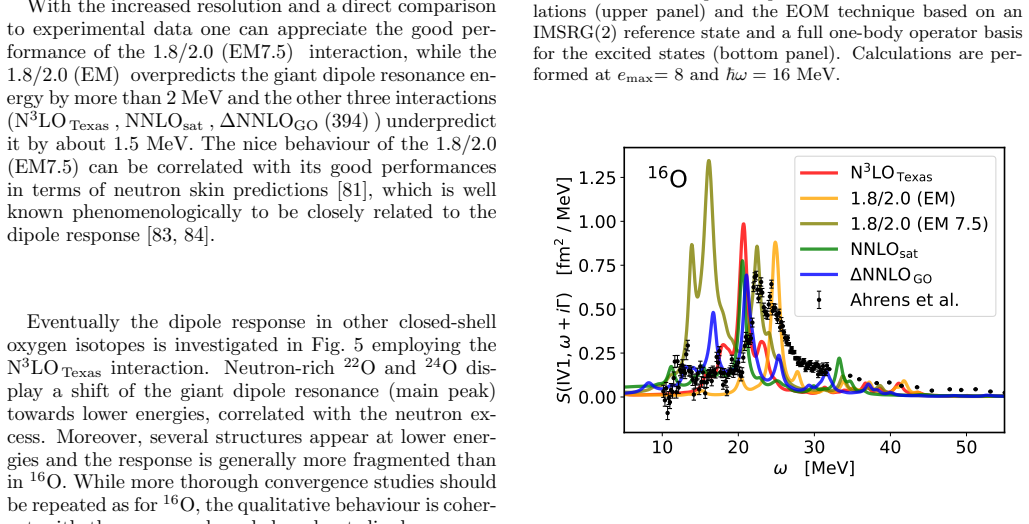
The central claim is that the EOM matrices A, B, U, V—defined as expectation values of (double) commutators of excitation operators on a reference state—can be evaluated in a complete one-body operator basis without ever committing to a particle-hole picture or to an independent-particle vacuum. This makes the generalized RPA-type eigenvalue problem (H X = N X Ω) applicable to arbitrary reference states. When the reference is an IMSRG(2) state of a closed-shell nucleus, ground-state correlations are propagated to the excited-state response non-perturbatively; the resulting isovector dipole strength in 4He, 16O, 22O, and 24O is stable in model-space size and, for 16O, reduces the spread among
What carries the argument
The engine is the generalized eigenvalue problem H X = N X Ω, with the super-matrix H built from double-commutator expectation values ⟨Ψ|[η_a, H, η_b†]|Ψ⟩ and ⟨Ψ|[η_a, H, η_b]|Ψ⟩, and the metric N from single commutators; {η} is the Lie algebra of all one-body operators c†_a c_b. The paper's formal contribution is an angular-momentum-coupled, operator-level construction of these commutators that holds for any |Ψ⟩, so the same code can be run on HF or correlated states. The symplectic/time-dependent variational derivation justifies interpreting the solutions as normal modes of the energy function.
Load-bearing premise
The load-bearing premise is that the reference state is a stationary point of the energy under the full one-body variation group; the paper's own states are not, and the claim that the resulting complex eigenvalues are physical resonance widths rather than artifacts is the step on which the quantitative response results depend.
What would settle it
Take the same chiral Hamiltonian and 16O, but replace the IMSRG(2) reference with one variationally optimized under one-body rotations (e.g., orbital-optimized or self-consistent RPA). If the complex branches disappear and the dipole response peak or interaction spread shifts substantially, the claim that complex eigenvalues encode physical widths would be refuted. A second test: compute the energy-weighted sum rule from the full one-body EOM solution; if it is not exhausted even in the complete one-body basis, the interpretation of the complete spectrum as the physical response is questionabl
If this is right
- EOM spectral functions can be computed from any correlated reference state whose one- and two-body densities are available, not just from Slater determinants.
- Ground-state correlations are transferred to excited states in a non-perturbative, basis-independent way, effectively dressing the RPA one-body propagators.
- The 16O dipole response shows a reduced interaction dependence compared to mean-field RPA, suggesting that correlated references absorb some of the interaction sensitivity.
- The Hessian of the energy in the one-body space is now accessible, enabling orbital-optimization and self-consistent RPA strategies in nuclear theory.
- Complex modes in the response may carry physical resonance width information and pinpoint missing correlation channels.
Where Pith is reading between the lines
- If the complex-branch interpretation survives testing, the method could provide parameter-free resonance widths, eliminating the ad-hoc smearing parameter in response calculations.
- The same operator-level construction should transfer directly to quantum-computing EOM, where the reference is a variational quantum state; the paper notes this connection but does not implement it.
- A natural stress test is to use a variationally optimized (orbital-optimized or symmetry-projected) reference: if the complex branches vanish and the response moves, that confirms the paper's claim that they flag missing correlations rather than being intrinsic.
- The two-body operator extension derived in the appendix could be used to build a second-RPA-type theory, though the paper notes it loses the Lie-algebra group structure.
Editorial analysis
A structured set of objections, weighed in public.
Referee Report
Summary. The paper presents a general equation-of-motion (EOM) framework for correlated quantum states, based on the time-dependent variational principle and formulated in a full one-body operator basis that is independent of the reference state. The method is applied to isovector dipole response in 4He, 16O, 22O, and 24O using IMSRG(2) correlated reference states and chiral interactions. The central claims are that the formalism provides a universal, non-perturbative way to propagate ground-state correlations to excited states, and that its use reduces the interaction spread of the 16O giant dipole resonance compared to RPA. The 4He benchmark against NCSM is presented as validation.
Significance. If the central claims are sustained, this is a valuable contribution. The derivation follows standard TDVP/Rowe constructions, the RPA limit is recovered for Hartree-Fock references, and the operator-level construction of the double-commutator matrix elements in a complete one-body basis is a genuine technical advance. The work is commendably transparent about numerical inputs: the chiral Hamiltonians are external inputs, and the harmonic-oscillator frequency, smearing width, and model-space truncation are not fitted parameters. The 4He NCSM comparison is an independent benchmark. However, the 16O results and the claimed reduction of interaction spread rest on an unvalidated interpretation of complex eigenvalues as physical resonance widths, which is at odds with the paper's own stability criterion for the EOM normal-mode problem. This is the load-bearing weakness that prevents the universal-framework claim from being fully supported.
major comments (3)
- [§IV D, §II B] The central numerical claim — that the EOM-IMSRG(2) approach reduces the interaction spread of the 16O GDR from about 7 MeV (RPA) to about 4 MeV — depends on including complex-energy solutions of Eq. (15) as physical resonance widths. However, §II B states that normal modes are meaningful only when the reference state is a stationary point and ideally a minimum; otherwise the reference state is unstable and more closely resembles an excited state. Section IV D then concedes that neither HF nor IMSRG(2) is stable under general one-body transformations. In standard RPA (Thouless 1961; Rowe 1968), complex eigenvalues signal reference-state instability, not decay widths. The manuscript introduces no continuum coupling, emission mechanism, or independent validation for the width interpretation. This is an interpretive assumption, not a derivation, and it is load-bearing for the 16O results an
- [§IV D, Figs. 3–6] The composition of the plotted strength functions is unclear. Figure 6 shows the 'complex part' of the response with Γ=0, and the text states that complex energies carry their own smearing. Are the complex-branch contributions included in the curves of Figs. 3–5? If they are, the comparison with experiment in Fig. 4 rests entirely on the unvalidated width assumption. If they are not, the curves are incomplete, and quantitative statements such as the 7→4 MeV spread reduction are not well defined. The paper should state explicitly how real and complex branches are combined, and should present results with and without the complex branch.
- [§IV B] The 4He NCSM benchmark is a useful check of the real-branch response, but the paper does not report the complex-eigenvalue content for 4He. Since the 16O claim is strongly influenced by the complex sector (Fig. 6), the benchmark does not validate the questionable part of the calculation. The authors should quantify the complex branches in 4He or explicitly restrict the benchmark conclusion to the stable sector, and clearly state that the 16O interaction-spread claim depends on an additional physical assumption.
minor comments (5)
- [§IV A] Typo: 'postive' should be 'positive'.
- [Footnote 1] Footnote 1 is dense and contains a substantive caveat about non-closure of Jπ sectors; consider moving it to the main text or an appendix.
- [Eq. (24)] The symbol ν is used both for eigenstate labels and for solution labels; please clarify the notation.
- [Figs. 2–5] Interaction names are inconsistent: 'N3LO T exas' appears in figures/captions while the text uses 'N3LO Texas'. Please standardize.
- [Abstract/Conclusions] The term 'universal' is used repeatedly. Given the demonstrated sensitivity to reference-state stability and the truncation of the operator basis, a more cautious term such as 'general' would better match the presented evidence.
Circularity Check
No circular reduction found: the EOM construction, IMSRG(2) input, and external benchmarks are independent; the complex-eigenvalue interpretation is a modeling risk, not circularity.
full rationale
The paper's derivation chain is mathematically self-contained. Eq. (15) follows from the time-dependent variational principle through Eqs. (7)-(14), and the double-commutator matrix elements entering Eqs. (16) are constructed explicitly in Appendix D, with full J-scheme expressions given in Eqs. (D14)-(D25). The derivation is traced to external references Refs. [66-68], not primarily to the author's own prior work; Refs. [69-70] are contextual implementation references and are not load-bearing. The reference state is an input: HF recovers standard RPA as a consistency check, and IMSRG(2) is generated by imsrg++, an external code. The 4He benchmark is an external comparison to NCSM calculations with the same NNLOopt interaction, and no parameter is fitted to NCSM or to the experimental photoabsorption data. Technical choices such as the harmonic-oscillator frequency, emax truncation, normal-ordered 3N approximation, and smearing width are not adjusted to reproduce the dipole response. The central quantitative comparison is across chiral interactions, so the claimed reduction of interaction spread is an output, not an input. The complex-eigenvalue sector is the only serious concern: the paper concedes that neither HF nor IMSRG(2) is stable under general one-body transformations, and standard RPA would interpret complex eigenvalues as instability rather than physical width. The paper then asserts that 'complex branches therefore encode physically relevant information' about missing correlation channels. That is an interpretive modeling assumption, a correctness risk, not a circular reduction of a prediction to a fitted parameter or to a self-citation chain. No equation or fitted parameter is equivalent by construction to the predicted response functions. Hence no significant circularity.
Axiom & Free-Parameter Ledger
free parameters (3)
- Harmonic oscillator frequency ℏω =
16 MeV
- Smearing width Γ =
1 MeV (0.5 MeV in Fig. 4)
- Model-space truncation emax =
8
axioms (5)
- standard math The TD variational principle (Eq. 4) with the symplectic structure of projective Hilbert space is the correct starting point for the EOM.
- standard math The full one-body operators c†_a c_b form a Lie algebra U(n) whose orbit is a symplectic submanifold with non-degenerate metric.
- domain assumption The reference state must be stationary, ideally a minimum, under the chosen variational manifold.
- domain assumption IMSRG(2) with the normal-ordered two-body approximation for three-nucleon forces and emax = 8 is a faithful correlated reference for the dipole response.
- ad hoc to paper Complex-energy solutions of Eq. (15) can be interpreted as physical resonance widths and included in the response function.
Cite this review
Pith. "Pith review of Revisiting the Equation-of-Motion Method: A Universal Framework for Correlated Quantum Systems." pith.science (2026). https://pith.science/paper/F6WOLLTB
@misc{pith2026260729396,
  author       = {Pith},
  title        = {Pith review of: Revisiting the Equation-of-Motion Method: A Universal Framework for Correlated Quantum Systems},
  year         = {2026},
  howpublished = {\url{https://pith.science/paper/F6WOLLTB}},
  note         = {Machine review of arXiv:2607.29396}
}
read the original abstract
A general implementation of the equation-of-motion (EOM) formalism for correlated many-body states is presented and applied to the description of collective excitations in atomic nuclei. While EOM approaches are traditionally formulated on top of independent-particle reference states, the present work extends the method to correlated reference states generated by modern many-body solvers. This formulation enables a consistent treatment of ground-state correlations and excited-state dynamics within a unified framework. Particular emphasis is placed on collective nuclear excitations employing chiral nuclear Hamiltonians in an ab initio context. The approach is motivated by the renewed interest in EOM techniques across several fields, including quantum chemistry and quantum computing, where they provide efficient and systematically improvable descriptions of excitation spectra. The present results demonstrate that the EOM framework offers a flexible and powerful tool for the microscopic description of nuclear spectroscopy beyond the traditional mean-field paradigm.
Figures




Reference graph
Works this paper leans on
-
[1]
the use of an initial state|Ψ⟩that isnotthe exact ground state
-
[2]
Regarding the first point, the EOM method does not uniquely define a strategy to determine the optimal state |Ψ⟩entering Eq
the truncation of the operator set{η a}. Regarding the first point, the EOM method does not uniquely define a strategy to determine the optimal state |Ψ⟩entering Eq. (15). The relevant question is therefore whether the chosen|Ψ⟩is a suitable reference with re- spect to the excitations spanned by the variational group, i.e., whether|Ψ⟩is stable under all c...
-
[3]
one-particle transformations; 2.N-particle excitations
-
[4]
δbc ( ja jb J1 J2 J jd ) QJ (ad)−δ ad(−)J1+J2+J ( ja jb J1 J J2 jc ) QJ (cb) # , (D10a) [ ˜AJ1 (ab), QJ2 (cd)]J = [J1][J2]
scale transformations. Higher many-body transformations (but notN-body), like two-particle transformations of the form U= exp (X abcd Xabdc c† ac† bcccd ) ,(C1) as used in the so-called second-RPA [110–114], do not unfortunately constitute a unitary group (except, for the given example of two-body transformations, for two- particle systems), since the bas...
-
[5]
A. L. Fetter,Quantum theory of many-particle sys, Dover Books on Physics (Dover Publications, Mineola, NY, 2003)
2003
-
[6]
J. W. Negele and H. Orland,Quantum Many-particle Systems, Frontiers in Physics (Perseus Books, Boulder, CO, 1994)
1994
-
[7]
Ring and P
P. Ring and P. Schuck,The Nuclear Many-Body Prob- lem, 1st ed., Theoretical and Mathematical Physics (Springer, New York, 1980)
1980
-
[8]
Giuliani and G
G. Giuliani and G. Vignale,Quantum Theory of the Electron Liquid(Cambridge University Press, Cam- bridge, England, 2005)
2005
-
[9]
Sachdev,Quantum phase transitions(Cambridge University Press, Cambridge, England, 2011)
S. Sachdev,Quantum phase transitions(Cambridge University Press, Cambridge, England, 2011)
2011
-
[10]
Gonz´ alez and R
L. Gonz´ alez and R. Lindh,Quantum chemistry and dynamics of excited states: methods and applications (John Wiley & Sons, 2020)
2020
-
[11]
E. A. Coello P´ erez and T. Papenbrock, Effective field theories for collective excitations of atomic nuclei, J. Phys. G52, 033001 (2025)
2025
-
[12]
Hergert, A guided tour ofab initionuclear many- body theory, Front
H. Hergert, A guided tour ofab initionuclear many- body theory, Front. Phys.8, 379 (2020)
2020
-
[13]
Epelbaum, H.-W
E. Epelbaum, H.-W. Hammer, and U.-G. Meißner, Modern theory of nuclear forces, Rev. Mod. Phys.81, 1773 (2009)
2009
-
[14]
Machleidt and D
R. Machleidt and D. R. Entem, Chiral effective field theory and nuclear forces, Phys. Rept.503, 1 (2011)
2011
-
[15]
Hammer, S
H.-W. Hammer, S. K¨ onig, and U. van Kolck, Nuclear ef- fective field theory: Status and perspectives, Rev. Mod. Phys.92, 025004 (2020)
2020
-
[16]
Krebs, Nuclear Currents in Chiral Effective Field Theory, Eur
H. Krebs, Nuclear Currents in Chiral Effective Field Theory, Eur. Phys. J. A56, 234 (2020)
2020
-
[17]
Miyagi,NuHamil: A numerical code to generate nuclear two- and three-body matrix elements from chiral effective field theory, Eur
T. Miyagi,NuHamil: A numerical code to generate nuclear two- and three-body matrix elements from chiral effective field theory, Eur. Phys. J. A59, 150 (2023)
2023
-
[18]
D. J. Rowe, Equations-of-Motion Method and the Ex- tended Shell Model, Rev. Mod. Phys.40, 153 (1968)
1968
-
[19]
McWeeny,Methods of molecular quantum mechanics, 2nd ed., Theoretical Chemistry (Academic Press, San Diego, CA, 1989)
R. McWeeny,Methods of molecular quantum mechanics, 2nd ed., Theoretical Chemistry (Academic Press, San Diego, CA, 1989)
1989
-
[20]
Schirmer,Many-body methods for atoms, molecules and clusters(Springer International Publishing, Cham, Germany, 2018)
J. Schirmer,Many-body methods for atoms, molecules and clusters(Springer International Publishing, Cham, Germany, 2018)
2018
-
[21]
J. F. Stanton and R. J. Bartlett, The equation of motion coupled-cluster method. A systematic biorthogonal ap- proach to molecular excitation energies, transition prob- abilities, and excited state properties, J. Chem. Phys. 98, 7029 (1993)
1993
-
[22]
Shavitt and R
I. Shavitt and R. J. Bartlett,Many-Body Methods in Chemistry and Physics: MBPT and Coupled-Cluster Theory(Cambridge University Press, Cambridge, Eng- land, 2009)
2009
-
[23]
Blaizot and G
J.-P. Blaizot and G. Ripka,Quantum theory of finite systems(MIT Press, Cambridge, MA, 1986)
1986
-
[24]
D. J. Rowe,Nuclear Collective Motion(World Scientific, Singapore, 2010)
2010
-
[25]
Suhonen,From Nucleons to Nucleus: Concepts of Mi- croscopic Nuclear Theory, Theoretical and Mathemati- cal Physics (Springer, Berlin, Germany, 2007)
J. Suhonen,From Nucleons to Nucleus: Concepts of Mi- croscopic Nuclear Theory, Theoretical and Mathemati- cal Physics (Springer, Berlin, Germany, 2007)
2007
-
[26]
S. Bacca, F. Marino, and A. Porro, Nuclear giant res- onances from first principles, (2026), arXiv:2604.07229 [nucl-th]
Pith/arXiv arXiv 2026
-
[27]
Musia l, Equation-of-motion coupled-cluster models, inQuantum Chemistry and Dynamics of Excited States (John Wiley & Sons, Ltd, 2020) Chap
M. Musia l, Equation-of-motion coupled-cluster models, inQuantum Chemistry and Dynamics of Excited States (John Wiley & Sons, Ltd, 2020) Chap. 4, pp. 77–108
2020
-
[28]
P. J. Ollitrault, A. Kandala, C.-F. Chen, P. K. Barkout- sos, A. Mezzacapo, M. Pistoia, S. Sheldon, S. Woerner, J. M. Gambetta, and I. Tavernelli, Quantum equation of motion for computing molecular excitation energies on a noisy quantum processor, Phys. Rev. Res.2, 043140 (2020)
2020
-
[29]
P. J. Ollitrault, A. Miessen, and I. Tavernelli, Molecular Quantum Dynamics: A Quantum Computing Perspec- tive, Accounts Chem. Res.54, 4229 (2021). 17
2021
-
[30]
Motta and J
M. Motta and J. E. Rice, Emerging quantum comput- ing algorithms for quantum chemistry, WIREs Comput. Mol. Sci.12, e1580 (2022)
2022
-
[31]
Motta, W
M. Motta, W. Kirby, I. Liepuoniute, K. J. Sung, J. Cohn, A. Mezzacapo, K. Klymko, N. Nguyen, N. Yoshioka, and J. E. Rice, Subspace methods for electronic structure simulations on quantum computers, Electron. Struct.6, 013001 (2024)
2024
-
[32]
M. Q. Hlatshwayo, Y. Zhang, H. Wibowo, R. LaRose, D. Lacroix, and E. Litvinova, Simulating excited states of the Lipkin model on a quantum computer, Phys. Rev. C106, 024319 (2022)
2022
-
[33]
M. Q. Hlatshwayo, J. Novak, and E. Litvinova, Quan- tum benefit of the quantum equation of motion for the strongly coupled many-body problem, Phys. Rev. C109, 014306 (2024)
2024
-
[34]
Kramer and M
P. Kramer and M. Saraceno,Geometry of the time- dependent variational principle in quantum mechanics (Springer, Heidelberg, Germany, 1981)
1981
-
[35]
Kramer, A review of the time-dependent variational principle, inJ
P. Kramer, A review of the time-dependent variational principle, inJ. Phys. Conf. Ser., Vol. 99 (2008) p. 012009
2008
-
[36]
D. J. Rowe, General variational equations for station- ary and time-dependent states, Nucl. Phys. A107, 99 (1968)
1968
-
[37]
D. J. Rowe, A. Ryman, and G. Rosensteel, Many-body quantum mechanics as a symplectic dynamical system, Phys. Rev. A22, 2362 (1980)
1980
-
[38]
Lathouwers, The generator coordinate representa- tion in an natural state formalism, Ann
L. Lathouwers, The generator coordinate representa- tion in an natural state formalism, Ann. Phys.102, 347 (1976)
1976
-
[39]
Bally and T
B. Bally and T. R. Rodr ´ ıguez, Symmetry-projected vari- ational calculations with the numerical suite TAURUS: II. Configuration mixing of symmetry-projected refer- ence states, Eur. Phys. J. A60, 62 (2024)
2024
-
[40]
D. J. Thouless, Vibrational states of nuclei in the ran- dom phase approximation, Nucl. Phys.22, 78 (1961)
1961
-
[41]
Schuck, D
P. Schuck, D. S. Delion, J. Dukelsky, M. Jemai, E. Litvi- nova, G. Roepke, and M. Tohyama, Equation of Motion Method for strongly correlated Fermi systems and Ex- tended RPA approaches, Phys. Rept.929, 1 (2021)
2021
-
[42]
Tsukiyama, S
K. Tsukiyama, S. K. Bogner, and A. Schwenk, In- Medium Similarity Renormalization Group for Nuclei, Phys. Rev. Lett.106, 222502 (2011)
2011
-
[43]
Hergert, S
H. Hergert, S. K. Bogner, T. D. Morris, A. Schwenk, and K. Tsukiyama, The In-Medium Similarity Renormaliza- tion Group: A Novel Ab Initio Method for Nuclei, Phys. Rept.621, 165 (2016)
2016
-
[44]
S. R. Stroberg, S. K. Bogner, H. Hergert, and J. D. Holt, Nonempirical Interactions for the Nuclear Shell Model: An Update, Annu. Rev. Nucl. Part. Sci.69, 307 (2019)
2019
-
[45]
Bonaiti, C
F. Bonaiti, C. Balos, K. Godbey, G. Hagen, T. Pa- penbrock, and C. S. Woodward, Computing nuclear re- sponse functions with time-dependent coupled-cluster theory, Phys. Rev. C113, 024312 (2026)
2026
-
[46]
Porro, T
A. Porro, T. Duguet, J.-P. Ebran, M. Frosini, R. Roth, and V. Som´ a, Ab initio description of monopole reso- nances in light- and medium-mass nuclei: I. Technical aspects and uncertainties of ab initio PGCM calcula- tions, Eur. Phys. J. A60, 133 (2024)
2024
-
[47]
Porro, T
A. Porro, T. Duguet, J.-P. Ebran, M. Frosini, R. Roth, and V. Som` a, Ab initio description of monopole reso- nances in light- and medium-mass nuclei: II. Ab initio PGCM calculations in 46Ti, 28Si and 24Mg, Eur. Phys. J. A60, 134 (2024)
2024
-
[48]
Porro, T
A. Porro, T. Duguet, J.-P. Ebran, M. Frosini, R. Roth, and V. Som` a, Ab initio description of monopole reso- nances in light- and medium-mass nuclei: III. Moments evaluation in ab initio PGCM calculations, Eur. Phys. J. A60, 155 (2024)
2024
-
[49]
Porro, T
A. Porro, T. Duguet, J.-P. Ebran, M. Frosini, R. Roth, and V. Som` a, Ab initio description of monopole reso- nances in light- and medium-mass nuclei: IV. Angular momentum projection and rotation-vibration coupling, Eur. Phys. J. A60, 233 (2024)
2024
-
[50]
B. R. Barrett, P. Navratil, and J. P. Vary, Ab initio no core shell model, Prog. Part. Nucl. Phys.69, 131 (2013)
2013
-
[51]
Tsukiyama, S
K. Tsukiyama, S. K. Bogner, and A. Schwenk, In- Medium Similarity Renormalization Group for Open- Shell Nuclei, Phys. Rev. C85, 061304 (2012)
2012
-
[52]
Caurier, G
E. Caurier, G. Martinez-Pinedo, F. Nowacki, A. Poves, and A. P. Zuker, The Shell Model as Unified View of Nuclear Structure, Rev. Mod. Phys.77, 427 (2005)
2005
-
[53]
Hagen, T
G. Hagen, T. Papenbrock, D. J. Dean, and M. Hjorth- Jensen, Ab initio coupled-cluster approach to nuclear structure with modern nucleon-nucleon interactions, Phys. Rev. C82, 034330 (2010)
2010
-
[54]
Hagen, T
G. Hagen, T. Papenbrock, M. Hjorth-Jensen, and D. J. Dean, Coupled-cluster computations of atomic nuclei, Rep. Prog. Phys.77, 096302 (2014)
2014
-
[55]
Bacca, N
S. Bacca, N. Barnea, G. Hagen, M. Miorelli, G. Orlan- dini, and T. Papenbrock, Giant and pigmy dipole res- onances in 4He, 16,22O, and 40Ca from chiral nucleon- nucleon interactions, Phys. Rev. C90, 064619 (2014)
2014
-
[56]
Marino, F
F. Marino, F. Bonaiti, S. Bacca, G. Hagen, and G. R. Jansen, Structure and dynamics of open-shell nuclei from spherical coupled-cluster theory, Phys. Rev. C 112, 014315 (2025)
2025
-
[57]
Miorelli, S
M. Miorelli, S. Bacca, G. Hagen, and T. Papenbrock, Computing the dipole polarizability of 48Ca with in- creased precision, Phys. Rev. C98, 014324 (2018)
2018
-
[58]
N. M. Parzuchowski, T. D. Morris, and S. K. Bogner, Ab Initio Excited States from the In-Medium Similar- ity Renormalization Group, Phys. Rev. C95, 044304 (2017)
2017
-
[59]
N. M. Parzuchowski, S. R. Stroberg, P. Navr´ atil, H. Hergert, and S. K. Bogner, Ab initio electromagnetic observables with the in-medium similarity renormaliza- tion group, Phys. Rev. C96, 034324 (2017)
2017
-
[60]
M. D. Prasad, S. Pal, and D. Mukherjee, Some aspects of self-consistent propagator theories, Phys. Rev. A31, 1287 (1985)
1985
-
[61]
Datta, D
B. Datta, D. Mukhopadhyay, and D. Mukherjee, Consis- tent propagator theory based on the extended coupled- cluster parametrization of the ground state, Phys. Rev. A47, 3632 (1993)
1993
-
[62]
Asthana, A
A. Asthana, A. Kumar, V. Abraham, H. Grimsley, Y. Zhang, L. Cincio, S. Tretiak, P. A. Dub, S. E. Economou, E. Barnes, and N. J. Mayhall, Quantum self-consistent equation-of-motion method for comput- ing molecular excitation energies, ionization potentials, and electron affinities on a quantum computer, Chem. Sci.14, 2405 (2023)
2023
-
[63]
Kim and A
Y. Kim and A. I. Krylov, Two Algorithms for Excited- State Quantum Solvers: Theory and Application to EOM-UCCSD, J. Phys. Chem. A127, 6552 (2023)
2023
-
[64]
Reinholdt, E
P. Reinholdt, E. R. Kjellgren, J. H. Fuglsbjerg, K. M. Ziems, S. Coriani, S. P. A. Sauer, and J. Kongsted, 18 Subspace Methods for the Simulation of Molecular Re- sponse Properties on a Quantum Computer, J. Chem. Theor. Comput.20, 3729 (2024)
2024
-
[65]
Raimondi and C
F. Raimondi and C. Barbieri, Nuclear electromagnetic dipole response with the Self-Consistent Green’s Func- tion formalism, Phys. Rev. C99, 054327 (2019)
2019
-
[66]
Duguet, J
T. Duguet, J. P. Ebran, M. Frosini, H. Hergert, and V. Som` a, Rooting the EDF method into the ab ini- tio framework: PGCM-PT formalism based on MR- IMSRG pre-processed Hamiltonians, Eur. Phys. J. A 59, 13 (2023)
2023
-
[67]
Reinhard, M
P.-G. Reinhard, M. Brack, and O. Genzken, Random- phase approximation in a local representation, Phys. Rev. A41, 5568 (1990)
1990
-
[68]
Reinhard, From sum rules to rpa: 1
P.-G. Reinhard, From sum rules to rpa: 1. nuclei, Ann. Phys.504, 632 (1992)
1992
-
[69]
Reinhard and Y
P.-G. Reinhard and Y. K. Gambhir, Rpa in wavefunc- tion representation, Ann. Phys.504, 598 (1992)
1992
-
[70]
Jin-Quan, C
C. Jin-Quan, C. Bing-Qing, and A. Klein, Factorization of commutators: The Wick theorem for coupled opera- tors, Nucl. Phys. A554, 61 (1993)
1993
-
[71]
Chen, The Wick theorem for coupled fermion clus- ters, Nucl
J.-Q. Chen, The Wick theorem for coupled fermion clus- ters, Nucl. Phys. A562, 218 (1993)
1993
-
[72]
Lu and C
Y. Lu and C. W. Johnson, Transition sum rules in the shell model, Phys. Rev. C97, 034330 (2018)
2018
-
[73]
Porro, A
A. Porro, A. Schwenk, and A. Tichai, Impact of ground- state correlations on the multipole response of nuclei: Ab initio calculations of moment operators, Phys. Rev. C112, 054303 (2025)
2025
-
[74]
Bonaiti, A
F. Bonaiti, A. Porro, S. Bacca, A. Schwenk, and A. Tichai, Ab initio calculations of monopole sum rules: From finite nuclei to infinite nuclear matter, Phys. Rev. C113, 024333 (2026)
2026
-
[75]
Heinz, A
M. Heinz, A. Tichai, J. Hoppe, K. Hebeler, and A. Schwenk, In-medium similarity renormalization group with three-body operators, Phys. Rev. C103, 044318 (2021)
2021
-
[76]
Frosini, T
M. Frosini, T. Duguet, B. Bally, Y. Beaujeault- Taudi` ere, J. P. Ebran, and V. Som` a, In-mediumk-body reduction ofn-body operators: A flexible symmetry- conserving approach based on the sole one-body density matrix, Eur. Phys. J. A57, 151 (2021)
2021
-
[77]
Miyagi, S
T. Miyagi, S. R. Stroberg, P. Navr´ atil, K. Hebeler, and J. D. Holt, Convergedab initiocalculations of heavy nuclei, Phys. Rev. C105, 014302 (2022)
2022
-
[78]
S. R. Stroberget al.,https://github.com/ ragnarstroberg/imsrg(2025)
2025
-
[79]
D. A. Varshalovich, A. N. Moskalev, and V. K. Kherson- skii,Quantum Theory of Angular Momentum(World Scientific, 1988)
1988
-
[80]
Ekstr¨ om, G
A. Ekstr¨ om, G. Baardsen, C. Forss´ en, G. Ha- gen, M. Hjorth-Jensen, G. Jansen, R. Machleidt, W. Nazarewicz, T. Papenbrock, J. Sarich, and S. M. Wild, Optimized Chiral Nucleon-Nucleon Interaction at Next-to-Next-to-Leading Order, Phys. Rev. Lett.110, 192502 (2013)
2013
This paper was first reviewed by deepseek-v4-flash on August 3, 2026.
discussion (0)
Sign in with ORCID, Apple, or X to comment. Anyone can read and Pith papers without signing in.