REVIEW 3 major objections 4 minor 1 cited by
Equivariant Riemannian stochastic interpolants can generate equilibrium configurations for amorphous particle systems, and importance-sampling estimates of energy, specific heat, and radial distribution converge with fewer samples when peri
Reviewed by Pith at T0; open to challenge. T0 means a machine referee read the full paper against a public rubric. the ladder, T0–T4 →
T0 review · deepseek-v4-flash
2026-08-03 15:28 UTC pith:FAVTOS64
load-bearing objection A genuinely new equivariant stochastic-interpolant framework for amorphous systems, with correct-looking theory and honest ablations, but the abstract's own warning about likelihood-integration error is never quantified, leaving the central importance-sampling results less secure than they appear. the 3 major comments →
Boltzmann generators for amorphous particle systems
The pith
A machine-rendered reading of the paper's core claim, the machinery that carries it, and where it could break.
Core claim
The central claim is that a Boltzmann generator for amorphous particle systems can be built by taking a stochastic interpolant on the flat torus, where particle coordinates are wrapped by periodic boundary conditions, and enforcing the full symmetry group of the Boltzmann measure: particle permutations, translations, and signed permutations of coordinate axes. The paper proves that a G_C-equivariant interpolation between G_C-invariant base and target distributions yields G_C-invariant marginals and a G_C-equivariant optimal velocity field, and that the graph-neural-network velocity parameterization is Lipschitz-bounded and G_C-equivariant. With this construction, generated configurations car
What carries the argument
The central object is the equivariant Riemannian stochastic interpolant: an interpolation path on the flat torus chosen to be G_C-equivariant, with the optimal velocity field v*(t, x) = E[∂t I(t, X0, X1) | Xt = x]. The paper proves that when the interpolant is equivariant and the endpoint distributions are invariant, the marginals and this conditional-expectation velocity are equivariant. The velocity is parameterized by an equivariant graph neural network operating on the torus, and the log-likelihood is obtained by integrating the divergence along the ODE flow. This identity carries the argument: it converts group symmetry of the data into group symmetry of the learned generative process,
Load-bearing premise
The method only works if the generated distribution covers every region where the Boltzmann target has significant probability, and if the numerically integrated log-likelihoods are accurate enough that time-reversibility holds; the paper itself states that accumulated numerical errors currently break this reversibility.
What would settle it
Take a trained eRSI model, integrate the probability-flow ODE forward and backward on the same samples, and check that log p_forward equals log p_backward within a tight tolerance; then recompute the importance-sampling estimates of U and c_V with a substantially stricter ODE tolerance or an exactly reversible integrator and compare with the reported values. If the estimates shift by more than the statistical error, numerical likelihood error is demonstrably causing the non-exact reweighting described in the paper.
If this is right
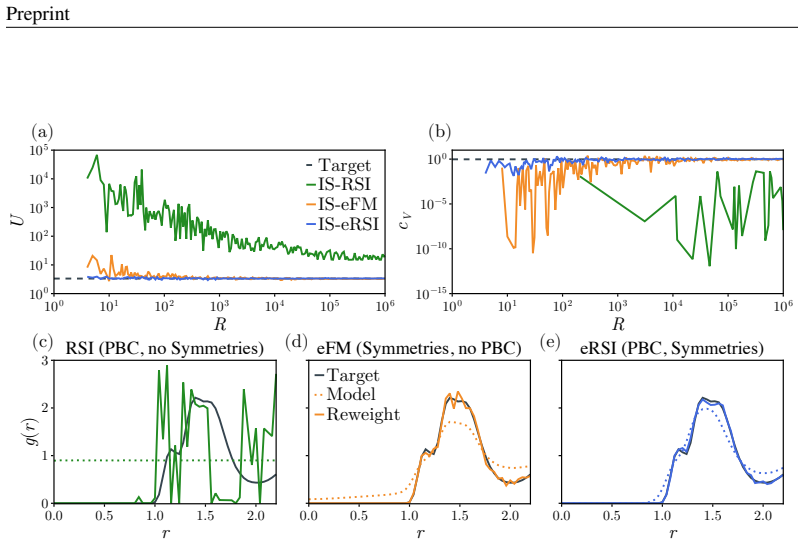
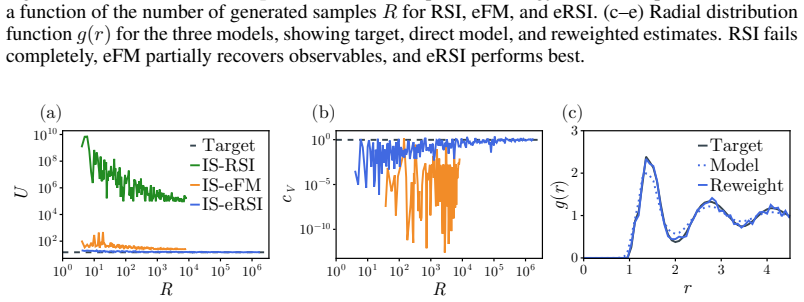
- Boltzmann generators can now target amorphous materials: for the 2D IPL model, importance-sampling estimates of U, c_V, and g(r) converge with about 10^3 samples where baselines need 10^4 samples or never converge.
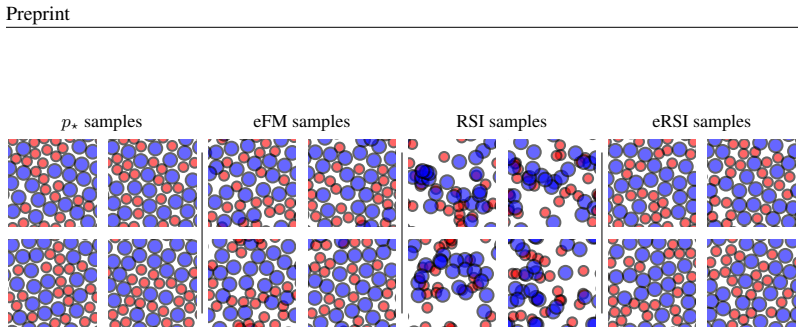
- Encoding periodic boundaries and G_C symmetries is not cosmetic; the comparisons show it directly prevents unphysical collapsed states and boundary overlaps that bias observables.
- The equivariance theorems generalize within flow matching and stochastic interpolants: any G_C-invariant base and target with a G_C-equivariant interpolation inherits invariant marginals and an equivariant optimal velocity field.
- The documented likelihood-integration error implies that continuous-flow Boltzmann generators need an additional mechanism—exactly reversible integrators, discrete flows, or acceptance corrections—before exact thermodynamic reweighting can be guaranteed.
- The approach scales to larger systems and to other glass formers, as demonstrated by the additional Kob-Andersen experiments, though 3D validation remains open.
Where Pith is reading between the lines
- A decisive test of the paper's stated limitation is to run the same model with forward and backward ODE likelihood integration and compare the importance-sampling estimates of U and c_V; if they disagree beyond Monte Carlo error, the numerical time-reversibility violation is quantitatively responsible for residual bias.
- The support assumption is the deeper load-bearing condition: at temperatures lower than those tested, target modes may fall outside the generated support, and finite importance-sampling estimates would silently omit part of the Boltzmann distribution.
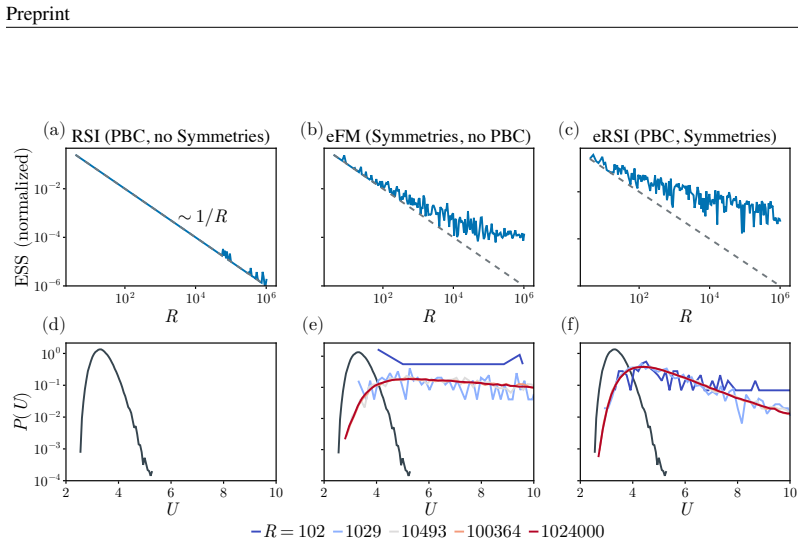
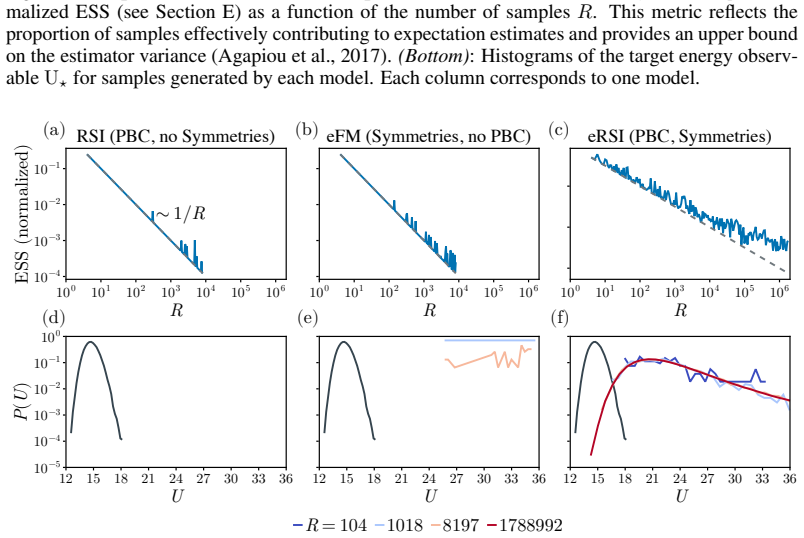
- The observed ESS pattern—decaying as 1/R before a plateau—can be used as a likelihood-free model-selection heuristic: the sample count at which ESS departs from 1/R measures how well the proposal overlaps the target.
- The equivariance mechanism likely transfers to other manifolds with the same affine-plus-modulo group action, which would cover crystal and other periodic materials beyond the two-component glass model studied here.
Editorial analysis
A structured set of objections, weighed in public.
Referee Report
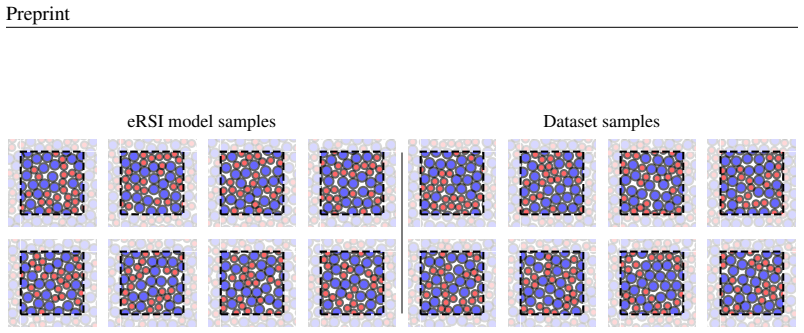
Summary. The paper introduces equivariant Riemannian stochastic interpolants (eRSI) for sampling equilibrium configurations of amorphous particle systems. It combines Riemannian stochastic interpolants on the flat torus with a G_C-equivariant graph neural network, enforcing periodic boundary conditions and the symmetries of multi-component particle systems. Theoretical contributions include proofs that G_C-invariant base/target distributions and G_C-equivariant interpolants yield invariant marginals (Prop. 4) and equivariant optimal velocity fields (Prop. 9), as well as an equivariance proof for the proposed GNN architecture (Prop. 34). Empirically, the authors compare eRSI against an equivariant-Euclidean flow-matching baseline (eFM) and a non-equivariant RSI baseline on 2D IPL glass models with N=10 and N=44. They report that eRSI produces samples from which importance-sampling estimates of potential energy, specific heat, and radial distribution function converge to ground-truth values with fewer samples than the baselines (Figs. 3–4). The abstract further claims an 'intrinsic limitation' of continuous flows: accumulated numerical errors during likelihood integration break time-reversibility and compromise exact thermodynamic reweighting.
Significance. If the empirical claims hold, this is a useful step toward generative sampling of glass-forming systems, a domain where existing Boltzmann generators do not directly apply. The theoretical equivariance results (Props. 4, 9, 33, 34) are clearly original and provide a principled foundation for architecture design on the torus. The paper also ships reproducible code, uses independently generated Monte Carlo training data, and evaluates against ground-truth observables rather than only visual fidelity. The central claim that explicit symmetry and geometry constraints improve sample efficiency is plausible and supported by the N=10 results. However, the abstract-level claim about an 'intrinsic limitation' from likelihood-integration error is not substantiated in the body, and the numerical accuracy of the likelihoods used in importance sampling is not quantified, which is load-bearing for the unbiasedness of the reported estimates.
major comments (3)
- [Section F.3, Eq. (8), Figs. 3–4] The IS estimates use weights w = p*/q, which require the exact model density q. The log-density is obtained by numerical integration of Eq. (8) with dopri5 at atol=rtol=1e-5, yet the abstract itself states that 'accumulated numerical errors during likelihood integration break time-reversibility, compromising exact thermodynamic reweighting.' The body never quantifies this error, gives no error bars on the IS curves, and does not show that the error is small relative to Monte Carlo sampling error. Without such evidence, the observed convergence to ground truth could be affected by biased weights. Please add (i) a tolerance-sensitivity study, for example comparing atol/rtol 1e-4, 1e-5, 1e-6, (ii) a forward/backward log-likelihood consistency check, and (iii) error bars or confidence intervals on the U and c_V curves, at least for the N=10 system.
- [Abstract vs. Section 6] The abstract's strong claim that the experiments 'reveal an intrinsic limitation of the continuous-flow formulation' is not supported by any experiment or analysis in Sections 5–6. Section 6 only mentions the computational cost of likelihood evaluation. The phrase 'intrinsic limitation' is a much stronger statement than 'numerical integration at the chosen tolerance introduces error.' Either provide a systematic demonstration that the error is inherent to continuous-flow likelihood integration (e.g., cannot be reduced by tighter tolerances or better integrators) or temper the claim to describe a practical limitation of the current implementation.
- [Fig. 4 and Section 5 (N=44)] For N=44, the eFM baseline is evaluated only up to R=8e3 samples, while eRSI is evaluated up to R=1e6 (Section F.4). The text states that eFM 'stabilizes away from the ground truth,' but given that a large fraction of eFM samples are discarded due to boundary overlaps and that no error bars are reported, the apparent failure may be a small-sample effect. Please report the effective sample size for eFM at R=8e3 and include confidence intervals on the U and c_V estimates, or extend the eFM run to a larger R if computationally feasible. Otherwise the N=44 comparison between eFM and eRSI is not fully conclusive.
minor comments (4)
- [Abstract (arXiv metadata vs. full text)] The abstract quoted in the manuscript metadata ('Boltzmann generators for amorphous particle systems... intrinsic limitation...') differs substantially from the abstract at the top of the full text. The two should be harmonized, especially regarding the 'intrinsic limitation' claim.
- [Eq. (13)] In Eq. (13), the expression 'dM(X(i), X(j)) + 1 \hat{\phi}_d(M^k_{ij})' appears to be missing a division symbol or parentheses. It should likely read '(dM(...) + 1) / \hat{\phi}_d(...)' or similar. Please clarify.
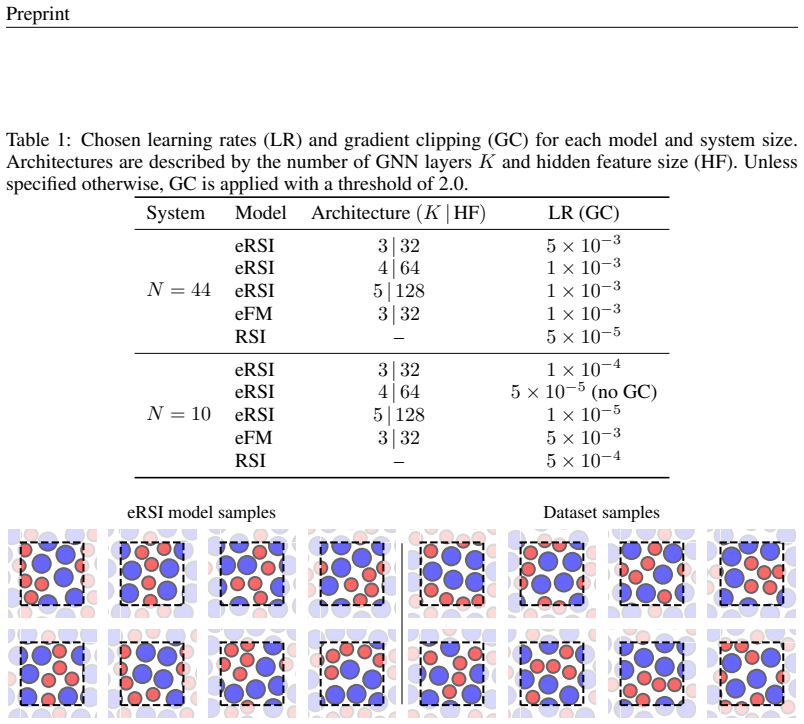
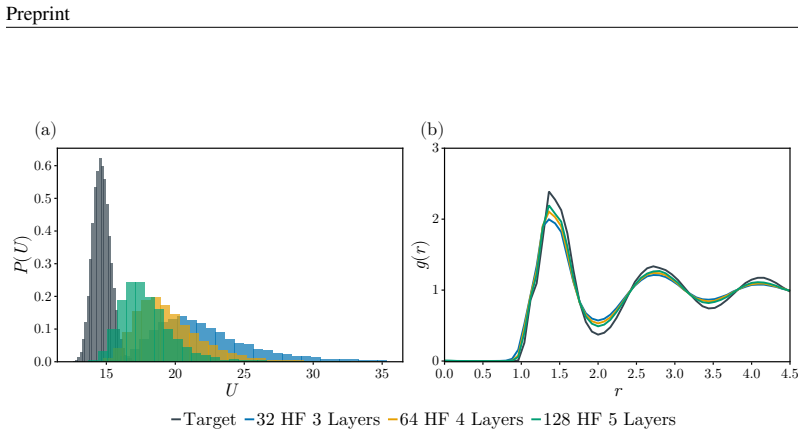
- [Section 5 / Table 1] The text says all architectures have the same number of trainable parameters, but Table 1 lists different hyperparameter choices for different systems. It would help to state the exact parameter counts for eRSI, eFM, and RSI in one place.
- [Section F.4] The notation R is used both for the number of generated samples and for the radial coordinate in g(r). This is slightly confusing in Figures 3–4 and the ESS discussion; consider renaming the sample size to N_s or R_s.
Circularity Check
No significant circularity: theoretical equivariance proofs are self-contained and the empirical benchmarks compare against independently generated ground-truth MC data.
full rationale
The paper's central derivation chains are self-contained. Propositions 4, 9, 33, and 34 are proved in the appendices from the definitions of G_C invariance, equivariant interpolants, the conditional-expectation velocity field, and the GNN update equations; they do not assume the conclusions. The training objective (9) and the IS estimator (Section E) are standard and do not define the target observables in terms of the model output. The reported U, c_V, and g(r) values are compared against ground truth computed from independently generated Monte Carlo samples (Zenodo dataset, Grenioux et al. 2025), and the reweighted estimates use the fitted model density inside the importance weights, so the comparison is not forced by construction. The abstract's statement that accumulated numerical errors in likelihood integration 'break time-reversibility, compromising exact thermodynamic reweighting' is an acknowledged correctness/robustness limitation, not a circularity: it concerns whether the implemented weights equal the intended model density, not whether the result is built into the input. The only self-citations (Jung et al. 2024, Gabrié et al. 2022, Grenioux et al. 2025) appear as related work, future-work suggestions, or dataset provenance; none is load-bearing for the central equivariance results or the empirical comparisons. No specific reduction of a claimed prediction to a fitted parameter or to a self-citation chain can be exhibited, so the appropriate finding is no significant circularity.
Axiom & Free-Parameter Ledger
free parameters (3)
- ODE solver tolerances (atol/rtol) =
1e-5
- GNN hyperparameters (K=3 layers, width 32) =
K=3, HF=32
- Minibatch-OT coupling (Hungarian per species)
axioms (5)
- domain assumption The flat torus M with geodesic interpolant exp_x(t log_x(y)) is the correct configuration-space geometry for amorphous particle systems under PBC.
- domain assumption The Boltzmann distribution p* (and its fixed-composition conditionals) is G_C-invariant.
- domain assumption The neural velocity field is Lipschitz-bounded so ODE solutions are unique and transport maps are diffeomorphisms.
- ad hoc to paper The learned flow's output distribution has support containing the target support (supp(p*) ⊆ supp(model)).
- ad hoc to paper The log-likelihood from the instantaneous change-of-variables formula is accurately approximated by numerical integration with dopri5 at tolerance 1e-5.
read the original abstract
Sampling configurations in thermodynamic equilibrium is a long-standing challenge in statistical physics. Boltzmann generators address this problem by employing generative models to propose independent configurations, which are then reweighted via importance sampling using exact likelihood evaluations. Recent Boltzmann Generators based on continuous normalizing flows and flow matching have achieved significant success for particle systems and biomolecules. However, these approaches have not been extended to amorphous materials (glasses), for which equilibrium sampling is notoriously slow. Because of their disordered structure, the invariances and geometrical constraints of amorphous materials differ from those of crystals and biomolecules, preventing the direct use of existing generative models. Here, we develop Boltzmann Generators tailored to amorphous materials by building the required equivariances directly into Riemannian stochastic interpolants. Our framework incorporates periodic boundary conditions and particle symmetries using equivariant graph neural networks. Numerical experiments demonstrate that enforcing physical symmetries significantly improves the accuracy of Boltzmann Generators, but also reveal an intrinsic limitation of the continuous-flow formulation: accumulated numerical errors during likelihood integration break time-reversibility, compromising exact thermodynamic reweighting. These results reveal a fundamental challenge for continuous-flow generative models in statistical mechanics and call for alternative approaches that preserve exact thermodynamic consistency.
Figures




Forward citations
Cited by 1 Pith paper
-
ATLAS: A Foundation Neural Sampler for Amorphous Materials
ATLAS is a force-trained diffusion sampler that generates Boltzmann-distributed amorphous structures, estimates free energies, and drives multi-objective inverse design of metallic glasses.
Reference graph
Works this paper leans on
-
[5]
Gerhard Jung, Giulio Biroli, and Ludovic Berthier
URLhttps://openreview.net/forum?id=89QPmZjIhv. Gerhard Jung, Giulio Biroli, and Ludovic Berthier. Predicting dynamic heterogeneity in glass- forming liquids by physics-inspired machine learning.Physical Review Letters, 130(23), June
-
[7]
Walter Kob and Hans C
URLhttps://proceedings.neurips.cc/paper_files/paper/2023/ file/bc827452450356f9f558f4e4568d553b-Paper-Conference.pdf. Walter Kob and Hans C. Andersen. Testing mode-coupling theory for a supercooled binary lennard-jones mixture i: The van hove correlation function.Phys. Rev. E, 51:4626–4641, May
2023
-
[9]
URLhttps://www.science.org/doi/full/ 10.1126/science.adv9817
doi: 10.1126/science.adv9817. URLhttps://www.science.org/doi/full/ 10.1126/science.adv9817. Publisher: American Association for the Advancement of Science. Honglin Li, Chuhao Liu, Yongfeng Guo, Xiaoshan Luo, Yijie Chen, Guangsheng Liu, Yu Li, Ruoyu Wang, Zhenyu Wang, Jianzhuo Wu, Cheng Ma, Zhuohang Xie, Jian Lv, Yufei Ding, Huabin Zhang, Jian Luo, Zhichen...
Pith/arXiv arXiv 2025
-
[10]
Benjamin Kurt Miller, Ricky T
URLhttps://proceedings.neurips.cc/paper_files/paper/2023/ file/fa55eb802a531c8087e225ecf2dcfbca-Paper-Conference.pdf. Benjamin Kurt Miller, Ricky T. Q. Chen, Anuroop Sriram, and Brandon M Wood. FlowMM: Generating materials with Riemannian flow matching. In Ruslan Salakhutdinov, Zico Kolter, Katherine Heller, Adrian Weller, Nuria Oliver, Jonathan Scarlett,...
2023
-
[11]
URLhttps://www.science.org/doi/abs/10
doi: 10.1126/science.aaw1147. URLhttps://www.science.org/doi/abs/10. 1126/science.aaw1147. Anshul D. S. Parmar, Misaki Ozawa, and Ludovic Berthier. Ultrastable metallic glasses in silico. Phys. Rev. Lett., 125:085505, Aug 2020. doi: 10.1103/PhysRevLett.125.085505. URLhttps: //link.aps.org/doi/10.1103/PhysRevLett.125.085505. 14 Preprint Donna N. Perera and...
-
[12]
Anuroop Sriram, Benjamin Kurt Miller, Ricky T
URLhttps://proceedings.neurips.cc/paper_files/paper/2023/ file/01d64478381c33e29ed611f1719f5a37-Paper-Conference.pdf. Anuroop Sriram, Benjamin Kurt Miller, Ricky T. Q. Chen, and Brandon M. Wood. Flowllm: Flow matching for material generation with large language models as base distributions. In A. Glober- son, L. Mackey, D. Belgrave, A. Fan, U. Paquet, J. ...
2023
-
[1987]
URLhttps://link.aps.org/doi/10.1103/ PhysRevA.36.4891
doi: 10.1103/PhysRevA.36.4891. URLhttps://link.aps.org/doi/10.1103/ PhysRevA.36.4891. Ludovic Berthier and Giulio Biroli. Theoretical perspective on the glass transition and amorphous materials.Reviews of Modern Physics, 83(2):587–645, June 2011. ISSN 1539-0756. doi: 10.1103/revmodphys.83.587. URLhttp://dx.doi.org/10.1103/RevModPhys.83. 587. Ludovic Berth...
-
[1995]
URLhttps://link.aps.org/doi/10.1103/ PhysRevE.51.4626
doi: 10.1103/PhysRevE.51.4626. URLhttps://link.aps.org/doi/10.1103/ PhysRevE.51.4626. Jonas K ¨ohler, Leon Klein, and Frank Noe. Equivariant flows: Exact likelihood generative learn- ing for symmetric densities. In Hal Daum ´e III and Aarti Singh (eds.),Proceedings of the 37th International Conference on Machine Learning, volume 119 ofProceedings of Machi...
-
[2019]
URLhttps://par.nsf.gov/biblio/10322883
doi: 10.24963/ijcai.2019/103. URLhttps://par.nsf.gov/biblio/10322883. Louis Grenioux, Leonardo Galliano, Ludovic Berthier, Giulio Biroli, and Marylou Gabri´e. Equilib- rium samples from Inverse Power Law and Kob-Andersen glassy systems, December 2025. URL https://zenodo.org/records/17966995. Emiel Hoogeboom, V´ıctor Garcia Satorras, Cl ´ement Vignac, and ...
arXiv 2019
-
[2021]
URLhttps://proceedings.neurips.cc/paper_files/paper/2021/ file/21b5680d80f75a616096f2e791affac6-Paper.pdf. Tomas Geffner, Kieran Didi, Zhonglin Cao, Danny Reidenbach, Zuobai Zhang, Christian Dallago, Emine Kucukbenli, Karsten Kreis, and Arash Vahdat. La-Proteina: Atomistic Protein Genera- tion via Partially Latent Flow Matching, July 2025. URLhttp://arxiv...
Pith/arXiv arXiv 2021
-
[2023]
doi: 10.1103/physrevlett.130.238202
ISSN 1079-7114. doi: 10.1103/physrevlett.130.238202. URLhttp://dx.doi.org/ 10.1103/PhysRevLett.130.238202. Gerhard Jung, Giulio Biroli, and Ludovic Berthier. Normalizing flows as an enhanced sampling method for atomistic supercooled liquids.Machine Learning: Science and Technology, 5(3): 035053, aug 2024. doi: 10.1088/2632-2153/ad6ca0. URLhttps://dx.doi.o...
-
[2024]
URLhttps://proceedings.neurips.cc/paper_files/paper/2024/ file/51d317df78eded9eb3c9d3fb1091c279-Paper-Conference.pdf. Alexander Tong, Kilian FATRAS, Nikolay Malkin, Guillaume Huguet, Yanlei Zhang, Jarrid Rector- Brooks, Guy Wolf, and Yoshua Bengio. Improving and generalizing flow-based generative mod- els with minibatch optimal transport.Transactions on M...
Pith/arXiv arXiv 2024
-
[2025]
URLhttp://arxiv.org/abs/2505.22598. arXiv:2505.22598 [cond-mat]. Ricky T. Q. Chen. torchdiffeq, 2018. URLhttps://github.com/rtqichen/ torchdiffeq. Ricky T. Q. Chen and Yaron Lipman. Flow matching on general geometries. InThe Twelfth Interna- tional Conference on Learning Representations, 2024. URLhttps://openreview.net/ forum?id=g7ohDlTITL. Ricky T. Q. Ch...
arXiv 2018
discussion (0)
Sign in with ORCID, Apple, or X to comment. Anyone can read and Pith papers without signing in.