REVIEW 3 major objections 4 minor 1 cited by
Neutron valence structure from nuclear deep inelastic scattering
T0 review · 3 major / 4 minor · reviewed 2026-08-14 · deepseek-v4-flash
Pith's one-line read Nuclear deep-inelastic data put the neutron-to-proton structure-function ratio at 0.47 ± 0.04 as momentum fraction approaches one.
desk verdict A new and internally coherent extraction of F2^n/F2^p from A>2 nuclear DIS, with a central claim that holds together but whose 0.47±0.04 is only as robust as the universal SRC modification assumption. read the letter →
The pith
A machine-rendered reading of the paper's core claim, the machinery that carries it, and where it could break.
The reading
What carries the argument
The load-bearing object is the universal modification function $f_{univ}(x_B)$, the average change in the structure function of a nucleon inside a short-range correlated pair normalized to the deuteron (Eq. 3). It enters Eq. 1, which writes any nuclear structure function as $F_2^A = Z F_2^p + N F_2^n + n_{SRC}^A(\Delta F_2^p + \Delta F_2^n)$: unmodified mean-field nucleons plus modified correlated nucleons. The assumption that the EMC effect for $0.3 \lesssim x_B \lesssim 0.7$ and nucleon-motion effects for $x_B > 0.7$ are both proportional to the number of nucleons in proton-neutron SRC pairs makes $f_{univ}$ independent of the nucleus. The analysis extracts it from $F_2^A/F_2^d$ ratios for eight nuclei using Bayesian Hamiltonian Markov Chain Monte Carlo, then converts the deuterium ratio into the neutron-to-proton structure-function ratio via Eq. 5, $F_2^n/F_2^p = (1 - f_{univ})/(F_2^p/F_2^d) - 1$, and generates the A=3 predictions through the correction factor $R$ of Eq. 7.
What would settle it
The direct test is the published helium-3/tritium $F_2$ ratio from the A=3 mirror-nuclei experiment: inserting that ratio into Eq. 6 with an independently validated $R$ must reproduce $F_2^n/F_2^p = 0.47 \pm 0.04$ as $x_B$ approaches 1. A result consistent with $1/4$ or with $2/3$ at the same kinematics, or outside roughly 0.43–0.51, would falsify the extraction; a higher-precision tagged-deuterium measurement of the ratio for $x_B > 0.6$ provides an independent check of the same plateau.
Extended reading notes
Core claim
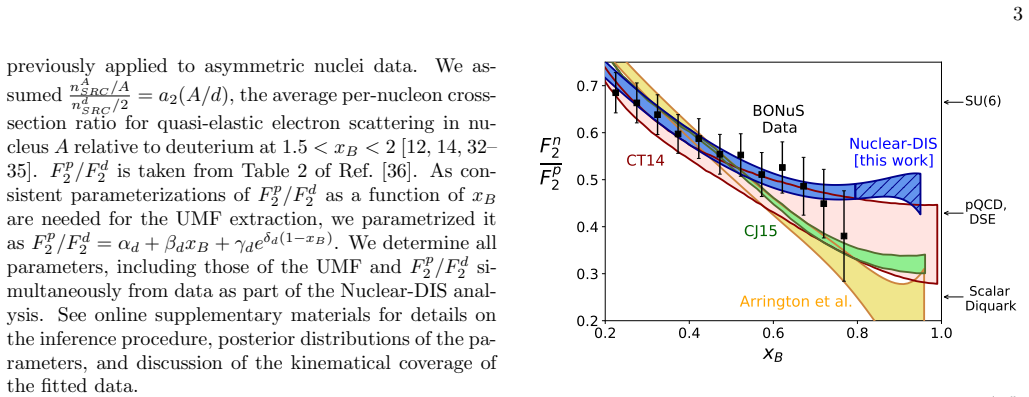
The paper's central discovery is that $F_2^n/F_2^p$ saturates for $x_B \ge 0.6$ at $0.47 \pm 0.04$ as $x_B$ approaches 1. The authors reach this by writing every nuclear structure function as unmodified mean-field nucleons plus modified nucleons inside short-range correlated proton-neutron pairs, with one nucleus-independent universal modification function; fitting that function to $F_2^A/F_2^d$ data from helium-3 to lead then corrects the deuterium data from which the neutron ratio is read off. On the paper's own terms this is decisive: the extracted limit agrees with perturbative QCD ($3/7$) and the Dyson-Schwinger range ($0.41$–$0.49$), and disagrees with the scalar-diquark prediction ($1/4$) and the SU(6) value ($2/3$). Previous deuterium-only extractions either could not distinguish these predictions or favored the scalar diquark, so the wider nuclear lever arm is what changes the answer. The same framework predicts the helium-3/tritium ratio from the A=3 mirror-nuclei experiment and shows that different models of the nuclear correction factor $R$ shift the extracted neutron ratio by up to about 25% at high $x_B$.
Load-bearing premise
Everything rests on assuming that a single universal modification function, proportional to the fraction of nucleons in proton-neutron short-range correlated pairs, describes the nuclear modification of structure functions, including Fermi-motion effects above $x_B = 0.7$, for every nucleus from deuterium to lead; if that universality fails, the deuterium correction is biased and the extracted limit is not the free-neutron value.
Editorial extensions
If this is right
- The high-$x_B$ neutron-to-proton structure-function ratio is fixed at a plateau of $0.47 \pm 0.04$ for $x_B \ge 0.6$, giving a target that future valence-quark extractions must reproduce.
- The scalar diquark dominance picture, with limit $1/4$, is excluded by the combined nuclear data set; perturbative QCD ($3/7$) and Dyson-Schwinger ($0.41$–$0.49$) predictions survive.
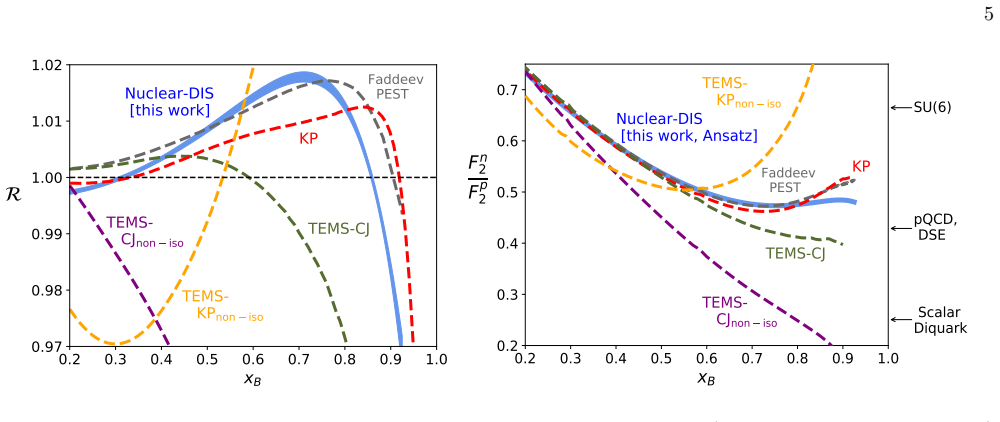
- The universal modification function from the global fit predicts the helium-3/tritium cross-section ratio and the correction function $R$ that converts that ratio into $F_2^n/F_2^p$; different models of $R$ change the extracted neutron ratio by up to about 25% at high $x_B$.
- Including nuclei heavier than deuterium is what separates this result from deuterium-only global fits, which either could not discriminate among the models or favored the scalar diquark.
- Removing low-energy resonance-region data or evolving the proton-to-deuteron ratio between $Q^2$ values does not change the saturation for $x_B$ up to about 0.8.
Reading between the lines
- If the plateau survives the A=3 and tagged-deuterium checks, large-$x$ parton distributions will need re-tuning: the implied $d/u$ ratio at $x$ near 1 enters $W^\pm$ and $Z$ production rates at colliders, so the change propagates beyond nuclear physics.
- The universality of $f_{univ}$ is itself a testable nuclear-physics statement: tagged-spectator measurements at high $x_B$ can check that the per-pair modification inferred from heavy nuclei equals that seen in the deuteron, exposing where short-range-correlation dominance of the EMC effect breaks down.
- With $F_2^n/F_2^p$ fixed, inclusive DIS ratios of less-studied nuclei become constraints on their short-range-correlation content, turning the neutron into a calibrated probe of nuclear structure.
- The central value sits above the perturbative-QCD value 3/7 and within the upper part of the Dyson-Schwinger range, so improved A=3 precision could separate those two surviving predictions.
Signed reviews
Editorial analysis
A structured set of objections, weighed in public.
Referee Report
Summary. The manuscript presents a global analysis of nuclear deep inelastic scattering ratios F2^A/F2^d for nuclei from A = 3 to 208 within the short-range-correlation (SRC) universal-modification framework. Equation (1) models the nuclear structure function as a sum of free-nucleon contributions and contributions from nucleons in np-SRC pairs, leading to Eq. (2) with a nucleus-independent universal modification function f_univ. The authors perform a Bayesian Hamiltonian Markov Chain Monte Carlo fit of f_univ and F2^p/F2^d, and then use Eq. (5) to correct the deuteron data and extract F2^n/F2^p. The central result is that F2^n/F2^p becomes approximately constant for xB ≥ 0.6 and equals 0.47 ± 0.04 as xB → 1, in agreement with pQCD and Dyson-Schwinger predictions and in disagreement with the scalar diquark prediction. The paper also predicts F2^{3He}/F2^{3H}, the nuclear correction function R needed for the MARATHON extraction, and quantifies the model dependence of that extraction.
Significance. If the result holds, it would resolve a long-standing question about the neutron valence structure and discriminate between competing QCD-inspired symmetry-breaking mechanisms. The paper is valuable for combining the large A = 3 to 208 dataset into a single SRC-based correction scheme and for producing falsifiable predictions for the MARATHON and BONuS experiments. Strengths include the simultaneous Bayesian extraction of f_univ and F2^p/F2^d, explicit checks on low-W data and Q2 evolution, and an honest attempt to quantify the model uncertainty in the MARATHON correction function R. However, the central claim rests on the untested assumption that a single f_univ describes all nuclear modifications from xB = 0.08 to 0.95, including the Fermi-motion region xB > 0.7, and the quoted 0.04 uncertainty is a posterior interval rather than a model uncertainty. The paper would be substantially strengthened by a closure test against a conventional nuclear model with non-SRC Fermi-motion and binding corrections.
major comments (3)
- [Sec. II, Eqs. (1)-(2)] The assumption that a single universal modification function f_univ describes all nuclear modifications from xB = 0.08 to 0.95, including nucleon-motion effects at xB > 0.7, is explicitly stated in Sec. II ('This model assumes that both the EMC effect at 0.3 ≤ xB ≤ 0.7 and nucleon-motion effects ... are dominated by short-range correlations') and is load-bearing for the F2^n/F2^p extraction. No closure test is provided against a nuclear model in which high-x Fermi motion or binding effects are not proportional to the SRC abundance a2(A/d). Because Eq. (5) applies f_univ to correct deuterium, any failure of this assumption biases the extracted ratio precisely in the xB ≥ 0.6 region where the saturation claim is made. The authors should add an explicit test, for example replacing the SRC-scaled high-x term by a deuteron wave-function smearing model, and report how the extracted x → 1 limit changes. The quoted 0.04 posterior width does not include this model uncertainty.
- [Sec. II, Eqs. (3) and (5)] f_univ is defined in Eq. (3) relative to F2^d, so any deuteron-specific high-x contribution that does not scale with a2(A/d) is absorbed into f_univ and then reapplied to deuterium through Eq. (5). The fit to F2^A/F2^d for A > 2 cannot separate a universal bound-nucleon modification from a deuterium-specific excess. A quantitative estimate of the possible non-SRC high-x tail in F2^d, for instance from off-shell, binding, or Fermi-motion effects, and its propagation into F2^n/F2^p is needed before the 0.47 ± 0.04 limit can be considered robust. As it stands, both the central value and the uncertainty are conditional on the universality assumption, and the paper should explicitly acknowledge and quantify this dependence.
- [Sec. II, Eq. (4) and Fig. 2] The xB → 1 limit of 0.47 ± 0.04 is obtained by extrapolating the fitted four-parameter forms to xB = 1, while the fit constraints weaken toward xB ~ 0.95 and the low-W data (W < sqrt(2) GeV) are used for xB > 0.8. The robustness checks reported in the text, removing low-W data and evolving Q2, preserve the qualitative saturation but do not address the extrapolation uncertainty in the x → 1 limit. The manuscript should report the value and uncertainty obtained from the fit restricted to W ≥ sqrt(2) GeV at the highest x reached, and assess how much of the claimed limit is an extrapolation of the fitted functional form rather than a direct data constraint.
minor comments (4)
- [Sec. II, Eq. (5)] The equation as printed, F2^n/F2^p = 1 - f_univ / F2^p/F2^d - 1, is arithmetically inconsistent; it should be written as (1 - f_univ)/(F2^p/F2^d) - 1. Please correct the typography so the intended expression is unambiguous.
- [Sec. II, after Eq. (4)] The text says 'F2^p/F2^d is taken from Table 2 of Ref. [36]' and then immediately says 'We determine all parameters, including those of the UMF and F2^p/F2^d simultaneously from data.' Please clarify whether Table 2 is used only for priors or initial values, and whether deuteron data themselves enter the simultaneous fit.
- [Sec. III, Fig. 3 caption] The caption states that predictions for 2F2^{3H}/3F2^d are based on the assumption n^{3H}_SRC = n^{3He}_SRC, but the sensitivity of this assumption is only reported in the supplementary materials. Since this is a model input for the MARATHON prediction, the caption should state the quoted ±20% variation changes the results by less than 5% at moderate and high x.
- [Fig. 2 caption] The caption should specify the Q2 evolution applied to each comparison extraction (CT14, CJ15, Arrington et al.) in addition to the overall statement that all extractions were evolved to Q2 = (14 GeV^2) × xB, so that the comparison is reproducible.
Circularity Check
Central F_n/F_p extraction is not circular; the in-sample 3He/F_d 'prediction' is a fitted reconstruction, while the 3H and 3He/3H predictions are genuine.
-
fitted input called prediction
[Sec. II (UMF parametrization/fit) and Sec. IV (A=3 mirror-nuclei predictions), Eqs. 2-3 and Fig. 3]
"for 0.08≤ xB≤ 0.95 in 3He, 4He, 9Be, 12C, 27Al, 56Fe, 197Au, and 208Pb, via Eq. 2. [...] We use our UMF to predict the expected DIS ratios for [F3He2/3]/[Fd2/2], [F3H2/3]/[Fd2/2], andF3He2/F3H2 (see Fig. 3)."
The UMF funiv is a fitted function whose parameters are estimated by HMCMC from the F_A/F_d data set that explicitly includes the 3He ratio, i.e. the same observable as [F_3He/3]/[F_d/2] up to the isoscalar factor 2/3. The paper then labels the resulting 3He curve as a 'prediction': for the 3He member this is an in-sample reconstruction, because the same best-fit parameters that minimized chi-square against the 3He/F_d data now generate that very ratio. That particular curve is therefore statistically forced and cannot provide an independent test of the model. The 3H curve and the F_3He/F_3H ratio are not similarly forced, since 3H data were not used in the fit and n_3H_SRC was assumed equal to n_3He_SRC; hence only part of the claimed prediction reduces to its inputs.
full rationale
The central derivation is not circular. funiv and F_p/F_d are fitted from F_A/F_d ratios for A = 3 to 208, with deuterium appearing only as the normalization denominator, and F_n/F_p is then obtained algebraically from Eq. 5 using the deuterium version of the model expression. F_n/F_p is never an input to the fit, so the x_B → 1 saturation value 0.47 ± 0.04 is not forced by assuming the answer. The universal-modification assumption (Eq. 1) is an openly stated model premise rather than a circular re-use of the target quantity; the concern that non-SRC Fermi-motion or deuteron-specific high-x effects could bias funiv is a model-uncertainty risk, not a circularity. The one partial circular element is the 3He ratio: the same F_3He/F_d data that constrain the HMCMC fit of funiv are later displayed as a 'predicted' [F_3He/3]/[F_d/2] curve, so that specific curve is an in-sample reconstruction. The 3H member and the F_3He/F_3H ratio remain genuinely predictive because the 3H data and n_3H_SRC were not fit inputs. Self-citations to the earlier CLAS/Nature UMF analysis are not load-bearing here, because the paper independently re-fits the data rather than relying solely on the cited extraction.
Assumptions & free parameters
free parameters (8)
- UMF parameter alpha
- UMF parameter beta
- UMF parameter gamma
- UMF parameter delta
- F2^p/F2^d parameter alpha_d
- F2^p/F2^d parameter beta_d
- F2^p/F2^d parameter gamma_d
- F2^p/F2^d parameter delta_d
assumptions (7)
- domain assumption Nuclear modification of structure functions is proportional to the fraction of nucleons in np-SRC pairs, captured by the additive term n^A_SRC(ΔF2^p+ΔF2^n) in Eq. 1 for all xB.
- domain assumption A single universal modification function funiv applies to all nuclei from deuterium to lead.
- domain assumption Contribution of pp- and nn-SRC pairs is negligible (about 10% of all NN-SRC pairs).
- domain assumption The per-nucleon SRC ratio a2(A/d) measured in quasi-elastic electron scattering at 1.5<xB<2 equals the SRC abundance ratio relevant to DIS.
- ad hoc to paper F2^p/F2^d can be represented by the four-parameter form alpha_d+beta_d xB+gamma_d e^{delta_d(1-xB)}, and funiv by an analogous form.
- domain assumption For tritium, n^3H_SRC/n^d_SRC equals the helium-3 value.
- domain assumption Existing published F2^A/F2^d data, including low-W data, are valid constraints in the fit up to xB=0.95.
Cite this review
Pith. "Pith review of Neutron valence structure from nuclear deep inelastic scattering." pith.science (2026). https://pith.science/paper/FHAO7HDV
@misc{pith2026190802223,
  author       = {Pith},
  title        = {Pith review of: Neutron valence structure from nuclear deep inelastic scattering},
  year         = {2026},
  howpublished = {\url{https://pith.science/paper/FHAO7HDV}},
  note         = {Machine review of arXiv:1908.02223}
}
abstract
Mechanisms of spin-flavor SU(6) symmetry breaking in Quantum Chromodynamics (QCD) are studied via an extraction of the free neutron structure function from a global analysis of deep inelastic scattering (DIS) data on the proton and on nuclei from $A = 2$ (deuterium) to 208 (lead). Modification of the structure function of nucleons bound in atomic nuclei (known as the EMC effect) are consistently accounted for within the framework of a universal modification of nucleons in short-range correlated (SRC) pairs. Our extracted neutron-to-proton structure function ratio $F_2^n/F_2^p$ becomes constant for $x_B \ge 0.6$, equalling $0.47 \pm 0.04$ as $x_B \rightarrow 1$, in agreement with theoretical predictions of perturbative QCD and the Dyson Schwinger equation, and in disagreement with predictions of the Scalar Diquark dominance model. We also predict $F_2^{^3\mathrm{He}}/F_2^{^3\mathrm{H}}$, recently measured, yet unpublished, by the MARATHON collaboration, the nuclear correction function that is needed to extract $F_2^n/F_2^p$ from $F_2^{^3\mathrm{He}}/F_2^{^3\mathrm{H}}$, and the theoretical uncertainty associated with this extraction.
Figures


Figures from the paper (1 more)
Forward citations
Cited by 1 Pith paper
-
Gluonic Probe for the Short Range Correlation in Nucleus
Gluon-sensitive heavy flavor production is proposed as a probe of short-range correlations, predicting that sub-threshold J/psi cross section ratios equal known SRC ratios.
Reference graph
Works this paper leans on
- [1]
-
[2]
C. D. Roberts, R. J. Holt, and S. M. Schmidt, Phys. Lett. B727, 249 (2013), 1308.1236
work page Pith review arXiv 2013
-
[3]
G. R. Farrar and D. R. Jackson, Phys. Rev. Lett. 35, 1416 (1975)
work page 1975
-
[4]
S. Dulat, T.-J. Hou, J. Gao, M. Guzzi, J. Huston, P. Nadolsky, J. Pumplin, C. Schmidt, D. Stump, and C. P. Yuan, Phys. Rev. D93, 033006 (2016), 1506.07443
arXiv 2016
-
[5]
A. Accardi, L. T. Brady, W. Melnitchouk, J. F. Owens, and N. Sato, Phys. Rev.D93, 114017 (2016), 1602.03154
arXiv 2016
-
[6]
How well do we know the neutron structure function?
J. Arrington, J. G. Rubin, and W. Melnitchouk, Phys. Rev. Lett. 108, 252001 (2012), 1110.3362
work page Pith review arXiv 2012
-
[7]
F. E. Close, Phys. Lett. 43B, 422 (1973)
work page 1973
-
[8]
R. D. Carlitz, Phys. Lett. 58B, 345 (1975)
work page 1975
Show all 49 references
-
[9]
G. G. Petratos et al., Jefferson Lab PAC37 Proposal (2010), experiment E12-10-103
2010
-
[10]
O. Hen, G. A. Miller, E. Piasetzky, and L. B. Weinstein, Rev. Mod. Phys. 89, 045002 (2017)
2017
-
[11]
L. B. Weinstein, E. Piasetzky, D. W. Higinbotham, J. Gomez, O. Hen, and R. Shneor, Phys. Rev. Lett. 106, 052301 (2011)
2011
-
[12]
O. Hen, E. Piasetzky, and L. B. Weinstein, Phys. Rev. C 85, 047301 (2012)
2012
-
[13]
O. Hen, D. W. Higinbotham, G. A. Miller, E. Piasetzky, and L. B. Weinstein, Int. J. Mod. Phys. E22, 1330017 (2013), 1304.2813
2013 arXiv
-
[14]
Schmookler et al
B. Schmookler et al. (CLAS), Nature 566, 354 (2019)
2019
-
[15]
Frankfurt and M
L. Frankfurt and M. Strikman, Phys. Rep. 160, 235 (1988)
1988
-
[16]
Piasetzky, M
E. Piasetzky, M. Sargsian, L. Frankfurt, M. Strikman, and J. W. Watson, Phys. Rev. Lett. 97, 162504 (2006)
2006
-
[17]
Subedi et al., Science 320, 1476 (2008)
R. Subedi et al., Science 320, 1476 (2008)
2008
-
[18]
Korover, N
I. Korover, N. Muangma, O. Hen, et al., Phys.Rev.Lett. 113, 022501 (2014)
2014
-
[19]
Hen et al
O. Hen et al. (CLAS Collaboration), Science 346, 614 (2014)
2014
-
[20]
Duer et al
M. Duer et al. (CLAS), Nature 560, 617 (2018)
2018
- [21]
-
[22]
Tang et al., Phys
A. Tang et al., Phys. Rev. Lett. 90, 042301 (2003)
2003
-
[23]
Shneor et al., Phys
R. Shneor et al., Phys. Rev. Lett. 99, 072501 (2007)
2007
-
[24]
E. O. Cohen et al. (CLAS), Phys. Rev. Lett. 121, 092501 (2018), 1805.01981
2018 arXiv
-
[25]
M. M. Sargsian et al., J. Phys. G29, R1 (2003)
2003
-
[26]
Melnitchouk, M
W. Melnitchouk, M. Sargsian, and M. Strikman, Z. Phys. A359, 99 (1997)
1997
-
[27]
Virchaux and A
M. Virchaux and A. Milsztajn, Phys. Lett. B274, 221 (1992)
1992
-
[28]
Carpenter, A
B. Carpenter, A. Gelman, M. Hoffman, D. Lee, B. Goodrich, M. Betancourt, M. Brubaker, J. Guo, P. Li, and A. Riddell, Journal of Statistical Software, Arti- cles 76, 1 (2017), ISSN 1548-7660, URL https://www. jstatsoft.org/v076/i01
2017
-
[29]
S. D. Team, Pystan: the python interface to stan, version 2.17.1.0, http://mc-stan.org (2018)
2018
-
[30]
Gomez et al., Phys
J. Gomez et al., Phys. Rev. D 49, 4348 (1994)
1994
-
[31]
Seely et al., Phys
J. Seely et al., Phys. Rev. Lett. 103, 202301 (2009)
2009
-
[32]
Frankfurt, M
L. Frankfurt, M. Strikman, D. Day, and M. Sargsyan, Phys. Rev. C 48, 2451 (1993)
1993
-
[33]
Egiyan et al
K. Egiyan et al. (CLAS Collaboration), Phys. Rev. C 68, 014313 (2003)
2003
-
[34]
Egiyan et al
K. Egiyan et al. (CLAS Collaboration), Phys. Rev. Lett. 96, 082501 (2006)
2006
-
[35]
Fomin et al., Phys
N. Fomin et al., Phys. Rev. Lett. 108, 092502 (2012)
2012
-
[36]
Arrington, F
J. Arrington, F. Coester, R. J. Holt, and T. S. H. Lee, J. Phys. G36, 025005 (2009), 0805.3116
2009 arXiv
-
[37]
Baillie et al
N. Baillie et al. (CLAS), Phys. Rev. Lett. 108, 142001 (2012), [Erratum: Phys. Rev. Lett.108,199902(2012)], 1110.2770
2012 arXiv
-
[38]
V. M. Abazov et al. (D0), Phys. Rev. D91, 032007 (2015), [Erratum: Phys. Rev.D91,no.7,079901(2015)], 1412.2862
2015 arXiv
-
[39]
F. E. Close, An Introduction to Quarks and Partons (Academic Press, London, 1979)
1979
-
[40]
Tropiano, J
A. Tropiano, J. Ethier, W. Melnitchouk, and N. Sato, Phys. Rev. C99, 035201 (2019), 1811.07668
2019 arXiv
-
[41]
S. A. Kulagin and R. Petti (private communication)
-
[42]
S. A. Kulagin and R. Petti, Phys. Rev. C82, 054614 (2010), 1004.3062
2010 arXiv
-
[43]
I. R. Afnan, F. R. P. Bissey, J. Gomez, A. T. Katram- atou, S. Liuti, W. Melnitchouk, G. G. Petratos, and A. W. Thomas, Phys. Rev. C68, 035201 (2003), nucl- th/0306054
2003
-
[44]
Accardi (private communication)
A. Accardi (private communication)
-
[45]
Melnitchouk and A
W. Melnitchouk and A. W. Thomas, Phys. Lett. B377, 11 (1996), nucl-th/9602038
1996 arXiv
- [46]
-
[47]
O. Hen, A. Accardi, W. Melnitchouk, and E. Piasetzky, Phys. Rev. D 84, 117501 (2011)
2011
-
[48]
M. M. Sargsian, S. Simula, and M. I. Strikman, Phys. Rev. C66, 024001 (2002), nucl-th/0105052
2002 arXiv
-
[49]
jlab.org/12GeV/SoLID/download/doc/ SoLIDWhitePaper-Sep9-2014.pdfu (2014)
SoLID Collaboration, https://hallaweb. jlab.org/12GeV/SoLID/download/doc/ SoLIDWhitePaper-Sep9-2014.pdfu (2014)
2014
Reviewed August 14, 2026 · model on record in the stance chip above.
Discussion (0). Continue with ORCID to comment.