REVIEW 3 major objections 6 minor 2 cited by
Generalized Anderson's theorem for superconductors derived from topological insulators
T0 review · 3 major / 6 minor · reviewed 2026-08-14 · deepseek-v4-flash
Pith's one-line read This paper argues that nodal superconductivity in multiorbital materials is protected from nonmagnetic disorder when pairing is isotropic in the orbital basis and impurities do not mix internal degrees of freedom, with…
desk verdict The fitness-function machinery is genuinely useful and the CPSBS thermal conductivity is impressive, but the generalized Anderson theorem as stated rests on an unjustified V proportional to identity assumption and is not generic for nonmixing impurities. read the letter →
The pith
A machine-rendered reading of the paper's core claim, the machinery that carries it, and where it could break.
The reading
What carries the argument
The central object is the superconducting fitness function $F_C(\mathbf{k}-\mathbf{k}') = V(\mathbf{k}-\mathbf{k}')\Delta - \Delta V^*(\mathbf{k}-\mathbf{k}')$, a modified commutator between the impurity scattering potential and the gap matrix; the effective pair-breaking rate is its normalized Fermi-surface trace average. The argument uses the fact that in Bi2Se3-based superconductors the nonmagnetic scattering potential has the form $V = V_0\tau_0\otimes\sigma_0$, because the two effective orbitals have opposite parity and the overlap integral of a symmetric impurity potential between them vanishes. Since the identity in orbital and spin space commutes with every allowed gap matrix of the form $\tau_a\otimes\sigma_b$, the fitness function is identically zero, so the impurity-induced pair-breaking rate vanishes even though the gap is nodal in the band basis. A unitary transformation from the orbital basis to the band basis is the step that converts the constant orbital-basis gap into a momentum-dependent nodal structure, and the node positions are set purely by normal-state parameters such as $h_{20}(\mathbf{k})\sim B_0 k_z$ and $h_{12}(\mathbf{k})\sim A_0 k_x$.
What would settle it
Introduce into CPSBS a controlled concentration of defects that are known to sit off inversion centers, and measure whether $T_c$ is suppressed along the generalized Abrikosov-Gor'kov curve as the defect density rises; observation of such a suppression would show that inversion-breaking scattering activates the fitness function. A null result—unchanged $T_c$ despite clear inversion-breaking scattering—would contradict the paper's central claim.
Extended reading notes
Core claim
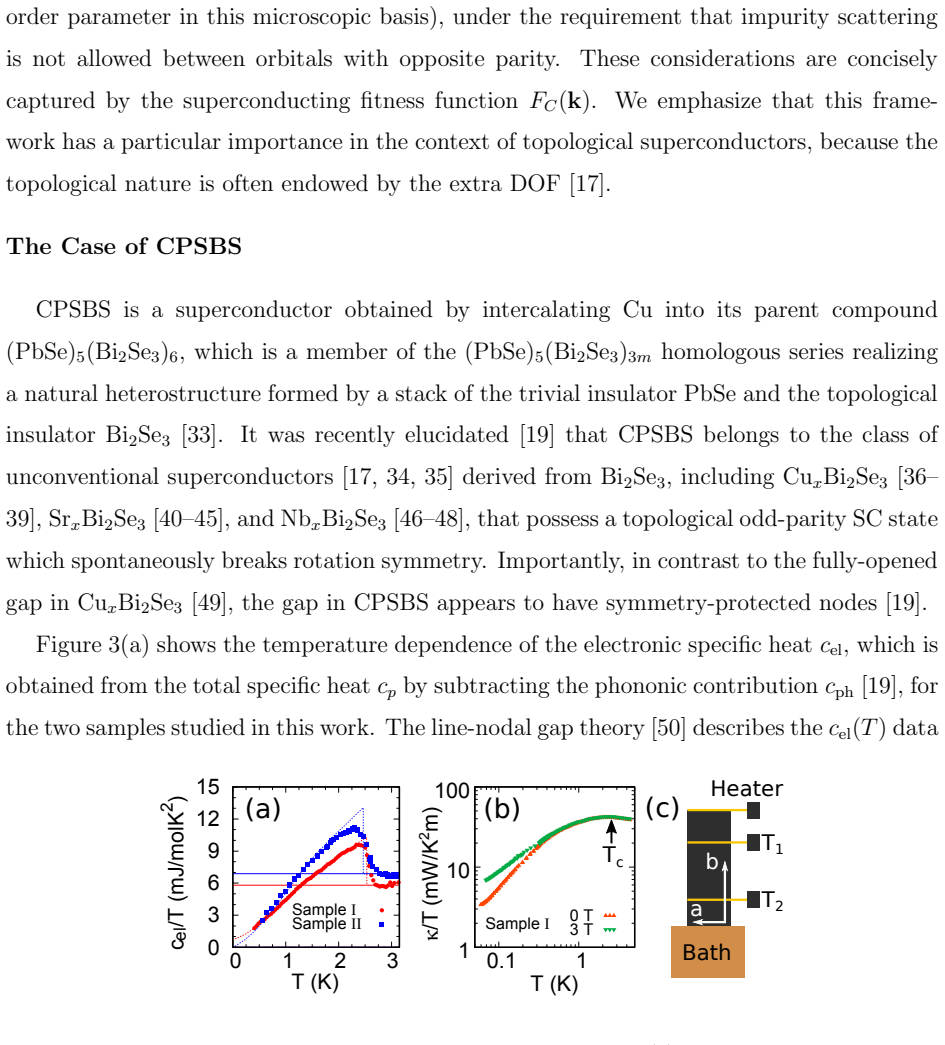
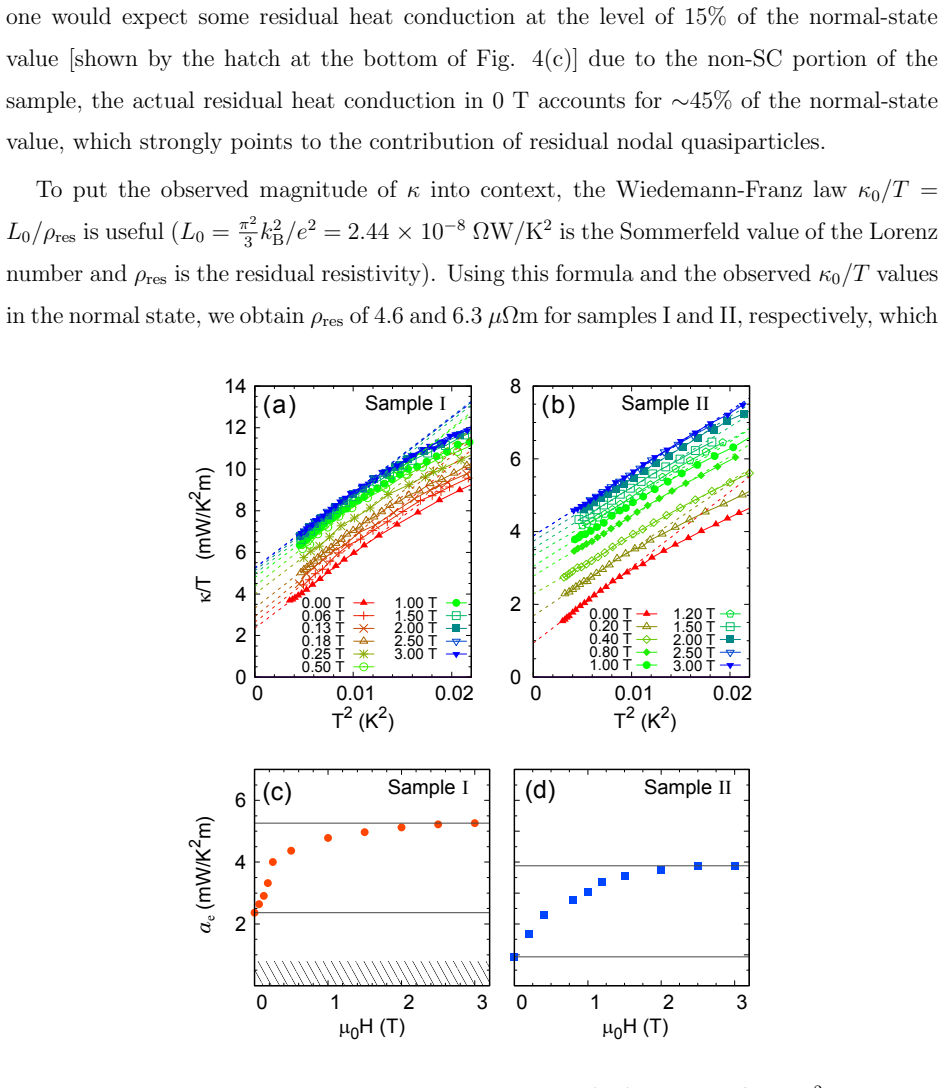
The central claim is a generalized Anderson's theorem: in a superconductor with multiple internal degrees of freedom, an isotropic pairing interaction written in the local orbital basis produces a momentum-dependent gap once projected onto the band basis, and that gap is immune to nonmagnetic impurities as long as the impurity potential does not mix the internal degrees of freedom. The argument is carried by the superconducting fitness function $F_C = V\Delta - \Delta V^*$, whose Fermi-surface average determines the effective pair-breaking rate $\hbar\Gamma_{\rm eff} = \frac{1}{4}\langle\mathrm{Tr}[\tilde F_C^\dagger\tilde F_C]\rangle_k$. For the Bi2Se3-based materials, the two effective orbitals have opposite parity, so a symmetric impurity potential reduces to $V = V_0\tau_0\otimes\sigma_0$, the identity in both orbital and spin space; because this commutes with every allowed gap matrix of the form $\tau_a\otimes\sigma_b$, the fitness function vanishes and the scattering rate is zero. The paper presents CPSBS as the extreme demonstration: thermal conductivity data show unambiguous nodal quasiparticle heat transport, while the Drude estimate gives $\hbar\Gamma \gtrsim 30$ meV compared with $\Delta_0 \simeq 0.5$ meV, so strong scattering coexists with a nodal superconducting state instead of destroying it.
Load-bearing premise
The load-bearing premise is that the impurity potential is inversion-symmetric, so scattering never mixes the two opposite-parity orbitals; if real defects sit off inversion centers or have an odd-parity component, the predicted zero scattering rate fails.
Editorial extensions
If this is right
- Any superconductor whose nonmagnetic impurity potential is proportional to the identity in all internal spaces has zero effective pair-breaking rate, so its $T_c$ is not suppressed by disorder even if the band-basis gap has nodes.
- The Abrikosov-Gor'kov-type formula $\log(T_c/T_c^0)=\Psi(1/2)-\Psi(1/2+\hbar\Gamma_{\rm eff}/2\pi k_B T_c)$ remains the correct description of disorder-suppressed $T_c$ in multiorbital systems provided $\hbar\Gamma_{\rm eff}$ is computed from the fitness function.
- The observed robustness of superconductivity in Bi2Se3-based materials against disorder is not evidence against unconventional pairing; it is the expected behaviour for isotropic pairing in the orbital basis with parity-preserving scattering.
- In CPSBS, the absence of universal thermal conductivity—with $\kappa_0/T$ about three orders of magnitude below the clean-limit estimate—shows that strong scattering persists in the superconducting state, and the survival of the nodal signature is a direct consequence of the generalized theorem.
Reading between the lines
- A direct extension would be to test the boundary of the protection by deliberately introducing inversion-breaking defects, which should add orbital-mixing terms to the impurity potential and restore pair-breaking; the predicted $T_c$ suppression as a function of such defect density is quantitatively given by the fitness formula.
- The same fitness logic suggests a screening criterion for other multiorbital or multi-valley superconductors: if the dominant impurity potential is block-diagonal in the internal degrees of freedom and the pairing is isotropic in the local basis, nodal gaps should be disorder-robust.
- Because bulk nodal quasiparticles dominate the low-temperature heat transport in nodal topological superconductors, the surface Majorana contribution remains tiny in bulk samples; isolating a quantized Majorana thermal signal would require ultra-clean thin geometries or surface-sensitive measurements.
Signed reviews
Editorial analysis
A structured set of objections, weighed in public.
Referee Report
Summary. The paper proposes a generalized Anderson theorem for superconductors with multiple internal degrees of freedom. The central idea is that when the pairing interaction is isotropic in the local orbital basis, a nonmagnetic impurity potential that is proportional to the identity in the internal space commutes with every allowed gap matrix, so the superconducting fitness function vanishes and the effective pair-breaking rate ΓEff is zero, even if the gap is nodal in the band basis. The authors apply this framework to the Bi2Se3-based superconductor CPSBS, combining specific-heat and ultra-low-temperature thermal-conductivity data to argue that nodal superconductivity persists although the normal-state scattering rate is more than an order of magnitude larger than the gap. The paper also derives ΓEff from the Abrikosov-Gorkov equations and expresses it in terms of the fitness function. The algebraic core—V ∝ τ0⊗σ0 commutes with all gap matrices—is sound, but the broader claim that any nonmagnetic scattering that does not mix internal degrees of freedom is harmless is not justified by the symmetry argument presented.
Significance. If the theorem as stated were correct, it would provide a general mechanism protecting unconventional multiorbital superconductors against disorder and would resolve the long-standing puzzle of robustness in Bi2Se3-based materials. The experimental data on CPSBS are of high quality and the use of the superconducting fitness function is elegant. The machine-checkable algebraic statement that commutativity implies zero pair-breaking is correct and is a useful contribution. However, the central claim is overstated: inversion symmetry does not imply V ∝ identity, and the allowed diagonal orbital term τ3⊗σ0 breaks the protection for the odd-parity inter-orbital order parameters. This severely limits the generality of the proposed theorem and undermines the claim that the CPSBS robustness is explained by the generalized Anderson mechanism as presented.
major comments (3)
- [Robust superconductivity in the Bi2Se3-based materials, Eq. (8)] The reduction of the impurity potential to V = V0 τ0⊗σ0 + Vs S·(τ0⊗σ) is not derived from the stated assumption of a symmetric impurity potential. Inversion symmetry forbids only the off-diagonal orbital terms τ1⊗σ0 and τ2⊗σ0; it allows a diagonal orbital term V3 τ3⊗σ0. Since the two effective orbitals P1z+ and P2z− are inequivalent—indeed Table S1 lists the (3,0) A1g term in the normal-state Hamiltonian—a local impurity potential will generically produce different on-site matrix elements on the two orbitals, so V3 ≠ 0. For the Eu order parameter of Eq. (7), the commutator [τ3, τ2] is nonzero, giving FC ≠ 0 and ΓEff ∝ V3^2; the same applies to the A1u and A2u odd-parity channels. Therefore the theorem as stated does not hold for all nonmagnetic scattering that fails to mix internal degrees of freedom; it holds only when V is strictly proportional to the identity in orbital space. The assumption V11 = V22 is not stated anywhere and is not a consequence of inversion symmetry. Since the CPSBS explanation relies on exactly this equality, this issue is load-bearing and must be addressed, either by proving V3 = 0 from a microscopic model or by reformulating the theorem with V ∝ identity as an explicit assumption and discussing the physical consequences for the experimental interpretation.
- [Abstract and main text] The statement that 'the conclusion of zero scattering rate is valid for any SC order parameter possible for the Bi2Se3-based materials, because the identity matrix τ0⊗σ0 commutes with any Δ' is only valid if the impurity potential has already been restricted to be proportional to τ0. The paper's broader claims—for example, that superconductors with momentum-dependent band-basis gaps are 'generically protected from nonmagnetic scattering that do not mix the internal DOF'—are false under the symmetries of the problem, because τ3⊗σ0 is diagonal in orbital space, does not mix internal degrees of freedom, and yet gives a nonzero fitness function for the odd-parity inter-orbital order parameters. The authors should either provide a microscopic justification for the vanishing of the τ3 component, or explicitly restrict the theorem to impurity potentials proportional to the identity in the internal space and clearly state that this is a necessary condition, not a consequence of symmetry.
- [Supplementary Materials, Eqs. (27)–(32)] The derivation of the effective scattering rate and the conclusion that ΓEff = 0 when FC = 0 are obtained within the self-consistent Born approximation. The experimental regime is ℏΓ/Δ0 ≳ 60, which lies far outside the weak-scattering limit. The paper states that the protection holds 'even for arbitrarily large τ1 and τ2 in the normal state,' but this statement is only established within the Born approximation. To support the strong-disorder conclusion, the authors should either extend the argument beyond the Born approximation (e.g., via a T-matrix treatment) or qualify the claim to the regime of validity of the derivation.
minor comments (6)
- [Main text, after Eq. (8)] There is a typo: 'CPSPB' should be 'CPSBS' in the sentence discussing the Eu channel.
- [Supplementary Materials, Eq. (S9)] The matrix elements in the unitary transformation are typeset ambiguously; for instance 'h11hv−ih12h30/hp' should read '(h11 hv − i h12 h30)/hp'. Please correct the parentheses throughout the matrix.
- [Main text, Eq. (5)] The notation 'the horizontal bar indicates impurity averaging' is unclear; please specify explicitly that the overline denotes the configurational average over impurity positions.
- [Supplementary Materials, Table S4] The row 'Dimension' contains the entry '2D?' with a question mark for one material; please resolve this ambiguity.
- [Abstract and main text] The abstract states that the scattering-rate energy scale is 'orders of magnitude larger' than the gap, while the main text says 'more than an order of magnitude'; please harmonize the wording.
- [Main text, Abstract] In the phrase 'nonmagnetic scattering that do not mix the internal DOF,' the verb should agree with the singular subject 'scattering'—use 'does not mix.'
Circularity Check
No significant circularity: the Abrikosov-Gorkov derivation is self-contained and the zero pair-breaking rate follows algebraically from the assumed impurity form; the minor self-citation of the fitness concept is not load-bearing.
full rationale
The paper's central derivation starts from the BdG Hamiltonian and the standard Abrikosov-Gorkov self-energy in the Born approximation, and derives Eqs. (4)-(6) of the main text: the effective scattering rate is expressed as a Fermi-surface average of Tr[F-dagger F], with F = V Delta - Delta V*. Given the assumed impurity potential V = V0 tau0⊗sigma0, this commutator vanishes by construction for every allowed Delta, so the zero pair-breaking rate is a direct algebraic consequence of the stated premise rather than a fitted or renamed prediction. The experimental content (specific heat, thermal conductivity, and the Drude estimate hbar-Gamma ≈ 30 meV ≫ Delta0 ≈ 0.5 meV) is independent of the derivation and is used to argue consistency with the theory, not to define the theoretical result. The fitness concept is cited from prior work by one of the authors, but the paper rederives the relevant equations rather than importing the result, so the self-citation is not load-bearing. A skeptical concern remains that Eq. (8) assumes equal diagonal impurity matrix elements on the two opposite-parity orbitals, since inversion symmetry alone would also allow a tau3⊗sigma0 term; however, this is an assumption gap about the physical impurity potential, not a circularity in the derivation chain. Accordingly, the circularity score is low.
Assumptions & free parameters
free parameters (1)
- SC volume fractions for samples I and II =
85% (sample I), 100% (sample II)
assumptions (5)
- domain assumption Pairing interaction is isotropic in the local orbital basis, making the order parameter momentum-independent in that basis.
- domain assumption Impurity potential is inversion-symmetric and cannot mix the opposite-parity effective orbitals, so V = V0 τ0⊗σ0 for nonmagnetic impurities.
- standard math Impurity self-energy is computed in the Born approximation.
- domain assumption The normal state is described by an effective two-orbital model with opposite-parity pz orbitals.
- domain assumption Time-reversal and inversion symmetries in the normal state restrict the allowed h_ab(k) terms to the set in Table S1.
Cite this review
Pith. "Pith review of Generalized Anderson's theorem for superconductors derived from topological insulators." pith.science (2026). https://pith.science/paper/FJBY3BEC
@misc{pith2026190808766,
  author       = {Pith},
  title        = {Pith review of: Generalized Anderson's theorem for superconductors derived from topological insulators},
  year         = {2026},
  howpublished = {\url{https://pith.science/paper/FJBY3BEC}},
  note         = {Machine review of arXiv:1908.08766}
}
abstract
A well-known result in unconventional superconductivity is the fragility of nodal superconductors against nonmagnetic impurities. Despite this common wisdom, Bi$_2$Se$_3$-based topological superconductors have recently displayed unusual robustness against disorder. Here we provide a theoretical framework which naturally explains what protects Cooper pairs from strong scattering in complex superconductors. Our analysis is based on the concept of superconducting fitness and generalizes the famous Anderson's theorem into superconductors having multiple internal degrees of freedom. For concreteness, we report on the extreme example of the Cu$_x$(PbSe)$_5$(Bi$_2$Se$_3$)$_6$ superconductor, where thermal conductivity measurements down to 50 mK not only give unambiguous evidence for the existence of nodes, but also reveal that the energy scale corresponding to the scattering rate is orders of magnitude larger than the superconducting energy gap. This provides a most spectacular case of the generalized Anderson's theorem protecting a nodal superconductor.
Figures

Figures from the paper (1 more)
Forward citations
Cited by 2 Pith papers
-
Robustness of unconventional $s$-wave superconducting states against disorder
In four-band superconductors, unconventional s-wave pairing states survive nonmagnetic disorder much better than single-band theory predicts, with resilience set by the superconducting fitness.
-
Topological nodal line in superfluid $^3$He and the Anderson theorem
Measurement of the polar-phase gap in 3He in nafen shows the predicted T^3 temperature law, providing the first experimental evidence for a Dirac nodal line and supporting a generalized Anderson theorem.
Reference graph
Works this paper leans on
-
[1]
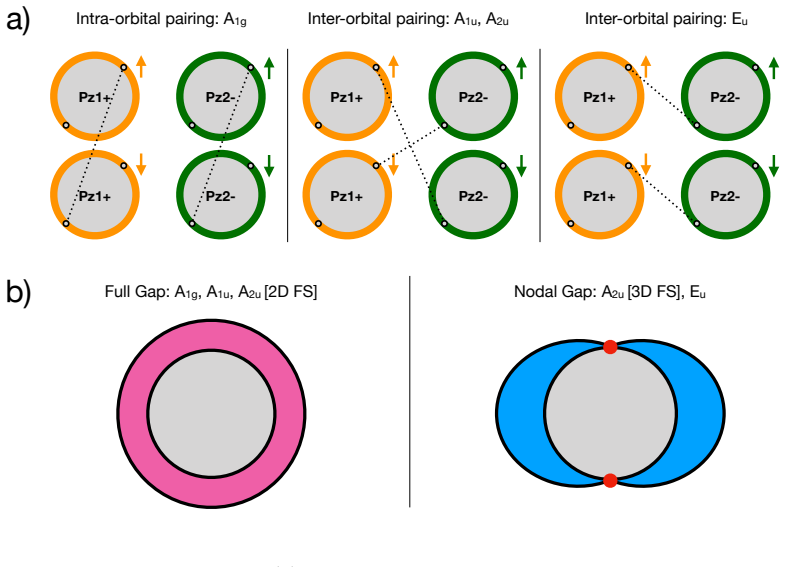
The dotted lines represent pairing between electrons with opposite momenta. Left: intra-orbital singlet pairing for A 1g. Middle: inter-orbital triplet/singlet pairing for A 1u/A2u. Right: inter- orbital triplet pairing for Eu. (b) Schematic representation of the gap function in the band basis. Left: fully gapped, for order parameters in A1g and A1u, as w...
-
[2]
Introduction to unconventional superconductivity,
Manfred Sigrist, “Introduction to unconventional superconductivity,” AIP Conference Pro- ceedings 789, 165–243 (2005), https://aip.scitation.org/doi/pdf/10.1063/1.2080350
-
[3]
Unconventional superconductivity,
G. R. Stewart, “Unconventional superconductivity,” Advances in Physics 66, 75–196 (2017), https://doi.org/10.1080/00018732.2017.1331615
arXiv 2017
-
[4]
Low-energy quasiparticles in high- Tc cuprates,
N. E. Hussey, “Low-energy quasiparticles in high- Tc cuprates,” Adv. Phys. 51, 1685–1771 (2002)
work page 2002
-
[5]
Heat transport as a probe of superconducting gap structure,
H Shakeripour, C Petrovic, and Louis Taillefer, “Heat transport as a probe of superconducting gap structure,” New J. Phys. 11, 055065 (2009)
work page 2009
-
[6]
Localized states in a d-wave superconductor,
Patrick A. Lee, “Localized states in a d-wave superconductor,” Phys. Rev. Lett. 71, 1887–1890 (1993)
work page 1993
-
[7]
Electronic thermal conductivity and the Wiedemann-Franz law for unconventional superconductors,
M. J. Graf, S-K. Yip, J. A. Sauls, and D. Rainer, “Electronic thermal conductivity and the Wiedemann-Franz law for unconventional superconductors,” Phys. Rev. B 53, 15147–15161 (1996)
work page 1996
-
[8]
Universal heat conduction in YBa 2Cu3O6.9,
Louis Taillefer, Benoit Lussier, Robert Gagnon, Kamran Behnia, and Herv´ e Aubin, “Universal heat conduction in YBa 2Cu3O6.9,” Phys. Rev. Lett. 79, 483–486 (1997)
work page 1997
Show all 68 references
-
[9]
Heat trans- port in a strongly overdoped cuprate: Fermi liquid and a pure d-wave BCS superconductor,
Cyril Proust, Etienne Boaknin, R. W. Hill, Louis Taillefer, and A. P. Mackenzie, “Heat trans- port in a strongly overdoped cuprate: Fermi liquid and a pure d-wave BCS superconductor,” Phys. Rev. Lett. 89, 147003 (2002). 12
2002
-
[10]
Superconducting gap structure of spin-triplet super- conductor Sr2RuO4 studied by thermal conductivity,
K. Izawa, H. Takahashi, H. Yamaguchi, Yuji Matsuda, M. Suzuki, T. Sasaki, T. Fukase, Y. Yoshida, R. Settai, and Y. Onuki, “Superconducting gap structure of spin-triplet super- conductor Sr2RuO4 studied by thermal conductivity,” Phys. Rev. Lett. 86, 2653–2656 (2001)
2001
-
[11]
Kramer-pesch approximation for analyzing field-angle- resolved measurements made in unconventional superconductors: A calculation of the zero- energy density of states,
Yuki Nagai and Nobuhiko Hayashi, “Kramer-pesch approximation for analyzing field-angle- resolved measurements made in unconventional superconductors: A calculation of the zero- energy density of states,” Phys. Rev. Lett. 101, 097001 (2008)
2008
-
[12]
Superconductivity with pairs in a relative p wave,
R. Balian and N. R. Werthamer, “Superconductivity with pairs in a relative p wave,” Phys. Rev. 131, 1553–1564 (1963)
1963
-
[13]
The superconductivity of sr 2ruo4 and the physics of spin-triplet pairing,
Andrew Peter Mackenzie and Yoshiteru Maeno, “The superconductivity of sr 2ruo4 and the physics of spin-triplet pairing,” Rev. Mod. Phys. 75, 657–712 (2003)
2003
-
[14]
Extremely strong dependence of superconductivity on disorder in sr 2ruo4,
A. P. Mackenzie, R. K. W. Haselwimmer, A. W. Tyler, G. G. Lonzarich, Y. Mori, S. Nishizaki, and Y. Maeno, “Extremely strong dependence of superconductivity on disorder in sr 2ruo4,” Phys. Rev. Lett. 80, 161–164 (1998)
1998
-
[15]
Impurity scattering and triplet superconductivity in upt 3,
Y. Dalichaouch, M. C. de Andrade, D. A. Gajewski, R. Chau, P. Visani, and M. B. Maple, “Impurity scattering and triplet superconductivity in upt 3,” Phys. Rev. Lett. 75, 3938–3941 (1995)
1995
-
[16]
Anomalous suppression of the superfluid density in the CuxBi2Se3 superconductor upon progressive cu intercalation,
M. Kriener, Kouji Segawa, Satoshi Sasaki, and Yoichi Ando, “Anomalous suppression of the superfluid density in the CuxBi2Se3 superconductor upon progressive cu intercalation,” Phys. Rev. B 86, 180505(R) (2012)
2012
-
[17]
Robust odd-parity superconduc- tivity in the doped topological insulator Nb xBi2Se3,
M. P. Smylie, K. Willa, H. Claus, A. Snezhko, I. Martin, W. K. Kwok, Y. Qiu, Y. S. Hor, E. Bokari, P. Niraula, A. Kayani, V. Mishra, and U. Welp, “Robust odd-parity superconduc- tivity in the doped topological insulator Nb xBi2Se3,” Phys. Rev. B 96, 115145 (2017)
2017
-
[18]
Topological superconductors: a review,
Masatoshi Sato and Yoichi Ando, “Topological superconductors: a review,” Rep. Prog. Phys. 80, 076501 (2017)
2017
-
[21]
Theory of dirty superconductors,
P.W. Anderson, “Theory of dirty superconductors,” Journal of Physics and Chemistry of Solids 11, 26 – 30 (1959)
1959
-
[22]
Impurity scattering in superconductors,
H. Suhl and B. T. Matthias, “Impurity scattering in superconductors,” Phys. Rev. 114, 977– 13 988 (1959)
1959
-
[23]
Odd-parity topological superconductors: Theory and application to CuxBi2Se3,
Liang Fu and Erez Berg, “Odd-parity topological superconductors: Theory and application to CuxBi2Se3,” Phys. Rev. Lett. 105, 097001 (2010)
2010
-
[26]
Identifying detrimental effects for multiorbital supercon- ductivity: Application to sr 2ruo4,
Aline Ramires and Manfred Sigrist, “Identifying detrimental effects for multiorbital supercon- ductivity: Application to sr 2ruo4,” Phys. Rev. B 94, 104501 (2016)
2016
-
[27]
Tailoring Tc by symmetry princi- ples: The concept of superconducting fitness,
Aline Ramires, Daniel F. Agterberg, and Manfred Sigrist, “Tailoring Tc by symmetry princi- ples: The concept of superconducting fitness,” Phys. Rev. B 98, 024501 (2018)
2018
-
[28]
This is represented by the gray square in Fig
For the specific case of CPSBS, the (PbSe) 5 layers actually have square symmetry, such that the entire structure has the reduced point group symmetry C2h. This is represented by the gray square in Fig. 1 (a). More details in the Supplementary Materials
-
[31]
Here we choose to start with a basis in which the parity operator is diagonal, which led to the insights described here
Note that the explicit form of the order parameters differ from the ones in Fu and Berg [22] since the character of the orbitals is different in our formalism, which is evident from the form of the parity operator. Here we choose to start with a basis in which the parity operato...
-
[32]
Spin-orbit locking as a protection mechanism of the odd-parity superconducting state against disorder,
Karen Michaeli and Liang Fu, “Spin-orbit locking as a protection mechanism of the odd-parity superconducting state against disorder,” Phys. Rev. Lett. 109, 187003 (2012)
2012
-
[33]
Robust superconductivity with nodes in the superconducting topological insu- lator CuxBi2Se3: Zeeman orbital field and nonmagnetic impurities,
Yuki Nagai, “Robust superconductivity with nodes in the superconducting topological insu- lator CuxBi2Se3: Zeeman orbital field and nonmagnetic impurities,” Phys. Rev. B 91, 060502 (2015)
2015
-
[34]
Pb 5Bi24Se41: A new member of the homolo- gous series forming topological insulator heterostructures,
Kouji Segawa, A.A. Taskin, and Yoichi Ando, “Pb 5Bi24Se41: A new member of the homolo- gous series forming topological insulator heterostructures,” J. Solid State Chem. 221, 196 – 201 (2015). 14
2015
-
[35]
Odd-parity topological superconductor with nematic order: Application to CuxBi2Se3,
Liang Fu, “Odd-parity topological superconductor with nematic order: Application to CuxBi2Se3,” Phys. Rev. B 90, 100509 (2014)
2014
-
[36]
Topological crystalline insulators and topological superconduc- tors: From concepts to materials,
Yoichi Ando and Liang Fu, “Topological crystalline insulators and topological superconduc- tors: From concepts to materials,” Annu. Rev. Condens. Matter Phys. 6, 361–381 (2015)
2015
-
[37]
Superconductivity in CuxBi2Se3 and its implications for pairing in the undoped topological insulator,
Y. S. Hor, A. J. Williams, J. G. Checkelsky, P. Roushan, J. Seo, Q. Xu, H. W. Zandbergen, A. Yazdani, N. P. Ong, and R. J. Cava, “Superconductivity in CuxBi2Se3 and its implications for pairing in the undoped topological insulator,” Phys. Rev. Lett. 104, 057001 (2010)
2010
-
[38]
Topological superconductivity in Cu xBi2Se3,
Satoshi Sasaki, M. Kriener, Kouji Segawa, Keiji Yada, Yukio Tanaka, Masatoshi Sato, and Yoichi Ando, “Topological superconductivity in Cu xBi2Se3,” Phys. Rev. Lett. 107, 217001 (2011)
2011
-
[39]
Spin-rotation symmetry breaking in the superconducting state of Cu xBi2Se3,
K. Matano, M. Kriener, K. Segawa, Y. Ando, and Guo-qing Zheng, “Spin-rotation symmetry breaking in the superconducting state of Cu xBi2Se3,” Nat. Phys. 12, 852–854 (2016)
2016
-
[40]
Thermodynamic evidence for nematic superconductivity in CuxBi2Se3,
Shingo Yonezawa, Kengo Tajiri, Suguru Nakata, Yuki Nagai, Zhiwei Wang, Kouji Segawa, Yoichi Ando, and Yoshiteru Maeno, “Thermodynamic evidence for nematic superconductivity in CuxBi2Se3,” Nat. Phys. 13, 123 (2016)
2016
-
[42]
High-pressure study of the basal-plane anisotropy of the upper critical field of the topological superconductor SrxBi2Se3,
A. M. Nikitin, Y. Pan, Y. K. Huang, T. Naka, and A. de Visser, “High-pressure study of the basal-plane anisotropy of the upper critical field of the topological superconductor SrxBi2Se3,” Phys. Rev. B 94, 144516 (2016)
2016
-
[43]
Rotational symmetry breaking in the topological superconductor SrxBi2Se3 probed by upper- critical field experiments,
Y. Pan, A. M. ikitin, G. K. Araizi, Y. K. Huang, Y. Matsushita, T. Naka, and A. de Visser, “Rotational symmetry breaking in the topological superconductor SrxBi2Se3 probed by upper- critical field experiments,” Scientific Reports 6, 28632 (2016)
2016
-
[44]
Superconductivity with two-fold symmetry in topological superconduc- tor SrxBi2Se3,
Guan Du, YuFeng Li, J. Schneeloch, R. D. Zhong, GenDa Gu, Huan Yang, Hai Lin, and Hai-Hu Wen, “Superconductivity with two-fold symmetry in topological superconduc- tor SrxBi2Se3,” Sci. China-Phys. Mech. Astron. 60, 037411 (2017)
2017
-
[45]
Structural distortion behind the nematic superconductivity in SrxBi2Se3,
A. Yu Kuntsevich, M. A. Bryzgalov, V. A. Prudkoglyad, V. P. Martovitskii, Yu G. Seliv- anov, and E. G. Chizhevskii, “Structural distortion behind the nematic superconductivity in SrxBi2Se3,” New J. Phys. 20, 103022 (2018)
2018
-
[46]
Superconducting and normal-state anisotropy of the doped topological insulator Sr 0.1Bi2Se3,
M. P. Smylie, K. Willa, H. Claus, A. E. Koshelev, K. W. Song, W. K. Kwok, Z. Islam, 15 G. D. Gu, J. A. Schneeloch, R. D. Zhong, and U. Welp, “Superconducting and normal-state anisotropy of the doped topological insulator Sr 0.1Bi2Se3,” Sci. Rep. 8, 7666 (2018)
2018
-
[48]
Nematic topological superconducting phase in Nb-doped Bi 2Se3,
Junying Shen, Wen-Yu He, Noah Fan Qi Yuan, Zengle Huang, Chang-woo Cho, Seng Huat Lee, Yew San Hor, Kam Tuen Law, and Rolf Lortz, “Nematic topological superconducting phase in Nb-doped Bi 2Se3,” npj Quantum Mater. 2, 59 (2017)
2017
-
[49]
Rotational symmetry breaking in a trigonal superconductor Nb-doped Bi2Se3,
Tomoya Asaba, B. J. Lawson, Colin Tinsman, Lu Chen, Paul Corbae, Gang Li, Y. Qiu, Y. S. Hor, Liang Fu, and Lu Li, “Rotational symmetry breaking in a trigonal superconductor Nb-doped Bi2Se3,” Phys. Rev. X 7, 011009 (2017)
2017
-
[52]
Superconductivity with lines of gap nodes: density of states in the vortex,
G. E. Volovik, “Superconductivity with lines of gap nodes: density of states in the vortex,” JETP Lett. 58, 469–473 (1993)
1993
-
[53]
Novel anisotropy in the superconducting gap structure of Bi 2Sr2CaCu2O8+δ probed by quasiparticle heat transport,
Yoichi Ando, J. Takeya, Yasushi Abe, X. Sun, and A. Lavrov, “Novel anisotropy in the superconducting gap structure of Bi 2Sr2CaCu2O8+δ probed by quasiparticle heat transport,” Phys. Rev. Lett. 88, 147004 (2002)
2002
-
[54]
Nodal structure of quasi-two-dimensional superconductors probed by a magnetic field,
A. Vorontsov and I. Vekhter, “Nodal structure of quasi-two-dimensional superconductors probed by a magnetic field,” Phys. Rev. Lett. 96, 237001 (2006)
2006
-
[55]
Quantum oscillations in the topological superconductor candidate Cu0.25Bi2Se3,
Ben J. Lawson, Y. S. Hor, and Lu Li, “Quantum oscillations in the topological superconductor candidate Cu0.25Bi2Se3,” Phys. Rev. Lett. 109, 226406 (2012)
2012
-
[56]
Multiple fermi surfaces in superconducting Nb-doped Bi2Se3,
B. J. Lawson, Paul Corbae, Gang Li, Fan Yu, Tomoya Asaba, Colin Tinsman, Y. Qiu, J. E. Medvedeva, Y. S. Hor, and Lu Li, “Multiple fermi surfaces in superconducting Nb-doped Bi2Se3,” Phys. Rev. B 94, 041114 (2016)
2016
-
[57]
Nakayama, H
K. Nakayama, H. Kimizuka, Y. Tanaka, T. Sato, S. Souma, T. Takahashi, Satoshi Sasaki, Kouji Segawa, and Yoichi Ando, “Observation of two-dimensional bulk electronic states in the superconducting topological insulator heterostructure Cux(PbSe)5(Bi2Se3)6: Implications 16 for unc...
2015
-
[58]
Evidence of nodes in the order parameter of the superconducting doped topological insulator NbxBi2Se3 via penetration depth measurements,
M. P. Smylie, H. Claus, U. Welp, W. K. Kwok, Y. Qiu, Y. S. Hor, and A. Snezhko, “Evidence of nodes in the order parameter of the superconducting doped topological insulator NbxBi2Se3 via penetration depth measurements,” Phys. Rev. B 94, 180510 (2016). Acknowledgments This work...
2016
-
[59]
Here, again, we suppressed the k-dependences of the hab functions for clarity, but they are in fact k-dependent as shown in Table S1. Note that the gap matrix in the band basis has now both intra-band components (diagonal blocks) and inter-band components (off-diagonal blocks),...
-
[60]
conventional
Close to Tc, with ∆0→ 0, we can rewrite this ratio in the Matsubara frequency notation as ωn ∆0 ≈un− ℏΓEff ∆0 (41) or ∆0un≈ωn + ℏΓEff, (42) and the gap equation becomes ∆0 =N(0)vπkBT ∑ n 1 |un| (43) or 1 =N(0)vπkBT ∑ n 1 ωn + ℏΓEff . (44) Writing the Matsubara frequencies explici...
-
[61]
Nematic superconduc- tivity in cu1.5(PbSe)5(Bi2Se3)6,
Lionel Andersen, Zhiwei Wang, Thomas Lorenz, and Yoichi Ando, “Nematic superconduc- tivity in cu1.5(PbSe)5(Bi2Se3)6,” Phys. Rev. B 98, 220512(R) (2018)
2018
-
[62]
Superconductor derived from a topological insulator heterostructure,
Satoshi Sasaki, Kouji Segawa, and Yoichi Ando, “Superconductor derived from a topological insulator heterostructure,” Phys. Rev. B 90, 220504 (2014)
2014
-
[63]
d-wave superconductor as a model of high- Tc supercon- ductors,
Hyekyung Won and Kazumi Maki, “d-wave superconductor as a model of high- Tc supercon- ductors,” Phys. Rev. B 49, 1397–1402 (1994)
1994
-
[64]
Topological insulators in bi2se3, bi2te3 and sb2te3 with a single dirac cone on the surface,
Haijun Zhang, Chao-Xing Liu, Xiao-Liang Qi, Xi Dai, Zhong Fang, and Shou-Cheng Zhang, “Topological insulators in bi2se3, bi2te3 and sb2te3 with a single dirac cone on the surface,” Nature Physics 5, 438 EP – (2009), article
2009
-
[65]
Model hamiltonian for topological insulators,
Chao-Xing Liu, Xiao-Liang Qi, HaiJun Zhang, Xi Dai, Zhong Fang, and Shou-Cheng Zhang, “Model hamiltonian for topological insulators,” Phys. Rev. B 82, 045122 (2010)
2010
-
[66]
Bulk electronic state of superconducting topological insulator,
Tatsuki Hashimoto, Keiji Yada, Ai Yamakage, Masatoshi Sato, and Yukio Tanaka, “Bulk electronic state of superconducting topological insulator,” Journal of the Physical Society of Japan 82, 044704 (2013), https://doi.org/10.7566/JPSJ.82.044704
2013 doi
-
[67]
Effect of fermi surface evolution on superconducting gap in superconducting topological insulator,
Tatsuki Hashimoto, Keiji Yada, Ai Yamakage, Masatoshi Sato, and Yukio Tanaka, “Effect of fermi surface evolution on superconducting gap in superconducting topological insulator,” Superconductor Science and Technology 27, 104002 (2014). 15
2014
-
[68]
Models of superconducting cu:bi 2se3: Single- versus two-band description,
S.-K. Yip, “Models of superconducting cu:bi 2se3: Single- versus two-band description,” Phys. Rev. B 87, 104505 (2013)
2013
-
[69]
Abrikosov, L.P
A.A. Abrikosov, L.P. Gorkov, I.E. Dzyaloshinski, and R.A. Silverman, Methods of Quantum Field Theory in Statistical Physics , Dover Books on Physics (Dover Publications)
-
[70]
R. D. parks, Superconductivity: Part II (Marcel Dekker Inc., New York, 1969)
1969
-
[71]
Bulk superconducting phase with a full energy gap in the doped topological insulator Cu xBi2Se3,
M. Kriener, Kouji Segawa, Zhi Ren, Satoshi Sasaki, and Yoichi Ando, “Bulk superconducting phase with a full energy gap in the doped topological insulator Cu xBi2Se3,” Phys. Rev. Lett. 106, 127004 (2011)
2011
-
[72]
Nanocalorimetric evidence for nematic superconductivity in the doped topological insulator sr 0.1bi2se3,
Kristin Willa, Roland Willa, Kok Wee Song, G. D. Gu, John A. Schneeloch, Ruidan Zhong, Alexei E. Koshelev, Wai-Kwong Kwok, and Ulrich Welp, “Nanocalorimetric evidence for nematic superconductivity in the doped topological insulator sr 0.1bi2se3,” Phys. Rev. B 98, 184509 (2018)
2018
-
[73]
Time reversal symmetry breaking superconductivity in topological materials,
Y. Qiu, K. Nocona Sanders, J. Dai, J. E. Medvedeva, W. Wu, P. Ghaemi, T. Vojta, and Y. San Hor, “Time reversal symmetry breaking superconductivity in topological materials,” ArXiv e-prints (2015), arXiv:1512.03519 [cond-mat.supr-con]
2015 arXiv
-
[74]
Superconductivity with topological surface state in SrxBi2Se3,
Zhongheng Liu, Xiong Yao, Jifeng Shao, Ming Zuo, Li Pi, Shun Tan, Changjin Zhang, and Yuheng Zhang, “Superconductivity with topological surface state in SrxBi2Se3,” J. Am. Chem. Soc. 137, 10512–10515 (2015)
2015
-
[75]
Electronic structure of a superconducting topological insulator sr-doped bi2se3,
C. Q. Han, H. Li, W. J. Chen, Fengfeng Zhu, Meng-Yu Yao, Z. J. Li, M. Wang, Bo F. Gao, D. D. Guan, Canhua Liu, C. L. Gao, Dong Qian, and Jin-Feng Jia, “Electronic structure of a superconducting topological insulator sr-doped bi2se3,” Applied Physics Letters 107, 171602 (2015),...
2015 doi
-
[76]
Surface transport coefficients for three-dimensional topological superconductors,
Hong-Yi Xie, Yang-Zhi Chou, and Matthew S. Foster, “Surface transport coefficients for three-dimensional topological superconductors,” Phys. Rev. B 91, 024203 (2015)
2015
-
[77]
Disorder effects on thermal transport on the surface of topological superconductors by the self-consistent Born approximation,
Ryota Nakai and Kentaro Nomura, “Disorder effects on thermal transport on the surface of topological superconductors by the self-consistent Born approximation,” Phys. Rev. B 89, 064503 (2014)
2014
-
[78]
Topological superconductors: a review,
Masatoshi Sato and Yoichi Ando, “Topological superconductors: a review,” Rep. Prog. Phys. 80, 076501 (2017). 16 34
2017
Reviewed August 14, 2026 · model on record in the stance chip above.
Discussion (0). Continue with ORCID to comment.