REVIEW 3 major objections 4 minor 13 cited by
Two-real-scalar-singlet extension of the SM: LHC phenomenology and benchmark scenarios
T0 review · 3 major / 4 minor · reviewed 2026-08-14 · deepseek-v4-flash
Pith's one-line read In a minimal two-singlet extension of the Standard Model, the three Higgs bosons can decay into one another at rates that dominate their decays to ordinary particles, producing three- and four-Higgs final states at the LHC.
desk verdict First systematic LHC pheno study of the Z2 x Z2' two-real-singlet extension; the asymmetry/cascade signatures are new and the benchmark planes are useful, though the NWA-based rates need caveats near thresholds and broad widths. read the letter →
The pith
A machine-rendered reading of the paper's core claim, the machinery that carries it, and where it could break.
The reading
What carries the argument
The machinery is the scalar spectrum of the model: three neutral CP-even Higgs states obtained by mixing the SM doublet with two singlet fields, with all couplings of a given mass eigenstate to SM particles rescaled by a single factor $\kappa_a = R_{a1}$ and obeying the sum rule $\sum_a \kappa_a^2 = 1$. The triple-scalar couplings that drive Higgs-to-Higgs decays are written directly in terms of the three masses, three mixing angles, and three vacuum expectation values, and the tree-level width for $h_a\to h_bh_c$ is given by the standard phase-space formula depending on those couplings. Production is then factorized through a narrow-width approximation, $\sigma(pp\to h_a) = \kappa_a^2 \sigma_{\rm SM}(M_a)$, with branching ratios built from the rescaled SM widths and the new scalar decay widths. That factorization is what lets the authors convert SM Higgs predictions into complete, surveyable collider phenomenology for all three states.
What would settle it
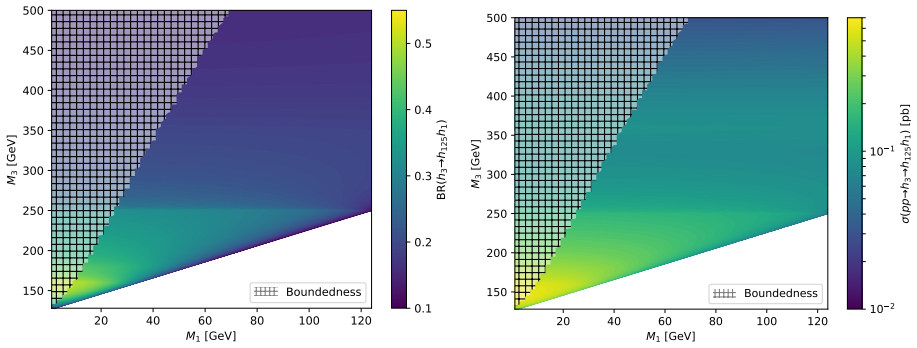
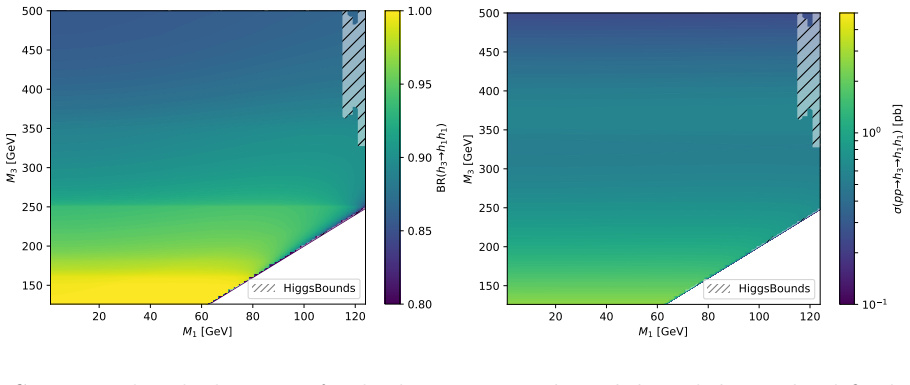
A dedicated LHC search for $pp\to h_3\to h_1h_2$ in the $b\bar{b}b\bar{b}$ final state across the BP2 plane ($M_3$ between 150 and 500 GeV, $M_1$ up to about 125 GeV) would confirm or exclude the predicted signal rates between roughly 50 fb and 0.6 pb, directly testing whether asymmetric Higgs-to-Higgs decays dominate as claimed. In BP6, a measurement of the $h_3$ line shape for $M_3\sim 400$--600 GeV would show whether the predicted $\Gamma_3/M_3$ up to about 14% is physically present.
Extended reading notes
Core claim
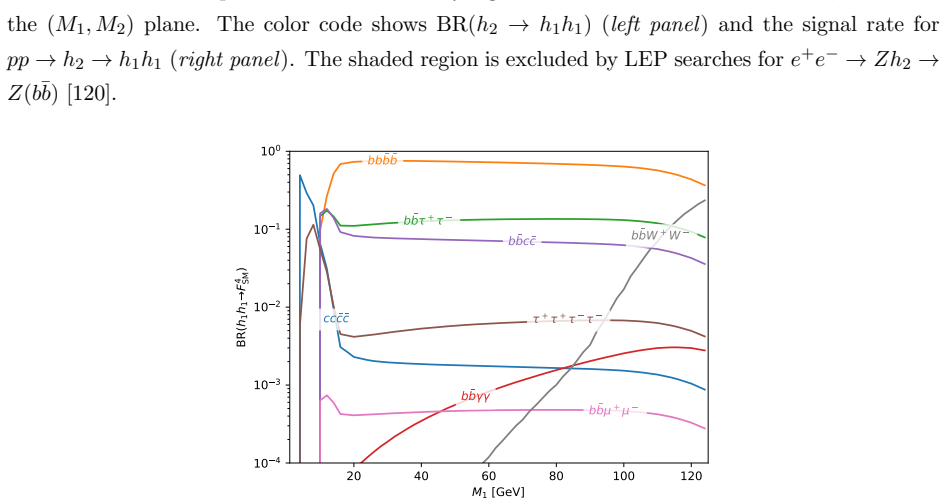
The central claim is that the two-real-singlet model with a spontaneously broken $\mathbb{Z}_2\otimes\mathbb{Z}_2'$ symmetry contains three CP-even Higgs mass eigenstates, one of which is the observed 125 GeV boson, and that resonant Higgs-to-Higgs decays among them can be sizable, easily dominating the direct decays to SM states. The paper demonstrates branching ratios up to roughly 50--90% for channels such as $h_3\to h_1h_2$, $h_3\to h_{125}h_2$, and $h_3\to h_1h_1$, together with cascade chains like $h_3\to h_1h_2$ followed by $h_2\to h_1h_1$, or $h_3\to h_2h_2$ followed by $h_2\to h_{125}h_{125}$, producing three- and four-Higgs final states. Benchmark signal rates span from tens of picobarns for light scalars down to roughly 14 fb near threshold for the four-Higgs final state. The paper also finds that current LHC searches for $h_{125}h_{125}$ and for $h_{125}\to h_ah_a$ are not sensitive to most of these signatures, so the benchmark planes are largely untested.
Load-bearing premise
All quoted rates rely on treating each scalar as a narrow resonance whose production cross section is exactly the SM value times $\kappa_a^2$ and whose production and decay factorize, with interference and off-shell effects neglected; for the widest benchmark states $\Gamma/M$ reaches about 14--18%, where that treatment is not obviously reliable.
Editorial extensions
If this is right
- Resonant LHC searches should target asymmetric decays such as $h_3\to h_1h_2$ and $h_3\to h_{125}h_2$, which reach branching ratios of 40--55% and cross sections around 0.3--0.6 pb in the benchmarks, not just the $h_{125}h_{125}$ channel.
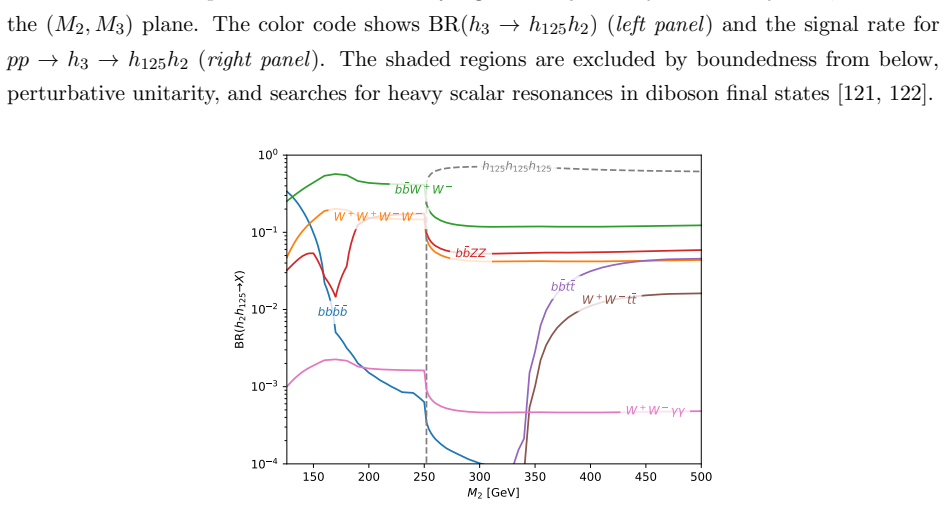
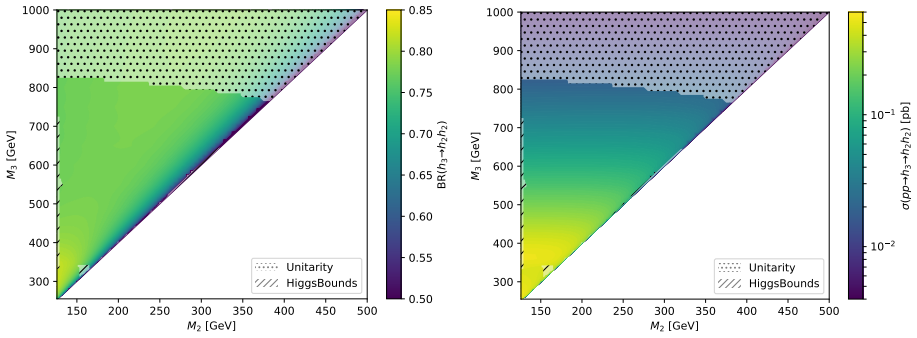
- Cascade decays produce three- and four-Higgs final states; the double cascade $h_3\to h_2h_2\to h_{125}h_{125}h_{125}h_{125}$ gives about 14 fb near threshold, with $b$-rich final states that should be visible with Run-II data.
- The six benchmark planes BP1--BP6 each maximize one novel signature while passing all applied constraints, so experimental results in those planes can be compared directly with model predictions or recast model-independently.
- Because the sum rule forces the other scalars' couplings to be small whenever the 125 GeV state is SM-like, Higgs-to-Higgs decays frequently dominate over direct SM decays, so conventional single-resonance searches can miss the model entirely.
Reading between the lines
- The same asymmetric and cascade patterns should appear in other models with three or more Higgs bosons and comparable triple-scalar couplings, so model-independent limits on these planes would constrain a broader class of singlet and multi-Higgs extensions, not only this one.
- The widest benchmark resonances reach $\Gamma_3/M_3\sim 14\%$, where the narrow-width approximation is stressed; finite-width and signal-signal interference effects could shift the quoted rates, and a line-shape measurement near threshold would settle how much the predictions move.
- Because the singlet vacuum expectation values enter the triple-scalar couplings but are only weakly constrained by current data, a future measurement of any Higgs-to-Higgs rate would give a direct, novel handle on the vacuum structure of the singlet sector, which precision electroweak fits barely probe.
Signed reviews
Editorial analysis
A structured set of objections, weighed in public.
Referee Report
Summary. The paper studies the two-real-scalar-singlet extension of the Standard Model (TRSM), in which an imposed Z2⊗Z2′ symmetry is spontaneously broken by the singlet vevs, giving three CP-even neutral scalars h1,2,3, one of which is identified with the 125 GeV Higgs boson. The authors parametrize the scalar potential in terms of physical masses, mixing angles, and vevs, and derive the resulting couplings, partial widths, and LHC signal rates. They apply theoretical constraints (boundedness, perturbative unitarity), electroweak precision constraints, and the public codes HiggsBounds and HiggsSignals to map the allowed parameter space. The central phenomenological claim is that, in addition to standard direct decays to SM particles, the model generically produces sizable Higgs-to-Higgs decays, including asymmetric decays h3→h1h2, symmetric decays h3→h1h1, h2→h1h1, and cascades such as h3→h2h2→h1h1h1h1. Six two-dimensional benchmark planes (BP1–BP6) are proposed to target these signatures, with cross sections ranging from tens of picobarns for light states to about 14 fb for the four-Higgs cascade final state near threshold.
Significance. If the quantitative rates stand, the paper fills a genuine gap: LHC searches for Higgs-to-Higgs decays have so far concentrated on h125h125 and h125→light+light, while asymmetric decays and cascades involving only non-SM scalars have received little experimental attention. The paper's strengths are its transparent physical parametrization, the explicit coupling and width formulas, the use of state-of-the-art public constraints (HiggsBounds, HiggsSignals, electroweak precision data), and the concrete, reproducible six benchmark parameter sets that experimental collaborations can adopt directly. The qualitative conclusion that these signatures can dominate over direct SM decays is robust, and the benchmark definitions are a useful community resource even if some absolute rates require further refinement.
major comments (3)
- [Sec. IV B and Eq. (40)] The central numerical predictions are computed in the narrow-width approximation with the factorized formula σ(pp→ha→hbhc) = κa^2 σSM(Ma) BR(ha→hbhc), i.e. only the s-channel single-resonance contribution is included. The paper notes in Sec. IV B that box diagrams and signal-signal interference can significantly affect di-Higgs production, but asserts without a dedicated check that such configurations "play no important role for most of the scenarios." This assertion is load-bearing because the benchmark planes include exactly the configurations where interference is known to be important: BP5 allows M1 up to 124 GeV while h125≡h2 has M2=125.09 GeV, and BP1 has a sharp threshold M2=2M1 across which BR(h2→h1h1) jumps from ~0 to ~100%. I request a quantitative estimate of off-shell and interference effects for at least the representative benchmark points, or a clear restriction of the claimed benchmark rates to regions where the NWA is reliable.
- [Sec. V F and Fig. 14] The narrow-width approximation is violated in BP6, where the total width of h3 reaches Γ3/M3 ~ 14% near the unitarity bound. The paper itself advises that "it may be important to include finite width effects in experimental analyses of this scenario," yet the quoted benchmark cross sections, including the ~14 fb four-Higgs cascade rate near threshold, are obtained under the NWA. Since the cross section is proportional to the on-shell branching ratio divided by the width, a 14% width can shift rates by order-one factors and distort line shapes near thresholds. I ask the authors to provide finite-width corrected estimates, or at least to state the expected size of the correction for the quoted benchmark rates.
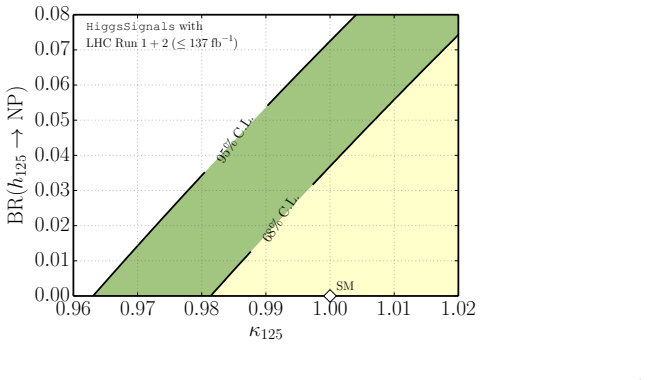
- [Eq. (22) and Sec. II B] The Higgs-to-Higgs partial widths are computed at leading order in the effective trilinear couplings, while the SM-like partial widths are taken from higher-order calculations. The branching ratios in Eqs. (26)–(28) therefore mix different perturbative orders. This is a standard limitation for benchmark studies, but it directly affects the quoted BR(h125→NP) limits and the benchmark BRs, especially in regions where a small change in a partial width can change the dominant decay mode. I ask the authors to state this limitation explicitly in Sec. II B or Sec. V, and, if feasible, to estimate the size of the leading QCD/electroweak corrections to the scalar trilinear couplings and widths.
minor comments (4)
- [Sec. V F] In the paragraph after Fig. 14 there is a typo: "the total width of of h3" should read "the total width of h3".
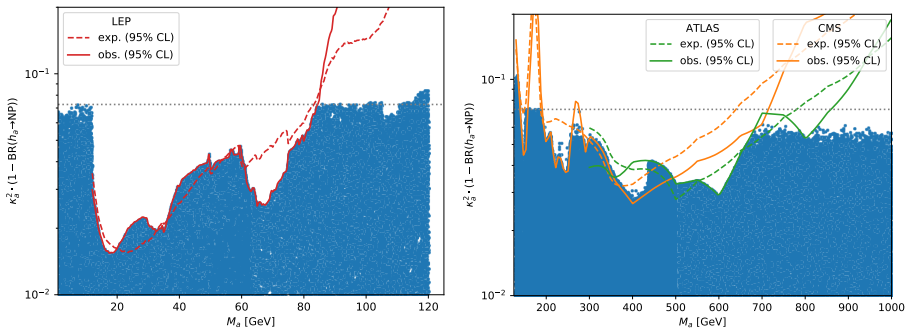
- [Fig. 4 caption] The right panel caption says the color scale shows Γa/Ma as a function of Ma and BR(ha→NP), but the plotted quantity is not fully clear from the caption alone; please clarify the color-coding and the ordering of the points.
- [Tables III and IV] The notation F^4_SM, F^6_SM, and F^8_SM is used in Tables III and IV before it is explicitly defined in the text of Sec. V; please define the notation at first use in Sec. IV B.
- [Sec. V E and Fig. 13] In BP5, the statement that the h1h1 state is identical to that of BP4 is correct only because h1 always decays like a SM Higgs of the same mass; note this explicitly in the text to avoid confusion, since the two benchmarks have different h125 assignments.
Circularity Check
No circularity: the TRSM rates are computed from scanned Lagrangian parameters and external LHC constraints, with no fitted input masquerading as a prediction.
full rationale
The paper's central predictions are the branching ratios and cross sections for Higgs-to-Higgs decays in the two-real-singlet model. These are obtained by evaluating tree-level partial widths, Eq. (22), and rescaling SM Higgs production cross sections and widths by the mixing-factor kappa_a^2, Eqs. (24)-(26) and Eq. (40). All model parameters (masses, mixing angles, vevs) are scanned input parameters, not fitted to the predicted observables. The benchmarks define explicit parameter planes with all other parameters fixed, so the quoted rates are direct evaluations rather than fits renamed as predictions. The experimental constraints come from independent data applied through HiggsBounds and HiggsSignals, which are external validation tools; the author overlap in maintaining these codes does not make the constraints circular, since they encode external LHC and LEP measurements. The paper's own caveats about the narrow-width approximation, box-diagram interference, and finite-width effects are accuracy or validity concerns, not circularity: they do not show that any prediction is equivalent to an input by construction. No load-bearing premise is justified solely by a self-citation, and no uniqueness theorem or ansatz is imported from prior author work to force the results. The derivation chain is therefore self-contained against external benchmarks, and no significant circularity is found.
Assumptions & free parameters
free parameters (1)
- Benchmark fixed parameters (six scenarios) =
Table II values (masses, theta_hS, theta_hX, theta_SX, vS, vX)
assumptions (5)
- domain assumption Global minimum theorem for the TRSM vacuum (Ref. [39])
- domain assumption Perturbative unitarity bound |M_i| < 8 pi
- domain assumption Boundedness conditions of the scalar potential (Eq. 34, from Refs. [84,85])
- domain assumption SM Higgs cross sections and decay tables from Refs. [77,114]
- domain assumption Narrow width approximation
Cite this review
Pith. "Pith review of Two-real-scalar-singlet extension of the SM: LHC phenomenology and benchmark scenarios." pith.science (2026). https://pith.science/paper/FNV7USVE
@misc{pith2026190808554,
  author       = {Pith},
  title        = {Pith review of: Two-real-scalar-singlet extension of the SM: LHC phenomenology and benchmark scenarios},
  year         = {2026},
  howpublished = {\url{https://pith.science/paper/FNV7USVE}},
  note         = {Machine review of arXiv:1908.08554}
}
abstract
We investigate the LHC phenomenology of a model where the Standard Model (SM) scalar sector is extended by two real scalar singlets. A $\mathbb{Z}_2\otimes\mathbb{Z}_2'$ discrete symmetry is imposed to reduce the number of scalar potential parameters, which is spontaneously broken by the vacuum expectation values of the singlet fields. As a result, all three neutral scalar fields mix, leading to three neutral CP-even scalar bosons, out of which one is identified with the observed Higgs boson at 125 GeV. We explore all relevant collider signatures of the three scalars in this model. Besides the single production of a scalar boson decaying directly to SM particle final states, we extensively discuss the possibility of resonant multi-scalar production. The latter includes decays of the produced scalar boson to two identical scalars ("symmetric decays"), as well as to two different scalars ("asymmetric decays"). Furthermore, we discuss the possibility of successive decays to the lightest scalar states ("cascade decays"), which lead to experimentally spectacular three- and four-Higgs final states. We provide six benchmark scenarios for detailed experimental studies of these Higgs-to-Higgs decay signatures.
Figures

Figures from the paper (12 more)






Forward citations
Cited by 13 Pith papers
-
Towards anomaly detection searches for new physics signatures including Higgs bosons with weakly supervised machine learning
HAXAD, a weakly supervised anomaly-detection search for Higgs-plus-X new physics, is extended with new embeddings and limit-setting, and on 470 fb^-1 of pseudo-data it matches or exceeds the best single cut-based limi...
-
Search for new scalars via $X \rightarrow SH \rightarrow b\bar{b}b\bar{b}$ in proton-proton collisions at $\sqrt{s} = 13$ TeV with the ATLAS detector
No excess over background is found in ATLAS's first search for X→SH→4b, which sets 95% CL upper limits of 0.7 fb–2.6 pb on the production cross-section times branching ratio.
-
TRSMScans
TRSMScans is an automated zoom-optimization scanner that computes maximal allowed rates for asymmetric scalar production and decay chains in the TRSM (and potentially other ScannerS models) under all theoretical and e...
-
Search for decays of the Higgs boson into scalar particles decaying into four or six $b$-quarks using $pp$ collisions at $\sqrt{s}= 13\,\mathrm{TeV}$ with the ATLAS detector
With 140 inverse femtobarns of 13 TeV LHC data, ATLAS finds no excess of Higgs decays to new scalars producing four or six bottom quarks, and sets 95% CL upper limits from 4% to 38% on the branching fractions.
-
Primordial Black Hole Formation via Inverted Bubble Collapse
Isolated bubbles from an incomplete phase transition, inverted into false-vacuum regions by a later bulk transition, collapse into nearly monochromatic primordial black holes up to about 10^-5 solar masses.
-
Probing new physics in the Boosted $HH \to b\bar{b}\gamma\gamma$ channel at the LHC
A dedicated boosted-jet category in HH→bbγγ is projected to narrow the κ2V constraint to [-0.4, 2.6] at 95% CL and improve heavy-resonance limits by 1–2x at 308 fb⁻¹.
-
From Qubits to Couplings: A Hybrid Quantum Machine Learning Framework for LHC Physics
A hybrid quantum-classical classifier on simulated HH→bbγγ events claims 95% CL limits of 1.9–2.1×SM, but the gain over XGBoost is 21–29%, not the advertised factor of two.
-
Triple Higgs Boson Production with Two Heavy Scalars at the LHC via a Simplified Approach
Double-resonant triple Higgs boson production at the LHC can be described by a single rescaling factor rho2, and projected 95% CL limits on rho2 over the (m2,m3) plane make the analysis applicable to any two-narrow-sc...
-
Interference effects in new physics searches
Interference between new-physics resonances and Standard Model backgrounds must be included in collider searches; the review shows it can distort, enhance, or even cancel expected signals.
-
Investigating extended scalar sectors at current and future colliders
Current LHC data leave substantial room for singlet and inert doublet scalar extensions, and scalar-to-scalar decay signatures with rates up to tens of picobarns remain unexplored.
-
Low mass scalars at $e^+e^-$ colliders
The paper summarizes new developments in models and experimental searches for low-mass scalars at Higgs factories since prior reviews.
-
Higgs physics beyond the Standard Model
A review of BSM Higgs models concludes that current LHC data imply near-alignment, leaving room for lighter or heavier additional scalars and specific untested signatures.
-
BSM: Extended Scalar Sectors
An updated review chapter on extended scalar sectors, their constraints, dark matter and CP violation links, and future collider searches.
Reference graph
Works this paper leans on
-
[1]
Englert and R
F. Englert and R. Brout, Phys. Rev. Lett. 13, 321 (1964)
1964
-
[2]
P. W. Higgs, Phys. Lett. 12, 132 (1964)
1964
-
[3]
P. W. Higgs, Phys. Rev. Lett. 13, 508 (1964)
1964
-
[4]
G. S. Guralnik, C. R. Hagen, and T. W. B. Kibble, Phys. Rev. Lett. 13, 585 (1964)
1964
-
[5]
P. W. Higgs, Phys. Rev. 145, 1156 (1966)
1966
-
[6]
T. W. B. Kibble, Phys. Rev. 155, 1554 (1967)
1967
- [7]
-
[8]
S. Chatrchyan et al. (CMS), Phys. Lett. B716, 30 (2012), arXiv:1207.7235 [hep-ex]
arXiv 2012
Show all 123 references
- [9]
-
[10]
A. M. Sirunyan et al. (CMS), Phys. Lett. B780, 501 (2018), arXiv:1709.07497 [hep-ex]
2018 arXiv
-
[11]
A. M. Sirunyan et al. (CMS), Phys. Rev. Lett. 120, 071802 (2018), arXiv:1709.05543 [hep-ex]
2018 arXiv
-
[12]
CMS collaboration, (2019), CMS-PAS-HIG-18-029
2019
-
[13]
CMS collaboration, (2019), CMS-PAS-HIG-18-030
2019
-
[14]
A. M. Sirunyan et al. (CMS), Phys. Rev. Lett. 122, 021801 (2019), arXiv:1807.06325 [hep-ex]
2019 arXiv
-
[15]
A. M. Sirunyan et al. (CMS), JHEP 08, 066 (2018), arXiv:1803.05485 [hep-ex]
2018 arXiv
-
[16]
A. M. Sirunyan et al. (CMS), Phys. Lett. B791, 96 (2019), arXiv:1806.05246 [hep-ex]
2019 arXiv
-
[17]
CMS collaboration, (2018), CMS-PAS-HIG-18-019
2018
- [18]
-
[19]
CMS collaboration, (2019), CMS-PAS-HIG-19-001
2019
-
[20]
CMS collaboration, (2019), CMS-PAS-HIG-18-032
2019
-
[21]
G. C. Branco, L. Lavoura, and J. P. Silva, Int. Ser. Monogr. Phys. 103, 1 (1999)
1999
-
[22]
I. P. Ivanov, Prog. Part. Nucl. Phys. 95, 160 (2017), arXiv:1702.03776 [hep-ph]
2017 arXiv
-
[23]
Datta and A
A. Datta and A. Raychaudhuri, Phys. Rev. D57, 2940 (1998), arXiv:hep-ph/9708444 [hep- ph]
1998 arXiv
-
[24]
R. M. Schabinger and J. D. Wells, Phys. Rev. D72, 093007 (2005), arXiv:hep-ph/0509209 [hep-ph]
2005 arXiv
- [25]
-
[26]
O’Connell, M
D. O’Connell, M. J. Ramsey-Musolf, and M. B. Wise, Phys. Rev. D75, 037701 (2007), arXiv:hep-ph/0611014 [hep-ph]. 31
2007 arXiv
-
[27]
Barger, P
V. Barger, P. Langacker, M. McCaskey, M. J. Ramsey-Musolf, and G. Shaughnessy, Phys. Rev. D77, 035005 (2008), arXiv:0706.4311 [hep-ph]
2008 arXiv
-
[28]
C.-Y. Chen, S. Dawson, and I. M. Lewis, Phys. Rev. D91, 035015 (2015), arXiv:1410.5488 [hep-ph]
2015 arXiv
-
[29]
Robens and T
T. Robens and T. Stefaniak, Eur. Phys. J. C75, 104 (2015), arXiv:1501.02234 [hep-ph]
2015 arXiv
-
[30]
Robens and T
T. Robens and T. Stefaniak, Eur. Phys. J. C76, 268 (2016), arXiv:1601.07880 [hep-ph]
2016 arXiv
-
[31]
I. M. Lewis and M. Sullivan, Phys. Rev. D96, 035037 (2017), arXiv:1701.08774 [hep-ph]
2017 arXiv
-
[32]
Ilnicka, T
A. Ilnicka, T. Robens, and T. Stefaniak, Mod. Phys. Lett. A33, 1830007 (2018), arXiv:1803.03594 [hep-ph]
2018 arXiv
-
[33]
Barger, P
V. Barger, P. Langacker, M. McCaskey, M. Ramsey-Musolf, and G. Shaughnessy, Phys. Rev. D79, 015018 (2009), arXiv:0811.0393 [hep-ph]
2009 arXiv
-
[34]
Alexander-Nunneley and A
L. Alexander-Nunneley and A. Pilaftsis, JHEP 09, 021 (2010), arXiv:1006.5916 [hep-ph]
2010 arXiv
-
[35]
Coimbra, M
R. Coimbra, M. O. P. Sampaio, and R. Santos, Eur. Phys. J. C73, 2428 (2013), arXiv:1301.2599 [hep-ph]
2013 arXiv
-
[36]
Ahriche, A
A. Ahriche, A. Arhrib, and S. Nasri, JHEP 02, 042 (2014), arXiv:1309.5615 [hep-ph]
2014 arXiv
-
[37]
Costa, A
R. Costa, A. P. Morais, M. O. P. Sampaio, and R. Santos, Phys. Rev. D92, 025024 (2015), arXiv:1411.4048 [hep-ph]
2015 arXiv
-
[38]
Costa, M
R. Costa, M. M¨ uhlleitner, M. O. P. Sampaio, and R. Santos, JHEP 06, 034 (2016), arXiv:1512.05355 [hep-ph]
2016 arXiv
-
[39]
P. M. Ferreira, Phys. Rev. D94, 096011 (2016), arXiv:1607.06101 [hep-ph]
2016 arXiv
-
[40]
Chang, K
J. Chang, K. Cheung, S.-C. Hsu, and C.-T. Lu, Phys. Rev. D95, 035012 (2017), arXiv:1607.07550 [hep-ph]
2017 arXiv
-
[41]
M¨ uhlleitner, M
M. M¨ uhlleitner, M. O. P. Sampaio, R. Santos, and J. Wittbrodt, JHEP 08, 132 (2017), arXiv:1703.07750 [hep-ph]
2017 arXiv
-
[42]
Dawson and M
S. Dawson and M. Sullivan, Phys. Rev. D97, 015022 (2018), arXiv:1711.06683 [hep-ph]
2018 arXiv
-
[43]
R. N. Lerner and J. McDonald, Phys. Rev. D80, 123507 (2009), arXiv:0909.0520 [hep-ph]
2009 arXiv
-
[44]
Barger, M
V. Barger, M. McCaskey, and G. Shaughnessy, Phys. Rev. D82, 035019 (2010), arXiv:1005.3328 [hep-ph]
2010 arXiv
-
[45]
Gonderinger, H
M. Gonderinger, H. Lim, and M. J. Ramsey-Musolf, Phys. Rev. D86, 043511 (2012), arXiv:1202.1316 [hep-ph]
2012 arXiv
-
[46]
Belanger, K
G. Belanger, K. Kannike, A. Pukhov, and M. Raidal, JCAP 1301, 022 (2013), arXiv:1211.1014 [hep-ph]
2013 arXiv
-
[47]
Ghorbani and H
K. Ghorbani and H. Ghorbani, Phys. Rev. D93, 055012 (2016), arXiv:1501.00206 [hep-ph]
2016 arXiv
-
[48]
Jiang, L
M. Jiang, L. Bian, W. Huang, and J. Shu, Phys. Rev. D93, 065032 (2016), arXiv:1502.07574 [hep-ph]
2016 arXiv
-
[49]
Athron et al
P. Athron et al. (GAMBIT), Eur. Phys. J. C77, 568 (2017), arXiv:1705.07931 [hep-ph]
2017 arXiv
-
[50]
Chiang, M
C.-W. Chiang, M. J. Ramsey-Musolf, and E. Senaha, Phys. Rev. D97, 015005 (2018), arXiv:1707.09960 [hep-ph]. 32
2018 arXiv
-
[51]
Athron, J
P. Athron, J. M. Cornell, F. Kahlhoefer, J. Mckay, P. Scott, and S. Wild, Eur. Phys. J. C78, 830 (2018), arXiv:1806.11281 [hep-ph]
2018 arXiv
-
[52]
Grzadkowski and D
B. Grzadkowski and D. Huang, JHEP 08, 135 (2018), arXiv:1807.06987 [hep-ph]
2018 arXiv
-
[53]
Curtin, P
D. Curtin, P. Meade, and C.-T. Yu, JHEP 11, 127 (2014), arXiv:1409.0005 [hep-ph]
2014 arXiv
-
[54]
A. V. Kotwal, M. J. Ramsey-Musolf, J. M. No, and P. Winslow, Phys. Rev. D94, 035022 (2016), arXiv:1605.06123 [hep-ph]
2016 arXiv
-
[55]
Beniwal, M
A. Beniwal, M. Lewicki, J. D. Wells, M. White, and A. G. Williams, JHEP 08, 108 (2017), arXiv:1702.06124 [hep-ph]
2017 arXiv
-
[56]
Cheng and L
W. Cheng and L. Bian, Phys. Rev. D98, 023524 (2018), arXiv:1801.00662 [hep-ph]
2018 arXiv
-
[57]
Ghorbani and P
K. Ghorbani and P. H. Ghorbani, JHEP 12, 077 (2019), arXiv:1906.01823 [hep-ph]
2019 arXiv
-
[58]
Aaboud et al
M. Aaboud et al. (ATLAS), Phys. Rev. D94, 052002 (2016), arXiv:1606.04782 [hep-ex]
2016 arXiv
-
[59]
A. M. Sirunyan et al. (CMS), JHEP 01, 054 (2018), arXiv:1708.04188 [hep-ex]
2018 arXiv
-
[60]
A. M. Sirunyan et al. (CMS), Phys. Lett. B778, 101 (2018), arXiv:1707.02909 [hep-ex]
2018 arXiv
- [61]
- [62]
-
[63]
Aaboud et al
M. Aaboud et al. (ATLAS), Phys. Rev. Lett. 121, 191801 (2018), [Erratum: Phys. Rev. Lett.122,no.8,089901(2019)], arXiv:1808.00336 [hep-ex]
2018 arXiv
-
[64]
Aaboud et al
M. Aaboud et al. (ATLAS), Eur. Phys. J. C78, 1007 (2018), arXiv:1807.08567 [hep-ex]
2018 arXiv
- [65]
-
[66]
A. M. Sirunyan et al. (CMS), Phys. Rev. Lett. 122, 121803 (2019), arXiv:1811.09689 [hep-ex]
2019 arXiv
-
[67]
A. M. Sirunyan et al. (CMS), JHEP 08, 152 (2018), arXiv:1806.03548 [hep-ex]
2018 arXiv
-
[68]
A. M. Sirunyan et al. (CMS), Phys. Lett. B788, 7 (2019), arXiv:1806.00408 [hep-ex]
2019 arXiv
-
[69]
Aad et al
G. Aad et al. (ATLAS), Phys. Lett. B800, 135103 (2020), arXiv:1906.02025 [hep-ex]
2020 arXiv
-
[70]
A. M. Sirunyan et al. (CMS), JHEP 11, 018 (2018), arXiv:1805.04865 [hep-ex]
2018 arXiv
-
[71]
A. M. Sirunyan et al. (CMS), Phys. Lett. B785, 462 (2018), arXiv:1805.10191 [hep-ex]
2018 arXiv
- [72]
-
[73]
Aaboud et al
M. Aaboud et al. (ATLAS), Phys. Lett. B782, 750 (2018), arXiv:1803.11145 [hep-ex]
2018 arXiv
-
[74]
A. M. Sirunyan et al. (CMS), Phys. Lett. B795, 398 (2019), arXiv:1812.06359 [hep-ex]
2019 arXiv
-
[75]
Aaboud et al
M. Aaboud et al. (ATLAS), Phys. Lett. B790, 1 (2019), arXiv:1807.00539 [hep-ex]
2019 arXiv
-
[76]
A. M. Sirunyan et al. (CMS), Phys. Lett. B800, 135087 (2020), arXiv:1907.07235 [hep-ex]
2020 arXiv
-
[77]
de Florian et al
D. de Florian et al. (LHC Higgs Cross Section Working Group), (2016), 10.23731/CYRM- 2017-002, arXiv:1610.07922 [hep-ph]
2016 arXiv
-
[78]
Djouadi, J
A. Djouadi, J. Kalinowski, and M. Spira, Comput. Phys. Commun. 108, 56 (1998), arXiv:hep-ph/9704448 [hep-ph]
1998 arXiv
-
[79]
J. M. Butterworth et al. , in Physics at TeV colliders. Proceedings, 6th Workshop, dedicated to Thomas Binoth, Les Houches, France, June 8-26, 2009 (2010) arXiv:1003.1643 [hep-ph]
2010 arXiv
-
[80]
Djouadi, J
A. Djouadi, J. Kalinowski, M. Muehlleitner, and M. Spira, Comput. Phys. Commun. 238, 214 (2019), arXiv:1801.09506 [hep-ph]. 33
2019 arXiv
-
[81]
Bredenstein, A
A. Bredenstein, A. Denner, S. Dittmaier, and M. M. Weber, Phys. Rev. D74, 013004 (2006), arXiv:hep-ph/0604011 [hep-ph]
2006 arXiv
-
[82]
Bredenstein, A
A. Bredenstein, A. Denner, S. Dittmaier, and M. M. Weber, Proceedings, 8th DESY Work- shop on Elementary Particle Theory: Loops and Legs in Quantum Field Theory: Eise- nach, Germany, 23-28 April 2006 , Nucl. Phys. Proc. Suppl. 160, 131 (2006), [,131(2006)], arXiv:hep-ph/060706...
2006 arXiv
-
[83]
Bredenstein, A
A. Bredenstein, A. Denner, S. Dittmaier, and M. M. Weber, JHEP 02, 080 (2007), arXiv:hep- ph/0611234 [hep-ph]
2007
- [84]
-
[85]
Kannike, Eur
K. Kannike, Eur. Phys. J. C76, 324 (2016), [Erratum: Eur. Phys. J.C78,no.5,355(2018)], arXiv:1603.02680 [hep-ph]
2016 arXiv
-
[86]
Altarelli and R
G. Altarelli and R. Barbieri, Phys. Lett. B253, 161 (1991)
1991
-
[87]
M. E. Peskin and T. Takeuchi, Phys. Rev. Lett. 65, 964 (1990)
1990
-
[88]
M. E. Peskin and T. Takeuchi, Phys. Rev. D46, 381 (1992)
1992
-
[89]
Maksymyk, C
I. Maksymyk, C. P. Burgess, and D. London, Phys. Rev. D50, 529 (1994), arXiv:hep- ph/9306267 [hep-ph]
1994
-
[90]
Haller, A
J. Haller, A. Hoecker, R. Kogler, K. M¨ onig, T. Peiffer, and J. Stelzer, Eur. Phys. J. C78, 675 (2018), arXiv:1803.01853 [hep-ph]
2018 arXiv
-
[91]
Grimus, L
W. Grimus, L. Lavoura, O. M. Ogreid, and P. Osland, J. Phys. G35, 075001 (2008), arXiv:0711.4022 [hep-ph]
2008 arXiv
-
[92]
Grimus, L
W. Grimus, L. Lavoura, O. M. Ogreid, and P. Osland, Nucl. Phys. B801, 81 (2008), arXiv:0802.4353 [hep-ph]
2008 arXiv
-
[93]
Lopez-Val and T
D. Lopez-Val and T. Robens, Phys. Rev. D90, 114018 (2014), arXiv:1406.1043 [hep-ph]
2014 arXiv
-
[94]
Schael et al
S. Schael et al. (ALEPH, DELPHI, L3, OPAL, LEP Electroweak), Phys. Rept. 532, 119 (2013), arXiv:1302.3415 [hep-ex]
2013 arXiv
-
[95]
T. A. Aaltonen et al. (CDF), Phys. Rev. D89, 072003 (2014), arXiv:1311.0894 [hep-ex]
2014 arXiv
-
[96]
Aaboud et al
M. Aaboud et al. (ATLAS), Eur. Phys. J. C78, 110 (2018), [Erratum: Eur. Phys. J.C78,no.11,898(2018)], arXiv:1701.07240 [hep-ex]
2018 arXiv
-
[97]
Tanabashi et al
M. Tanabashi et al. (Particle Data Group), Phys. Rev. D98, 030001 (2018)
2018
-
[98]
Bechtle, O
P. Bechtle, O. Brein, S. Heinemeyer, G. Weiglein, and K. E. Williams, Comput. Phys. Commun. 181, 138 (2010), arXiv:0811.4169 [hep-ph]
2010 arXiv
-
[99]
Bechtle, O
P. Bechtle, O. Brein, S. Heinemeyer, G. Weiglein, and K. E. Williams, Comput. Phys. Commun. 182, 2605 (2011), arXiv:1102.1898 [hep-ph]
2011 arXiv
-
[100]
Bechtle, O
P. Bechtle, O. Brein, S. Heinemeyer, O. St˚ al, T. Stefaniak, G. Weiglein, and K. Williams, Proceedings, 4th International Workshop on Prospects for Charged Higgs Discovery at Col- liders (CHARGED 2012): Uppsala, Sweden, October 8-11, 2012 , PoS CHARGED2012, 024 (2012), arXiv:...
2012 arXiv
-
[101]
Bechtle, O
P. Bechtle, O. Brein, S. Heinemeyer, O. St˚ al, T. Stefaniak, G. Weiglein, and K. E. Williams, Eur. Phys. J. C74, 2693 (2014), arXiv:1311.0055 [hep-ph]
2014 arXiv
-
[102]
Bechtle, S
P. Bechtle, S. Heinemeyer, O. St˚ al, T. Stefaniak, and G. Weiglein, Eur. Phys. J. C75, 421 (2015), arXiv:1507.06706 [hep-ph]
2015 arXiv
-
[103]
HiggsBounds,
P. Bechtle, D. Dercks, S. Heinemeyer, T. Klingl, T. Stefaniak, G. Weiglein, and J. Wittbrodt, “HiggsBounds,” https://gitlab.com/higgsbounds/higgsbounds (2019)
2019
-
[104]
St˚ al and T
O. St˚ al and T. Stefaniak, Proceedings, 2013 European Physical Society Conference on High Energy Physics (EPS-HEP 2013): Stockholm, Sweden, July 18-24, 2013 , PoS EPS- HEP2013, 314 (2013), arXiv:1310.4039 [hep-ph]
2013 arXiv
-
[105]
Bechtle, S
P. Bechtle, S. Heinemeyer, O. St˚ al, T. Stefaniak, and G. Weiglein, Eur.Phys.J. C74, 2711 (2014), arXiv:1305.1933 [hep-ph]
2014 arXiv
-
[106]
Bechtle, S
P. Bechtle, S. Heinemeyer, O. St˚ al, T. Stefaniak, and G. Weiglein, JHEP 11, 039 (2014), arXiv:1403.1582 [hep-ph]
2014 arXiv
-
[107]
HiggsSignals,
P. Bechtle, D. Dercks, S. Heinemeyer, T. Klingl, T. Stefaniak, G. Weiglein, and J. Wittbrodt, “HiggsSignals,” https://gitlab.com/higgsbounds/higgssignals (2019)
2019
-
[108]
ATLAS collaboration, (2019), ATLAS-CONF-2019-005
2019
-
[109]
Cepeda et al
M. Cepeda et al. (Physics of the HL-LHC Working Group), (2019), arXiv:1902.00134 [hep- ph]
2019 arXiv
-
[110]
A. M. Sirunyan et al. (CMS), Phys. Lett. B793, 520 (2019), arXiv:1809.05937 [hep-ex]
2019 arXiv
-
[111]
Aaboud et al
M. Aaboud et al. (ATLAS), Phys. Rev. Lett. 122, 231801 (2019), arXiv:1904.05105 [hep-ex]
2019 arXiv
-
[112]
P. M. Ferreira, R. Guedes, M. O. P. Sampaio, and R. Santos, JHEP 12, 067 (2014), arXiv:1409.6723 [hep-ph]
2014 arXiv
-
[113]
M¨ uhlleitner, M
M. M¨ uhlleitner, M. O. P. Sampaio, R. Santos, and J. Wittbrodt, JHEP 03, 094 (2017), arXiv:1612.01309 [hep-ph]
2017 arXiv
-
[114]
J. R. Andersen et al. (LHC Higgs Cross Section Working Group), (2013), 10.5170/CERN- 2013-004, arXiv:1307.1347 [hep-ph]
2013 arXiv
-
[115]
Anastasiou, C
C. Anastasiou, C. Duhr, F. Dulat, E. Furlan, T. Gehrmann, F. Herzog, A. Lazopoulos, and B. Mistlberger, JHEP 05, 058 (2016), arXiv:1602.00695 [hep-ph]
2016 arXiv
-
[116]
Dawson and I
S. Dawson and I. M. Lewis, Phys. Rev. D92, 094023 (2015), arXiv:1508.05397 [hep-ph]
2015 arXiv
-
[117]
Carena, Z
M. Carena, Z. Liu, and M. Riembau, Phys. Rev. D97, 095032 (2018), arXiv:1801.00794 [hep-ph]
2018 arXiv
-
[118]
Alison et al
J. Alison et al. , in Double Higgs Production at Colliders Batavia, IL, USA, September 4, 2018-9, 2019 , edited by B. Di Micco, M. Gouzevitch, J. Mazzitelli, and C. Vernieri (2019) arXiv:1910.00012 [hep-ph]
2019 arXiv
-
[119]
Basler, S
P. Basler, S. Dawson, C. Englert, and M. M¨ uhlleitner, (2019), arXiv:1909.09987 [hep-ph]
2019 arXiv
-
[120]
Schael et al
S. Schael et al. (ALEPH, DELPHI, L3, OPAL, LEP Working Group for Higgs Boson Searches), Eur. Phys. J. C47, 547 (2006), arXiv:hep-ex/0602042 [hep-ex]
2006 arXiv
-
[121]
Aaboud et al
M. Aaboud et al. (ATLAS), Phys. Rev. D98, 052008 (2018), arXiv:1808.02380 [hep-ex]. 35
2018 arXiv
-
[122]
A. M. Sirunyan et al. (CMS), JHEP 06, 127 (2018), [Erratum: JHEP03,128(2019)], arXiv:1804.01939 [hep-ex]
2018 arXiv
-
[123]
Aaboud et al
M. Aaboud et al. (ATLAS), Phys. Rev. D99, 012008 (2019), arXiv:1808.10515 [hep-ex]. 36
2019 arXiv
Reviewed August 14, 2026 · model on record in the stance chip above.
Discussion (0). Continue with ORCID to comment.