Emergent Local Phase-Space Scaling in Small-x Gluon Evolution
Pith reviewed 2026-07-01 04:28 UTC · model grok-4.3
The pith
Gluon momentum distributions in small-x evolution collapse onto a universal curve when resolved at the local saturation scale.
A machine-rendered reading of the paper's core claim, the machinery that carries it, and where it could break.
Core claim
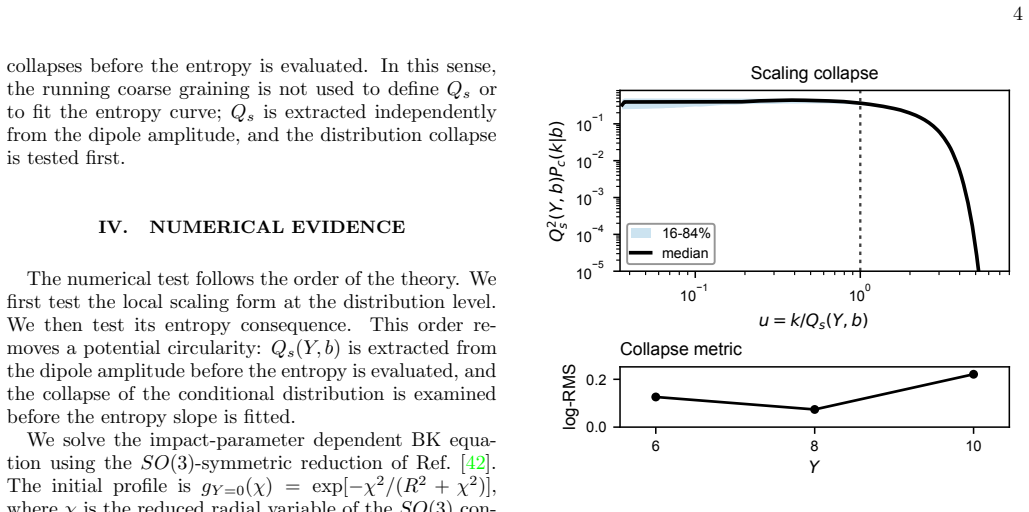
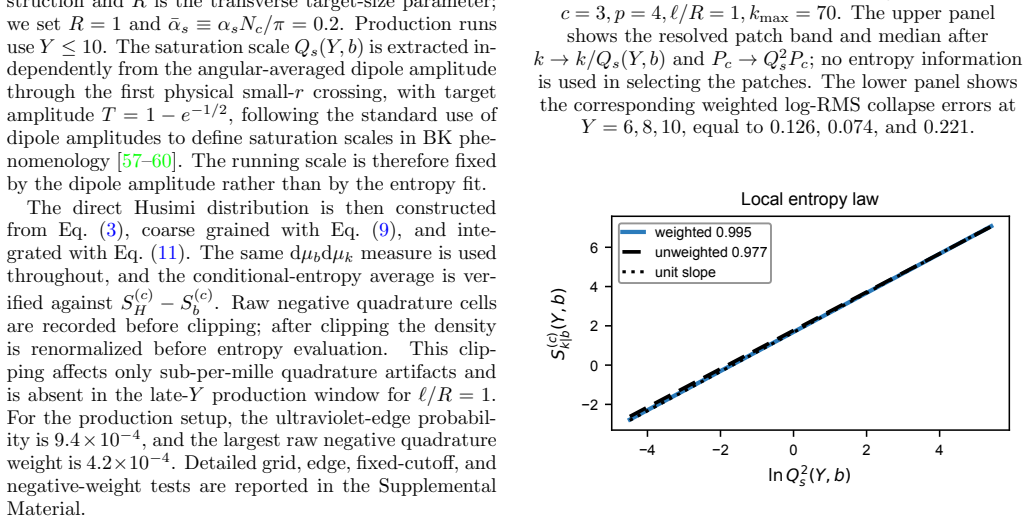
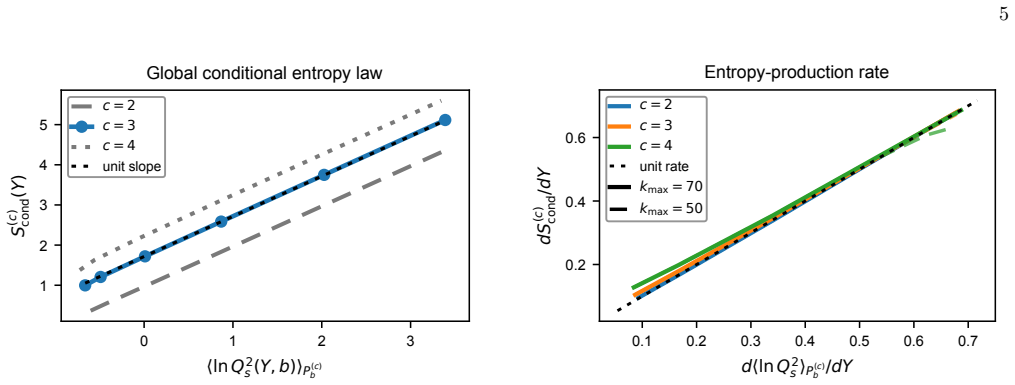
In the SO(3)-symmetric fixed-coupling BK setting the gluon Husimi phase-space distribution, once resolved by a local coarse graining whose ultraviolet boundary follows Q_s(Y,b), yields conditional momentum distributions that collapse as functions of k/Q_s(Y,b). The conditional entropy consequently grows with unit slope relative to the expectation value of ln Q_s squared. Fixed laboratory cutoffs do not produce this relation, while multiple numerical scans confirm stability of the Q_s-adaptive result inside the controlled window. The finding is presented as a local phase-space scaling structure rather than a universal law for unregulated global entropy.
What carries the argument
The Q_s(Y,b)-adaptive local coarse graining of the normalized gluon Husimi phase-space distribution, which produces the observed collapse of conditional momentum distributions.
If this is right
- Fixed laboratory cutoffs produce no linear entropy growth law.
- The collapse and unit-slope entropy relation remain stable under dense-rapidity sampling, cutoff-window variation, box-size changes, regulator-shape alterations, and Husimi-resolution adjustments.
- The identified structure is a local phase-space scaling of the gluon Husimi distribution rather than a statement about unregulated global entropy.
Where Pith is reading between the lines
- The distinction between adaptive local scaling and fixed-cutoff behavior suggests that global entropy measures may obscure the underlying saturation-driven organization of phase space.
- If the same adaptive-resolution procedure is applied to running-coupling or full impact-parameter BK evolution, the unit slope may serve as a diagnostic of how saturation dynamics organizes momentum distributions.
- The collapse onto k/Q_s offers a concrete way to test whether phenomenological models of transverse-momentum-dependent gluon distributions inherit the same local scaling.
Load-bearing premise
The ultraviolet boundary of the local coarse graining is taken to follow Q_s(Y,b) exactly.
What would settle it
A numerical run in which the conditional momentum distributions do not collapse when the coarse-graining cutoff is set to the local Q_s(Y,b), or in which the conditional entropy slope deviates from unity under that same resolution.
Figures
read the original abstract
Geometric scaling is a central output of nonlinear small-$x$ evolution, but it is less clear whether the same dynamics fixes a probability distribution in transverse phase space. Using fixed-coupling impact-parameter BK evolution in the $SO(3)$-symmetric construction, we build a normalized gluon Husimi phase-space distribution and resolve it with a local coarse graining whose ultraviolet boundary follows $Q_s(Y,b)$. The main result is a distribution-level one: after this $Q_s$-adaptive resolution, the conditional momentum distributions collapse as functions of $k/Q_s(Y,b)$. The conditional entropy then grows with unit slope relative to $\langle\ln Q_s^2\rangle$, as the integrated consequence of that collapse and the two-dimensional momentum measure. Fixed laboratory cutoffs do not show this law, while dense-rapidity, cutoff-window, box-size, regulator-shape, and Husimi-resolution scans keep the $Q_s$-adaptive result stable in the controlled window. Within this fixed-coupling $SO(3)$-BK setting, the result identifies a local phase-space scaling structure of the gluon Husimi distribution rather than a universal law for unregulated global entropy.
Editorial analysis
A structured set of objections, weighed in public.
Referee Report
Summary. The paper studies the normalized gluon Husimi phase-space distribution obtained from fixed-coupling impact-parameter BK evolution in the SO(3)-symmetric construction. It introduces a local coarse-graining procedure whose ultraviolet cutoff is set to follow the saturation scale Q_s(Y,b) extracted from the same distribution, and reports that the conditional transverse-momentum distributions then collapse onto functions of k/Q_s(Y,b). As a direct consequence of this collapse and the two-dimensional momentum measure, the conditional entropy grows linearly with unit slope versus ⟨ln Q_s²⟩. Fixed laboratory cutoffs do not produce the scaling, while multiple numerical scans (dense rapidity, cutoff window, box size, regulator shape, Husimi resolution) leave the Q_s-adaptive result stable within the controlled window.
Significance. If the reported collapse is shown to be independent of the precise adaptive-cutoff construction, the result would identify a local phase-space scaling structure inside the SO(3)-BK dynamics that is not visible in global quantities. The numerical stability under several controlled scans supplies concrete evidence for the robustness of the observation within the chosen model and resolution scheme.
major comments (1)
- [resolution procedure / abstract] The ultraviolet boundary of the local coarse graining is defined to track Q_s(Y,b) exactly (abstract and methods description of the resolution procedure). Because Q_s is extracted from the gluon distribution being evolved and the scaling variable is k/Q_s, the observed collapse onto k/Q_s and the unit-slope entropy law are at risk of being direct consequences of this modeling choice rather than independent emergent features. The manuscript correctly notes that fixed cutoffs do not exhibit the law, but does not provide an explicit test that separates the cutoff definition from the scaling variable while keeping the same dynamics.
Simulated Author's Rebuttal
We thank the referee for the careful reading and the constructive comment on the potential dependence on the adaptive-cutoff construction. We address the point below and will strengthen the manuscript accordingly.
read point-by-point responses
-
Referee: [resolution procedure / abstract] The ultraviolet boundary of the local coarse graining is defined to track Q_s(Y,b) exactly (abstract and methods description of the resolution procedure). Because Q_s is extracted from the gluon distribution being evolved and the scaling variable is k/Q_s, the observed collapse onto k/Q_s and the unit-slope entropy law are at risk of being direct consequences of this modeling choice rather than independent emergent features. The manuscript correctly notes that fixed cutoffs do not exhibit the law, but does not provide an explicit test that separates the cutoff definition from the scaling variable while keeping the same dynamics.
Authors: We agree that an explicit decoupling test would further substantiate the claim. While the fixed-cutoff scans already demonstrate that a non-adaptive ultraviolet boundary fails to produce the collapse, we will add in the revision a controlled scan in which the coarse-graining cutoff is set to a constant multiple (0.5 Q_s and 2 Q_s) of the locally extracted saturation scale while the conditional distributions are still examined versus k/Q_s. This will test whether the observed scaling persists only when the cutoff precisely matches Q_s or remains robust under modest detuning, thereby separating the cutoff definition from the scaling variable within the same underlying dynamics. The additional numerical results will be reported in a new subsection of the methods and results sections. revision: yes
Circularity Check
No circularity; scaling is numerical observation under stated modeling choice
full rationale
The derivation evolves the gluon Husimi distribution via fixed-coupling SO(3)-BK, then applies local coarse graining with UV boundary set to Q_s(Y,b) as an explicit modeling choice. The collapse onto k/Q_s and the resulting unit-slope entropy growth (explicitly derived as the integral consequence of that collapse plus the 2D momentum measure) are reported as numerical outcomes, with direct verification that fixed laboratory cutoffs fail to produce the law. No self-citations appear, no parameters are fitted then relabeled as predictions, and no equation reduces by construction to its input; the adaptive resolution is presented as the procedure that reveals the structure rather than a definitional tautology. The central claim therefore remains self-contained within the controlled numerical scans described.
Axiom & Free-Parameter Ledger
free parameters (1)
- fixed coupling strength
axioms (2)
- domain assumption Fixed-coupling approximation is valid for the evolution under study
- domain assumption SO(3) symmetry adequately captures impact-parameter dependence
Reference graph
Works this paper leans on
-
[1]
L. V. Gribov, E. M. Levin, and M. G. Ryskin, Phys. Rept.100, 1 (1983)
1983
-
[2]
A. H. Mueller and J.-w. Qiu, Nucl. Phys. B268, 427 (1986)
1986
-
[3]
A. H. Mueller, Nucl. Phys. B415, 373 (1994)
1994
-
[4]
L. D. McLerran and R. Venugopalan, Phys. Rev. D49, 2233 (1994), arXiv:hep-ph/9309289
work page internal anchor Pith review Pith/arXiv arXiv 1994
-
[5]
L. D. McLerran and R. Venugopalan, Phys. Rev. D49, 3352 (1994), arXiv:hep-ph/9311205
work page internal anchor Pith review Pith/arXiv arXiv 1994
-
[6]
L. D. McLerran and R. Venugopalan, Phys. Rev. D50, 2225 (1994), arXiv:hep-ph/9402335
work page internal anchor Pith review Pith/arXiv arXiv 1994
-
[7]
Y. V. Kovchegov, Phys. Rev. D54, 5463 (1996), arXiv:hep-ph/9605446
work page internal anchor Pith review Pith/arXiv arXiv 1996
-
[8]
J. Jalilian-Marian, A. Kovner, A. Leonidov, and H. Weigert, Nucl. Phys. B504, 415 (1997), arXiv:hep- ph/9701284
-
[9]
J. Jalilian-Marian, A. Kovner, A. Leonidov, and H. Weigert, Phys. Rev. D59, 014014 (1998), arXiv:hep- ph/9706377
-
[10]
The Wilson renormalization group for low x physics: Gluon evolution at finite parton density
J. Jalilian-Marian, A. Kovner, and H. Weigert, Phys. Rev. D59, 014015 (1998), arXiv:hep-ph/9709432
work page internal anchor Pith review Pith/arXiv arXiv 1998
-
[11]
Nonlinear Gluon Evolution in the Color Glass Condensate: I
E. Iancu, A. Leonidov, and L. D. McLerran, Nucl. Phys. A692, 583 (2001), arXiv:hep-ph/0011241
work page internal anchor Pith review Pith/arXiv arXiv 2001
-
[12]
The Renormalization Group Equation for the Color Glass Condensate
E. Iancu, A. Leonidov, and L. D. McLerran, Phys. Lett. B510, 133 (2001), arXiv:hep-ph/0102009
work page internal anchor Pith review Pith/arXiv arXiv 2001
-
[13]
Nonlinear Gluon Evolution in the Color Glass Condensate: II
E. Ferreiro, E. Iancu, A. Leonidov, and L. McLerran, Nucl. Phys. A703, 489 (2002), arXiv:hep-ph/0109115
work page internal anchor Pith review Pith/arXiv arXiv 2002
-
[14]
The Colour Glass Condensate: An Introduction
E. Iancu, A. Leonidov, and L. McLerran, arXiv preprint (2002), arXiv:hep-ph/0202270
work page internal anchor Pith review Pith/arXiv arXiv 2002
-
[15]
Evolution at small x_bj: The Color Glass Condensate
H. Weigert, Prog. Part. Nucl. Phys.55, 461 (2005), arXiv:hep-ph/0501087
work page internal anchor Pith review Pith/arXiv arXiv 2005
-
[16]
F. Gelis, E. Iancu, J. Jalilian-Marian, and R. Venu- gopalan, Ann. Rev. Nucl. Part. Sci.60, 463 (2010), arXiv:1002.0333 [hep-ph]
work page internal anchor Pith review Pith/arXiv arXiv 2010
-
[17]
Balitsky, Nucl
I. Balitsky, Nucl. Phys. B463, 99 (1996)
1996
-
[18]
Y. V. Kovchegov, Phys. Rev. D60, 034008 (1999), arXiv:hep-ph/9901281
work page internal anchor Pith review Pith/arXiv arXiv 1999
-
[19]
Y. V. Kovchegov, Phys. Rev. D61, 074018 (2000), arXiv:hep-ph/9905214
work page internal anchor Pith review Pith/arXiv arXiv 2000
-
[20]
I. Balitsky, Phys. Rev. D75, 014001 (2007), arXiv:hep- ph/0609105
-
[21]
Y. V. Kovchegov and H. Weigert, Nucl. Phys. A784, 188 (2007), arXiv:hep-ph/0609090
work page internal anchor Pith review Pith/arXiv arXiv 2007
-
[22]
A. M. Stasto, K. J. Golec-Biernat, and J. Kwiecinski, Phys. Rev. Lett.86, 596 (2001), arXiv:hep-ph/0007192
work page internal anchor Pith review Pith/arXiv arXiv 2001
-
[23]
D. N. Triantafyllopoulos, Nucl. Phys. B648, 293 (2003), arXiv:hep-ph/0209121
work page internal anchor Pith review Pith/arXiv arXiv 2003
-
[24]
Geometric scaling as traveling waves
S. Munier and R. Peschanski, Phys. Rev. Lett.91, 232001 (2003), arXiv:hep-ph/0309177
work page internal anchor Pith review Pith/arXiv arXiv 2003
-
[25]
Geometric Scaling above the Saturation Scale
E. Iancu, K. Itakura, and L. McLerran, Nucl. Phys. A 708, 327 (2002), arXiv:hep-ph/0203137
work page internal anchor Pith review Pith/arXiv arXiv 2002
-
[26]
A. H. Mueller and D. N. Triantafyllopoulos, Nucl. Phys. B640, 331 (2002), arXiv:hep-ph/0205167
work page internal anchor Pith review Pith/arXiv arXiv 2002
-
[27]
A. H. Mueller and A. I. Shoshi, Nucl. Phys. B692, 175 (2004), arXiv:hep-ph/0402193
work page internal anchor Pith review Pith/arXiv arXiv 2004
-
[28]
The Color Glass Condensate and hadron production in the forward region
A. Dumitru, A. Hayashigaki, and J. Jalilian-Marian, Nucl. Phys. A765, 464 (2006), arXiv:hep-ph/0506308
work page internal anchor Pith review Pith/arXiv arXiv 2006
-
[29]
Saturation QCD predictions with heavy quarks at HERA
G. Soyez, Phys. Lett. B655, 32 (2007), arXiv:0705.3672 [hep-ph]
work page internal anchor Pith review Pith/arXiv arXiv 2007
-
[30]
Improving the kinematics for low-x QCD evolution equations in coordinate space
G. Beuf, Phys. Rev. D89, 074039 (2014), arXiv:1401.0313 [hep-ph]
work page internal anchor Pith review Pith/arXiv arXiv 2014
- [31]
-
[32]
A. V. Belitsky, X. Ji, and F. Yuan, Phys. Rev. D69, 074014 (2004), arXiv:hep-ph/0307383
work page internal anchor Pith review Pith/arXiv arXiv 2004
-
[33]
Generalized parton correlation functions for a spin-1/2 hadron
S. Meissner, A. Metz, and M. Schlegel, JHEP08, 056 (2009), arXiv:0906.5323 [hep-ph]
work page internal anchor Pith review Pith/arXiv arXiv 2009
-
[34]
Quark Wigner Distributions and Orbital Angular Momentum
C. Lorc´ e and B. Pasquini, Phys. Rev. D84, 014015 (2011), arXiv:1106.0139 [hep-ph]
work page internal anchor Pith review Pith/arXiv arXiv 2011
-
[35]
C. Lorc´ e, B. Pasquini, and M. Vanderhaeghen, JHEP 05, 041 (2011), arXiv:1102.4704 [hep-ph]
work page internal anchor Pith review Pith/arXiv arXiv 2011
-
[36]
Gluons and the quark sea at high energies: distributions, polarization, tomography
D. Boeret al., arXiv preprint (2011), arXiv:1108.1713 [nucl-th]
work page internal anchor Pith review Pith/arXiv arXiv 2011
-
[37]
Universality of Unintegrated Gluon Distributions at small x
F. Dominguez, C. Marquet, B.-W. Xiao, and F. Yuan, Phys. Rev. D83, 105005 (2011), arXiv:1101.0715 [hep- ph]
work page internal anchor Pith review Pith/arXiv arXiv 2011
-
[38]
Gluon polarization in the nucleon demystified
Y. Hatta, Phys. Rev. D84, 041701 (2011), arXiv:1101.5989 [hep-ph]
work page internal anchor Pith review Pith/arXiv arXiv 2011
-
[39]
Notes on the orbital angular momentum of quarks in the nucleon
Y. Hatta, Phys. Lett. B708, 186 (2012), arXiv:1111.3547 [hep-ph]
work page internal anchor Pith review Pith/arXiv arXiv 2012
-
[40]
Probing the Small-$x$ Gluon Tomography in Correlated Hard Diffractive Dijet Production in DIS
Y. Hatta, B.-W. Xiao, and F. Yuan, Phys. Rev. Lett. 116, 202301 (2016), arXiv:1601.01585 [hep-ph]
work page internal anchor Pith review Pith/arXiv arXiv 2016
-
[41]
The elliptic gluon GTMD inside a large nucleus
J. Zhou, Phys. Rev. D94, 114017 (2016), arXiv:1611.02397 [hep-ph]
work page internal anchor Pith review Pith/arXiv arXiv 2016
-
[42]
Wigner, Husimi and GTMD distributions in the Color Glass Condensate
Y. Hagiwara, Y. Hatta, and T. Ueda, Phys. Rev. D94, 094036 (2016), arXiv:1609.05773 [hep-ph]
work page internal anchor Pith review Pith/arXiv arXiv 2016
-
[43]
Gluon Tomography from Deeply Virtual Compton Scattering at Small-x
Y. Hatta, B.-W. Xiao, and F. Yuan, Phys. Rev. D95, 114026 (2017), arXiv:1703.02085 [hep-ph]
work page internal anchor Pith review Pith/arXiv arXiv 2017
-
[44]
Husimi, Proc
K. Husimi, Proc. Phys. Math. Soc. Jpn.22, 264 (1940)
1940
-
[45]
Wehrl, Rev
A. Wehrl, Rev. Mod. Phys.50, 221 (1978)
1978
-
[46]
E. H. Lieb, Commun. Math. Phys.62, 35 (1978)
1978
-
[47]
Lee,Theory and application of the quantum phase- space distribution functions, Physics Reports, Vol
H.-W. Lee,Theory and application of the quantum phase- space distribution functions, Physics Reports, Vol. 259 (Elsevier, 1995) pp. 147–211
1995
-
[48]
Y. Hagiwara and Y. Hatta, Phys. Rev. D92, 094007 (2015), arXiv:1504.07618 [hep-ph]
-
[49]
D. E. Kharzeev and E. M. Levin, Phys. Rev. D95, 114008 (2017), arXiv:1702.03489 [hep-ph]
work page internal anchor Pith review Pith/arXiv arXiv 2017
-
[50]
Entanglement entropy and entropy production in the Color Glass Condensate framework
A. Kovner and M. Lublinsky, Phys. Rev. D92, 034016 (2015), arXiv:1506.05394 [hep-ph]
work page internal anchor Pith review Pith/arXiv arXiv 2015
-
[51]
Exact dynamics of a Gaussian wave-packet in two potential curves coupled at a point
A. Kovner, M. Lublinsky, and V. V. Skokov, Phys. Rev. D98, 014004 (2018), arXiv:1805.01463 [hep-ph]
work page internal anchor Pith review Pith/arXiv arXiv 2018
-
[52]
N. Armesto, F. Dominguez, A. Kovner, M. Lublin- sky, and V. V. Skokov, JHEP05, 025 (2019), arXiv:1901.08080 [hep-ph]
work page internal anchor Pith review Pith/arXiv arXiv 2019
-
[53]
Dynamics of entanglement in expanding quantum fields
J. Berges, S. Floerchinger, and R. Venugopalan, JHEP 04, 145 (2018), arXiv:1712.09362 [hep-th]
work page internal anchor Pith review Pith/arXiv arXiv 2018
- [54]
-
[55]
M. Hentschinski and K. Kutak, Eur. Phys. J. C82, 111 (2022), arXiv:2110.06156 [hep-ph]
-
[56]
M. Hentschinski, K. Kutak, and R. Straka, Eur. Phys. J. C82, 1147 (2022), arXiv:2207.09430 [hep-ph]
-
[57]
K. J. Golec-Biernat and M. Wusthoff, Phys. Rev. D59, 014017 (1998), arXiv:hep-ph/9807513
work page internal anchor Pith review Pith/arXiv arXiv 1998
-
[58]
K. J. Golec-Biernat and M. Wusthoff, Phys. Rev. D60, 114023 (1999), arXiv:hep-ph/9903358
work page internal anchor Pith review Pith/arXiv arXiv 1999
-
[59]
J. L. Albacete and Y. V. Kovchegov, Phys. Rev. D75, 125021 (2007), arXiv:0704.0612 [hep-ph]
work page internal anchor Pith review Pith/arXiv arXiv 2007
-
[60]
J. L. Albacete, N. Armesto, J. G. Milhano, P. Quiroga- Arias, and C. A. Salgado, Eur. Phys. J. C71, 1705 (2011), arXiv:1012.4408 [hep-ph]. 7 Appendix A: Supplemental Material The main text gives the shortest version of the argu- ment: a gluon Husimi distribution is normalized as a phase-space probability, conditioned at fixed impact pa- rameter, and then ...
work page internal anchor Pith review Pith/arXiv arXiv 2011
-
[61]
The small-xWigner distribution con- tains the transverse phase-space information needed for a local entropy, but it is a quasi-probability and can be neg- ative
Exact Husimi Kernel and Probability Measure The first step is to define the object whose entropy is being measured. The small-xWigner distribution con- tains the transverse phase-space information needed for a local entropy, but it is a quasi-probability and can be neg- ative. The Husimi transform is therefore not a cosmetic smoothing: it is the operation...
-
[62]
A bare global entropy is too inclusive for this purpose
Conditional Entropy Law The central question is which part of the Husimi en- tropy is controlled by saturation scaling. A bare global entropy is too inclusive for this purpose. It contains the impact-parameter marginal, the changing transverse sup- port of the target, the high-kdilute tail, and finite-box sensitivity. The observable used in the Letter rem...
-
[63]
The saturation scale is extracted from the dipole amplitude before the Husimi entropy is evaluated, and the entropy fit is never used to defineQ s
Numerical Implementation and Diagnostics The numerical calculation is organized to avoid circu- larity. The saturation scale is extracted from the dipole amplitude before the Husimi entropy is evaluated, and the entropy fit is never used to defineQ s. Thus the ob- served unit slope is a prediction of the scaling construc- tion, not a consequence of fittin...
-
[64]
First, the result could be tuned by the choice of the running windowc
Stability of the Global Conditional Slope The stability tests address four possible alternative ex- planations of the unit slope. First, the result could be tuned by the choice of the running windowc. Second, it could come from the particular smooth cutoff shape. Third, it could be a finitek max orb max effect. Fourth, it could be an artifact of using a f...
-
[65]
It does not exhaust all in- formation in the Husimi distribution
Mutual Information and Angular Extensions The conditional entropy measures the growth of local momentum phase-space area. It does not exhaust all in- formation in the Husimi distribution. Momentum-impact mutual information measures genuine correlations be- tween where a gluon is resolved and what momentum it carries. It is therefore sensitive to spatial i...
discussion (0)
Sign in with ORCID, Apple, or X to comment. Anyone can read and Pith papers without signing in.