Identifying Observational Signatures of Flux Eruption Events in Supermassive Black Hole Accretion Flows with Machine Learning
Pith reviewed 2026-06-30 00:41 UTC · model grok-4.3
The pith
Machine learning identifies diffuse emission, higher polarization, and lower flux as signatures of flux eruption events in black hole accretion flows, though these are weak compared to normal variability.
A machine-rendered reading of the paper's core claim, the machinery that carries it, and where it could break.
Core claim
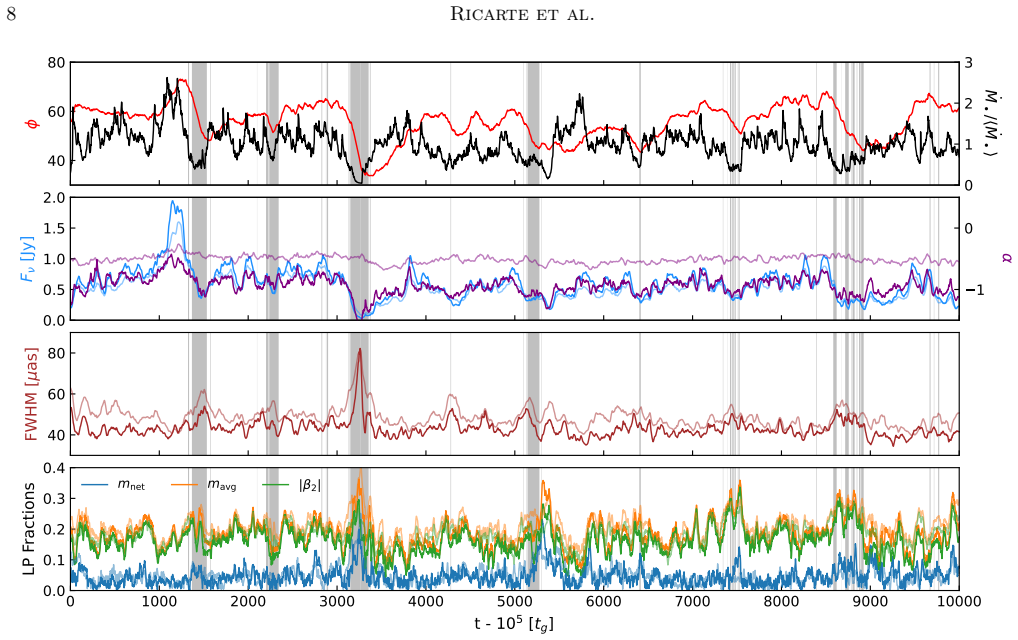
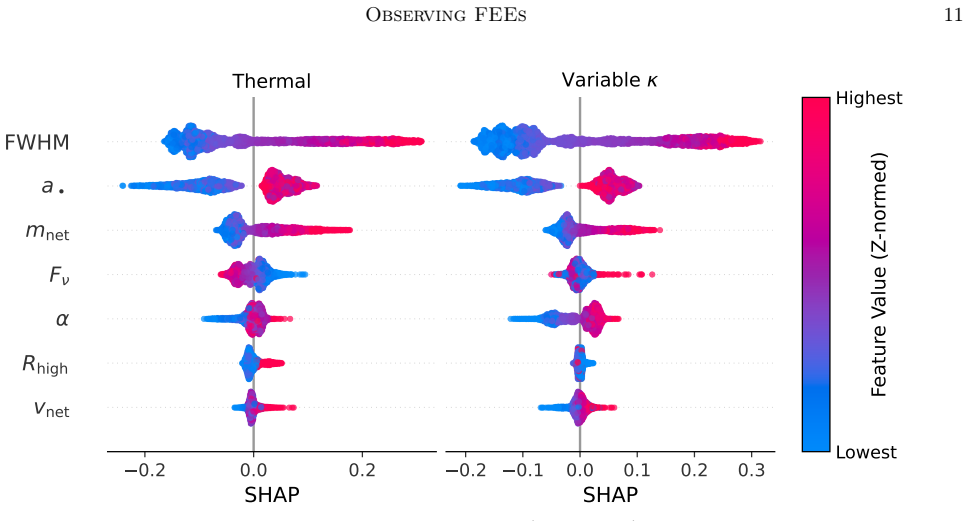
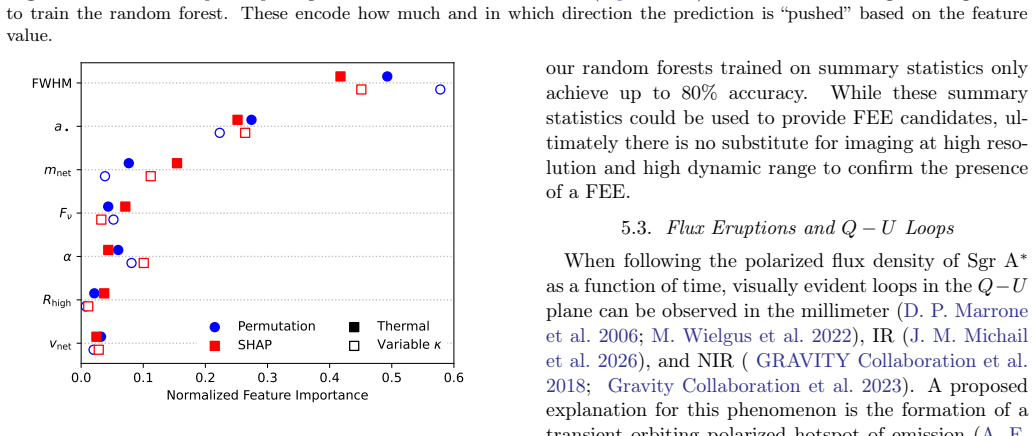
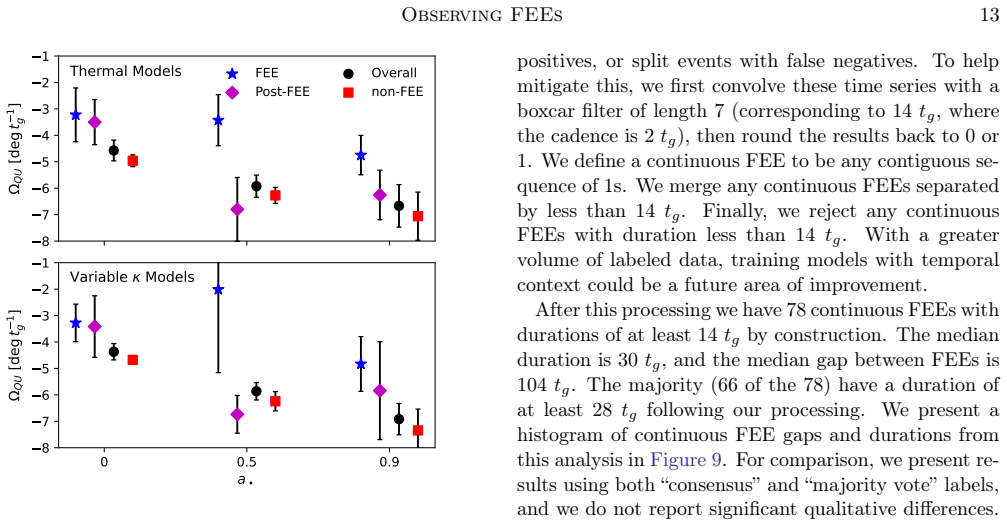
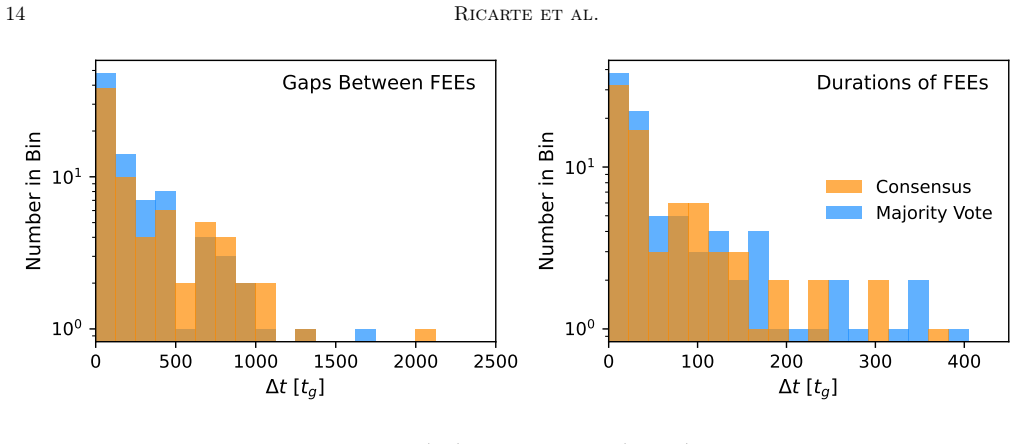
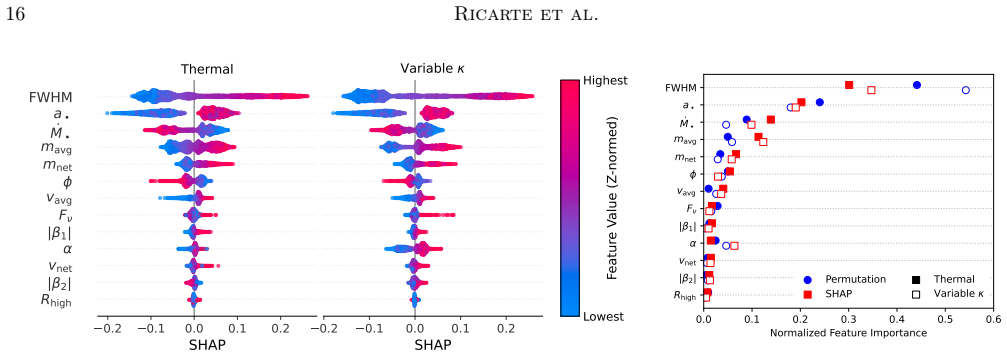
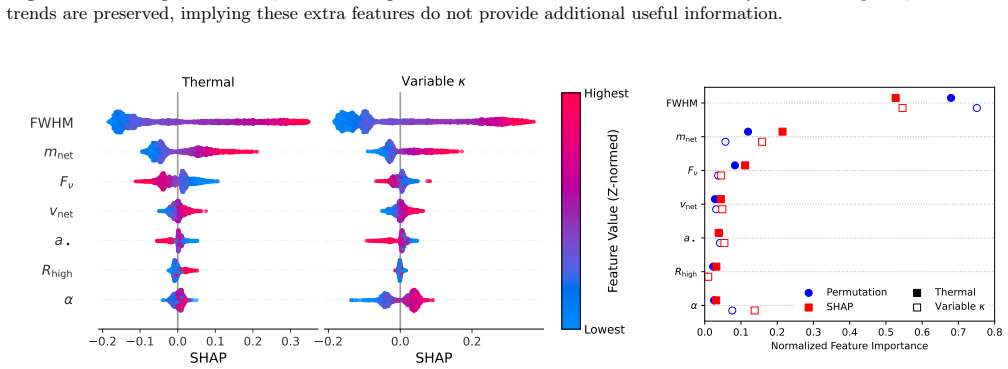
During a flux eruption event, simulated images tend toward more diffuse emission, higher linear polarization, and lower total fluxes, with the Q-U loop rotation rate decreasing, contrary to a picture in which FEEs cause both loops and flares. A random forest trained on observable summary statistics achieves about 80% class-weighted accuracy, indicating that the CNN learns FEE structure not fully captured by these traditional statistics. The results imply that image size and polarization fraction can flag candidate FEEs, but high-resolution, high-dynamic range images remain important for confirmation.
What carries the argument
A two-stage machine learning approach: a convolutional neural network trained on uncorrupted simulated images to learn FEE representations, followed by random forest and logistic regression models on summary statistics for interpretable signatures.
If this is right
- Image size and polarization fraction can flag candidate FEEs.
- High-resolution and high-dynamic range images are needed to confirm FEEs.
- FEEs decrease the Q-U loop rotation rate and do not jointly cause both loops and flares.
- Machine learning captures FEE features beyond traditional summary statistics.
- These signatures are weak for most FEEs relative to usual time variability.
Where Pith is reading between the lines
- If applicable to real data, EHT observations could search for magnetic reconnection in accretion flows using polarization and image properties.
- The gap between CNN performance and summary statistics suggests deep learning may reveal new aspects of accretion dynamics.
- Statistical stacking of multiple observations may be necessary to detect these weak signals amid variability.
- This method could be applied to identify other transient phenomena in future higher-sensitivity black hole images.
Load-bearing premise
The simulated accretion flows with strong magnetic fields accurately represent the physical conditions around real supermassive black holes that the Event Horizon Telescope can observe, and the machine learning models trained on these simulations generalize to actual observational data without being dominated by simulation-specific artifacts.
What would settle it
Comparing the predicted changes in image diffuseness, polarization fraction, and Q-U rotation during observed flares with EHT data against the absence or presence of such signatures in the simulations.
Figures
read the original abstract
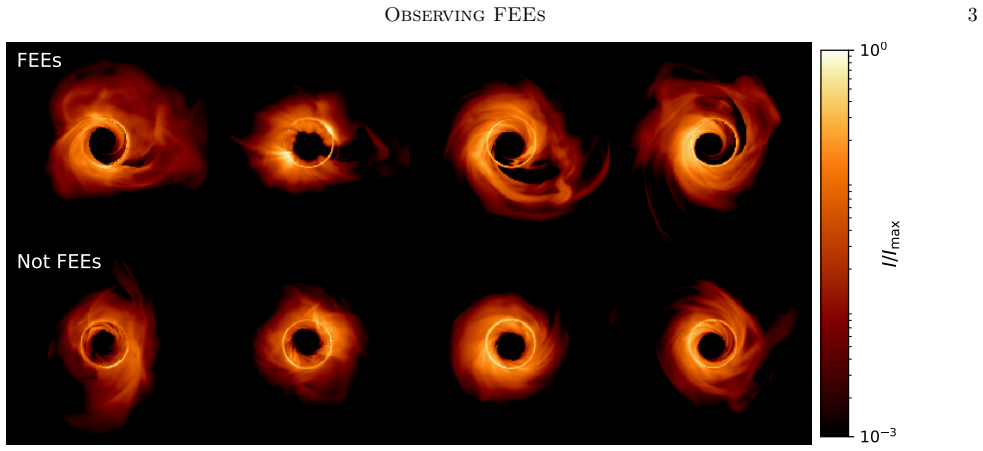
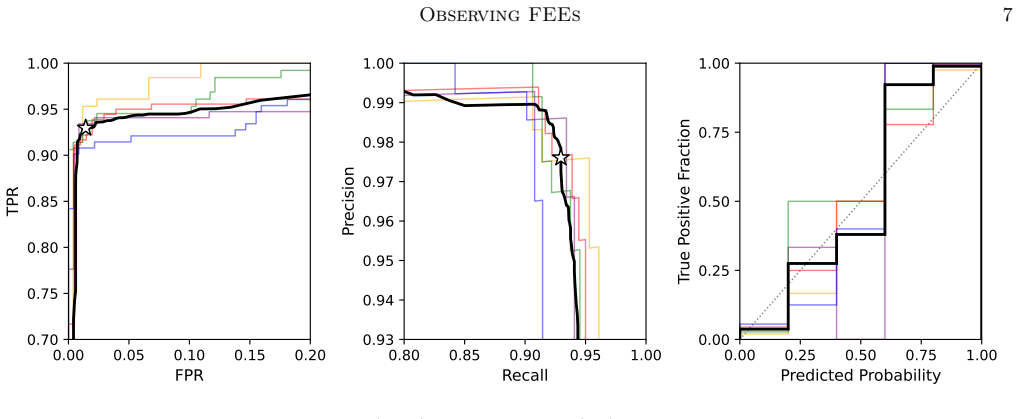
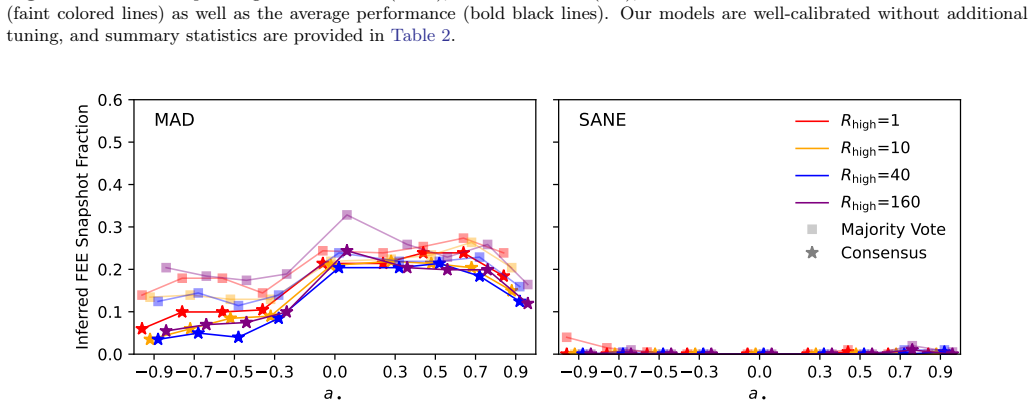
Simulated black hole accretion flows with strong magnetic fields often exhibit "flux eruption events" (FEEs), transient and localized expulsions of matter near the event horizon due to magnetic reconnection. It may now be possible to image them with the Event Horizon Telescope (EHT), a global network of millimeter-wave observatories that images black holes. Here we use machine learning as an interpretable inference tool to identify observational signatures of FEEs that could be accessible to the EHT. First, we train a convolutional neural network to learn task-relevant representations of FEEs in uncorrupted simulated images. After using this network to label a larger set of images, we then train interpretable models (random forest and logistic regression) to determine observational signatures. We find that during a FEE, images in the millimeter tend toward more diffuse emission, higher linear polarization, and lower total fluxes, but these signatures are weak for most FEEs compared to the usual time variability of these features. Moreover, the Q-U loop rotation rate decreases during FEEs, contrary to a picture in which FEEs could jointly cause both millimeter Q-U loops and flares. Our random forest trained on observable summary statistics achieves ~80% class-weighted accuracy, suggesting that the CNN learns FEE structure not fully mapped onto these traditional summary statistics. Our results imply that image size and polarization fraction can be used to flag candidate FEEs, but high-resolution, high-dynamic range images will still be important to confirm FEEs and test accretion flows for this phenomenon.
Editorial analysis
A structured set of objections, weighed in public.
Referee Report
Summary. The paper trains a CNN on ideal (uncorrupted) simulated millimeter images of black hole accretion flows to label flux eruption events (FEEs), then fits interpretable models (random forest, logistic regression) to observable summary statistics derived from those labels. It reports that FEEs are associated with more diffuse emission, higher linear polarization, lower total flux, and slower Q-U loop rotation rates, though these trends are weak relative to ordinary variability; the random forest achieves ~80% class-weighted accuracy on the summary statistics, implying the CNN captures additional FEE structure.
Significance. If the pipeline generalizes, the work supplies concrete, testable guidance on which image properties (size, polarization fraction) could flag candidate FEEs in EHT data and demonstrates that traditional summary statistics do not fully capture the CNN-learned representation. The empirical, simulation-driven approach and the explicit statement that signatures are weak compared with normal variability are strengths.
major comments (2)
- [Abstract / Methods] Abstract and Methods (pipeline description): The CNN is trained exclusively on uncorrupted simulated images. Because the subsequent labels are used both to identify the reported trends (diffuse emission, polarization, Q-U rate) and to train the random forest that reaches ~80% accuracy, any FEE-discriminating features that are erased by realistic EHT uv-coverage, thermal noise, or scattering would render both the signatures and the accuracy claim non-observable. A concrete test (e.g., re-training or evaluating the CNN on forward-modeled EHT images) is required to establish that the reported observational signatures survive the instrument response.
- [Results] Results (80% accuracy claim): No information is supplied on training/validation splits, hyperparameter selection, class-imbalance handling, or error bars/statistical significance tests for the random-forest performance. Without these details the headline accuracy figure cannot be evaluated and the claim that the CNN learns structure “not fully mapped onto these traditional summary statistics” remains unsupported.
minor comments (2)
- [Methods] Clarify the exact definition of the summary statistics fed to the random forest and logistic regression (e.g., how image size, polarization fraction, and Q-U rotation rate are computed from the images).
- [Results] The abstract states the signatures are “weak for most FEEs”; quantify this statement with effect sizes or overlap metrics relative to the non-FEE variability distribution.
Simulated Author's Rebuttal
We thank the referee for their constructive and detailed report. The comments highlight important limitations in the current presentation of our methods and results. We respond point-by-point below, indicating where revisions will be made to strengthen the manuscript.
read point-by-point responses
-
Referee: [Abstract / Methods] Abstract and Methods (pipeline description): The CNN is trained exclusively on uncorrupted simulated images. Because the subsequent labels are used both to identify the reported trends (diffuse emission, polarization, Q-U rate) and to train the random forest that reaches ~80% accuracy, any FEE-discriminating features that are erased by realistic EHT uv-coverage, thermal noise, or scattering would render both the signatures and the accuracy claim non-observable. A concrete test (e.g., re-training or evaluating the CNN on forward-modeled EHT images) is required to establish that the reported observational signatures survive the instrument response.
Authors: We agree that training exclusively on ideal images means the reported signatures and accuracy are not yet demonstrated to be observable. The manuscript intentionally isolates intrinsic simulation features before instrumental effects, as stated in the abstract and methods. In revision we will add explicit language in the abstract, methods, and discussion clarifying that the signatures are derived from uncorrupted images and constitute potential rather than guaranteed observables. We will also include a qualitative assessment of how uv-coverage, noise, and scattering are expected to affect diffuse emission and polarization fraction. A full forward-modeling test lies outside the present computational scope but will be noted as future work. This revision makes the scope of the claims transparent without overstating current results. revision: partial
-
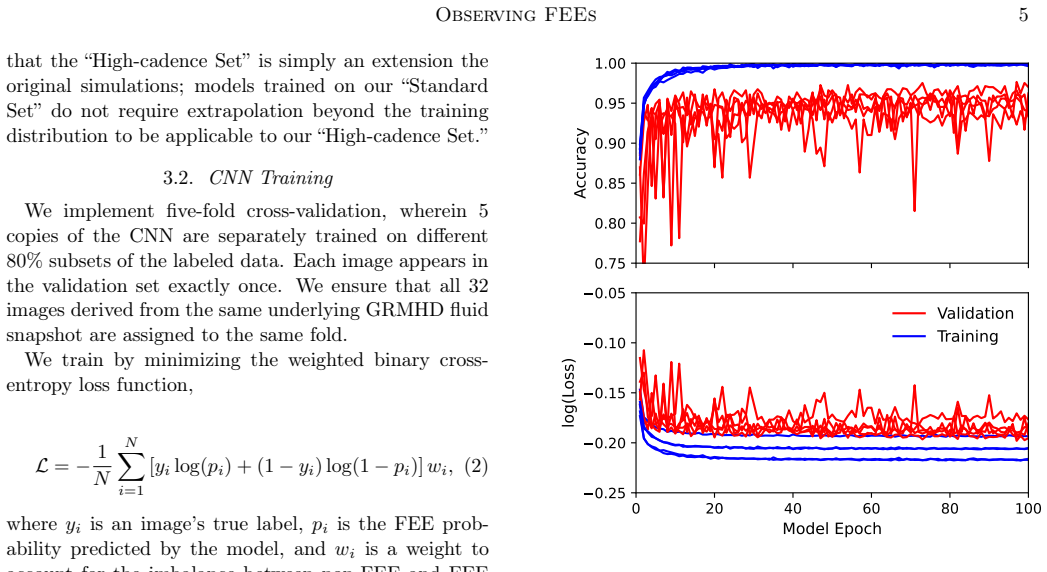
Referee: [Results] Results (80% accuracy claim): No information is supplied on training/validation splits, hyperparameter selection, class-imbalance handling, or error bars/statistical significance tests for the random-forest performance. Without these details the headline accuracy figure cannot be evaluated and the claim that the CNN learns structure “not fully mapped onto these traditional summary statistics” remains unsupported.
Authors: The omission of these implementation details was an oversight. In the revised manuscript we will insert a new subsection (likely in Results or an expanded Methods) that specifies: (i) the train/validation split and any temporal blocking used to avoid leakage, (ii) hyperparameter search procedure (grid or random search with cross-validation), (iii) class-imbalance treatment via class weights or resampling, and (iv) uncertainty quantification via bootstrap or k-fold estimates together with a statistical comparison (e.g., McNemar test or permutation test) against a null model. These additions will allow readers to evaluate the ~80% figure and the claim that the CNN captures structure beyond the summary statistics. revision: yes
Circularity Check
No circularity: purely empirical ML pipeline on independent simulations
full rationale
The paper trains a CNN on simulated images to label FEEs, then fits random forest and logistic regression to observable summary statistics derived from those labels. No equations, derivations, or self-citations reduce any output to a fitted parameter or prior result by construction. All steps are data-driven fitting on simulation outputs treated as ground truth; the 80% accuracy and reported trends (diffuse emission, polarization, Q-U rotation) are statistical associations, not tautological. This matches the default non-circular case for simulation-based ML studies.
Axiom & Free-Parameter Ledger
Reference graph
Works this paper leans on
-
[1]
Coevolution (Or Not) of Supermassive Black Holes and Host Galaxies
Coevolution (Or Not) of Supermassive Black Holes and Host Galaxies. , archivePrefix = "arXiv", eprint =. doi:10.1146/annurev-astro-082708-101811 , adsurl =
work page internal anchor Pith review doi:10.1146/annurev-astro-082708-101811
-
[2]
Model comparisons and theoretical interpretations
The persistent shadow of the supermassive black hole of M87: II. Model comparisons and theoretical interpretations. , keywords =. doi:10.1051/0004-6361/202451296 , adsurl =
-
[3]
Bayesian Accretion Modeling: Axisymmetric Equatorial Emission in the Kerr Spacetime. , keywords =. doi:10.3847/1538-4357/ac9ab7 , archivePrefix =. 2210.07108 , primaryClass =
-
[5]
Disentangling nature from nurture: tracing the origin of seed black holes
Disentangling nature from nurture: tracing the origin of seed black holes. , keywords =. doi:10.48550/arXiv.1904.09326 , archivePrefix =. 1904.09326 , primaryClass =
work page internal anchor Pith review Pith/arXiv arXiv doi:10.48550/arxiv.1904.09326 1904
-
[6]
Black hole binary remnant mass and spin: A new phenomenological formula
Black hole binary remnant mass and spin: A new phenomenological formula. , keywords =. doi:10.1103/PhysRevD.89.104052 , archivePrefix =. 1312.5775 , primaryClass =
work page internal anchor Pith review Pith/arXiv arXiv doi:10.1103/physrevd.89.104052
-
[7]
Monthly Notices of the Royal Astronomical Society , year=
On the spin paradigm and the radio dichotomy of quasars , author=. Monthly Notices of the Royal Astronomical Society , year=
-
[8]
Constraints on the radio loud/radio quiet dichotomy from the fundamental plane
Constraints on the radio-loud/radio-quiet dichotomy from the Fundamental Plane. , keywords =. doi:10.1093/mnras/stu1086 , archivePrefix =. 1406.2778 , primaryClass =
work page internal anchor Pith review Pith/arXiv arXiv doi:10.1093/mnras/stu1086
-
[9]
A public code for general relativistic, polarised radiative transfer around spinning black holes
A public code for general relativistic, polarised radiative transfer around spinning black holes. , keywords =. doi:10.1093/mnras/stw1526 , archivePrefix =. 1602.03184 , primaryClass =
work page internal anchor Pith review Pith/arXiv arXiv doi:10.1093/mnras/stw1526
-
[10]
Sagittarius A* Accretion Flow and Black Hole Parameters from General Relativistic Dynamical and Polarized Radiative Modeling. , keywords =. doi:10.1088/0004-637X/755/2/133 , archivePrefix =. 1007.4832 , primaryClass =
work page internal anchor Pith review Pith/arXiv arXiv doi:10.1088/0004-637x/755/2/133
-
[11]
First M87 Event Horizon Telescope Results. VI. The Shadow and Mass of the Central Black Hole. , keywords =. doi:10.3847/2041-8213/ab1141 , archivePrefix =. 1906.11243 , primaryClass =
work page internal anchor Pith review Pith/arXiv arXiv doi:10.3847/2041-8213/ab1141 2041
-
[12]
First M87 Event Horizon Telescope Results. V. Physical Origin of the Asymmetric Ring. , keywords =. doi:10.3847/2041-8213/ab0f43 , archivePrefix =. 1906.11242 , primaryClass =
work page internal anchor Pith review Pith/arXiv arXiv doi:10.3847/2041-8213/ab0f43 2041
-
[13]
First M87 Event Horizon Telescope Results. IV. Imaging the Central Supermassive Black Hole. , keywords =. doi:10.3847/2041-8213/ab0e85 , archivePrefix =. 1906.11241 , primaryClass =
work page internal anchor Pith review Pith/arXiv arXiv doi:10.3847/2041-8213/ab0e85 2041
-
[14]
First M87 Event Horizon Telescope Results. III. Data Processing and Calibration. , keywords =. doi:10.3847/2041-8213/ab0c57 , archivePrefix =. 1906.11240 , primaryClass =
work page internal anchor Pith review Pith/arXiv arXiv doi:10.3847/2041-8213/ab0c57 2041
-
[15]
First M87 Event Horizon Telescope Results. II. Array and Instrumentation. , keywords =. doi:10.3847/2041-8213/ab0c96 , archivePrefix =. 1906.11239 , primaryClass =
work page internal anchor Pith review Pith/arXiv arXiv doi:10.3847/2041-8213/ab0c96 2041
-
[16]
First M87 Event Horizon Telescope Results. I. The Shadow of the Supermassive Black Hole. , keywords =. doi:10.3847/2041-8213/ab0ec7 , archivePrefix =. 1906.11238 , primaryClass =
work page internal anchor Pith review Pith/arXiv arXiv doi:10.3847/2041-8213/ab0ec7 2041
-
[17]
Measuring Mass Accretion Rate onto the Supermassive Black Hole in M87 Using Faraday Rotation Measure with the Submillimeter Array. , keywords =. doi:10.1088/2041-8205/783/2/L33 , archivePrefix =. 1402.5238 , primaryClass =
work page internal anchor Pith review Pith/arXiv arXiv doi:10.1088/2041-8205/783/2/l33 2041
-
[18]
ALMA Polarimetry of Sgr A*: Probing the Accretion Flow from the Event Horizon to the Bondi Radius
ALMA Polarimetry of Sgr A*: Probing the Accretion Flow from the Event Horizon to the Bondi Radius. , keywords =. doi:10.3847/1538-4357/aae983 , archivePrefix =. 1810.07317 , primaryClass =
work page internal anchor Pith review Pith/arXiv arXiv doi:10.3847/1538-4357/aae983
-
[19]
arXiv e-prints , keywords =
Discriminating Accretion States via Rotational Symmetry in Simulated Polarimetric Images of M87. arXiv e-prints , keywords =
-
[20]
Polarization imaging of M 87 jets by general relativistic radiative transfer calculation based on GRMHD simulations. , keywords =. doi:10.1093/pasj/psaa008 , archivePrefix =. 2002.00954 , primaryClass =
-
[21]
Radio circular polarization produced in helical magnetic fields in eight active galactic nuclei. , keywords =. doi:10.1111/j.1365-2966.2007.12773.x , archivePrefix =. 0711.4572 , primaryClass =
-
[22]
Theoretical Models for Producing Circularly Polarized Radiation in Extragalactic Radio Sources. , keywords =. doi:10.1023/B:ASTR.0000005001.80514.0c , archivePrefix =. astro-ph/0305136 , primaryClass =
-
[23]
Does circular polarisation reveal the rotation of quasar engines?
Does circular polarisation reveal the rotation of quasar engines?. , keywords =. doi:10.1051/0004-6361:20030162 , archivePrefix =. astro-ph/0212387 , primaryClass =
work page internal anchor Pith review Pith/arXiv arXiv doi:10.1051/0004-6361:20030162
-
[24]
Propagation-induced Circular Polarisation in Synchrotron Sources. , keywords =. doi:10.1071/AS98211 , adsurl =
-
[25]
Supermassive Black Hole Spin Constraints from Polarimetry in an Equatorial Disk Model. , keywords =. doi:10.3847/2041-8213/ad9bb4 , archivePrefix =. 2412.06719 , primaryClass =
-
[26]
Detection of orbital motions near the last stable circular orbit of the massive black hole SgrA*
Detection of orbital motions near the last stable circular orbit of the massive black hole SgrA*. , keywords =. doi:10.1051/0004-6361/201834294 , archivePrefix =. 1810.12641 , primaryClass =
work page internal anchor Pith review Pith/arXiv arXiv doi:10.1051/0004-6361/201834294
-
[27]
First Mid-infrared Detection and Modeling of a Flare from Sgr A*. II. Mid-infrared Spectral Energy Distribution and Millimeter Polarimetry. , keywords =. doi:10.3847/1538-4357/ae25ef , archivePrefix =. 2511.14836 , primaryClass =
-
[28]
Particles and Fields in Radio Galaxies Conference , year = 2001, editor =
The nature of jets: evidence from circular polarization observations. Particles and Fields in Radio Galaxies Conference , year = 2001, editor =
2001
-
[29]
The Coevolution of Galaxies and Supermassive Black Holes: Insights from Surveys of the Contemporary Universe. , keywords =. doi:10.1146/annurev-astro-081913-035722 , archivePrefix =. 1403.4620 , primaryClass =
work page internal anchor Pith review Pith/arXiv arXiv doi:10.1146/annurev-astro-081913-035722
-
[30]
Energy input from quasars regulates the growth and activity of black holes and their host galaxies
Energy input from quasars regulates the growth and activity of black holes and their host galaxies. , keywords =. doi:10.1038/nature03335 , archivePrefix =. astro-ph/0502199 , primaryClass =
work page internal anchor Pith review Pith/arXiv arXiv doi:10.1038/nature03335
-
[31]
A unified model for the evolution of galaxies and quasars. , keywords =. doi:10.1046/j.1365-8711.2000.03077.x , archivePrefix =. astro-ph/9906493 , primaryClass =
-
[32]
Polarized Synchrotron Emissivities and Absorptivities for Relativistic Thermal, Power-law, and Kappa Distribution Functions. , keywords =. doi:10.3847/0004-637X/822/1/34 , archivePrefix =. 1602.08749 , primaryClass =
work page internal anchor Pith review Pith/arXiv arXiv doi:10.3847/0004-637x/822/1/34
-
[33]
Transfer of polarized radiation in self-absorbed synchrotron sources. I. Results for a homogeneous source. , keywords =. doi:10.1086/155278 , adsurl =
-
[34]
The impact of non-thermal electrons on event horizon scale images and spectra of Sgr A*
The impact of non-thermal electrons on event horizon scale images and spectra of Sgr A*. , keywords =. doi:10.1093/mnras/stw3324 , archivePrefix =. 1611.04601 , primaryClass =
work page internal anchor Pith review Pith/arXiv arXiv doi:10.1093/mnras/stw3324
-
[35]
Circular polarization from compact extragalactic radio sources as a result of nonuniform magnetic fields. , keywords =. doi:10.1086/160530 , adsurl =
-
[36]
Determining the Composition of Relativistic Jets from Polarization Maps. , keywords =. doi:10.3847/1538-4357/ab9103 , archivePrefix =. 1909.09230 , primaryClass =
-
[37]
The Influence of Magnetic Field Geometry on the Evolution of Black Hole Accretion Flows: Similar Disks, Drastically Different Jets. , keywords =. doi:10.1086/533492 , archivePrefix =. 0709.3833 , primaryClass =
work page internal anchor Pith review Pith/arXiv arXiv doi:10.1086/533492
-
[38]
Galaxies , year = 2018, month = jan, volume =
Determining the Jet Poloidal B Field and Black-Hole Rotation Directions in AGNs. Galaxies , year = 2018, month = jan, volume =. doi:10.3390/galaxies6010009 , adsurl =
-
[39]
Galaxies , year = 2018, month = dec, volume =
Evidence for Helical Magnetic Fields Associated with AGN Jets and the Action of a Cosmic Battery. Galaxies , year = 2018, month = dec, volume =. doi:10.3390/galaxies7010005 , adsurl =
-
[40]
Analysing the Transverse Structure of the Relativistic Jets of AGN
Analysing the transverse structure of the relativistic jets of active galactic nuclei. , keywords =. doi:10.1093/mnras/sts561 , archivePrefix =. 1302.0186 , primaryClass =
work page internal anchor Pith review Pith/arXiv arXiv doi:10.1093/mnras/sts561
-
[41]
Accretion disk radiation dynamics and the cosmic battery
Accretion Disk Radiation Dynamics and the Cosmic Battery. , keywords =. doi:10.1088/0004-637X/794/1/27 , archivePrefix =. 1405.6018 , primaryClass =
work page internal anchor Pith review Pith/arXiv arXiv doi:10.1088/0004-637x/794/1/27
-
[42]
A Cosmic Battery. , keywords =. doi:10.1086/306426 , archivePrefix =. astro-ph/9808223 , primaryClass =
work page internal anchor Pith review Pith/arXiv arXiv doi:10.1086/306426
-
[43]
Hybrid Thermal-Nonthermal Synchrotron Emission from Hot Accretion Flows
Hybrid Thermal-Nonthermal Synchrotron Emission from Hot Accretion Flows. , keywords =. doi:10.1086/309396 , archivePrefix =. astro-ph/0004195 , primaryClass =
work page internal anchor Pith review Pith/arXiv arXiv doi:10.1086/309396
-
[44]
ipole - semianalytic scheme for relativistic polarized radiative transport
IPOLE - semi-analytic scheme for relativistic polarized radiative transport. , keywords =. doi:10.1093/mnras/stx3162 , archivePrefix =. 1712.03057 , primaryClass =
work page internal anchor Pith review Pith/arXiv arXiv doi:10.1093/mnras/stx3162
-
[45]
Decomposing the Internal Faraday Rotation of Black Hole Accretion Flows. , keywords =. doi:10.1093/mnras/staa2692 , archivePrefix =. 2009.02369 , primaryClass =
-
[46]
Advection-Dominated Accretion: A Self-Similar Solution
Advection-dominated Accretion: A Self-similar Solution. , keywords =. doi:10.1086/187381 , archivePrefix =. astro-ph/9403052 , primaryClass =
work page internal anchor Pith review Pith/arXiv arXiv doi:10.1086/187381
-
[47]
General relativistic magnetohydrodynamical simulations of the jet in M87
General relativistic magnetohydrodynamical simulations of the jet in M 87. , keywords =. doi:10.1051/0004-6361/201526630 , archivePrefix =. 1510.07243 , primaryClass =
work page internal anchor Pith review Pith/arXiv arXiv doi:10.1051/0004-6361/201526630
-
[48]
Magnetic Reconnection and Hot Spot Formation in Black Hole Accretion Disks. , keywords =. doi:10.3847/1538-4357/ababab , archivePrefix =. 2003.04330 , primaryClass =
-
[49]
Universal interferometric signatures of a black hole's photon ring. Science Advances , keywords =. doi:10.1126/sciadv.aaz1310 , archivePrefix =. 1907.04329 , primaryClass =
-
[50]
Universal polarimetric signatures of the black hole photon ring. , keywords =. doi:10.1103/PhysRevD.101.084020 , archivePrefix =. 2001.08750 , primaryClass =
-
[51]
The Structure and Dynamics of the Subparsec Jet in M87 Based on 50 VLBA Observations over 17 Years at 43 GHz. , keywords =. doi:10.3847/1538-4357/aaafcc , archivePrefix =. 1802.06166 , primaryClass =
work page internal anchor Pith review Pith/arXiv arXiv doi:10.3847/1538-4357/aaafcc
-
[52]
Weber and Hari Krishnan and Thomas Fogal and Allen Sanderson and Christoph Garth and E
Hank Childs and Eric Brugger and Brad Whitlock and Jeremy Meredith and Sean Ahern and David Pugmire and Kathleen Biagas and Mark Miller and Cyrus Harrison and Gunther H. Weber and Hari Krishnan and Thomas Fogal and Allen Sanderson and Christoph Garth and E. Wes Bethel and David Camp and Oliver R\". 2012
2012
-
[53]
HARM: A Numerical Scheme for General Relativistic Magnetohydrodynamics
HARM: A Numerical Scheme for General Relativistic Magnetohydrodynamics. , keywords =. doi:10.1086/374594 , archivePrefix =. astro-ph/0301509 , primaryClass =
work page internal anchor Pith review Pith/arXiv arXiv doi:10.1086/374594
-
[54]
The matter content of the jet in M87: evidence for an electron-positron jet
The matter content of the jet in M87: evidence for an electron-positron jet. , keywords =. doi:10.1093/mnras/283.3.873 , archivePrefix =. astro-ph/9603140 , primaryClass =
work page internal anchor Pith review Pith/arXiv arXiv doi:10.1093/mnras/283.3.873
-
[55]
2009, MNRAS, 397, 666, doi: 10.1111/j.1365-2966.2009.15008.x
Effect of plasma composition on the interpretation of Faraday rotation. , keywords =. doi:10.1111/j.1365-2966.2009.16228.x , archivePrefix =. 0906.4985 , primaryClass =
-
[56]
Reviews of Modern Physics , year = 1984, month = apr, volume =
Theory of extragalactic radio sources. Reviews of Modern Physics , year = 1984, month = apr, volume =. doi:10.1103/RevModPhys.56.255 , adsurl =
-
[57]
, year = 1998, month = oct, volume =
Electron-positron jets associated with the quasar 3C279. , year = 1998, month = oct, volume =. doi:10.1038/26675 , adsurl =
-
[58]
Advection-Dominated Accretion: Underfed Black Holes and Neutron Stars
Advection-dominated Accretion: Underfed Black Holes and Neutron Stars. , keywords =. doi:10.1086/176343 , archivePrefix =. astro-ph/9411059 , primaryClass =
work page internal anchor Pith review Pith/arXiv arXiv doi:10.1086/176343
-
[59]
Bimodal behavior of accretion disks: theory and application to Cygnus X-1 transitions. , keywords =. doi:10.1086/155314 , adsurl =
-
[60]
Ion-supported tori and the origin of radio jets. , keywords =. doi:10.1038/295017a0 , adsurl =
-
[61]
The `quiescent' black hole in M87
The `quiescent' black hole in M87. , keywords =. doi:10.1093/mnras/283.4.L111 , archivePrefix =. astro-ph/9610097 , primaryClass =
work page internal anchor Pith review Pith/arXiv arXiv doi:10.1093/mnras/283.4.l111
-
[62]
Spatially resolved origin of mm-wave linear polarization in the nuclear region of 3C 84
Spatially resolved origin of millimeter-wave linear polarization in the nuclear region of 3C 84. , keywords =. doi:10.1051/0004-6361/201832920 , archivePrefix =. 1811.07815 , primaryClass =
work page internal anchor Pith review Pith/arXiv arXiv doi:10.1051/0004-6361/201832920
-
[63]
Probing the Parsec-scale Accretion Flow of 3C 84 with Millimeter Polarimetry
Probing the Parsec-scale Accretion Flow of 3C 84 with Millimeter Wavelength Polarimetry. , keywords =. doi:10.1088/0004-637X/797/1/66 , archivePrefix =. 1410.5887 , primaryClass =
work page internal anchor Pith review Pith/arXiv arXiv doi:10.1088/0004-637x/797/1/66
-
[64]
Circular polarization from stochastic synchrotron sources
Circular Polarization from Stochastic Synchrotron Sources. , keywords =. doi:10.1086/340659 , archivePrefix =. astro-ph/0112090 , primaryClass =
work page internal anchor Pith review Pith/arXiv arXiv doi:10.1086/340659
-
[65]
Circular Polarization of Radio Emission from Relativistic Jets
Circular polarization of radio emission from relativistic jets. , keywords =. doi:10.1051/0004-6361:20020484 , archivePrefix =. astro-ph/0112398 , primaryClass =
work page internal anchor Pith review Pith/arXiv arXiv doi:10.1051/0004-6361:20020484
-
[66]
Faraday rotation in GRMHD simulations of the jet launching zone of M87
Faraday rotation in GRMHD simulations of the jet launching zone of M87. , keywords =. doi:10.1093/mnras/stx587 , archivePrefix =. 1703.02390 , primaryClass =
work page internal anchor Pith review Pith/arXiv arXiv doi:10.1093/mnras/stx587
-
[67]
Hot Accretion Flows Around Black Holes
Hot Accretion Flows Around Black Holes. , keywords =. doi:10.1146/annurev-astro-082812-141003 , archivePrefix =. 1401.0586 , primaryClass =
work page internal anchor Pith review Pith/arXiv arXiv doi:10.1146/annurev-astro-082812-141003
-
[68]
Nonthermal Electrons in Radiatively Inefficient Accretion Flow Models of Sagittarius A*
Nonthermal Electrons in Radiatively Inefficient Accretion Flow Models of Sagittarius A*. , keywords =. doi:10.1086/378716 , archivePrefix =. astro-ph/0304125 , primaryClass =
work page internal anchor Pith review Pith/arXiv arXiv doi:10.1086/378716
-
[69]
arXiv e-prints , keywords =
Polarization images of accretion flow around supermassive black holes: imprints of toroidal field structure. arXiv e-prints , keywords =
-
[70]
Determining the composition of radio plasma via circular polarization: the prospects of the Cygnus A hot spots. , keywords =. doi:10.1088/1475-7516/2019/01/035 , archivePrefix =. 1808.07061 , primaryClass =
work page internal anchor Pith review Pith/arXiv arXiv doi:10.1088/1475-7516/2019/01/035 2019
-
[71]
The Structure of the M87 Jet: A Transition from Parabolic to Conical Streamlines
The Structure of the M87 Jet: A Transition from Parabolic to Conical Streamlines. , keywords =. doi:10.1088/2041-8205/745/2/L28 , archivePrefix =. 1110.1793 , primaryClass =
work page internal anchor Pith review Pith/arXiv arXiv doi:10.1088/2041-8205/745/2/l28 2041
-
[72]
Accelerating AGN jets to parsec scales using general relativistic MHD simulations. , keywords =. doi:10.1093/mnras/stz2626 , archivePrefix =. 1904.03243 , primaryClass =
-
[73]
The impact of Faraday effects on polarized black hole images of Sagittarius A*
The impact of Faraday effects on polarized black hole images of Sagittarius A*. , keywords =. doi:10.1093/mnras/sty1210 , archivePrefix =. 1805.02652 , primaryClass =
work page internal anchor Pith review Pith/arXiv arXiv doi:10.1093/mnras/sty1210
-
[74]
Interferometric Detection of Linear Polarization from Sagittarius A* at 230 GHz
Interferometric Detection of Linear Polarization from Sagittarius A* at 230 GHz. , keywords =. doi:10.1086/373989 , archivePrefix =. astro-ph/0302227 , primaryClass =
work page internal anchor Pith review Pith/arXiv arXiv doi:10.1086/373989
-
[75]
Detection of Polarized Millimeter and Submillimeter Emission from Sagittarius A*. , keywords =. doi:10.1086/312685 , adsurl =
-
[76]
Submillimeter properties of Sagittarius A*: The polarization and spectrum from 230 to 690 GHz and the submillimeter array polarimeter
-
[77]
The Circular Polarization of Sagittarius A* at Submillimeter Wavelengths
The Circular Polarization of Sagittarius A* at Submillimeter Wavelengths. , keywords =. doi:10.1088/0004-637X/745/2/115 , archivePrefix =. 1105.0427 , primaryClass =
work page internal anchor Pith review Pith/arXiv arXiv doi:10.1088/0004-637x/745/2/115
-
[78]
Constraining Radiatively Inefficient Accretion Flows with Polarization
Constraining Radiatively Inefficient Accretion Flows with Polarization. , keywords =. doi:10.1086/519951 , archivePrefix =. 0705.2590 , primaryClass =
work page internal anchor Pith review Pith/arXiv arXiv doi:10.1086/519951
-
[79]
The Black-Hole Mass in M87 from Gemini/NIFS Adaptive Optics Observations
The Black Hole Mass in M87 from Gemini/NIFS Adaptive Optics Observations. , keywords =. doi:10.1088/0004-637X/729/2/119 , archivePrefix =. 1101.1954 , primaryClass =
work page internal anchor Pith review Pith/arXiv arXiv doi:10.1088/0004-637x/729/2/119 1954
-
[80]
Polarimetric Imaging of the Massive Black Hole at the Galactic Center
Polarimetric Imaging of the Massive Black Hole at the Galactic Center. , keywords =. doi:10.1086/322862 , archivePrefix =. astro-ph/0106180 , primaryClass =
work page internal anchor Pith review Pith/arXiv arXiv doi:10.1086/322862
-
[81]
2006, MNRAS, 372, 1699, doi: 10.1111/j.1365-2966.2006.10972.x
Imaging optically-thin hotspots near the black hole horizon of Sgr A* at radio and near-infrared wavelengths. , keywords =. doi:10.1111/j.1365-2966.2006.10152.x , archivePrefix =. astro-ph/0509237 , primaryClass =
discussion (0)
Sign in with ORCID, Apple, or X to comment. Anyone can read and Pith papers without signing in.