REVIEW 3 major objections 5 minor 9 cited by
Gravitational Observatories in AdS$_4$
T0 review · 3 major / 5 minor · reviewed 2026-08-11 · deepseek-v4-flash
Pith's one-line read A finite AdS4 worldtube grows gravitational boundary modes
desk verdict Solid linearized analysis of conformal worldtubes in AdS4, with a genuinely new complex-frequency mode; the physical interpretation hinges on the open well-posedness question, and the paper says so itself. read the letter →
The pith
A machine-rendered reading of the paper's core claim, the machinery that carries it, and where it could break.
The reading
What carries the argument
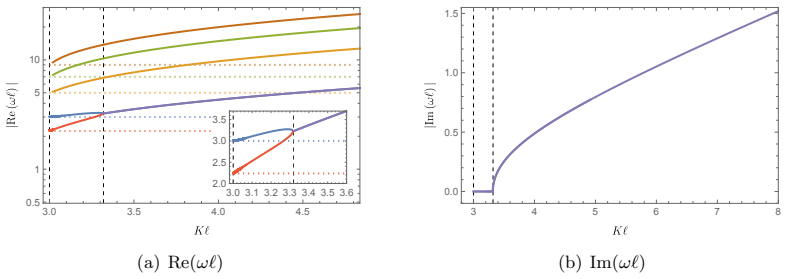
The central object is the boundary mode $\omega(x^m)$, the dynamical Weyl factor of the induced metric on the finite timelike boundary; it is a corner degree of freedom that cannot be removed by diffeomorphisms respecting the boundary conditions. The analysis carries it through the Kodama-Ishibashi decomposition of metric perturbations into scalar and vector master fields satisfying a wave equation on AdS$_2$, with the conformal boundary conditions imposed as a functional equation $F_l^{(S)}(K\ell,\omega\ell)=0$ that fixes the trace of the extrinsic curvature at $\Gamma$. Solving that equation produces the real normal modes and the new complex-frequency pairs; a WKB estimate together with a numerical scan over $l$ up to 130 yields the critical-curvature law $K_c\ell = 3 + 0.26/l + O(l^{-2})$.
What would settle it
Solve the linearized evolution numerically for a spherical boundary at, say, $K\ell=3.5$ with $l=2$ initial data chosen from the boundary mode; the paper predicts exponential growth with a rate set by $\mathrm{Im}(\omega\ell)$ near the critical curve. For example, for $l=4$ the paper fits $\mathrm{Im}(\omega\ell)=0.89\sqrt{K\ell-K_c\ell}$ near threshold; a numerical linearized run with those initial data either reproduces that growth rate or contradicts it. A proof or disproof of well-posedness for the conformal initial boundary value problem would also settle whether the growing modes are genuine dynamical evolutions.
Extended reading notes
Core claim
Starting from the Fefferman-Graham expansion, the paper treats the finite boundary as a gravitational observatory: instead of fixing the full induced metric at $\Gamma$, it fixes only its conformal class and the trace $K(x^m)$ of the extrinsic curvature, the data that asymptotically are fixed to $K\ell=3$. At linearized order about global AdS$_4$, the bulk perturbations are decomposed with the Kodama-Ishibashi method into scalar and vector master fields. In the scalar sector with $l \ge 2$, imposing the conformal boundary conditions yields the usual real normal-mode spectrum along with a boundary mode $\omega(x^m)$; for sufficiently large $l$, two pairs of frequencies become complex, one with positive imaginary part. Numerically the onset is $K_c\ell=3+0.26/l+O(l^{-2})$, and near threshold $\mathrm{Im}(\omega\ell)\sim \alpha(l)\sqrt{K\ell-K_c\ell}$. As $\Gamma$ is moved toward the asymptotic boundary ($K\ell\to3$), the growing modes move to $l\to\infty$ and disappear; in planar AdS$_4$ the analogous mode has real frequencies only, while on the AdS$_4$ black brane it dresses the horizon and carries conformal energy. In Euclidean signature, $K(x^m)$ sources $\omega(x^m)$, giving a two-point function of a massless scalar on the boundary.
Load-bearing premise
The load-bearing premise is that the Lorentzian initial boundary value problem with conformal boundary conditions is well-posed, a conjecture the paper cites but does not prove; if that fails, the complex-frequency modes are formal solutions of the linearized equations but may not correspond to any actual spacetime evolution.
Editorial extensions
If this is right
- Inside any finite conformal worldtube around global AdS$_4$, empty AdS$_4$ is linearly unstable: modes with $l \gtrsim 0.26/(K\ell-3)$ grow exponentially, so the vacuum must be sought elsewhere.
- Pushing the wall toward the asymptotic AdS$_4$ boundary suppresses the instability: the growing modes appear at larger and larger $l$ and vanish in the strict $K\ell\to3$ limit, recovering the standard AdS$_4$/CFT$_3$ spectrum.
- The phase space of gravity with a finite conformal boundary is larger than the bulk Cauchy data alone: initial data for $\{\omega,\partial_t\omega\}$ at the corner $\partial\Sigma$ must be supplied along with the standard Cauchy data on the spatial slice.
- In planar AdS$_4$ the boundary mode is massless, locally diffeomorphic, and has no complex frequencies; on the AdS$_4$ black brane it can dress the geometry, carries physical conformal energy, and its linearized equation has real exponential solutions controlled by the brane mass.
- The Euclidean on-shell action under conformal boundary data produces a two-point function for $\omega$ that is that of a massless scalar sourced by $K$, and $K$ acts as the parameter that regulates the divergences of the usual asymptotic boundary stress tensor.
Reading between the lines
- Editorial inference: if the growing linearized modes persist nonlinearly, the natural end state is a different bulk configuration, possibly a black hole or a time-dependent boundary; this could be tested by numerical relativity with conformal boundary conditions.
- Editorial inference: the paper's speculation that $K(x^m)$ acts as a coordinate-dependent ultraviolet cutoff suggests a concrete finite-size dictionary in which the effective action is a Legendre transform with respect to $K$; verifying the massless two-point structure for non-constant $K$ on $S^3$ would support or refute that picture.
- Editorial inference: the wrong-sign kinetic structure seen in the $l=0$ sector hints that stabilizing the finite conformal worldtube may require extra boundary counterterms, such as the boundary cosmological constant the paper mentions; adding such a term is a direct, testable modification of the action.
Signed reviews
Editorial analysis
A structured set of objections, weighed in public.
Referee Report
Summary. The paper studies four-dimensional Einstein gravity with negative cosmological constant on a manifold with a finite timelike boundary Γ, imposing conformal boundary conditions that fix the conformal class of the induced metric and the trace of the extrinsic curvature K(x^m). It analyzes linearized perturbations about global AdS4 with an S^2×R boundary and about planar AdS4 with an R^{1,2} boundary, using the Kodama-Ishibashi decomposition. For global AdS4 the authors find the usual normal modes together with a novel boundary mode ω(x^m); for sufficiently large K the scalar-sector modes acquire complex frequencies, with a numerically fitted critical curve Kcℓ = 3 + 0.26/l at large l, so that for any Kℓ > 3 there are growing modes with l ≳ 0.26/(Kℓ−3). In the planar case the analogous mode is locally diffeomorphic and all frequencies are real. In Euclidean signature K acts as a source for ω, and the two-point function is that of a massless scalar. The paper speculates that these growing modes indicate that global AdS4 is not the ground state inside a finite conformal worldtube.
Significance. If the conclusions hold, the paper identifies a new boundary degree of freedom in gravitational systems with finite conformal boundaries and provides concrete evidence for linearized instability of global AdS4 in a finite-size setting, with a clean recovery of flat-space results at large K. The manuscript is technically rich: the master equation and boundary conditions are derived explicitly, the analysis includes analytic WKB and large-l limits, and the Euclidean source computation is a useful step toward a finite-boundary holographic dictionary. The main physical interpretation, however, is conditional on the Lorentzian well-posedness of the conformal initial boundary value problem, which the authors themselves state is open, and on numerical root-finding that is not accompanied by error analysis. These issues are load-bearing for the central claim, but they are addressable within the scope of the manuscript.
major comments (3)
- [Sec. 2.1, footnote 1, and Sec. 3.4.2] The central claim that the complex-frequency modes signal an instability — and hence that global AdS4 is not the ground state — presupposes that the conformal boundary conditions define a well-posed Lorentzian initial boundary value problem. The manuscript explicitly states in footnote 1 that a complete proof of well-posedness (or lack thereof) remains an open problem and that the boundary/corner mode must be incorporated at the nonlinear level, and it relies on a conjecture from [15]. Without uniqueness of the evolution for admissible initial data CΣ ∪ C∂Σ, the modes found in Sec. 3.4.2 are only formal solutions of the linearized equations; they could be Hadamard instabilities of the formulation rather than physical perturbations. This is a load-bearing gap. The authors should either prove (or cite a proof of) well-posedness for the linearized conformal IBVP, or explicitly and consistently qualify the instability conclusion as conditional on that conjecture.
- [Sec. 3.4.2, Figs. 3–5, Eq. (3.36)] The existence of complex frequencies and the critical scaling Kcℓ = 3 + 0.26/l are established by numerical root-finding of F_l^(S)(Kℓ, ωℓ)=0, but the manuscript reports no precision estimates, convergence checks, or error bars for the fit. The analytic WKB analysis in Sec. 3.4 only shows reality of frequencies in the strict Kℓ → 3 limit; the crucial finite-K complex region is numerical. Since the claim that growing modes exist for any Kℓ > 3 at sufficiently large l rests directly on this fit, the numerical evidence needs to be made quantitative: for example, by reporting the residual of F_l^(S) at the claimed zeros, the dependence on numerical resolution in l and ω, and the uncertainty in the coefficient a ≈ 0.26.
- [Sec. 3.4.2, Eq. (3.32) and concluding remarks] The manuscript states that the conformal energy of the l ≥ 2 complex modes vanishes to leading order because the integral of a spherical harmonic is zero, and it defers higher-order energy considerations to future work. Nevertheless, the concluding remarks assert that the growing modes indicate that the global AdS4 solution is no longer the vacuum state. A complex-frequency mode in the linearized spectrum is evidence of linearized instability, but the stronger statement about the ground state requires some control of the nonlinear dynamics or of the second-order energy. The paper should either supply such control or rephrase the conclusion as a linearized-instability result, which is what the present analysis actually establishes.
minor comments (5)
- [Sec. 4.1] There is a typo in the last line of Sec. 4.1: 'boudary' should be 'boundary'.
- [Appendix E] In the discussion of Fig. 8, 'atributed' should be 'attributed'.
- [Table of contents and Sec. 5] The running headers and the table of contents contain the typo 'W eyl' for 'Weyl'.
- [Fig. 1 and Fig. 2] The density plots would benefit from a color scale or contour labels; as printed, the reader cannot quantitatively read the roots of F_l^(S/V) from the figures.
- [Abstract and Sec. 3.4.2] The abstract says complex frequencies appear 'at sufficiently large angular momentum,' but the precise statement is that they appear only when K exceeds the critical value Kc(l); the text clarifies this, but the abstract could be more explicit.
Circularity Check
The derivation is self-contained: the boundary mode and complex frequencies follow from solving the linearized Einstein equations with the stated conformal boundary conditions; the paper's self-citations are non-load-bearing, and the flagged open well-posedness question is an assumption, not a circular step.
full rationale
This paper's central results—the boundary Weyl mode ω(x^m), the complex-frequency regime for l ≥ 2, and the critical scaling Kcℓ = 3 + 0.26/l—are obtained by directly imposing the conformal boundary conditions (2.5)-(2.6) on linearized perturbations of global AdS4. The boundary conditions select the allowed frequencies through the secular equation F_l^(S)(Kℓ,ωℓ)=0 (3.29); no parameter is fitted into that equation, and the complex frequencies are read off as its roots. The scaling Kcℓ = 3 + 0.26/l + O(l^{-2}) is a numerical fit to the computed Kc values across l = 2..130 (figure 5) and is explicitly presented as such ('we numerically find'), not as an independent first-principles prediction; inverting the fit to state the growth condition l ≳ 0.26/(Kℓ−3) is an arithmetic restatement, not a circular construction. The Euclidean section derives δω from δK via the linearized equations (5.10)-(5.12), then evaluates the on-shell action; the resulting two-point function is the standard second derivative of the semiclassical generating functional, so the statement that K sources ω is a derived dictionary relation, not an input. The paper does cite the authors' prior work [20,21,28] for the conformal boundary condition framework, the corner-mode analysis, and the flat-space limit, but the l=0 and l≥2 modes are re-derived in the present paper (sections 3.1, 3.4, 4.1), and the flat-space agreement (ωr ≈ ±l ± 0.34i l^{1/3}) is used only as a consistency check in the Kℓ→∞ limit. The conjectural Lorentzian well-posedness of the conformal boundary conditions is explicitly flagged in footnote 1 as an open problem and in Section 5 as 'one of the main unresolved questions'; that is a physical/mathematical assumption limiting the interpretation of the modes as genuine instabilities, but it is not circularity, since the mode analysis is a formal solution of the stated equations rather than an inference from the conjecture. Overall, the derivation chain is self-contained and the self-citations are not load-bearing; no step reduces by construction to an input.
Assumptions & free parameters
free parameters (2)
- a (critical curvature coefficient) =
0.26
- alpha(l) (near-critical growth coefficient) =
e.g., 0.89 for l=4
assumptions (5)
- domain assumption Lorentzian conformal boundary conditions constitute a well-posed initial boundary value problem.
- standard math The Kodama-Ishibashi scalar/vector decomposition captures all linearized gravitational perturbations in the chosen gauge.
- standard math The Fefferman-Graham expansion and the asymptotic AdS4/CFT3 dictionary are valid.
- domain assumption The boundary mode omega(x^m) is a physical degree of freedom, not removable by allowed diffeomorphisms.
- domain assumption The interior region r in (0, rbar) is selected by choosing the sign of K*ell, with K*ell >= 3 for global AdS4.
invented entities (1)
-
Boundary Weyl mode omega(x^m)
independent evidence
Cite this review
Pith. "Pith review of Gravitational Observatories in AdS$_4$." pith.science (2026). https://pith.science/paper/G4TZJTNM
@misc{pith2026241216305,
  author       = {Pith},
  title        = {Pith review of: Gravitational Observatories in AdS$_4$},
  year         = {2026},
  howpublished = {\url{https://pith.science/paper/G4TZJTNM}},
  note         = {Machine review of arXiv:2412.16305}
}
abstract
We consider four-dimensional general relativity with a negative cosmological constant in the presence of a finite size boundary, $\Gamma$, for both Euclidean and Lorentzian signature. As our boundary condition, we consider the `conformal' boundary condition that fixes the conformal class of the induced metric at $\Gamma$ and the trace of the extrinsic curvature, $K(x^m)$. In Lorentzian signature, we must supplement these with appropriate initial data comprising the standard Cauchy data along a spatial slice and, in addition, initial data for a boundary mode that appears due to the presence of the finite size boundary. We perform a linearised analysis of the gravitational field equations for both an $S^2\times \mathbb{R}$ as well as a Minkowskian, $\mathbb{R}^{1,2}$, boundary. In the $S^2\times \mathbb{R}$ case, in addition to the usual AdS$_4$ normal modes, we uncover a novel linearised perturbation, $\boldsymbol{\omega}(x^m)$, which can exhibit complex frequencies at sufficiently large angular momentum. Upon moving $\Gamma$ toward the infinite asymptotic AdS$_4$ boundary, the complex frequencies appear at increasingly large angular momentum and vanish altogether in the strict limit. In the $\mathbb{R}^{2,1}$ case, although we uncover an analogous novel perturbation, we show it does not exhibit complex frequencies. In Euclidean signature, we show that $K(x^m)$ plays the role of a source for $\boldsymbol{\omega}(x^m)$. When close to the AdS$_4$ asymptotic boundary, we speculate on the holographic interpretation of $\boldsymbol{\omega}(x^m)$.
Figures


Figures from the paper (5 more)


Forward citations
Cited by 9 Pith papers
-
Dirichlet walls and the end of time
Generic Dirichlet-wall spacetimes can end in finite-time spacelike singularities at the wall, including walls that fall into BTZ black holes.
-
Well-posed geometric boundary data in General Relativity, I: Dirichlet boundary data
Local-in-time existence and uniqueness hold for the vacuum Einstein initial-boundary value problem with Dirichlet boundary data whenever the Brown-York tensor of the boundary is a Lorentz metric of the same signature ...
-
JT gravity on the worldline
Coupling a worldline observer to JT gravity replaces its evolution operator by an exactly computed average over fluctuating Euclidean times; the fluctuations are small in the disk but large on the double trumpet.
-
Ill-posedness of the Cauchy problem for linearized gravity in a cavity with conformal boundary conditions
Linearized gravity in a cavity with conformal boundary conditions is ill-posed: a sequence of smooth perturbations with vanishing initial data grows without bound at every positive time.
-
Holographic entanglement entropy with conformal boundary conditions
In AdS3 with conformal boundary conditions, holographic entanglement entropy is still the minimal-surface area over 4G_N, and the dual Liouville plus T Tbar theory gives entropy governed by the effective central charge c_eff.
-
A Linearized Obstruction to the Supersymmetric Extension of Conformal Boundary Conditions in Euclidean Gravity
Witten's conformal boundary condition admits no half-supersymmetric extension in linearized minimal supergravity because supersymmetry maps the natural gravitino datum to the trace-free extrinsic curvature left unfixe...
-
Well-posed geometric boundary data in General Relativity, II: twisted Dirichlet boundary data
Local-in-time well-posedness is proved for the vacuum Einstein equations with twisted Dirichlet boundary data: the conformal class of the boundary metric plus a bulk-to-boundary volume scalar.
-
Fluid Boundary Conditions from AdS/BCFT
In AdS/BCFT, the metric boundary condition on the end-of-the-world brane determines the fluid boundary condition: Neumann gives no-penetration plus Neumann conditions on velocity and temperature, and Dirichlet gives no-slip.
-
GGI lectures on boundary and asymptotic symmetries
A lecture-note review of boundary and asymptotic symmetries that re-derives the BMS group as the asymptotic symmetry group of Minkowski spacetime alone and constructs an integral Hamiltonian generator for scalar-field...
Reference graph
Works this paper leans on
-
[20]
D. Anninos, D. A. Galante and C. Maneerat, Gravitational observatories, JHEP 12 (2023) 024 [2310.08648]
arXiv 2023
- [15]
-
[1]
C. Fefferman and C. R. Graham, Conformal invariants , ” Elie Cartan et les Mathematiques d’Aujourd’hui,” Asterisque, hors serie (1985) 95
work page 1985
-
[2]
Witten, Anti-de Sitter space and holography , Adv
E. Witten, Anti-de Sitter space and holography , Adv. Theor. Math. Phys. 2 (1998) 253 [hep-th/9802150]
arXiv 1998
-
[3]
E. T. Akhmedov, A Remark on the AdS / CFT correspondence and the renormalization group flow, Phys. Lett. B 442 (1998) 152 [ hep-th/9806217]. 47
work page Pith review arXiv 1998
-
[4]
J. de Boer, E. P. Verlinde and H. L. Verlinde, On the holographic renormalization group , JHEP 08 (2000) 003 [ hep-th/9912012]
arXiv 2000
-
[5]
Lee, Quantum Renormalization Group and Holography , JHEP 01 (2014) 076 [1305.3908]
S.-S. Lee, Quantum Renormalization Group and Holography , JHEP 01 (2014) 076 [1305.3908]
arXiv 2014
-
[6]
I. Heemskerk and J. Polchinski, Holographic and Wilsonian Renormalization Groups , JHEP 06 (2011) 031 [ 1010.1264]
arXiv 2011
Show all 67 references
-
[7]
Skenderis, Lecture notes on holographic renormalization , Class
K. Skenderis, Lecture notes on holographic renormalization , Class. Quant. Grav. 19 (2002) 5849 [hep-th/0209067]
2002 arXiv
-
[8]
Hartman, J
T. Hartman, J. Kruthoff, E. Shaghoulian and A. Tajdini, Holography at finite cutoff with a T 2 deformation, JHEP 03 (2019) 004 [ 1807.11401]
2019 arXiv
-
[9]
Taylor, T ¯T deformations in general dimensions , Adv
M. Taylor, T ¯T deformations in general dimensions , Adv. Theor. Math. Phys. 27 (2023) 37 [1805.10287]
2023 arXiv
-
[10]
Araujo-Regado, R
G. Araujo-Regado, R. Khan and A. C. Wall, Cauchy slice holography: a new AdS/CFT dictionary, JHEP 03 (2023) 026 [ 2204.00591]
2023 arXiv
-
[11]
Silverstein and G
E. Silverstein and G. Torroba, Timelike-bounded dS4 holography from a solvable sector of the T 2 deformation, 2409.08709
-
[12]
J. W. York, Jr., Black hole thermodynamics and the Euclidean Einstein action , Phys. Rev. D 33 (1986) 2092
1986
-
[13]
Marolf and M
D. Marolf and M. Rangamani, Causality and the AdS Dirichlet problem , JHEP 04 (2012) 035 [1201.1233]
2012 arXiv
-
[14]
Andrade, W
T. Andrade, W. R. Kelly, D. Marolf and J. E. Santos, On the stability of gravity with Dirichlet walls , Class. Quant. Grav. 32 (2015) 235006 [ 1504.07580]
2015 arXiv
-
[16]
I. G. Avramidi and G. Esposito, Lack of strong ellipticity in Euclidean quantum gravity , Class. Quant. Grav. 15 (1998) 1141 [ hep-th/9708163]
1998 arXiv
-
[17]
M. T. Anderson, On boundary value problems for einstein metrics , Geometry and Topology 12 (2008) 2009 [ math/0612647]
2008 arXiv
-
[18]
York, Boundary terms in the action principles of general relativity , Found
J. York, Boundary terms in the action principles of general relativity , Found. Phys. 16 (1986) 249
1986
-
[19]
Witten, A note on boundary conditions in Euclidean gravity , Rev
E. Witten, A note on boundary conditions in Euclidean gravity , Rev. Math. Phys. 33 (2021) 2140004 [1805.11559]
2021 arXiv
-
[21]
Anninos, D
D. Anninos, D. A. Galante and C. Maneerat, Cosmological observatories, Class. Quant. Grav. 41 (2024) 165009 [ 2402.04305]
2024 arXiv
-
[22]
X. Liu, J. E. Santos and T. Wiseman, New Well-Posed boundary conditions for semi-classical Euclidean gravity, JHEP 06 (2024) 044 [ 2402.04308]. 48
2024 arXiv
-
[23]
Banihashemi, E
B. Banihashemi, E. Shaghoulian and S. Shashi, Flat space gravity at finite cutoff , 2409.07643
-
[24]
Bredberg and A
I. Bredberg and A. Strominger, Black Holes as Incompressible Fluids on the Sphere , JHEP 05 (2012) 043 [ 1106.3084]
2012 arXiv
-
[25]
Anninos, T
D. Anninos, T. Anous, I. Bredberg and G. S. Ng, Incompressible Fluids of the de Sitter Horizon and Beyond , JHEP 05 (2012) 107 [ 1110.3792]
2012 arXiv
-
[26]
An and L.-H
Z. An and L.-H. Huang, Local structure theory of Einstein manifolds with boundary , 2405.17577
-
[27]
Capoferri, S
M. Capoferri, S. Murro and G. Schmid, On boundary conditions for linearised Einstein ’s equations, Appl. Math. Lett. 158 (2024) 109210 [ 2407.07576]
2024 arXiv
-
[28]
Odak and S
G. Odak and S. Speziale, Brown-York charges with mixed boundary conditions , JHEP 11 (2021) 224 [ 2109.02883]
2021 arXiv
-
[29]
Elitzur, G
S. Elitzur, G. W. Moore, A. Schwimmer and N. Seiberg, Remarks on the Canonical Quantization of the Chern-Simons-Witten Theory , Nucl. Phys. B 326 (1989) 108
1989
-
[30]
Anninos, D
D. Anninos, D. A. Galante and B. M¨ uhlmann, Finite features of quantum de Sitter space , Class. Quant. Grav. 40 (2023) 025009 [ 2206.14146]
2023 arXiv
-
[31]
Schlenker, Einstein manifolds with convex boundaries , Commentarii Mathematici Helvetici 76 (2001) 1
J.-M. Schlenker, Einstein manifolds with convex boundaries , Commentarii Mathematici Helvetici 76 (2001) 1
2001
-
[32]
Fournodavlos and J
G. Fournodavlos and J. Smulevici, The Initial Boundary Value Problem in General Relativity: The Umbilic Case , Int. Math. Res. Not. 2023 (2023) 3790 [ 2104.08851]
2023 arXiv
-
[33]
Coleman and V
E. Coleman and V. Shyam, Conformal boundary conditions from cutoff AdS 3, JHEP 09 (2021) 079 [ 2010.08504]
2021 arXiv
-
[34]
D. L. Jafferis, I. R. Klebanov, S. S. Pufu and B. R. Safdi, Towards the F-Theorem: N=2 Field Theories on the Three-Sphere , JHEP 06 (2011) 102 [ 1103.1181]
2011 arXiv
-
[35]
Balasubramanian and P
V. Balasubramanian and P. Kraus, A Stress tensor for Anti-de Sitter gravity , Commun. Math. Phys. 208 (1999) 413 [ hep-th/9902121]
1999 arXiv
-
[36]
Maneerat and et al., to appear,
C. Maneerat and et al., to appear,
-
[37]
Hayward, Euclidean action and the thermodynamics of manifolds without boundary , Phys
G. Hayward, Euclidean action and the thermodynamics of manifolds without boundary , Phys. Rev. D 41 (1990) 3248
1990
-
[38]
Lehner, R
L. Lehner, R. C. Myers, E. Poisson and R. D. Sorkin, Gravitational action with null boundaries, Phys. Rev. D 94 (2016) 084046 [ 1609.00207]
2016 arXiv
-
[39]
Lichnerowicz, L’int´ egration des ´ equations de la gravitation relativiste et le probl` eme desn corps, Journal de Math´ ematiques Pures et Appliqu´ ees9e s´ erie, 23(1944) 37
A. Lichnerowicz, L’int´ egration des ´ equations de la gravitation relativiste et le probl` eme desn corps, Journal de Math´ ematiques Pures et Appliqu´ ees9e s´ erie, 23(1944) 37
1944
-
[40]
J. W. York, Role of conformal three-geometry in the dynamics of gravitation , Phys. Rev. Lett. 28 (1972) 1082
1972
-
[41]
Choquet-Bruhat, General relativity and the Einstein equations , ch
Y. Choquet-Bruhat, General relativity and the Einstein equations , ch. VII. Oxford mathematical monographs. Oxford University Press, 1st ed., 2009. 49
2009
-
[42]
Witten, Anti-de Sitter space, thermal phase transition, and confinement in gauge theories , Adv
E. Witten, Anti-de Sitter space, thermal phase transition, and confinement in gauge theories , Adv. Theor. Math. Phys. 2 (1998) 505 [ hep-th/9803131]
1998 arXiv
-
[43]
Kodama, A
H. Kodama, A. Ishibashi and O. Seto, Brane world cosmology: Gauge invariant formalism for perturbation, Phys. Rev. D 62 (2000) 064022 [ hep-th/0004160]
2000 arXiv
-
[44]
Kodama and A
H. Kodama and A. Ishibashi, A Master equation for gravitational perturbations of maximally symmetric black holes in higher dimensions , Prog. Theor. Phys. 110 (2003) 701 [hep-th/0305147]
2003 arXiv
-
[45]
L. F. Abbott and S. Deser, Stability of Gravity with a Cosmological Constant , Nucl. Phys. B 195 (1982) 76
1982
-
[46]
S. W. Hawking, M. J. Perry and A. Strominger, Soft Hair on Black Holes , Phys. Rev. Lett. 116 (2016) 231301 [ 1601.00921]
2016 arXiv
-
[47]
J. D. Brown and M. Henneaux, Central Charges in the Canonical Realization of Asymptotic Symmetries: An Example from Three-Dimensional Gravity , Commun. Math. Phys. 104 (1986) 207
1986
-
[48]
Anninos, G
D. Anninos, G. S. Ng and A. Strominger, Asymptotic Symmetries and Charges in De Sitter Space, Class. Quant. Grav. 28 (2011) 175019 [ 1009.4730]
2011 arXiv
-
[49]
Castro and P
A. Castro and P. J. Martinez, Revisiting Extremal Couplings in AdS/CFT , 2409.15410
-
[50]
Silverstein, Black hole to cosmic horizon microstates in string/M theory: timelike boundaries and internal averaging , JHEP 05 (2023) 160 [ 2212.00588]
E. Silverstein, Black hole to cosmic horizon microstates in string/M theory: timelike boundaries and internal averaging , JHEP 05 (2023) 160 [ 2212.00588]
2023 arXiv
-
[51]
Ahmadain, S
A. Ahmadain, S. Akhtar and R. Khan, The GHY boundary term from the string worldsheet to linear order , 2411.06400
-
[52]
G. W. Gibbons and S. W. Hawking, Action Integrals and Partition Functions in Quantum Gravity, Phys. Rev. D 15 (1977) 2752
1977
-
[53]
Anninos, F
D. Anninos, F. Denef, Y. T. A. Law and Z. Sun, Quantum de Sitter horizon entropy from quasicanonical bulk, edge, sphere and topological string partition functions , JHEP 01 (2022) 088 [2009.12464]
2022 arXiv
-
[54]
Polchinski, The phase of the sum over spheres , Phys
J. Polchinski, The phase of the sum over spheres , Phys. Lett. B 219 (1989) 251
1989
-
[55]
B. B. Wang and C. G. Huang, Thermodynamics of de Sitter space-time in York’s formalism , Mod. Phys. Lett. A 16 (2001) 1487
2001
-
[56]
Anninos and D
D. Anninos and D. M. Hofman, Infrared Realization of dS2 in AdS2, Class. Quant. Grav. 35 (2018) 085003 [ 1703.04622]
2018 arXiv
-
[57]
Anninos, D
D. Anninos, D. A. Galante and D. M. Hofman, De Sitter horizons & holographic liquids , JHEP 07 (2019) 038 [ 1811.08153]
2019 arXiv
-
[58]
M. J. Blacker and S. A. Hartnoll, Cosmological quantum states of de Sitter-Schwarzschild are static patch partition functions , JHEP 12 (2023) 025 [ 2304.06865]
2023 arXiv
-
[59]
Banihashemi and T
B. Banihashemi and T. Jacobson, Thermodynamic ensembles with cosmological horizons , JHEP 07 (2022) 042 [ 2204.05324]
2022 arXiv
-
[60]
Coleman, E
E. Coleman, E. A. Mazenc, V. Shyam, E. Silverstein, R. M. Soni, G. Torroba et al., De Sitter 50 microstates from T T + Λ2 and the Hawking-Page transition , JHEP 07 (2022) 140 [2110.14670]
2022 arXiv
-
[61]
Svesko, E
A. Svesko, E. Verheijden, E. P. Verlinde and M. R. Visser, Quasi-local energy and microcanonical entropy in two-dimensional nearly de Sitter gravity , JHEP 08 (2022) 075 [2203.00700]
2022 arXiv
-
[62]
Batra, G
G. Batra, G. B. De Luca, E. Silverstein, G. Torroba and S. Yang, Bulk-local dS3 holography: the matter with T T + Λ2, JHEP 10 (2024) 072 [ 2403.01040]
2024 arXiv
-
[63]
Maldacena, Real observers solving imaginary problems , 2412.14014
J. Maldacena, Real observers solving imaginary problems , 2412.14014
-
[64]
Anninos and E
D. Anninos and E. Harris, Interpolating geometries and the stretched dS 2 horizon, JHEP 11 (2022) 166 [ 2209.06144]
2022 arXiv
-
[65]
Andrade and D
T. Andrade and D. Marolf, Asymptotic Symmetries from finite boxes , Class. Quant. Grav. 33 (2016) 015013 [ 1508.02515]
2016 arXiv
-
[66]
Paris, Asymptotics of the gauss hypergeometric function with large parameters, i , Journal of Classical Analysis 2 (2013) 183
R. Paris, Asymptotics of the gauss hypergeometric function with large parameters, i , Journal of Classical Analysis 2 (2013) 183
2013
-
[67]
Paris, Asymptotics of the gauss hypergeometric function with large parameters, ii , Journal of Classical Analysis 3 (2013) 1
R. Paris, Asymptotics of the gauss hypergeometric function with large parameters, ii , Journal of Classical Analysis 3 (2013) 1. 51
2013
Reviewed August 11, 2026 · model on record in the stance chip above.
Discussion (0). Continue with ORCID to comment.