REVIEW 2 major objections 4 minor 4 cited by
Resolving Hubble Tension with Quintom Dark Energy Model
T0 review · 2 major / 4 minor · reviewed 2026-08-14 · deepseek-v4-flash
Pith's one-line read A tiny negative-density component added to the Friedmann equation can relieve the Hubble tension without changing the Planck-preferred matter and dark-energy fractions.
desk verdict A neat Friedmann-equation observation and a serious model, but the only point that resolves the Hubble tension is excluded by the paper's own CMB-peak fit. read the letter →
The pith
A machine-rendered reading of the paper's core claim, the machinery that carries it, and where it could break.
The reading
What carries the argument
The load-bearing object is the generalized Friedmann equation with an extra component, $$$H^{2}$(z)=$H_0^{2}$\left[\$Omega_r^{{(0)}}$(1+z)^4+\$Omega_m^{{(0)}}$(1+z)^3+\Omega_{\rm DE}^{(0)}\exp\left(3\int_0^z\frac{1+w_{\rm DE}(z)}{1+z}dz\right)+\$Omega_X^{{(0)}}$\exp\left(3\int_0^z\frac{1+w_X(z)}{1+z}dz\right)\right] ,$$ which translates a target present-day $H_0$ into a required negative $\Omega_X^{(0)}$ at fixed early-universe parameters. The concrete realization is the coupled quintom action, in which the phantom field's negative kinetic term generates $\rho_\sigma<0$ with $w_\sigma=+1$, and the conformal matter coupling provides an effective potential that keeps $\Omega_\sigma$ small throughout cosmic history. The dynamics are analyzed through the autonomous system of four dimensionless variables, whose fixed points connect radiation domination, matter domination, and accelerated expansion, allowing $H(N)$ to be integrated from the last-scattering surface forward to the present day.
What would settle it
Compute the quantum decay rate of the ghost field $\sigma$ in the coupled quintom theory, and if the rate exceeds the Hubble scale at any epoch the classical trajectory used in the paper is not the physical one; observationally, a high-precision measurement of the CMB acoustic scale that pins $\ell_A$ near 300 while $H_0$ stays near 73.4 km s$^{-1}$ Mpc$^{-1}$ would exclude the benchmark Quintom I parameters.
Extended reading notes
Core claim
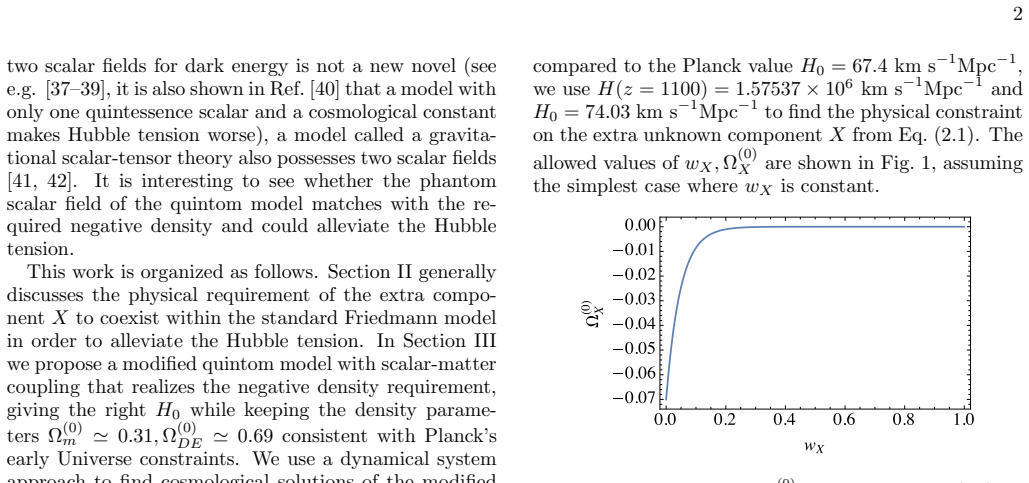
On its own terms, the paper's discovery is that the standard Friedmann equation already admits a solution to the Hubble tension once a small negative-density component is allowed: fixing the early-universe abundances ($\Omega_m^{(0)}=0.308$, $\Omega_r^{(0)}=9.2\times10^{-5}$, $\Omega_\Lambda^{(0)}=0.692$) and the last-scattering value of $H$, a present-day $H_0=74.03$ km s$^{-1}$ Mpc$^{-1}$ forces $\Omega_X^{(0)}$ to lie in $[-6.4\times10^{-5}, -5.2\times10^{-11}]$ when $1/3\le w_X\le 1$. The paper then shows that a quintom model—one ordinary quintessence field $\varphi$ and one 'phantom' field $\sigma$ whose kinetic term has the wrong sign—can supply exactly this negative density: the phantom has $w_\sigma=+1$ and $\rho_\sigma=-\dot\sigma^2/2$, and a conformal coupling $\kappa\delta\rho_m$ drags it along with matter so that its fraction stays below one percent. With only two parameters, $\lambda_\varphi$ (the rolling of the quintessence potential) and $\delta$ (the phantom-matter coupling strength), the model yields $H_0\simeq73.4$ km s$^{-1}$ Mpc$^{-1}$ while keeping $\Omega_m^{(0)}\simeq0.31$ and $\Omega_{\rm DE}^{(0)}\simeq0.69$; a parameter scan over $\delta$ and $\Omega_m^{(0)}$ finds a region, $0.02<\delta<0.10$ and $\Omega_m^{(0)}<0.31$, where the model provides better combined fits to SN Ia, BAO, and the first CMB peak than $\Lambda$CDM while still not completely resolving the tension.
Load-bearing premise
The phantom scalar has a negative kinetic term, making it a ghost; the paper acknowledges the resulting quantum instability but assumes the model is safe because the total energy density stays positive, treating the unstable degree of freedom classically without a proof that the vacuum does not decay.
Editorial extensions
If this is right
- Raising $H_0$ to about 74 km s$^{-1}$ Mpc$^{-1}$ requires only a tiny negative density, $\Omega_X^{(0)}\sim -10^{-5}$ to $-10^{-11}$, when $1/3\le w_X\le 1$, so the Planck-era abundances stay effectively unchanged.
- The benchmark Quintom I ($\lambda_\varphi=0.10$, $\delta=0.113$) reaches $H_0=73.36$ km s$^{-1}$ Mpc$^{-1}$ and fits the Pantheon supernovae as well as $\Lambda$CDM, but predicts an acoustic multipole $\ell_A=285.5$, about five percent below the observed value.
- In the region $0.02<\delta<0.10$ with $\Omega_m^{(0)}<0.31$, the model's combined fits to BAO and the first CMB peak improve on $\Lambda$CDM while giving $H_0$ in the 68–69.5 km s$^{-1}$ Mpc$^{-1}$ range, significantly relieving the tension.
- The phantom contribution must stay below about one percent of the total density at all times, so the negative-density effect acts as a small cumulative shift in $H_0$ rather than a large change at any single epoch.
Reading between the lines
- The constraint $1/3\le w_X\le 1$ is model-independent: any stiff negative-density substance, not necessarily a scalar ghost, can serve as the extra component, so the mechanism could survive in a ghost-free ultraviolet completion.
- The model leaves a testable fingerprint in the absolute magnitude of Type Ia supernovae, preferring $M\simeq-19.25$ where $\Lambda$CDM prefers $M\simeq-19.43$; a future precise calibration of SN Ia absolute magnitude could discriminate between the two.
- The contours relating $\delta$ to $H_0$ imply that once $\Omega_m^{(0)}$ and $H_0$ are both pinned down, the phantom-matter coupling is determined, making the model checkable against structure-formation or weak-lensing constraints on conformal couplings.
- The same Friedmann-equation logic suggests that other late-time modifications producing a small negative density—such as a negative cosmological constant paired with a compensating quintessence—could relieve the tension, and the paper's $\chi^2$ comparison provides a template for testing such alternatives.
Signed reviews
Editorial analysis
A structured set of objections, weighed in public.
Referee Report
Summary. The paper proposes that adding an extra component X with negative energy density to the Friedmann equation can raise the present Hubble parameter from the Planck-\LambdaCDM value H0=67.4 km/s/Mpc to about 74 km/s/Mpc while keeping the matter and dark-energy density parameters at their Planck-compatible values. Section II derives a condition 1/3 <= wX <= 1 for the extra component to be small. The authors then propose a quintom model with a quintessence field and a phantom field conformally coupled to matter, analyze its fixed points via a dynamical system, and present two benchmark models: Quintom I (delta=0.113) reaches H0=73.356 km/s/Mpc with Omega_m=0.3078 and Omega_DE=0.692, and Quintom II (delta=0.06) fits the BAO and first CMB peak but gives H0=68.55 km/s/Mpc. The paper claims that the model can significantly alleviate, and in some places completely resolve, the Hubble tension.
Significance. If the central claim were established, this would be an interesting mechanism because the extra component is very small at low redshift and the model keeps the late-time densities close to LambdaCDM values. The paper has some genuine strengths: the dynamical-system analysis is presented in detail, the numerical procedure is explicit, and the authors report the chi-square values for their benchmarks, including the large chi-square for the first CMB peak of Quintom I. This transparency allows the reader to check the main claim. However, the paper's own numbers show that the benchmark that resolves the Hubble tension is excluded by the CMB acoustic scale, and the benchmark that fits the CMB leaves H0 essentially at the LambdaCDM value. The claimed resolution is therefore not supported by the presented results.
major comments (2)
- [II, Eq. (2.1)] The derivation of the required negative density is tautological: H0=74.03 km/s/Mpc is inserted on the right-hand side of Eq. (2.1) and the equation is then solved for Omega_X^(0). The statement that a negative component with 1/3 <= wX <= 1 is required is exactly equivalent to assuming that the target H0 is the correct one. The later quintom analysis does not remove this circularity because H0 is not predicted; Section V states that H0 can be tuned by choosing delta and initial conditions, and Fig. 4 displays H0 contours, not a derived value.
- [VI, Eqs. (6.11)-(6.13)] The claim that Quintom II is preferred over LambdaCDM via AIC/BIC rests on a reduced chi2 that includes only the first CMB peak position, BAO, and SN distance moduli, and on a parameter count that omits the tuned initial conditions and integration constant C in Eq. (5.2). Even if that comparison were accepted, it does not support the paper's title: Quintom II has H0=68.55 km/s/Mpc, so it does not resolve the Hubble tension.
minor comments (4)
- [Abstract and Section VII] Calling lA=285.54 'slightly small' is misleading; it is about 5% below the Planck value and is the dominant source of exclusion for Quintom I.
- [Abstract] The statement that 'the model depends only on two parameters' undercounts the freedom used in the analysis, since initial conditions and the integration constant C in Eq. (5.2) are also tuned; the text itself acknowledges this in Section V.
- [Throughout] There are several grammatical and typographical errors, including 'provide better model' in the abstract, 'prefered' in Section VI, and inconsistent capitalization of 'universe'; these should be corrected.
- [VI, Eq. (6.9)] The BAO calculation rescales rs(zdrag) by 1.0275 to match numerical results; the sensitivity of the final chi2 to this ad hoc rescaling should be stated explicitly.
Circularity Check
The headline H0 result is tuned, not predicted: Section II solves for the negative component by imposing H0=74.03, and the quintom benchmark is then chosen to hit H0≈74, so the claimed resolution is partly by construction; the model's independent CMB-peak check fails at the resolving point.
-
fitted input called prediction
[Section II, Eq. (2.1), paragraph beginning 'In order to address the Hubble tension...']
"In order to address the Hubble tension where the value of H at small z is relatively large compared to the Planck value H0 = 67.4 km s−1Mpc−1, we use H(z = 1100) = 1.57537× 10^6 km s−1Mpc−1 and H0 = 74.03 km s−1Mpc−1 to find the physical constraint on the extra unknown component X from Eq. (2.1)."
The negative-density component X is not predicted; it is solved for by inserting the target H0=74.03 into Eq. (2.1) while holding the early-time Hubble value fixed. The conclusion that a small negative component with 1/3≤wX≤1 can resolve the tension is therefore equivalent to the assumed H0. The later model realization does not remove this: the benchmark is selected by tuning parameters to hit the same target, so the headline H0 is an input reproduced by construction rather than an independent output.
-
fitted input called prediction
[Section V, after Eq. (5.2) and Fig. 3]
"By tuning the model parameters and initial condition, we can obtain the Hubble parameter in the desired range of values, namely H0≈ 74 km s−1 Mpc−1 in order to relieve the Hubble tension."
This sentence states explicitly that H0≈74 is the objective of the tuning. Consequently the reported Quintom I value H0=73.356 in Table III is a fitted target, not a successful prediction of the model. The claim 'the Hubble tension is alleviated' reduces to the parameter choice. The model does have independent outputs (l1, BAO, SN fits), but those outputs at the resolving point fail (l1=210.093 vs the observed 220.0), while the benchmark that fits the CMB peak, Quintom II, gives H0=68.55 and does not resolve the tension.
full rationale
The paper is not circular as a whole: the autonomous-system equations, the fixed-point analysis, and the numerical integrations are explicit and self-contained, and the comparisons to SN Ia, BAO, and the CMB acoustic peak use external data. There is no load-bearing self-citation: Ref. [35] is peripheral, and the quintom construction is not imported from the authors' own prior work. However, the central claim that the model 'resolves' the Hubble tension is partially circular by construction. Section II fixes H0=74.03 as an input and solves Eq. (2.1) for the negative-density component, so the phenomenological existence of that component is equivalent to the assumed target. Section V then openly tunes model parameters and initial conditions to obtain H0≈74, and the benchmark Quintom I is presented with H0=73.356. The independent acoustic-peak output at that point, l1=210.093 against the observed 220.0±0.5, fails, while the benchmark chosen to fit BAO and l1 (Quintom II) returns H0=68.55. Thus the only parameter point that 'resolves' the tension does so because it was tuned to do so, and the surviving viable point does not resolve it. This is partial circularity: the headline result reduces to a fitted target, even though the model has genuine non-tautological constraints that can and do falsify that target. Score 6.
Assumptions & free parameters
free parameters (4)
- λφ (exponential potential slope) =
0.1 for benchmarks, 1.0 in some contours
- δ (phantom-matter coupling) =
0.113 for Quintom I, 0.06 for Quintom II
- Initial conditions (x1_i, x2_i, x3_i, x4_i) =
1e-5, 1e-10, 1e-5, 0.9983 at N=-13.79
- Integration constant C in Eq. (5.2) =
Matched to ΛCDM H(1100)=1.57537e6 km/s/Mpc
assumptions (5)
- domain assumption Flat FLRW metric and standard Friedmann equations with a ghost scalar field.
- domain assumption Conformal interaction form ∇μTμ(M)ν = κδ TM ∇ν σ.
- ad hoc to paper Exponential potential V(φ)=V0 e^{-κλφφ}.
- ad hoc to paper Classical treatment of the phantom ghost is physically meaningful despite its quantum instability.
- domain assumption zdec and zdrag are given by Hu-Sugiyama and Eisenstein-Hu formulas, with rs(zdrag) rescaled by 1.0275.
invented entities (1)
-
Phantom scalar σ with negative kinetic energy and conformal coupling to matter
Cite this review
Pith. "Pith review of Resolving Hubble Tension with Quintom Dark Energy Model." pith.science (2026). https://pith.science/paper/G7HJ34M5
@misc{pith2026190803324,
  author       = {Pith},
  title        = {Pith review of: Resolving Hubble Tension with Quintom Dark Energy Model},
  year         = {2026},
  howpublished = {\url{https://pith.science/paper/G7HJ34M5}},
  note         = {Machine review of arXiv:1908.03324}
}
abstract
Recent low-redshift observations give value of the present-time Hubble parameter $H_{0}\simeq 74~\rm{km s}^{-1}\rm{Mpc}^{-1}$, roughly 10\% higher than the predicted value $H_{0}=67.4~\rm{km s}^{-1}\rm{Mpc}^{-1}$ from Planck's observations of the Cosmic Microwave Background radiation~(CMB) and the $\Lambda$CDM model. Phenomenologically, we show that by adding an extra component X with negative density in the Friedmann equation, it can relieve the Hubble tension without changing the Planck's constraint on the matter and dark energy densities. For the extra negative density to be sufficiently small, its equation-of-state parameter must satisfy $1/3\leq w_{X}\leq1$. We propose a quintom model of two scalar fields that realizes this condition and potentially alleviate the Hubble tension. One scalar field acts as a quintessence while another "phantom" scalar conformally couples to matter in such a way that viable cosmological scenario can be achieved. The model depends only on two parameters, $\lambda_{\phi}$ and $\delta$ which represent rolling tendency of the self-interacting potential of the quintessence and the strength of conformal phantom-matter coupling respectively. The toy quintom model with $H_{0}=73.4~\rm{km s}^{-1}\rm{Mpc}^{-1}$~(Quintom I) gives good Supernovae-Ia luminosity fits, decent $r_{\rm BAO}$ fit, but slightly small acoustic multipole $\ell_{A}=285.54$. Full parameter scan reveals that quintom model provide better model than the $\Lambda$CDM model in certain region of the parameter space, $0.02<\delta<0.10, \Omega_{m}^{(0)}<0.31$, while significantly relieving Hubble tension even though not completely resolving it. A benchmark quintom model, Quintom II, is presented as an example.
Figures


Figures from the paper (7 more)


Forward citations
Cited by 4 Pith papers
-
How Holographic is the Dark Energy? A Spline Nodal reconstruction approach
A three-node spline reconstruction of holographic dark energy improves chi-squared over LambdaCDM by about 10 to 12, but Bayesian evidence gives no clear preference.
-
Interacting dark energy in the early 2020s: a promising solution to the $H_0$ and cosmic shear tensions
An interacting dark energy model with coupling proportional to the dark energy density alleviates the H0 and S8 tensions in Planck 2018 data but is not preferred once BAO and supernova data are included.
-
Hubble tension: a short review of theoretical explanations
A comprehensive review finds no theoretical Hubble-tension solution yet passes all consistency tests; new early-dark-energy chains reach high H0 only when the SH0ES calibration is added.
-
Hubble Tension and the G-step Model: Re-examination of Recent Constraints on Modified Local Physics
The paper argues that the G-step model remains a viable solution to the Hubble tension by widening error bars, adopting a weaker luminosity-gravity scaling, and reinterpreting Earth history and distance-ladder data.
Reference graph
Works this paper leans on
-
[1]
Fixed Point (a) Eigenvalues of the fixed point are µ(a) = 1, 0, 3± √ 6δ √ x2 1− 1, 3− √ 3 2λφx1. (4.16) Although a sign ± depends on roots of the condition x2 1−x2 3 = 1, the fixed point is either saddle or unstable point. Since this fixed point does not match with any known cosmological era, we no longer consider it. 5 Ωm Ωr ΩDE wDE weff (a) 0 0 1 1 1 (b) 0 ...
-
[2]
Radiation Dominated Solutions Eigenvalues of the fixed point (b), (c), (e), and (f) are given by µ(b) = 2 ,−1,−1, 1. (4.17) µ(c) = −1, 2,−1 2± 1 2 √ − ( 2 δ2 + 3 ) , (4.18) µ(e) = −1, 1,−1 2± √ 16 λ2 φ − 15 4 , (4.19) µ(f) = −1 2± 1 2δ2λ2 φ √ −δ2λ4 φ +δ4(32λ2 φ− 9λ4 φ) + √ δ4λ4 φ(λ4 φ + 4δ4(16− 3λ2 φ)2− 4δ2λ2 φ(16 + 3λ2 φ)), (4.20) −1 2± 1 2δ2λ2 φ √ −δ2λ4 ...
-
[3]
(4.23) The fixed point (d) is stable when δ2 > 3 2, whereas it is a saddle point when δ2 < 3
Matter Dominated Solutions For the fixed point (d) and (h), their corresponding eigenvalues are µ(d) = −3 2−δ2,−3 2−δ2,−1 2−δ2, 3 2−δ2, (4.22) µ(h) = λ2 φ + 2δ2(λ2 φ− 4) 4δ2− 2λ2 φ , 3λ2 φ + 2δ2(λ2 φ− 6) 4δ2− 2λ2 φ , 1 4(λ2 φ− 2δ2)2 ( −3λ4 φ− 2δ2λ2 φ(λ2 φ− 9) + 4δ4(λ2 φ− 6) ± √ 3(λ2 φ− 2δ2)2(72λ2 φ− 21λ4 φ + 4δ2(−72 + 18λ2 φ +λ4 φ) + 4δ4(60− 28λ2 φ + 3λ4 φ...
-
[4]
For the fixed point (h), the 6 eigenvalues can be understood once we set the value of λφ and δ
-
[5]
(4.24) Thus, the fixed point is stable when λ2 φ < 3
Accelerated Expansion Solutions Eigenvalues of the fixed point (g) are µ(g) = 1 2(λ2 φ− 6), 1 2(λ2 φ− 6), 1 2(λ2 φ− 4),λ 2 φ− 3. (4.24) Thus, the fixed point is stable when λ2 φ < 3. For the point (h) it is the same as the previous case. V. NUMERICAL SOLUTIONS In this section, the autonomous equations (4.12) - (4.15) are solved numerically, where we set λφ ...
-
[6]
A. G. Riess et al. [Supernova Search Team], Astron. J. 116, 1009 (1998) doi:10.1086/300499 [astro-ph/9805201]
arXiv 1998
-
[7]
S. Perlmutter et al. [Supernova Cosmology Project Collaboration], Astrophys. J. 517, 565 (1999) doi:10.1086/307221 [astro-ph/9812133]
arXiv 1999
-
[8]
G. W. Horndeski, Int. J. Theor. Phys. 10, 363 (1974). doi:10.1007/BF01807638
Show all 69 references
-
[9]
Deffayet, X
C. Deffayet, X. Gao, D. A. Steer and G. Za- hariade, Phys. Rev. D 84, 064039 (2011) doi:10.1103/PhysRevD.84.064039 [arXiv:1103.3260 [hep-th]]
2011 arXiv
-
[10]
Kobayashi, M
T. Kobayashi, M. Yamaguchi and J. Yokoyama, Prog. Theor. Phys. 126, 511 (2011) doi:10.1143/PTP.126.511 [arXiv:1105.5723 [hep-th]]
2011 arXiv
-
[11]
Heisenberg, JCAP 1405, 015 (2014) doi:10.1088/1475- 7516/2014/05/015 [arXiv:1402.7026 [hep-th]]
L. Heisenberg, JCAP 1405, 015 (2014) doi:10.1088/1475- 7516/2014/05/015 [arXiv:1402.7026 [hep-th]]
2014 arXiv
-
[12]
De Felice, L
A. De Felice, L. Heisenberg, R. Kase, S. Muko- hyama, S. Tsujikawa and Y. l. Zhang, JCAP 1606, no. 06, 048 (2016) doi:10.1088/1475-7516/2016/06/048 [arXiv:1603.05806 [gr-qc]]
2016 arXiv
-
[13]
de Rham, G
C. de Rham, G. Gabadadze and A. J. Tol- ley, Phys. Rev. Lett. 106, 231101 (2011) doi:10.1103/PhysRevLett.106.231101 [arXiv:1011.1232 [hep-th]]
2011 arXiv
-
[14]
de Rham and G
C. de Rham and G. Gabadadze, Phys. Rev. D 82, 044020 (2010) doi:10.1103/PhysRevD.82.044020 [arXiv:1007.0443 [hep-th]]
2010 arXiv
-
[15]
B. P. Abbott et al. [LIGO Scientific and Virgo Collab- orations], Phys. Rev. Lett. 116, no. 6, 061102 (2016) doi:10.1103/PhysRevLett.116.061102 [arXiv:1602.03837 [gr-qc]]
2016 arXiv
-
[16]
B. P. Abbott et al. [LIGO Scientific and Virgo Collab- orations], Phys. Rev. Lett. 119, no. 16, 161101 (2017) doi:10.1103/PhysRevLett.119.161101 [arXiv:1710.05832 [gr-qc]]
2017 arXiv
-
[17]
Baker, E
T. Baker, E. Bellini, P. G. Ferreira, M. Lagos, J. Noller and I. Sawicki, Phys. Rev. Lett. 119, no. 25, 251301 (2017) doi:10.1103/PhysRevLett.119.251301 [arXiv:1710.06394 [astro-ph.CO]]
2017 arXiv
-
[18]
Sakstein and B
J. Sakstein and B. Jain, Phys. Rev. Lett. 119, no. 25, 251303 (2017) doi:10.1103/PhysRevLett.119.251303 [arXiv:1710.05893 [astro-ph.CO]]
2017 arXiv
-
[19]
P. A. R. Ade et al. [Planck Collaboration], Astron. Astro- phys. 594, A13 (2016) doi:10.1051/0004-6361/201525830 [arXiv:1502.01589 [astro-ph.CO]]
2016 arXiv
-
[20]
A. G. Riess, S. Casertano, W. Yuan, L. M. Macri and D. Scolnic, Astrophys. J. 876, no. 1, 85 (2019) doi:10.3847/1538-4357/ab1422 [arXiv:1903.07603 [astro- ph.CO]]
2019 arXiv
-
[21]
K. C. Wong et al. , arXiv:1907.04869 [astro-ph.CO]
1907 arXiv
-
[22]
G. C.-F. Chen et al. , arXiv:1907.02533 [astro-ph.CO]
1907 arXiv
-
[23]
W. L. Freedman et al. , arXiv:1907.05922 [astro-ph.CO]
1907 arXiv
-
[24]
W. Yuan, A. G. Riess, L. M. Macri, S. Caser- tano and D. Scolnic, Astrophys. J. 886 (2019), 61 doi:10.3847/1538-4357/ab4bc9 [arXiv:1908.00993 [astro- ph.GA]]
2019 arXiv
-
[25]
J. Renk, M. Zumalacrregui, F. Montanari and A. Bar- reira, JCAP 1710, no. 10, 020 (2017) doi:10.1088/1475- 7516/2017/10/020 [arXiv:1707.02263 [astro-ph.CO]]
2017 arXiv
-
[26]
R. C. Nunes, JCAP 1805, no. 05, 052 (2018) doi:10.1088/1475-7516/2018/05/052 [arXiv:1802.02281 [gr-qc]]
2018 arXiv
- [27]
-
[28]
U. Alam, S. Bag and V. Sahni, Phys. Rev. D 95, no. 2, 023524 (2017) doi:10.1103/PhysRevD.95.023524 [arXiv:1605.04707 [astro-ph.CO]]
2017 arXiv
-
[29]
Khosravi, S
N. Khosravi, S. Baghram, N. Afshordi and N. Al- tamirano, Phys. Rev. D 99, no. 10, 103526 (2019) doi:10.1103/PhysRevD.99.103526 [arXiv:1710.09366 [astro-ph.CO]]
2019 arXiv
-
[30]
Di Valentino, E
E. Di Valentino, E. V. Linder and A. Mel- chiorri, Phys. Rev. D 97, no. 4, 043528 (2018) doi:10.1103/PhysRevD.97.043528 [arXiv:1710.02153 [astro-ph.CO]]
2018 arXiv
-
[31]
Banihashemi, N
A. Banihashemi, N. Khosravi and A. H. Shi- razi, Phys. Rev. D 99, no. 8, 083509 (2019) doi:10.1103/PhysRevD.99.083509 [arXiv:1810.11007 [astro-ph.CO]]
2019 arXiv
-
[32]
Poulin, T
V. Poulin, T. L. Smith, T. Karwal and M. Kamionkowski, Phys. Rev. Lett. 122, no. 22, 221301 (2019) doi:10.1103/PhysRevLett.122.221301 [arXiv:1811.04083 [astro-ph.CO]]
2019 arXiv
-
[33]
Vattis, S
K. Vattis, S. M. Koushiappas and A. Loeb, Phys. Rev. D 99, no. 12, 121302 (2019) doi:10.1103/PhysRevD.99.121302 [arXiv:1903.06220 [astro-ph.CO]]
2019 arXiv
-
[34]
Kumar, R
S. Kumar, R. C. Nunes and S. K. Yadav, Eur. Phys. J. C 79, no. 7, 576 (2019) doi:10.1140/epjc/s10052-019-7087-7 [arXiv:1903.04865 [astro-ph.CO]]
2019 arXiv
-
[35]
W. Yang, S. Pan, E. Di Valentino, R. C. Nunes, S. Vagnozzi and D. F. Mota, JCAP 1809, no. 09, 019 (2018) doi:10.1088/1475-7516/2018/09/019 [arXiv:1805.08252 [astro-ph.CO]]
2018 arXiv
-
[36]
C. D. Kreisch, F. Y. Cyr-Racine and O. Dor, arXiv:1902.00534 [astro-ph.CO]
1902 arXiv
- [37]
-
[38]
Dutta, Ruchika, A
K. Dutta, Ruchika, A. Roy, A. A. Sen and M. M. Sheikh- Jabbari, arXiv:1808.06623 [astro-ph.CO]
-
[39]
Visinelli, S
L. Visinelli, S. Vagnozzi and U. Danielsson, Sym- metry 11, 1035 (2019) doi:10.3390/sym11081035 [arXiv:1907.07953 [astro-ph.CO]]
2019 arXiv
-
[40]
Panpanich and P
S. Panpanich and P. Burikham, Phys. Rev. D 98, no. 6, 064008 (2018) doi:10.1103/PhysRevD.98.064008 [arXiv:1806.06271 [gr-qc]]
2018 arXiv
-
[41]
Z. K. Guo, Y. S. Piao, X. M. Zhang and Y. Z. Zhang, Phys. Lett. B 608, 177 (2005) doi:10.1016/j.physletb.2005.01.017 [astro-ph/0410654]
2005 arXiv
-
[42]
Elizalde, S
E. Elizalde, S. Nojiri and S. D. Odintsov, Phys. Rev. D 70, 043539 (2004) doi:10.1103/PhysRevD.70.043539 [hep-th/0405034]
2004 arXiv
-
[43]
Elizalde, S
E. Elizalde, S. Nojiri, S. D. Odintsov, D. Saez-Gomez and V. Faraoni, Phys. Rev. D 77, 106005 (2008) doi:10.1103/PhysRevD.77.106005 [arXiv:0803.1311 [hep- th]]
2008 arXiv
-
[44]
Alexander and E
S. Alexander and E. McDonough, Physics Let- ters B 797 (2019) doi:10.1016/j.physletb.2019.134830 [arXiv:1904.08912 [astro-ph.CO]]
2019
- [45]
-
[46]
Naruko, D
A. Naruko, D. Yoshida and S. Mukohyama, Class. Quant. Grav. 33, no. 9, 09LT01 (2016) doi:10.1088/0264- 15 9381/33/9/09LT01 [arXiv:1512.06977 [gr-qc]]
2016 arXiv
-
[47]
E. N. Saridakis and M. Tsoukalas, Phys. Rev. D 93, no. 12, 124032 (2016) doi:10.1103/PhysRevD.93.124032 [arXiv:1601.06734 [gr-qc]]
2016 arXiv
- [48]
-
[49]
Amendola, Phys
L. Amendola, Phys. Rev. D 62, 043511 (2000) doi:10.1103/PhysRevD.62.043511 [astro-ph/9908023]
2000 arXiv
-
[50]
Tsujikawa, doi:10.1007/978-90-481-8685-3 8 arXiv:1004.1493 [astro-ph.CO]
S. Tsujikawa, doi:10.1007/978-90-481-8685-3 8 arXiv:1004.1493 [astro-ph.CO]
-
[51]
Hinterbichler, J
K. Hinterbichler, J. Khoury, A. Levy and A. Matas, Phys. Rev. D 84, 103521 (2011) doi:10.1103/PhysRevD.84.103521 [arXiv:1107.2112 [astro-ph.CO]]
2011 arXiv
-
[52]
Khoury and A
J. Khoury and A. Weltman, Phys. Rev. Lett. 93, 171104 (2004) doi:10.1103/PhysRevLett.93.171104 [astro-ph/0309300]
2004 arXiv
-
[53]
Khoury and A
J. Khoury and A. Weltman, Phys. Rev. D 69, 044026 (2004) doi:10.1103/PhysRevD.69.044026 [astro- ph/0309411]
2004
-
[54]
H. Yu, B. Ratra and F. Wang, Astrophys. J. 856, no.1, 3 (2018) doi:10.3847/1538-4357/aab0a2 [arXiv:1711.03437 [astro-ph.CO]]
2018 arXiv
-
[55]
D. M. Scolnic et al., Astrophys. J. 859, no. 2, 101 (2018) doi:10.3847/1538-4357/aab9bb [arXiv:1710.00845 [astro- ph.CO]]
2018 arXiv
-
[56]
Jones, D
D. Jones, D. Scolnic, A. Riess, A. Rest, R. Kirshner, E. Berger, R. Kessler, Y. Pan, R. Foley, R. Chornock, C. Ortega, P. Challis, W. Burgett, K. Chambers, P. Draper, H. Flewelling, M. Huber, N. Kaiser, R. Ku- dritzki, N. Metcalfe, J. Tonry, R. Wainscoat, C. Waters, E. Gall, R...
2018 arXiv
-
[57]
Conley et al
A. Conley et al. [SNLS], Astrophys. J. Suppl. 192, 1 (2011) doi:10.1088/0067-0049/192/1/1 [arXiv:1104.1443 [astro-ph.CO]]
2011 arXiv
-
[58]
Richardson, R
D. Richardson, R. L. Jenkins, J. Wright and L. Mad- dox, Astron. J. 147, 118 (2014) doi:10.1088/0004- 6256/147/5/118 [arXiv:1403.5755 [astro-ph.SR]]
2014 arXiv
-
[59]
Hu and N
W. Hu and N. Sugiyama, Astrophys. J. 471, 542 (1996) doi:10.1086/177989 [astro-ph/9510117]
1996 arXiv
-
[60]
D. J. Eisenstein and W. Hu, Astrophys. J. 496, 605 (1998) doi:10.1086/305424 [astro-ph/9709112]
1998 arXiv
-
[61]
P. A. R. Ade et al. [Planck Collaboration], Astron. Astro- phys. 571, A16 (2014) doi:10.1051/0004-6361/201321591 [arXiv:1303.5076 [astro-ph.CO]]
2014 arXiv
-
[62]
W. J. Percival, S. Cole, D. J. Eisenstein, R. C. Nichol, J. A. Peacock, A. C. Pope and A. S. Szalay, Mon. Not. Roy. Astron. Soc. 381, 1053 (2007) doi:10.1111/j.1365- 2966.2007.12268.x [arXiv:0705.3323 [astro-ph]]
2007
-
[63]
Beutler, F., Blake, C., Colless, M. et al. , Mon. Not. Roy. Astron. Soc. 416, 3017 (2011)
2011
-
[64]
A. J. Ross, L. Samushia, C. Howlett, W. J. Percival, A. Burden and M. Manera, Mon. Not. Roy. Astron. Soc. 449, no. 1, 835 (2015) doi:10.1093/mnras/stv154 [arXiv:1409.3242 [astro-ph.CO]]
2015 arXiv
-
[65]
Alam et al
S. Alam et al. [BOSS Collaboration], Mon. Not. Roy. Astron. Soc. 470, no. 3, 2617 (2017) doi:10.1093/mnras/stx721 [arXiv:1607.03155 [astro- ph.CO]]
2017 arXiv
-
[66]
Arevalo, A
F. Arevalo, A. Cid and J. Moya, Eur. Phys. J. C 77, no.8, 565 (2017) doi:10.1140/epjc/s10052-017-5128-7 [arXiv:1610.09330 [astro-ph.CO]]
2017 arXiv
-
[67]
W. Hu, M. Fukugita, M. Zaldarriaga and M. Tegmark, Astrophys. J. 549 (2001), 669 doi:10.1086/319449 [arXiv:astro-ph/0006436 [astro-ph]]
2001 arXiv
-
[68]
Doran and M
M. Doran and M. Lilley, Mon. Not. Roy. Astron. Soc.330 (2002), 965-970 doi:10.1046/j.1365-8711.2002.05144.x [arXiv:astro-ph/0104486 [astro-ph]]
2002
-
[69]
Aghanim et al
N. Aghanim et al. [Planck], Astron. Astrophys. 594, A11 (2016) doi:10.1051/0004-6361/201526926 [arXiv:1507.02704 [astro-ph.CO]]
2016 arXiv
Reviewed August 14, 2026 · model on record in the stance chip above.
Discussion (0). Continue with ORCID to comment.