Modelling Dissipative Dynamics of r-mode Instability in Hybrid Stars
Pith reviewed 2026-06-29 01:08 UTC · model grok-4.3
The pith
Hybrid star viscosity timescales inferred from pulsar data produce an r-mode instability window that accounts for observed stability in specific millisecond pulsars.
A machine-rendered reading of the paper's core claim, the machinery that carries it, and where it could break.
Core claim
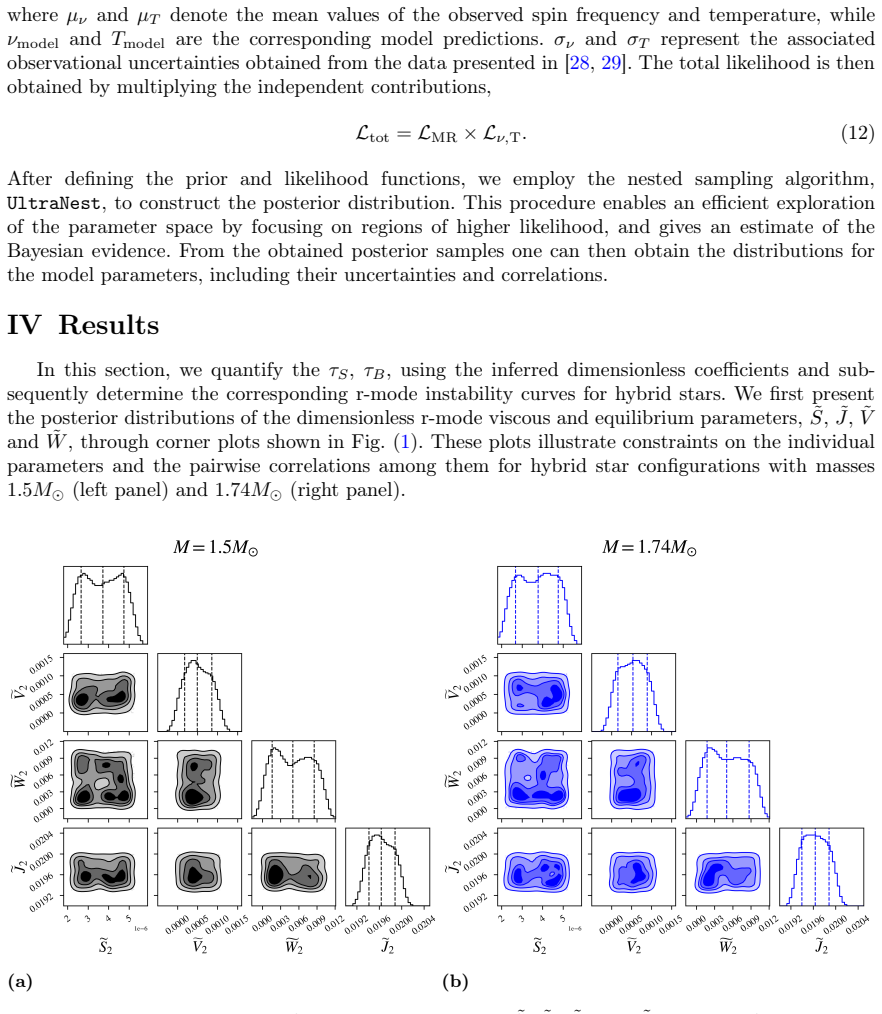
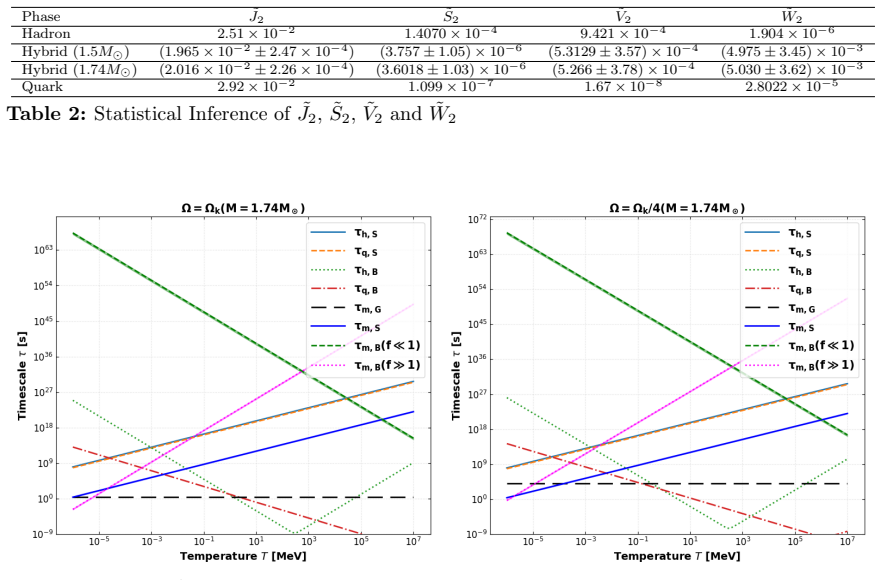
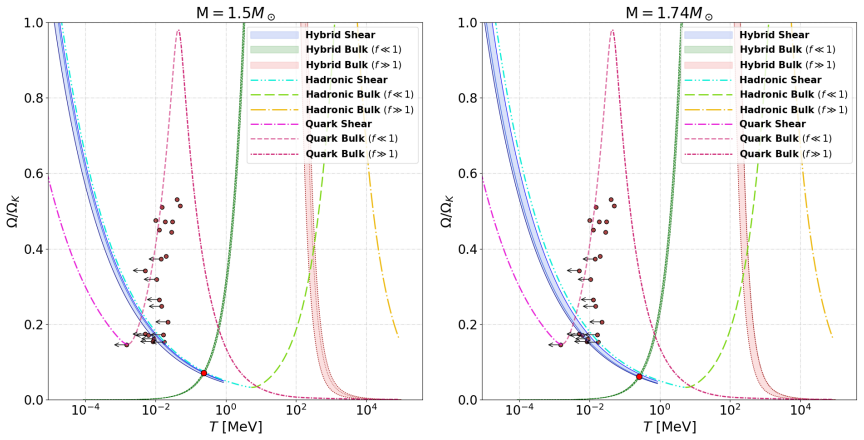
The paper infers shear and bulk viscous dissipation time scales of τ_s = (4.99^{+0.49}_{-0.52}) × 10^8 T^{5/3} s and τ_B = (2.150^{+1.23}_{-0.60}) × 10^{19} (T^4 10^{-12} + T^2 10^{-6})^{-1} Ω^{-2} s for a two-layer hybrid star. These timescales determine the minima of the star's rotation frequency at Ω = 451.87 Hz at T = 0.259 MeV for a 1.5 solar-mass star and Ω = 517.47 Hz at T = 0.234 MeV for a 1.75 solar-mass star. The instability window obtained through this inference explains the observed stability of millisecond pulsars in both the radio and LMXB populations, in particular XTE J0929-314, XTE J1807-294, J0437-4715 and J2124-3358.
What carries the argument
The r-mode instability window set by the competition between gravitational-wave driving and viscous damping from the mixed hadronic-quark phase, with the damping timescales obtained via Bayesian inference on observational data.
If this is right
- The derived timescales fix concrete lower bounds on stable rotation frequency for hybrid stars of 1.5 and 1.75 solar masses at given temperatures.
- The calculated instability window places the cited radio and LMXB pulsars outside the unstable region.
- The combination of LMXB timing data and NICER mass-radius constraints directly limits the viscous transport coefficients of the hybrid phase.
- The same viscous timescales can be inserted into evolution calculations to predict how a hybrid star spins down or heats while crossing the instability boundary.
Where Pith is reading between the lines
- Repeating the inference on a larger set of pulsars would further restrict the allowed range of mixed-phase parameters.
- If future gravitational-wave observatories detect an r-mode signal from a compact star, the frequency and amplitude could be compared directly against the predicted instability edge.
- The same Bayesian procedure could be applied to models containing other dense-matter phases to test how the presence or absence of a mixed phase changes the location of the stability boundary.
Load-bearing premise
The mixed hadronic-quark phase in the two-layer hybrid star supplies the dominant shear and bulk viscosity that damps r-modes, and no other damping mechanisms contribute significantly.
What would settle it
Detection of r-mode growth or gravitational-wave emission from one of the listed stable pulsars (XTE J0929-314, XTE J1807-294, J0437-4715 or J2124-3358) at its observed frequency and temperature would falsify the model.
Figures
read the original abstract
Compact star cores reach extreme densities and may contain exotic dense-matter phases. Information about the exotic interiors of rapidly rotating pulsars can be inferred from r-mode oscillations, whose stability is governed by viscous dissipation. In this work, we model a compact star containing a possible mixed phase of hadronic and quark matter and employ a hybrid statistical framework based on Bayesian inference to infer the dissipation time scales associated with the hybrid phase. Using low-mass X-ray binaries (LMXB) timing observations together with mass-radius constraints from the Neutron Star Interior Composition Explorer (NICER) mission, we estimate the shear and bulk viscosity contributions to r-mode damping for a hybrid star of two layers. Our inference yields shear and bulk viscous dissipation time scales of $\tau_s=(4.99^{+0.49}_{-0.52}) \times 10^8 T^{\frac{5}{3}}$s and $\tau_B=(2.150^{+1.23}_{-0.60}) \times 10^{19} (T^4 10^{-12}+T^2 10^{-6})^{-1}\Omega^{-2}$s respectively. The timescales thus obtained can be implemented to obtain the minima of the star's rotation frequency at $\Omega=451.87$ Hz at temperature $T=0.259$ MeV for a hybrid star of mass $1.5$ $M_{\odot}$ and $\Omega=517.47$ Hz at $T=0.234$ MeV for $M=1.75 M_{\odot}$. We find that the instability window obtained through the inference framework effectively explains the observed stability of millisecond pulsars in both the radio and LMXB populations, particularly for XTE J0929-314 and XTE J1807-294, J0437-4715, J2124-3358, respectively. These results demonstrate that Bayesian inference combined with r-mode phenomenology provides a powerful and observationally consistent framework for constraining the transport properties of dense hybrid matter.
Editorial analysis
A structured set of objections, weighed in public.
Referee Report
Summary. The manuscript models r-mode instability in two-layer hybrid stars containing a mixed hadronic-quark phase. It employs Bayesian inference on LMXB timing observations and NICER mass-radius constraints to infer shear and bulk viscosity timescales τ_s = (4.99^{+0.49}_{-0.52}) × 10^8 T^{5/3} s and τ_B = (2.150^{+1.23}_{-0.60}) × 10^{19} (T^4 10^{-12} + T^2 10^{-6})^{-1} Ω^{-2} s. These are used to locate instability-window minima (Ω = 451.87 Hz at T = 0.259 MeV for 1.5 M_⊙; Ω = 517.47 Hz at T = 0.234 MeV for 1.75 M_⊙) and to claim that the resulting window explains the observed stability of millisecond pulsars including XTE J0929-314, XTE J1807-294, J0437-4715 and J2124-3358.
Significance. If the inference is non-circular and the mixed-phase viscosities indeed dominate all relevant damping, the work supplies observationally anchored transport coefficients for hybrid matter and demonstrates a concrete link between microphysical timescales and pulsar phenomenology. The Bayesian approach itself is a methodological strength when properly validated against independent constraints.
major comments (3)
- [Abstract] Abstract: the shear and bulk timescales are obtained by Bayesian fitting to LMXB and NICER data and are then used to compute the frequency minima that are asserted to explain the stability of pulsars drawn from the same observational populations; this circularity is load-bearing for the central explanatory claim and requires explicit demonstration that the fit and the stability test employ disjoint data or independent priors.
- [Abstract] Abstract: the model presupposes that the mixed hadronic-quark phase supplies the dominant shear and bulk viscosity contributions, with no other significant damping channels present; standard r-mode calculations include Ekman-layer and magnetic damping whose timescales are comparable in the 0.2–0.3 MeV range, yet the manuscript provides no quantitative justification for neglecting them when locating the reported minima.
- [Abstract] Abstract: the reported numerical values for τ_s, τ_B and the instability-window minima are stated without the underlying model equations, priors, likelihood function, or data-selection criteria, preventing verification that the data actually support the consistency claim.
minor comments (1)
- The bulk-viscosity expression contains the compact notation (T^4 10^{-12} + T^2 10^{-6})^{-1}; expanding or defining the temperature scaling explicitly would improve readability.
Simulated Author's Rebuttal
We thank the referee for the thoughtful and detailed report. We address each major comment below, indicating revisions where appropriate to strengthen the manuscript.
read point-by-point responses
-
Referee: [Abstract] Abstract: the shear and bulk timescales are obtained by Bayesian fitting to LMXB and NICER data and are then used to compute the frequency minima that are asserted to explain the stability of pulsars drawn from the same observational populations; this circularity is load-bearing for the central explanatory claim and requires explicit demonstration that the fit and the stability test employ disjoint data or independent priors.
Authors: The Bayesian inference constrains the viscosity timescales using specific LMXB timing data and NICER mass-radius measurements. The resulting timescales are then inserted into the r-mode evolution equations to predict the location of the instability-window minimum. The stability claim is that the observed spin frequencies of the listed pulsars lie below this minimum (i.e., in the stable region). While the populations overlap, the fit determines microphysical parameters and the test evaluates whether those parameters produce a window consistent with the observed spins. We will revise the text to tabulate the exact data subsets used for inference versus those used only for the consistency check, thereby making the separation explicit. revision: partial
-
Referee: [Abstract] Abstract: the model presupposes that the mixed hadronic-quark phase supplies the dominant shear and bulk viscosity contributions, with no other significant damping channels present; standard r-mode calculations include Ekman-layer and magnetic damping whose timescales are comparable in the 0.2–0.3 MeV range, yet the manuscript provides no quantitative justification for neglecting them when locating the reported minima.
Authors: The manuscript focuses on the damping provided by the mixed phase in the two-layer hybrid-star model. We agree that a direct comparison with Ekman-layer and magnetic damping is needed to justify dominance in the 0.2–0.3 MeV window. We will add a dedicated subsection that evaluates the relevant timescales for the reported temperatures and frequencies and states the assumptions under which the mixed-phase contributions dominate. revision: yes
-
Referee: [Abstract] Abstract: the reported numerical values for τ_s, τ_B and the instability-window minima are stated without the underlying model equations, priors, likelihood function, or data-selection criteria, preventing verification that the data actually support the consistency claim.
Authors: The abstract is a concise summary; the full Bayesian setup (model equations, priors, likelihood, and data-selection criteria) is presented in Sections 3 and 4. To improve readability we will add a short parenthetical reference in the abstract directing readers to those sections and will ensure the results section explicitly links each reported number to the corresponding methodological detail. revision: partial
Axiom & Free-Parameter Ledger
free parameters (2)
- shear viscosity timescale prefactor =
4.99e8
- bulk viscosity timescale prefactor =
2.150e19
axioms (2)
- domain assumption Hybrid star consists of two layers with a mixed hadronic-quark phase that supplies the relevant shear and bulk viscosity
- domain assumption Viscous dissipation dominates r-mode stability with no other significant damping channels
Reference graph
Works this paper leans on
-
[1]
Madsen, J.: Bulk viscosity in hybrid stars. Phys. Rev. D46, 3290–3295 (1992) https://doi.org/ 10.1103/PhysRevD.46.3290
-
[2]
Jones, P.B.: Bulk viscosity of neutron-star matter. Phys. Rev. D 64, 084003 (2001) https: //doi.org/10.1103/PhysRevD.64.084003
-
[3]
Alford, M.G., Mahmoodifar, S., Schwenzer, K.: Large amplitude behavior of the bulk viscosity of dense matter. J. Phys. G37, 125202 (2010) https://doi.org/10.1088/0954-3899/37/12/125202 arXiv:1005.3769 [nucl-th]
work page internal anchor Pith review Pith/arXiv arXiv doi:10.1088/0954-3899/37/12/125202 2010
-
[4]
Yakovlev, D.G., Gusakov, M.E., Haensel, P.: Bulk viscosity in a neutron star mantle. Mon. Not.Roy.Astron.Soc. 481(4),4924–4930(2018)https://doi.org/10.1093/mnras/sty2639[astro- ph.HE]
-
[5]
Sawyer, R.F.: Bulk viscosity of hot neutron-star matter and the maximum rotation rates of neutron stars. Phys. Rev. D39, 3804–3806 (1989) https://doi.org/10.1103/PhysRevD.39.3804
-
[6]
Heiselberg, H., Pethick, C.J.: Transport and relaxation in degenerate quark plasmas. Phys. Rev. D 48, 2916–2928 (1993) https://doi.org/10.1103/PhysRevD.48.2916
-
[7]
Alford, M.G., Bovard, L., Hanauske, M., Rezzolla, L., Schwenzer, K.: Viscous Dissipation and Heat Conduction in Binary Neutron-Star Mergers. Phys. Rev. Lett. 120(4), 041101 (2018) https://doi.org/10.1103/PhysRevLett.120.041101 arXiv:1707.09475 [gr-qc]
work page internal anchor Pith review Pith/arXiv arXiv doi:10.1103/physrevlett.120.041101 2018
-
[8]
Alford, M.G., Haber, A., Zhang, Z.: Isospin equilibration in neutron star mergers. Phys. Rev. C 10 109(5), 055803 (2024) https://doi.org/10.1103/PhysRevC.109.055803 arXiv:2306.06180 [nucl- th]
-
[9]
Alford, M., Harutyunyan, A., Sedrakian, A.: Bulk viscosity from Urca processes: npeµ matter in the neutrino-trapped regime. Phys. Rev. D104(10), 103027 (2021) https://doi.org/10.1103/ PhysRevD.104.103027 arXiv:2108.07523 [astro-ph.HE]
arXiv 2021
-
[10]
Alford, M., Harutyunyan, A., Sedrakian, A.: Bulk viscosity of baryonic matter with trapped neutrinos. Phys. Rev. D100(10), 103021 (2019) https://doi.org/10.1103/PhysRevD.100.103021 arXiv:1907.04192 [astro-ph.HE]
-
[11]
Most, E.R., Harris, S.P., Plumberg, C., Alford, M.G., Noronha, J., Noronha-Hostler, J., Pre- torius, F., Witek, H., Yunes, N.: Projecting the likely importance of weak-interaction-driven bulk viscosity in neutron star mergers. Mon. Not. Roy. Astron. Soc.509(1), 1096–1108 (2021) https://doi.org/10.1093/mnras/stab2793 arXiv:2107.05094 [astro-ph.HE]
-
[12]
Universe 7(11), 399 (2021) https://doi.org/10.3390/universe7110399 arXiv:2108.03324 [nucl-th]
Alford, M.G., Haber, A., Harris, S.P., Zhang, Z.: Beta Equilibrium Under Neutron Star Merger Conditions. Universe 7(11), 399 (2021) https://doi.org/10.3390/universe7110399 arXiv:2108.03324 [nucl-th]
-
[13]
Sedrakian, A., Harutyunyan, A.: Delta-resonances and hyperons in proto-neutron stars and merger remnants. Eur. Phys. J. A 58(7), 137 (2022) https://doi.org/10.1140/epja/ s10050-022-00792-w arXiv:2202.12083 [nucl-th]
-
[14]
Sarkar, S., Nandi, R.: MURCA driven bulk viscosity in neutrino trapped baryonic mat- ter. Eur. Phys. J. C 84(9), 902 (2024) https://doi.org/10.1140/epjc/s10052-024-13236-0 arXiv:2406.08978 [nucl-th]
-
[15]
Shternin, P.S., Yakovlev, D.G.: Shear viscosity in neutron star cores. Phys. Rev. D78, 063006 (2008) https://doi.org/10.1103/PhysRevD.78.063006 arXiv:0808.2018 [astro-ph]
work page internal anchor Pith review Pith/arXiv arXiv doi:10.1103/physrevd.78.063006 2008
-
[16]
Manuel, C., Tolos, L.: Shear viscosity and the r-mode instability window in superfluid neu- tron stars. Phys. Rev. D 88, 043001 (2013) https://doi.org/10.1103/PhysRevD.88.043001 arXiv:1212.2075 [astro-ph.SR]
work page internal anchor Pith review Pith/arXiv arXiv doi:10.1103/physrevd.88.043001 2013
-
[17]
In: Workshop on Pre- Equilibrium Parton Dynamics in Heavy Ion Collisions, pp
Heiselberg, H.: Transport properties of quark and gluon plasmas. In: Workshop on Pre- Equilibrium Parton Dynamics in Heavy Ion Collisions, pp. 125–136 (1994)
1994
-
[18]
Alford, M.G., Nishimura, H., Sedrakian, A.: Transport coefficients of two-flavor superconducting quark matter. Phys. Rev. C90(5), 055205 (2014) https://doi.org/10.1103/PhysRevC.90.055205 arXiv:1408.4999 [hep-ph]
work page internal anchor Pith review Pith/arXiv arXiv doi:10.1103/physrevc.90.055205 2014
-
[19]
Sarkar, S., Sharma, R.: Shear viscosity of two-flavor inhomogenous color superconducting quark matter. Phys. Rev. D96, 094025 (2017) https://doi.org/10.1103/PhysRevD.96.094025 arXiv:1701.00010 [hep-ph]
work page internal anchor Pith review Pith/arXiv arXiv doi:10.1103/physrevd.96.094025 2017
-
[20]
Chatterjee, D., Bandyopadhyay, D.: Bulk viscosity in kaon condensed matter. Phys. Rev. D75, 123006 (2007) https://doi.org/10.1103/PhysRevD.75.123006 arXiv:astro-ph/0702259
work page internal anchor Pith review Pith/arXiv arXiv doi:10.1103/physrevd.75.123006 2007
-
[21]
Drago, A., Lavagno, A., Pagliara, G.: . Phys. Rev. D71, 103004 (2005) https://doi.org/10. 1103/PhysRevD.71.103004 arXiv:astro-ph/0312009
Pith/arXiv arXiv 2005
-
[22]
Pan, N.-N., Zheng, X.-P., Li, J.-R.: Bulk viscosity of Mixed nucleon-hyperon-quark Matter in Neutron stars. Mon. Not. Roy. Astron. Soc.371, 1359–1366 (2006) https://doi.org/10.1111/j. 1365-2966.2006.10759.x arXiv:astro-ph/0607051
work page doi:10.1111/j 2006
-
[23]
Jaccarino, D., Plumari, S., Greco, V., Lombardo, U., Santra, A.B.: Shear viscosity in hybrid stars. Phys. Rev. D85, 103001 (2012) https://doi.org/10.1103/PhysRevD.85.103001 11
-
[24]
Alford, M., Mahmoodifar, S., Schwenzer, K.: Viscous damping of r-modes: Small ampli- tude instability. Phys. Rev. D85, 024007 (2012) https://doi.org/10.1103/PhysRevD.85.024007 arXiv:1012.4883 [astro-ph.HE]
work page internal anchor Pith review Pith/arXiv arXiv doi:10.1103/physrevd.85.024007 2012
-
[25]
Jaikumar, P., Rupak, G., Steiner, A.W.: Viscous damping of r-mode oscillations in compact stars with quark matter. Phys. Rev. D78, 123007 (2008) https://doi.org/10.1103/PhysRevD. 78.123007 arXiv:0806.1005 [nucl-th]
work page internal anchor Pith review Pith/arXiv arXiv doi:10.1103/physrevd 2008
-
[26]
Alford, M.G., Schwenzer, K.: Gravitational wave emission from oscillating millisecond pulsars. Mon. Not. Roy. Astron. Soc.446(4), 3631–3641 (2015) https://doi.org/10.1093/mnras/stu2361 arXiv:1403.7500 [gr-qc]
work page internal anchor Pith review Pith/arXiv arXiv doi:10.1093/mnras/stu2361 2015
-
[27]
Mahmoodifar, S., Strohmayer, T.: Upper Bounds onr-mode Amplitudes from Observations of Low-mass X-Ray Binary Neutron Stars. Astrophys. J.773, 140 (2013) https://doi.org/10.1088/ 0004-637X/773/2/140 arXiv:1302.1204 [astro-ph.HE]
Pith/arXiv arXiv 2013
-
[28]
Haskell, B., Degenaar, N., Ho, W.C.G.: Constraining the physics of the r-mode instabil- ity in neutron stars with x-ray and ultraviolet observations. Monthly Notices of the Royal Astronomical Society 424(1), 93–103 (2012) https://doi.org/10.1111/j.1365-2966.2012.21171.x https://academic.oup.com/mnras/article-pdf/424/1/93/3256129/mnras0424-0093.pdf
-
[29]
Monthly Notices of the Royal Astronomical Society466(3), 2560–2569 (2017)
Schwenzer, K., Boztepe, T., Güver, T., Vurgun, E.: X-ray bounds on the r-mode amplitude in millisecond pulsars. Monthly Notices of the Royal Astronomical Society466(3), 2560–2569 (2017)
2017
-
[30]
Haskell, B.: R-modes in neutron stars: Theory and observations. Int. J. Mod. Phys. E24(09), 1541007 (2015) https://doi.org/10.1142/S0218301315410074 arXiv:1509.04370 [astro-ph.HE]
work page internal anchor Pith review Pith/arXiv arXiv doi:10.1142/s0218301315410074 2015
-
[31]
Lalazissis, G.A., Niksic, T., Vretenar, D., Ring, P.: New relativistic mean-field interaction with density-dependent meson-nucleon couplings. Phys. Rev. C71, 024312 (2005) https://doi.org/ 10.1103/PhysRevC.71.024312
-
[32]
Gravitational Radiation Instability in Hot Young Neutron Stars
Lindblom, L., Owen, B.J., Morsink, S.M.: Gravitational radiation instability in hot young neu- tronstars.PhysicalReviewLetters 80,4843–4846(1998)https://doi.org/10.1103/PhysRevLett. 80.4843 arXiv:gr-qc/9803053 [gr-qc]
work page internal anchor Pith review Pith/arXiv arXiv doi:10.1103/physrevlett 1998
-
[33]
Greif, S.K., Raaijmakers, G., Hebeler, K., Schwenk, A., Watts, A.L.: Equation of state sen- sitivities when inferring neutron star and dense matter properties. Mon. Not. Roy. Astron. Soc. 485(4), 5363–5376 (2019) https://doi.org/10.1093/mnras/stz654 arXiv:1812.08188 [astro- ph.HE]
work page internal anchor Pith review Pith/arXiv arXiv doi:10.1093/mnras/stz654 2019
-
[34]
arXiv preprint arXiv:1909.12313 (2019) https://doi.org/10.48550/arXiv.1909.12313
Speagle, J.S.: A conceptual introduction to markov chain monte carlo methods. arXiv preprint arXiv:1909.12313 (2019) https://doi.org/10.48550/arXiv.1909.12313
-
[35]
Huang, C., et al.: CompactObject: An open-source Python package for full-scope neutron star equation of state inference (2024) arXiv:2411.14615 [astro-ph.HE]
arXiv 2024
-
[36]
Typel, S., Oertel, M., Klähn, T.: CompOSE CompStar online supernova equations of state harmonising the concert of nuclear physics and astrophysics compose.obspm.fr. Phys. Part. Nucl.46(4), 633–664 (2015) https://doi.org/10.1134/S1063779615040061 arXiv:1307.5715 [astro-ph.SR] 12
work page internal anchor Pith review Pith/arXiv arXiv doi:10.1134/s1063779615040061 2015
discussion (0)
Sign in with ORCID, Apple, or X to comment. Anyone can read and Pith papers without signing in.