REVIEW 3 major objections 4 minor 22 references
Failure-mined offline RL lifts web agents on all three benchmarks
Reviewed by Pith at T0; open to challenge. T0 means a machine referee read the full paper against a public rubric. the ladder, T0–T4 →
T0 review · deepseek-v4-flash
2026-08-04 00:41 UTC pith:GBZ2HTNY
load-bearing objection Solid three-part recipe for compact web agents, but the missing SFT-on-mined control means the RL-specific claim isn't isolated. the 3 major comments →
RMSWeb: Reflection, Failure-Mode Mining, and Salvage-DS for Web Agent Reinforcement Learning
The pith
A machine-rendered reading of the paper's core claim, the machinery that carries it, and where it could break.
Core claim
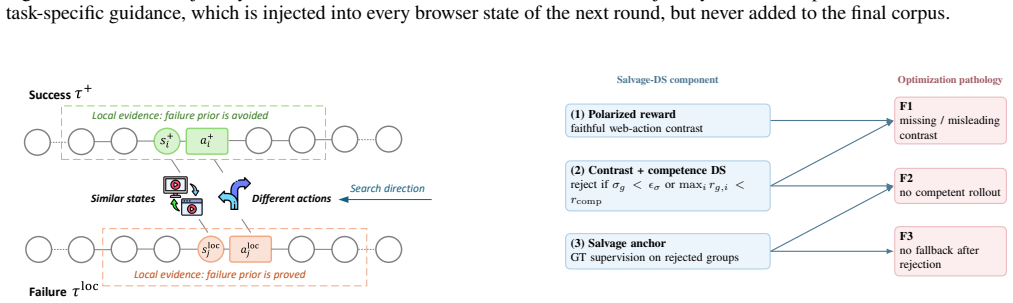
The central claim is that the SFT policy's own failures identify where RL should be spent. The paper pairs verified successful trajectories with failed or inefficient ones, finds the last state-aligned divergence whose surrounding evidence matches an assigned failure mode, and keeps only the successful-side observation-action pair as an RL prompt-target. On WebVoyager, Online-Mind2Web, and WebTailBench, this recipe improves over SFT by 3.7/7.0/2.4 points at 8B and 1.2/2.0/7.7 points at 32B; reflection-collected data reduces action steps on solved tasks by up to 19.7%. Under the paper's fixed evaluation harness, the 8B model reaches 86.39% on WebVoyager and 66.44% on Online-Mind2Web.
What carries the argument
The load-bearing object is the failure-mode-mined 'critical divergence': for each task, a verified successful trajectory is contrasted with a failed or detoured one, and the last aligned pre-action state pair is selected where states are comparable, actions differ, and local evidence matches an assigned failure category. Only the successful-side observation and its verified action enter RL. Salvage-DS then scores sampled actions against that verified action with a four-level polarized reward (1.0 exact, 0.7 core-correct, 0.3 right action type with wrong key parameter, 0.0 wrong), applies group-relative advantages only when within-group reward spread and a competent-rollout threshold both pas
Load-bearing premise
Everything rests on the assumption that the LLM-judged, state-aligned 'critical divergence' between a successful run and a failed/detoured run identifies the causally correct action to reinforce; if the divergence search or failure labels are noisy, the RL can reinforce spurious actions and the reported live-web gains would not replicate.
What would settle it
Take the mined 4.5k critical states, shuffle or corrupt the failure labels (or replace the divergence search with randomly chosen same-state action pairs), and retrain under the identical Salvage-DS objective; if the gain over SFT persists within roughly a point, critical-state selection is not the driver. A complementary check is to re-adjudicate the judge's success verdicts on a labeled subset and flip the disputed ones, then see whether the RL gain collapses.
If this is right
- Failure-mode-mined RL adds consistent gains over SFT on all three live-web benchmarks at both 8B and 32B, making offline RL on a compact critical-state corpus a workable alternative to RL over the full trajectory set.
- Reflection-conditioned collection shortens successful trajectories by 12.9–19.7% under matched decoding, so data collection can buy step efficiency without sacrificing accuracy on shorter-horizon tasks.
- Ablations show that full-corpus RL, anchor-free RL, and a strong group-relative baseline each trail the full recipe, indicating that both critical-state selection and the salvage anchor contribute independently.
- The salvage anchor turns rejected groups into supervised teaching on hard states and anti-forgetting on mastered ones, so the algorithm keeps learning even when a sampled group is unsuitable for a relative update.
Where Pith is reading between the lines
- Editorial extension: if the divergence signal transfers, the same success-versus-failure contrast could be applied to other sequential decision domains such as OS-level GUI control, converting sparse task-level outcomes into dense step-level training targets.
- Editorial extension: the coarse 1.0/0.7/0.3/0.0 reward spacing implies a testable experiment — vary the spacing while holding the contrast and competence gates fixed and observe whether accepted-group ratios or final accuracy move.
- Editorial extension: the paper itself notes the reward is a proxy for task success, not success itself, so the strongest test of the routing mechanism is swapping the verified-action target for an outcome-based judge in a live browser; if gains persist, the gating mechanism rather than the offline proxy is doing the work.
Editorial analysis
A structured set of objections, weighed in public.
Referee Report
Summary. RMSWeb proposes a three-part recipe for post-SFT offline RL training of compact web agents: (1) reflection-conditioned trajectory collection to increase yield and reduce detours, (2) failure-mode-guided mining that contrasts successful and failed/detoured executions to select critical states, and (3) Salvage-DS, an offline RL objective combining a polarized action-semantic reward, contrast- and competence-gated dynamic sampling, and an action-only salvage anchor. Experiments on Qwen3-VL-Instruct 8B/32B report pass@1 gains over SFT on WebVoyager, Online-Mind2Web, and WebTailBench (2.4–7.0 points at 8B; 1.2–7.7 points at 32B), step-efficiency gains up to 19.7%, and ablations showing full-corpus RL, anchor-free RL, and DAPO trail the full recipe.
Significance. If the results hold, RMSWeb would provide a practical data-centric recipe for improving compact web agents. The paper's strengths are its same-harness internal comparisons, the ablation set (full-corpus RL, anchor-free, DAPO), the detailed evaluation protocol and contamination checks, and the training-dynamics analysis supporting the stability claims. The collection-side yield analysis and reflection ablation are also well designed. However, the experimental design does not yet isolate the RL objective from the mined data selection, and the external comparability of the WebTailBench numbers is weakened by the judge substitution. These issues are fixable but require additional experiments before the central claims are fully supported.
major comments (3)
- [Experiments — Ablation studies (Table 2); Salvage-DS Eq. (2)] The ablations compare the full recipe against full-corpus RL, anchor-free RL, and DAPO, but not against continued supervised fine-tuning on the same 4.5k mined critical-state prompts. Since the paper's central claim is that the RL objective improves over SFT, and the mined data already contains verified action targets, plain cross-entropy on those prompts could reproduce the gains. If it does, the improvement is attributable to mining/selection, not to the Salvage-DS objective. Add an SFT-on-mined control (and ideally SFT on the full corpus) with the same training budget and report the comparison. This is load-bearing because the salvage term in Eq. (2) is itself supervised cross-entropy; without the control the reader cannot tell whether the relative-RL term adds anything beyond data selection.
- [Evaluation protocol — Cross-harness check; Table 1; Figure 1] WebTailBench is scored with a substituted WebVoyager-style DOM-aware judge rather than Fara's native verifier. This does not affect the same-harness internal 8B/32B comparisons, but Table 1 and Figure 1 place these numbers beside external WebTailBench scores produced under Fara's native judge. The re-adjudication documents false negatives in the native judge, but it does not establish that the substituted judge is not also more lenient in the opposite direction. At minimum, report one external model (e.g., Fara-7B) scored with the same DOM-aware judge, or otherwise calibrate the two judges, before claiming a 'leading' accuracy–cost frontier on WebTailBench.
- [Table 1; Main results] The claim that RL 'improves all three benchmarks at both scales' rests partly on small differences: +1.2 on WebVoyager and +2.0 on Online-Mind2Web at 32B. No variance, confidence intervals, or per-evaluation scores are reported. For pass@1 on 588 or 300 tasks, binomial standard errors are roughly 1–2 percentage points, so the 32B gains on those benchmarks may be within noise. Report the three per-evaluation scores, confidence intervals, and/or a paired significance test (e.g., McNemar on per-task outcomes for SFT vs. RL) to support the cross-scale claim.
minor comments (4)
- [Table 1] The table mixes task sets: external WebVoyager rows report F595 while our rows are the 588-task retained set. A footnote caveats this, but the layout invites direct comparison; consider separating external rows visually or adding a task-set column.
- [Figure 1 and cost accounting] Repeated-rollout cost curves use the nominal budget C_k = k*C_1 without early stopping, while the paper's deployment is single-run. Clarify how the external curves were reconstructed and state whether the same no-early-stopping convention is used for all systems.
- [Equation (2)] The clipping bounds ϵ_lo and ϵ_hi are introduced after the equation rather than before, and it would help to state explicitly whether the min is applied per token or per group. Small clarity fix.
- [Table 3] The text says reflection leaves accuracy essentially unchanged on WebVoyager and Online-Mind2Web, but the WebVoyager accuracy is numerically lower with reflection (82.65 vs. 83.28). This is consistent with noise, but given the small differences, consider flagging non-significance explicitly.
Circularity Check
No significant circularity: benchmark gains are measured outcomes, not entailed by the training objective or mining criteria.
full rationale
The paper's central claims are empirical: RL on a failure-mode-mined corpus improves measured task success on three live-web benchmarks, and reflection-collected data reduces action steps. These are not derived quantities that reduce to the paper's inputs. Equation (2) defines a training loss that combines a gated relative-RL surrogate, a salvage anchor, and a KL term; it is a training objective, not a prediction mechanism whose outputs are logically implied by its reward levels or gate thresholds. The mined corpus is produced by a separate, benchmark-excluded procedure: the contamination check rejects any training task lexically overlapping the benchmarks, the failure-mode taxonomy comes from a held-out development split, and the RL reward is step-level action matching rather than the benchmark judge. The reported WebVoyager / Online-Mind2Web / WebTailBench numbers are measured under a fixed harness and are not forced by the objective or by the mining thresholds. The paper adopts rather than claims novelty for action matching, citing GUI-R1 and SRL, so no ansatz is smuggled in as an external result. There are no author-overlapping uniqueness theorems or load-bearing self-citations; the cited algorithmic components (PPO, GRPO, DAPO) are external and explicit. The acknowledged limitation that the reward is a proxy for task success is a validity caveat, not a circularity. The absence of an SFT-on-mined-states control and the WebTailBench judge substitution are evaluation-design concerns, but they do not make the derivation circular. Therefore the paper exhibits no significant circularity under the stated criteria.
Axiom & Free-Parameter Ledger
free parameters (5)
- Polarized reward levels {1.0, 0.7, 0.3, 0.0} =
1.0 / 0.7 / 0.3 / 0.0
- Contrast gate threshold ε_σ =
0.10
- Competence gate threshold r_comp =
0.55
- Salvage weight λ_salvage =
0.10
- Mining selection thresholds =
S_total ≥ 0.62, S_category ≥ 0.45, state score ≥ 0.60, 30% per-domain cap, 10% technical cap
axioms (4)
- domain assumption Browser Use interface faithfully renders live web pages and captures sufficient state for action selection.
- domain assumption LLM judges (GPT-4o) provide valid and stable task-success labels across benchmarks.
- domain assumption Step-level action matching against verified ground truth is an adequate proxy reward for task success.
- ad hoc to paper The failure-mode taxonomy and LLM-assisted divergence labels are accurate enough to select causally important states.
read the original abstract
Compact web agents can reduce deployment cost, but training them poses challenges in both data collection and post-SFT reinforcement learning (RL). Successful trajectories are expensive to collect and often contain inefficient detours. After supervised fine-tuning (SFT), full trajectory corpora are dominated by routine states; moreover, when group-relative RL is applied to web actions, inadequately designed action-level rewards can yield weak or misleading relative updates, while groups rejected as unsuitable for such updates receive no fallback learning signal. We present RMSWeb, a three-part recipe for Qwen3-VL-Instruct at 8B and 32B. Reflection-conditioned retries increase collection yield and shorten successful trajectories; failure-mode mining concentrates offline RL on critical states exposed by the SFT policy; and Salvage-DS combines an action-semantic polarized reward, contrast-and-competence-gated dynamic sampling, and an action-only anchor for rejected groups. Policies trained with reflection-collected data use up to 19.7% fewer action steps on solved tasks. On WebVoyager, Online-Mind2Web, and WebTailBench, RMSWeb improves over SFT by 2.4-7.0 points at 8B and 1.2-7.7 points at 32B. Our 8B model also achieves the strongest reported Online-Mind2Web result among similarly sized open-weight models in our comparison and a leading reported accuracy-cost trade-off on WebVoyager and WebTailBench, with the caveat that external evaluation protocols differ.
Figures




Reference graph
Works this paper leans on
-
[3]
The Browser- Gym Ecosystem for Web Agent Research.arXiv preprint arXiv:2412.05467. Deng, X.; et al
-
[4]
Gupta,T.;Wolters,P.;Ma,Z.;Sushko,P.;Pang,R.Y.;Llanes, D.; Yang, Y.; Anderson, T.; Zheng, B.; et al
Is Your LLM Secretly a World Model of the Internet? Model-Based Planning for Web Agents.arXiv preprint arXiv:2411.06559. Gupta,T.;Wolters,P.;Ma,Z.;Sushko,P.;Pang,R.Y.;Llanes, D.; Yang, Y.; Anderson, T.; Zheng, B.; et al
-
[6]
In International Conference on Learning Representations
A Real-World WebAgent with Planning, Long Context Understanding, and Program Synthesis. In International Conference on Learning Representations. He,H.;etal.2024a.OpenWebVoyager:BuildingMultimodal Web Agents via Iterative Real-World Exploration, Feedback and Optimization.arXiv preprint arXiv:2410.19609. He, H.; et al. 2024b. WebVoyager: Building an End-to-...
-
[7]
Weblica: Scalable and Reproducible Train- ingEnvironmentsforVisualWebAgents.arXiv:2605.06761. Koh, J. Y.; et al. 2024a. Tree Search for Language Model Agents.arXiv preprint arXiv:2407.01476. Koh, J. Y.; et al. 2024b. VisualWebArena: Evaluating Mul- timodal Agents on Realistic Visual Web Tasks. InAnnual Meeting of the Association for Computational Linguist...
-
[8]
InInternational Confer- ence on Machine Learning
WebLINX: Real-World Website Nav- igation with Multi-Turn Dialogue. InInternational Confer- ence on Machine Learning. Luo,R.;etal.2025. GUI-R1:AGeneralistR1-StyleVision- Language Action Model for GUI Agents.arXiv preprint arXiv:2504.10458. Murty, S.; Zhu, H.; Bahdanau, D.; and Manning, C. D
Pith/arXiv arXiv 2025
-
[10]
InFind- ings of the Association for Computational Linguistics: ACL 2025, 22522–22538
GUI Agents: A Survey. InFind- ings of the Association for Computational Linguistics: ACL 2025, 22522–22538. Vienna, Austria: Association for Com- putational Linguistics. Ou,T.;Xu,F.F.;Madaan,A.;Liu,J.;Lo,R.;Sridhar,A.;Sen- gupta,S.;Roth,D.;Neubig,G.;andZhou,S.2024. Synatra: Turning Indirect Knowledge into Direct Demonstrations for Digital Agents at Scale....
2025
-
[11]
Agent Q: Advanced Reasoning and Learning for Autonomous AI Agents.arXiv preprint arXiv:2408.07199. Qi, Z.; et al
-
[12]
UI-TARS: Pioneering Automated GUI Interaction with Native Agents.arXiv preprint arXiv:2501.12326. Schulman, J.; et al
-
[14]
DeepSeekMath: Pushing the Limits of Mathematical Reasoning in Open Language Models.arXiv preprint arXiv:2402.03300. Shinn, N.; et al
-
[15]
Learn-by-Interact: A Data-Centric Framework for Self-Adaptive Agents.arXiv preprint arXiv:2501.10893. Sun, Q.; Cheng, K.; Ding, Z.; Jin, C.; Wang, Y.; Xu, F.; Wu, Z.;Jia,C.;Chen,L.;Liu,Z.;Kao,B.;Li,G.;He,J.;Qiao,Y.; and Wu, Z
-
[16]
Agent Workflow Memory.arXiv preprint arXiv:2409.07429. Wei,Z.;etal.2025. WebAgent-R1:TrainingWebAgentsvia End-to-End Multi-Turn Reinforcement Learning. InConfer- ence on Empirical Methods in Natural Language Processing. Xie, T.; et al
Pith/arXiv arXiv 2025
-
[17]
Mobile-Agent-v3.5: Multi- platform Fundamental GUI Agents. arXiv:2602.16855. Xu,Y.;Lu,D.;Shen,Z.;Wang,J.;Wang,Z.;Mao,Y.;Xiong, C.; and Yu, T
-
[18]
InConference on Language Modeling
An Illusion of Progress? Assessing the Current State of Web Agents. InConference on Language Modeling. Yan, D.; Zhang, H.; Huzhang, G.; Li, Y.; Wang, Y.; Chen, Q.-G.; Xu, Z.; Luo, W.; et al. 2026.M 2: Dual-Memory Augmentation for Long-Horizon Web Agents via Trajectory Summarization and Insight Retrieval. arXiv:2603.00503. Yang, J.; et al
arXiv 2026
-
[20]
OpenWebRL: DemystifyingOnlineMulti-turnReinforcementLearningfor Visual Web Agents. arXiv:2606.02031. Yao, S.; et al
-
[21]
DAPO: An Open-Source LLM Re- inforcement Learning System at Scale.arXiv preprint arXiv:2503.14476. Zhang,C.;etal.2024. LargeLanguageModel-BrainedGUI Agents: A Survey.arXiv preprint arXiv:2411.18279. Zheng, B.; Gou, B.; Kil, J.; Sun, H.; and Su, Y
Pith/arXiv arXiv 2024
-
[22]
GPT- 4V(ision) is a Generalist Web Agent, if Grounded. InPro- ceedings of the 41st International Conference on Machine Learning, volume 235 ofProceedings of Machine Learning Research, 61349–61385. PMLR. Zhou, S.; et al. 2024a. WebArena: A Realistic Web Envi- ronment for Building Autonomous Agents. InInternational Conference on Learning Representations. Zh...
Pith/arXiv arXiv 2025
-
[2017]
Proximal Policy Optimization Algorithms.arXiv preprint arXiv:1707.06347. Shao, Z.; et al
-
[2021]
WebGPT: Browser-Assisted Question-Answering with Human Feedback.arXiv preprint arXiv:2112.09332. Nguyen, D.; Chen, J.; Wang, Y.; Wu, G.; Park, N.; Hu, Z.; Lyu, H.; Wu, J.; Aponte, R.; Xia, Y.; Li, X.; Shi, J.; Chen, H.; Lai, V. D.; Xie, Z.; Kim, S.; Zhang, R.; Yu, T.; Tanjim, M.; Ahmed, N. K.; Mathur, P.; Yoon, S.; Yao, L.; Kveton, B.; Kil, J.; Nguyen, T....
-
[2023]
Yang, R.; Wu, Q.; Chen, Y.; Bai, H.; Yao, W.; Cheng, H.; Peng, B.; Zhang, H.; Zhang, T.; et al
Set-of-Mark Prompting Unleashes Extraordinary Visual Grounding in GPT-4V.arXiv preprint arXiv:2310.11441. Yang, R.; Wu, Q.; Chen, Y.; Bai, H.; Yao, W.; Cheng, H.; Peng, B.; Zhang, H.; Zhang, T.; et al
-
[2024]
Open-sourcesoftware,https: //github.com/browser-use/browser-use
Browser Use: Make Web- sitesAccessibleforAIAgents. Open-sourcesoftware,https: //github.com/browser-use/browser-use. Accessed: 2026-07-
2026
-
[2025]
Fara-7B: An Efficient Agentic ModelforComputerUse.arXiv preprint arXiv:2511.19663. Bai, H.; et al
-
[2026]
Mol- moWeb: Open Visual Web Agent and Open Data for the Open Web. arXiv:2604.08516. Gur, I.; et al
discussion (0)
Sign in with ORCID, Apple, or X to comment. Anyone can read and Pith papers without signing in.