Effects of Super-rotating Jets on Phase-Resolved Transmission Spectra at High Spectral Resolution
Pith reviewed 2026-06-26 06:42 UTC · model grok-4.3
The pith
Super-rotating jets in hot Jupiters change Doppler shifts in high-resolution transmission spectra most strongly during ingress and egress.
A machine-rendered reading of the paper's core claim, the machinery that carries it, and where it could break.
Core claim
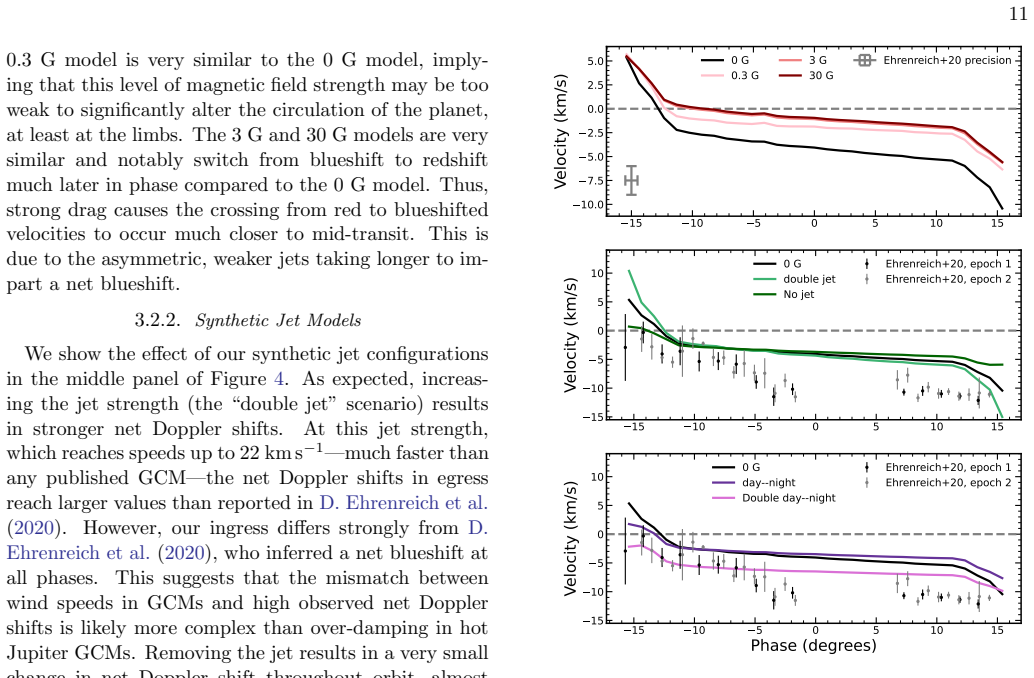
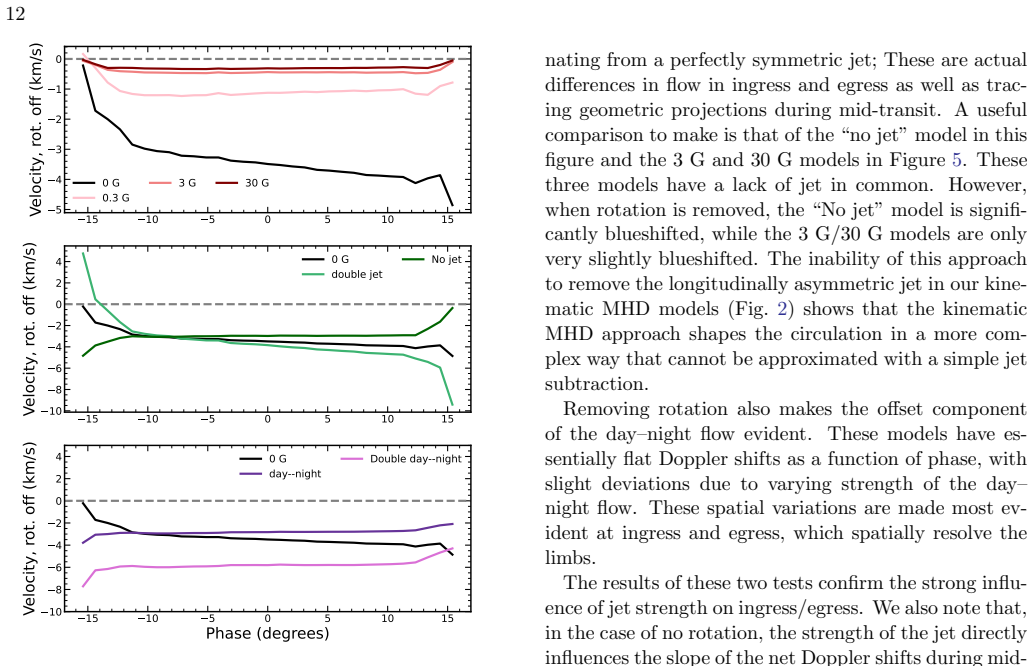
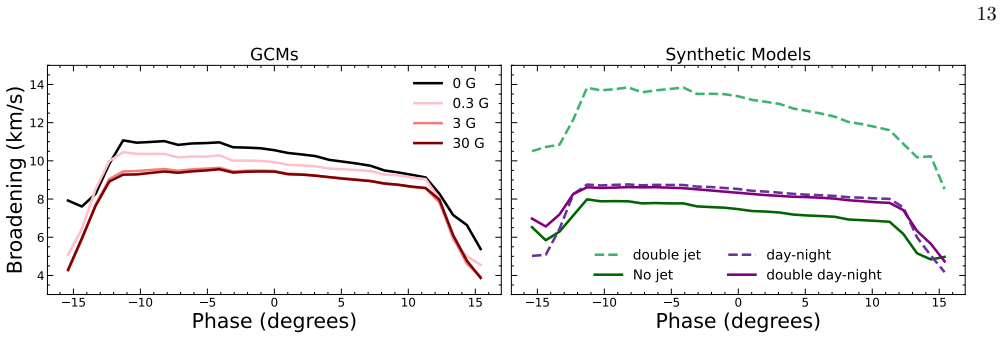
In models of hot Jupiter circulation, the presence and strength of a super-rotating equatorial jet most strongly modifies the net Doppler shifts measured during ingress and egress in high-resolution transmission spectra. At mid-transit the jet contributes a linear slope to the Doppler shift time series that is usually smaller than the blueshift from planetary rotation. Pure day-night flows instead produce constant offsets. Jets additionally increase the width of the cross-correlation function by raising the velocity dispersion between the limbs. Semi-analytical arguments confirm that first-order changes in CCF centroid and width track thermal and velocity asymmetries.
What carries the argument
Idealized circulation models that isolate the equatorial jet component, used to generate phase-resolved high-resolution transmission spectra and extract net Doppler shifts.
If this is right
- Jet strength controls the magnitude of Doppler shifts observed at ingress and egress.
- At mid-transit, jet strength sets a linear slope in the Doppler time series that is secondary to rotation-induced blueshift.
- Faster jets increase the width of the cross-correlation function through greater limb-to-limb velocity dispersion.
- Day-night flows produce constant offsets in Doppler shifts rather than phase-dependent slopes.
- Net Doppler shifts can be interpreted to distinguish jet-driven circulation from other flow patterns.
Where Pith is reading between the lines
- Phase-dependent Doppler measurements could separate jet signatures from rotation without requiring full three-dimensional retrievals.
- The same modeling approach might be applied to interpret spectra of non-synchronized or cooler planets where different flow regimes dominate.
- Repeated observations of the same target could test whether changes in apparent jet strength track known variations in irradiation or magnetic activity.
Load-bearing premise
The idealized models that isolate individual circulation components produce net Doppler effects that match those in full dynamical models without introducing artifacts.
What would settle it
High-resolution spectra showing identical Doppler shift patterns at ingress and egress for models with and without jets would falsify the claim that jet strength dominates those phases.
Figures
read the original abstract
Hot Jupiter atmospheric circulation can be shaped by a range of processes and planetary parameters, including rotation rate, irradiation gradients from tidal synchronization, magnetic effects, gravity, and clouds. Observations of exoplanetary spectral Doppler shifts as a function of phase, made possible with high-resolution spectrographs, can now probe the effects of exoplanetary winds at several points throughout transit. However, these measurements are difficult to interpret, given the variety of relevant atmospheric mechanisms. In this work, we generate high-resolution transmission spectra from two sets of circulation models: self-consistent dynamical models and idealized models that isolate circulation components. We identify how the strength of the jet -- or the absence of one -- alters the resultant net Doppler shifts. We find that the jet strength most prominently affects Doppler shifts during ingress and egress. During mid-transit, the strength of the jet linearly influences the Doppler shifts' slope; however, this effect is generally secondary to the overall blueshifting from planetary rotation. The slope induced by equatorial jets contrasts with the effect of pure day-night flows, which tend to add constant offsets to Doppler shifts during transit. Our modeling shows that jets also impact the cross-correlation function width; faster jets increase velocity dispersion across the limbs. We complement our simulations with semi-analytical arguments indicating that first-order changes of the cross-correlation function centroid and width (but not amplitude) probe thermal and velocity asymmetries. This work provides recommendations for interpreting net Doppler shifts in transmission and connecting these shifts with exoplanets' atmospheric circulation.
Editorial analysis
A structured set of objections, weighed in public.
Referee Report
Summary. The manuscript models high-resolution transmission spectra of hot Jupiters using both self-consistent dynamical models and idealized models that isolate individual circulation components. It reports that super-rotating jet strength most strongly modulates Doppler shifts during ingress and egress; at mid-transit the jet produces a linear change in the slope of the Doppler shift that is generally secondary to the blueshift from planetary rotation. Jets also increase the width of the cross-correlation function, and semi-analytical arguments are presented showing that first-order changes in CCF centroid and width (but not amplitude) trace thermal and velocity asymmetries. Recommendations are offered for interpreting net Doppler shifts in terms of atmospheric circulation.
Significance. If the separation of jet, rotation, and day-night flow effects holds, the work supplies a practical framework for connecting phase-resolved high-resolution spectra to specific dynamical features. The dual use of self-consistent and idealized models plus the semi-analytical arguments constitute a clear methodological strength and should aid interpretation of existing and forthcoming observations.
major comments (2)
- [Methods (idealized models)] Methods section on idealized-model construction: the claim that isolating the jet component accurately captures net Doppler effects without artifacts requires an explicit quantitative comparison (e.g., residual maps or Doppler-shift differences) between the isolated-jet runs and the corresponding self-consistent runs; without this check the central separation of circulation components remains unverified.
- [Results (mid-transit analysis)] Results on mid-transit slope: the statement that the jet-induced slope is 'generally secondary' to rotation needs tabulated slope values (or effect-size ratios) for the range of jet strengths examined; the current qualitative description is insufficient to assess the relative importance asserted in the abstract.
minor comments (3)
- [Abstract / Introduction] The abstract states that two sets of models are used but does not name the specific GCM or the parameter values varied; this information should appear in the first paragraph of the introduction or methods.
- [Figures] Figure captions for the phase-resolved Doppler-shift panels should list the exact jet-strength parameter values shown rather than referring only to 'fast' or 'slow' jets.
- [Semi-analytical arguments] Notation for the cross-correlation function width and centroid should be defined at first use in the text rather than only in the semi-analytical section.
Simulated Author's Rebuttal
We thank the referee for their constructive comments, which have helped clarify the presentation of our results. We address each major comment below.
read point-by-point responses
-
Referee: [Methods (idealized models)] Methods section on idealized-model construction: the claim that isolating the jet component accurately captures net Doppler effects without artifacts requires an explicit quantitative comparison (e.g., residual maps or Doppler-shift differences) between the isolated-jet runs and the corresponding self-consistent runs; without this check the central separation of circulation components remains unverified.
Authors: We agree that an explicit quantitative comparison would strengthen the validation of the idealized models. In the revised manuscript we will add residual maps and Doppler-shift difference plots comparing the isolated-jet runs to the corresponding self-consistent runs in the Methods section. revision: yes
-
Referee: [Results (mid-transit analysis)] Results on mid-transit slope: the statement that the jet-induced slope is 'generally secondary' to rotation needs tabulated slope values (or effect-size ratios) for the range of jet strengths examined; the current qualitative description is insufficient to assess the relative importance asserted in the abstract.
Authors: We agree that tabulated values are needed to support the claim. We will add a table of mid-transit slopes for the examined jet strengths together with effect-size ratios relative to the rotational blueshift. revision: yes
Circularity Check
No significant circularity
full rationale
The paper generates high-resolution transmission spectra from self-consistent dynamical models and idealized models that isolate circulation components, then examines how jet strength affects Doppler shifts via numerical output and semi-analytical arguments. The claims (jet effects prominent at ingress/egress, linear slope influence at mid-transit secondary to rotation, impacts on CCF width) are direct results of these forward simulations rather than reductions to fitted parameters or self-citations by construction. No load-bearing derivation step is shown to be equivalent to its inputs; the work is self-contained against external benchmarks.
Axiom & Free-Parameter Ledger
free parameters (1)
- jet strength parameter
axioms (1)
- domain assumption Self-consistent dynamical models and idealized models faithfully represent relevant atmospheric physics for transmission spectra
Reference graph
Works this paper leans on
-
[1]
Astronomy & Astrophysics , author =
Gkouvelis, L. 2025, A&A, 699, A74, doi: 10.1051/0004-6361/202453597
-
[2]
Arcangeli, J., D´ esert, J.-M., Parmentier, V., et al. 2019, A&A, 625, A136, doi: 10.1051/0004-6361/201834891 20 15 10 5 0 5 10 15 Phase (degrees) 10 8 6 4 2 0 2 4 6 Velocity (km/s) 0 G 0 G, 1.5x barotropic extension Figure B1.The results of our sensitivity test to the barotropic extension. Altering the extended velocity profile by a factor of 1.5 only mi...
-
[3]
Bell, T. J., & Cowan, N. B. 2018, The Astrophysical Journal, 857, L20, doi: 10.3847/2041-8213/aabcc8
-
[4]
Beltz, H., & Rauscher, E. 2024, ApJ, 976, 32, doi: 10.3847/1538-4357/ad7ded
-
[5]
Beltz, H., Rauscher, E., Brogi, M., & Kempton, E. M. R. 2021, AJ, 161, 1, doi: 10.3847/1538-3881/abb67b
-
[6]
2023, arXiv e-prints, arXiv:2302.13969, doi: 10.48550/arXiv.2302.13969
Beltz, H., Rauscher, E., Kempton, E., Malsky, I., & Savel, A. 2023, arXiv e-prints, arXiv:2302.13969, doi: 10.48550/arXiv.2302.13969
-
[7]
Beltz, H., Rauscher, E., Kempton, E. M. R., et al. 2022a, AJ, 164, 140, doi: 10.3847/1538-3881/ac897b
-
[8]
Beltz, H., Rauscher, E., Roman, M. T., & Guilliat, A. 2022b, AJ, 163, 35, doi: 10.3847/1538-3881/ac3746
-
[9]
Birkby, J. L. 2018, arXiv e-prints, arXiv:1806.04617. https://arxiv.org/abs/1806.04617 Bl¨ ocker, A., Carone, L., & Helling, C. 2026, arXiv e-prints, arXiv:2602.18101, doi: 10.48550/arXiv.2602.18101
work page internal anchor Pith review Pith/arXiv arXiv doi:10.48550/arxiv.2602.18101 2018
-
[10]
Borsa, F., Allart, R., Casasayas-Barris, N., et al. 2021, A&A, 645, A24, doi: 10.1051/0004-6361/202039344
-
[11]
2025, A&A, 700, A10, doi: 10.1051/0004-6361/202453341
Bouchy, F., Doyon, R., Pepe, F., et al. 2025, A&A, 700, A10, doi: 10.1051/0004-6361/202453341
-
[12]
2018,, 0.3.13 http://github.com/jax-ml/jax
Bradbury, J., Frostig, R., Hawkins, P., et al. 2018,, 0.3.13 http://github.com/jax-ml/jax
2018
-
[13]
Brogi, M., & Line, M. R. 2019, AJ, 157, 114, doi: 10.3847/1538-3881/aaffd3
-
[14]
Brown, T. M. 2001, The Astrophysical Journal, 553, 1006
2001
-
[15]
2021, arXiv preprint arXiv:2107.03374
Chen, M., Tworek, J., Jun, H., et al. 2021, arXiv preprint arXiv:2107.03374
Pith/arXiv arXiv 2021
-
[16]
Nature, Volume 457, Issue 7226, pp
Christensen, U. R., Holzwarth, V., & Reiners, A. 2009, Nature, 457, 167, doi: 10.1038/nature07626
-
[17]
Kohary, K. 2025, MNRAS, 541, 2773, doi: 10.1093/mnras/staf1146
-
[18]
Christie, D. A., Mayne, N. J., Zamyatina, M., et al. 2024, MNRAS, 532, 3001, doi: 10.1093/mnras/stae1408 da Costa-Luis, C. 2019, Journal of Open Source Software, 4, 1277
-
[19]
2016, Journal of Open Research Software, 4
Dawson, A. 2016, Journal of Open Research Software, 4
2016
-
[20]
2020, A&A, 633, A2, doi: 10.1051/0004-6361/201936110
Debras, F., Mayne, N., Baraffe, I., et al. 2020, A&A, 633, A2, doi: 10.1051/0004-6361/201936110
-
[21]
2022, MNRAS, 512, 3759, doi: 10.1093/mnras/stac680
Deitrick, R., Heng, K., Schroffenegger, U., et al. 2022, MNRAS, 512, 3759, doi: 10.1093/mnras/stac680
-
[22]
2013, MNRAS, 435, 3159, doi: 10.1093/mnras/stt1509
Dobbs-Dixon, I., & Agol, E. 2013, MNRAS, 435, 3159, doi: 10.1093/mnras/stt1509
-
[23]
2019, arXiv preprint arXiv:1903.09173
Dragomir, D., Kempton, E., Bean, J., et al. 2019, arXiv preprint arXiv:1903.09173
Pith/arXiv arXiv 2019
-
[24]
Drummond, B., Mayne, N. J., Manners, J., et al. 2018, ApJL, 855, L31, doi: 10.3847/2041-8213/aab209
-
[25]
Dutton, J. A. 2002, The ceaseless wind: An introduction to the theory of atmospheric motion (Courier Corporation)
2002
-
[26]
Ehrenreich, D., Lovis, C., Allart, R., et al. 2020, Nature, 580, 597, doi: 10.1038/s41586-020-2107-1
-
[27]
2019, AJ, 157, 209, doi: 10.3847/1538-3881/ab164c
Chiavassa, A. 2019, AJ, 157, 209, doi: 10.3847/1538-3881/ab164c
-
[28]
Ground-based and Airborne Instrumentation for Astronomy V , year = 2014, editor =
Follert, R., Dorn, R. J., Oliva, E., et al. 2014, in Society of Photo-Optical Instrumentation Engineers (SPIE) Conference Series, Vol. 9147, Ground-based and Airborne Instrumentation for Astronomy V, ed. S. K. Ramsay, I. S. McLean, & H. Takami, 914719, doi: 10.1117/12.2054197
-
[29]
Gandhi, S., Brogi, M., & Webb, R. K. 2020, Monthly Notices of the Royal Astronomical Society, 498, 194
2020
-
[30]
Gandhi, S., Kesseli, A., Snellen, I., et al. 2022, MNRAS, 515, 749, doi: 10.1093/mnras/stac1744
-
[31]
Gibson, N. P., Merritt, S., Nugroho, S. K., et al. 2020, MNRAS, 493, 2215, doi: 10.1093/mnras/staa228
-
[32]
2007, The Messenger, 127, 3 21
Gilmozzi, R., & Spyromilio, J. 2007, The Messenger, 127, 3 21
2007
-
[33]
E., & P´ erez, F
Granger, B. E., & P´ erez, F. 2021, Computing in Science & Engineering, 23, 7
2021
-
[34]
On the radiative equilibrium of irradiated planetary atmospheres
Guillot, T. 2010, A&A, 520, A27, doi: 10.1051/0004-6361/200913396
-
[35]
Hammond, M., & Abbot, D. S. 2022, MNRAS, 511, 2313, doi: 10.1093/mnras/stac228
-
[36]
Hammond, M., & Lewis, N. T. 2021, Proceedings of the National Academy of Sciences, 118, e2022705118
2021
-
[37]
Hammond, M., & Pierrehumbert, R. T. 2018, The Astrophysical Journal, 869, 65
2018
-
[38]
Harris, C. R., Millman, K. J., van der Walt, S. J., et al. 2020, Nature, 585, 357, doi: 10.1038/s41586-020-2649-2
-
[39]
Heng, K., Menou, K., & Phillipps, P. J. 2011, MNRAS, 413, 2380, doi: 10.1111/j.1365-2966.2011.18315.x
-
[40]
E., Fortney, J
Hood, C. E., Fortney, J. J., Line, M. R., et al. 2020, The Astronomical Journal, 160, 198
2020
-
[41]
Hunter, J. D. 2007, Computing in Science & Engineering, 9, 90, doi: 10.1109/MCSE.2007.55
-
[42]
2012, Ground-based and Airborne Telescopes IV, 8444, 526
Johns, M., McCarthy, P., Raybould, K., et al. 2012, Ground-based and Airborne Telescopes IV, 8444, 526
2012
-
[43]
M.-R., Bean, J
Kempton, E. M.-R., Bean, J. L., & Parmentier, V. 2017, The Astrophysical Journal Letters, 845, L20
2017
-
[44]
M.-R., Perna, R., & Heng, K
Kempton, E. M.-R., Perna, R., & Heng, K. 2014, The Astrophysical Journal, 795, 24
2014
-
[45]
Kesseli, A. Y., Beltz, H., Rauscher, E., & Snellen, I. A. G. 2024, ApJ, 975, 9, doi: 10.3847/1538-4357/ad772f
-
[46]
Komacek, T. D. 2025, ApJ, 983, 7, doi: 10.3847/1538-4357/adbae9
-
[47]
Komacek, T. D., & Showman, A. P. 2016, ApJ, 821, 16, doi: 10.3847/0004-637X/821/1/16
-
[48]
Komacek, T. D., & Showman, A. P. 2020, ApJ, 888, 2, doi: 10.3847/1538-4357/ab5b0b
-
[49]
Komacek, T. D., Tan, X., Gao, P., & Lee, E. K. H. 2022, ApJ, 934, 79, doi: 10.3847/1538-4357/ac7723
-
[50]
2015, Publications of the Astronomical Society of the Pacific, 127, 1161
Kreidberg, L. 2015, Publications of the Astronomical Society of the Pacific, 127, 1161
2015
-
[51]
1995, Atomic Line List
Kurucz, R. 1995, Atomic Line List
1995
-
[52]
Lodders, K. 2003, ApJ, 591, 1220, doi: 10.1086/375492
-
[53]
and Barman, Travis and Koskinen, Tommi , month = oct, year =
Lothringer, J. D., Barman, T., & Koskinen, T. 2018, ApJ, 866, 27, doi: 10.3847/1538-4357/aadd9e
-
[54]
R., Deming, D., Albert, L., et al
Louie, D. R., Deming, D., Albert, L., et al. 2018, Publications of the Astronomical Society of the Pacific, 130, 044401
2018
-
[55]
M., et al
Malik, M., Kitzmann, D., Mendon¸ ca, J. M., et al. 2019, The Astronomical Journal, 157, 170
2019
-
[56]
Malsky, I., Rauscher, E., Roman, M. T., et al. 2024, ApJ, 961, 66, doi: 10.3847/1538-4357/ad0b70
-
[57]
Mayne, N. J., Baraffe, I., Acreman, D. M., et al. 2014, Geoscientific Model Development, 7, 3059, doi: 10.5194/gmd-7-3059-2014 Miller-Ricci Kempton, E., & Rauscher, E. 2012, ApJ, 751, 117, doi: 10.1088/0004-637X/751/2/117 Molli` ere, P., Wardenier, J., Van Boekel, R., et al. 2019, Astronomy & Astrophysics, 627, A67
-
[58]
2024, Detection of the resolved signatures of a supersonic equatorial jet and cool poles in a hot planet, publication Title: arXiv
Nortmann, L., Lesjak, F., Yan, F., et al. 2024, Detection of the resolved signatures of a supersonic equatorial jet and cool poles in a hot planet, publication Title: arXiv. org
2024
-
[59]
doi:10.5281/zenodo.3509134 , url =
Palle, E., Biazzo, K., Bolmont, E., et al. 2025, Experimental Astronomy, 59, 1 pandas development team, T. 2020,, latest Zenodo, doi: 10.5281/zenodo.3509134
-
[60]
Ground-based and Airborne Instrumentation for Astronomy V , year = 2014, editor =
Park, C., Jaffe, D. T., Yuk, I.-S., et al. 2014, in Society of Photo-Optical Instrumentation Engineers (SPIE) Conference Series, Vol. 9147, Ground-based and Airborne Instrumentation for Astronomy V, ed. S. K. Ramsay, I. S. McLean, & H. Takami, 91471D, doi: 10.1117/12.2056431
-
[61]
Parmentier, V., Guillot, T., Fortney, J. J., & Marley, M. S. 2015, A&A, 574, A35, doi: 10.1051/0004-6361/201323127
-
[62]
P., & Fortney, J
Parmentier, V., Showman, A. P., & Fortney, J. J. 2021, Monthly Notices of the Royal Astronomical Society, 501, 78
2021
-
[63]
Parmentier, V., Line, M. R., Bean, J. L., et al. 2018, A&A, 617, A110, doi: 10.1051/0004-6361/201833059
-
[64]
Pelletier, S., Benneke, B., Ali-Dib, M., et al. 2023, Nature, 619, 491, doi: 10.1038/s41586-023-06134-0
-
[65]
2014, Astronomische Nachrichten, 335, 8, doi: 12.1002/asna.201312004
Pepe, F., Molaro, P., Cristiani, S., et al. 2014, Astronomische Nachrichten, 335, 8, doi: 12.1002/asna.201312004
2014
-
[66]
Perez-Becker, D., & Showman, A. P. 2013, ApJ, 776, 134, doi: 10.1088/0004-637X/776/2/134
-
[67]
2012, ApJ, 751, 59, doi: 10.1088/0004-637X/751/1/59
Perna, R., Heng, K., & Pont, F. 2012, ApJ, 751, 59, doi: 10.1088/0004-637X/751/1/59
-
[68]
Perna, R., Menou, K., & Rauscher, E. 2010, ApJ, 719, 1421, doi: 10.1088/0004-637X/719/2/1421
-
[69]
Pino, L., Brogi, M., D´ esert, J. M., et al. 2022, A&A, 668, A176, doi: 10.1051/0004-6361/202244593
-
[70]
2019, The Astrophysical Journal, 887, 170
Powell, D., Louden, T., Kreidberg, L., et al. 2019, The Astrophysical Journal, 887, 170
2019
-
[71]
Prinoth, B., Hoeijmakers, H. J., Pelletier, S., et al. 2023, A&A, 678, A182, doi: 10.1051/0004-6361/202347262
-
[72]
Rauscher, E., & Kempton, E. M. R. 2014, ApJ, 790, 79, doi: 10.1088/0004-637X/790/1/79
-
[74]
2012b, ApJ, 750, 96, doi: 10.1088/0004-637X/750/2/96
Rauscher, E., & Menou, K. 2012b, ApJ, 750, 96, doi: 10.1088/0004-637X/750/2/96
-
[75]
Rauscher, E., & Menou, K. 2013, The Astrophysical Journal, 764, 103, doi: 10.1088/0004-637x/764/1/103
-
[76]
Rogers, T. M. 2017, Nature Astronomy, 1, 0131, doi: 10.1038/s41550-017-0131 22
-
[77]
Rogers, T. M., & Komacek, T. D. 2014, The Astrophysical Journal, 794, 132, doi: 10.1088/0004-637x/794/2/132
-
[78]
Roman, M. T., Kempton, E. M.-R., Rauscher, E., et al. 2021, The Astrophysical Journal, 908, 101, doi: 10.3847/1538-4357/abd549
-
[79]
Roth, A., Parmentier, V., & Hammond, M. 2024, MNRAS, 531, 1056, doi: 10.1093/mnras/stae984
-
[80]
Savel, A. B., Kempton, E. M. R., Rauscher, E., et al. 2023, ApJ, 944, 99, doi: 10.3847/1538-4357/acb141
-
[81]
Savel, A. B., Kempton, E. M. R., Malik, M., et al. 2022, ApJ, 926, 85, doi: 10.3847/1538-4357/ac423f
discussion (0)
Sign in with ORCID, Apple, or X to comment. Anyone can read and Pith papers without signing in.