REVIEW 4 major objections 5 minor 5 cited by
The paper establishes the first non-asymptotic convergence guarantee for a diffusion-based posterior score estimator, with Wasserstein-2 error bounds that cover multi-modal posteriors.
Reviewed by Pith at T0; open to challenge. T0 means a machine referee read the full paper against a public rubric. the ladder, T0–T4 →
T0 review · deepseek-v4-flash
2026-08-03 17:48 UTC pith:GD7DSRBI
load-bearing objection Conditional theory is real and worth reading, but the implemented inner-chain initialization makes the key divergence infinite, so the theorem does not apply to the algorithm as run. the 4 major comments →
Provable Diffusion Posterior Sampling for Bayesian Inversion
The pith
A machine-rendered reading of the paper's core claim, the machinery that carries it, and where it could break.
Core claim
The paper's central claim is Theorem 5.9: under six assumptions — semi-log-concavity and sub-Gaussian tails of the posterior, polynomial growth of the prior score, a bounded posterior score at the origin, small L2 prior score-matching error, and Lipschitz continuity of the estimated drift — the proposed sampler, warm-started by Langevin sampling of the terminal posterior and driven by a Monte Carlo score estimate, satisfies an expected squared 2-Wasserstein error bound of order ε^{1/2} log(1/ε) when the early-stopping time is set to √ε and the hyperparameters follow the paper's prescriptions. The score estimate itself is constructed by running Langevin dynamics against the posterior denoisin
What carries the argument
The load-bearing object is the posterior denoising density p_t(x0|x,y) ∝ π0(x0) exp(-||x - μ_t x0||²/(2σ_t²) - ℓ_y(x0)), called the restricted Gaussian oracle. Tweedie's formula converts the posterior score into a conditional expectation of this density, and Lemma 4.6 shows that for small t the density is log-concave even when the posterior is multi-modal, so Langevin dynamics can sample it efficiently. A second mechanism is the terminal posterior q_T(·|y): Lemma 4.12 shows that for sufficiently large T it satisfies a log-Sobolev inequality, which makes the warm-start Langevin chain converge. Theorem 4.16 guarantees that the small-time and large-time windows overlap when 2αV_SG² ≤ 1, and Lem
Load-bearing premise
The central bound depends on Assumptions 5 and 6: the learned prior score must be close in L2 to the true prior score and the estimated drift must be Lipschitz, yet the experiments use a fixed smoothing level in a pretrained denoiser and a pretrained nonlinear network for which neither ε_prior nor G is estimated, so if those constants are unfavorable the proof does not apply to the executed algorithm.
What would settle it
Run the algorithm on a synthetic Gaussian-mixture posterior whose prior score is known analytically, with deliberately poor prior scores or with T outside the predicted window; if the observed Wasserstein-2 error does not follow the O(ε^{1/2} log(1/ε)) scaling as ε, the particle count m, and the Langevin horizon S are increased per Corollary 5.6, the claimed rate is falsified. Alternatively, estimate ε_prior and G for the smoothed denoiser and blur network used in the paper; no such estimates are reported, and without them Theorem 5.9 is not connected to the numerical results.
If this is right
- Semi-log-concave and sub-Gaussian multi-modal posteriors can be sampled with a diffusion-based algorithm whose expected squared 2-Wasserstein error is O(ε^{1/2} log(1/ε)), a regime classical Langevin guarantees do not cover.
- The total error separates into early-stopping, score-estimation, and warm-start terms; the score term diverges as σ_{T0}→0, so the early stop is a theoretical necessity, not a practical convenience.
- Prior score-matching error ε_prior enters the posterior bound multiplied by the condition number κ_y and an exponential in the Langevin horizon S, so score quality and problem ill-posedness jointly control performance.
- The method is plug-and-play: the learned prior score is measurement-independent, and the same module can be paired with arbitrary differentiable likelihoods, including nonlinear forward operators; the numerical experiments support this across several deblurring tasks.
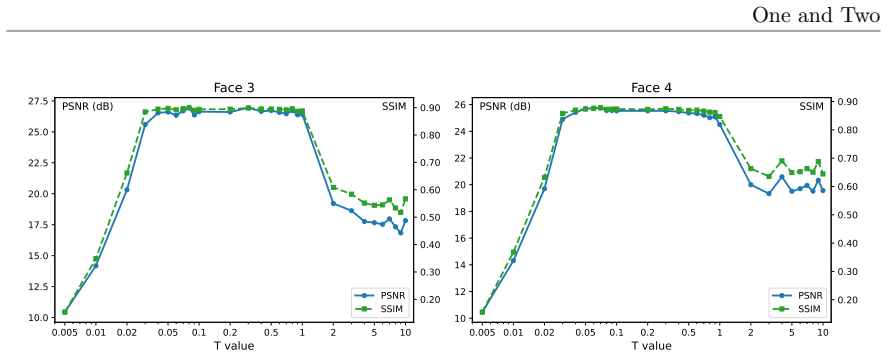
- The terminal diffusion time must lie in a finite window; the ablation shows best performance for T between about 0.05 and 1.0 and degradation outside it, matching the predicted trade-off.
Where Pith is reading between the lines
- Editorial inference: the theorem is conditional on ε_prior and G; if one supplied certified bounds for a given pretrained denoiser and forward model, the method would become a certificate for that executed algorithm, but the paper does not provide such certification for its own implementations.
- Editorial inference: because the inner score estimate only needs the gradient of the negative log-likelihood, replacing ∇ℓ_y with a stochastic or zeroth-order oracle could extend the method to derivative-free Bayesian inversion, at the cost of a fourth error term in Lemma 5.4.
- Editorial inference: the ε^{1/2} rate comes from balancing early stopping against the score singularity near zero; using a higher-order reverse-SDE integrator or a learned initial condition at T0 could shift that balance and produce faster rates, a testable modification of the main bound.
- Editorial inference: the condition 2αV_SG² ≤ 1 implies the method works when the posterior's curvature and tail spread do not conflict; very flat or heavy-tailed multi-modal priors may push the two convergence windows apart, and the observable signature would be a sharp performance cliff as T is varied.
Editorial analysis
A structured set of objections, weighed in public.
Referee Report
Summary. The paper proposes PDPS, a plug-and-play diffusion-based posterior sampler. It runs an OU forward process from the target posterior, then simulates the reverse SDE with an early-stopping time; the posterior score is estimated by Monte Carlo averaging of Langevin trajectories targeting the restricted Gaussian oracle p_t(·|x,y), using a learned prior score; the terminal distribution is sampled by a separate Langevin warm-start. The main theoretical result, Theorem 5.9, gives E[W_2^2(q0(·|y), M(μ_{T0}^{-1})♯q̂^R_{T-T0}(·|y))] ≤ C' ε^{1/2} log(1/ε) under Assumptions 1–6 and hyperparameter choices in Corollary 5.6 and Lemma 5.8. Experiments on Gaussian/motion/nonlinear deblurring with the FFHQ dataset report strong PSNR/SSIM and uncertainty maps.
Significance. The conditional theory is genuinely useful: Lemma 5.4 gives a clean three-way error decomposition; Lemma 5.5 separates Monte Carlo error, Langevin convergence, and prior score-matching error; Lemma 4.12 and Lemma 5.8 provide an LSI-based warm-start analysis. If the stated theorem applied to the implemented algorithm, it would be the first non-asymptotic W_2 guarantee for a diffusion-based posterior score estimator in multimodal settings. The paper also ships a public repository and explicitly lists assumptions, which is commendable. However, the gap between the theorem and the executed algorithm is large and load-bearing: the implemented inner and outer chains are initialized at N(0,I), the nonlinear experiments use T values far outside the proven interval, and no discretization or score-estimation constants are controlled. These issues prevent the paper from currently substantiating its central 'provable' claim.
major comments (4)
- [§5.3, Lemma 5.5 / Cor. 5.6; Appendix B.2.2] The theorem is stated for a finite η_y, but the implemented inner Langevin is initialized at N(0,I) for every t and x. For t=T0=0.05, Lemma 4.6 makes p_t(·|x,y) strongly log-concave with constant at least μ_t²/σ_t²−α ≈ 9.5−α; under T0<T<¯t the allowed α is <~9.5, and for α<8.5 the density decays faster than exp(−‖x‖²/2). Then χ²(N(0,I)∥p_t)=∫φ²/p_t−1 diverges, so η_y=∞ and the S, ε_prior choices in Corollary 5.6 are undefined. Theorem 5.9 therefore does not bound the algorithm actually run. The same issue can make ζ_y in Lemma 5.8 infinite.
- [§6.1, B.4, Table 6] The quantitative nonlinear-deblur experiments use T=20.0, and the case studies use T=3.5–9.0. Theorem 4.16 and Remark 4.7 require T < 0.5 log(1+α⁻¹), which is <0.35 even for α=1 and becomes smaller for larger α. For the multimodal Gaussian-mixture and Gaussian-convolution priors discussed in Examples 4.4–4.5, α is at least of order 1/σ_min², so T=20 cannot satisfy the bound. The nonlinear experiments are thus outside the theoretical regime, and the claim that they corroborate Theorem 5.9 is not supported.
- [§5, Appendices B.2.2–B.2.4] The theory is continuous-time, while the experiments use Euler-Maruyama discretizations with adaptive/fixed step sizes, a burn-in factor ρ=0.5, and a final deterministic denoising step at σ′_d=0.03. None of these discretization, burn-in, or post-processing effects appear in Theorem 5.9. As a result, the non-asymptotic bound cannot be invoked for the numerical sampler whose output is actually evaluated.
- [Assumptions 5–6; §6.2] The experimental prior score is a fixed EDM denoiser at σ_d=0.09. Assumption 5 requires an L²(π0) error bound ε_prior and Assumption 6 requires a uniform Lipschitz constant G for ŝ_prior−∇ℓ_y; neither is estimated or certified for the pretrained network. The theoretical results are therefore conditional on unverified constants, while Sections 1.1 and 6 present the method as 'provable' without a clear caveat that these assumptions are not checked for the deployed estimator.
minor comments (5)
- [§5.5, Theorem 5.9] The theorem says 'the hyperparameter selections follow Corollary 5.5', but the referenced result is Corollary 5.6.
- [§5.3, Corollary 5.6] The text says 'the terminal time S of Langevin dynamics'; S is the simulation horizon, not a time index in the diffusion. This is confusing notation.
- [Appendix G.2] The proof heading says 'Proof of Lemma 5.4' but the section proves Lemma 5.8; the introductory sentence in Appendix G has the same mislabel.
- [Appendix H.4] The proof heading says 'Proof of Lemma H.1' but the statement proved is Lemma H.4. This makes cross-referencing difficult.
- [Table 5] The notation table lists ε_post twice (once as 'The error of the warm-start' and once as 'The terminal posterior score estimation error'), which is inconsistent with Lemma 5.8.
Circularity Check
No load-bearing circularity: the convergence theorem is conditional on stated assumptions and is not fitted to the numerical experiments.
specific steps
-
self citation load bearing
[Appendix C.2 / Example 4.5]
"The Lipschitz continuity and linear growth of the score can be found as Ding et al. (2024a, Propositions 3.2 and 3.5)."
This is a self-citation by overlapping authors used to verify that the Gaussian-convolution example satisfies Assumptions 1 and 3. It is not load-bearing for the main theorem: Theorem 5.9 takes Assumptions 1-6 as hypotheses, and the proof of the main bound is carried out in the paper rather than imported from Ding et al. The citation only supports an illustrative example, so it does not make the predicted rate reduce to the cited result.
full rationale
The derivation chain is not circular. Lemma 4.1 is a direct conditional-Tweedie identity; Lemma 4.6 is a Hessian computation from Assumption 1; Lemma 4.12 applies an external log-Sobolev theorem (Chen et al. 2021) under Assumption 2; Lemma 5.5 is a standard three-term decomposition (Monte Carlo, Langevin convergence, prior-score error) whose proof is given in Appendix F; Lemma 5.8 and Theorem 5.9 assemble these with the error decomposition Lemma 5.4. The hyperparameters in Corollary 5.6 and Lemma 5.8 are specified as functions of the assumed quantities η_y, ζ_y, ε_prior, κ_y, α, V_SG; these are assumptions/inputs, not values fitted to the data, so the Wasserstein bound is conditional rather than forced by a fit. The paper itself flags that Assumption 5 is not instantiated by explicit score-matching bounds (Section 5.1), and the implementation uses a fixed σ_d=0.09-smoothed EDM denoiser (Appendix B.2.1) and a pretrained nonlinear operator (Appendix B.1.2), so ε_prior and G are not certified; these are validity/application gaps, not circularity. The possible divergence of η_y for the implemented N(0,I_n) initialization (Appendix B.2.2) is a separate correctness concern, not a circularity. The self-citations (Ding et al. 2024a, 2024b, 2025) are used for supporting example verification and as inspiration for a bound whose proof is included; none is invoked as a black-box premise to forbid alternatives or to define the target. No equation in the paper reduces a prediction to its own inputs by construction.
Axiom & Free-Parameter Ledger
free parameters (5)
- Diffusion terminal time T =
0.2 (Gaussian deblur), 0.5 (motion deblur), 3.5-20 (nonlinear deblur), per Appendix B.4
- Inner Langevin horizon (step size and iteration count) =
Nin=50 (warm-start), 20 (reverse); SNR r_in=0.075
- Monte Carlo particle count m =
20 chains with burn-in factor 0.5
- Prior score smoothing σ_d and final denoise σ'_d =
0.09 and 0.03
- Early-stopping time T0 =
0.05
axioms (8)
- domain assumption Assumption 1: -∇² log q0(·|y) + α I_d ⪰ 0 for some α > 0 (semi-log-concavity of posterior)
- domain assumption Assumption 2: prior has sub-Gaussian tails with constants V_SG, C_SG
- domain assumption Assumption 3: prior score grows at most polynomially: ∥∇log π0(x)∥ ≤ B(1+∥x∥^r)
- domain assumption Assumption 4: posterior score is bounded at the origin
- domain assumption Assumption 5: L2(π0) prior score matching error ≤ ε_prior
- domain assumption Assumption 6: s_prior − ∇ℓ_y is G-Lipschitz
- standard math Chen et al. (2021, Theorem 2): dimension-free log-Sobolev inequality for Gaussian convolutions of sub-Gaussian measures
- standard math Bakry-Émery theorem and standard Langevin convergence under LSI / strong log-concavity
read the original abstract
We propose a novel diffusion-based posterior sampling method within a plug-and-play framework. Our approach constructs a probability transport from an easy-to-sample distribution to the target posterior via a diffusion process. To initialize the sampler efficiently, we introduce a warm-start strategy for the particles. The posterior score is then approximated using a Monte Carlo estimator in which samples are generated via Langevin dynamics, avoiding the heuristic approximations prevalent in prior work. The score function driving the Langevin dynamics is learned from data, enabling the model to capture rich structural features of the underlying prior. We also establish non-asymptotic error bounds in Wasserstein-2 distance guaranteeing convergence of the proposed method even for complex, multimodal posterior distributions. We corroborate our theoretical findings with numerical experiments demonstrating the effectiveness of the method across a variety of inverse problems.
Figures


Forward citations
Cited by 5 Pith papers
-
Tracing the Oracle: Improving Diffusion Timestep Scheduling for 3D CT Reconstruction
TrO extracts an optimized few-step timestep schedule for conditional diffusion in 3D CT reconstruction by globally minimizing cumulative truncation error against dense numerical oracle trajectories via dynamic programming.
-
Image Restoration via Diffusion Models with Dynamic Resolution
Dynamic resolution priors enable faster diffusion-based image restoration by operating in lower-dimensional subspaces, with adapted methods outperforming prior DM approaches on most tasks.
-
Proximal-Based Generative Modeling for Bayesian Inverse Problems
PGM replaces the intractable likelihood score in diffusion models with a closed-form Moreau score computed via proximal operators, enabling non-asymptotic sampling for inverse problems trained only on prior data.
-
Proximal-Based Generative Modeling for Bayesian Inverse Problems
PGM framework links diffusion to proximal regularization for closed-form Moreau-score sampling in Bayesian inverse problems, learned only from prior samples.
-
Beyond Expected Information Gain: Stable Bayesian Optimal Experimental Design with Integral Probability Metrics and Plug-and-Play Extensions
An IPM-based framework for Bayesian optimal experimental design is proposed that replaces KL-based expected information gain with Wasserstein, MMD, and energy distances, delivering stronger stability guarantees and pl...
Reference graph
Works this paper leans on
-
[1]
Inverse problem sampling in latent space using sequential monte carlo, 2025
Idan Achituve, Hai Victor Habi, Amir Rosenfeld, Arnon Netzer, Idit Diamant, and Ethan Fetaya. Inverse problem sampling in latent space using sequential monte carlo, 2025. arXiv:2502.05908
Pith/arXiv arXiv 2025
-
[2]
Michael S. Albergo, Nicholas M. Boffi, and Eric Vanden-Eijnden. Stochastic interpolants: A unifying framework for flows and diffusions, 2025. arXiv:2303.08797
Pith/arXiv arXiv 2025
-
[3]
Building normalizing flows with stochastic interpolants
Michael Samuel Albergo and Eric Vanden-Eijnden. Building normalizing flows with stochastic interpolants. In The Eleventh International Conference on Learning Representations, 2023
2023
-
[4]
Reverse-time diffusion equation models
Brian DO Anderson. Reverse-time diffusion equation models. Stochastic Processes and their Applications, 12 0 (3): 0 313--326, 1982
1982
-
[5]
Uncertainty estimation for computed tomography with a linearised deep image prior
Javier Antoran, Riccardo Barbano, Johannes Leuschner, Jos \'e Miguel Hern \'a ndez-Lobato, and Bangti Jin. Uncertainty estimation for computed tomography with a linearised deep image prior. Transactions on Machine Learning Research, 2023. ISSN 2835-8856
2023
-
[6]
Wasserstein generative adversarial networks
Martin Arjovsky, Soumith Chintala, and L \'e on Bottou. Wasserstein generative adversarial networks. In Proceedings of the 34th International Conference on Machine Learning, volume 70 of Proceedings of Machine Learning Research, pages 214--223. PMLR, 06--11 Aug 2017
2017
-
[7]
Machine learning for inverse problems and data assimilation, 2025
Eviatar Bach, Ricardo Baptista, Daniel Sanz-Alonso, and Andrew Stuart. Machine learning for inverse problems and data assimilation, 2025. arXiv:2410.10523
arXiv 2025
-
[8]
Variationally correct neural residual regression for parametric pdes: on the viability of controlled accuracy
Markus Bachmayr, Wolfgang Dahmen, and Mathias Oster. Variationally correct neural residual regression for parametric pdes: on the viability of controlled accuracy. IMA Journal of Numerical Analysis, page draf073, 10 2025
2025
-
[9]
Diffusions hypercontractives
Dominique Bakry and Michael \'E mery. Diffusions hypercontractives. In S \'e minaire de Probabilit \'e s XIX 1983/84 , pages 177--206. Springer Berlin Heidelberg, 1985
1983
-
[10]
Analysis and Geometry of Markov Diffusion Operators, volume 348 of Grundlehren der mathematischen Wissenschaften (GL)
Dominique Bakry, Ivan Gentil, and Michel Ledoux. Analysis and Geometry of Markov Diffusion Operators, volume 348 of Grundlehren der mathematischen Wissenschaften (GL). Springer Cham, first edition, 2014
2014
-
[11]
Universal guidance for diffusion models
Arpit Bansal, Hong-Min Chu, Avi Schwarzschild, Roni Sengupta, Micah Goldblum, Jonas Geiping, and Tom Goldstein. Universal guidance for diffusion models. In The Twelfth International Conference on Learning Representations, 2024
2024
-
[12]
A score-based filter for nonlinear data assimilation
Feng Bao, Zezhong Zhang, and Guannan Zhang. A score-based filter for nonlinear data assimilation. Journal of Computational Physics, 514: 0 113207, 2024
2024
-
[13]
On Deep Learning as a Remedy for the Curse of Dimensionality in Nonparametric Regression
Benedikt Bauer and Michael Kohler. On Deep Learning as a Remedy for the Curse of Dimensionality in Nonparametric Regression . The Annals of Statistics, 47 0 (4): 0 2261--2285, 2019
2019
-
[14]
Modern regularization methods for inverse problems
Martin Benning and Martin Burger. Modern regularization methods for inverse problems. Acta Numerica, 27: 0 1--111, 2018
2018
-
[15]
Eliot Beyler and Francis Bach. Convergence of deterministic and stochastic diffusion-model samplers: A simple analysis in wasserstein distance, 2025. arXiv:2508.03210
arXiv 2025
-
[16]
Bayesian inversion for nonlinear imaging models using deep generative priors
Pakshal Bohra, Thanh-an Pham, Jonathan Dong, and Michael Unser. Bayesian inversion for nonlinear imaging models using deep generative priors. IEEE Transactions on Computational Imaging, 8: 0 1237--1249, 2022
2022
-
[17]
Provable posterior sampling with denoising oracles via tilted transport
Joan Bruna and Jiequn Han. Provable posterior sampling with denoising oracles via tilted transport. In Advances in Neural Information Processing Systems, volume 37, pages 82863--82894. Curran Associates, Inc., 2024
2024
-
[18]
Nf-ula: Normalizing flow-based unadjusted langevin algorithm for imaging inverse problems
Ziruo Cai, Junqi Tang, Subhadip Mukherjee, Jinglai Li, Carola-Bibiane Sch \"o nlieb, and Xiaoqun Zhang. Nf-ula: Normalizing flow-based unadjusted langevin algorithm for imaging inverse problems. SIAM Journal on Imaging Sciences, 17 0 (2): 0 820--860, 2024
2024
-
[19]
Monte carlo guided denoising diffusion models for bayesian linear inverse problems
Gabriel Cardoso, Yazid Janati el idrissi, Sylvain Le Corff, and Eric Moulines. Monte carlo guided denoising diffusion models for bayesian linear inverse problems. In The Twelfth International Conference on Learning Representations, 2024
2024
-
[20]
Deep conditional distribution learning via conditional F \"ollmer flow, 2024
Jinyuan Chang, Zhao Ding, Yuling Jiao, Ruoxuan Li, and Jerry Zhijian Yang. Deep conditional distribution learning via conditional F \"ollmer flow, 2024. arXiv:2402.01460
arXiv 2024
-
[21]
Neural sampling from boltzmann densities: Fisher-rao curves in the wasserstein geometry
Jannis Chemseddine, Christian Wald, Richard Duong, and Gabriele Steidl. Neural sampling from boltzmann densities: Fisher-rao curves in the wasserstein geometry. In The Thirteenth International Conference on Learning Representations, 2025
2025
-
[22]
Haoxuan Chen, Yinuo Ren, Martin Renqiang Min, Lexing Ying, and Zachary Izzo. Solving inverse problems via diffusion-based priors: An approximation-free ensemble sampling approach, 2025. arXiv:2506.03979
Pith/arXiv arXiv 2025
-
[23]
Dimension-free log- S obolev inequalities for mixture distributions
Hong-Bin Chen, Sinho Chewi, and Jonathan Niles-Weed. Dimension-free log- S obolev inequalities for mixture distributions. Journal of Functional Analysis, 281 0 (11): 0 109236, 2021. ISSN 0022-1236
2021
-
[24]
Improved analysis of score-based generative modeling: U ser-friendly bounds under minimal smoothness assumptions
Hongrui Chen, Holden Lee, and Jianfeng Lu. Improved analysis of score-based generative modeling: U ser-friendly bounds under minimal smoothness assumptions. In Proceedings of the 40th International Conference on Machine Learning, volume 202 of Proceedings of Machine Learning Research, pages 4735--4763. PMLR, 23--29 Jul 2023 a
2023
-
[25]
Minshuo Chen, Wenjing Liao, Hongyuan Zha, and Tuo Zhao. Distribution approximation and statistical estimation guarantees of generative adversarial networks, 2022. arXiv:2002.03938
Pith/arXiv arXiv 2022
-
[26]
The probability flow ode is provably fast
Sitan Chen, Sinho Chewi, Holden Lee, Yuanzhi Li, Jianfeng Lu, and Adil Salim. The probability flow ode is provably fast. In Advances in Neural Information Processing Systems, volume 36, pages 68552--68575. Curran Associates, Inc., 2023 b
2023
-
[27]
Sampling is as easy as learning the score: theory for diffusion models with minimal data assumptions
Sitan Chen, Sinho Chewi, Jerry Li, Yuanzhi Li, Adil Salim, and Anru Zhang. Sampling is as easy as learning the score: theory for diffusion models with minimal data assumptions. In The Eleventh International Conference on Learning Representations, 2023 c
2023
-
[28]
Diffusive G ibbs sampling
Wenlin Chen, Mingtian Zhang, Brooks Paige, Jos\' e Miguel Hern\' a ndez-Lobato, and David Barber. Diffusive G ibbs sampling. In Ruslan Salakhutdinov, Zico Kolter, Katherine Heller, Adrian Weller, Nuria Oliver, Jonathan Scarlett, and Felix Berkenkamp, editors, Proceedings of the 41st International Conference on Machine Learning, volume 235 of Proceedings o...
2024
-
[29]
Efficient, multimodal, and derivative-free bayesian inference with fisher-rao gradient flows
Yifan Chen, Daniel Zhengyu Huang, Jiaoyang Huang, Sebastian Reich, and Andrew M Stuart. Efficient, multimodal, and derivative-free bayesian inference with fisher-rao gradient flows. Inverse Problems, 40 0 (12): 0 125001, oct 2024 b
2024
-
[30]
Erdogdu, Mufan Li, Ruoqi Shen, and Matthew S
Sinho Chewi, Murat A. Erdogdu, Mufan Li, Ruoqi Shen, and Matthew S. Zhang. Analysis of L angevin M onte C arlo from P oincar \'e to log- S obolev. Foundations of Computational Mathematics, 2024
2024
-
[31]
What does guidance do? a fine-grained analysis in a simple setting
Muthu Chidambaram, Khashayar Gatmiry, Sitan Chen, Holden Lee, and Jianfeng Lu. What does guidance do? a fine-grained analysis in a simple setting. Advances in Neural Information Processing Systems, 37: 0 84968--85005, 2024
2024
-
[32]
Stargan v2: Diverse image synthesis for multiple domains
Yunjey Choi, Youngjung Uh, Jaejun Yoo, and Jung-Woo Ha. Stargan v2: Diverse image synthesis for multiple domains. In Proceedings of the IEEE/CVF conference on computer vision and pattern recognition, pages 8188--8197, 2020
2020
-
[33]
Split gibbs discrete diffusion posterior sampling, 2025
Wenda Chu, Zihui Wu, Yifan Chen, Yang Song, and Yisong Yue. Split gibbs discrete diffusion posterior sampling, 2025. arXiv:2503.01161
arXiv 2025
-
[34]
Improving diffusion models for inverse problems using manifold constraints
Hyungjin Chung, Byeongsu Sim, Dohoon Ryu, and Jong Chul Ye. Improving diffusion models for inverse problems using manifold constraints. Advances in Neural Information Processing Systems, 35: 0 25683--25696, 2022 a
2022
-
[35]
Come-closer-diffuse-faster: Accelerating conditional diffusion models for inverse problems through stochastic contraction
Hyungjin Chung, Byeongsu Sim, and Jong Chul Ye. Come-closer-diffuse-faster: Accelerating conditional diffusion models for inverse problems through stochastic contraction. In Proceedings of the IEEE/CVF conference on computer vision and pattern recognition, pages 12413--12422, 2022 b
2022
-
[36]
Diffusion posterior sampling for general noisy inverse problems
Hyungjin Chung, Jeongsol Kim, Michael Thompson Mccann, Marc Louis Klasky, and Jong Chul Ye. Diffusion posterior sampling for general noisy inverse problems. In The Eleventh International Conference on Learning Representations, 2023
2023
-
[37]
Cfg++: Manifold-constrained classifier free guidance for diffusion models, 2024
Hyungjin Chung, Jeongsol Kim, Geon Yeong Park, Hyelin Nam, and Jong Chul Ye. Cfg++: Manifold-constrained classifier free guidance for diffusion models, 2024. arXiv:2406.08070
Pith/arXiv arXiv 2024
-
[38]
Plug-and-play split gibbs sampler: Embedding deep generative priors in bayesian inference
Florentin Coeurdoux, Nicolas Dobigeon, and Pierre Chainais. Plug-and-play split gibbs sampler: Embedding deep generative priors in bayesian inference. IEEE Transactions on Image Processing, 33: 0 3496--3507, 2024
2024
-
[39]
S. L. Cotter, M. Dashti, and A. M. Stuart. Approximation of bayesian inverse problems for pdes. SIAM Journal on Numerical Analysis, 48 0 (1): 0 322--345, 2010
2010
-
[40]
Theoretical guarantees for approximate sampling from smooth and log-concave densities
Arnak S Dalalyan. Theoretical guarantees for approximate sampling from smooth and log-concave densities. Journal of the Royal Statistical Society Series B: Statistical Methodology, 79 0 (3): 0 651--676, 2017
2017
-
[41]
Patel, Deep Ray, Erik A
Agnimitra Dasgupta, Dhruv V. Patel, Deep Ray, Erik A. Johnson, and Assad A. Oberai. A dimension-reduced variational approach for solving physics-based inverse problems using generative adversarial network priors and normalizing flows. Computer Methods in Applied Mechanics and Engineering, 420: 0 116682, 2024
2024
-
[42]
Masoumeh Dashti and Andrew M. Stuart. The bayesian approach to inverse problems. In Handbook of Uncertainty Quantification, pages 311--428, 2017
2017
-
[43]
Diffusion models beat GAN s on image synthesis
Prafulla Dhariwal and Alexander Quinn Nichol. Diffusion models beat GAN s on image synthesis. In A. Beygelzimer, Y. Dauphin, P. Liang, and J. Wortman Vaughan, editors, Advances in Neural Information Processing Systems, 2021
2021
-
[44]
Sampling via f \"o llmer flow, 2023
Zhao Ding, Yuling Jiao, Xiliang Lu, Zhijian Yang, and Cheng Yuan. Sampling via f \"o llmer flow, 2023. arXiv:2311.03660
Pith/arXiv arXiv 2023
-
[45]
Characteristic learning for provable one step generation, 2024 a
Zhao Ding, Chenguang Duan, Yuling Jiao, Ruoxuan Li, Jerry Zhijian Yang, and Pingwen Zhang. Characteristic learning for provable one step generation, 2024 a . arXiv:2405.05512
arXiv 2024
-
[46]
Nonlinear assimilation via score-based sequential L angevin sampling, 2024 b
Zhao Ding, Chenguang Duan, Yuling Jiao, Jerry Zhijian Yang, Cheng Yuan, and Pingwen Zhang. Nonlinear assimilation via score-based sequential L angevin sampling, 2024 b . arXiv:2411.13443
Pith/arXiv arXiv 2024
-
[47]
Semi-supervised deep sobolev regression: E stimation and variable selection by ReQU neural network
Zhao Ding, Chenguang Duan, Yuling Jiao, and Jerry Zhijian Yang. Semi-supervised deep sobolev regression: E stimation and variable selection by ReQU neural network. IEEE Transactions on Information Theory, 71 0 (4): 0 2955--2981, 2025
2025
-
[48]
Jing Dong and Xin T. Tong. Spectral gap of replica exchange langevin diffusion on mixture distributions. Stochastic Processes and their Applications, 151: 0 451--489, 2022
2022
-
[49]
Statistics and Information Theory
John Duchi. Statistics and Information Theory. Lecture notes, 2025. URL https://stanford.edu/class/ee377/lecture-notes.pdf
2025
-
[50]
Richard Duong, Jannis Chemseddine, Peter K. Friz, and Gabriele Steidl. Telegrapher's generative model via kac flows, 2025. arXiv:2506.20641
Pith/arXiv arXiv 2025
-
[51]
A proximal markov chain monte carlo method for bayesian inference in imaging inverse problems: When langevin meets moreau
Alain Durmus, \' E ric Moulines, and Marcelo Pereyra. A proximal markov chain monte carlo method for bayesian inference in imaging inverse problems: When langevin meets moreau. SIAM Review, 64 0 (4): 0 991--1028, 2022
2022
-
[52]
Lawrence C. Evans. Partial Differential Equations , volume 19 of Graduate Studies in Mathematics. American Mathematical Society (AMS), second edition, 2010
2010
-
[53]
Rafael Flock, Shuigen Liu, Yiqiu Dong, and Xin T. Tong. Local mala-within-gibbs for bayesian image deblurring with total variation prior. SIAM Journal on Scientific Computing, 47 0 (4): 0 A2127--A2153, 2025
2025
-
[54]
Unveil conditional diffusion models with classifier-free guidance: A sharp statistical theory, 2024
Hengyu Fu, Zhuoran Yang, Mengdi Wang, and Minshuo Chen. Unveil conditional diffusion models with classifier-free guidance: A sharp statistical theory, 2024. arXiv:2403.11968
Pith/arXiv arXiv 2024
-
[55]
Learn to guide your diffusion model, 2025
Alexandre Galashov, Ashwini Pokle, Arnaud Doucet, Arthur Gretton, Mauricio Delbracio, and Valentin De Bortoli. Learn to guide your diffusion model, 2025. arXiv:2510.00815
arXiv 2025
-
[56]
Markov Chain Monte Carlo: Stochastic Simulation for Bayesian Inference
Dani Gamerman and Hedibert Freita Lopes. Markov Chain Monte Carlo: Stochastic Simulation for Bayesian Inference. CRC Texts in Statistical Science. Chapman & Hall, second edition, 2006
2006
-
[57]
Generative adversarial nets
Ian Goodfellow, Jean Pouget-Abadie, Mehdi Mirza, Bing Xu, David Warde-Farley, Sherjil Ozair, Aaron Courville, and Yoshua Bengio. Generative adversarial nets. In Advances in Neural Information Processing Systems, volume 27. Curran Associates, Inc., 2014
2014
-
[58]
Stochastic localization via iterative posterior sampling
Louis Grenioux, Maxence Noble, Marylou Gabri\' e , and Alain Oliviero Durmus. Stochastic localization via iterative posterior sampling. In Proceedings of the 41st International Conference on Machine Learning, volume 235 of Proceedings of Machine Learning Research, pages 16337--16376. PMLR, 21--27 Jul 2024
2024
-
[59]
Improved training of W asserstein GANs
Ishaan Gulrajani, Faruk Ahmed, Martin Arjovsky, Vincent Dumoulin, and Aaron C Courville. Improved training of W asserstein GANs . In Advances in Neural Information Processing Systems, volume 30. Curran Associates, Inc., 2017
2017
-
[60]
Proximal diffusion neural sampler, 2025 a
Wei Guo, Jaemoo Choi, Yuchen Zhu, Molei Tao, and Yongxin Chen. Proximal diffusion neural sampler, 2025 a . arXiv:2510.03824
Pith/arXiv arXiv 2025
-
[61]
Provable benefit of annealed langevin monte carlo for non-log-concave sampling
Wei Guo, Molei Tao, and Yongxin Chen. Provable benefit of annealed langevin monte carlo for non-log-concave sampling. In The Thirteenth International Conference on Learning Representations, 2025 b
2025
-
[62]
Gradient guidance for diffusion models: An optimization perspective
Yingqing Guo, Hui Yuan, Yukang Yang, Minshuo Chen, and Mengdi Wang. Gradient guidance for diffusion models: An optimization perspective. Advances in Neural Information Processing Systems, 37: 0 90736--90770, 2024
2024
-
[63]
Sur les probl \`e mes aux d \'e riv \'e es partielles et leur signification physique
Jacques Hadamard. Sur les probl \`e mes aux d \'e riv \'e es partielles et leur signification physique. Princeton university bulletin, pages 49--52, 1902
1902
-
[64]
Zeroth-order sampling methods for non-log-concave distributions: Alleviating metastability by denoising diffusion
Ye He, Kevin Rojas, and Molei Tao. Zeroth-order sampling methods for non-log-concave distributions: Alleviating metastability by denoising diffusion. In Advances in Neural Information Processing Systems, volume 37, pages 71122--71161. Curran Associates, Inc., 2024
2024
-
[65]
Classifier-free diffusion guidance
Jonathan Ho and Tim Salimans. Classifier-free diffusion guidance. arXiv preprint arXiv:2207.12598, 2022
Pith/arXiv arXiv 2022
-
[66]
Denoising diffusion probabilistic models
Jonathan Ho, Ajay Jain, and Pieter Abbeel. Denoising diffusion probabilistic models. Advances in neural information processing systems, 33: 0 6840--6851, 2020
2020
-
[67]
Convergence analysis of probability flow ode for score-based generative models
Daniel Zhengyu Huang, Jiaoyang Huang, and Zhengjiang Lin. Convergence analysis of probability flow ode for score-based generative models. IEEE Transactions on Information Theory, 71 0 (6): 0 4581--4601, 2025 a
2025
-
[68]
An error analysis of generative adversarial networks for learning distributions
Jian Huang, Yuling Jiao, Zhen Li, Shiao Liu, Yang Wang, and Yunfei Yang. An error analysis of generative adversarial networks for learning distributions. Journal of Machine Learning Research, 23 0 (116): 0 1--43, 2022
2022
-
[69]
o dinger-f \
Jian Huang, Yuling Jiao, Lican Kang, Xu Liao, Jin Liu, and Yanyan Liu. Schr \"o dinger-f \"o llmer sampler. IEEE Transactions on Information Theory, 71 0 (2): 0 1283--1299, 2025 b
2025
-
[70]
Reverse diffusion M onte C arlo
Xunpeng Huang, Hanze Dong, Yifan HAO, Yian Ma, and Tong Zhang. Reverse diffusion M onte C arlo. In The Twelfth International Conference on Learning Representations, 2024 a
2024
-
[71]
Faster sampling without isoperimetry via diffusion-based monte carlo
Xunpeng Huang, Difan Zou, Hanze Dong, Yi-An Ma, and Tong Zhang. Faster sampling without isoperimetry via diffusion-based monte carlo. In Proceedings of Thirty Seventh Conference on Learning Theory, volume 247 of Proceedings of Machine Learning Research, pages 2438--2493. PMLR, 30 Jun--03 Jul 2024 b
2024
-
[72]
Estimation of non-normalized statistical models by score matching
Aapo Hyv \"a rinen. Estimation of non-normalized statistical models by score matching. Journal of Machine Learning Research, 6 0 (24): 0 695--709, 2005
2005
-
[73]
Inverse Problems
Kazufumi Ito and Bangti Jin. Inverse Problems. World Scientific, 2014
2014
-
[74]
Bridging diffusion posterior sampling and monte carlo methods: a survey
Yazid Janati, Eric Moulines, Jimmy Olsson, and Alain Oliviero-Durmus. Bridging diffusion posterior sampling and monte carlo methods: a survey. Philosophical Transactions of the Royal Society A: Mathematical, Physical and Engineering Sciences, 383 0 (2299): 0 20240331, 2025
2025
-
[75]
Simulation-based inference via langevin dynamics with score matching, 2025
Haoyu Jiang, Yuexi Wang, and Yun Yang. Simulation-based inference via langevin dynamics with score matching, 2025. arXiv:2509.03853
Pith/arXiv arXiv 2025
-
[76]
Towards a unified framework for guided diffusion models, 2025
Yuchen Jiao, Yuxin Chen, and Gen Li. Towards a unified framework for guided diffusion models, 2025. arXiv:2512.04985
arXiv 2025
-
[77]
Deep nonparametric regression on approximate manifolds: Nonasymptotic error bounds with polynomial prefactors
Yuling Jiao, Guohao Shen, Yuanyuan Lin, and Jian Huang. Deep nonparametric regression on approximate manifolds: Nonasymptotic error bounds with polynomial prefactors. The Annals of Statistics, 51 0 (2): 0 691 -- 716, 2023
2023
-
[78]
A style-based generator architecture for generative adversarial networks
Tero Karras, Samuli Laine, and Timo Aila. A style-based generator architecture for generative adversarial networks. In Proceedings of the IEEE/CVF conference on computer vision and pattern recognition, pages 4401--4410, 2019
2019
-
[79]
Elucidating the design space of diffusion-based generative models
Tero Karras, Miika Aittala, Timo Aila, and Samuli Laine. Elucidating the design space of diffusion-based generative models. Advances in neural information processing systems, 35: 0 26565--26577, 2022
2022
-
[80]
Solving linear-gaussian bayesian inverse problems with decoupled diffusion sequential monte carlo
Filip Ekstr \"o m Kelvinius, Zheng Zhao, and Fredrik Lindsten. Solving linear-gaussian bayesian inverse problems with decoupled diffusion sequential monte carlo. In Forty-second International Conference on Machine Learning, 2025
2025
discussion (0)
Sign in with ORCID, Apple, or X to comment. Anyone can read and Pith papers without signing in.