TransitNet: A Compact Attention-Augmented Deep Learning Framework for Low-SNR Transit Blind Searches
Pith reviewed 2026-06-26 19:17 UTC · model grok-4.3
The pith
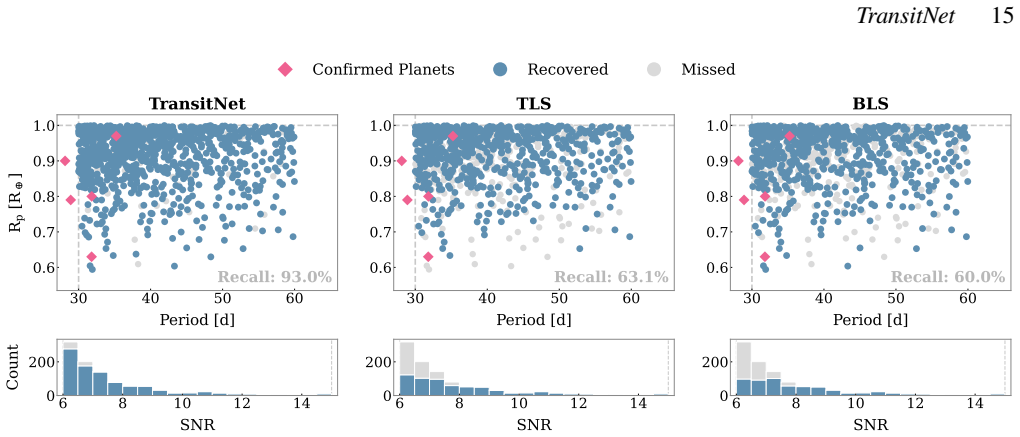
TransitNet recovers 93 percent of injected Earth-size transits in Kepler data where TLS and BLS recover only about 60 percent.
A machine-rendered reading of the paper's core claim, the machinery that carries it, and where it could break.
Core claim
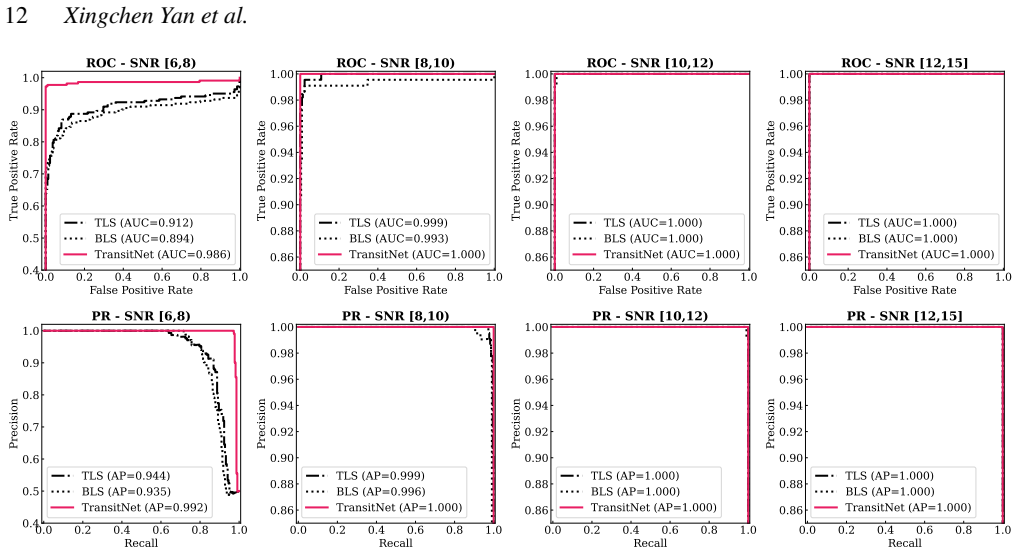
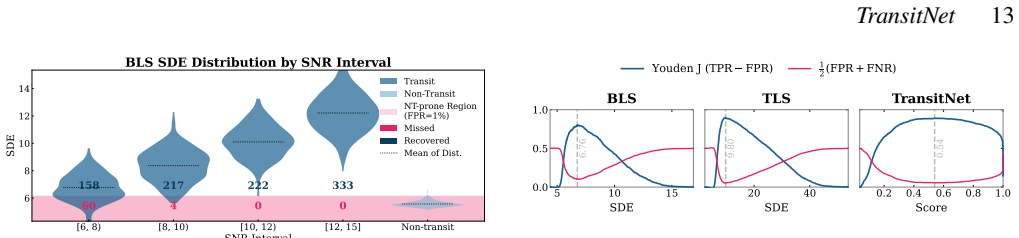
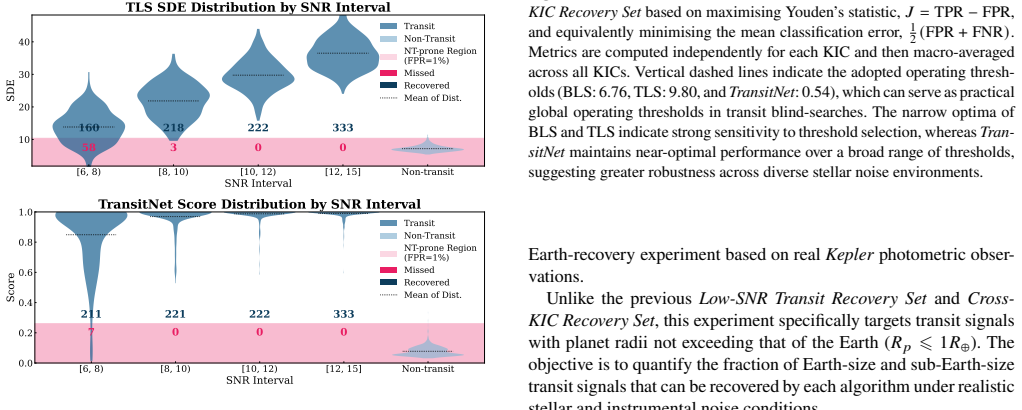
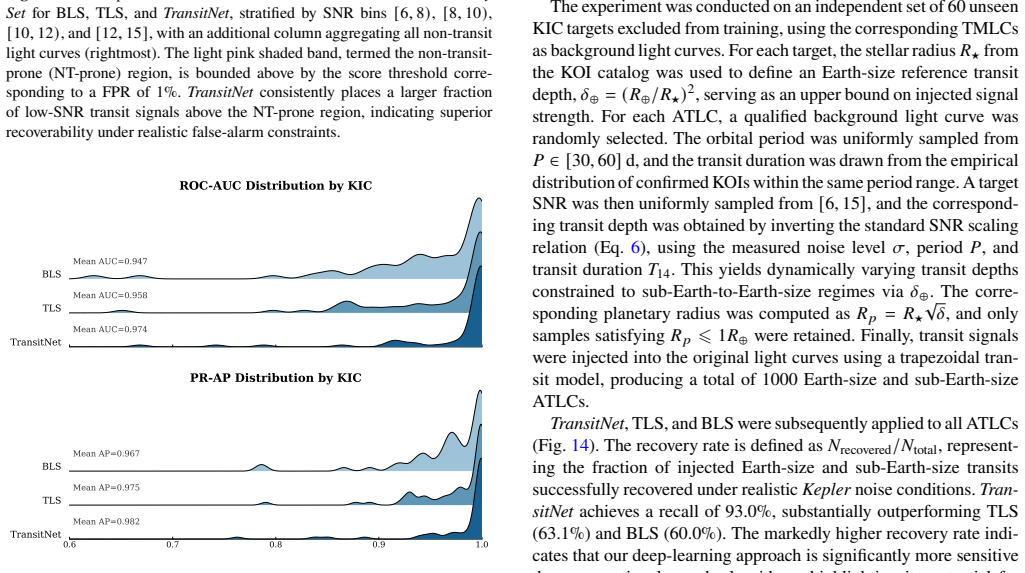
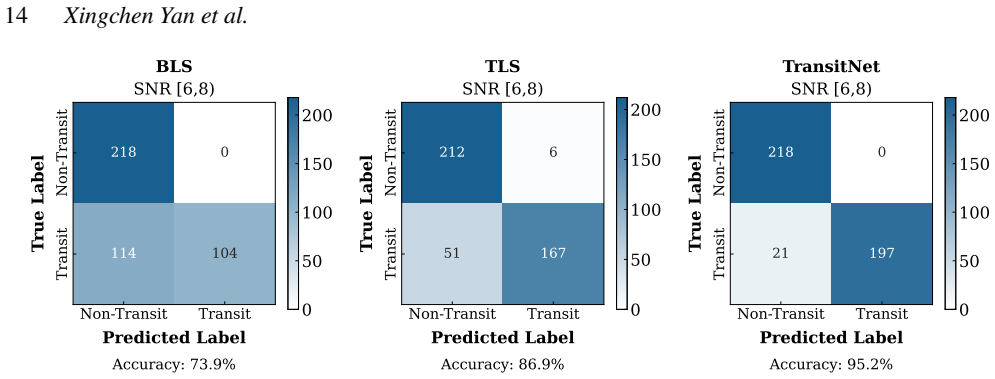
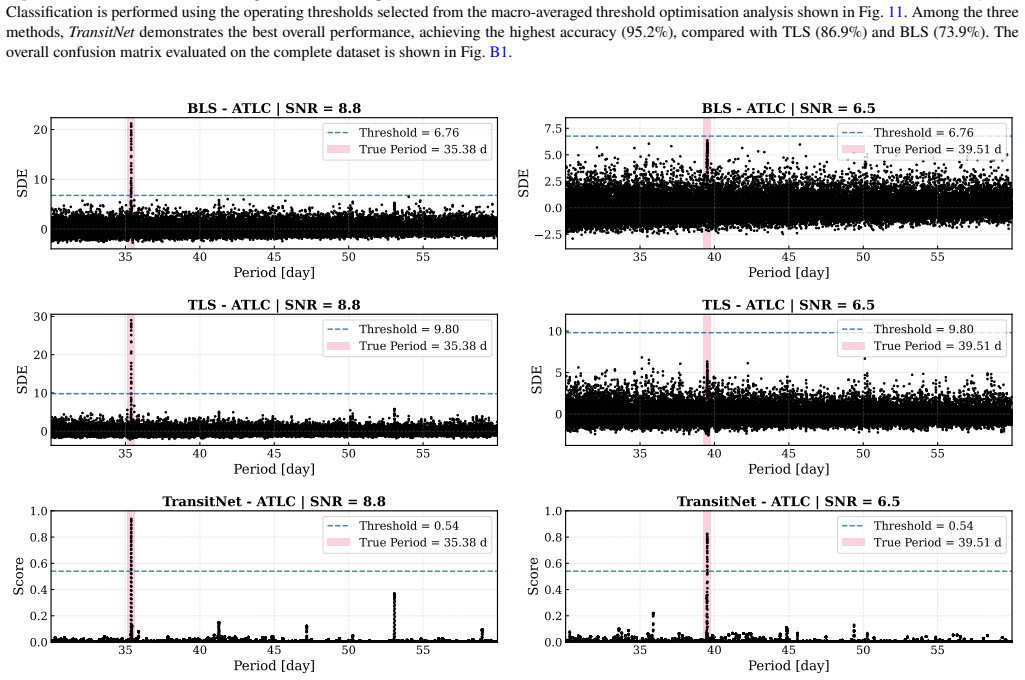
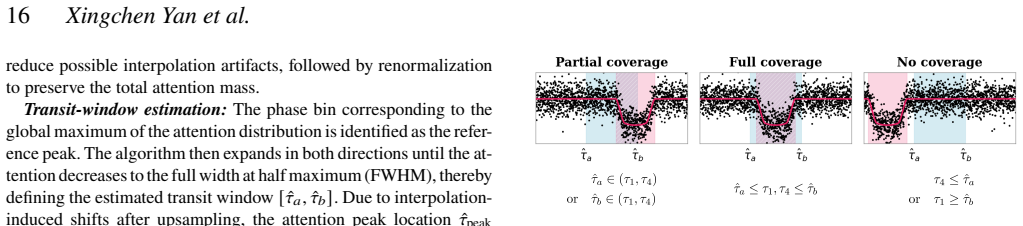
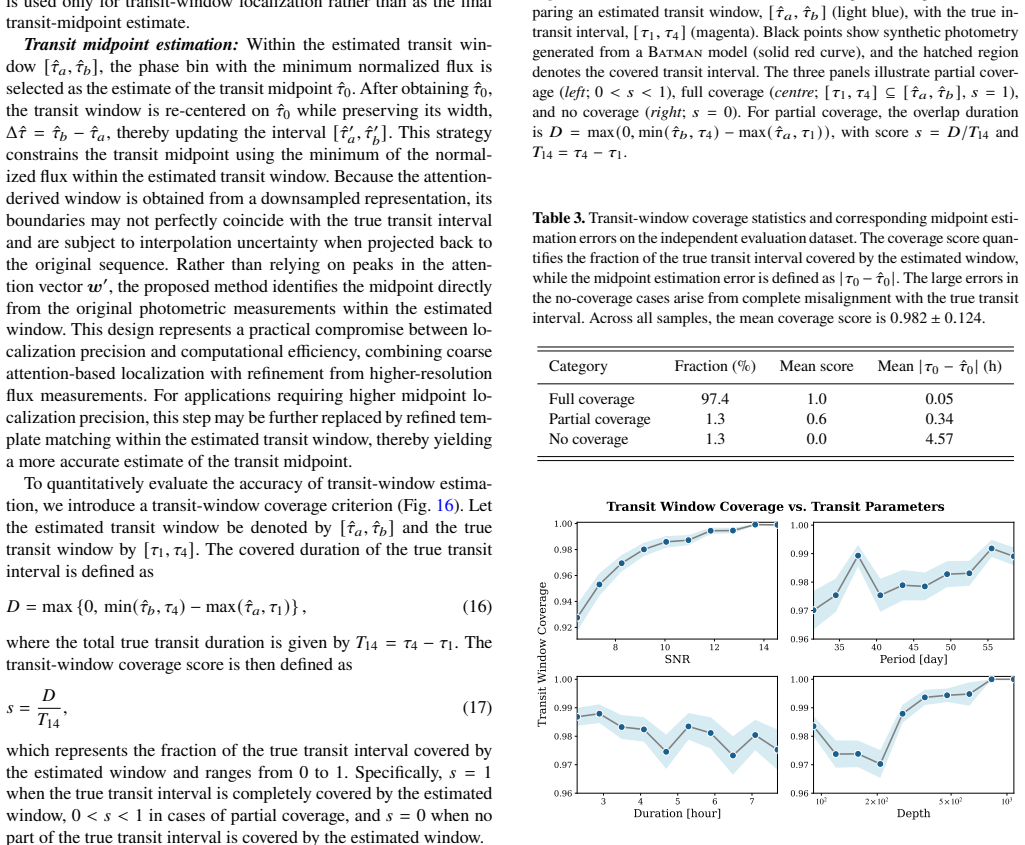
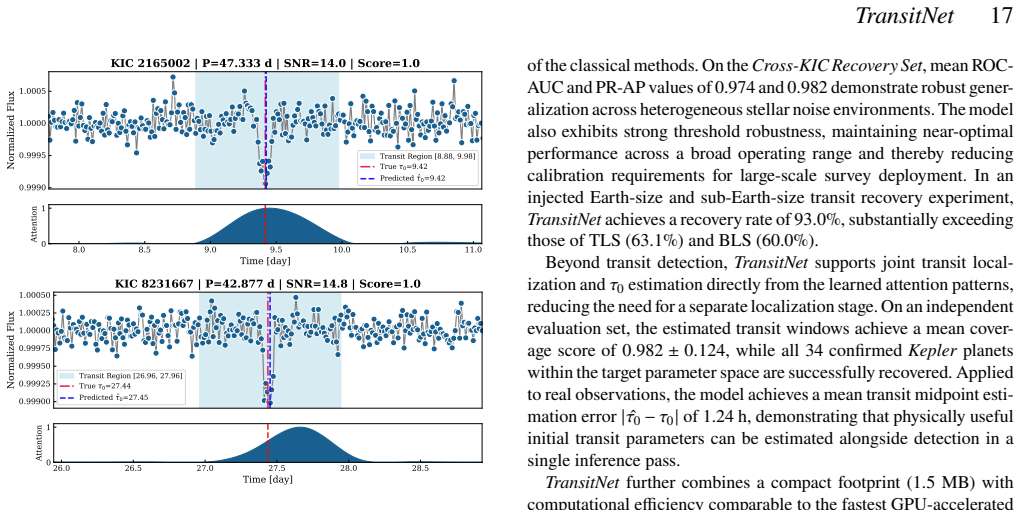
TransitNet is a compact attention-augmented deep-learning model that attains 95.2 percent accuracy on low-SNR (6-8) recovery benchmarks from unseen Kepler targets, ROC-AUC of 0.974, and PR-AP of 0.982, while recovering 93.0 percent of injected Earth-size and sub-Earth-size transits; the same model recovers all 34 selected confirmed Kepler planets on real data with 1.24-hour mean midpoint error and supplies attention-based transit-window estimates that fully cover 97.4 percent of injected cases.
What carries the argument
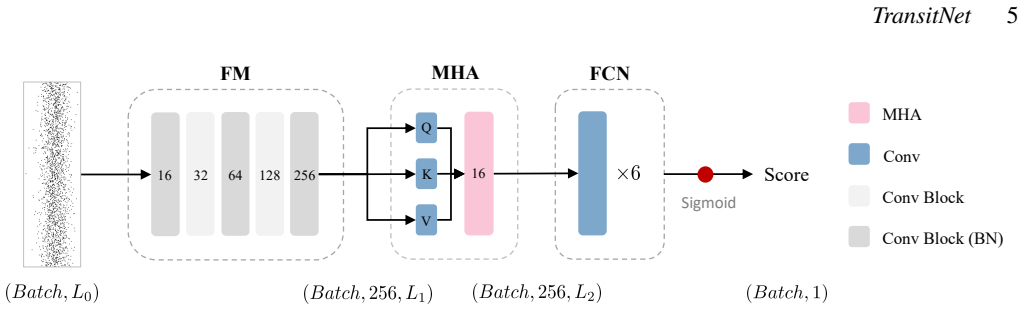
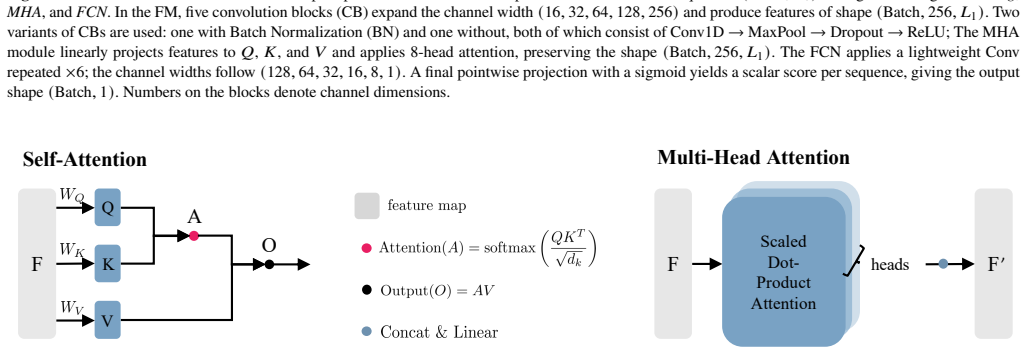
TransitNet, an attention-augmented convolutional-recurrent network that processes light curves to output both a detection score and attention-weighted transit-window estimates.
If this is right
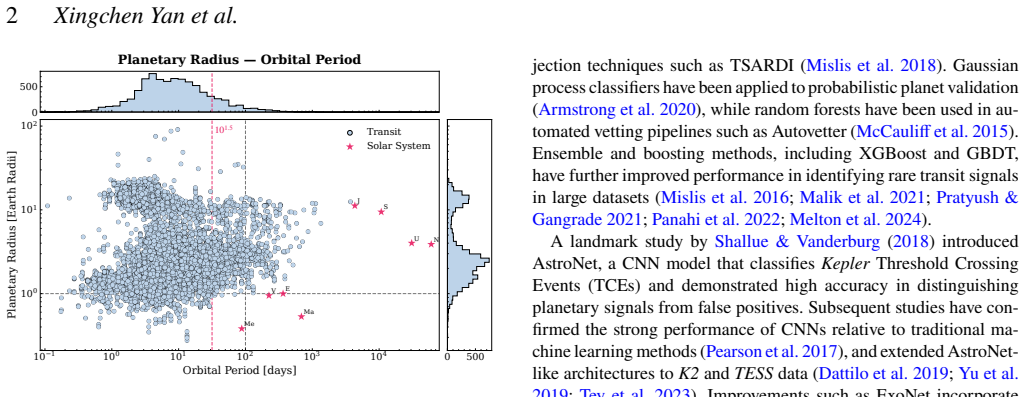
- The method can be applied directly to existing Kepler data to search for additional Earth-size planets at periods longer than those already catalogued.
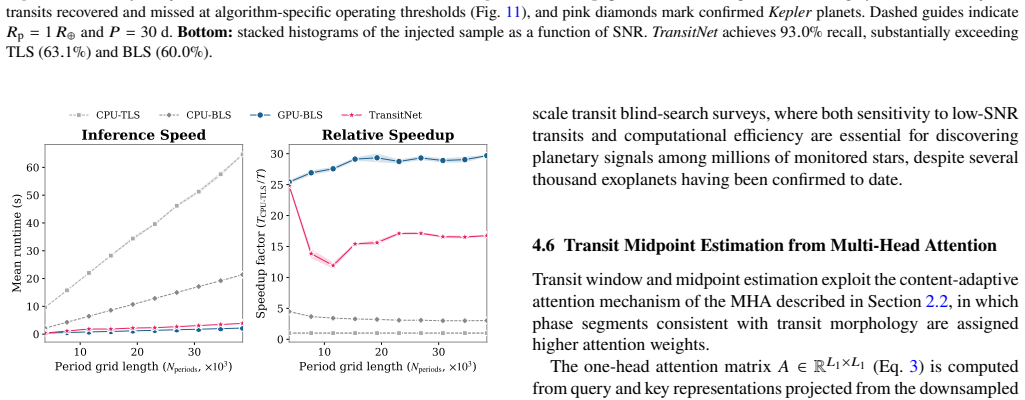
- Because the model runs 4-5 times faster than CPU-BLS, full blind searches of large photometric surveys become computationally practical on modest hardware.
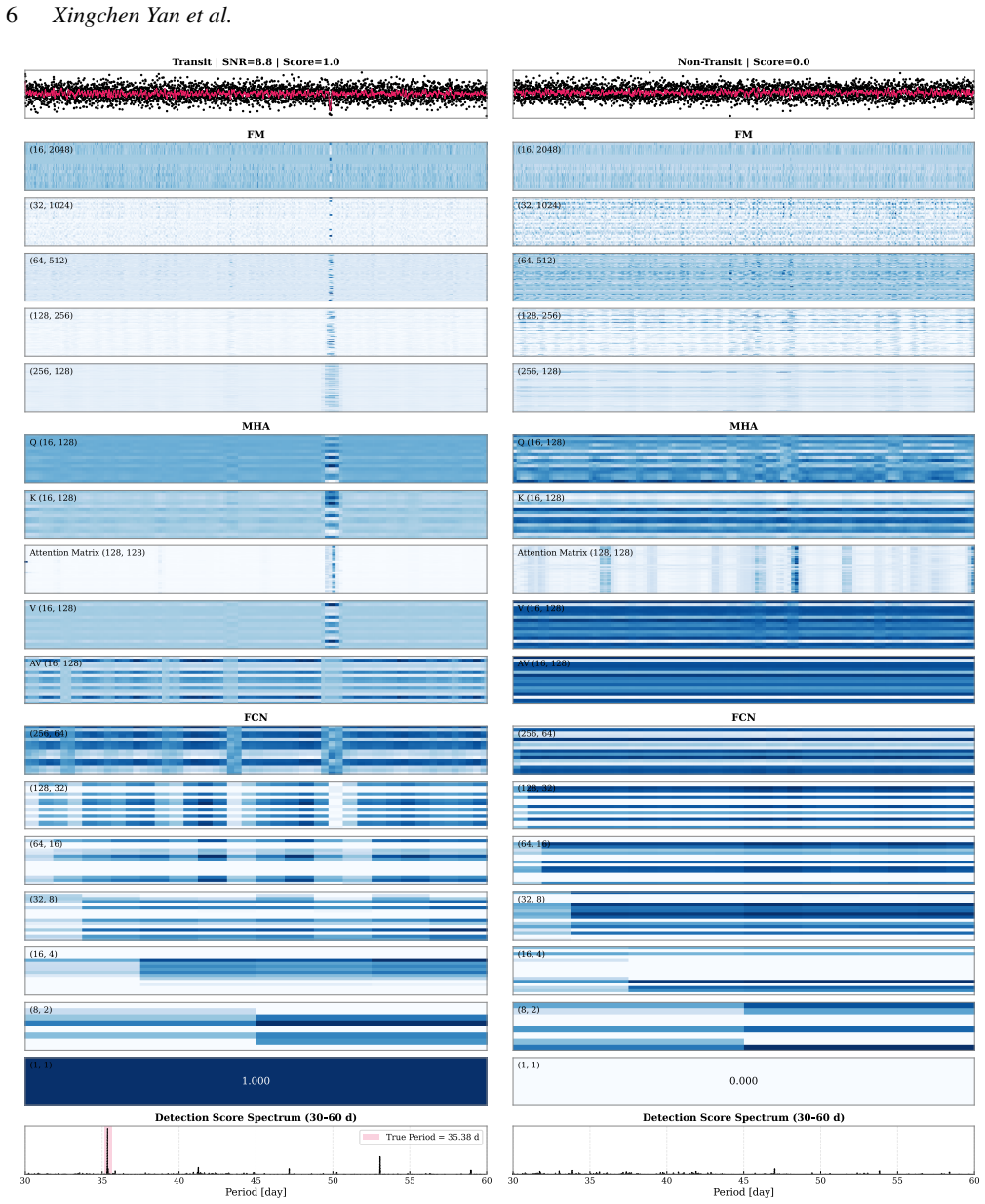
- Attention maps provide per-light-curve transit midpoint and duration estimates without a separate fitting step.
- The compact 1.5 MB size allows deployment on edge devices or in real-time pipelines for upcoming surveys.
Where Pith is reading between the lines
- Extending the same training and benchmarking pipeline to TESS or PLATO data would test whether the performance advantage holds for shorter-cadence or higher-noise observations.
- If the attention mechanism reliably localizes transits, it could be combined with period-folding routines to improve orbital-parameter recovery for marginal detections.
- The reported speed-up suggests that re-processing the entire Kepler archive at higher sensitivity thresholds is now feasible within existing compute budgets.
Load-bearing premise
The statistical properties of the injected signals and noise used to train and test the network match those of actual Kepler light curves without systematic biases that would favor the neural network.
What would settle it
A blind search on a fresh set of Kepler or TESS light curves containing only confirmed non-transit signals or planets with periods and depths outside the training distribution that yields substantially lower recovery rates than reported here.
Figures
read the original abstract
Motivated by the observational incompleteness of intermediate-to-long-period Earth-size planets, we present TransitNet, a compact attention-augmented deep-learning framework for low-SNR transit blind searches. To enable realistic method development and objective threshold calibration under blind-search conditions, we develop a unified dataset construction, benchmarking, and threshold-selection framework. On recovery benchmarks constructed from unseen Kepler targets, TransitNet attains 95.2 percent accuracy in the challenging SNR range of 6 to 8 and outperforms both TLS and BLS, achieving ROC-AUC and PR-AP values of 0.974 and 0.982, respectively. In an injected Earth-size and sub-Earth-size transit recovery experiment, TransitNet achieves a recovery rate of 93.0 percent, substantially exceeding those of TLS (63.1 percent) and BLS (60.0 percent). In addition to detection, TransitNet provides attention-based estimates of transit windows and midpoints. On an independent evaluation set, 97.4 percent of injected transits are fully covered by the estimated transit window. Applied to real Kepler observations, the model successfully recovers all 34 selected confirmed Kepler planets, with a mean absolute transit midpoint error of 1.24 hours. The model combines a compact footprint of about 1.5 MB with high inference efficiency, yielding speed-ups of about 12 to 25 times relative to CPU-TLS and about 4 to 5 times relative to CPU-BLS. These results demonstrate that TransitNet provides an accurate, scalable, and computationally efficient framework for low-SNR transit blind searches in the tested regime and motivate its extension to longer-period Earth-size planet searches.
Editorial analysis
A structured set of objections, weighed in public.
Referee Report
Summary. The manuscript introduces TransitNet, a compact attention-augmented neural network for blind low-SNR transit searches in Kepler photometry. It develops a unified dataset construction, injection, and benchmarking pipeline and reports 95.2% accuracy (SNR 6–8), ROC-AUC 0.974 and PR-AP 0.982 on held-out Kepler targets, 93% recovery of injected Earth/sub-Earth transits (vs. 63.1% TLS, 60% BLS), 97.4% transit-window coverage on an independent set, recovery of all 34 tested confirmed planets (mean midpoint error 1.24 h), and 4–25× speed-up relative to CPU baselines. The model footprint is stated as ~1.5 MB.
Significance. If the benchmark results prove robust, TransitNet would supply a practical, scalable complement to traditional periodogram methods for recovering small, long-period planets that remain observationally incomplete. The attention-based window estimation and the unified injection-plus-threshold framework are constructive contributions that could aid future method comparisons. The computational efficiency is a clear practical strength for large-scale surveys.
major comments (2)
- [Dataset construction / unified benchmarking framework] § Dataset construction / unified benchmarking framework: The central performance claims (95.2% accuracy, 93% Earth-size recovery, large gaps versus TLS/BLS) rest on the premise that the injected signals plus underlying noise statistically match the distribution of real undetected low-SNR Kepler transits, including red noise and instrumental systematics. No quantitative validation (power-spectrum matching, variability statistics, or comparison against real non-detections) is reported; any systematic mismatch would directly inflate the reported advantage of the attention layers over BLS/TLS.
- [Baseline implementation details (methods section)] Baseline implementation details (methods section): The large reported gaps versus TLS and BLS require explicit confirmation that the traditional pipelines were run with equivalent search ranges, detrending choices, and threshold calibration on the identical light-curve set. Without these specifics it remains unclear whether the performance difference is intrinsic or arises from implementation disparities.
minor comments (2)
- The abstract repeatedly uses approximate phrasing (“about 1.5 MB”, “about 12 to 25 times”); exact values and hardware specifications would improve reproducibility.
- Clarify whether the 34 confirmed planets used for real-data validation were selected before or after model development to avoid inadvertent selection bias.
Simulated Author's Rebuttal
We thank the referee for the constructive review and the positive assessment of the work's potential impact. We address the two major comments point by point below and will incorporate clarifications and additional validation into the revised manuscript.
read point-by-point responses
-
Referee: [Dataset construction / unified benchmarking framework] The central performance claims (95.2% accuracy, 93% Earth-size recovery, large gaps versus TLS/BLS) rest on the premise that the injected signals plus underlying noise statistically match the distribution of real undetected low-SNR Kepler transits, including red noise and instrumental systematics. No quantitative validation (power-spectrum matching, variability statistics, or comparison against real non-detections) is reported; any systematic mismatch would directly inflate the reported advantage of the attention layers over BLS/TLS.
Authors: The injection procedure operates directly on real Kepler light curves pre-selected to contain no known transits, thereby retaining the actual red noise, instrumental systematics, and variability present in the survey data by construction. We agree, however, that explicit quantitative checks would strengthen the claim. In the revised manuscript we will add power-spectral-density comparisons and basic variability statistics between the injected training/validation sets and an independent sample of real non-detection Kepler light curves. revision: yes
-
Referee: [Baseline implementation details (methods section)] The large reported gaps versus TLS and BLS require explicit confirmation that the traditional pipelines were run with equivalent search ranges, detrending choices, and threshold calibration on the identical light-curve set. Without these specifics it remains unclear whether the performance difference is intrinsic or arises from implementation disparities.
Authors: We concur that full reproducibility of the baseline comparisons requires explicit parameter documentation. The original manuscript states that standard TLS and BLS implementations were applied to the same light-curve sets, but the revised methods section will list the precise search-period grids, detrending filters, and threshold-selection procedure (all performed on the identical held-out Kepler targets) to remove any ambiguity. revision: yes
Circularity Check
No circularity: empirical ML performance on held-out data with no self-referential derivations
full rationale
The paper presents a trained neural network (TransitNet) and reports its detection performance on benchmarks constructed from unseen Kepler targets plus independent injected transit sets. These are standard held-out evaluation practices with no equations, parameters, or predictions that reduce by construction to quantities defined from the training data or fitted thresholds. No self-citations, uniqueness theorems, or ansatzes are invoked to justify the central claims; the reported accuracies, ROC-AUC, recovery rates, and midpoint errors are externally falsifiable empirical results rather than tautological outputs of the model's own training procedure.
Axiom & Free-Parameter Ledger
free parameters (1)
- neural network hyperparameters and training schedule
axioms (1)
- domain assumption Injected transit signals plus added noise accurately reproduce the statistical properties of real Kepler light curves at SNR 6-8.
Reference graph
Works this paper leans on
-
[1]
and Marcy, Geoffrey W
Howard, Andrew W. and Marcy, Geoffrey W. and Bryson, Stephen T. and Jenkins, Jon M. and Rowe, Jason F. and Batalha, Natalie M. and Borucki2, William J. and Koch, David G. and Dunham, Edward W. and Gautier, Thomas N. and Van Cleve, Jeffrey and Cochran, William D. and Latham, David W. and Lissauer, Jack J. and Torres, Guillermo and Brown, Timothy M. and Gil...
-
[2]
Thompson, Susan E. and Coughlin, Jeffrey L. and Hoffman, Kelsey and Mullally, Fergal and Christiansen, Jessie L. and Burke, Christopher J. and Bryson, Steve and Batalha, Natalie and Haas, Michael R. and Catanzarite, Joseph and Rowe, Jason F. and Barentsen, Geert and Caldwell, Douglas A. and Clarke, Bruce D. and Jenkins, Jon M. and Li, Jie and Latham, Davi...
-
[3]
Youden, W. J. , title =. Cancer , volume =. doi:https://doi.org/10.1002/1097-0142(1950)3:1<32::AID-CNCR2820030106>3.0.CO;2-3 , url =. https://acsjournals.onlinelibrary.wiley.com/doi/pdf/10.1002/1097-0142 year =
-
[4]
and Christiansen, Jessie and Dressing, Courtney D
Fressin, François and Torres, Guillermo and Charbonneau, David and Bryson, Stephen T. and Christiansen, Jessie and Dressing, Courtney D. and Jenkins, Jon M. and Walkowicz, Lucianne M. and Batalha, Natalie M. , doi =. THE FALSE POSITIVE RATE OFKEPLERAND THE OCCURRENCE OF PLANETS , url =. ApJ , month =
-
[5]
and Coughlin, Jeffrey L
Bryson, Steve and Kunimoto, Michelle and Kopparapu, Ravi K. and Coughlin, Jeffrey L. and Borucki, William J. and Koch, David and Aguirre, Victor Silva and Allen, Christopher and Barentsen, Geert and Batalha, Natalie M. and Berger, Travis and Boss, Alan and Buchhave, Lars A. and Burke, Christopher J. and Caldwell, Douglas A. and Campbell, Jennifer R. and C...
-
[6]
Pollacco, D. L. and Skillen, I. and Cameron, A. Collier and Christian, D. J. and Hellier, C. and Irwin, J. and Lister, T. A. and Street, R. A. and West, R. G. and Anderson, D. and Clarkson, W. I. and Deeg, H. and Enoch, B. and Evans, A. and Fitzsimmons, A. and Haswell, C. A. and Hodgkin, S. and Horne, K. and Kane, S. R. and Keenan, F. P. and Maxted, P. F....
-
[7]
and Siverd, Robert and James, David and Stassun, Keivan , doi =
Pepper, Joshua and Kuhn, Rudolf B. and Siverd, Robert and James, David and Stassun, Keivan , doi =. The KELT-South Telescope1 , url =. PASP , month =. 2012 , bdsk-url-1 =
2012
-
[8]
2022 , eprint=
ET White Paper: To Find the First Earth 2.0 , author=. 2022 , eprint=
2022
-
[9]
Ge, Jian and Zhang, Hui and Deng, Hongping and Howell, Steve B. , doi =. The ET mission to search for earth 2.0s , url =. The Innovation , month =
-
[10]
The Earth 2.0 Space Mission for Detecting Earth-like Planets Around Solar Type Stars , author =. 2022 , booktitle =. doi:10.1117/12.2630656 , url =
-
[11]
Chinese Journal of Space Science , volume =
Ge, Jian and Chen, Wen and Chen, Yonghe and Song, Zongxi and Wang, Jian and Zhang, Hui and Li, Yan and Zang, Weicheng and Zhou, Dan and Zhang, Yongshuai and Chen, Kun and Yang, Yingquan and Mao, Shude and Huang, Chelsea and Yao, Xinyu and Li, Xinglong and Jiang, Haijiao and Yu, Yong and Tang, Zhenghong and Dong, Feng and Gao, Wei and Zhang, Hongfei and Sh...
2024
-
[12]
The Earth 2.0 Mission: Space Telescopes and Instrumentation 2024 , author =. 2024 , booktitle =. doi:10.1117/12.3018669 , url =
-
[13]
Rauer, Heike and Aerts, Conny and Cabrera, Juan and Deleuil, Magali and Erikson, Anders and Gizon, Laurent and Goupil, Mariejo and Heras, Ana and Walloschek, Thomas and Lorenzo-Alvarez, Jose and Marliani, Filippo and Martin-Garcia, César and Mas-Hesse, J. Miguel and O’Rourke, Laurence and Osborn, Hugh and Pagano, Isabella and Piotto, Giampaolo and Pollacc...
-
[14]
and Bodin, P
Auvergne, M. and Bodin, P. and Boisnard, L. and Buey, J.-T. and Chaintreuil, S. and Epstein, G. and Jouret, M. and Lam-Trong, T. and Levacher, P. and Magnan, A. and Perez, R. and Plasson, P. and Plesseria, J. and Peter, G. and Steller, M. and Tiphène, D. and Baglin, A. and Agogué, P. and Appourchaux, T. and Barbet, D. and Beaufort, T. and Bellenger, R. an...
-
[15]
and Borucki, William J
Koch, David G. and Borucki, William J. and Basri, Gibor and Batalha, Natalie M. and Brown, Timothy M. and Caldwell, Douglas and Christensen-Dalsgaard, Jørgen and Cochran, William D. and DeVore, Edna and Dunham, Edward W. and Gautier, Thomas N. and Geary, John C. and Gilliland, Ronald L. and Gould, Alan and Jenkins, Jon and Kondo, Yoji and Latham, David W....
-
[16]
and Sobeck, Charlie and Haas, Michael and Still, Martin and Barclay, Thomas and Mullally, Fergal and Troeltzsch, John and Aigrain, Suzanne and Bryson, Stephen T
Howell, Steve B. and Sobeck, Charlie and Haas, Michael and Still, Martin and Barclay, Thomas and Mullally, Fergal and Troeltzsch, John and Aigrain, Suzanne and Bryson, Stephen T. and Caldwell, Doug and Chaplin, William J. and Cochran, William D. and Huber, Daniel and Marcy, Geoffrey W. and Miglio, Andrea and Najita, Joan R. and Smith, Marcie and Twicken, ...
-
[17]
and Winn, Joshua N
Ricker, George R. and Winn, Joshua N. and Vanderspek, Roland and Latham, David W. and Bakos, Gáspár Á. and Bean, Jacob L. and Berta-Thompson, Zachory K. and Brown, Timothy M. and Buchhave, Lars and Butler, Nathaniel R. and Butler, R. Paul and Chaplin, William J. and Charbonneau, David and Christensen-Dalsgaard, Jørgen and Clampin, Mark and Deming, Drake a...
-
[18]
PLATO: PLAnetary Transits and Oscillations of Stars , author =. Exp Astron , volume =. 2009 , fjournal =. doi:10.1007/s10686-008-9122-9 , url =
-
[19]
and Agol, Eric , doi =
Carter, Joshua A. and Agol, Eric , doi =. THE QUASIPERIODIC AUTOMATED TRANSIT SEARCH ALGORITHM , url =. ApJ , month =
-
[20]
and Zucker, S
Kovács, G. and Zucker, S. and Mazeh, T. , doi =. A box-fitting algorithm in the search for periodic transits , url =. A&A , month =
-
[21]
Optimized transit detection algorithm to search for periodic transits of small planets , url =
Hippke, Michael and Heller, René , doi =. Optimized transit detection algorithm to search for periodic transits of small planets , url =. A&A , month =
-
[22]
and Mullally, Fergal and Coughlin, Jeff and Christiansen, Jessie L
Thompson, Susan E. and Mullally, Fergal and Coughlin, Jeff and Christiansen, Jessie L. and Henze, Christopher E. and Haas, Michael R. and Burke, Christopher J. , doi =. A MACHINE LEARNING TECHNIQUE TO IDENTIFY TRANSIT SHAPED SIGNALS , url =. ApJ , month =
-
[23]
and Coughlin, Jeffery L
Mullally, F. and Coughlin, Jeffery L. and Thompson, Susan E. and Christiansen, Jessie and Burke, Christopher and Clarke, Bruce D. and Haas, Michael R. , doi =. Identifying False Alarms in theKeplerPlanet Candidate Catalog , url =. PASP , month =
-
[24]
Armstrong, D. J. and Pollacco, D. and Santerne, A. , doi =. Transit shapes and self-organizing maps as a tool for ranking planetary candidates: application toKeplerandK2 , url =. MNRAS , month =
-
[25]
TSARDI: a Machine Learning data rejection algorithm for transiting exoplanet light curves , url =
Mislis, D and Pyrzas, S and Alsubai, K A , doi =. TSARDI: a Machine Learning data rejection algorithm for transiting exoplanet light curves , url =. MNRAS , month =
-
[26]
Exoplanet validation with machine learning: 50 new validated Kepler planets , url =
Armstrong, David J and Gamper, Jevgenij and Damoulas, Theodoros , doi =. Exoplanet validation with machine learning: 50 new validated Kepler planets , url =. MNRAS , month =
-
[27]
Auto-Vetting Transiting Planet Candidates Identified by the Kepler Pipeline , author =. Proc. IAU , volume =. 2012 , fjournal =. doi:10.1017/S1743921313012611 , url =
-
[28]
and Jenkins, Jon M
McCauliff, Sean D. and Jenkins, Jon M. and Catanzarite, Joseph and Burke, Christopher J. and Coughlin, Jeffrey L. and Twicken, Joseph D. and Tenenbaum, Peter and Seader, Shawn and Li, Jie and Cote, Miles , doi =. AUTOMATIC CLASSIFICATION OFKEPLERPLANETARY TRANSIT CANDIDATES , url =. ApJ , month =
-
[29]
Sidra: A Blind Algorithm for Signal Detection in Photometric Surveys , author =. MNRAS , volume =. 2016 , fjournal =. doi:10.1093/mnras/stv2333 , url =
-
[30]
and Feigelson, Eric D
Melton, Elizabeth J. and Feigelson, Eric D. and Montalto, Marco and Caceres, Gabriel A. and Rosenswie, Andrew W. and Abelson, Cullen S. , doi =. DIAmante TESS AutoRegressive Planet Search (DTARPS). I. Analysis of 0.9 Million Light Curves , url =. AJ , month =
-
[31]
The detection of transiting exoplanets by Gaia , url =
Panahi, Aviad and Zucker, Shay and Clementini, Gisella and Audard, Marc and Binnenfeld, Avraham and Cusano, Felice and Evans, Dafydd Wyn and Gomel, Roy and Holl, Berry and Ilyin, Ilya and de Fombelle, Grégory Jevardat and Mazeh, Tsevi and Mowlavi, Nami and Nienartowicz, Krzysztof and Rimoldini, Lorenzo and Shahaf, Sahar and Eyer, Laurent , doi =. The dete...
-
[32]
Exoplanet detection using machine learning , url =
Malik, Abhishek and Moster, Benjamin P and Obermeier, Christian , doi =. Exoplanet detection using machine learning , url =. MNRAS , month =
-
[33]
2021 , eprint=
Automation Of Transiting Exoplanet Detection, Identification and Habitability Assessment Using Machine Learning Approaches , author=. 2021 , eprint=
2021
-
[34]
and Vanderburg, Andrew , doi =
Shallue, Christopher J. and Vanderburg, Andrew , doi =. Identifying Exoplanets with Deep Learning: A Five-planet Resonant Chain around Kepler-80 and an Eighth Planet around Kepler-90 , url =. AJ , month =
-
[35]
and Palafox, Leon and Griffith, Caitlin A
Pearson, Kyle A. and Palafox, Leon and Griffith, Caitlin A. , doi =. Searching for exoplanets using artificial intelligence , url =. MNRAS , month =
-
[36]
and Mayo, Andrew W
Dattilo, Anne and Vanderburg, Andrew and Shallue, Christopher J. and Mayo, Andrew W. and Berlind, Perry and Bieryla, Allyson and Calkins, Michael L. and Esquerdo, Gilbert A. and Everett, Mark E. and Howell, Steve B. and Latham, David W. and Scott, Nicholas J. and Yu, Liang , doi =. Identifying Exoplanets with Deep Learning. II. Two New Super-Earths Uncove...
-
[37]
and Crossfield, Ian J
Yu, Liang and Vanderburg, Andrew and Huang, Chelsea and Shallue, Christopher J. and Crossfield, Ian J. M. and Gaudi, B. Scott and Daylan, Tansu and Dattilo, Anne and Armstrong, David J. and Ricker, George R. and Vanderspek, Roland K. and Latham, David W. and Seager, Sara and Dittmann, Jason and Doty, John P. and Glidden, Ana and Quinn, Samuel N. , doi =. ...
-
[38]
and Shporer, Avi and Daylan, Tansu and Muthukrishna, Daniel and Vanderburg, Andrew and Dattilo, Anne and Ricker, George R
Tey, Evan and Moldovan, Dan and Kunimoto, Michelle and Huang, Chelsea X. and Shporer, Avi and Daylan, Tansu and Muthukrishna, Daniel and Vanderburg, Andrew and Dattilo, Anne and Ricker, George R. and Seager, S. , doi =. Identifying Exoplanets with Deep Learning. V. Improved Light-curve Classification for TESS Full-frame Image Observations , url =. AJ , month =
-
[39]
and Sasdelli, Michele and Smith, Jeffrey C
Ansdell, Megan and Ioannou, Yani and Osborn, Hugh P. and Sasdelli, Michele and Smith, Jeffrey C. and Caldwell, Douglas and Jenkins, Jon M. and Räissi, Chedy and Angerhausen, Daniel , doi =. Scientific Domain Knowledge Improves Exoplanet Transit Classification with Deep Learning , url =. ApJL , month =
-
[40]
Valizadegan, Hamed and Martinho, Miguel J. S. and Wilkens, Laurent S. and Jenkins, Jon M. and Smith, Jeffrey C. and Caldwell, Douglas A. and Twicken, Joseph D. and Gerum, Pedro C. L. and Walia, Nikash and Hausknecht, Kaylie and Lubin, Noa Y. and Bryson, Stephen T. and Oza, Nikunj C. , doi =. ExoMiner: A Highly Accurate and Explainable Deep Learning Classi...
-
[41]
Valizadegan, Hamed and Martinho, Miguel J. S. and Jenkins, Jon M. and Caldwell, Douglas A. and Twicken, Joseph D. and Bryson, Stephen T. , doi =. Multiplicity Boost of Transit Signal Classifiers: Validation of 69 New Exoplanets using the Multiplicity Boost of ExoMiner , url =. AJ , month =
-
[42]
Shallow Transits—Deep Learning
Zucker, Shay and Giryes, Raja , doi =. Shallow Transits—Deep Learning. I. Feasibility Study of Deep Learning to Detect Periodic Transits of Exoplanets , url =. AJ , month =
-
[43]
One-Dimensional Convolutional Neural Networks for Detecting Transiting Exoplanets , url =
Iglesias Álvarez, Santiago and Díez Alonso, Enrique and Sánchez Rodríguez, María Luisa and Rodríguez Rodríguez, Javier and Sánchez Lasheras, Fernando and de Cos Juez, Francisco Javier , doi =. One-Dimensional Convolutional Neural Networks for Detecting Transiting Exoplanets , url =. Axioms , month =
-
[44]
Osborn, H. P. and Ansdell, M. and Ioannou, Y. and Sasdelli, M. and Angerhausen, D. and Caldwell, D. and Jenkins, J. M. and Räissi, C. and Smith, J. C. , doi =. Rapid classification of TESS planet candidates with convolutional neural networks , url =. A&A , month =
-
[45]
Li, Jie and Tenenbaum, Peter and Twicken, Joseph D. and Burke, Christopher J. and Jenkins, Jon M. and Quintana, Elisa V. and Rowe, Jason F. and Seader, Shawn E. , year =. PASP , volume =. doi:10.1088/1538-3873/aaf44d , url =
-
[46]
Searching for Possible Exoplanet Transits from BRITE Data through a Machine Learning Technique , url =
Yeh, Li-Chin and Jiang, Ing-Guey , doi =. Searching for Possible Exoplanet Transits from BRITE Data through a Machine Learning Technique , url =. PASP , month =
-
[47]
Deep Learning Exoplanets Detection by Combining Real and Synthetic Data , author =. PLoS ONE , volume =. 2022 , fjournal =. doi:10.1371/journal.pone.0268199 , url =
-
[48]
Detecting Exoplanet Transits through Machine-learning Techniques with Convolutional Neural Networks , url =
Chintarungruangchai, Pattana and Jiang, Ing-Guey , doi =. Detecting Exoplanet Transits through Machine-learning Techniques with Convolutional Neural Networks , url =. PASP , month =
-
[49]
Identify Light-curve Signals with Deep Learning Based Object Detection Algorithm
Cui, Kaiming and Liu, Junjie and Feng, Fabo and Liu, Jifeng , doi =. Identify Light-curve Signals with Deep Learning Based Object Detection Algorithm. I. Transit Detection , url =. AJ , month =
-
[50]
and Latham, David W
Brown, Timothy M. and Latham, David W. and Everett, Mark E. and Esquerdo, Gilbert A. , doi =. KEPLER INPUT CATALOG: PHOTOMETRIC CALIBRATION AND STELLAR CLASSIFICATION , url =. AJ , month =. 2011 , bdsk-url-1 =
2011
-
[51]
Shallow Transits—Deep Learning
Dvash, Elad and Peleg, Yam and Zucker, Shay and Giryes, Raja , doi =. Shallow Transits—Deep Learning. II. Identify Individual Exoplanetary Transits in Red Noise using Deep Learning , url =. AJ , month =
-
[52]
2022 , eprint=
Exoplanet Detection by Machine Learning with Data Augmentation , author=. 2022 , eprint=
2022
-
[53]
Distinguishing a planetary transit from false positives: a Transformer-based classification for planetary transit signals , url =
Salinas, Helem and Pichara, Karim and Brahm, Rafael and Pérez-Galarce, Francisco and Mery, Domingo , doi =. Distinguishing a planetary transit from false positives: a Transformer-based classification for planetary transit signals , url =. MNRAS , month =
-
[54]
2023 , eprint=
Identification and Classification of Exoplanets Using Machine Learning Techniques , author=. 2023 , eprint=
2023
-
[55]
Discovery of small ultra-short-period planets orbiting Kepler KG dwarfs with GPU phase folding and deep learning , url =
Wang, Kaitlyn and Ge, Jian and Willis, Kevin and Wang, Kevin and Zhao, Yinan and Hu, Quanquan , doi =. Discovery of small ultra-short-period planets orbiting Kepler KG dwarfs with GPU phase folding and deep learning , url =. MNRAS , month =
-
[56]
The GPU phase folding and deep learning method for detecting exoplanet transits , url =
Wang, Kaitlyn and Ge, Jian and Willis, Kevin and Wang, Kevin and Zhao, Yinan , doi =. The GPU phase folding and deep learning method for detecting exoplanet transits , url =. MNRAS , month =
-
[57]
and Kaiser,
Vaswani, Ashish and Shazeer, Noam and Parmar, Niki and Uszkoreit, Jakob and Jones, Llion and Gomez, Aidan N. and Kaiser,. Attention Is All You Need , booktitle=
-
[58]
In: Proceedings of the IEEE conference on computer vision and pattern recognition
Long, Jonathan and Shelhamer, Evan and Darrell, Trevor , booktitle =. Fully Convolutional Networks for Semantic Segmentation , year =. doi:10.1109/CVPR.2015.7298965 , langid =
-
[59]
2017 , eprint=
MobileNets: Efficient Convolutional Neural Networks for Mobile Vision Applications , author=. 2017 , eprint=
2017
-
[60]
2019 , editor =
Tan, Mingxing and Le, Quoc , booktitle =. 2019 , editor =
2019
-
[61]
Xception: Deep Learning with Depthwise Separable Convolutions , year =
Chollet, Fran. Xception: Deep Learning with Depthwise Separable Convolutions , year =. Proceedings of the IEEE Conference on Computer Vision and Pattern Recognition (CVPR) , doi =
-
[62]
Journal of Machine Learning Research , year =
Dropout: A Simple Way to Prevent Neural Networks from Overfitting , author =. Journal of Machine Learning Research , year =
-
[63]
Proceedings of the 32nd International Conference on Machine Learning , pages =
Batch Normalization: Accelerating Deep Network Training by Reducing Internal Covariate Shift , author =. Proceedings of the 32nd International Conference on Machine Learning , pages =. 2015 , editor =
2015
-
[64]
International Conference on Learning Representations (ICLR) , year=
Decoupled Weight Decay Regularization , author=. International Conference on Learning Representations (ICLR) , year=
-
[65]
International Conference on Learning Representations (ICLR) , year=
Adam: A Method for Stochastic Optimization , author=. International Conference on Learning Representations (ICLR) , year=
-
[66]
and Caceres, Gabriel A
Gondhalekar, Yash and Feigelson, Eric D. and Caceres, Gabriel A. and Montalto, Marco and Saha, Snehanshu , doi =. A Study of Two Periodogram Algorithms for Improving the Detection of Small Transiting Planets , url =. ApJL , month =. 2023 , bdsk-url-1 =
2023
-
[67]
and Marcy, Geoffrey W
Petigura, Erik A. and Marcy, Geoffrey W. and Howard, Andrew W. , doi =. A PLATEAU IN THE PLANET POPULATION BELOW TWICE THE SIZE OF EARTH , url =. ApJ , month =
-
[68]
GTLS: A method for speeding up periodic transit detection using GPU , year =
Hu, Quanquan and Ge, Jian and Jin, Luoxi and Willis, Kevin , note =. GTLS: A method for speeding up periodic transit detection using GPU , year =
-
[69]
2026 , note =
Michael Telesco and Jian Ge and Kevin Willis and Chuanfei Dong and Jun Yang and Beibei Liu and Luoxi Jin , title =. 2026 , note =
2026
-
[70]
and Caldwell, Douglas A
Jenkins, Jon M. and Caldwell, Douglas A. and Chandrasekaran, Hema and Twicken, Joseph D. and Bryson, Stephen T. and Quintana, Elisa V. and Clarke, Bruce D. and Li, Jie and Allen, Christopher and Tenenbaum, Peter and Wu, Hayley and Klaus, Todd C. and Middour, Christopher K. and Cote, Miles T. and McCauliff, Sean and Girouard, Forrest R. and Gunter, Jay P. ...
-
[71]
Software and Cyberinfrastructure for Astronomy , year = 2010, editor =
Jenkins, Jon M. and Chandrasekaran, Hema and McCauliff, Sean D. and Caldwell, Douglas A. and Tenenbaum, Peter and Li, Jie and Klaus, Todd C. and Cote, Miles T. and Middour, Christopher , editor =. Transiting Planet Search in the Kepler Pipeline , booktitle =. 2010 , pages =. doi:10.1117/12.856764 , abstract =
-
[72]
Rauer, H. and Catala, C. and Aerts, C. and Appourchaux, T. and Benz, W. and Brandeker, A. and Christensen-Dalsgaard, J. and Deleuil, M. and Gizon, L. and Goupil, M. -J. and G. The PLATO 2.0 mission , url =. Experimental Astronomy , number =. 2014 , bdsk-url-1 =. doi:10.1007/s10686-014-9383-4 , id =
-
[73]
Analytic Light Curves for Planetary Transit Searches , url =
Mandel, Kaisey and Agol, Eric , doi =. Analytic Light Curves for Planetary Transit Searches , url =. ApJ , month =. 2002 , bdsk-url-1 =
2002
-
[74]
and McElroy, Douglas L
Christiansen, Jessie L. and McElroy, Douglas L. and Harbut, Marcy and Ciardi, David R. and Crane, Megan and Good, John and Hardegree-Ullman, Kevin K. and Kesseli, Aurora Y. and Lund, Michael B. and Lynn, Meca and Muthiar, Ananda and Nilsson, Ricky and Oluyide, Toba and Papin, Michael and Rivera, Amalia and Swain, Melanie and Susemiehl, Nicholas D. and Tam...
-
[75]
ExoMiner++: Enhanced Transit Classification and a New Vetting Catalog for 2-Minute TESS Data , author =. 2025 , journal =. doi:10.3847/1538-3881/ae03a4 , eprint =
-
[76]
Martinho, Miguel J. S. and Valizadegan, Hamed and Jenkins, Jon M. and Caldwell, Douglas A. and Twicken, Joseph D. and Tofflemire, Ben and Jafariyazani, Marziye , title =. 2026 , eprint =
2026
-
[77]
and Pichara, Karim and Ishitani Silva, Stela and Araujo, Vladimir , title =
Salinas, Helem and Brahm, Rafael and Olmschenk, Greg and Barry, Richard K. and Pichara, Karim and Ishitani Silva, Stela and Araujo, Vladimir , title =. MNRAS , volume =. 2025 , doi =
2025
-
[78]
Vivien, H. G. and Deleuil, M. and Jannsen, N. and De Ridder, J. and Seynaeve, D. and Carpine, M.-A. and Zerah, Y. , doi =. PANOPTICON: A novel deep learning model to detect single transit events with no prior data filtering in PLATO light curves , url =. A&A , month =
-
[79]
and Mohammed, Salman Arafath and Mohammed, Abdul Wase and Dessalegn, Adis Abebaw and Mittal, Mohit , title =
Thomas, Bibin and Bhat, Vittal M. and Mohammed, Salman Arafath and Mohammed, Abdul Wase and Dessalegn, Adis Abebaw and Mittal, Mohit , title =. 2025 , eprint =
2025
-
[80]
Choudhary, Anupma and Bandari, Sohith and Kushvah, B. S. and Swastik, C. , doi =. Exoplanet Classification Through Vision Transformers with Temporal Image Analysis , url =. The Astronomical Journal , month =. 2025 , bdsk-url-1 =
2025
discussion (0)
Sign in with ORCID, Apple, or X to comment. Anyone can read and Pith papers without signing in.