ELMA: ELlipse-based bar MAjor axis estimator
Pith reviewed 2026-06-26 15:26 UTC · model grok-4.3
The pith
ELMA automates bar length measurement in galaxies by locating the peak ellipticity in isophote fits.
A machine-rendered reading of the paper's core claim, the machinery that carries it, and where it could break.
Core claim
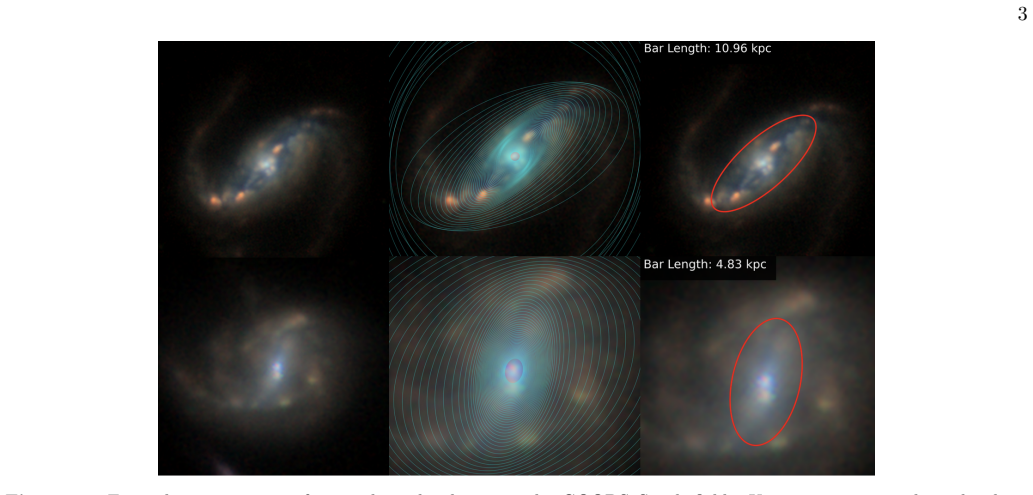
The ELMA method applies iterative elliptical-isophote fitting directly to imaging data to generate a radial ellipticity profile, then identifies the projected bar length as the semi-major axis value at the local maximum of that profile, and uses WCS information plus user redshift to output a physical length.
What carries the argument
Iterative elliptical-isophote fitting that traces the radial ellipticity profile and selects the local maximum as the bar-length proxy.
Load-bearing premise
The local maximum in the radial ellipticity profile reliably marks the end of the bar rather than rings, spiral arms, or other structures.
What would settle it
A set of galaxies whose bar lengths are independently known from kinematics or simulations, yet whose ellipticity profiles show the local maximum at a radius clearly set by a ring or arm instead of the bar.
Figures
read the original abstract
Galactic bars are key non-axisymmetric structures in disk galaxies, driving angular-momentum redistribution and contributing to secular evolution, central mass build-up, and the formation of nuclear structures. Robust and homogeneous measurements of bar length, however, remain challenging, particularly for large imaging surveys, where manual estimates are time-consuming and sensitive to methodological choices. We introduce elma, a standalone, pip-installable Python package for automated bar-length estimation in galaxies already identified as candidate barred systems. The method operates directly on two-dimensional imaging data, using iterative elliptical-isophote fitting to trace the radial ellipticity profile and identify a projected bar-length estimate from the semi-major axis associated with the local maximum in ellipticity. Using the image WCS information and a user-supplied redshift, elma converts angular measurement into a projected physical length. We demonstrate the package on JWST/NIRCam imaging of barred galaxies in the GOODS-South field. The code is released under the MIT license at a repository in Github.
Editorial analysis
A structured set of objections, weighed in public.
Referee Report
Summary. The manuscript introduces ELMA, a standalone Python package for automated bar-length estimation in pre-identified barred galaxies. The method performs iterative elliptical-isophote fitting on 2D imaging data to extract the radial ellipticity profile and adopts the semi-major axis at the local ellipticity maximum as the projected bar length; WCS information plus a user-supplied redshift then converts the angular size to a projected physical length. The package is demonstrated on JWST/NIRCam imaging of barred galaxies in the GOODS-South field and is released under the MIT license.
Significance. A validated, reproducible implementation of an ellipticity-peak bar-length estimator would address a practical bottleneck for homogeneous measurements across large imaging surveys. The pip-installable release and explicit use of WCS/redshift information are concrete strengths that support reproducibility if the underlying proxy can be shown to be reliable.
major comments (2)
- [Abstract / demonstration] Abstract and demonstration section: the manuscript reports only that the code executes and produces outputs on the JWST/NIRCam GOODS-South sample; no quantitative comparison to independent (manual or literature) bar-length measurements, no error analysis, and no assessment of how often the ellipticity peak coincides with rings, spiral arms, or other non-bar features are provided. This leaves the central claim that the semi-major axis at the ellipticity maximum supplies a reliable bar-length estimate untested.
- [Method] Method description: the choice of the local ellipticity maximum as the bar-end proxy rests on the untested assumption that this feature is produced by the bar rather than other disk structures. No test cases, false-positive rate, or reference to literature validation of the proxy are supplied, making the assumption load-bearing for any claim of reliability.
minor comments (1)
- [Abstract] The abstract would benefit from a single sentence stating the absence (or presence) of quantitative validation so that readers immediately understand the scope of the demonstration.
Simulated Author's Rebuttal
We thank the referee for their constructive comments on the manuscript. We address the two major comments point by point below, clarifying the scope of the work while agreeing to strengthen the presentation where appropriate.
read point-by-point responses
-
Referee: [Abstract / demonstration] Abstract and demonstration section: the manuscript reports only that the code executes and produces outputs on the JWST/NIRCam GOODS-South sample; no quantitative comparison to independent (manual or literature) bar-length measurements, no error analysis, and no assessment of how often the ellipticity peak coincides with rings, spiral arms, or other non-bar features are provided. This leaves the central claim that the semi-major axis at the ellipticity maximum supplies a reliable bar-length estimate untested.
Authors: The manuscript presents ELMA as a software tool that automates an established ellipticity-peak method for galaxies already identified as barred; the demonstration section is intended only to illustrate package functionality and output on real JWST data rather than to constitute a validation study. We agree that the current text does not include quantitative comparisons or false-positive assessments. We will revise the abstract and demonstration section to explicitly state the limited scope of the demonstration and to note that scientific users should conduct their own validation against manual or literature measurements. No new quantitative analysis will be added, as that lies outside the present scope. revision: partial
-
Referee: [Method] Method description: the choice of the local ellipticity maximum as the bar-end proxy rests on the untested assumption that this feature is produced by the bar rather than other disk structures. No test cases, false-positive rate, or reference to literature validation of the proxy are supplied, making the assumption load-bearing for any claim of reliability.
Authors: The ellipticity-maximum proxy is drawn from established practice in the galactic-bar literature, where the local peak in the radial ellipticity profile is routinely adopted as an indicator of bar length. We will revise the method section to include appropriate literature citations supporting this proxy and to add a short discussion of possible contaminants such as rings or spiral arms. This will better contextualize the assumption without introducing new test cases or false-positive statistics. revision: yes
Circularity Check
Method description only; no derivation or fitted prediction present
full rationale
The paper introduces and demonstrates a software package (elma) that applies standard iterative elliptical-isophote fitting to 2D images and selects the semi-major axis at the local ellipticity maximum as a bar-length proxy. No equations, first-principles derivations, or statistical predictions are claimed; the central step is an explicit algorithmic choice rather than a result derived from inputs. No self-citations, fitted parameters renamed as predictions, or ansatzes appear in the provided text. The work is therefore self-contained as a tool description with no load-bearing circular reductions.
Axiom & Free-Parameter Ledger
axioms (1)
- domain assumption Iterative elliptical-isophote fitting can be performed on 2D galaxy images to produce a radial ellipticity profile
Reference graph
Works this paper leans on
-
[1]
Aguerri, J. A. L., M´ endez-Abreu, J., & Corsini, E. M. 2009, A&A, 495, 491, doi: 10.1051/0004-6361:200810931 Astropy Collaboration, Price-Whelan, A. M., Sip˝ ocz, B. M., et al. 2018, AJ, 156, 123, doi: 10.3847/1538-3881/aabc4f
-
[2]
2024, astropy/photutils: 1.13.0, 1.13.0, Zenodo, doi: 10.5281/zenodo.11185515
Bradley, L., Sip˝ ocz, B., Robitaille, T., et al. 2024, astropy/photutils: 1.13.0, 1.13.0, Zenodo, doi: 10.5281/zenodo.11185515
-
[3]
Cavanagh, M. K., Bekki, K., & Groves, B. A. 2024, MNRAS, 530, 1171, doi: 10.1093/mnras/stae801
-
[4]
Costantin, L., P´ erez-Gonz´ alez, P. G., Guo, Y., et al. 2023, Nature, 623, 499, doi: 10.1038/s41586-023-06636-x
-
[5]
Debattista, V. P., Mayer, L., Carollo, C. M., et al. 2006, ApJ, 645, 209, doi: 10.1086/504147
-
[6]
Eisenstein, D. J., Johnson, B. D., Robertson, B., et al. 2025, ApJS, 281, 50, doi: 10.3847/1538-4365/ae1137
-
[7]
J., Willott, C., Alberts, S., et al
Eisenstein, D. J., Willott, C., Alberts, S., et al. 2026, ApJS, 283, 6, doi: 10.3847/1538-4365/ae3163
-
[8]
Erwin, P. 2005, MNRAS, 364, 283, doi: 10.1111/j.1365-2966.2005.09560.x
-
[9]
Harris, C. R., Millman, K. J., van der Walt, S. J., et al. 2020, Nature, 585, 357, doi: 10.1038/s41586-020-2649-2
-
[10]
Monthly Notices of the Royal Astronomical Society , author =
Hoyle, B., Masters, K. L., Nichol, R. C., et al. 2011, MNRAS, 415, 3627, doi: 10.1111/j.1365-2966.2011.18979.x
-
[11]
Hunter, J. D. 2007, Computing in Science & Engineering, 9, 90, doi: 10.1109/MCSE.2007.55
-
[12]
Hutchinson-Smith, T., Simmons, B. D., Masters, K. L., et al. 2026, arXiv e-prints, arXiv:2604.27100, doi: 10.48550/arXiv.2604.27100
work page internal anchor Pith review Pith/arXiv arXiv doi:10.48550/arxiv.2604.27100 2026
-
[13]
Jedrzejewski, R. I. 1987, MNRAS, 226, 747, doi: 10.1093/mnras/226.4.747 4 Le Conte, Z. A., Gadotti, D. A., Ferreira, L., et al. 2024, MNRAS, 530, 1984, doi: 10.1093/mnras/stae921
-
[14]
2007, ApJ, 659, 1176, doi: 10.1086/512355
Marinova, I., & Jogee, S. 2007, ApJ, 659, 1176, doi: 10.1086/512355
-
[15]
J., Robertson, B., Tacchella, S., et al
Rieke, M. J., Robertson, B., Tacchella, S., et al. 2023, ApJS, 269, 16, doi: 10.3847/1538-4365/acf44d
-
[16]
Teuben, P. J. 2005, ApJ, 632, 217, doi: 10.1086/432409
-
[17]
Virtanen, P., Gommers, R., Oliphant, T. E., et al. 2020, Nature Methods, 17, 261, doi: 10.1038/s41592-019-0686-2
-
[18]
2023, arXiv e-prints, arXiv:2312.02908, doi: 10.48550/arXiv.2312.02908
Walmsley, M., & Spindler, A. 2023, arXiv e-prints, arXiv:2312.02908, doi: 10.48550/arXiv.2312.02908
discussion (0)
Sign in with ORCID, Apple, or X to comment. Anyone can read and Pith papers without signing in.