REVIEW 2 major objections 2 minor 73 references
Revealing the topology of quantum states via Kirkwood-Dirac quasiprobabilities
T0 review · 2 major / 2 minor · reviewed 2026-06-27 · grok-4.3
Pith's one-line read Strange correlators serve as weak values of an observable that converts a trivial state into a topologically nontrivial one.
desk verdict The paper recasts strange correlators as Kirkwood-Dirac quasiprobabilities to get a weak-value quench witness for topology, but the mapping step is asserted without visible derivation. read the letter →
The pith
A machine-rendered reading of the paper's core claim, the machinery that carries it, and where it could break.
The reading
What carries the argument
The expression of strange correlators in terms of Kirkwood-Dirac quasiprobabilities, which identifies them as weak values under quench dynamics.
What would settle it
If the witness fails to correctly identify known trivial and topological phases in a quench experiment on a specific many-body model, the proposed approach would not hold.
Extended reading notes
Core claim
Strange correlators between states are expressed as functions of Kirkwood-Dirac quasiprobabilities. This shows that the correlators are weak values of an observable converting an initial trivial state into a topologically non-trivial one. A quantum topology witness is proposed that is achieved by measuring the prior and subsequent effects of a sudden quench transformation realizing the transition between trivial and topological phases. The witness is evaluated on a probe quantum state, and an interferometric protocol for topology discrimination is addressed.
Load-bearing premise
The mapping from strange correlators to Kirkwood-Dirac quasiprobabilities remains valid and experimentally accessible for the chosen probe state and many-body systems under sudden quench transformations.
Editorial extensions
If this is right
- A topology witness can be constructed from quench effects on the system.
- The witness works with a defined probe state.
- An interferometric protocol enables discrimination by reconstructing KDQs.
- Implementation challenges are outlined.
Reading between the lines
- This witness could be tested in quantum simulators where KDQ reconstruction is feasible.
- It may generalize to other many-body phenomena beyond topology if similar correlator mappings exist.
- Connections to other weak-value based measurements in condensed matter could be explored.
Editorial analysis
A structured set of objections, weighed in public.
Referee Report
Summary. The paper claims that strange correlators between many-body quantum states can be expressed as functions of Kirkwood-Dirac quasiprobabilities (KDQs), allowing them to be interpreted as weak values of an observable that converts an initial trivial state into a topologically non-trivial one. This link is used to propose a topology witness based on sudden quench dynamics realizing the trivial-to-topological transition, evaluated on a specific probe state, together with an interferometric protocol for discrimination via complete KDQ reconstruction.
Significance. If the asserted mapping from strange correlators to KDQs holds with the required support and commutation conditions, the work supplies a quasiprobability-based route to topology discrimination that connects recent strange-correlator literature to weak-value and KDQ formalisms, potentially offering an experimentally accessible witness through quench protocols.
major comments (2)
- [Abstract (and the section introducing the strange-correlator-to-KDQ link)] The central claim (abstract) that strange correlators equal weak values of the topology-converting observable via a KDQ rewriting requires an explicit derivation of the mapping, including the precise conditions on the probe state and the action of the quench unitary. No such derivation, commutation relations, or verification that the quasiprobability representation preserves the topological distinction appears in the provided text; this step is load-bearing for the witness proposal.
- [Probe-state description and quench-dynamics section] The assumption that the KDQ representation of the strange correlator survives the sudden quench for the chosen probe state (abstract) is stated without support conditions or error analysis. If the quench introduces additional phases or if the probe state lacks the necessary support, the equality to the weak value fails and the topology witness does not follow.
minor comments (2)
- Clarify the precise timing and measurement sequence for extracting the 'prior and subsequent effects' of the quench in the weak-value protocol.
- The abstract refers to 'schemes that allows for the complete reconstruction of KDQs' – supply the relevant references or a brief outline of the reconstruction method used.
Simulated Author's Rebuttal
We thank the referee for the careful reading and the detailed comments on the central mapping and its assumptions. We address each point below and will incorporate the requested clarifications and derivations into a revised manuscript.
read point-by-point responses
-
Referee: [Abstract (and the section introducing the strange-correlator-to-KDQ link)] The central claim (abstract) that strange correlators equal weak values of the topology-converting observable via a KDQ rewriting requires an explicit derivation of the mapping, including the precise conditions on the probe state and the action of the quench unitary. No such derivation, commutation relations, or verification that the quasiprobability representation preserves the topological distinction appears in the provided text; this step is load-bearing for the witness proposal.
Authors: We agree that the mapping requires an explicit, self-contained derivation. In the revised manuscript we will add a dedicated subsection (immediately following the definition of strange correlators) that derives the equality between the strange correlator and the weak value expressed via KDQs. The derivation will state the precise support condition on the probe state (non-vanishing overlap with the eigenbasis of the topology-converting observable) and the commutation relation [U, O] = 0 that is used to interchange the quench unitary with the KDQ representation. We will also include a short verification that the topological invariant extracted from the weak value remains unchanged under the quasiprobability rewriting for the class of states considered. revision: yes
-
Referee: [Probe-state description and quench-dynamics section] The assumption that the KDQ representation of the strange correlator survives the sudden quench for the chosen probe state (abstract) is stated without support conditions or error analysis. If the quench introduces additional phases or if the probe state lacks the necessary support, the equality to the weak value fails and the topology witness does not follow.
Authors: We acknowledge that the survival of the KDQ representation under the sudden quench must be justified explicitly. In the revised version we will expand the probe-state section with (i) the explicit support condition required for the chosen initial state, (ii) a short calculation showing that the additional dynamical phases acquired during the quench factor out of the KDQ and therefore cancel in the weak-value ratio, and (iii) a brief error-bound estimate demonstrating that the topological distinction is preserved up to an exponentially small correction for system sizes relevant to the proposal. These additions will be placed immediately before the interferometric-protocol discussion. revision: yes
Circularity Check
No significant circularity; derivation links established tools without self-reduction
full rationale
The paper's approach expresses strange correlators (from prior literature) as functions of KDQs to identify them as weak values, then proposes a quench-based witness evaluated on a described probe state. No quoted equations or steps reduce a claimed result to a fitted parameter, self-definition, or load-bearing self-citation chain. The mapping is presented as a derived link rather than an input renamed as output, and the central witness follows from the stated connection without internal equivalence by construction. This is a standard self-contained proposal.
Assumptions & free parameters
Cite this review
Pith. "Pith review of Revealing the topology of quantum states via Kirkwood-Dirac quasiprobabilities." pith.science (2026). https://pith.science/paper/GRC3LFMU
@misc{pith2026260611002,
  author       = {Pith},
  title        = {Pith review of: Revealing the topology of quantum states via Kirkwood-Dirac quasiprobabilities},
  year         = {2026},
  howpublished = {\url{https://pith.science/paper/GRC3LFMU}},
  note         = {Machine review of arXiv:2606.11002}
}
read the original abstract
We discuss a theoretical approach to discriminate whether two states of a many-body quantum system belong or not to different topology classes. This approach is based on expressing a strange correlator - a recently established tool for quantum topology discrimination - between the states as a function of Kirkwood-Dirac quasiprobabilities (KDQs). KDQs provide a first-principles representation of two-time quantum correlators. The link between strange correlators and KDQs allows to establish that strange correlators are weak values of an observable converting an initial trivial state into a topologically non-trivial one. We thus propose a quantum topology witness that is achievable measuring the prior and subsequent effects on a many-body system of a sudden quench transformation that realizes the transition between trivial and topological phases. The witness is evaluated on a probe quantum state whose main features are detailed within the paper. Finally, directly exploiting schemes that allows for the complete reconstruction of KDQs, we address an interferometric protocol for topology discrimination, along with a general discussion of the main lines and challenges towards its implementation.
Figures
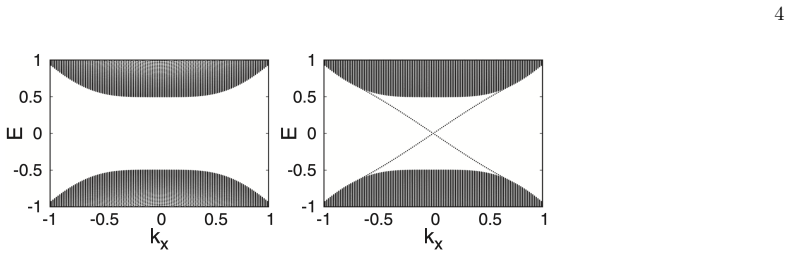


Figures from the paper (1 more)

Reference graph
Works this paper leans on
-
[1]
(9) tend to zero ask→0 (in parallel the system sizeLdiverges), and the numerator⟨Ω|Υ k⟩vanishes faster (see [30] and the supplemental material of [31])
More in detail, both the terms of the ratio in Eq. (9) tend to zero ask→0 (in parallel the system sizeLdiverges), and the numerator⟨Ω|Υ k⟩vanishes faster (see [30] and the supplemental material of [31]). On the other hand, if|Ω⟩and|Ψ⟩share the same topology (i.e., both states have trivial or non-trivial topology), then aroundk= 0 we determine that |s[ˆok]...
-
[2]
National Quantum Science and Technology Institute
For finite chains, these edge states mix in a singlet and a higher-energy triplet states, similarly as for the closed chain, while, as the size increases, the edge states decouple exponentially, leading to a ground-state manifold that is four-fold degenerate. Therefore, the edge states are massless in the thermodynamic limit. In this scheme, thes (±) j op...
2022
-
[3]
Yago Malo, L
J. Yago Malo, L. Lepori, L. Gentini, and M. L. Chiofalo,Atomic Quantum Technologies for Quantum Matter and Funda- mental Physics Applications,Technologies12(2024)
2024
-
[4]
X.-L. Qi, T. L. Hughes, and S.-C. Zhang,Topological field theory of time-reversal invariant insulators, Phys. Rev. B78, 195424 (2010)
2010
-
[5]
B. A. Bernevig and T. L. Hughes,Topological Insulators and Topological Superconductors, Princeton University Press, Princeton (2013)
2013
-
[6]
Nakahara,Geometry, topology, and physics, second edition, Institute of physics publishing (Bristol and Philadelphia, 2005)
M. Nakahara,Geometry, topology, and physics, second edition, Institute of physics publishing (Bristol and Philadelphia, 2005)
2005
-
[7]
H. J. Rothe,Lattice gauge theories: An Introduction, World Sci. Lect. Notes Phys., Vol.82(2005)
2005
-
[8]
G. E. Volovik,The Universe in a Helium Droplet(Oxford University Press, Oxford, 2003)
2003
Show all 73 references
-
[9]
Coleman,The magnetic monopole fifty years later, inThe Unity of the Fundamental Interactions, edited by A
S. Coleman,The magnetic monopole fifty years later, inThe Unity of the Fundamental Interactions, edited by A. Zichichi (Plenum, London, 1983). Available at this webpage
1983
-
[10]
Coleman,Classical lumps and their quantum descendants, (1975), published inAspects of symmetry (selected Erice lectures), Cambridge University Press (1985)
S. Coleman,Classical lumps and their quantum descendants, (1975), published inAspects of symmetry (selected Erice lectures), Cambridge University Press (1985)
1975
-
[11]
Altland and M
A. Altland and M. R. Zirnbauer,Nonstandard symmetry classes in mesoscopic normal-superconducting hybrid structures, Phys. Rev. B55, 1142 (1997)
1997
-
[12]
A. P. Schnyder, S. Ryu, A. Furusaki, and A. W.W. Ludwig,Classification of Topological Insulators and Superconductors, AIP Conf. Proc.1134, 10 (2009)
2009
-
[13]
F. D. M. Haldane,Topological Quantum Matter, Nobel Lecture (2016), available at this webpage
2016
-
[14]
Fu,Topological Crystalline Insulators, Phys
L. Fu,Topological Crystalline Insulators, Phys. Rev. Lett.106, 106802 (2011)
2011
-
[15]
Chen, Z.-C
X. Chen, Z.-C. Gu, and X.-G. Wen,Local unitary transformation, long-range quantum entanglement, wave function renor- malization, and topological order, Phys. Rev. B82, 155138 (2010)
2010
-
[16]
A. Y. Kitaev,Fault-tolerant quantum computation by anyons, Ann. Phys.303, 2 (2003)
2003
-
[17]
R. B. Laughlin,Fractional quantization, Nobel Lecture (1998), available at this webpage
1998
-
[18]
Fradkin,Field theories of condensed matter physics, 2nd ed
E. Fradkin,Field theories of condensed matter physics, 2nd ed. Cambridge University Press, Cambridge (2013)
2013
-
[19]
Jose,40 Years of Berezinskii–Kosterlitz–Thouless Theory, World Scientific, 2013
J.V. Jose,40 Years of Berezinskii–Kosterlitz–Thouless Theory, World Scientific, 2013
2013
-
[20]
J. M. Kosterlitz,Topological Defects and Phase Transitions, Nobel Lecture (2016), available at this webpage. 12
2016
-
[21]
K. V. Klitzing,The quantized Hall effect, Nobel Lecture (1985), available at this webpage
1985
-
[22]
K. v. Klitzing, G. Dorda, and M. Pepper,New Method for High-Accuracy Determination of the Fine-Structure Constant Based on Quantized Hall Resistance,Phys. Rev. Lett.45, 494 (1980)
1980
-
[23]
B. J. van Wees, H. van Houten, C. W. J. Beenakker, J. G. Williamson, L. P. Kouwenhoven, D. van der Marel, and C. T. Foxon,Quantized conductance of point contacts in a two-dimensional electron gas, Phys. Rev. Lett.60, 848 (1988)
1988
-
[24]
Konig, S
M. Konig, S. Wiedmann, C. Brune, A. Roth, H. Buhmann, L. W. Molenkamp, X.-L. Qi, S.-C. Zhang,Quantum spin Hall insulator state in HgTe quantum wells,Science,3185851 766 (2007)
2007
-
[25]
Y. Xia, D. Qian, D. Hsieh, L. Wray, A. Pal, H. Lin, A. Bansil, D. Grauer, Y. S. Hor, R. J. Cava, and M. Z. Hasan Observation of a large-gap topological-insulator class with a single Dirac cone on the surface,Nat. Phys.5, 398 (2009)
2009
-
[26]
Y. L. Chen, J. G. Analytis, J.-H. Chu, Z. K. Liu, S.-K. Mo, X. L. Qi, H. J. Zhang, D. H. Lu, X. Dai, Z. Fang, S. C. Zhang, I. R. Fisher, Z. Hussain, and Z.-X. Shen,Experimental Realization of a Three-Dimensional Topological Insulator, Bi2Te3, Science3255937 178 (2009)
2009
-
[27]
Nadj-Perge, I
S. Nadj-Perge, I. K. Drozdov, J. Li, H. Chen, S. Jeon, J. Seo, A. H. MacDonald, B. A. Bernevig, and A. Yazdani,Observation of Majorana fermions in ferromagnetic atomic chains on a superconductorScience346602–7 (2014)
2014
-
[28]
Y. Ji, Y. Chung, D. Sprinzak, M. Heiblum, D. Mahalu, and H. Shtrikman,An electronic Mach-Zehnder interferometer, Nature422, 415 (2003)
2003
-
[29]
Neder, N
I. Neder, N. Ofek, Y. Chung, M. Heiblum, D. Mahalu, and V. Umansky,Interference between two indistinguishable electrons from independent sources, Nature448, 333 (2007)
2007
-
[30]
L. Duca, T. Li, M. Reitter, I. Bloch, M. Schleier-Smith, and U. Schneider,An Aharonov-Bohm interferometer for deter- mining Bloch band topology, Science347, 288 (2015)
2015
-
[31]
T. Li, L. Duca, M. Reitter, F. Grusdt, E. Demler, M. Endres, M. Schleier-Smith, I. Bloch, and U. Schneider,Bloch state tomography using Wilson lines, Science352, 1094 (2016)
2016
-
[32]
Lepori, M
L. Lepori, M. Burrello, A. Trombettoni, and S. Paganelli,Strange correlators for topological quantum systems from bulk- boundary correspondence, Phys. Rev. B108, 035110 (2023)
2023
-
[33]
Y. Z. You, Z. Bi, A. Rasmussen, K. Slagle, and C. Xu,Wave Function and Strange Correlator of Short-Range Entangled States, Phys. Rev. Lett.112, 247202 (2014)
2014
-
[34]
De Bi` evre,Complete Incompatibility, Support Uncertainty, and Kirkwood-Dirac Nonclassicality, Phys
S. De Bi` evre,Complete Incompatibility, Support Uncertainty, and Kirkwood-Dirac Nonclassicality, Phys. Rev. Lett.127, 190404 (2021)
2021
-
[35]
Lostaglio, A
M. Lostaglio, A. Belenchia, A. Levy, S. Hern´ andez-G´ omez, N. Fabbri, and S. Gherardini,Kirkwood-Dirac quasiprobability approach to the statistics of incompatible observables, Quantum7, 1128 (2023)
2023
-
[36]
De Bi` evre,Relating incompatibility, noncommutativity, uncertainty, and Kirkwood-Dirac nonclassicality, J
S. De Bi` evre,Relating incompatibility, noncommutativity, uncertainty, and Kirkwood-Dirac nonclassicality, J. Math. Phys. 64, 022202 (2023)
2023
-
[37]
Gherardini, and G
S. Gherardini, and G. De Chiara,Quasiprobabilities in Quantum Thermodynamics and Many-Body Systems, PRX Quantum 5, 030201 (2024)
2024
-
[38]
Hern´ andez-G´ omez, T
S. Hern´ andez-G´ omez, T. Isogawa, A. Belenchia, A. Levy, N. Fabbri, S. Gherardini, and P. Cappellaro,Interferometry of quantum correlation functions to access quasiprobability distribution of work, Npj Quantum Inf.10, 115 (2024)
2024
-
[39]
D. R. M. Arvidsson-Shukur, W. F. Braasch Jr., S. De Bievre, J. Dressel, A. N. Jordan, C. Langrenez, M. Lostaglio, J. Lundeen, and N. Yunger Halpern,Properties and Applications of the Kirkwood-Dirac Distribution, New J. Phys.26, 121201 (2024)
2024
-
[40]
Aharonov, D
Y. Aharonov, D. Z. Albert, and L. Vaidman,How the result of a measurement of a component of the spin of a spin-1/2 particle can turn out to be 100, Phys. Rev. Lett.60, 1351 (1988)
1988
-
[41]
Dressel, M
J. Dressel, M. Malik, F. M. Miatto, A. N. Jordan, and R. W. Boyd,Colloquium: Understanding quantum weak values: Basics and applications, Rev. Mod. Phys.86, 307 (2014)
2014
-
[42]
Lostaglio,Certifying Quantum Signatures in Thermodynamics and Metrology via Contextuality of Quantum Linear Response, Phys
M. Lostaglio,Certifying Quantum Signatures in Thermodynamics and Metrology via Contextuality of Quantum Linear Response, Phys. Rev. Lett.125, 230603 (2020)
2020
-
[43]
M. F. Pusey,Anomalous Weak Values Are Proofs of Contextuality, Phys. Rev. Lett.113, 200401 (2014)
2014
-
[44]
Calarco, and R
T. Calarco, and R. Onofrio,Quantum nondemolition measurements on two-level atomic systems and temporal Bell inequal- ities, Applied Physics B64 (2), 141-144 (1997)
1997
-
[45]
Solinas, M
P. Solinas, M. Amico, and N. Zangh` ı,Measurement of work and heat in the classical and quantum regimes,Phys. Rev. A 103, L060202 (2021)
2021
-
[46]
Solinas, M
P. Solinas, M. Amico, and N. Zangh` ı,Quasiprobabilities of work and heat in an open quantum system,Phys. Rev. A105, 032606 (2022)
2022
-
[47]
De Chiara, P
G. De Chiara, P. Solinas, F. Cerisola, A. J. Roncaglia,Ancilla-assisted measurement of quantum work,inThermodynamics in the Quantum Regime: Fundamental Aspects and New Directions,pags. 337–362, edited by F. Binder, L. A. Correa, C. Gogolin, J. Anders, Janet and G. Adesso, Spri...
-
[48]
Solinas and S
P. Solinas and S. Gherardini,Negativity of nondemolition quasiprobability distribution as a necessary and sufficient condition for macrorealism violation, Phys. Rev. A111, 052217 (2025)
2025
-
[49]
Solinas and S
P. Solinas and S. Gherardini,Quantumness certification via non-demolition measurements, Advances in Physics: X11 (1), 2637832 (2026)
2026
-
[50]
Donelli, G
B. Donelli, G. De Chiara, F. Scazza, and S. Gherardini,Impact of quantum coherence on the dynamics and thermodynamics of quenched free fermions coupled to a localized defect, Phys. Rev. A113, 013311 (2026)
2026
-
[51]
Kotetes,Topological insulators, Morgan and Claypool Publishers, San Rafael, CA (2019)
P. Kotetes,Topological insulators, Morgan and Claypool Publishers, San Rafael, CA (2019)
2019
-
[52]
See also at this webpage. 13
-
[53]
Here, the subscripts{Ω,Ψ}label to which ground-state the bulk operators belong to
It is worth noting that more complex strange correlators can be considered as well, for instance: ⟨Ω|ˆη(−)† Ω,k ˆη(+) Ω,k ˆη(+)† Ψ,k ˆη(−) Ψ,k|Ψ⟩ ⟨Ω|ˆη(−)† Ω,k ˆη(+) Ω,k|Ψ⟩ (40) that involves four bulk operators. Here, the subscripts{Ω,Ψ}label to which ground-state the bulk op...
-
[54]
Boada, A
O. Boada, A. Celi, J. I. Latorre, and M. Lewenstein,Quantum Simulation of an Extra Dimension, Phys. Rev. Lett.108, 133001 (2012)
2012
-
[55]
Mancini, G
M. Mancini, G. Pagano, G. Cappellini, L. Livi, M. Rider, J. Catani, C. Sias, P. Zoller, M. Inguscio, M. Dalmonte, and L. Fallani,Observation of chiral edge states with neutral fermions in synthetic Hall ribbons, Science25349, 6255 (2015)
2015
-
[56]
Affleck, T
I. Affleck, T. Kennedy, E. H. Lieb, and H. Tasaki,Rigorous results on valence-bond ground states in antiferromagnets, Phys. Rev. Lett.59, 799 (1987)
1987
-
[57]
J. C. Y. Teo and C. L. Kane,From Luttinger liquid to non-Abelian quantum Hall states, Phys. Rev. B89, 085101 (2014)
2014
-
[58]
B. Mera, C. Vlachou, N. Paunkovi´ c, and V. R. Vieira,Uhlmann Connection in Fermionic Systems Undergoing Phase Transitions,Phys. Rev. Lett.119, 015702 (2017)
2017
-
[59]
Grusdt, N
F. Grusdt, N. Y. Yao, D. Abanin, M. Fleischhauer, and E. Demler,Interferometric measurements of many-body topological invariants using mobile impurities,Nat. Commun.7, 11994 (2016)
2016
-
[60]
Viebahn,Introduction to Floquet theory, available at this webpage
K. Viebahn,Introduction to Floquet theory, available at this webpage
-
[61]
Martin, G
I. Martin, G. Refael, and B. Halperin,Topological Frequency Conversion in Strongly Driven Quantum Systems, Phys. Rev. X7, 041008 (2017)
2017
-
[62]
Kitagawa, E
T. Kitagawa, E. Berg, M. Rudner, and E. Demler,Topological characterization of periodically driven quantum systems, Phys. Rev. B82, 235114 (2010)
2010
-
[63]
D. J. Thouless,Quantization of particle transport,Phys. Rev. B27, 6083 (1983)
1983
-
[64]
M. M. Wauters and G. E. Santoro,Quantization of the Hall conductivity in the Harper-Hofstadter model,Phys. Rev. B 98, 205112 (2018)
2018
-
[65]
Jaksch, J
D. Jaksch, J. I. Cirac, P. Zoller, S. L. Rolston, R. Cˆ ot´ e, and M. D. Lukin,Fast Quantum Gates for Neutral Atoms,Phys. Rev. Lett.85, 2208 (2000)
2000
-
[66]
Hirose and P
M. Hirose and P. Cappellaro,Coherent feedback control of a single qubit in diamond, Nature 532,77(2016)
2016
-
[67]
Macedonioet al., Molecular spin qudits to test generalized Bell inequalities,Phys
S. Macedonioet al., Molecular spin qudits to test generalized Bell inequalities,Phys. Rev. Res.8, 013138 (2026)
2026
-
[68]
Rossignoloet al.,QuOCS: The quantum optimal control suite, Comp
M. Rossignoloet al.,QuOCS: The quantum optimal control suite, Comp. Phys. Comm.291108782 (2023)
2023
-
[69]
Hern´ andez-G´ omez, S
S. Hern´ andez-G´ omez, S. Gherardini, A. Belenchia, M. Lostaglio, A. Levy and N. Fabbri,Projective measurements can probe nonclassical work extraction and time correlations, Phys. Rev. Research6 (2), 023280 (2024)
2024
-
[70]
Wagner, Z
R. Wagner, Z. Schwartzman-Nowik, I. L. Paiva, A. Te’eni, A. Ruiz-Molero, R. Soares Barbosa, E. Cohen and E. F. Galv˜ ao, Quantum circuits for measuring weak values, Kirkwood–Dirac quasiprobability distributions, and state spectra, Quantum Sci. Technol.9, 015030 (2024)
2024
-
[71]
Bizzarri, S
G. Bizzarri, S. Gherardini, M. Manrique, F. Bruni, I. Gianani and M. Barbieri,Quasiprobability distributions with weak measurements, Quantum Sci. Technol.10, 045008 (2025)
2025
-
[72]
Jotzu, M
G. Jotzu, M. Messer, R. Desbuquois, M. Lebrat, T. Uehlinger, D. Greif, and T. Esslinger,Experimental realisation of the topological Haldane model,Nature515, 237-240 (2014)
2014
-
[73]
Giuliani and G
G. Giuliani and G. Vignale,Quantum Theory of Electron Liquid, Cambridge University Press (2005). 14 Appendix A: Linear response theory applied to quantum topology probing Kirkwood-Dirac quasiprobabilities have a direct link with the linear response theory [33], which allows us...
2005
Reviewed June 27, 2026 · model on record in the stance chip above.
Discussion (0). Continue with ORCID to comment.