REVIEW 2 major objections 5 minor 6 cited by
Chiral condensates and screening masses of neutral pseudoscalar mesons from lattice QCD at physical quark masses
T0 review · 2 major / 5 minor · reviewed 2026-08-10 · deepseek-v4-flash
Pith's one-line read Lattice QCD with physical quark masses yields continuum estimates of how magnetic fields reshape chiral condensates and neutral meson screening masses near the QCD crossover.
desk verdict A solid, public-data lattice QCD benchmark at physical quark masses for chiral condensates and neutral pseudoscalar screening masses in magnetic fields, with one real caveat about neglected disconnected diagrams in the pi0 channel. read the letter →
The pith
A machine-rendered reading of the paper's core claim, the machinery that carries it, and where it could break.
The reading
What carries the argument
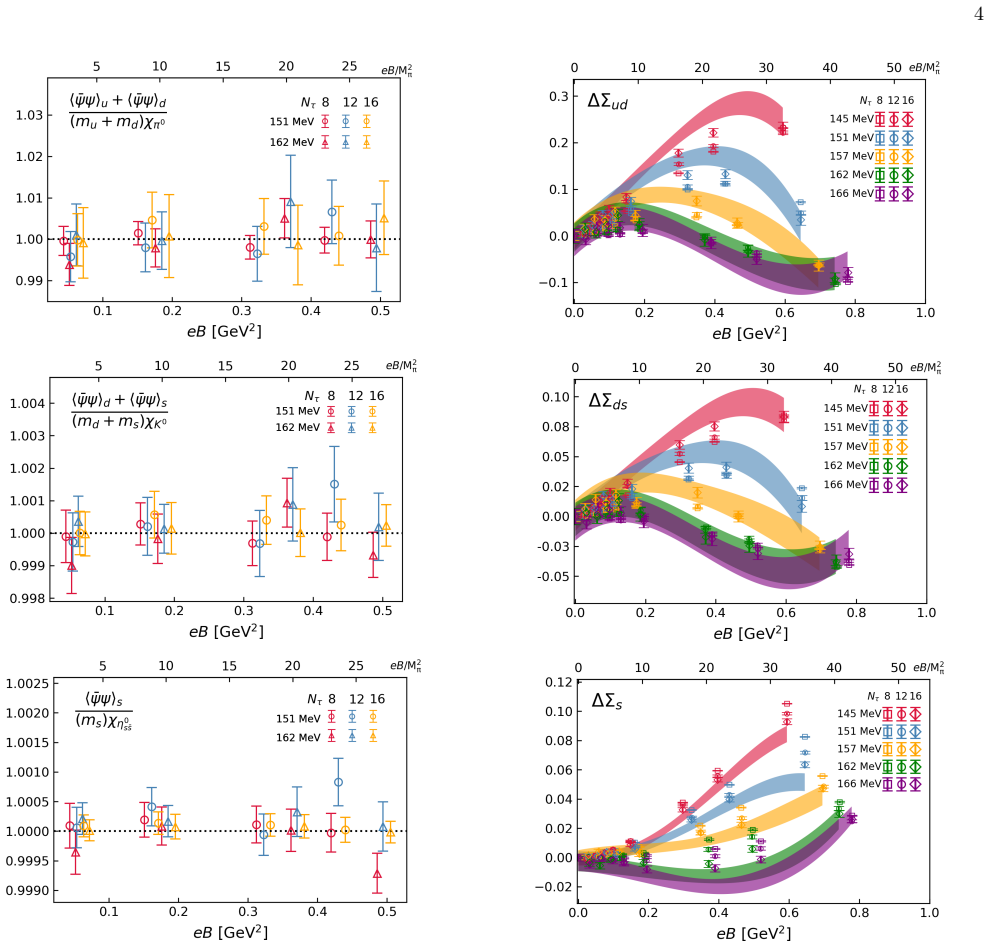
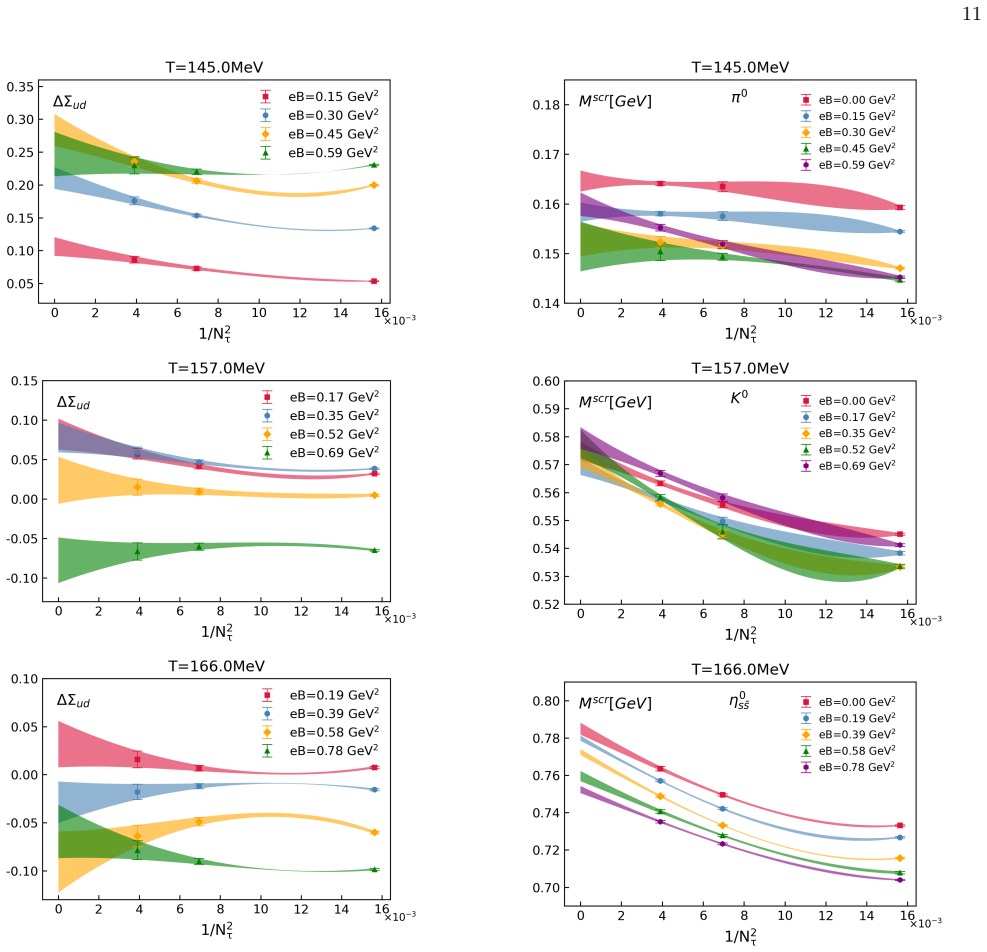
The load-bearing object is the Ward–Takahashi identity (m_u+m_d)χ_{π⁰}=⟨ψ̄ψ⟩_u+⟨ψ̄ψ⟩_d (and its K⁰ and η⁰_{s\bar{s}} analogues), which ties each chiral condensate combination to the space-time integral of the corresponding pseudoscalar correlation function; the screening mass is then the inverse correlation length extracted from the same spatial correlator. On the lattice, the correlators are computed with highly improved staggered (HISQ) fermions in a quantized magnetic flux background, and the screening masses are obtained from multi-state $\cosh$ fits with an oscillating parity-partner term; continuum estimates come from averaging linear and quadratic 1/Nτ² extrapolations of the Nτ = 8, 12, 16 data.
What would settle it
Compute the disconnected contribution to the π⁰ screening correlator on the finest lattice (Nτ = 16) at T ≈ 157 MeV and eB ≈ 0.2–0.4 GeV², where the non-monotonic dip is most visible; if including it moves the extracted screening mass by more than the quoted uncertainty, the claimed non-monotonic eB dependence of m_{π⁰} is not robust.
Extended reading notes
Core claim
The paper establishes that in QCD with physical up, down, and strange quark masses, the magnetic-field dependence of the neutral pseudoscalar screening masses is governed by the same competition between magnetic catalysis and inverse magnetic catalysis that shapes the chiral condensates. Using the Ward–Takahashi identities that tie each condensate combination to a pseudoscalar susceptibility, the authors extract screening masses from the exponential decay of spatial correlation functions on Nτ = 8, 12, and 16 lattices and extrapolate to the continuum with linear and quadratic ansätze in 1/Nτ². The resulting continuum estimates show that ΔΣ_ud and ΔΣ_ds rise to a peak and then fall as eB grows at low temperature, with the peak shifting to smaller eB as T increases, while ΔΣ_s keeps rising in the covered window; at higher temperatures all three develop more intricate rise–fall–rise patterns. Correspondingly, the screening masses of π⁰ and K⁰ first decrease and then increase with eB, mirroring their condensates, whereas m_{η⁰_{s\bar{s}}} decreases monotonically. All screening masses increase with T, with steeper slopes at larger eB, and the crossing of constant-eB curves is interpreted as the magnetic-field-induced reduction of the pseudocritical temperature.
Load-bearing premise
The extraction of the π⁰ and K⁰ screening masses assumes that disconnected quark-line contributions to the neutral pseudoscalar spatial correlators are negligibly small, an assumption the paper states but does not quantitatively verify at physical quark masses.
Editorial extensions
If this is right
- The non-monotonic screening masses mean that inverse magnetic catalysis is not only a short-distance/integrated effect: it extends to the long-distance spatial correlation lengths that govern how mesonic excitations screen color fields in the medium.
- The peak of ΔΣ moving to smaller eB with temperature implies a T-dependent boundary between magnetic catalysis and inverse magnetic catalysis, consistent with a falling T_pc(eB).
- Continuum estimates of ΔΣ_ud, ΔΣ_ds, and ΔΣ_s provide direct targets for NJL-type models, the linear sigma model, and holographic AdS/QCD constructions that currently disagree on whether inverse magnetic catalysis appears.
- The monotonic decrease of the η⁰_{s\bar{s}} screening mass with eB shows that strange-quark pseudoscalars remain in the magnetic-catalysis regime across the whole temperature window, so model comparisons should treat light and strange channels separately.
- The growing up–down condensate asymmetry ΔΣ_{u−d} with eB, which shrinks as T rises, offers an observable signature of charge-dependent chiral symmetry breaking that could be probed by future simulations on larger volumes.
Reading between the lines
- If the disconnected-diagram contribution to the π⁰ correlator is not negligible, the reported non-monotonic dip in m_{π⁰}(eB) could be partially an artifact; a dedicated computation of the disconnected part on the Nτ = 16 ensemble would settle this without a full new simulation campaign.
- The close tracking between screening masses and condensates suggests that at these temperatures the pseudoscalar screening masses might be expressible through a generalized Gell-Mann–Oakes–Renner relation with eB-dependent decay constants, which could be tested by measuring the amplitudes A_H of the correlators.
- The crossing of constant-eB curves in m_{π⁰}(T) could be used as an alternative, correlation-based definition of T_pc(eB); comparing it with the inflection-point definition would show whether the field-induced T_pc reduction is observable-independent.
Signed reviews
Editorial analysis
A structured set of objections, weighed in public.
Referee Report
Summary. This paper presents lattice QCD results for chiral condensates and neutral pseudoscalar screening masses in a background magnetic field, using (2+1)-flavor HISQ fermions at physical quark masses. Simulations are performed on N_tau = 8, 12, and 16 lattices with aspect ratio 4, at five temperatures between about 145 and 166 MeV and eight magnetic field values up to eB ~ 0.8 GeV^2. The paper reports continuum estimates obtained by interpolating in the T–eB plane and extrapolating in 1/N_tau^2 using two ansätze. The main physical results are that the light and strange-light chiral condensates show magnetic catalysis at small eB followed by inverse magnetic catalysis at larger eB, that the pi0 and K0 screening masses are non-monotonic in eB and track the corresponding condensates, and that the eta_{s sbar} screening mass decreases monotonically with eB. The analysis includes a Ward-Takahashi identity check relating the condensates to the integrated pseudoscalar correlators.
Significance. If the results are correct, this is the first continuum-estimate study of these observables at physical quark masses in a thermomagnetic medium near the chiral crossover. The paper uses a standard and defensible lattice setup, with three lattice spacings, multiple correlator fit states selected by AICc, a B-spline interpolation procedure, two continuum-extrapolation ansätze, and a public dataset deposit. These are genuine strengths that make the paper a useful benchmark for effective models. The central caveat, acknowledged in the text, is the neglect of disconnected quark-line contributions to the neutral pion and kaon screening correlators; because the main quantitative claims concern precisely those channels, this issue is load-bearing and needs to be addressed before the results can be fully accepted.
major comments (2)
- [Section III (lattice observables)] The neglect of disconnected quark-line contributions to the neutral pseudoscalar screening correlators is not quantified. At zero magnetic field the disconnected contribution to the pi0 correlator cancels by u–d degeneracy, but at eB != 0 that cancellation is broken by the charge asymmetry, which the paper itself shows grows with eB in Figure 4 (Delta Sigma_{u-d}). The references cited for the expectation that the contribution is small, [34] and [55], are zero-temperature or different-setup studies and do not provide a bound at T near Tpc with physical quark masses. The Ward-Takahashi check in Figure 1 is performed on the integrated susceptibility, which is dominated by short-distance correlator contributions; it does not constrain the asymptotic, long-distance screening mass that defines M_{pi0}. If the disconnected hairpin correlator has a smaller screening mass than the connected pi0 channel at large eB, it could dominate the large-z behavior and change the extracted non-monotonic dependence. The authors should compute the disconnected contribution on at least a subset of ensembles, or provide an explicit model-based upper bound and demonstrate that the screening-mass results are stable under including it.
- [Figure 5 caption] The pion correlator is defined as G_{pi0} = (G_{uu} + G_{dd})/2 with equal weights for the up and down quark contributions. This is presented as an assumption in a footnote, but it is not a symmetry statement in the presence of a magnetic field, where the u/d charge splitting breaks SU(2)_V. The physical neutral pion is a field-dependent combination of the light flavors, and the choice of equal weights defines the interpolating operator rather than the mass eigenstate. The paper does not estimate the systematic uncertainty that this operator choice introduces. The assumption should be moved into the main text and justified, or the extraction should be interpreted as the screening mass of this particular operator rather than the physical pi0 mass.
minor comments (5)
- [Abstract / Section III] The abstract states the temperature range as 145 MeV to 166 MeV, while Section III says 145 MeV to 165 MeV; the tables list temperatures such as 165.98 and 166.03 MeV. Please harmonize the quoted range.
- [Figure 1] The caption says the ratios are 'normalized with respect to their corresponding quark masses and susceptibility' but does not define the plotted quantity explicitly. Please give the explicit ratio, for example (mu+md) chi_{pi0} / ( <psi-bar psi>_u + <psi-bar psi>_d ).
- [Section II] The sums over i and j in the multi-state fit ansatz are not defined. Please state explicitly that they run over excited states and that A and M are fit parameters for the non-oscillating and oscillating contributions.
- [Appendix C] For the N_tau = 12 ensemble at beta = 6.712, the screening-mass configuration counts for Nb = 1 through 6 are all listed as 3157. This repetition looks like a possible placeholder or transcription error; please verify the entries.
- [Appendix A] The B-spline interpolation procedure requires a smoothing factor, but its value is not reported. A sentence giving the chosen smoothing factor and its sensitivity would improve reproducibility.
Circularity Check
No significant circularity: the chiral condensates and screening masses are direct lattice observables, and the central eB-dependence claims do not reduce to fitted inputs or to a self-citation chain.
full rationale
The paper's central observables are computed from first-principles lattice QCD: the renormalized condensates are traced quark propagators with additive divergences removed via eB=0 subtraction and GMOR normalization, and the screening masses are extracted from the exponential decay of spatial correlators using a standard multi-state cosh ansatz selected by AICc. No physical parameter is fitted to make the reported non-monotonic pi0/K0 screening-mass behavior true; the only fitted quantities are nuisance parameters of the correlator and continuum extrapolations (linear/quadratic in 1/Ntau^2). The Ward-Takahashi identities are used as a cross-check (Fig. 1), not as a derivation of screening masses from condensates; the paper explicitly notes the screening mass and susceptibility probe different distance regimes. The normalization inputs (f_pi, f_K, M_pi, M_K, ms/ml) are external and are not tuned to the target observables. Self-citations [26,34] supply methodology, prior context, and the expected-smallness argument for neglecting disconnected diagrams, but they do not by themselves force the central result; the cited disconnected-size evidence also includes an independent reference [55]. The neglect of disconnected contributions is an unquantified systematic approximation that could shift the pi0 screening mass if the cited smallness fails, but that is a correctness/robustness concern, not a circular reduction: the paper does not define the pi0 screening mass as the connected-only quantity by construction. Therefore there is no step in the derivation chain that is equivalent to its own input.
Assumptions & free parameters
free parameters (2)
- Continuum extrapolation coefficients (b, c, d) =
not reported
- B-spline smoothing factor =
not reported
assumptions (5)
- standard math Ward-Takahashi identities (Eqs. 1-3) relate chiral condensates to pseudoscalar susceptibilities at nonzero B.
- domain assumption The HISQ action and the magnetic field implementation preserve the physical content of QCD with O(a^2) discretization errors.
- ad hoc to paper Disconnected quark-line contributions to the neutral pseudoscalar screening correlators are negligible.
- domain assumption Continuum limit is approached as O(1/N_tau^2) with the linear and quadratic ansatz (Eqs. A1, A2), and the two-ansatz average captures the systematic uncertainty.
- domain assumption Physical quark masses are set by ml = ms/27 and the scale is set via the kaon decay constant parameterization of [41], giving M_pi around 135 MeV.
Cite this review
Pith. "Pith review of Chiral condensates and screening masses of neutral pseudoscalar mesons from lattice QCD at physical quark masses." pith.science (2026). https://pith.science/paper/GWZ5WVAB
@misc{pith2026250111262,
  author       = {Pith},
  title        = {Pith review of: Chiral condensates and screening masses of neutral pseudoscalar mesons from lattice QCD at physical quark masses},
  year         = {2026},
  howpublished = {\url{https://pith.science/paper/GWZ5WVAB}},
  note         = {Machine review of arXiv:2501.11262}
}
abstract
We investigate the effects of temperature $T$ and external magnetic fields $eB$ on the chiral condensates and screening masses of neutral pseudoscalar mesons, including $\pi^0$, $K^0$, and $\eta_{s\bar{s}}^0$, in (2+1)-flavor lattice QCD with physical quark masses. The chiral condensates are intrinsically connected to the screening masses via Ward-Takahashi identities, with the latter characterizing the inverse of the spatial correlation length in the pseudoscalar channel. Using highly improved staggered quarks, we perform simulations on lattices with temporal extents $N_\tau = 8, 12, 16$ and an aspect ratio of 4, covering five temperatures from 145 MeV to 166 MeV. For each temperature, eight magnetic field strengths are simulated, reaching up to $eB \sim 0.8$ GeV$^2$. These simulations allow us to provide continuum estimates for the chiral condensates and screening masses. We observe intricate behavior in the light ($ud$), strange-light ($ds$) and strange ($s$) quark condensates as functions of the magnetic field and temperature, reflecting the competition between magnetic catalysis and inverse magnetic catalysis effects. This complex behavior is also mirrored in the screening masses of the neutral pseudoscalar mesons. Notably, the screening masses of $\pi^0$ and $K^0$ exhibit a non-monotonic dependence on $eB$, closely following the variations in their corresponding chiral condensates. Meanwhile, the screening mass of $\eta_{s\bar{s}}^0$ decreases monotonically with increasing $eB$. These findings provide valuable insights for understanding the behavior of QCD in a thermomagnetic medium and can serve as benchmarks for low-energy QCD models and effective theories.
Figures


Figures from the paper (4 more)



Forward citations
Cited by 6 Pith papers
-
Leading-Order QCD Equation of State in Strong Magnetic Fields at Nonzero Baryon Chemical Potential
Continuum-estimated leading-order EoS coefficients in magnetized strangeness-neutral QCD at nonzero baryon chemical potential show temperature-band crossings in q1 and P2 and a possible sign change of the trace anomal...
-
Probing the chiral and $U(1)$ axial symmetry restoration via meson susceptibilities in holographic QCD
In a soft-wall holographic QCD model, chiral symmetry restores at ~155 MeV while the U(1) axial symmetry restores near 190 MeV — a separation the authors present despite an admitted mismatch with lattice QCD below 175 MeV.
-
Quarkonium spectra with magnetically induced anisotropic confinement
Radially excited charmonium masses fall sharply with magnetic field strength under lattice-inspired anisotropic confinement, while the ground state barely moves.
-
Landau-Zener-St\"uckelberg-Majorana dynamics of magnetized quarkonia
A Landau-Zener Hamiltonian fitted to the static charmonium spectrum predicts that fast magnetic-field sweeps drive nonadiabatic transitions between charmonium states, with Stückelberg interference controlling final po...
-
Pseudoscalar Screening Mass at Finite Temperature and Magnetic Field from Lattice QCD with Physical Quark Masses
Continuum-estimated lattice QCD screening masses of neutral pseudoscalar mesons show a magnetic-field-induced minimum for pi and K, but not for the strange eta, near the QCD transition temperature.
-
QCD Equation of State with Strong Magnetic Fields and Nonzero Baryon Density
Lattice QCD continuum estimates of leading-order baryon-density Taylor coefficients of the magnetized QCD equation of state show deviations from hadron gas and approach to a free gas at strong fields.
Reference graph
Works this paper leans on
-
[26]
by performing lattice simulations with a physical pion mass on Nτ = 8, 12, and 16 lattices, maintaining an aspect ratio of 4. These simulations cover five different temperature values around the pseudo-transition tem- perature and eight values of the external magnetic field strength ( eB) at each temperature. This setup allows for a continuum estimate of ...
-
[58]
E.V. Luschevskaya, O.E. Solovjeva, O.A. Kochetkov and O.V. Teryaev, Magnetic polarizabilities of light mesons in SU (3) lattice gauge theory , Nucl. Phys. B 898 (2015) 627 [ 1411.4284]
arXiv 2015
-
[34]
T.H. Moreira and F.L. Braghin, Magnetic field induced corrections to the NJL model coupling constant from vacuum polarization, Phys. Rev. D 105 (2022) 114009 [2202.10559]
arXiv 2022
-
[55]
HotQCD collaboration, SIMULATeQCD: A simple multi-GPU lattice code for QCD calculations , Comput. Phys. Commun. 300 (2024) 109164 [ 2306.01098]
arXiv 2024
-
[1]
Vachaspati, Magnetic fields from cosmological phase transitions, Phys
T. Vachaspati, Magnetic fields from cosmological phase transitions, Phys. Lett. B 265 (1991) 258
work page 1991
-
[2]
K. Enqvist and P. Olesen, On primordial magnetic fields of electroweak origin , Phys. Lett. B 319 (1993) 178 [hep-ph/9308270]
arXiv 1993
-
[3]
G. Baym, D. Bodeker and L.D. McLerran, Magnetic fields produced by phase transition bubbles in the electroweak phase transition, Phys. Rev. D 53 (1996) 662 [hep-ph/9507429]
arXiv 1996
-
[4]
D. Grasso and H.R. Rubinstein, Magnetic fields in the early universe, Phys. Rept. 348 (2001) 163 [astro-ph/0009061]
arXiv 2001
Show all 60 references
-
[5]
Kharzeev and J
D.E. Kharzeev and J. Liao, Chiral magnetic effect reveals the topology of gauge fields in heavy-ion collisions, Nature Rev. Phys. 3 (2021) 55 [ 2102.06623]. 9
2021 arXiv
-
[6]
Skokov, A.Y
V. Skokov, A.Y. Illarionov and V. Toneev, Estimate of the magnetic field strength in heavy-ion collisions , Int. J. Mod. Phys. A 24 (2009) 5925 [ 0907.1396]
2009 arXiv
-
[7]
Voronyuk, V.D
V. Voronyuk, V.D. Toneev, W. Cassing, E.L. Bratkovskaya, V.P. Konchakovski and S.A. Voloshin, (Electro-)Magnetic field evolution in relativistic heavy-ion collisions , Phys. Rev. C 83 (2011) 054911 [1103.4239]
2011 arXiv
-
[8]
Deng and X.-G
W.-T. Deng and X.-G. Huang, Event-by-event generation of electromagnetic fields in heavy-ion collisions, Phys. Rev. C85 (2012) 044907 [ 1201.5108]
2012 arXiv
-
[9]
Duncan and C
R.C. Duncan and C. Thompson, Formation of very strongly magnetized neutron stars - implications for gamma-ray bursts, Astrophys. J. Lett. 392 (1992) L9
1992
-
[10]
Andersen, W.R
J.O. Andersen, W.R. Naylor and A. Tranberg, Phase diagram of QCD in a magnetic field: A review , Rev. Mod. Phys. 88 (2016) 025001 [ 1411.7176]
2016 arXiv
-
[11]
Cao, Recent progresses on QCD phases in a strong magnetic field: views from Nambu–Jona-Lasinio model , Eur
G. Cao, Recent progresses on QCD phases in a strong magnetic field: views from Nambu–Jona-Lasinio model , Eur. Phys. J. A 57 (2021) 264 [ 2103.00456]
2021 arXiv
-
[12]
Endrodi, QCD with background electromagnetic fields on the lattice: a review , 2406.19780
G. Endrodi, QCD with background electromagnetic fields on the lattice: a review , 2406.19780
-
[13]
Adhikari et al., Strongly interacting matter in extreme magnetic fields , 2412.18632
P. Adhikari et al., Strongly interacting matter in extreme magnetic fields , 2412.18632
-
[14]
Ding, S.T
H.T. Ding, S.T. Li, Q. Shi and X.D. Wang, Fluctuations and correlations of net baryon number, electric charge and strangeness in a background magnetic field , Eur. Phys. J. A 57 (2021) 202 [ 2104.06843]
2021 arXiv
-
[15]
Ding, S.T
H.T. Ding, S.T. Li, Q. Shi, A. Tomiya, X.D. Wang and Y. Zhang, QCD phase structure in strong magnetic fields, Acta Phys. Polon. Supp. 14 (2021) 403 [2011.04870]
2021 arXiv
-
[16]
Ding, J.-B
H.-T. Ding, J.-B. Gu, A. Kumar, S.-T. Li and J.-H. Liu, Baryon Electric Charge Correlation as a Magnetometer of QCD , Phys. Rev. Lett. 132 (2024) 201903 [2312.08860]
2024 arXiv
-
[17]
Bruckmann, G
F. Bruckmann, G. Endrodi and T.G. Kovacs, Inverse magnetic catalysis and the Polyakov loop , JHEP 04 (2013) 112 [ 1303.3972]
2013 arXiv
-
[18]
D’Elia, F
M. D’Elia, F. Manigrasso, F. Negro and F. Sanfilippo, QCD phase diagram in a magnetic background for different values of the pion mass , Phys. Rev. D 98 (2018) 054509 [ 1808.07008]
2018 arXiv
-
[19]
Bonati, M
C. Bonati, M. D’Elia, M. Mariti, M. Mesiti, F. Negro, A. Rucci et al., Magnetic field effects on the static quark potential at zero and finite temperature , Phys. Rev. D 94 (2016) 094007 [ 1607.08160]
2016 arXiv
-
[20]
G.S. Bali, F. Bruckmann, G. Endr¨ odi, S.D. Katz and A. Sch¨ afer,The QCD equation of state in background magnetic fields , JHEP 08 (2014) 177 [ 1406.0269]
2014 arXiv
-
[21]
G.S. Bali, F. Bruckmann, G. Endrodi, Z. Fodor, S.D. Katz and A. Schafer, QCD quark condensate in external magnetic fields , Phys. Rev. D86 (2012) 071502 [1206.4205]
2012 arXiv
-
[22]
G.S. Bali, F. Bruckmann, G. Endrodi, Z. Fodor, S.D. Katz, S. Krieg et al., The QCD phase diagram for external magnetic fields , JHEP 02 (2012) 044 [1111.4956]
2012 arXiv
-
[23]
Bornyakov, P.V
V.G. Bornyakov, P.V. Buividovich, N. Cundy, O.A. Kochetkov and A. Sch¨ afer,Deconfinement transition in two-flavor lattice QCD with dynamical overlap fermions in an external magnetic field , Phys. Rev. D 90 (2014) 034501 [ 1312.5628]
2014 arXiv
-
[24]
Tomiya, H.-T
A. Tomiya, H.-T. Ding, X.-D. Wang, Y. Zhang, S. Mukherjee and C. Schmidt, Phase structure of three flavor QCD in external magnetic fields using HISQ fermions, PoS LA TTICE2018(2019) 163 [1904.01276]
2019 arXiv
-
[25]
Endrodi, M
G. Endrodi, M. Giordano, S.D. Katz, T.G. Kov´ acs and F. Pittler, Magnetic catalysis and inverse catalysis for heavy pions, JHEP 07 (2019) 007 [ 1904.10296]
2019 arXiv
-
[27]
Ding, S.T
H.T. Ding, S.T. Li, J.H. Liu and X.D. Wang, Chiral condensates and screening masses of neutral pseudoscalar mesons in thermomagnetic QCD medium , Phys. Rev. D 105 (2022) 034514 [ 2201.02349]
2022 arXiv
-
[28]
Shovkovy, Magnetic Catalysis: A Review , Lect
I.A. Shovkovy, Magnetic Catalysis: A Review , Lect. Notes Phys. 871 (2013) 13 [ 1207.5081]
2013 arXiv
-
[29]
Coppola, W.R
M. Coppola, W.R. Tavares, S.S. Avancini, J.C. Sodr´ e and N.N. Scoccola, Thermomagnetic effects on light pseudoscalar meson masses within the SU(3) Nambu–Jona-Lasinio model, Phys. Rev. D 110 (2024) 114036 [2410.05568]
2024 arXiv
-
[30]
N. Wen, X. Cao, J. Chao and H. Liu, Neutral pion masses within a hot and magnetized medium in a lattice-improved soft-wall AdS/QCD model , Phys. Rev. D 109 (2024) 086021 [ 2402.06239]
2024 arXiv
-
[31]
Mao, Reduction of pseudocritical temperatures of chiral restoration and deconfinement phase transitions in a magnetized PNJL model , Phys
S. Mao, Reduction of pseudocritical temperatures of chiral restoration and deconfinement phase transitions in a magnetized PNJL model , Phys. Rev. D 110 (2024) 054002 [2404.05294]
2024 arXiv
-
[32]
Ayala, R.L.S
A. Ayala, R.L.S. Farias, L.A. Hern´ andez, A.J. Mizher, J. Rend´ on, C. Villavicencio et al.,Magnetic field dependence of the neutral pion longitudinal screening mass in the linear sigma model with quarks , Phys. Rev. D 109 (2024) 074019 [ 2311.13068]
2024 arXiv
-
[33]
Sheng, X
B.-k. Sheng, X. Wang and L. Yu, Impacts of inverse magnetic catalysis on screening masses of neutral pions and sigma mesons in hot and magnetized quark matter , Phys. Rev. D 105 (2022) 034003 [ 2110.12811]
2022 arXiv
-
[35]
Ding, S.T
H.T. Ding, S.T. Li, A. Tomiya, X.D. Wang and Y. Zhang, Chiral properties of (2+1)-flavor QCD in strong magnetic fields at zero temperature , Phys. Rev. D 104 (2021) 014505 [ 2008.00493]
2021 arXiv
-
[36]
Colangelo and S
G. Colangelo and S. Durr, The Pion mass in finite volume, Eur. Phys. J. C 33 (2004) 543 [hep-lat/0311023]
2004 arXiv
-
[37]
Colangelo, S
G. Colangelo, S. Durr and C. Haefeli, Finite volume effects for meson masses and decay constants , Nucl. Phys. B 721 (2005) 136 [ hep-lat/0503014]
2005 arXiv
-
[38]
Gell-Mann, R.J
M. Gell-Mann, R.J. Oakes and B. Renner, Behavior of current divergences under SU(3) x SU(3) , Phys. Rev. 175 (1968) 2195
1968
-
[39]
Gasser and H
J. Gasser and H. Leutwyler, Chiral Perturbation Theory: Expansions in the Mass of the Strange Quark , Nucl. Phys. B 250 (1985) 465
1985
-
[40]
Detar and J.B
C.E. Detar and J.B. Kogut, The Hadronic Spectrum of the Quark Plasma , Phys. Rev. Lett. 59 (1987) 399
1987
-
[41]
Detar and J.B
C.E. Detar and J.B. Kogut, Measuring the Hadronic Spectrum of the Quark Plasma , Phys. Rev. D 36 (1987) 2828
1987
-
[42]
Bazavov et al., Meson screening masses in (2+1)-flavor QCD , Phys
A. Bazavov et al., Meson screening masses in (2+1)-flavor QCD , Phys. Rev. D 100 (2019) 094510 [1908.09552]. 10
2019 arXiv
-
[43]
Cheng et al., Meson screening masses from lattice QCD with two light and the strange quark , Eur
M. Cheng et al., Meson screening masses from lattice QCD with two light and the strange quark , Eur. Phys. J. C 71 (2011) 1564 [ 1010.1216]
2011 arXiv
-
[44]
Bali, B.B
G.S. Bali, B.B. Brandt, G. Endr˝ odi and B. Gl¨ aßle, Meson masses in electromagnetic fields with Wilson fermions, Phys. Rev. D97 (2018) 034505 [ 1707.05600]
2018 arXiv
-
[45]
Karsch and E
F. Karsch and E. Laermann, Thermodynamics and in medium hadron properties from lattice QCD , hep-lat/0305025
-
[46]
HPQCD, UKQCDcollaboration, Highly improved staggered quarks on the lattice, with applications to charm physics , Phys. Rev. D75 (2007) 054502 [hep-lat/0610092]
2007 arXiv
-
[47]
Bazavov, T
A. Bazavov, T. Bhattacharya, M. Cheng, C. DeTar, H.-T. Ding et al., The chiral and deconfinement aspects of the QCD transition , Phys.Rev. D85 (2012) 054503 [1111.1710]
2012 arXiv
-
[48]
D86 (2012) 034509 [ 1203.0784]
HotQCD Collaborationcollaboration, Fluctuations and Correlations of net baryon number, electric charge, and strangeness: A comparison of lattice QCD results with the hadron resonance gas model , Phys.Rev. D86 (2012) 034509 [ 1203.0784]
2012 arXiv
-
[49]
D90 (2014) 094503 [1407.6387]
HotQCD Collaborationcollaboration, Equation of state in ( 2+1 )-flavor QCD , Phys.Rev. D90 (2014) 094503 [1407.6387]
2014 arXiv
-
[50]
Bazavov et al., The QCD Equation of State to O(µ6 B) from Lattice QCD, Phys
A. Bazavov et al., The QCD Equation of State to O(µ6 B) from Lattice QCD, Phys. Rev. D95 (2017) 054504 [1701.04325]
2017 arXiv
-
[51]
HotQCD collaboration, Chiral crossover in QCD at zero and non-zero chemical potentials , Phys. Lett. B795 (2019) 15 [ 1812.08235]
2019 arXiv
-
[52]
Bollweg, H.T
D. Bollweg, H.T. Ding, J. Goswami, F. Karsch, S. Mukherjee, P. Petreczky et al., Strangeness-correlations on the pseudocritical line in (2+1)-flavor QCD , Phys. Rev. D 110 (2024) 054519 [2407.09335]
2024 arXiv
-
[53]
D’Elia, S
M. D’Elia, S. Mukherjee and F. Sanfilippo, QCD Phase Transition in a Strong Magnetic Background , Phys. Rev. D82 (2010) 051501 [ 1005.5365]
2010 arXiv
-
[54]
Bazavov, F
A. Bazavov, F. Karsch, Y. Maezawa, S. Mukherjee and P. Petreczky, In-medium modifications of open and hidden strange-charm mesons from spatial correlation functions, Phys. Rev. D 91 (2015) 054503 [ 1411.3018]
2015 arXiv
-
[56]
Luschevskaya, O
E. Luschevskaya, O. Solovjeva and O. Teryaev, Magnetic polarizability of pion , Phys. Lett. B 761 (2016) 393 [ 1511.09316]
2016 arXiv
-
[57]
D’Elia, L
M. D’Elia, L. Maio, F. Sanfilippo and A. Stanzione, Phase diagram of QCD in a magnetic background , Phys. Rev. D 105 (2022) 034511 [ 2111.11237]
2022 arXiv
-
[59]
Thakkar, J.-B
R. Thakkar, J.-B. Gu, S.-T. Li and H.-T. Ding, Dataset for chiral condensates and screening masses of neutral pseudoscalar mesons from lattice qcd at physical quark masses, 2025. 10.5281/zenodo.15090182 (2025)
2025 doi
-
[60]
Dierckx, An algorithm for surface-fitting with spline functions, IMA Journal of Numerical Analysis 1 (1981) 267
P. Dierckx, An algorithm for surface-fitting with spline functions, IMA Journal of Numerical Analysis 1 (1981) 267. Figure 7. Samples of interpolation estimate of the screen- ing mass as a function of the magnetic field strength eB at fixed temperatures are shown for three qua...
1981
Reviewed August 10, 2026 · model on record in the stance chip above.
Discussion (0). Continue with ORCID to comment.