Governed Evolution of Agent Runtimes through Executable Operational Cognition
Pith reviewed 2026-06-29 15:47 UTC · model grok-4.3
The pith
A framework formalizes agent-generated artifacts as persistent runtime capabilities that evolve under explicit governance constraints.
A machine-rendered reading of the paper's core claim, the machinery that carries it, and where it could break.
Core claim
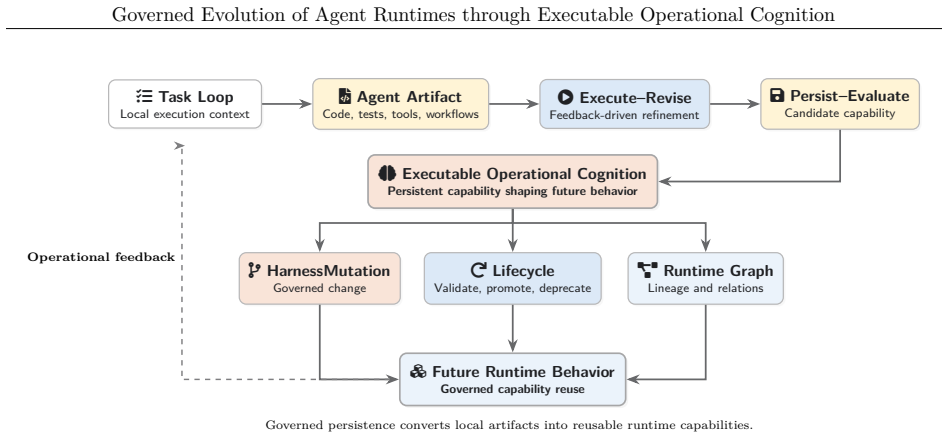
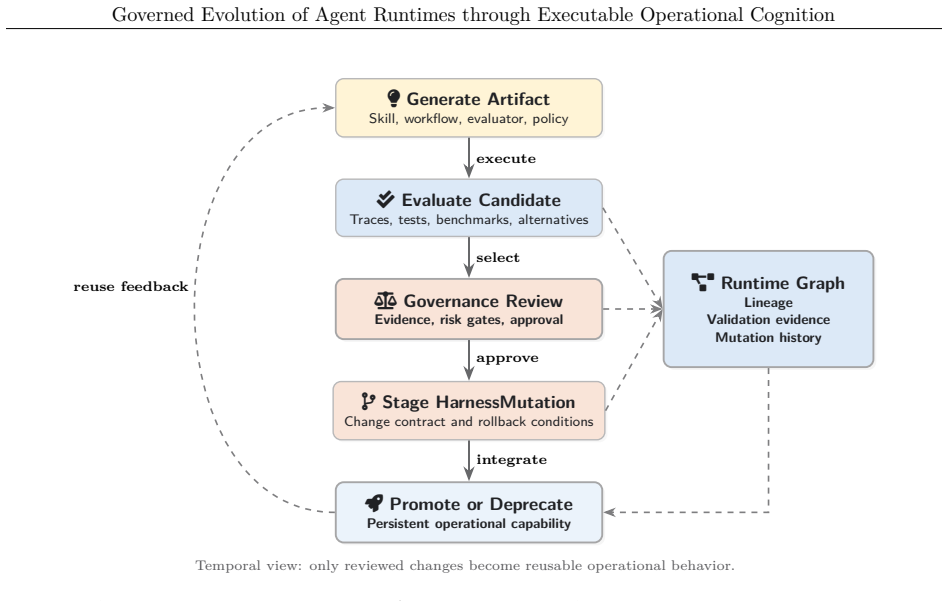
Agent-generated artifacts are formalized as persistent runtime capabilities that progressively become part of the operational substrate rather than transient intermediate outputs. HarnessMutation is introduced as a governed mechanism for lifecycle-aware runtime adaptation that operates under explicit validation, traceability, evaluation, and rollback constraints. Rather than treating runtime adaptation as unrestricted self-modification, the framework models evolution as a bounded and observable process over persistent operational memory and shows how these ideas can be operationalized over modern agent runtimes, providing a conceptual foundation for adaptive infrastructures whose evolution r
What carries the argument
HarnessMutation, the governed mechanism for lifecycle-aware runtime adaptation that enforces validation, traceability, evaluation, and rollback constraints on changes to persistent operational memory.
If this is right
- Runtime adaptation is treated as a bounded process over persistent operational memory instead of unrestricted self-modification.
- Changes to agent systems remain explicit, traceable, and subject to rollback through the defined constraints.
- The ideas can be applied to modern agent runtimes and governance-oriented orchestration systems.
- Adaptive infrastructures gain a foundation where evolution stays auditable and constrained.
Where Pith is reading between the lines
- This framing could support safer deployment of self-modifying agents by making rollback and audit trails standard features.
- The approach might extend to non-agent software systems where code changes need similar governance.
- A practical test could measure whether adding HarnessMutation increases traceability without reducing adaptation speed in an existing runtime.
Load-bearing premise
Agent-generated artifacts can be formalized as persistent runtime capabilities that become part of the operational substrate, and governance mechanisms like HarnessMutation can be added to modern agent runtimes without losing adaptability.
What would settle it
An attempt to implement HarnessMutation in a current agent runtime that either violates one of the required constraints or eliminates the system's capacity for further adaptation would falsify the claim that the framework can be operationalized while preserving governance and adaptability.
Figures
read the original abstract
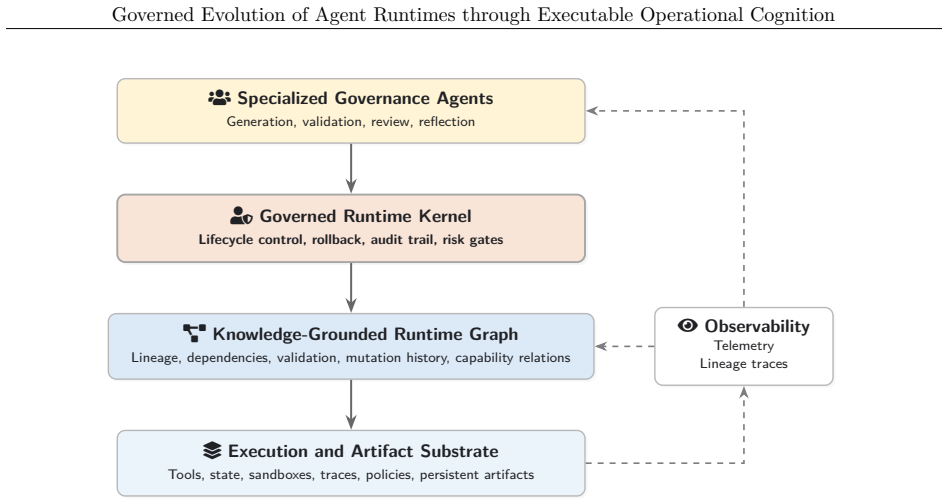
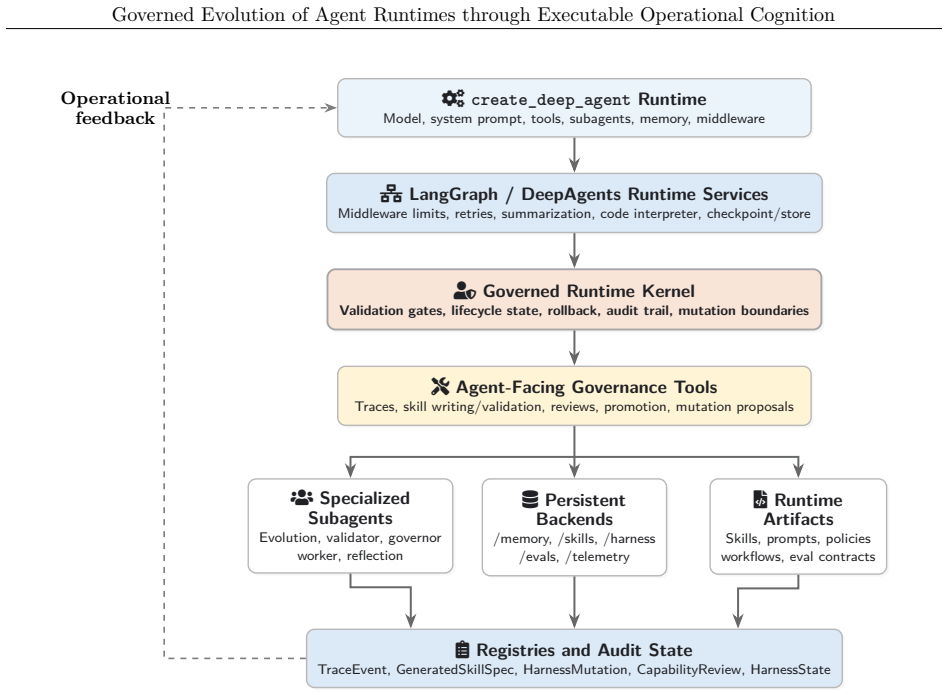
Recent advances in agentic systems increasingly treat code as an executable operational substrate rather than as a disposable output artifact. Prior work such as \emph{Code as Agent Harness} frames validated agent-generated artifacts as runtime entities that can be created, executed, revised, persisted, and reused within long-running cognitive loops. However, the governance, lifecycle management, and operational evolution of such artifacts remain under-specified. This paper proposes a framework for governed runtime evolution in multi-agent systems through executable operational cognition. We formalize agent-generated artifacts as persistent runtime capabilities that progressively become part of the operational substrate rather than transient intermediate outputs. Building on this perspective, we introduce \emph{HarnessMutation} as a governed mechanism for lifecycle-aware runtime adaptation operating under explicit validation, traceability, evaluation, and rollback constraints. Rather than treating runtime adaptation as unrestricted self-modification, the proposed framework models evolution as a bounded and observable process over persistent operational memory. It further shows how these ideas can be operationalized over modern agent runtimes and governance-oriented orchestration systems, providing a conceptual foundation for adaptive infrastructures whose evolution remains explicit, auditable, and constrained.
Editorial analysis
A structured set of objections, weighed in public.
Referee Report
Summary. The paper proposes a conceptual framework for governed runtime evolution in multi-agent systems. It formalizes agent-generated artifacts as persistent runtime capabilities that become part of the operational substrate, introduces HarnessMutation as a lifecycle-aware adaptation mechanism operating under explicit constraints (validation, traceability, evaluation, rollback), and models evolution as a bounded, observable process over persistent operational memory to support auditable and constrained adaptive infrastructures.
Significance. As a perspective-shifting conceptual contribution in cs.SE, the framework could help reframe runtime adaptation in agentic systems from disposable outputs to governed, persistent capabilities if the operationalization claims hold. It explicitly positions itself as providing a foundation rather than empirical results or proofs, which aligns with its scope but limits immediate applicability.
major comments (1)
- [Abstract] Abstract: The central claim that the ideas 'can be operationalized over modern agent runtimes and governance-oriented orchestration systems' is presented without any concrete examples, pseudocode, architecture diagrams, or case studies, making the operationalization assertion load-bearing but unsupported in the manuscript.
Simulated Author's Rebuttal
We thank the referee for the detailed review and constructive feedback. We address the single major comment below and commit to revisions that strengthen the manuscript while preserving its conceptual scope.
read point-by-point responses
-
Referee: [Abstract] Abstract: The central claim that the ideas 'can be operationalized over modern agent runtimes and governance-oriented orchestration systems' is presented without any concrete examples, pseudocode, architecture diagrams, or case studies, making the operationalization assertion load-bearing but unsupported in the manuscript.
Authors: We acknowledge the validity of this observation. The manuscript is positioned as a conceptual framework rather than an empirical or implementation paper, and the abstract's phrasing that the ideas 'can be operationalized' is not backed by explicit artifacts. In revision we will add a new section containing (1) a high-level architecture diagram showing integration points with governance-oriented orchestration systems, (2) pseudocode for the core HarnessMutation lifecycle (validation-traceability-evaluation-rollback), and (3) a brief illustrative walkthrough using a representative modern agent runtime. These additions will be framed as demonstrations of compatibility rather than full implementations, thereby supporting the claim without altering the paper's foundational character. revision: yes
Circularity Check
No significant circularity identified
full rationale
The paper is a purely conceptual proposal that formalizes agent artifacts as persistent runtime capabilities and introduces HarnessMutation as a governed adaptation mechanism. It contains no equations, derivations, fitted parameters, or load-bearing self-citations that reduce any claim to its own inputs by construction. The central framing of evolution as a bounded process over operational memory is presented as the paper's definitional contribution rather than a deduction from prior results, rendering the argument self-contained.
Axiom & Free-Parameter Ledger
axioms (2)
- domain assumption Agent-generated artifacts can be treated as persistent runtime capabilities that progressively become part of the operational substrate rather than transient outputs.
- domain assumption Runtime adaptation can be modeled as a bounded and observable process under explicit validation, traceability, evaluation, and rollback constraints.
invented entities (1)
-
HarnessMutation
no independent evidence
Forward citations
Cited by 1 Pith paper
-
From Task-Guided Conversational Graphs to Goal-Oriented Dialogue Runtimes
Proposes GODR, a framework-neutral runtime pattern treating goals and their lifecycle as first-class objects for complex, interruptible multi-domain dialogues.
Reference graph
Works this paper leans on
-
[1]
Wenhu Chen, Xueguang Ma, Xinyi Wang, and William W. Cohen. Program of thoughts prompting: Disentangling computation from reasoning for numerical reasoning tasks, 2022. URL https://arxiv.org/ abs/2211.12588
work page internal anchor Pith review Pith/arXiv arXiv 2022
-
[2]
React: Synergizing reasoning and acting in language models
Shunyu Yao, Jeffrey Zhao, Dian Yu, Nan Du, Izhak Shafran, Karthik Narasimhan, and Yuan Cao. React: Synergizing reasoning and acting in language models. InInternational Conference on Learning Representations, 2023. URL https://openreview.net/forum?id=WE_vluYUL-X
2023
-
[3]
Pal: Program-aided language models
Luyu Gao, Aman Madaan, Shuyan Zhou, Uri Alon, Pengfei Liu, Yiming Yang, Jamie Callan, and Graham Neubig. Pal: Program-aided language models. InInternational Conference on Machine Learning, pages 10764–10799. PMLR, 2023. URL https://proceedings.mlr.press/v202/gao23f.html
2023
-
[4]
Jimenez, John Yang, Alexander Wettig, Shunyu Yao, Kexin Pei, Ofir Press, and Karthik R
Carlos E. Jimenez, John Yang, Alexander Wettig, Shunyu Yao, Kexin Pei, Ofir Press, and Karthik R. Narasimhan. Swe-bench: Can language models resolve real-world github issues? InInternational Conference on Learning Representations, 2024. URL https://openreview.net/forum?id=VTF8yNQM66
2024
-
[5]
OpenHands: An Open Platform for AI Software Developers as Generalist Agents
Xingyao Wang, Boxuan Li, Yufan Song, Frank F. Xu, Xiangru Tang, Mingchen Zhuge, Jiayi Pan, Yueqi Song, Bowen Li, Jaskirat Singh, Hoang H. Tran, Fuqiang Li, Ren Ma, Mingzhang Zheng, Bill Qian, Yanjun Shao, Niklas Muennighoff, Yizhe Zhang, Binyuan Hui, Junyang Lin, Robert Brennan, Hao Peng, Heng Ji, and Graham Neubig. Openhands: An open platform for ai soft...
work page internal anchor Pith review Pith/arXiv arXiv 2025
-
[6]
Voyager: An Open-Ended Embodied Agent with Large Language Models
Guanzhi Wang, Yuqi Xie, Yunfan Jiang, Ajay Mandlekar, Chaowei Xiao, Yuke Zhu, Linxi Fan, and Anima Anandkumar. Voyager: An open-ended embodied agent with large language models, 2023. URL https://arxiv.org/abs/2305.16291
work page internal anchor Pith review Pith/arXiv arXiv 2023
-
[7]
GEPA: Reflective Prompt Evolution Can Outperform Reinforcement Learning
Lakshya A. Agrawal, Shangyin Tan, Dilara Soylu, Noah Ziems, Rishi Khare, Krista Opsahl-Ong, Arnav Singhvi, Herumb Shandilya, Michael J. Ryan, Meng Jiang, Christopher Potts, Koushik Sen, Alexandros G. Dimakis, Ion Stoica, Dan Klein, Matei Zaharia, and Omar Khattab. Gepa: Reflective prompt evolution can outperform reinforcement learning, 2025. URL https://a...
work page internal anchor Pith review Pith/arXiv arXiv 2025
-
[8]
Agentic Context Engineering: Evolving Contexts for Self-Improving Language Models
Qizheng Zhang, Changran Hu, Shubhangi Upasani, Boyuan Ma, Fenglu Hong, Vamsidhar Kamanuru, Jay Rainton, Chen Wu, Mengmeng Ji, Hanchen Li, Urmish Thakker, James Zou, and Kunle Olukotun. Agentic context engineering: Evolving contexts for self-improving language models, 2025. URL https: //arxiv.org/abs/2510.04618
work page internal anchor Pith review Pith/arXiv arXiv 2025
-
[9]
Xinghua Lou, Miguel Lázaro-Gredilla, Antoine Dedieu, Carter Wendelken, Wolfgang Lehrach, and Kevin P. Murphy. Autoharness: Improving llm agents by automatically synthesizing a code harness,
- [10]
-
[11]
Meta-Harness: End-to-End Optimization of Model Harnesses
Yoonho Lee, Roshen Nair, Qizheng Zhang, Kangwook Lee, Omar Khattab, and Chelsea Finn. Meta- harness: End-to-end optimization of model harnesses, 2026. URL https://arxiv.org/abs/2603.28052
work page internal anchor Pith review Pith/arXiv arXiv 2026
-
[12]
SkillOpt: Executive Strategy for Self-Evolving Agent Skills
Yifan Yang, Ziyang Gong, Weiquan Huang, Qihao Yang, Ziwei Zhou, Zisu Huang, Yan Li, Xuemei Gao, Qi Dai, Bei Liu, Kai Qiu, Yuqing Yang, Dongdong Chen, Xue Yang, and Chong Luo. Skillopt: Executive strategy for self-evolving agent skills, 2026. URL https://arxiv.org/abs/2605.23904. 13 Governed Evolution of Agent Runtimes through Executable Operational Cognition
work page internal anchor Pith review Pith/arXiv arXiv 2026
-
[13]
Xuying Ning, Katherine Tieu, Dongqi Fu, Tianxin Wei, Zihao Li, Yuanchen Bei, Jiaru Zou, Mengting Ai, Zhining Liu, Ting-Wei Li, Lingjie Chen, Yanjun Zhao, Ke Yang, Bingxuan Li, Cheng Qian, Gaotang Li, Xiao Lin, Zhichen Zeng, Ruizhong Qiu, Sirui Chen, Yifan Sun, Xiyuan Yang, Ruida Wang, Rui Pan, Chenyuan Yang, Dylan Zhang, Liri Fang, Zikun Cui, Yang Cao, Pa...
work page internal anchor Pith review Pith/arXiv arXiv 2026
-
[14]
Chain of code: Reasoning with a language model-augmented code emulator, 2023
Chengshu Li, Jacky Liang, Andy Zeng, Xinyun Chen, Karol Hausman, Dorsa Sadigh, Sergey Levine, Li Fei-Fei, Fei Xia, and Brian Ichter. Chain of code: Reasoning with a language model-augmented code emulator, 2023. URL https://arxiv.org/abs/2312.04474
-
[15]
Do As I Can, Not As I Say: Grounding Language in Robotic Affordances
Michael Ahn, Anthony Brohan, Noah Brown, Yevgen Chebotar, Omar Cortes, Byron David, Chelsea Finn, Chuyuan Fu, Keerthana Gopalakrishnan, Karol Hausman, Alexander Herzog, Daniel Ho, Jasmine Hsu, Julian Ibarz, Brian Ichter, Alex Irpan, Eric Jang, Rosario Jauregui Ruano, Kyle Jeffrey, Sally Jesmonth, Nikhil Joshi, Ryan Julian, Dmitry Kalashnikov, Yuheng Kuang...
work page internal anchor Pith review Pith/arXiv arXiv 2022
-
[16]
URLhttps://doi.org/ 10.1109/ICRA48891.2023.10161447
Jacky Liang, Wenlong Huang, Fei Xia, Peng Xu, Karol Hausman, Brian Ichter, Pete Florence, and Andy Zeng. Codeaspolicies: Languagemodelprogramsforembodiedcontrol. InIEEE International Conference on Robotics and Automation, pages 9493–9500. IEEE, 2023. doi:10.1109/ICRA48891.2023.10160591. URL https://arxiv.org/abs/2209.07753
-
[17]
Langgraph documentation
LangChain. Langgraph documentation. https://docs.langchain.com/oss/python/langgraph/overview,
-
[18]
Accessed: 2026-05-25
2026
-
[19]
Deep agents overview
LangChain. Deep agents overview. https://docs.langchain.com/oss/python/deepagents/overview, 2026. Accessed: 2026-05-25
2026
-
[20]
Kephart and David M
Jeffrey O. Kephart and David M. Chess. The vision of autonomic computing.Computer, 36(1):41–50,
-
[21]
doi:10.1109/MC.2003.1160055
-
[22]
Betty H. C. Cheng, Rogério de Lemos, Holger Giese, Paola Inverardi, Jeff Magee, Jesper Andersson, Basil Becker, Nelly Bencomo, Yuriy Brun, Bojan Cukic, Ron Desmarais, Schahram Dustdar, Anthony Finkelstein, Alessandra Gorla, Vincenzo Grassi, Sam Malek, Raffaela Mirandola, Hausi Muller, Sooyong Park, Mary Shaw, Matthias Tichy, Massimo Tivoli, Danny Weyns, a...
-
[23]
Codetree: Agent-guided tree search for code generation with large language models
Jierui Li, Hung Le, Yingbo Zhou, Caiming Xiong, Silvio Savarese, and Doyen Sahoo. Codetree: Agent-guided tree search for code generation with large language models. InProceedings of the 2025 Conference of the Nations of the Americas Chapter of the Association for Computational Linguistics: Human Language Technologies, pages 3711–3726, 2025. doi:10.18653/v...
-
[24]
AgentCoder: Multi-Agent-based Code Generation with Iterative Testing and Optimisation
Dong Huang, Jie M. Zhang, Michael Luck, Qingwen Bu, Yuhao Qing, and Heming Cui. Agentcoder: Multi-agent-based code generation with iterative testing and optimisation, 2023. URL https://arxiv.org/ abs/2312.13010
work page internal anchor Pith review Pith/arXiv arXiv 2023
-
[25]
Mapcoder: Multi-agent code generation for competitive problem solving
Md Ashraful Islam, Mohammed Eunus Ali, and Md Rizwan Parvez. Mapcoder: Multi-agent code generation for competitive problem solving. InProceedings of the 62nd Annual Meeting of the Association for Computational Linguistics, pages 4912–4944, 2024. doi:10.18653/v1/2024.acl-long.269. URL https: //aclanthology.org/2024.acl-long.269/
-
[26]
Ui-voyager: A self-evolving gui agent learning via failed experience, 2026
Zichuan Lin, Feiyu Liu, Yijun Yang, Jiafei Lyu, Yiming Gao, Yicheng Liu, Zhicong Lu, Yangbin Yu, Mingyu Yang, Junyou Li, Deheng Ye, and Jie Jiang. Ui-voyager: A self-evolving gui agent learning via failed experience, 2026. URL https://arxiv.org/abs/2603.24533. 14
discussion (0)
Sign in with ORCID, Apple, or X to comment. Anyone can read and Pith papers without signing in.