Diffractive Production of Heavy Quarkonia at the Electron Ion Collider
Pith reviewed 2026-06-26 20:34 UTC · model grok-4.3
The pith
Retaining the full transverse-momentum dependence of the two-gluon kernel improves the description of radially excited heavy quarkonia in diffractive production at the EIC.
A machine-rendered reading of the paper's core claim, the machinery that carries it, and where it could break.
Core claim
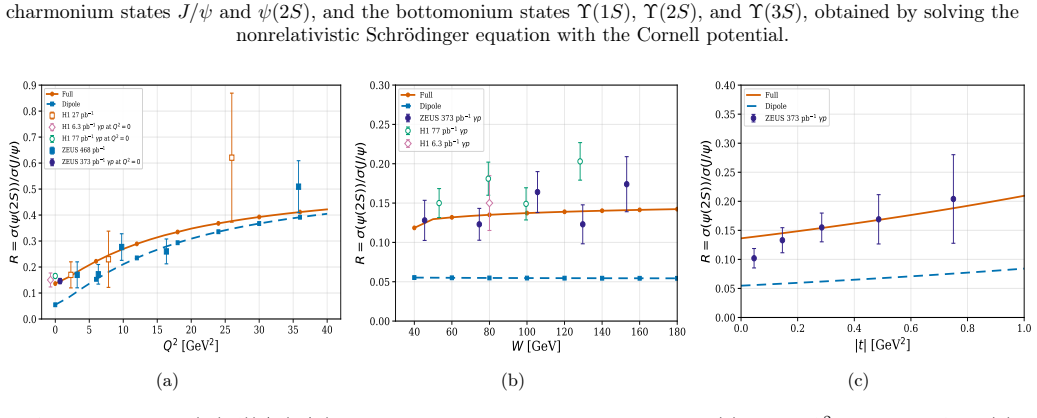
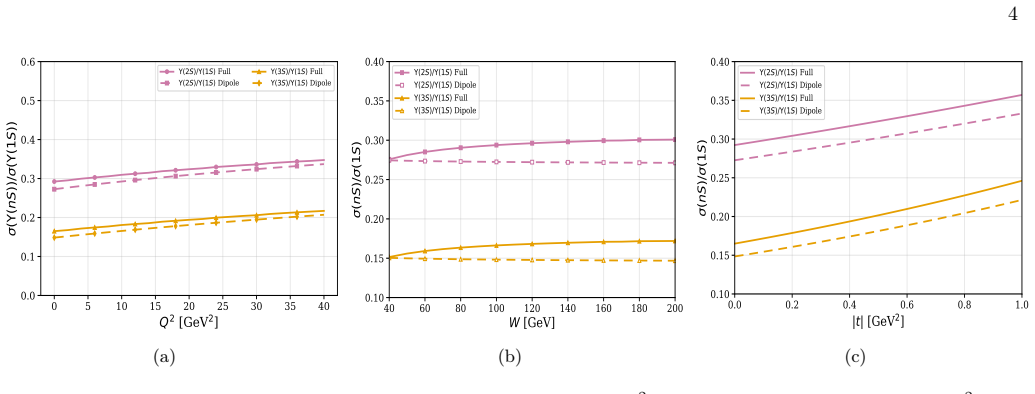
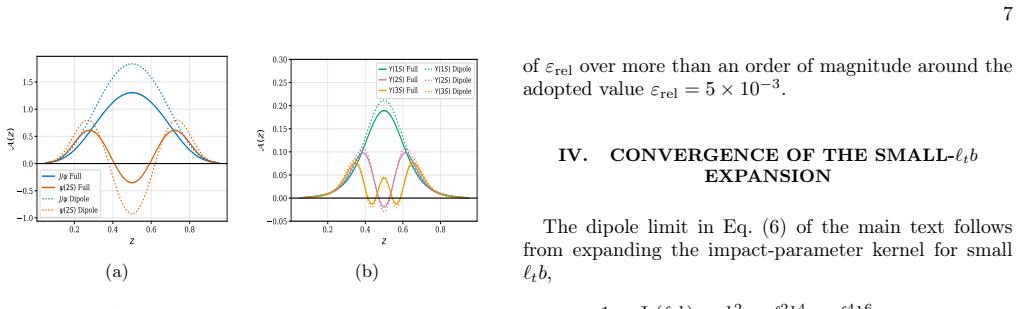
By retaining the full ℓ_t dependence of the hard two-gluon kernel in the production amplitude for S-wave heavy quarkonia, rather than expanding the impact-parameter Bessel kernel in the small-size color-dipole limit, and employing light-cone wave functions built from Cornell-potential Schrödinger solutions normalized to leptonic widths together with a modern collinear gluon distribution, the framework improves the description of radially excited states after validation on HERA charmonium data and yields consistent bottomonium cross-section ratio predictions in EIC kinematics, with the largest gains in identified kinematic windows.
What carries the argument
The full transverse-momentum (ℓ_t) resolved two-gluon kernel in the production amplitude, which avoids the Bessel expansion of the impact-parameter kernel used in the dipole limit and thereby captures improved overlap with the radially excited quarkonia wave functions.
If this is right
- Cross-section ratios for radially excited states to ground states will be larger than those obtained in the dipole limit.
- The difference between full ℓ_t and dipole treatments reaches its maximum in specific kinematic windows at EIC energies.
- A consistent set of bottomonium production ratios is obtained once the framework is benchmarked on HERA charmonium data.
- The same full-kernel approach applies to both photoproduction and electroproduction channels.
Where Pith is reading between the lines
- EIC data on bottomonium ratios could be used to test whether the full ℓ_t treatment is required for accurate extractions of gluon distributions from diffractive processes.
- The method could be applied to other vector-meson production channels where measurements of excited states are available at similar energies.
- Re-analysis of existing HERA excited-state data with this kernel might reduce tensions between theory and experiment in those ratios.
Load-bearing premise
The light-cone wave functions from Cornell-potential Schrödinger solutions, normalized to leptonic widths and combined with a modern collinear gluon distribution, accurately represent the production dynamics when the full transverse-momentum dependence of the hard two-gluon kernel is retained.
What would settle it
EIC measurements of the ψ(2S) to J/ψ cross-section ratio in the kinematic windows where the paper predicts the largest difference that instead match the dipole-limit values rather than the full ℓ_t calculation would falsify the claim of systematic improvement.
Figures
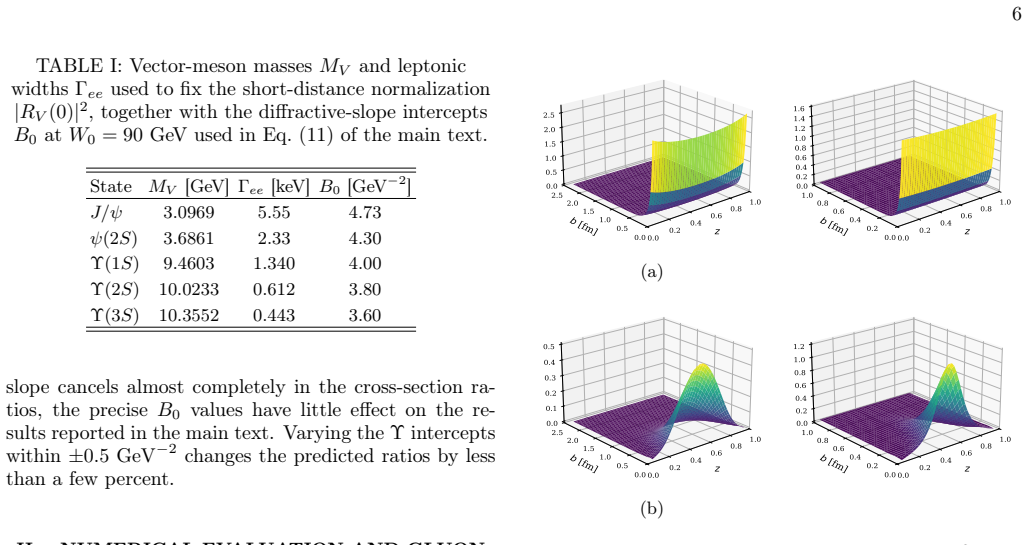
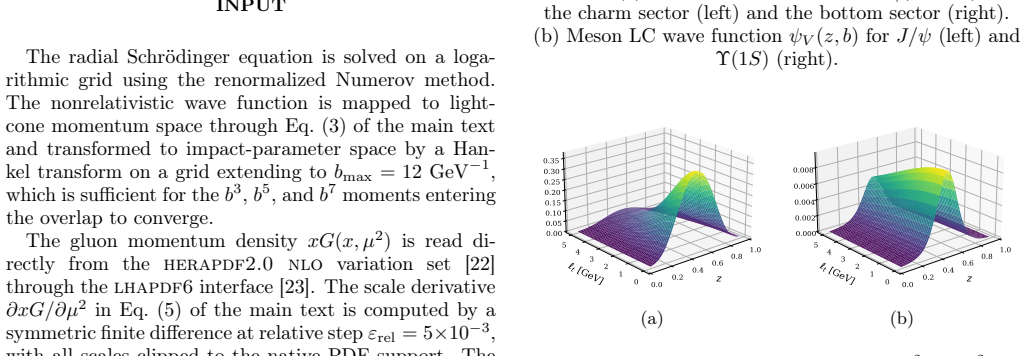
read the original abstract
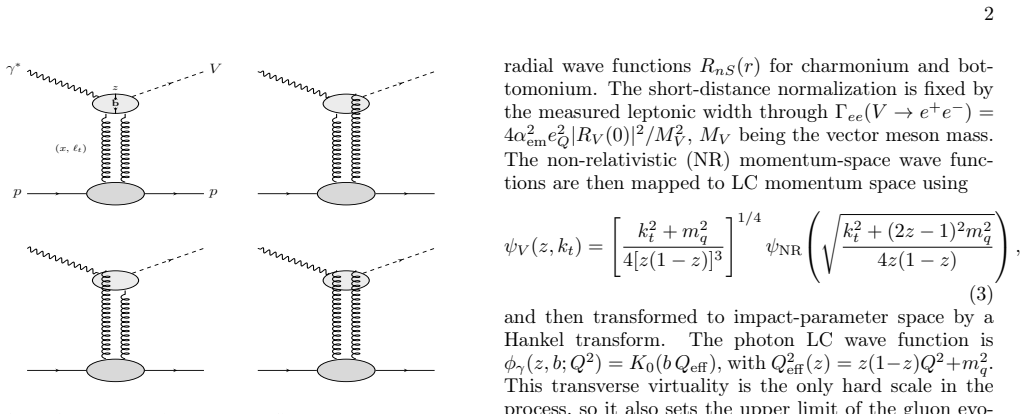
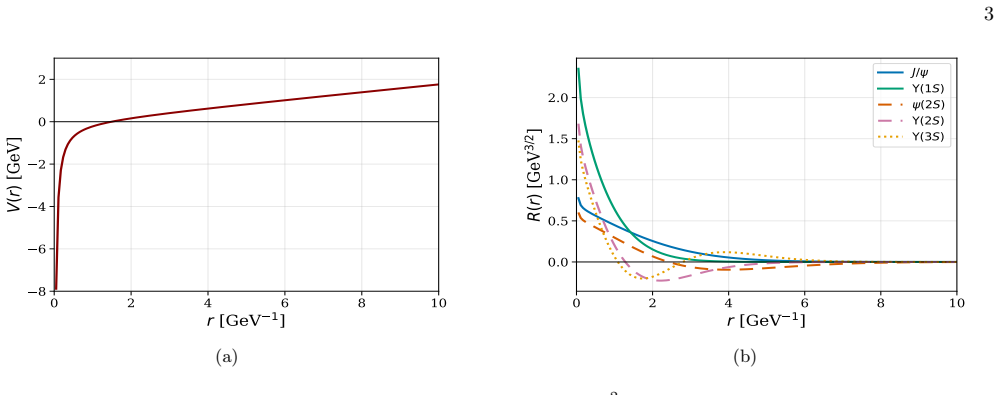
We study diffractive photo- and electroproduction of the $S$-wave heavy quarkonia $J/\psi$, $\psi(2S)$, and $\Upsilon(nS)$ at energies relevant for the Electron-Ion Collider (EIC). The production amplitude is evaluated while retaining the full transverse-momentum ($\ell_t$) dependence of the hard two-gluon kernel, that is, without expanding the impact-parameter Bessel kernel as is done in the small-size color-dipole limit. The quarkonia light-cone wave functions are built from Cornell-potential solutions of the Schr\"odinger equation, normalized to the measured leptonic widths, and combined with a modern collinear gluon distribution. After benchmarking the framework against the full set of HERA charmonium cross-section ratio data, we provide a consistent set of bottomonium cross-section ratio predictions in EIC kinematics. We find that the full $\ell_t$-resolved treatment systematically improves the description of the radially excited states relative to the leading dipole limit, and we identify the kinematic windows where this difference is largest.
Editorial analysis
A structured set of objections, weighed in public.
Referee Report
Summary. The manuscript calculates diffractive photo- and electroproduction of S-wave heavy quarkonia (J/ψ, ψ(2S), Υ(nS)) at EIC energies. The amplitude retains the full transverse-momentum dependence of the two-gluon kernel (no small-dipole Bessel expansion). Light-cone wave functions are obtained from Cornell-potential Schrödinger solutions, normalized to measured leptonic widths, and combined with a modern collinear gluon PDF. After benchmarking the framework against the complete HERA charmonium cross-section ratio data set, the authors supply bottomonium ratio predictions and state that the full ℓ_t treatment systematically improves the description of radially excited states relative to the dipole limit, with the largest differences in identifiable kinematic windows.
Significance. If the central claim holds, the work supplies a consistent set of EIC predictions that highlight the practical importance of the unexpanded kernel for excited-state ratios. The explicit benchmarking against the full HERA data set is a clear strength, as is the identification of kinematic windows where the difference is largest. The result is of direct relevance for EIC planning in the heavy-quarkonium sector.
major comments (2)
- [Abstract and benchmarking section] Abstract and benchmarking paragraph: the central claim that the full ℓ_t treatment improves the description of radially excited states rests on the Cornell wave functions accurately capturing the radial dependence at dipole sizes weighted by the unexpanded Bessel kernel. Normalization is performed solely to leptonic widths (primarily fixing |R(0)|); for nodal states such as ψ(2S) this leaves the shape at larger r less constrained. Because the same wave-function model is used both to generate the predictions and to benchmark against HERA data, the reported improvement could be an artifact of the potential choice rather than a robust feature of the ℓ_t treatment.
- [Method / wave-function section] Wave-function construction (method section): no sensitivity study is described that varies the potential parameters or substitutes alternative wave functions (e.g., from other quarkonium potentials or lattice inputs) while keeping the full kernel fixed. Such a test is required to establish that the reported improvement for excited states survives changes in the radial shape.
minor comments (2)
- [Numerical implementation] Notation: the precise numerical implementation of the full ℓ_t kernel (integration limits, regularization of the Bessel function at large arguments) should be stated explicitly so that the results can be reproduced.
- [Results figures] Figure clarity: the plots comparing full-kernel vs. dipole-limit ratios would benefit from explicit indication of the HERA data points used in the benchmark and the kinematic cuts applied.
Simulated Author's Rebuttal
We thank the referee for the careful reading and constructive comments on our manuscript. We respond to the major comments point by point below.
read point-by-point responses
-
Referee: [Abstract and benchmarking section] Abstract and benchmarking paragraph: the central claim that the full ℓ_t treatment improves the description of radially excited states rests on the Cornell wave functions accurately capturing the radial dependence at dipole sizes weighted by the unexpanded Bessel kernel. Normalization is performed solely to leptonic widths (primarily fixing |R(0)|); for nodal states such as ψ(2S) this leaves the shape at larger r less constrained. Because the same wave-function model is used both to generate the predictions and to benchmark against HERA data, the reported improvement could be an artifact of the potential choice rather than a robust feature of the ℓ_t treatment.
Authors: We thank the referee for highlighting this subtlety. Importantly, the full ℓ_t calculation and the dipole-limit calculation are performed with identical Cornell wave functions (and the same gluon PDF). The reported improvement in the HERA charmonium ratios for excited states is therefore a direct consequence of the more accurate kernel treatment at the larger dipole sizes relevant to radially excited states, rather than a difference in wave-function modeling. The Cornell potential is a standard choice that reproduces the observed quarkonium spectrum, and normalization to leptonic widths follows the conventional procedure used in the literature. The HERA benchmarking, which includes excited-state ratios, provides empirical support for the framework in the kinematics of interest. Nevertheless, we agree that robustness to the radial shape merits explicit discussion; in the revised manuscript we will add a paragraph in the benchmarking section addressing the expected sensitivity based on existing comparisons of alternative quarkonium potentials in the literature. revision: partial
-
Referee: [Method / wave-function section] Wave-function construction (method section): no sensitivity study is described that varies the potential parameters or substitutes alternative wave functions (e.g., from other quarkonium potentials or lattice inputs) while keeping the full kernel fixed. Such a test is required to establish that the reported improvement for excited states survives changes in the radial shape.
Authors: We agree that a dedicated sensitivity study varying the potential or employing alternative wave functions (e.g., from other potentials or lattice QCD) would strengthen the claim of robustness. However, because the comparison between full ℓ_t and dipole limit uses exactly the same wave functions, the relative improvement for excited states is attributable to the kernel and is independent of the specific radial shape chosen. A comprehensive scan over multiple wave-function models would require substantial additional computational work outside the primary scope of demonstrating the effect of the unexpanded kernel. In the revised version we will expand the method section with a short discussion of this point, including references to prior studies that compare different light-cone wave functions for heavy quarkonia, while noting that the HERA data agreement constrains the present choice. revision: partial
Circularity Check
No significant circularity detected
full rationale
The derivation uses external inputs: Cornell-potential Schrödinger solutions normalized to measured leptonic widths (external data fixing |R(0)|), a modern collinear gluon PDF, and a numerical two-gluon kernel evaluated both in full ℓ_t form and in the dipole approximation. Benchmarking against the full HERA charmonium ratio dataset is a comparison to independent external measurements using the same fixed framework on both sides; no parameters are fitted inside the paper to the target ratios, and no self-citation chain or self-definitional loop is invoked to justify the central claim. The reported systematic improvement for radially excited states is therefore a numerical outcome of retaining the unexpanded Bessel kernel rather than a quantity forced by construction from the paper's own inputs.
Axiom & Free-Parameter Ledger
free parameters (1)
- wave-function normalization constants
axioms (2)
- domain assumption Cornell potential solutions of the Schrödinger equation provide accurate light-cone wave functions for S-wave heavy quarkonia
- domain assumption A modern collinear gluon distribution is sufficient for the diffractive amplitude at the relevant kinematics
Reference graph
Works this paper leans on
-
[1]
M. G. Ryskin, Z. Phys. C57, 89 (1993)
1993
-
[2]
M. G. Ryskin, R. G. Roberts, A. D. Martin, and E. M. Levin, Z. Phys. C76, 231 (1997), arXiv:hep-ph/9511228
Pith/arXiv arXiv 1997
-
[3]
L. Frankfurt, W. Koepf, and M. Strikman, Phys. Rev. D 57, 512 (1998), arXiv:hep-ph/9702216
Pith/arXiv arXiv 1998
-
[4]
S. Chekanovet al.(ZEUS), Eur. Phys. J. C24, 345 (2002), arXiv:hep-ex/0201043
Pith/arXiv arXiv 2002
-
[5]
R. Abdul Khaleket al., Nucl. Phys. A1026, 122447 (2022), arXiv:2103.05419 [physics.ins-det]
Pith/arXiv arXiv 2022
-
[6]
D. Boer, C. Pisano, and P. Taels, Phys. Rev. D103, 074012 (2021), arXiv:2102.00003 [hep-ph]
arXiv 2021
-
[7]
C. Fanelliet al., Nucl. Instrum. Meth. A1047, 167748 (2023), arXiv:2205.09185 [physics.ins-det]
arXiv 2023
-
[8]
A. D. Martin, C. Nockles, M. G. Ryskin, and T. Teubner, Phys. Lett. B662, 252 (2008), arXiv:0709.4406 [hep-ph]
Pith/arXiv arXiv 2008
-
[9]
S. P. Jones, A. D. Martin, M. G. Ryskin, and T. Teubner, JHEP11, 085, arXiv:1307.7099 [hep-ph]
-
[10]
T. Lappi and H. Mantysaari, Phys. Rev. C87, 032201 (2013), arXiv:1301.4095 [hep-ph]
Pith/arXiv arXiv 2013
-
[11]
Tu (STAR), PoSHardProbes2020, 100 (2021), arXiv:2009.04860 [nucl-ex]
Z. Tu (STAR), PoSHardProbes2020, 100 (2021), arXiv:2009.04860 [nucl-ex]
arXiv 2021
-
[12]
J. Nemchik, N. N. Nikolaev, E. Predazzi, B. G. Zakharov, and V. R. Zoller, J. Exp. Theor. Phys.86, 1054 (1998), arXiv:hep-ph/9712469
Pith/arXiv arXiv 1998
-
[13]
M. Wusthoff and A. D. Martin, J. Phys. G25, R309 (1999), arXiv:hep-ph/9909362
Pith/arXiv arXiv 1999
-
[14]
C. Adloffet al.(H1), Phys. Lett. B541, 251 (2002), arXiv:hep-ex/0205107
Pith/arXiv arXiv 2002
-
[15]
L. L. Frankfurt, M. F. McDermott, and M. Strikman, JHEP02, 002, arXiv:hep-ph/9812316
-
[16]
P. Hoyer and S. Peigne, Phys. Rev. D61, 031501 (2000), arXiv:hep-ph/9909519
Pith/arXiv arXiv 2000
-
[17]
J.Cepila, J.Nemchik, M.Krelina,andR.Pasechnik,Eur. Phys. J. C79, 495 (2019), arXiv:1901.02664 [hep-ph]
Pith/arXiv arXiv 2019
-
[18]
M. A. Peredo and M. Hentschinski, Phys. Rev. D109, 014032 (2024), arXiv:2308.15430 [hep-ph]
arXiv 2024
- [19]
-
[20]
Buchmuller and S
W. Buchmuller and S. H. H. Tye, Phys. Rev. D24, 132 (1981)
1981
-
[21]
Quigg and J
C. Quigg and J. L. Rosner, Phys. Lett. B71, 153 (1977)
1977
-
[22]
Abramowiczet al.(H1, ZEUS), Eur
H. Abramowiczet al.(H1, ZEUS), Eur. Phys. J. C75, 580 (2015), arXiv:1506.06042 [hep-ex]
Pith/arXiv arXiv 2015
-
[23]
Buckleyet al., Eur
A. Buckleyet al., Eur. Phys. J. C75, 132 (2015)
2015
-
[24]
A. Accardiet al., Eur. Phys. J. A52, 268 (2016), arXiv:1212.1701 [nucl-ex]
Pith/arXiv arXiv 2016
-
[25]
M. B. Gay Ducati, F. Kopp, M. V. T. Machado, and S. Martins, Phys. Rev. D94, 094023 (2016), arXiv:1610.06647 [hep-ph]
Pith/arXiv arXiv 2016
-
[26]
Abtet al.(ZEUS), JHEP12, 164, arXiv:2206.13343 [hep-ex]
I. Abtet al.(ZEUS), JHEP12, 164, arXiv:2206.13343 [hep-ex]
-
[27]
S. Chekanovet al.(ZEUS), Nucl. Phys. B695, 3 (2004), arXiv:hep-ex/0404008
Pith/arXiv arXiv 2004
-
[28]
A. Aktaset al.(H1), Eur. Phys. J. C46, 585 (2006), arXiv:hep-ex/0510016
Pith/arXiv arXiv 2006
-
[29]
C. Adloffet al.(H1), Eur. Phys. J. C3, 13 (1998), arXiv:hep-ex/9712020
Pith/arXiv arXiv 1998
-
[30]
See Supplemental Material at [URL] for parameters, nu- merical details, the convergence analysis of the small-ℓtb expansion, and three-dimensional visualizationsof the in- termediate quantities
-
[31]
C. Alexaet al.(H1), Eur. Phys. J. C73, 2466 (2013), arXiv:1304.5162 [hep-ex]
Pith/arXiv arXiv 2013
-
[32]
Navaset al.(Particle Data Group), Phys
S. Navaset al.(Particle Data Group), Phys. Rev. D110, 030001 (2024). Supplemental Material This Supplemental Material collects the inputs, the nu- merical procedures, and the auxiliary results referenced in the main text. Section I lists the parameters and the diffractive-slope intercepts, Section II describes the numerical evaluation of the amplitude and...
2024
discussion (0)
Sign in with ORCID, Apple, or X to comment. Anyone can read and Pith papers without signing in.