Principled RL for Flow Matching Emerges from the Chunk-level Policy Optimization
Pith reviewed 2026-05-21 19:41 UTC · model grok-4.3
The pith
Chunk-level policy optimization mitigates inaccurate advantage attribution in reinforcement learning for flow matching models.
A machine-rendered reading of the paper's core claim, the machinery that carries it, and where it could break.
Core claim
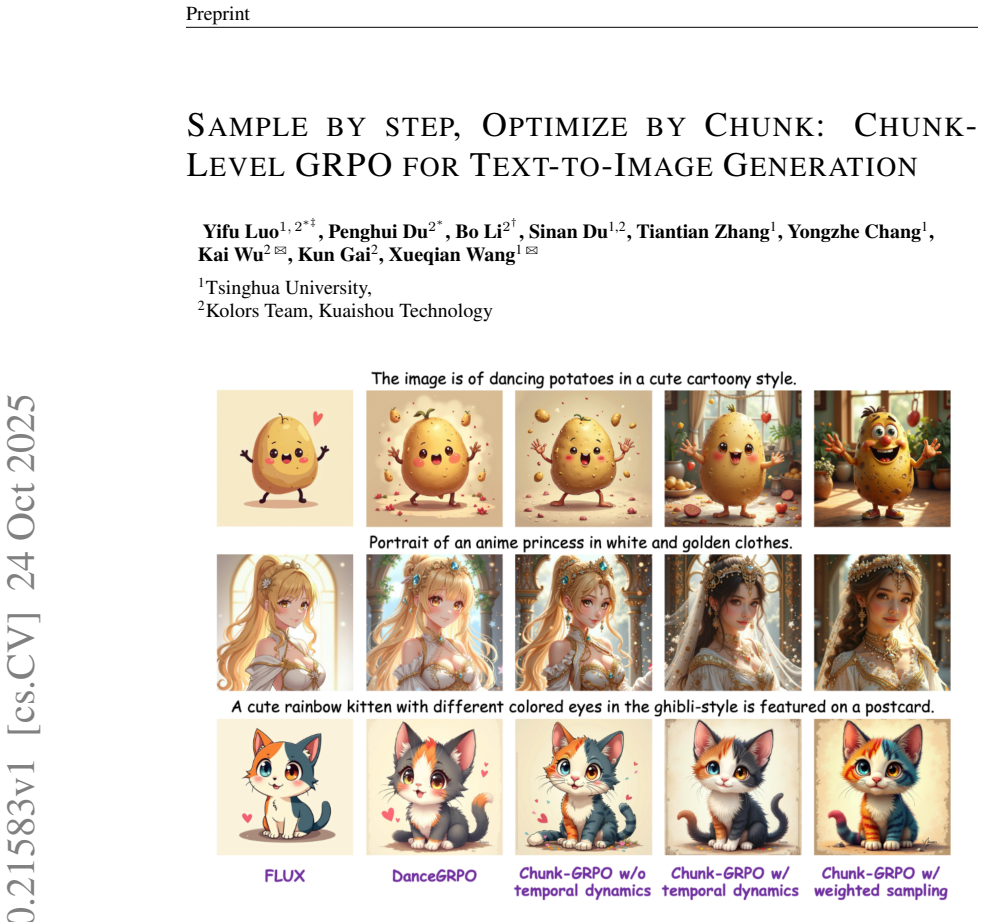
Group Chunking Policy Optimization (GCPO) is the first chunk-level reinforcement learning method for post-training flow matching. It aggregates consecutive denoising steps into a single coherent chunk, computes advantages at the chunk level rather than the individual step level, and thereby reduces the negative effects of inaccurate advantage attribution that arise in Group Relative Policy Optimization (GRPO). Experiments show that this change yields up to 43 percent relative improvement on standard text-to-image benchmarks and stronger preference alignment.
What carries the argument
Group Chunking Policy Optimization (GCPO), which replaces step-level advantage estimation with chunk-level policy optimization by treating sequences of consecutive denoising steps as single policy actions.
If this is right
- Text-to-image models trained with GCPO outperform those trained with GRPO on both standard quality metrics and human preference scores.
- The chunk-level formulation can be applied to any flow-matching or diffusion-based generator that uses step-wise reinforcement learning.
- Policy optimization at the chunk level preserves the same sampling procedure at inference time while only changing the training objective.
- Up to 43 percent relative gains are observed on existing T2I benchmarks when switching from step-level to chunk-level optimization.
Where Pith is reading between the lines
- The same chunking principle might improve reinforcement learning fine-tuning for other autoregressive or iterative generative processes such as video or audio synthesis.
- If chunk boundaries can be learned rather than fixed in advance, the method could adapt to varying coherence lengths across different prompts or image regions.
- The approach suggests that reward models for generative tasks should be evaluated at the level of coherent trajectory segments rather than isolated steps.
Load-bearing premise
The main performance bottleneck in current reinforcement learning for flow matching is inaccurate advantage attribution at the individual denoising step, and grouping steps into chunks will correct this without introducing new credit-assignment problems.
What would settle it
A controlled comparison in which advantage signals are measured before and after chunking on the same set of flow-matching trajectories; if the variance or bias of the advantage estimates does not decrease measurably under chunking, the performance gains cannot be attributed to the proposed mechanism.
Figures


read the original abstract
Recent Progress in post-training flow matching for text-to-image (T2I) generation with Group Relative Policy Optimization (GRPO) has demonstrated strong potential. However, it is hindered by a critical limitation: inaccurate advantage attribution. In this work, we argue that aggregating consecutive steps into a coherent `chunk' and shifting the policy optimization paradigm from GRPO's step level to the chunk level can effectively mitigate the negative impact of this issue. Building on this insight, we propose Group Chunking Policy Optimization (GCPO), the first chunk-level reinforcement learning approach for post-training flow matching. Extensive experiments demonstrate that GCPO achieves superior performance on both standard T2I benchmarks and preference alignment, with up to 43% relative gains over GRPO, highlighting the promise of chunk-level policy optimization. The code is available on https://github.com/xingzhejun/GCPO.
Editorial analysis
A structured set of objections, weighed in public.
Referee Report
Summary. The paper proposes Group Chunking Policy Optimization (GCPO), a chunk-level RL method for post-training flow matching in text-to-image generation. It argues that aggregating consecutive denoising steps into chunks and optimizing at the chunk level (rather than GRPO's step level) mitigates inaccurate advantage attribution, yielding up to 43% relative gains over GRPO on T2I benchmarks and preference alignment tasks. Code is released.
Significance. If the performance gains prove robust and the chunking mechanism is shown to specifically improve advantage attribution (rather than arising from other factors), the work could establish a useful paradigm for RL post-training of flow models, addressing credit assignment in long-horizon generation. Releasing code supports reproducibility, which strengthens the contribution if the experiments are adequately detailed.
major comments (2)
- [Abstract and §3] The central claim that chunk-level optimization mitigates inaccurate advantage attribution (abstract and §3) lacks direct supporting analysis, such as variance or correlation metrics comparing per-chunk versus per-step advantages with terminal rewards. Without this or an ablation isolating attribution quality, gains cannot be confidently attributed to the hypothesized mechanism rather than changes in effective batch size, credit assignment granularity, or hyperparameters.
- [§4.2 and Table 1] Table 1 and §4.2 report up to 43% relative gains, but the manuscript supplies no details on number of random seeds, statistical tests, variance across runs, or full ablation studies (e.g., chunk size sensitivity). This is load-bearing for the empirical superiority claim and prevents verification of the results.
minor comments (2)
- [§3] Notation for chunk boundaries and advantage aggregation should be formalized with an equation in §3 to improve clarity.
- [Abstract] The abstract mentions 'extensive experiments' but provides no quantitative details on baselines or metrics; this should be expanded in the introduction for reader orientation.
Simulated Author's Rebuttal
We thank the referee for their constructive and detailed feedback. We address each major comment below and outline the revisions we will make to strengthen the manuscript.
read point-by-point responses
-
Referee: [Abstract and §3] The central claim that chunk-level optimization mitigates inaccurate advantage attribution (abstract and §3) lacks direct supporting analysis, such as variance or correlation metrics comparing per-chunk versus per-step advantages with terminal rewards. Without this or an ablation isolating attribution quality, gains cannot be confidently attributed to the hypothesized mechanism rather than changes in effective batch size, credit assignment granularity, or hyperparameters.
Authors: We agree that additional direct evidence would strengthen the mechanistic claim. Section 3 develops the theoretical motivation by showing that flow matching's continuous denoising trajectory assigns terminal rewards to sequences of steps with correlated noise levels, making per-step advantage estimates in GRPO prone to high variance and misattribution. Chunking aggregates these steps into coherent units that share semantic and noise characteristics, yielding more stable advantage signals. While the current manuscript relies on this reasoning plus consistent empirical gains, we will add an explicit analysis in the revision: variance and correlation metrics between per-chunk/per-step advantages and terminal rewards, together with a controlled ablation that holds effective batch size and other hyperparameters fixed while varying only the chunking granularity. This will help isolate the contribution of improved attribution. revision: yes
-
Referee: [§4.2 and Table 1] Table 1 and §4.2 report up to 43% relative gains, but the manuscript supplies no details on number of random seeds, statistical tests, variance across runs, or full ablation studies (e.g., chunk size sensitivity). This is load-bearing for the empirical superiority claim and prevents verification of the results.
Authors: We acknowledge that the current experimental reporting is insufficient for full verification. In the revised manuscript we will: (i) state that all main results were obtained with 5 independent random seeds, (ii) report mean and standard deviation in Table 1 and the associated figures, (iii) include statistical significance tests (paired t-tests with p-values), and (iv) add a dedicated chunk-size sensitivity ablation showing performance across a range of chunk lengths while controlling for total compute. These additions will directly address concerns about robustness and reproducibility. revision: yes
Circularity Check
No circularity in derivation; empirical proposal with independent experimental support
full rationale
The paper proposes GCPO based on the insight that chunk-level optimization mitigates inaccurate advantage attribution in step-level GRPO for flow matching. No equations, fitted parameters renamed as predictions, or self-citation chains are present in the provided abstract or description that reduce the central claim to its own inputs by construction. The performance gains (up to 43% relative) are reported from experiments on T2I benchmarks and preference alignment, which constitute external validation rather than a closed loop. This is a standard empirical RL paper without load-bearing self-referential derivations.
Axiom & Free-Parameter Ledger
axioms (1)
- domain assumption Flow matching models generate images through a sequence of denoising steps.
Lean theorems connected to this paper
-
IndisputableMonolith/Foundation/RealityFromDistinction.leanreality_from_one_distinction unclear?
unclearRelation between the paper passage and the cited Recognition theorem.
group consecutive timesteps into ‘chunk’s ... temporal-dynamic-guided chunking ... ri_j(θ) = (∏_{t∈chj} pθ / pold )^{1/cs_j}
What do these tags mean?
- matches
- The paper's claim is directly supported by a theorem in the formal canon.
- supports
- The theorem supports part of the paper's argument, but the paper may add assumptions or extra steps.
- extends
- The paper goes beyond the formal theorem; the theorem is a base layer rather than the whole result.
- uses
- The paper appears to rely on the theorem as machinery.
- contradicts
- The paper's claim conflicts with a theorem or certificate in the canon.
- unclear
- Pith found a possible connection, but the passage is too broad, indirect, or ambiguous to say the theorem truly supports the claim.
Forward citations
Cited by 2 Pith papers
-
HP-Edit: A Human-Preference Post-Training Framework for Image Editing
HP-Edit introduces a post-training framework and RealPref-50K dataset that uses a VLM-based HP-Scorer to align diffusion image editing models with human preferences, improving outputs on Qwen-Image-Edit-2509.
-
Power Reinforcement Post-Training of Text-to-Image Models with Super-Linear Advantage Shaping
Super-Linear Advantage Shaping (SLAS) introduces a non-linear geometric policy update for RL post-training of text-to-image models that reshapes the local policy space via advantage-dependent Fisher-Rao weighting to r...
Reference graph
Works this paper leans on
-
[1]
$\pi_0$: A Vision-Language-Action Flow Model for General Robot Control
Kevin Black, Noah Brown, Danny Driess, Adnan Esmail, Michael Equi, Chelsea Finn, Niccolo Fusai, Lachy Groom, Karol Hausman, Brian Ichter, et al.pi 0: A vision-language-action flow model for general robot control.arXiv preprint arXiv:2410.24164, 2024a. Kevin Black, Michael Janner, Yilun Du, Ilya Kostrikov, and Sergey Levine. Training diffusion models with ...
work page internal anchor Pith review Pith/arXiv arXiv
-
[2]
DeepSeek-R1: Incentivizing Reasoning Capability in LLMs via Reinforcement Learning
Daya Guo, Dejian Yang, Haowei Zhang, Junxiao Song, Ruoyu Zhang, Runxin Xu, Qihao Zhu, Shirong Ma, Peiyi Wang, Xiao Bi, et al. Deepseek-r1: Incentivizing reasoning capability in llms via reinforcement learning.arXiv preprint arXiv:2501.12948,
work page internal anchor Pith review Pith/arXiv arXiv
-
[3]
TempFlow-GRPO: When Timing Matters for GRPO in Flow Models
Xiaoxuan He, Siming Fu, Yuke Zhao, Wanli Li, Jian Yang, Dacheng Yin, Fengyun Rao, and Bo Zhang. Tempflow-grpo: When timing matters for grpo in flow models.arXiv preprint arXiv:2508.04324,
work page internal anchor Pith review arXiv
-
[4]
$\pi_{0.5}$: a Vision-Language-Action Model with Open-World Generalization
Physical Intelligence, Kevin Black, Noah Brown, James Darpinian, Karan Dhabalia, Danny Driess, Adnan Esmail, Michael Equi, Chelsea Finn, Niccolo Fusai, et al.π0. 5: a vision-language-action model with open-world generalization, 2025.URL https://arxiv. org/abs/2504.16054, 1(2):3. Aaron Jaech, Adam Kalai, Adam Lerer, Adam Richardson, Ahmed El-Kishky, Aiden ...
work page internal anchor Pith review Pith/arXiv arXiv 2025
-
[5]
FLUX.1 Kontext: Flow Matching for In-Context Image Generation and Editing in Latent Space
URLhttps://arxiv.org/abs/2506.15742. Lucy Lai, Ann ZX Huang, and Samuel J Gershman. Action chunking as conditional policy com- pression
work page internal anchor Pith review Pith/arXiv arXiv
-
[6]
MixGRPO: Unlocking Flow-based GRPO Efficiency with Mixed ODE-SDE
Junzhe Li, Yutao Cui, Tao Huang, Yinping Ma, Chun Fan, Miles Yang, and Zhao Zhong. Mixgrpo: Unlocking flow-based grpo efficiency with mixed ode-sde.arXiv preprint arXiv:2507.21802, 2025a. Qiyang Li, Zhiyuan Zhou, and Sergey Levine. Reinforcement learning with action chunking.arXiv preprint arXiv:2507.07969, 2025b. Yuming Li, Yikai Wang, Yuying Zhu, Zhongy...
work page internal anchor Pith review Pith/arXiv arXiv
-
[7]
Flow-GRPO: Training Flow Matching Models via Online RL
Feng Liu, Shiwei Zhang, Xiaofeng Wang, Yujie Wei, Haonan Qiu, Yuzhong Zhao, Yingya Zhang, Qixiang Ye, and Fang Wan. Timestep embedding tells: It’s time to cache for video diffusion model. InProceedings of the Computer Vision and Pattern Recognition Conference, pp. 7353– 7363, 2025a. Jie Liu, Gongye Liu, Jiajun Liang, Yangguang Li, Jiaheng Liu, Xintao Wang...
work page internal anchor Pith review Pith/arXiv arXiv
-
[8]
Hpsv3: Towards wide-spectrum human preference score.arXiv preprint arXiv:2508.03789,
Yuhang Ma, Xiaoshi Wu, Keqiang Sun, and Hongsheng Li. Hpsv3: Towards wide-spectrum human preference score.arXiv preprint arXiv:2508.03789,
-
[9]
WISE: A World Knowledge-Informed Semantic Evaluation for Text-to-Image Generation
Yuwei Niu, Munan Ning, Mengren Zheng, Weiyang Jin, Bin Lin, Peng Jin, Jiaqi Liao, Chaoran Feng, Kunpeng Ning, Bin Zhu, et al. Wise: A world knowledge-informed semantic evaluation for text-to-image generation.arXiv preprint arXiv:2503.07265,
work page internal anchor Pith review Pith/arXiv arXiv
-
[10]
Proximal Policy Optimization Algorithms
John Schulman, Filip Wolski, Prafulla Dhariwal, Alec Radford, and Oleg Klimov. Proximal policy optimization algorithms.arXiv preprint arXiv:1707.06347,
work page internal anchor Pith review Pith/arXiv arXiv
-
[11]
DeepSeekMath: Pushing the Limits of Mathematical Reasoning in Open Language Models
13 Preprint Zhihong Shao, Peiyi Wang, Qihao Zhu, Runxin Xu, Junxiao Song, Xiao Bi, Haowei Zhang, Mingchuan Zhang, YK Li, et al. Deepseekmath: Pushing the limits of mathematical reasoning in open language models.arXiv preprint arXiv:2402.03300,
work page internal anchor Pith review Pith/arXiv arXiv
-
[12]
SmolVLA: A Vision-Language-Action Model for Affordable and Efficient Robotics
Mustafa Shukor, Dana Aubakirova, Francesco Capuano, Pepijn Kooijmans, Steven Palma, Adil Zouitine, Michel Aractingi, Caroline Pascal, Martino Russi, Andres Marafioti, et al. Smolvla: A vision-language-action model for affordable and efficient robotics.arXiv preprint arXiv:2506.01844,
work page internal anchor Pith review Pith/arXiv arXiv
-
[13]
Haoyuan Sun, Bin Liang, Bo Xia, Jiaqi Wu, Yifei Zhao, Kai Qin, Yongzhe Chang, and Xueqian Wang. Diffusion-rainbowpa: Improvements integrated preference alignment for diffusion-based text-to-image generation.Transactions on Machine Learning Research, 2025a. Haoyuan Sun, Jiaqi Wu, Bo Xia, Yifu Luo, Yifei Zhao, Kai Qin, Xufei Lv, Tiantian Zhang, Yongzhe Chan...
-
[14]
Feng Wang and Zihao Yu. Coefficients-preserving sampling for reinforcement learning with flow matching.arXiv preprint arXiv:2509.05952,
-
[15]
Pref-GRPO: Pairwise Preference Reward-based GRPO for Stable Text-to-Image Reinforcement Learning
Yibin Wang, Zhimin Li, Yuhang Zang, Yujie Zhou, Jiazi Bu, Chunyu Wang, Qinglin Lu, Cheng Jin, and Jiaqi Wang. Pref-grpo: Pairwise preference reward-based grpo for stable text-to-image reinforcement learning.arXiv preprint arXiv:2508.20751,
work page internal anchor Pith review Pith/arXiv arXiv
-
[16]
Chenfei Wu, Jiahao Li, Jingren Zhou, Junyang Lin, Kaiyuan Gao, Kun Yan, Sheng-ming Yin, Shuai Bai, Xiao Xu, Yilei Chen, et al. Qwen-image technical report.arXiv preprint arXiv:2508.02324,
work page internal anchor Pith review Pith/arXiv arXiv
-
[17]
Xiaoshi Wu, Yiming Hao, Keqiang Sun, Yixiong Chen, Feng Zhu, Rui Zhao, and Hongsheng Li. Human preference score v2: A solid benchmark for evaluating human preferences of text-to- image synthesis.arXiv preprint arXiv:2306.09341,
work page internal anchor Pith review Pith/arXiv arXiv
-
[18]
DanceGRPO: Unleashing GRPO on Visual Generation
Zeyue Xue, Jie Wu, Yu Gao, Fangyuan Kong, Lingting Zhu, Mengzhao Chen, Zhiheng Liu, Wei Liu, Qiushan Guo, Weilin Huang, et al. Dancegrpo: Unleashing grpo on visual generation.arXiv preprint arXiv:2505.07818,
work page internal anchor Pith review Pith/arXiv arXiv
-
[19]
Learning Fine-Grained Bimanual Manipulation with Low-Cost Hardware
14 Preprint Tony Z Zhao, Vikash Kumar, Sergey Levine, and Chelsea Finn. Learning fine-grained bimanual manipulation with low-cost hardware.arXiv preprint arXiv:2304.13705,
work page internal anchor Pith review Pith/arXiv arXiv
-
[20]
Group Sequence Policy Optimization
Chujie Zheng, Shixuan Liu, Mingze Li, Xiong-Hui Chen, Bowen Yu, Chang Gao, Kai Dang, Yuqiong Liu, Rui Men, An Yang, et al. Group sequence policy optimization.arXiv preprint arXiv:2507.18071,
work page internal anchor Pith review Pith/arXiv arXiv
-
[21]
For simplicity, we assume that there aremtimesteps with inaccurate advantage attribution between two trajectory segments: (xT , xT−1 ,· · ·, x 2, x1, x0)1, (xT , xT−1 ,· · ·, x 2, x1, x0)2, (17) where1≤m≤T. We denoteT a andT ia as the sets of timesteps with accurate and inaccurate advantage attribution, respectively, and: Ta ∩T ia =∅, T a ∩T ia ={1,2,· · ...
work page 2015
-
[22]
and GRPO-based methods, the importance ratior i t (θ)remains close to1due to trust-region constraints Schulman et al. (2015; 2017). We therefore set: ri t (θ) = 1 +ϵ i t,(31) whereϵ i t is a minimal term. Substituting into Equation (24) and Equation (25): ˆJ(θ) = X t∈Ta ϵ1 t −ϵ 2 t + X t∈Tia ϵ2 t −ϵ 1 t (32) J(θ) GRP O = X t∈Ta ϵ1 t −ϵ 2 t + X t∈Tia ϵ1 t ...
work page 2015
discussion (0)
Sign in with ORCID, Apple, or X to comment. Anyone can read and Pith papers without signing in.