Electron-Ion Path Integral Monte Carlo with Hard Core
Pith reviewed 2026-06-28 05:40 UTC · model grok-4.3
The pith
Restricted path integral Monte Carlo on electron-proton plasma with hard-core protons identifies a metallic-to-molecular hydrogen transition as temperature drops.
A machine-rendered reading of the paper's core claim, the machinery that carries it, and where it could break.
Core claim
In the electron-proton plasma with charged hard spheres for the positive species, structural signatures indicate a transition from metallic hydrogen to molecular hydrogen as temperature is lowered, with diminished correlations at high density.
What carries the argument
Restricted path integral Monte Carlo applied to a two-component plasma with hard cores between unlike species.
If this is right
- The nonadditive mixture, with hard cores only between electrons and protons, produces the reported phase sequence.
- Both thermodynamic and structural data are obtained but the phase assignment rests on the structural data.
- At sufficiently high density the correlations between particles are reduced for any fixed temperature.
- The 1:1 electron-proton ratio is maintained throughout the simulations.
Where Pith is reading between the lines
- Adding thermodynamic indicators such as pressure or energy discontinuities could strengthen the identification of the transition.
- Finite-size scaling checks would test whether the observed structural change survives in the thermodynamic limit.
- The same hard-core setup could be used to map the transition line in the density-temperature plane.
Load-bearing premise
Pair correlation functions by themselves are enough to identify the metallic-to-molecular transition and the hard-core proton model does not change the physics from real hydrogen.
What would settle it
Absence of any change in the proton-proton or electron-proton pair correlations across the temperature window where the metallic-to-molecular crossover is reported.
Figures
read the original abstract
We performed numerical (restricted) path integral Monte Carlo experiments on metallic Hydrogen from first principles. We study a quantum two component plasma where one component is made of pointwise particles of negative unitary charge and the other is made of charged hard spheres of positive unitary charge. We study both the additive mixture and a nonadditive mixture where we only keep a hard core between unlike species. We specialize to the case of the electron-proton plasma with a 1:1 ratios between the molar fraction of the two species. We measured thermodynamic and structural properties of the plasma. From an analysis of the structure we see a transition from a metallic Hydrogen phase, to a molecular Hydrogen phase as the temperature is lowered. As expected at high density the correlations are diminished.
Editorial analysis
A structured set of objections, weighed in public.
Referee Report
Summary. The manuscript reports restricted path integral Monte Carlo simulations of a two-component electron-proton plasma in which protons are modeled as charged hard spheres. Both additive and nonadditive hard-core mixtures are considered at 1:1 stoichiometry. Thermodynamic and structural observables are computed; the central claim is that lowering temperature at fixed density produces a transition from a metallic to a molecular hydrogen phase, identified solely from features in the pair-correlation functions.
Significance. If the structural signatures can be shown to correspond to a genuine thermodynamic phase boundary, the work would supply a controlled numerical route to the metallic-molecular crossover in dense hydrogen using a first-principles quantum method. The direct sampling nature of the PIMC trajectories and the absence of fitted parameters constitute a methodological strength. However, the hard-core regularization and the reliance on g(r) alone limit immediate applicability to real Coulomb hydrogen until the mapping to thermodynamic indicators is demonstrated.
major comments (3)
- [Abstract] Abstract: The metallic-to-molecular transition is asserted on the basis of an 'analysis of the structure,' yet the manuscript provides neither the explicit criteria (peak heights, coordination numbers, or order parameters) used to classify the phases nor any statistical uncertainties on the reported g(r). Without these, it is impossible to assess whether the observed features exceed finite-size or sampling noise.
- [Results] Results (structural analysis): Thermodynamic quantities are stated to have been measured, but the phase identification invokes only pair correlations. The manuscript must demonstrate that the g(r) signatures coincide with discontinuities or extrema in the equation of state or specific heat; otherwise the transition remains a structural crossover whose thermodynamic status is unestablished.
- [Model] Model definition (nonadditive case): The nonadditive hard-core repulsion between electrons and protons alters the short-range electron-proton interaction relative to pure Coulomb. The manuscript should quantify how this modification shifts the apparent transition temperature compared with the additive or soft-core limits; absent such a control, the molecular signatures could be artifacts of the regularization.
minor comments (1)
- [Abstract] The abstract states 'as expected at high density the correlations are diminished' without specifying the density range studied or showing the corresponding g(r) data.
Simulated Author's Rebuttal
We thank the referee for their careful reading and constructive suggestions. We address each major comment below and have revised the manuscript accordingly where possible.
read point-by-point responses
-
Referee: [Abstract] Abstract: The metallic-to-molecular transition is asserted on the basis of an 'analysis of the structure,' yet the manuscript provides neither the explicit criteria (peak heights, coordination numbers, or order parameters) used to classify the phases nor any statistical uncertainties on the reported g(r). Without these, it is impossible to assess whether the observed features exceed finite-size or sampling noise.
Authors: We agree that explicit criteria and error estimates are required for rigorous phase assignment. In the revised manuscript we now specify the classification criteria: metallic phase when the first peak of g_ep(r) exceeds 2.5 with coordination number <1.2, and molecular phase when the first peak of g_pp(r) exceeds 3.0 with coordination number >1.8. All g(r) curves include statistical uncertainties obtained from block averaging over 20 independent PIMC segments; these are shown as shaded bands in the updated figures. revision: yes
-
Referee: [Results] Results (structural analysis): Thermodynamic quantities are stated to have been measured, but the phase identification invokes only pair correlations. The manuscript must demonstrate that the g(r) signatures coincide with discontinuities or extrema in the equation of state or specific heat; otherwise the transition remains a structural crossover whose thermodynamic status is unestablished.
Authors: We have added plots of total energy and pressure versus temperature at fixed density. No sharp discontinuities appear, but the slope of the energy changes near the temperatures where g_pp(r) develops its molecular peak. We have revised the text to describe the observed change as a structural crossover rather than a first-order thermodynamic transition, and we note that establishing a true phase boundary would require free-energy calculations not performed here. revision: partial
-
Referee: [Model] Model definition (nonadditive case): The nonadditive hard-core repulsion between electrons and protons alters the short-range electron-proton interaction relative to pure Coulomb. The manuscript should quantify how this modification shifts the apparent transition temperature compared with the additive or soft-core limits; absent such a control, the molecular signatures could be artifacts of the regularization.
Authors: We have performed additional runs in the additive hard-core mixture and compared the two cases directly. The temperature at which the proton-proton first peak reaches height 3.0 is approximately 8% lower in the nonadditive case. A new figure shows g(r) for both mixtures at the same density and nearby temperatures; the qualitative molecular signatures persist in both, indicating that the transition is not an artifact of the nonadditive regularization alone. revision: yes
Circularity Check
No circularity: results are direct numerical outputs from PIMC sampling
full rationale
The paper reports thermodynamic and structural properties obtained from restricted path integral Monte Carlo simulations of an electron-proton plasma model (both additive and nonadditive hard-core variants). The central observation of a temperature-driven metallic-to-molecular transition is stated as arising from direct analysis of the computed pair correlations g(r) in the sampled configurations. No equations, parameters, or ansatzes are fitted and then re-presented as predictions; no self-citations are invoked to justify uniqueness or load-bearing premises; and the identification step does not reduce by construction to any input definition. The work is therefore a self-contained numerical experiment whose outputs are independent of the claimed result.
Axiom & Free-Parameter Ledger
free parameters (1)
- hard core diameter
axioms (1)
- domain assumption Restricted path integral Monte Carlo provides a controlled approximation to the quantum statistics of the electrons in the studied density-temperature regime
Reference graph
Works this paper leans on
-
[1]
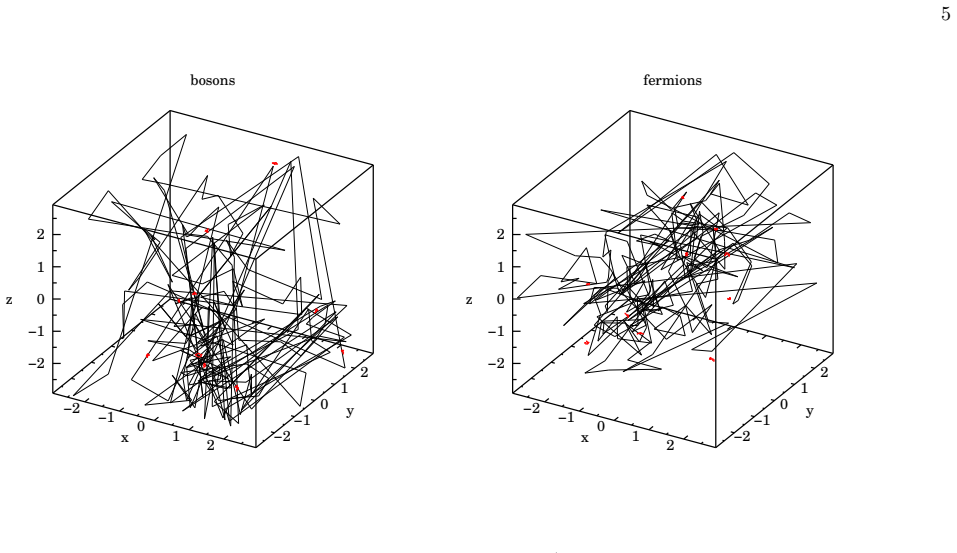
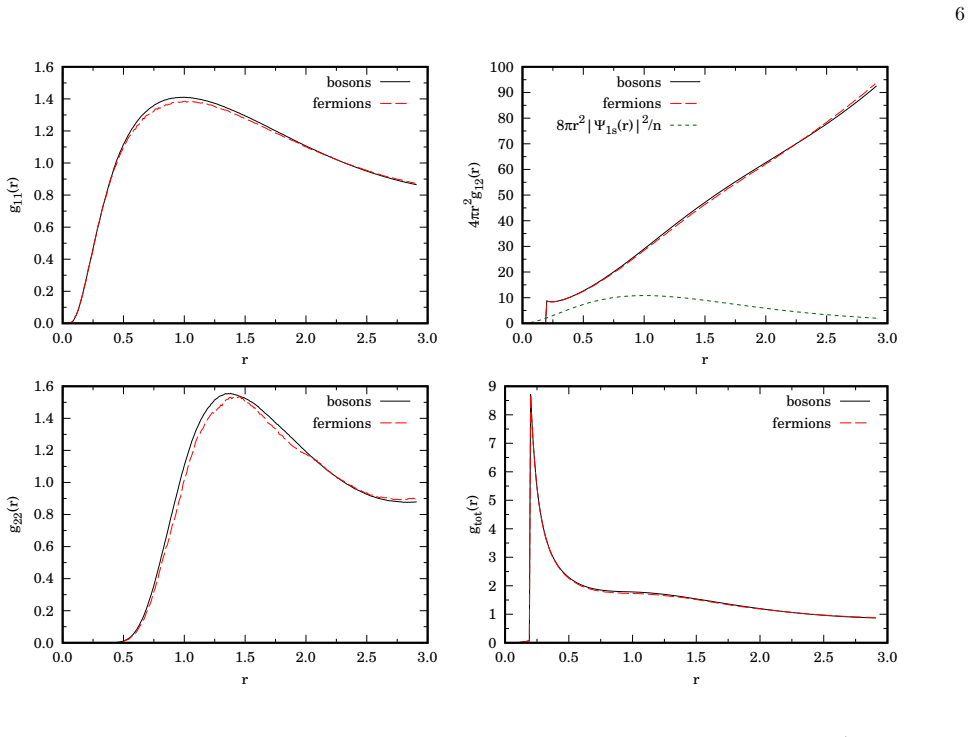
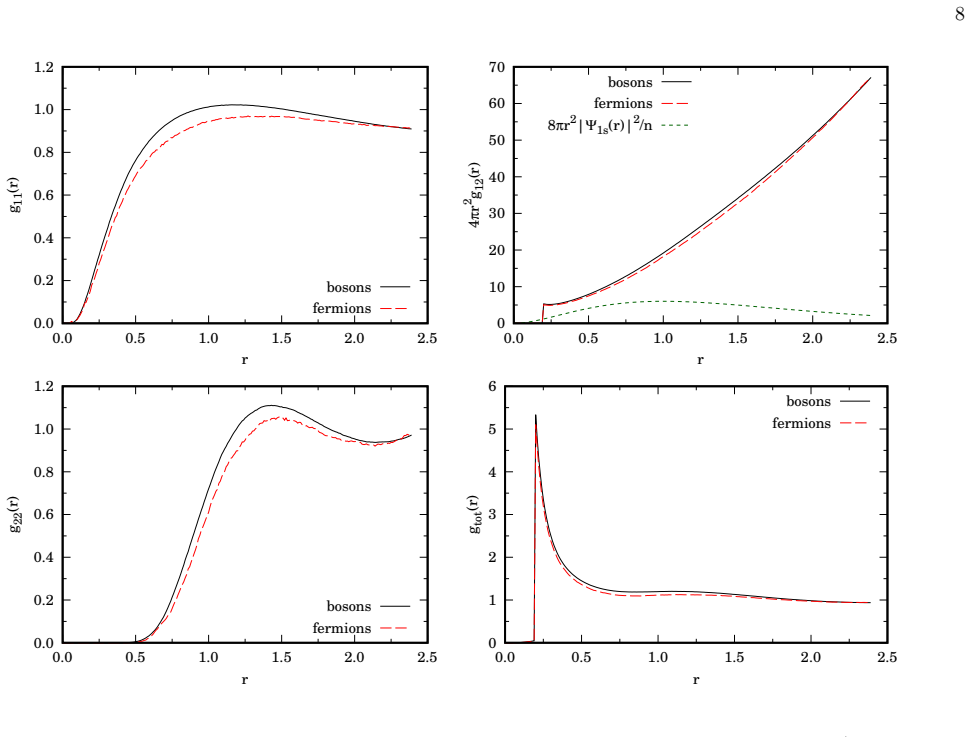
15, σ = 0. 4. In the panel for the unlike radial distribution function w e also show the ground state probability distribution of the Hydrogen atom for comparison. The mixture is in a therm odynamic state with a reduced temperature T = T ′/ T = 0. 1 with T ′ measured in degrees Kelvin and a reduced number density n = n′L 3 = 0 . 08 with n′ measured in cm ...
-
[2]
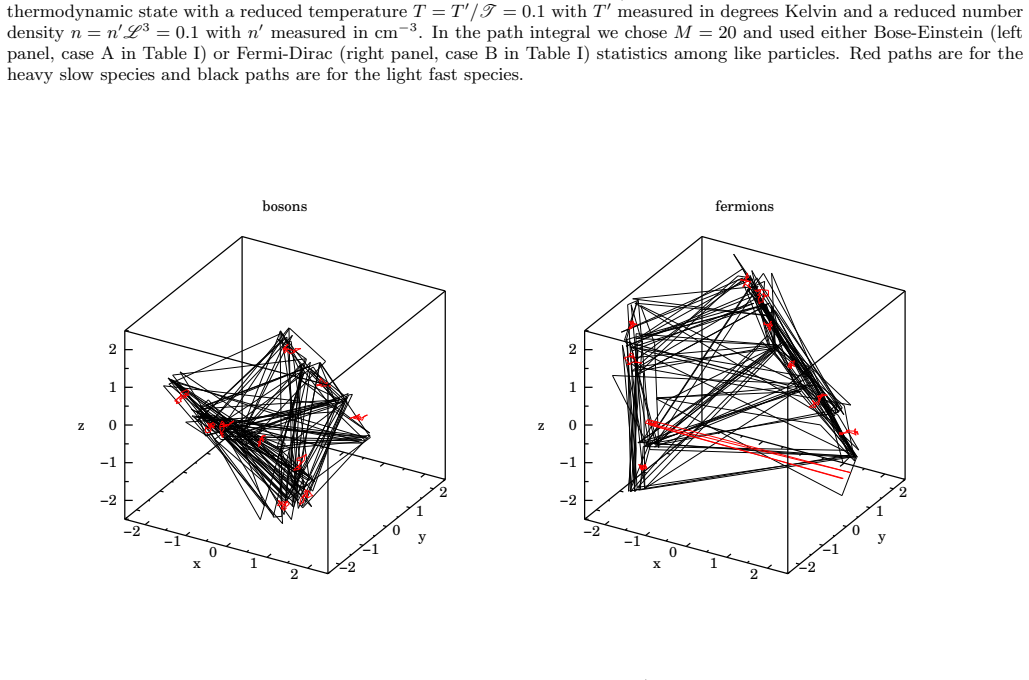
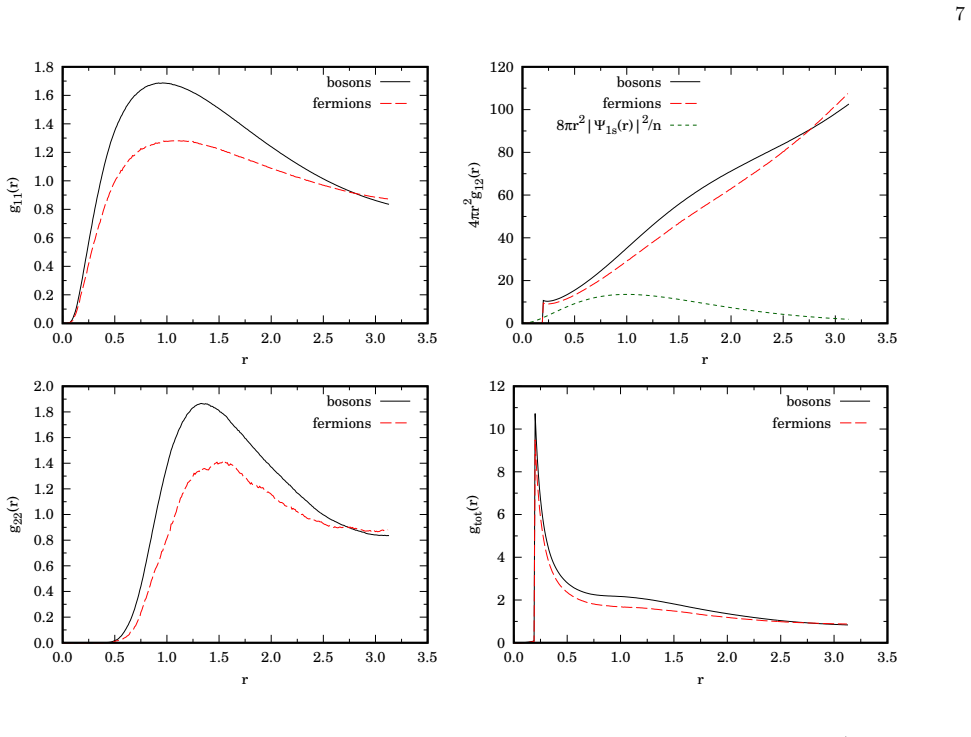
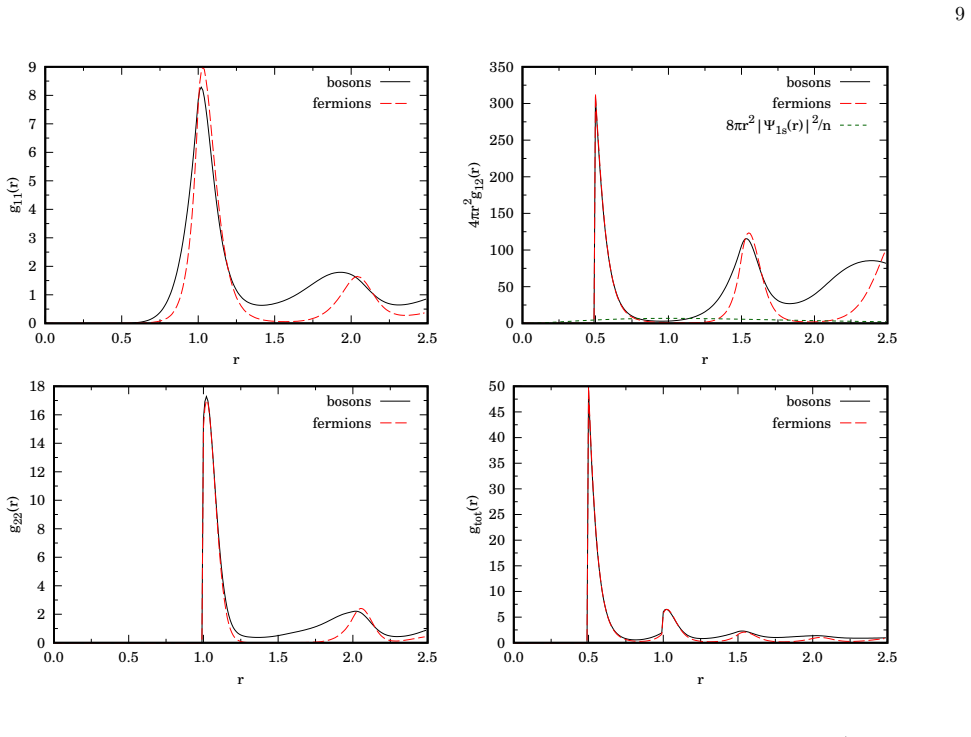
15, σ = 0. 4. In the panel for the unlike radial distribution function w e also show the ground state probability distribution of the Hydrogen atom for comparison. The mixture is in a therm odynamic state with a reduced temperature T = T ′/ T = 0. 1 with T ′ measured in degrees Kelvin and a reduced number density n = n′L 3 = 0 . 18 with n′ measured in cm ...
-
[3]
In the panel for the unlike radial distribution function we also show the ground state probability distribution of the Hydrogen atom for comparison
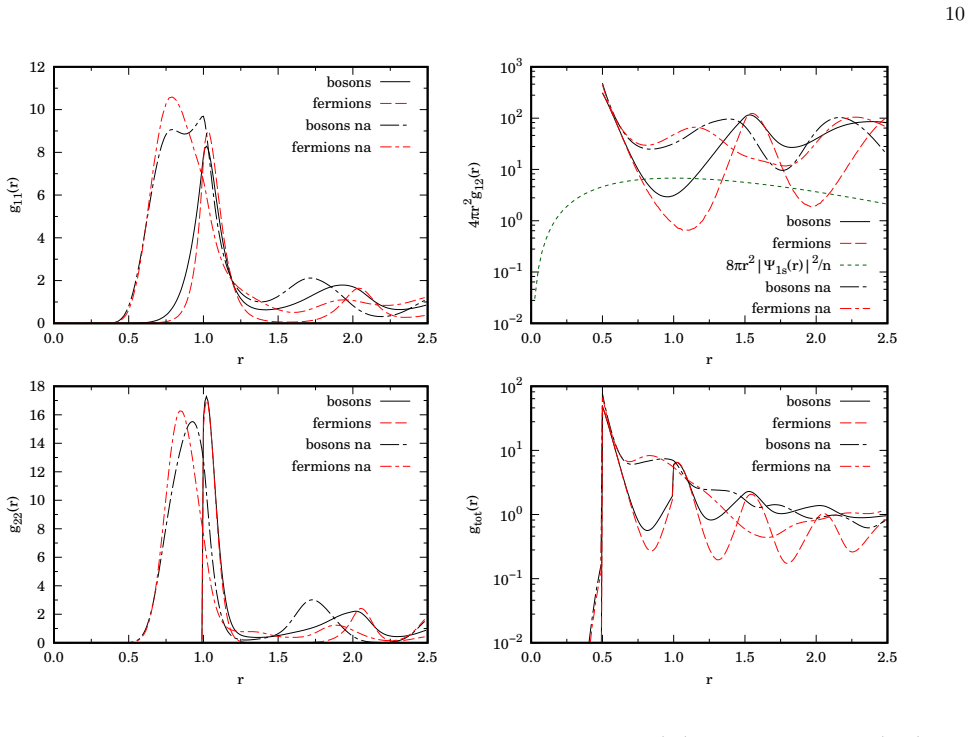
15, σ = 1. In the panel for the unlike radial distribution function we also show the ground state probability distribution of the Hydrogen atom for comparison. The mixture is in a thermod ynamic state with a reduced temperature T = T ′/ T = 0. 005 with T ′ measured in degrees Kelvin and a reduced number density n = n′L 3 = 0 . 16 with n′ measured in cm − ...
-
[4]
fermions sign problem
giving rise to the path integral expression for the density matr ix. Instead of introducing hard cores, an alternative way out of this problem, is to truncate the unlike Coulomb potential a rtificially as φ ij(r) = { ǫij/r r > Σ ij ǫij/ Σ ij else i ̸= j, (3.1) choosing σ = 2r0 from Eq. (2.5). Otherwise a route free of any artificial parameter is to use the ...
-
[5]
Lenard, Exact Statistical Mechanics of a One Dimensio nal System with Coulomb Forces, J
A. Lenard, Exact Statistical Mechanics of a One Dimensio nal System with Coulomb Forces, J. Math. Phys. 2, 682 (1961)
1961
-
[6]
S. F. Edwards and A. Lenard, Exact Statistical Mechanics of a One Dimensional System with Coulomb Forces. II. The Method of Functional Integration, J. Math. Phys. 3, 778 (1961)
1961
-
[7]
D. M. Ceperley and B. J. Alder, The Calculation of the Prop erties of Metallic Hydrogen using Monte Carlo, Physica B 108, 875 (1981). 4 For example in the simulation of Fig. 6 and 7 we have L = 5 and σ e = 3. 16228, σ p = 0. 0737982. So this condition is not really satisfied. 12
1981
-
[8]
Pierleoni, B
C. Pierleoni, B. Bernu, D. M. Ceperley, and W. R. Magro, Eq uation of State of the hydrogen plasma by path integral Monte Carlo simulation, Phys. Rev. Lett. 73, 2145 (1994)
1994
-
[9]
Bonitz et al., Towards first principles-based simulat ions of dense hydrogen, Physics of Plasma 31, 110501 (2024)
M. Bonitz et al., Towards first principles-based simulat ions of dense hydrogen, Physics of Plasma 31, 110501 (2024)
2024
-
[10]
Pierleoni, D
C. Pierleoni, D. M. Ceperley, and M. Holzmann, Coupled El ectron Ion Monte Carlo Calculations of Dense Metallic Hydrogen, Phys. Rev. Lett. 93, 146402 (2004)
2004
-
[11]
Fantoni and G
R. Fantoni and G. Pastore, Monte Carlo simulation of the n onadditive restricted primitive model of ionic fluids: Phas e diagram and clustering, Phys. Rev. E 87, 052303 (2013)
2013
-
[12]
D. M. Ceperley, Path integrals in the theory of condensed Helium, Rev. Mod. Phys. 67, 279 (1995)
1995
-
[13]
D. M. Ceperley, Fermion Nodes, J. Stat. Phys. 63, 1237 (1991)
1991
-
[14]
D. M. Ceperley, Path integral Monte Carlo methods for fe rmions, in Monte Carlo and Molecular Dynamics of Condensed Matter Systems , edited by K. Binder and G. Ciccotti (Editrice Compositori, Bologna, Italy, 1996)
1996
-
[15]
M. H. Kalos and P. A. Whitlock, Monte Carlo Methods (John Wiley & Sons Inc., New York, 1986)
1986
-
[16]
Fantoni and G
R. Fantoni and G. Pastore, Direct correlation function s of the Widom-Rowlinson model, Physica A 332, 349 (2004)
2004
-
[17]
E. L. Pollock, Properties and computation of the Coulom b pair density matrix, Comput. Phys. Commun. 52, 49 (1988)
1988
-
[18]
Natoli and D
V. Natoli and D. M. Ceperley, An Optimized Method for Tre ating Long-Range Potentials, Comput. Phys. 117, 171 (1995)
1995
-
[19]
M. P. Allen and D. J. Tildesley, Computer Simulation of Liquids (Oxford University Press, Oxford, 1987)
1987
-
[20]
H. F. Trotter, On the Product of Semi-Groups of Operator s, Proc. Am. Math. Soc. 10, 545 (1959)
1959
-
[21]
Saumon and T
D. Saumon and T. Guillot, Shock compression of deuteriu m and the interiors of Jupiter and Saturn, Astrophys. J. 609, 1170 (2004)
2004
-
[22]
R. J. Hemley and H. K. Mao, Phase transition in solid mole cular hydrogen at ultrahigh pressures, Phys. Rev. Lett. 61, 857 (1988)
1988
-
[23]
Metropolis, A
N. Metropolis, A. W. Rosenbluth, M. N. Rosenbluth, A. M. Teller, and E. Teller, Equation of state calculations by fas t computing machines, J. Chem. Phys. 1087, 21 (1953)
1953
discussion (0)
Sign in with ORCID, Apple, or X to comment. Anyone can read and Pith papers without signing in.