Unconventional incommensurate epitaxy of superconducting FeSe films on SrTiO₃
Pith reviewed 2026-06-27 15:25 UTC · model grok-4.3
The pith
FeSe films align epitaxially on SrTiO3 without atomic lattice matching at the interface.
A machine-rendered reading of the paper's core claim, the machinery that carries it, and where it could break.
Core claim
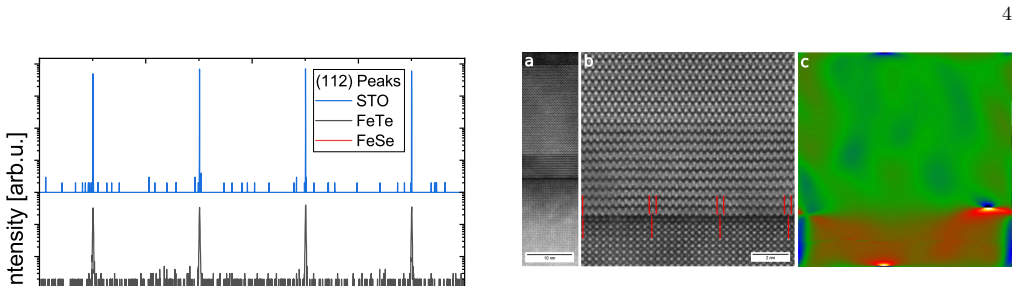
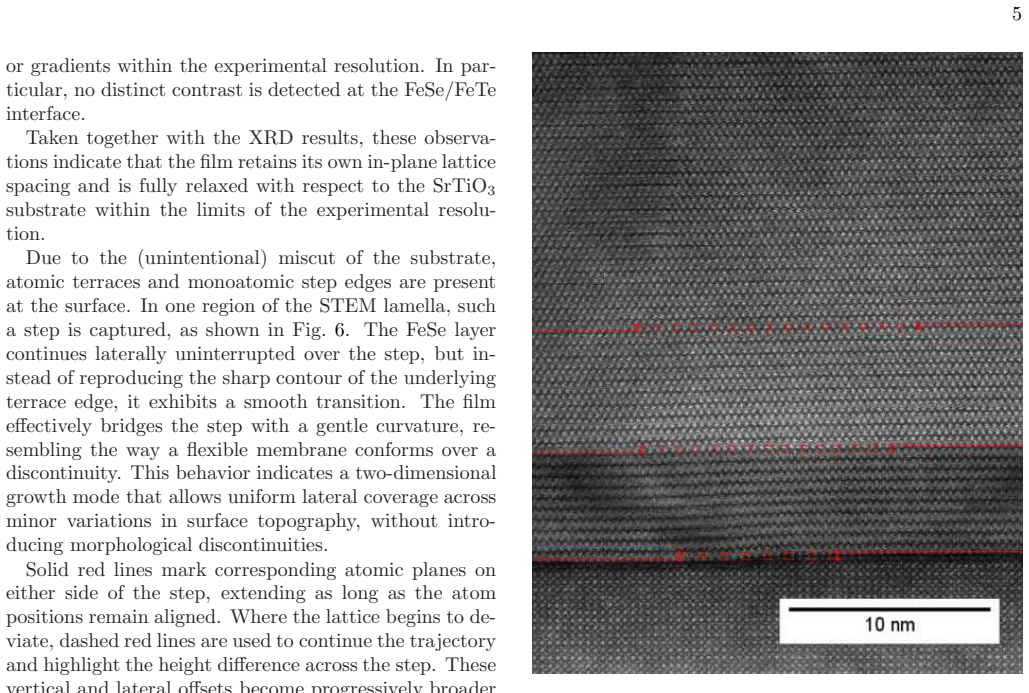
The FeSe/SrTiO3 interface exhibits directional epitaxy without atomic registry. A periodic lateral shift occurs between the atomic columns of FeSe and SrTiO3, with the registry recurrence length matching the lattice mismatch measured by X-ray diffraction. No misfit dislocations or other relaxation features are present.
What carries the argument
The periodic lateral shift at the FeSe/SrTiO3 interface whose recurrence length equals the XRD-measured mismatch, allowing crystallographic orientation to persist without atomic matching.
If this is right
- Strain in these layered films is accommodated by periodic shifts instead of dislocation formation.
- Crystallographic orientation can be maintained independently of lattice commensurability.
- Interface properties in Fe-based superconductors can be engineered without introducing mismatch-relaxation defects.
- Similar growth behavior may appear in other systems where directional alignment occurs on mismatched substrates.
Where Pith is reading between the lines
- Applying the same growth conditions to other chalcogenide films on SrTiO3 could test whether the recurrence length always tracks the mismatch.
- Transport measurements across films of varying thickness might show whether the shift periodicity affects superconducting coherence.
- Cross-sectional imaging after different thinning procedures would help confirm that the observed shifts are not preparation-dependent.
Load-bearing premise
The TEM images accurately capture the true interface atomic positions without preparation artifacts or projection effects, and the observed registry recurrence length directly corresponds to the XRD-measured mismatch without additional fitting or selection.
What would settle it
High-resolution STEM images that either reveal direct atomic registry across the interface or show misfit dislocations would falsify the registry-free growth description.
Figures
read the original abstract
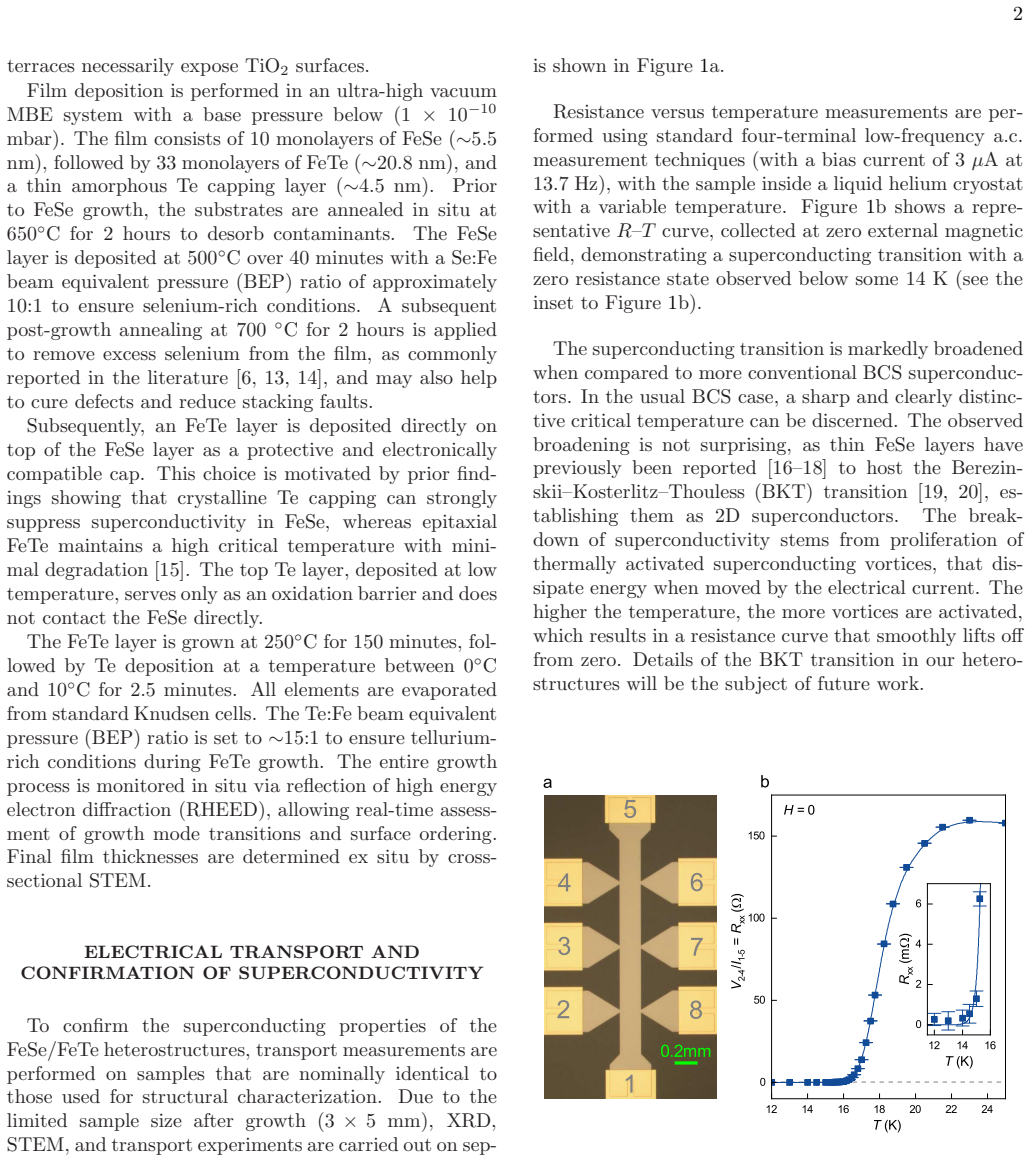
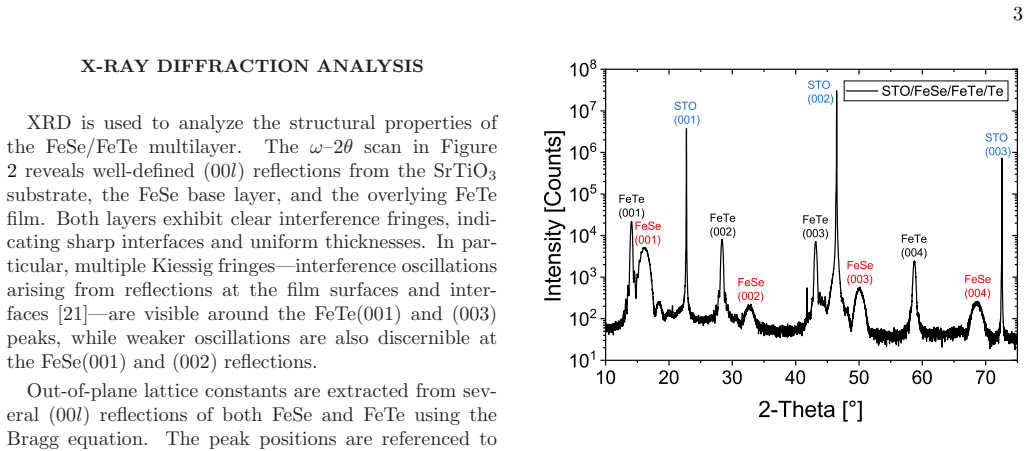
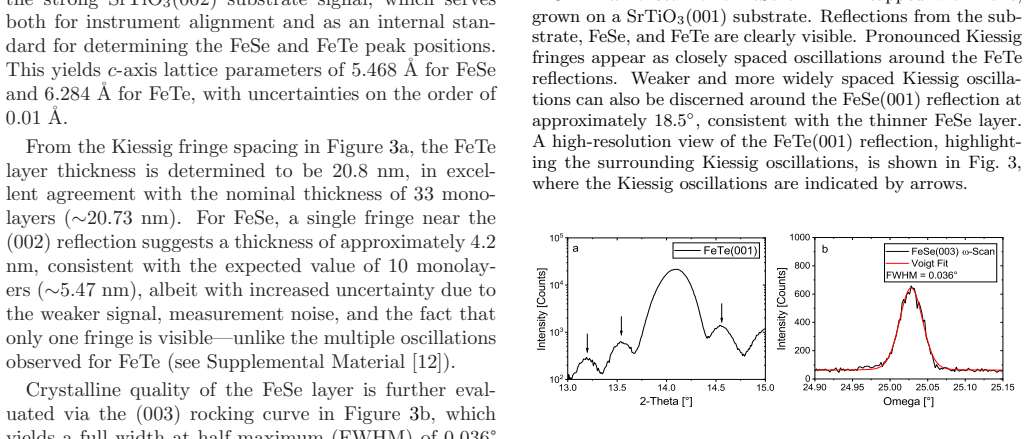
We present a combined X-ray diffraction and transmission electron microscopy study of superconducting FeSe/FeTe multilayers grown by molecular beam epitaxy on SrTiO$_3$(001) substrates. While X-ray diffraction confirms perfect in-plane epitaxial alignment between FeSe, FeTe, and the substrate, scanning transmission electron microscopy reveals a surprising lack of atomic registry at the FeSe/SrTiO$_3$ interface. Instead of adapting to the substrate lattice, FeSe retains its own in-plane lattice spacing. A periodic lateral shift between the atomic positions of FeSe and SrTiO$_3$ is observed, with a registry recurrence length that matches the lattice mismatch determined by X-ray diffraction. No misfit dislocations or other relaxation features are detected at the interface. This coexistence of directional alignment and registry-free growth suggests an unconventional regime of epitaxy in which crystallographic orientation is maintained without atomic matching. The findings offer insight into strain accommodation in layered systems and may have implications for interface engineering in Fe-based superconductors.
Editorial analysis
A structured set of objections, weighed in public.
Referee Report
Summary. The manuscript presents a combined X-ray diffraction (XRD) and scanning transmission electron microscopy (STEM) study of molecular-beam-epitaxy-grown FeSe/FeTe multilayers on SrTiO3(001). XRD indicates perfect in-plane epitaxial alignment, while STEM images are interpreted as showing retention of the bulk FeSe in-plane spacing, a periodic lateral shift whose recurrence length matches the XRD-derived mismatch, and an absence of misfit dislocations, leading to the claim of an unconventional incommensurate epitaxy regime in which directional alignment occurs without atomic registry.
Significance. If the STEM observations are shown to reflect the as-grown interface, the result would be significant for understanding strain accommodation and interface engineering in Fe-based superconductors, as it suggests a regime of epitaxy that decouples crystallographic orientation from lattice matching without conventional relaxation mechanisms.
major comments (3)
- [TEM results] The central claim of registry-free growth (Abstract and TEM results section) rests on qualitative interpretation of periodic lateral shifts without quantitative image simulations, thickness-dependent contrast analysis, or statistical error bars on the measured recurrence length; this is load-bearing because the distinction from preparation or projection artifacts is not secured.
- [TEM results] The assertion of 'no misfit dislocations or other relaxation features' (Abstract) lacks controls for FIB/ion-milling artifacts or multiple preparation methods, which directly affects the interpretation that the observed structure is the as-grown interface rather than a relaxed or disordered state.
- [Abstract] The statement that the registry recurrence length 'matches the lattice mismatch determined by X-ray diffraction' (Abstract) is presented without explicit comparison of numerical values, uncertainties, or fitting procedures, undermining the quantitative link between the two techniques.
minor comments (2)
- [Methods] Figure captions and methods should explicitly state the number of independent interfaces and images analyzed to support the 'no dislocations detected' claim.
- [Results] Notation for lattice parameters and mismatch should be defined consistently between the XRD and STEM sections to avoid ambiguity in the recurrence-length comparison.
Simulated Author's Rebuttal
We thank the referee for their thorough review and valuable comments on our manuscript. We address each of the major comments below and indicate the revisions we will make to strengthen the presentation of our results.
read point-by-point responses
-
Referee: [TEM results] The central claim of registry-free growth (Abstract and TEM results section) rests on qualitative interpretation of periodic lateral shifts without quantitative image simulations, thickness-dependent contrast analysis, or statistical error bars on the measured recurrence length; this is load-bearing because the distinction from preparation or projection artifacts is not secured.
Authors: We acknowledge the value of quantitative analysis to support the interpretation. In the revised version, we will include statistical measurements of the recurrence length from multiple STEM images with error bars. We will also add a discussion addressing potential artifacts by noting the consistency of the observed periodicity with the XRD mismatch and the absence of such features in control regions. While full dynamical image simulations are beyond the scope of the current work, the direct visualization in atomic-resolution STEM provides compelling evidence for the registry-free interface. revision: partial
-
Referee: [TEM results] The assertion of 'no misfit dislocations or other relaxation features' (Abstract) lacks controls for FIB/ion-milling artifacts or multiple preparation methods, which directly affects the interpretation that the observed structure is the as-grown interface rather than a relaxed or disordered state.
Authors: The samples were prepared using standard FIB techniques optimized to minimize damage, and the interfaces appear sharp and consistent across the imaged areas. The lack of relaxation is also supported by the XRD data showing coherent epitaxy without peak broadening indicative of dislocations. We will add a section in the methods describing the preparation protocol and argue that any significant milling artifacts would disrupt the observed periodic shifts. However, we did not employ alternative preparation methods such as mechanical polishing, which represents a limitation we will note. revision: partial
-
Referee: [Abstract] The statement that the registry recurrence length 'matches the lattice mismatch determined by X-ray diffraction' (Abstract) is presented without explicit comparison of numerical values, uncertainties, or fitting procedures, undermining the quantitative link between the two techniques.
Authors: We agree that an explicit comparison is necessary. In the revised manuscript, we will update the abstract and the results section to provide the specific numerical values: the XRD-derived mismatch and the measured recurrence length from STEM, including uncertainties and a brief description of the fitting procedure used to determine the periodicity. revision: yes
Circularity Check
No circularity: pure experimental observations with no derivations or self-referential steps
full rationale
The paper reports combined XRD and STEM/TEM measurements on FeSe/FeTe multilayers. The central claim (directional alignment without atomic registry, recurrence length matching XRD mismatch) rests on direct imaging and diffraction data, not on any equations, fitted parameters renamed as predictions, or self-citation chains. No mathematical derivations, ansatzes, or uniqueness theorems appear in the provided text. The reader's assessment of 0.0 is consistent with the absence of any load-bearing reduction to inputs by construction.
Axiom & Free-Parameter Ledger
Reference graph
Works this paper leans on
-
[1]
Su- perconductivity in the pbo-type structure α -fese,
F.-C. Hsu, J.-Y. Luo, K.-W. Yeh, T.-K. Chen, T.- W. Huang, P. M. Wu, Y.-C. Lee, Y.-L. Huang, Y.-Y. Chu, D.-C. Yan, and M.-K. Wu, “Su- perconductivity in the pbo-type structure α -fese,” Proc. Natl. Acad. Sci. USA 105, 14262–14264 (2008)
2008
-
[2]
Interface-induced high- temperature superconductivity in single unit-cell fese films on srtio 3,
Q.-Y. Wang, Z. Li, W.-H. Zhang, Z.-C. Zhang, J.-S. Zhang, W. Li, H. Ding, Y.-B. Ou, P. Deng, K. Chang, J. Wang, X.-C. Ma, X. Chen, Z.-A. Xu, C. Chen, X. J. Zhou, and Q.-K. Xue, “Interface-induced high- temperature superconductivity in single unit-cell fese films on srtio 3,” Chin. Phys. Lett. 29, 037402 (2012)
2012
-
[3]
Superconductivity above 100 k in single-layer fese films on doped srtio 3,
J.-F. Ge, Z.-L. Liu, C. Liu, C.-L. Gao, D. Qian, Q.- K. Xue, Y. Liu, and J.-F. Jia, “Superconductivity above 100 k in single-layer fese films on doped srtio 3,” Nat. Mater. 14, 285–289 (2015)
2015
-
[4]
R. Peng, H. C. Xu, S. Y. Tan, H. Y. Cao, M. Xia, X. P. Shen, Z. C. Huang, C. H. P. Wen, Q. Song, T. Zhang, B. P. Xie, X. G. Hu, and D. L. Feng, “Measurement of an enhanced superconducting phase and a pronounced anisotropy of the energy gap of a strained FeSe single layer in fese/nbsrtio 3/ktao3 heterostructures using photoemission spectroscopy,” Physical ...
2014
-
[5]
Interfacial mode coupling as the ori- gin of the enhancement of tc in fese films on srtio 3,
J. J. Lee, F. T. Schmitt, R. G. Moore, S. Johnston, Y.-T. Cui, W. Li, M. Yi, Z. K. Liu, M. Hashimoto, Y. Zhang, D. H. Lu, T. P. Devereaux, D.-H. Lee, and Z.-X. Shen, “Interfacial mode coupling as the ori- gin of the enhancement of tc in fese films on srtio 3,” Nature 515, 245–248 (2014)
2014
-
[6]
Atomically resolved fese/srtio 3(001) interface structure by scanning transmission electron microscopy,
F. Li, Q. Zhang, C. Tang, C. Liu, J. Shi, C.-N. Nie, G. Zhou, Z. Li, W. Zhang, C.-L. Song, K. He, S. Ji, S. Zhang, L. Gu, L. Wang, X.-C. Ma, and Q.- K. Xue, “Atomically resolved fese/srtio 3(001) interface structure by scanning transmission electron microscopy,” 2D Materials 3, 024002 (2016)
2016
-
[7]
Picoscale structural in- sight into superconductivity of monolayer FeSe/SrTiO 3,
R. Peng, K. Zou, M. G. Han, S. D. Albright, H. Hong, C. Lau, H. C. Xu, Y. Zhu, F. J. Walker, and C. H. Ahn, “Picoscale structural in- sight into superconductivity of monolayer FeSe/SrTiO 3,” Science Advances 6, eaay4517 (2020)
2020
-
[8]
Phonon modes and electron–phonon coupling at the fese/srtio 3 interface,
H. Yang, P. Zhang, K. Liu, Z. Lu, and S. Zhang, “Phonon modes and electron–phonon coupling at the fese/srtio 3 interface,” Nature 635, 332–336 (2024)
2024
-
[9]
Ab initio study of cross-interface electron–phonon couplings in fese thin films on srtio 3 and batio 3,
Y. Wang, A. Linscheid, T. Berlijn, and S. John- ston, “Ab initio study of cross-interface electron–phonon couplings in fese thin films on srtio 3 and batio 3,” Phys. Rev. B 93, 134513 (2016)
2016
-
[10]
Inter- facial effects on the spin density wave in fese/srtio 3 thin films,
H.-Y. Cao, S.-S. Tan, H. Xiang, and X. Gong, “Inter- facial effects on the spin density wave in fese/srtio 3 thin films,” Phys. Rev. B 89, 014501 (2014)
2014
-
[11]
Guideline to atomi- cally flat tio 2-terminated srtio 3(001) surfaces,
F. Gell´ e, R. Chirita, D. Mertz, M.-V. Rastei, A. Dinia, and S. Colis, “Guideline to atomi- cally flat tio 2-terminated srtio 3(001) surfaces,” Surface Science 677, 39–45 (2018)
2018
-
[12]
See Supplemental Material for AFM substrate charac- terization, asymmetric (112) X-ray diffraction scans of FeSe and FeTe, additional HAADF-STEM images of the lamella, and the one-dimensional Fourier-amplitude anal- ysis used to extract the in-plane lattice constants from STEM line profiles
-
[13]
Incoherent cooper pairing and pseudogap behavior in single-layer fese/srtio 3,
B. D. Faeth, S. Yang, J. K. Kawasaki, J. N. Nel- son, P. Mishra, L. Chen, D. G. Schlom, and K. M. Shen, “Incoherent cooper pairing and pseudogap behavior in single-layer fese/srtio 3,” Physical Review X 11, 021054 (2021)
2021
-
[14]
Tuning stoichiometry and its impact on superconductivity of monolayer and multilayer fese on srtio3,
C. Liu and K. Zou, “Tuning stoichiometry and its impact on superconductivity of monolayer and multilayer fese on srtio3,” Physical Review B 101, 140502(R) (2020)
2020
-
[15]
Capping layer influ- ence and isotropic in-plane upper critical field of the superconductivity at the fese/srtio3 interface,
Y. Li, Z. Wang, R. Xiao, Q. Li, K. Wang, A. Richardella, J. Wang, and N. Samarth, “Capping layer influ- ence and isotropic in-plane upper critical field of the superconductivity at the fese/srtio3 interface,” Phys. Rev. Materials 5, 034802 (2021)
2021
-
[16]
Excess conductiv- ity and Berezinskii–Kosterlitz–Thouless tran- sition in superconducting FeSe thin films,
R. Schneider, A. G. Zaitsev, D. Fuchs, and H. von L¨ ohneysen, “Excess conductiv- ity and Berezinskii–Kosterlitz–Thouless tran- sition in superconducting FeSe thin films,” J. Phys. Condens. Matter 26, 455701 (2014)
2014
-
[17]
Vortex phase transitions in monolayer FeSe film on SrTiO3,
W. Zhao, C.-Z. Chang, X. Xi, K. F. Mak, and J. S. Moodera, “Vortex phase transitions in monolayer FeSe film on SrTiO3,” 2D Mater. 3, 024006 (2016)
2016
-
[18]
Growth and characterization of high-quality fese thin films on srtio 3 with enhanced superconductivity,
Z. Zhao, Z. Wei, X. Yu, W. Dong, H. Zhang, L. Chen, J. Li, Y. Peng, Q. Sun, and M. Liu, “Growth and characterization of high-quality fese thin films on srtio 3 with enhanced superconductivity,” Phys. Rev. B 110, L140507 (2024)
2024
-
[19]
Ordering, metasta- bility and phase transitions in two-dimensional systems,
J. M. Kosterlitz and D. J. Thouless, “Ordering, metasta- bility and phase transitions in two-dimensional systems,” J. Phys. C Sol. St. Phys. 6, 1181 (1973)
1973
-
[20]
Resis- tive transition in superconducting films,
B. I. Halperin and D. R. Nelson, “Resis- tive transition in superconducting films,” J. Low Temp. Phys. 36, 599–616 (1979)
1979
-
[21]
Extracting information from x-ray diffrac- tion patterns containing laue oscillations,
A. M. Miller, C. R. Wiebe, and S. E. Dut- ton, “Extracting information from x-ray diffrac- tion patterns containing laue oscillations,” Zeitschrift f¨ ur Naturforschung B77, 385–392 (2022)
2022
-
[22]
Direct-arpes and stm investigation of fese thin film growth by nd:yag laser,
G.-Q. Huang, B. Chen, and H. Lei, “Direct-arpes and stm investigation of fese thin film growth by nd:yag laser,” Coatings 11, 276 (2021)
2021
-
[23]
Tunable critical temper- ature for superconductivity in fese thin films by pulsed laser deposition,
Z. Feng, J. Yuan, G. He, W. Hu, Z. Lin, D. Li, X. Jiang, Y. Huang, S. Ni, J. Li, B. Zhu, X. Dong, F. Zhou, H. Wang, Z. Zhao, and K. Jin, “Tunable critical temper- ature for superconductivity in fese thin films by pulsed laser deposition,” Scientific Reports 8, 4039 (2018) . 8
2018
-
[24]
Heterostructural one-unit-cell fese/srtio3: from high-temperature superconductivity to topological states,
C. Liu and J. Wang, “Heterostructural one-unit-cell fese/srtio3: from high-temperature superconductivity to topological states,” 2D Materials 7, 022006 (2020)
2020
-
[25]
Tuning the band structure and superconductivity in single-layer fese by interface en - gineering,
R. Peng, X. P. Shen, X. X. Xie, H. C. Xu, S. Y. Tan, M. Y. Xia, T. Zhang, H. Y. Cao, X. G. Gong, J. P. Hu, B. P. Xie, and D. L. Feng, “Tuning the band structure and superconductivity in single-layer fese by interface en - gineering,” Nature Communications 5, 5044 (2014)
2014
-
[26]
Interface-induced superconductivity and strain-dependent spin density wave in fese/srtio 3 thin films,
S. Y. Tan, M. Y. Xia, Y. Zhang, Z. R. Ye, F. Chen, X. X. Xie, R. Peng, D. F. Xu, Q. Fan, H. C. Xu, et al. , “Interface-induced superconductivity and strain-dependent spin density wave in fese/srtio 3 thin films,” Nature Materials 12, 634–640 (2013)
2013
-
[27]
The structure and chemistry of the tio 2-rich surface of srtio 3(001),
N. Erdman, K. Poeppelmeier, M. Asta, O. Warschkow, D. Ellis, and L. Marks, “The structure and chemistry of the tio 2-rich surface of srtio 3(001),” Nature 419, 55–58 (2002)
2002
-
[28]
Surface of strontium titanate (001),
R. Herger, P. R. Willmott, O. Bunk, C. M. Schlepuetz, B. D. Patterson, and B. Delley, “Surface of strontium titanate (001),” Phys. Rev. Lett. 98, 076102 (2007)
2007
-
[29]
Bonding and structure of a reconstructed (001) surface of srtio 3 from tem,
G.-Z. Zhu, G. Radtke, and G. A. Botton, “Bonding and structure of a reconstructed (001) surface of srtio 3 from tem,” Nature 490, 384–387 (2012)
2012
-
[30]
Vacant-site octahedral tilings on srtio 3 (001), the ( √ 13 × √ 13)r33. 7◦ surface, and related structures,
D. M. Kienzle, A. E. Becerra-Toledo, and L. D. Marks, “Vacant-site octahedral tilings on srtio 3 (001), the ( √ 13 × √ 13)r33. 7◦ surface, and related structures,” Phys. Rev. Lett. 106, 176102 (2011)
2011
-
[31]
Defects on strontium titanate,
M. S. J. Marshall, A. E. Becerra-Toledo, L. D. Marks, and M. R. Castell, “Defects on strontium titanate,” in Defects at Oxide Surfaces , Springer Series in Surface Sci- ences, Vol. 58, edited by J. Jupille and G. Thornton (Springer International Publishing Switzerland, 2015) pp. 327–349
2015
-
[32]
Oxy- gen vacancies in srtio 3 and their impact on electronic structure,
Harald O. Jeschke, Juan Shen, and Roser Valenti, “Oxy- gen vacancies in srtio 3 and their impact on electronic structure,” New Journal of Physics 17, 023034 (2015)
2015
-
[33]
Van der Waals epitaxy—a new epitaxial growth method for a highly lattice-mismatched system,
A. Koma, “Van der Waals epitaxy—a new epitaxial growth method for a highly lattice-mismatched system,” Thin Solid Films 216, 72–76 (1992)
1992
-
[34]
Van der Waals epitaxy: 2D materials and topological insulators,
L. A. Walsh and C. L. Hinkle, “Van der Waals epitaxy: 2D materials and topological insulators,” Appl. Mater. Today 9, 504–515 (2017) . 9 Unconventional incommensurate epitaxy of superconductin g FeSe films on SrTiO 3 - Supplemental Materials M. Klement, 1,2 K. M. Fijalkowski, 1,2 M. Kamp, 3 C. Gould, 1,2 and L. W. Molenkamp 1,2
2017
-
[35]
S1 The AFM image in Fig
MBE GROWTH Fig. S1 The AFM image in Fig. S1 shows the surface morphol- ogy of a SrTiO 3(001) substrate after buffered HF etch- ing and high-temperature O 2 annealing, yielding atomi- cally flat terraces with single-unit-cell step heights ( ∼ 0.4 nm). Such a well-ordered TiO 2 termination is crucial for obtaining the registry-free yet epitaxially aligned FeS...
-
[36]
S2 The XRD scan of the FeSe(002) reflection in Fig
X-RAY DIFFRACTION ANALYSIS Fig. S2 The XRD scan of the FeSe(002) reflection in Fig. S2 confirms the epitaxial growth of the FeSe layer on SrTiO3(001) with the c-axis oriented perpendicular to the substrate. The presence of a single, weak Kiessig fringe on the low-angle side indicates a well-defined but comparatively thin layer, with a thickness of about 4.2 ...
-
[37]
S5 The STEM image in Fig
Transmission Electron Microscopy Analysis Fig. S5 The STEM image in Fig. S5 shows the cross-sectional lamella prepared by focused ion beam (FIB) milling from a representative surface region. The lamella has a to- tal length of ∼ 8 µ m and was thinned to electron trans- parency for high-resolution STEM. /s52/s51/s46/s52 /s52/s51/s46/s56 /s52/s52/s46/s50 /s...
-
[38]
010 ˚ A. These values agree with the XRD-extracted lat- tice constants and confirm that neither FeSe nor FeTe adopts the SrTiO 3 in-plane lattice parameter, support- 12 ing the interpretation of a registry-free, incommensurate epitaxial relationship evident in the Fourier amplitude signatures (panel c). /s48 /s50 /s52 /s54 /s48 /s53/s48/s48/s48 /s49/s48/s4...
discussion (0)
Sign in with ORCID, Apple, or X to comment. Anyone can read and Pith papers without signing in.