REVIEW 3 major objections 4 minor 12 references
HatePRISM: Policies, Platforms, and Research Integration. Advancing NLP for Hate Speech Proactive Mitigation
T0 review · 3 major / 4 minor · reviewed 2026-08-06 · deepseek-v4-flash
Pith's one-line read HatePRISM finds that hate speech definitions and moderation strategies are deeply inconsistent across national regulations, social media platform policies, and NLP research datasets, with only 16% of the surveyed dataset papers aligned…
desk verdict A broad, genuinely synthetic survey of hate speech regimes, but the headline percentages rest on undocumented hand-coding and one internal contradiction; treat the qualitative direction as solid and the numbers as provisional. read the letter →
The pith
A machine-rendered reading of the paper's core claim, the machinery that carries it, and where it could break.
The reading
What carries the argument
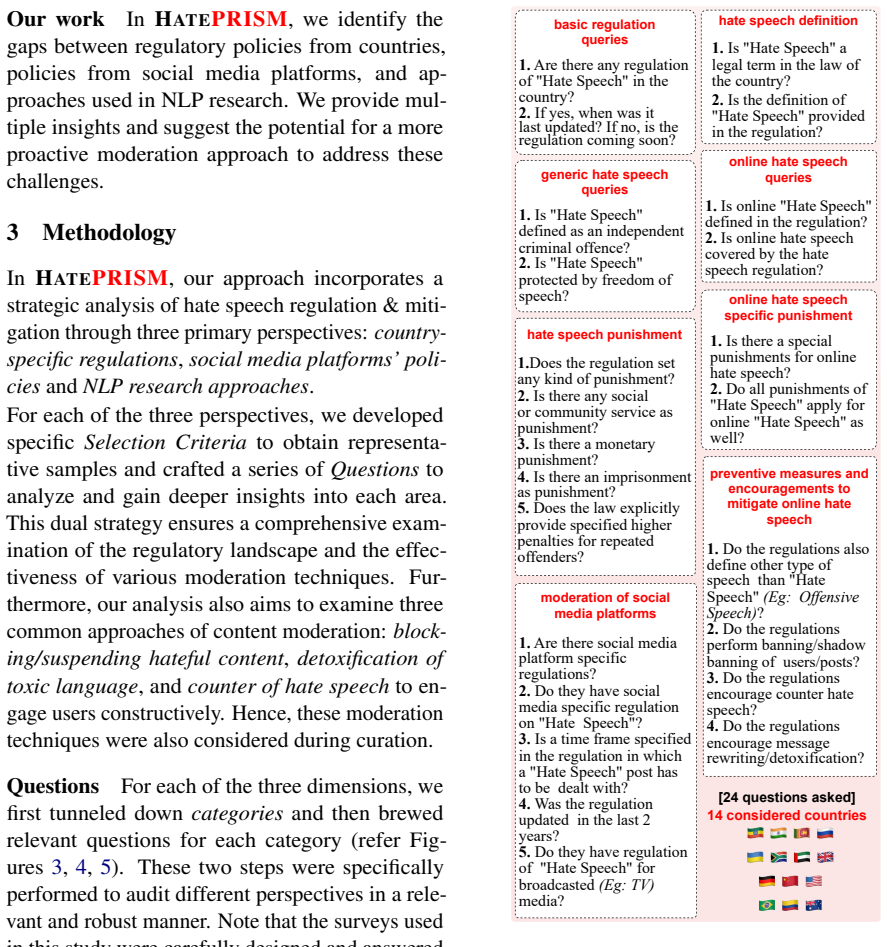
The load-bearing instrument is the HatePRISM questionnaire—24 questions on country regulations, 30 on platform policies, and 34 on research datasets—hand-coded from primary legal texts, platform policy documents, and the dataset papers themselves. These three coordinated surveys are what convert individual cases into comparable percentages and make the inconsistency claim quantitative.
What would settle it
Have two independent legal experts re-answer the 24 country-regulation questions from primary statutes using a published codebook; if the independently coded share of countries that define online hate speech differs materially from the reported 43%, the survey's alignment percentages are not stable.
Extended reading notes
Core claim
The paper claims to document a three-way mismatch in hate speech governance: national laws, platform community guidelines, and academic datasets each define and punish hate speech along different lines, and the research community's outputs are the most detached from the other two. Concretely, it reports that the U.S. is the only country among the 14 studied that tolerates hate speech and has no legal definition; that most countries' regulations do not address the online setting; that platform policies vary widely on age verification, moderation staffing, and proactive measures; and that dataset construction rarely references either national or platform definitions. The authors present this as evidence that reactive 'block and ban' moderation is the default everywhere, while proactive strategies like counterspeech and text detoxification are endorsed by platforms far more often than by law or by dataset creators, justifying a call for a unified framework integrating all three perspectives.
Load-bearing premise
The percentages depend entirely on the authors' own hand-coded answers to their questionnaires, with no published coding protocol, no independent annotators, and no inter-annotator agreement reported, so another team might code the same texts differently.
Editorial extensions
If this is right
- A unified moderation framework would need a core definition of hate speech that national laws can adapt, since no single definition currently spans all countries.
- Platforms that already endorse counterspeech and detoxification—64% of the 14 surveyed—are natural testbeds for deploying proactive moderation at scale.
- Requiring dataset papers to document alignment with national and platform regulations would directly address the 16% and 8% alignment gaps the survey reports.
- Moving from reactive banning to proactive strategies would require updating both country regulations (only 21% encourage them) and dataset annotation practices.
Reading between the lines
- If the alignment figures are correct, a hate-detection model trained on these datasets would frequently contradict the legal definitions of the jurisdictions where it is deployed; this is testable by scoring posts under both the dataset label and a national statute and measuring disagreement.
- The dataset portfolio is skewed—one platform accounts for over half of samples despite not being the largest platform by users—so a traffic-weighted re-analysis could shift the 16% and 8% alignment numbers.
- A practical next step would be a multilingual benchmark in which every item is labeled by a specific country's legal definition, making cross-jurisdiction model performance directly measurable.
Editorial analysis
A structured set of objections, weighed in public.
Referee Report
Summary. The paper presents HATEPRISM, a survey and position piece that examines hate speech regulation from three perspectives: national regulations from 14 countries, policies from 14 social media platforms, and 38 NLP dataset papers covering 20 languages. The authors report large inconsistencies across these perspectives, including claims that only 43% of countries define online hate speech, 64% of platforms encourage counterspeech or detoxification, and only 16% of dataset papers align with national regulations while 8% align with platform regulations. On the basis of these findings, the paper argues for a unified framework for automated hate speech moderation that incorporates proactive strategies such as counterspeech and text detoxification.
Significance. If the quantitative claims were fully supported, this would be a valuable synthesis for the NLP community: it brings together three usually separate corpora, provides a structured questionnaire, and identifies a concrete gap between research datasets and regulatory frameworks. The qualitative direction of the paper—that definitions and moderation practices differ across countries, platforms, and datasets—is credible and consistent with prior work such as Arora et al. (2024). The paper also deserves credit for making its questionnaire publicly available and for involving a legal expert in the design of the country-survey questions. However, the headline percentages are currently not auditable because they rest on undocumented hand-coding by the author team, and at least one statistic is internally contradicted by the paper's own qualitative text. These issues are load-bearing because the percentages are what distinguish the paper from a purely qualitative position essay.
major comments (3)
- [§4.2 / Figure 7 / Key observations (iii)] The paper reports two incompatible figures for platform encouragement of counterspeech or detoxification. The key observations and Figure 7 state that nearly 64% of platforms encourage counterspeech or text detoxification, while the qualitative analysis in Section 4.2 states that only Facebook, VK, and Odnoklassniki do so, which is 3 of 14 platforms (21%). Since this statistic is one of the main quantitative results motivating the proposed unified framework, the authors must resolve the discrepancy and specify the coding criterion used to determine what counts as 'encouraging' counterspeech or detoxification.
- [§3 Methodology / §4 Results] All quantitative percentages—43%, 21%, 64%, 16%, and 8%—are derived from questionnaires filled in by members of the research team, but the manuscript does not provide a published coding protocol, inter-annotator agreement statistics, adjudication procedures, or a release of per-item responses. The GitHub link in footnote 2 is mentioned, but the manuscript does not state what the repository contains, and the response data are absent from the paper. Because these numbers are the paper's central quantitative output, the authors should either release the item-level response table with justifications or re-label the figures as expert judgments rather than measured frequencies. The Limitations section acknowledges only scope limitations and does not address this reliability issue.
- [§4.3 / Figure 8] The 16% and 8% 'alignment' statistics measure whether a paper mentions alignment with national or platform regulations—the questionnaire item in Figure 5 asks 'Does the paper mention alignment'—not whether the dataset's hate speech definition actually conforms to those regulations. The text of Section 4.3 and the conclusion ('most NLP research did not align') consequently overstate the finding. Please rephrase the claims as 'mentioning alignment' or provide a separate rubric-based assessment of substantive alignment.
minor comments (4)
- [Key observations (i) / Figure 6] The introduction says only 43% of countries have regulations of online hate speech, while Figure 6 and Section 4.1 say 43% 'define online hate speech'; these are different statements and should be reconciled.
- [§4.2] The discussion of age restrictions distinguishes 'age limit' from 'age verification' only implicitly; the text should clarify that 93% of platforms have an age limit, but only three platforms verify age, to avoid the apparent contradiction within the same paragraph.
- [Figure 7] Figure 7 contains two separate '64%' statistics (API access for research and encouragement of counterspeech/detoxification), which can easily be misread as one duplicated value; using distinct labels or colors would improve clarity.
- [Appendix A] The taxonomy in Appendix A (target, discrimination, intent, language usage, emotions, frequency, time, fact-checking, topic and context) is plausible but is presented as derived from the survey without citation; grounding it in prior taxonomies from the hate speech literature would improve verifiability.
Circularity Check
No reduction-to-input circularity found; the headline numbers are survey observations, though the author-completed questionnaires raise separate reliability concerns.
full rationale
HatePRISM's central claims are descriptive survey findings, such as 'Only 16% of considered research dataset papers are aligned with countries' regulation and just 8% align with data sources' regulations' (Key observations). These percentages are produced by the authors' manual coding of regulations, platform policies, and 38 dataset papers; they are not derived from an equation, a fitted parameter, or a prior result of the same authors. The related work contains several self-citations (e.g., Mathew et al. 2019; Dementieva et al. 2021; Logacheva et al. 2022; Saha et al. 2024), but these are used as prior evidence that counterspeech and detoxification are established proactive strategies, not as premises that force the survey outcomes. No 'uniqueness theorem' or analogous imported result is invoked to make the paper's choices forced. The most serious weaknesses are methodological, not circular: the questionnaires were 'carefully designed and answered by a group of qualified researchers' (Section 3) with no published coding protocol, no inter-annotator agreement, and no per-item responses released, and the paper's own platform result appears internally inconsistent (Section 4.2 names only Facebook, VK, and Odnoklassniki as encouraging counterspeech/detoxification, i.e., 3 of 14, while Figure 7 and the Key observations report 64%). These issues undermine verifiability and internal consistency, but they are not instances of a claim reducing by construction to its own input. Accordingly, no circular step meeting the quoted-reduction standard is found; score 2 reflects only the presence of minor, non-load-bearing self-citations.
Assumptions & free parameters
assumptions (2)
- domain assumption The 14 selected countries and 14 platforms are representative of global and platform-wise hate speech regulation.
- domain assumption The authors' hand-coded survey responses accurately reflect the content of legal and policy documents.
Cite this review
Pith. "Pith review of HatePRISM: Policies, Platforms, and Research Integration. Advancing NLP for Hate Speech Proactive Mitigation." pith.science (2026). https://pith.science/paper/HUSTVPLS
@misc{pith2026250704350,
  author       = {Pith},
  title        = {Pith review of: HatePRISM: Policies, Platforms, and Research Integration. Advancing NLP for Hate Speech Proactive Mitigation},
  year         = {2026},
  howpublished = {\url{https://pith.science/paper/HUSTVPLS}},
  note         = {Machine review of arXiv:2507.04350}
}
read the original abstract
Despite regulations imposed by nations and social media platforms, e.g. (Government of India, 2021; European Parliament and Council of the European Union, 2022), inter alia, hateful content persists as a significant challenge. Existing approaches primarily rely on reactive measures such as blocking or suspending offensive messages, with emerging strategies focusing on proactive measurements like detoxification and counterspeech. In our work, which we call HatePRISM, we conduct a comprehensive examination of hate speech regulations and strategies from three perspectives: country regulations, social platform policies, and NLP research datasets. Our findings reveal significant inconsistencies in hate speech definitions and moderation practices across jurisdictions and platforms, alongside a lack of alignment with research efforts. Based on these insights, we suggest ideas and research direction for further exploration of a unified framework for automated hate speech moderation incorporating diverse strategies.
Figures


Figures from the paper (5 more)


Reference graph
Works this paper leans on
-
[3]
Counter hate speech in social media: A survey. CoRR, abs/2203.03584. Salaheddin Alzubi, Thiago Castro Ferreira, Lucas Pa- vanelli, and Mohamed Al-Badrashiny. 2022. aiX- plain at Arabic hate speech 2022: An ensemble based approach to detecting offensive tweets. In Proceed- insg of the 5th Workshop on Open-Source Arabic Corpora and Processing Tools with Sha...
arXiv 2022
-
[6]
Counterspeakers' Perspectives: Unveiling Barriers and AI Needs in the Fight against Online Hate
ParaDetox: Detoxification with parallel data. In Proceedings of the 60th Annual Meeting of the Association for Computational Linguistics (Volume 1: Long Papers), pages 6804–6818, Dublin, Ireland. Association for Computational Linguistics. Sean MacAvaney, Hao-Ren Yao, Eugene Yang, Katina Russell, Nazli Goharian, and Ophir Frieder. 2019. Hate speech detecti...
work page Pith review arXiv 2019
-
[7]
Detecting abusive albanian. Preprint, arXiv:2107.13592. Nedjma Ousidhoum, Zizheng Lin, Hongming Zhang, Yangqiu Song, and Dit-Yan Yeung. 2019. Multi- lingual and multi-aspect hate speech analysis. In Proceedings of the 2019 Conference on Empirical Methods in Natural Language Processing and the 9th International Joint Conference on Natural Lan- guage Proces...
work page Pith review arXiv 2019
-
[8]
CoRAL: a context-aware Croatian abusive language dataset. In Findings of the Association for Computational Linguistics: AACL-IJCNLP 2022, pages 217–225, Online only. Association for Compu- tational Linguistics. Zheyuan Ryan Shi, Claire Wang, and Fei Fang. 2020. Artificial intelligence for social good: A survey. CoRR, abs/2001.01818. Gudbjartur Ingi Sigurb...
arXiv 2022
-
[9]
Offensive language and hate speech detec- tion for Danish. In Proceedings of the Twelfth Lan- guage Resources and Evaluation Conference, pages 3498–3508, Marseille, France. European Language Resources Association. Rachele Sprugnoli, Stefano Menini, Sara Tonelli, Fil- ippo Oncini, and Enrico Piras. 2018. Creating a WhatsApp dataset to study pre-teen cyberb...
work page 2018
-
[10]
Towards a friendly online community: An unsupervised style transfer framework for profan- ity redaction. In Proceedings of the 28th Inter- national Conference on Computational Linguistics, pages 2107–2114, Barcelona, Spain (Online). Inter- national Committee on Computational Linguistics. Amaury Trujillo, Tiziano Fagni, and Stefano Cresci
-
[12]
In Proceedings of the Fourth Workshop on Online Abuse and Harms, pages 65–69, Online
Reducing unintended identity bias in Russian hate speech detection. In Proceedings of the Fourth Workshop on Online Abuse and Harms, pages 65–69, Online. Association for Computational Linguistics. Fahri Özsungur. 2022. Handbook of Research on Digi- tal Violence and Discrimination Studies: A volume in the Advances in Human and Social Aspects of Technology ...
work page 2022
-
[2018]
Are they our brothers? analysis and detec- tion of religious hate speech in the arabic twitter- sphere. In 2018 IEEE/ACM International Confer- ence on Advances in Social Networks Analysis and Mining (ASONAM), pages 69–76. Dana Alsagheer, Hadi Mansourifar, and Weidong Shi
work page 2018
Show all 12 references
-
[2019]
In Proceedings of the 13th International Workshop on Semantic Evaluation, pages 54–63, Min- neapolis, Minnesota, USA
SemEval-2019 task 5: Multilingual detection of hate speech against immigrants and women in Twitter. In Proceedings of the 13th International Workshop on Semantic Evaluation, pages 54–63, Min- neapolis, Minnesota, USA. Association for Compu- tational Linguistics. Mohit Bhardwaj...
2019 arXiv
-
[2020]
In Proceedings of the Fourth Workshop on Online Abuse and Harms, pages 125–137, Online
A unified taxonomy of harmful content. In Proceedings of the Fourth Workshop on Online Abuse and Harms, pages 125–137, Online. Association for Computational Linguistics. Davide Barbieri, Charlotte Dahin, Brianna Guidorzi, Zuzana Madarova Marre Karu, Blandine Mollard, Jolanta R...
2019
-
[2022]
In Ad- vances of Science and Technology, pages 603–618, Cham
Multi-channel convolutional neural network for hate speech detection in social media. In Ad- vances of Science and Technology, pages 603–618, Cham. Springer International Publishing. Nuha Albadi, Maram Kurdi, and Shivakant Mishra
-
[2023]
CoRR, abs/2312.10269
The DSA transparency database: Auditing self- reported moderation actions by social media. CoRR, abs/2312.10269. Bertie Vidgen and Leon Derczynski. 2020. Direc- tions in abusive language training data, a system- atic review: Garbage in, garbage out. PLOS ONE, 15(12):e0243300. ...
2020 arXiv
Reviewed August 6, 2026 · model on record in the stance chip above.
Discussion (0). Sign in to comment.