CHESS: CHEbyshev pSeudo-Spectral transport for Feynman integral differential equations
Pith reviewed 2026-06-26 04:35 UTC · model grok-4.3
The pith
CHESS package solves epsilon-factorized Feynman DEs via Chebyshev-Lobatto collocation on pulled paths with rapid node convergence.
A machine-rendered reading of the paper's core claim, the machinery that carries it, and where it could break.
Core claim
The central claim is that Chebyshev pseudo-spectral collocation applied to the pulled transport matrix of epsilon-factorized differential equations yields an efficient high-precision solver for one-dimensional transport of Feynman master integrals, as evidenced by rapid convergence with increasing nodes and agreement with reference data in benchmarks of large multi-scale integral families.
What carries the argument
Chebyshev-Lobatto spectral collocation on the pulled differential matrix, with sequential epsilon-expansion propagation and residue-based endpoint regularization.
If this is right
- Large multi-scale integral families become computable with fewer discretization nodes while preserving high precision.
- Wall-clock times become shorter than those of fixed local-series methods in direct comparisons of the same systems.
- Process-tree memory usage drops for the largest benchmark families relative to the local-series baseline.
- Spurious regular singular endpoints are handled automatically through residue regularization without manual intervention.
Where Pith is reading between the lines
- The same pulled-matrix plus spectral-collocation structure could be applied to other classes of linear differential systems that admit an epsilon factorization.
- Sparse assembly of the collocation matrix might combine with existing reduction algorithms to further lower the cost of multi-scale calculations.
- Sequential propagation in the epsilon expansion suggests a natural way to obtain results at several orders simultaneously from a single transport run.
Load-bearing premise
The differential equations must be epsilon-factorized and the transport matrix must be assemblable from constant matrices and precomputed scalar pullbacks of the one-forms.
What would settle it
For a known large multi-scale integral family, increase the number of Chebyshev nodes and check whether the numerical results fail to converge to the independent reference values within the claimed precision or require unexpectedly many nodes.
Figures
read the original abstract
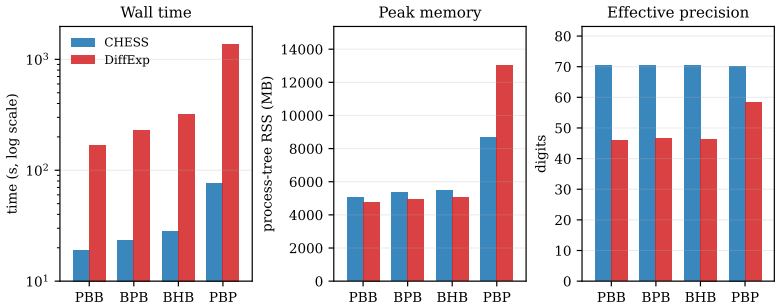
We present CHESS (CHEbyshev pSeudo Spectrum), a Wolfram Language package for high-precision one-dimensional transport of {\epsilon}-factorized differential equations for Feynman master integrals. The solver works with the matrix obtained by pulling a differential one-form to a chosen path. This matrix may be supplied directly, or assembled from constant matrices and precomputed scalar pullbacks of the one-forms. The program combines Chebyshev-Lobatto spectral collocation, sparse matrix assembly, sequential propagation in the {\epsilon}-expansion, and residue-based regularization of spurious regular singular endpoints. Benchmarks for large multi-scale integral families show rapid node convergence and agreement with independent reference data where such data are available. In the fixed local-series comparison used here, the Chebyshev transports also give shorter wall times; the reported process-tree memory usage is comparable for the smaller parallel runs and lower for the largest benchmark system in that comparison.
Editorial analysis
A structured set of objections, weighed in public.
Referee Report
Summary. The manuscript presents CHESS, a Wolfram Language package implementing Chebyshev-Lobatto pseudo-spectral collocation for one-dimensional transport of ε-factorized differential equations for Feynman master integrals. The solver operates on the pulled transport matrix (supplied directly or assembled from constant matrices plus precomputed scalar one-form pullbacks), using sparse assembly, sequential ε-expansion propagation, and residue-based regularization at spurious regular singular points. Benchmarks on large multi-scale families report rapid convergence with node count, agreement with independent reference data, shorter wall times than fixed local-series methods, and lower process-tree memory usage on the largest system.
Significance. If the numerical performance claims hold under the stated operating conditions, the work supplies a practical high-precision tool for multi-scale Feynman integral families where the differential equations have already been prepared in ε-factorized form. The explicit demonstration of node convergence, wall-time and memory advantages relative to local-series transport, and the provision of a reusable Wolfram package constitute concrete strengths for the numerical methods literature in this area.
major comments (2)
- [Abstract] Abstract: the reported rapid node convergence, agreement with reference data, and performance gains (shorter wall times and lower memory on the largest benchmark system) are demonstrated exclusively under the precondition that the input differential equations are already ε-factorized and that the transport matrix can be supplied or assembled exactly as described (constant matrices plus scalar one-form pullbacks). No separate evidence, procedure, or discussion is given on how generally or automatically this precondition can be met for arbitrary large multi-scale families; this assumption is load-bearing for the transferability of the benchmark advantages.
- [Abstract] Abstract and benchmarks description: no error bars or quantitative uncertainty measures are reported on the agreement with independent reference data, and no explicit derivation or validation of the residue-based regularization for spurious regular singular endpoints is provided; both omissions directly affect the strength of the central numerical claims.
Simulated Author's Rebuttal
We thank the referee for the detailed review and constructive comments on our manuscript. We address each major comment below, clarifying the scope of the work and indicating revisions where appropriate to strengthen the presentation.
read point-by-point responses
-
Referee: [Abstract] Abstract: the reported rapid node convergence, agreement with reference data, and performance gains (shorter wall times and lower memory on the largest benchmark system) are demonstrated exclusively under the precondition that the input differential equations are already ε-factorized and that the transport matrix can be supplied or assembled exactly as described (constant matrices plus scalar one-form pullbacks). No separate evidence, procedure, or discussion is given on how generally or automatically this precondition can be met for arbitrary large multi-scale families; this assumption is load-bearing for the transferability of the benchmark advantages.
Authors: The manuscript and package focus exclusively on the numerical transport step for differential equations that have already been prepared in ε-factorized form, as stated in the title, abstract, and introduction. This precondition is standard in the current literature on Feynman integrals, where ε-factorization is handled by separate algorithms and packages (e.g., those based on integration-by-parts reduction and symbol methods). The benchmarks and performance claims are presented under these operating conditions, which define the intended use case for CHESS. We will revise the abstract and add a short paragraph in the introduction to explicitly state the scope and reference representative works on the factorization step, thereby clarifying transferability without claiming to address the factorization problem itself. revision: yes
-
Referee: [Abstract] Abstract and benchmarks description: no error bars or quantitative uncertainty measures are reported on the agreement with independent reference data, and no explicit derivation or validation of the residue-based regularization for spurious regular singular endpoints is provided; both omissions directly affect the strength of the central numerical claims.
Authors: We acknowledge that quantitative uncertainty measures (such as maximum absolute differences or relative errors with respect to reference values) are not tabulated in the current benchmarks section, even though visual agreement and node-convergence plots are shown. Similarly, while the residue-based regularization procedure is described operationally in the methods, an explicit derivation and additional validation tests are not provided. Both points are valid and we will revise the manuscript to include (i) tabulated quantitative discrepancy measures for the benchmark families where independent data exist and (ii) an expanded subsection (or short appendix) deriving the regularization and presenting targeted numerical tests on spurious singularities. These additions will be made without altering the core claims. revision: yes
Circularity Check
No significant circularity; numerical solver benchmarked against independent references
full rationale
The paper presents CHESS as a numerical solver for one-dimensional transport of already epsilon-factorized differential equations, using Chebyshev-Lobatto collocation on a pulled transport matrix that is either supplied or assembled from constants and precomputed scalar pullbacks. The load-bearing claims are benchmark results (node convergence, agreement with independent reference data, wall-time and memory comparisons) obtained by running the solver on large multi-scale families and comparing outputs to external references. No derivation chain reduces a result to its own inputs by construction, no fitted parameters are relabeled as predictions, and no load-bearing premise rests on self-citation chains or uniqueness theorems imported from the authors' prior work. The epsilon-factorized precondition is stated explicitly as the solver's operating mode rather than derived internally.
Axiom & Free-Parameter Ledger
axioms (2)
- domain assumption The differential equations for the master integrals are epsilon-factorized and can be represented by a matrix obtained via pullback along a chosen path.
- domain assumption Chebyshev-Lobatto collocation combined with sequential epsilon-expansion and residue regularization produces convergent high-precision solutions.
Reference graph
Works this paper leans on
-
[1]
J. M. Henn, A. Matijašić, J. Miczajka, T. Peraro, Y. Xu, Y. Zhang, A computation of two-loop six-point feynman integrals in dimensional regularization, JHEP 08 (2024) 027.arXiv:2403.19742,doi:10.1007/ JHEP08(2024)027
arXiv 2024
-
[2]
Y. Liu, A. Matijašić, J. Miczajka, Y. Xu, Y. Xu, Y. Zhang, Analytic computation of three-loop five-point feynman integrals, Phys. Rev. D 112 (1) (2025) 016021.arXiv:2411.18697,doi:10.1103/qrk2-cym5
-
[3]
D. Chicherin, Y. Wu, Z. Wu, Y. Xu, S.-Q. Zhang, Y. Zhang, Complete computation of all three-loop five-point massless planar integrals, arXiv e-prints (2025).arXiv:2512.17330
arXiv 2025
-
[4]
Y. Liu, A. Matijašić, T. Peraro, Y. Xu, Z. Yang, Y. Zhang, Two-loop six-point planar massless feynman integrals to higherϵorders, arXiv e-prints (2026).arXiv:2603.16831
arXiv 2026
-
[7]
M. Borinsky, H. J. Munch, F. Tellander, Tropical Feynman integration in the Minkowski regime, Comput. Phys. Commun. 292 (2023) 108874. arXiv:2302.08955,doi:10.1016/j.cpc.2023.108874
-
[8]
X. Liu, Y.-Q. Ma, AMFlow: a mathematica package for feynman inte- grals computation via auxiliary mass flow, Comput. Phys. Commun. 283 (2023) 108565.arXiv:2201.11669,doi:10.1016/j.cpc.2022.108565
-
[10]
T. Armadillo, R. Bonciani, S. Devoto, N. Rana, A. Vicini, Evaluation of Feynman integrals with arbitrary complex masses via series expansions, Comput. Phys. Commun. 282 (2023) 108545.arXiv:2205.03345,doi: 10.1016/j.cpc.2022.108545
-
[11]
R. M. Prisco, J. Ronca, F. Tramontano, LINE: Loop integrals numerical evaluation, JHEP 07 (2025) 219.arXiv:2501.01943,doi:10.1007/ JHEP07(2025)219
arXiv 2025
-
[12]
Armadillo, Evaluating Feynman integrals through differential equa- tions and series expansions, Eur
T. Armadillo, Evaluating Feynman integrals through differential equa- tions and series expansions, Eur. Phys. J. ST (2025).arXiv:2502. 14742,doi:10.1140/epjs/s11734-025-01995-0
-
[13]
P.PetitRosàs, Evaluationoffeynmanintegralsvianumericalintegration ofdifferentialequations, arXive-prints(Mar.2026).arXiv:2603.05336
arXiv 2026
-
[14]
G. Baur, C. Duhr, IterInt: Evaluating iterated integrals via differential equations, arXiv e-prints (Jun. 2026).arXiv:2606.02744
Pith/arXiv arXiv 2026
-
[15]
K. G. Chetyrkin, F. V. Tkachov, Integration by parts: The algorithm to calculateβ-functions in 4 loops, Nucl. Phys. B 192 (1981) 159–204. doi:10.1016/0550-3213(81)90199-1
-
[16]
High-precision calculation of multi-loop Feynman integrals by difference equations
S. Laporta, High-precision calculation of multiloop feynman integrals by difference equations, Int. J. Mod. Phys. A 15 (2000) 5087–5159.arXiv: hep-ph/0102033,doi:10.1142/S0217751X00002159. 40
work page internal anchor Pith review Pith/arXiv arXiv doi:10.1142/s0217751x00002159 2000
-
[17]
A. V. Kotikov, Differential equations method: New technique for mas- sive feynman diagrams calculation, Phys. Lett. B 254 (1991) 158–164. doi:10.1016/0370-2693(91)90413-K
-
[18]
Remiddi, Differential equations for feynman graph amplitudes, Nuovo Cim
E. Remiddi, Differential equations for feynman graph amplitudes, Nuovo Cim. A 110 (1997) 1435–1452.arXiv:hep-th/9711188,doi:10.1007/ BF03185566
arXiv 1997
-
[19]
Differential Equations for Two-Loop Four-Point Functions
T. Gehrmann, E. Remiddi, Differential equations for two-loop four-point functions, Nucl. Phys. B 580 (2000) 485–518.arXiv:hep-ph/9912329, doi:10.1016/S0550-3213(00)00223-6
work page internal anchor Pith review Pith/arXiv arXiv doi:10.1016/s0550-3213(00)00223-6 2000
-
[20]
J. M. Henn, Multiloop integrals in dimensional regularization made simple, Phys. Rev. Lett. 110 (2013) 251601.arXiv:1304.1806,doi: 10.1103/PhysRevLett.110.251601
work page internal anchor Pith review Pith/arXiv arXiv doi:10.1103/physrevlett.110.251601 2013
-
[21]
R.N.Lee, Reducingdifferentialequationsformultiloopmasterintegrals, JHEP 04 (2015) 108.arXiv:1411.0911,doi:10.1007/JHEP04(2015) 108
work page internal anchor Pith review Pith/arXiv arXiv doi:10.1007/jhep04(2015 2015
-
[22]
Transforming differential equations of multi-loop Feynman integrals into canonical form
C. Meyer, Transforming differential equations of multi-loop feynman integrals into canonical form, JHEP 04 (2017) 006.arXiv:1611.01087, doi:10.1007/JHEP04(2017)006
work page internal anchor Pith review Pith/arXiv arXiv doi:10.1007/jhep04(2017)006 2017
-
[23]
epsilon: A tool to find a canonical basis of master integrals
M. Prausa, epsilon: A tool to find a canonical basis of master integrals, Comput. Phys. Commun. 219 (2017) 361–376.arXiv:1701.00725,doi: 10.1016/j.cpc.2017.05.026
work page internal anchor Pith review Pith/arXiv arXiv doi:10.1016/j.cpc.2017.05.026 2017
-
[24]
Fuchsia: a tool for reducing differential equations for Feynman master integrals to epsilon form
O. Gituliar, V. Magerya, Fuchsia: a tool for reducing differential equa- tions for feynman master integrals to epsilon form, Comput. Phys. Com- mun. 219 (2017) 329–338.arXiv:1701.04269,doi:10.1016/j.cpc. 2017.05.004
work page internal anchor Pith review Pith/arXiv arXiv doi:10.1016/j.cpc 2017
-
[25]
R. N. Lee, Libra: A package for transformation of differential systems for multiloop integrals, Comput. Phys. Commun. 267 (2021) 108058. arXiv:2012.00279,doi:10.1016/j.cpc.2021.108058
-
[26]
I. Bree, et al., Geometric bookkeeping guide to feynman integral reduc- tion andϵ-factorized differential equations, Phys. Rev. Lett. 136 (24) (2026) 241602.arXiv:2506.09124,doi:10.1103/pyt8-d7rt. 41
-
[27]
New algorithms for Feynman integral reduction and $\varepsilon$-factorised differential equations
I. Bree, et al., New algorithms for feynman integral reduction and epsilon-factorized differential equations, Phys. Rev. D 113 (11) (2026) 116019.arXiv:2511.15381,doi:10.1103/mjpn-61yv
work page internal anchor Pith review Pith/arXiv arXiv doi:10.1103/mjpn-61yv 2026
-
[28]
H. Frellesvig, On epsilon factorized differential equations for elliptic feynman integrals, JHEP 03 (2022) 079.arXiv:2110.07968,doi: 10.1007/JHEP03(2022)079
-
[29]
H. Frellesvig, S. Weinzierl, Onε-factorised bases and pure feynman integrals, SciPost Phys. 16 (6) (2024) 150.arXiv:2301.02264,doi: 10.21468/SciPostPhys.16.6.150
-
[30]
L. Görges, C. Nega, L. Tancredi, F. J. Wagner, On a procedure to deriveϵ-factorised differential equations beyond polylogarithms, JHEP 07 (2023) 206.arXiv:2305.14090,doi:10.1007/JHEP07(2023)206
-
[31]
C. Duhr, F. Porkert, S. F. Stawinski, Canonical differential equations beyond genus one, JHEP 02 (2025) 014.arXiv:2412.02300,doi:10. 1007/JHEP02(2025)014
arXiv 2025
-
[32]
S. Maggio, Y. Sohnle, On canonical differential equations for calabi-yau multi-scale feynman integrals, JHEP 10 (2025) 202.arXiv:2504.17757, doi:10.1007/JHEP10(2025)202
-
[33]
C. Duhr, S. Maggio, F. Porkert, C. Semper, Y. Sohnle, S. F. Stawin- ski, Canonical differential equations and intersection matrices, JHEP 02 (2026) 211.arXiv:2509.17787,doi:10.1007/JHEP02(2026)211
-
[34]
L. N. Trefethen, Spectral Methods in MATLAB, SIAM, Philadelphia, 2000
2000
-
[35]
C. Canuto, M. Y. Hussaini, A. Quarteroni, T. A. Zang, Spectral Meth- ods: FundamentalsinSingleDomains, ScientificComputation, Springer, Berlin, Heidelberg, 2006.doi:10.1007/978-3-540-30726-6
-
[36]
J. P. Boyd, Chebyshev and Fourier Spectral Methods, 2nd Edition, Dover Publications, Mineola, NY, 2001
2001
-
[37]
L. N. Trefethen, Approximation Theory and Approximation Practice, Extended Edition, Society for Industrial and Applied Mathematics, Philadelphia, 2019.doi:10.1137/1.9781611975949. 42
-
[38]
E. Tadmor, The exponential accuracy of fourier and chebyshev differenc- ing methods, SIAM Journal on Numerical Analysis 23 (1) (1986) 1–10. doi:10.1137/0723001
-
[39]
Demanet, L
L. Demanet, L. Ying, On chebyshev interpolation of analytic functions, Technical note (Mar. 2010). URLhttps://math.mit.edu/icg/papers/cheb-interp.pdf
2010
-
[40]
H. B. Keller, Singular problems, in: Numerical Solution of Two Point Boundary Value Problems, Vol. 24 of CBMS-NSF Regional Confer- ence Series in Applied Mathematics, Society for Industrial and Ap- plied Mathematics, Philadelphia, 1976, pp. 49–58.doi:10.1137/1. 9781611970449.ch4
work page doi:10.1137/1 1976
-
[41]
W. Huang, H. Ma, W. Sun, Convergence analysis of spectral collocation methods for a singular differential equation, SIAM Journal on Numerical Analysis 41 (6) (2003) 2333–2349.doi:10.1137/S0036142902381024
- [42]
discussion (0)
Sign in with ORCID, Apple, or X to comment. Anyone can read and Pith papers without signing in.