REVIEW 4 major objections 6 minor 46 references
Compared head-to-head across ten satellite-imagery tasks, two geospatial foundation models differ less in which model you pick than in how you deploy it: token size and decoder choice together explain more performance variance than model id
Reviewed by Pith at T0; open to challenge. T0 means a machine referee read the full paper against a public rubric. the ladder, T0–T4 →
T0 review · deepseek-v4-flash
2026-08-01 15:11 UTC pith:I6FRL3AK
load-bearing objection A transparent, useful GFM comparison whose qualitative findings are solid, but the headline variance-decomposition claim is not statistically supported because the ANOVA design is non-orthogonal. the 4 major comments →
Now We Know? A Systematic Comparison of TerraMind and THOR
The pith
A machine-rendered reading of the paper's core claim, the machinery that carries it, and where it could break.
Core claim
The paper claims that the 'which model is better' question is the wrong question. Through a controlled ablation of two geospatial foundation models, it finds that architectural deployment choices — the spatial token grid (patch size) and the decoder head — jointly account for more of the variance in downstream performance than which foundation model is used, across the swept datasets and under the shared training recipe. It further shows the two models represent two viable investment strategies: TerraMind's heavy multimodal pretraining buys strong features at a fixed patch size, while THOR's variable patch size buys accuracy through denser tokenisation at inference time, closing the gap only
What carries the argument
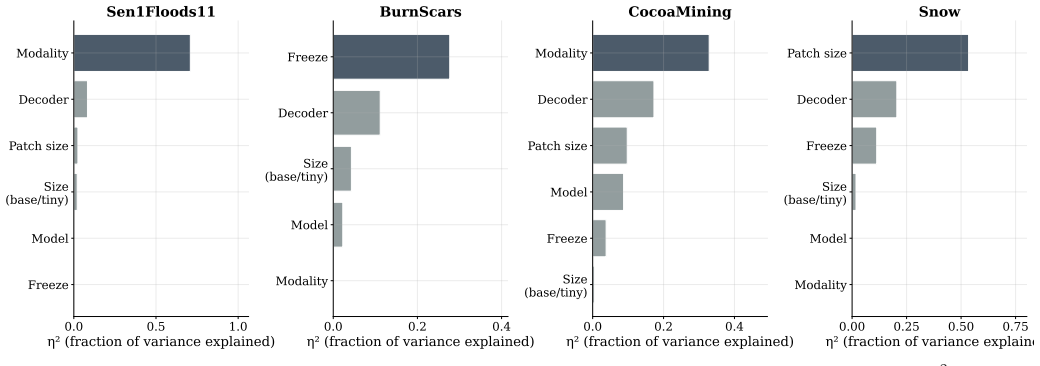
The load-bearing device is a controlled ablation grid run under a single shared evaluation framework: ten Earth-observation use cases, with each model varied along patch size (THOR alone, over four levels), decoder type (a minimal linear head vs. a multi-scale pyramid decoder), backbone freeze state, input modality, and model scale — more than 800 runs. Performance differences are then decomposed with a one-way ANOVA, reporting eta-squared, the fraction of variance in the task metric attributable to each design factor. Patch size is the side length, in pixels, of each image patch a Vision Transformer tokenises; halving it quadruples the token count and roughly quadruples compute. This decomp
Load-bearing premise
The headline variance ranking (Section 6.9) treats every configuration as an independent, fairly sampled observation, but all full-data runs share a single seed (Section 5.1), only THOR gets a four-level patch-size sweep, and headline numbers pick each model's best configuration — if that grid asymmetry is doing the work, the ranking is a property of the experiment design, not of the models.
What would settle it
Recompute the variance decomposition on a symmetric grid: give TerraMind a properly re-pretrained patch-size sweep (ps4/8/32) and run every configuration with at least five seeds. If model identity then explains as much variance as patch size — or if the patch-size effect drops below the decoder effect — the paper's central claim is an artefact of its asymmetric single-seed grid.
If this is right
- Fix the compute budget and decoder before choosing between models: on the tested tasks, those choices move performance more than the foundation model itself.
- For tasks with small or rare targets — floods, icebergs, artisanal mines — fine tokenisation (small patch size) is the strongest available lever, and coarse fixed tokenisation can collapse performance outright.
- At matched compute, a pretraining-heavy model is the better buy on optical tasks; an inference-adaptive model is the better buy where spatial detail or SAR signal dominates, at several times the compute.
- Shallow channel-concatenation or mean-pooling sensor fusion does not reliably beat optical-only input when labels are plentiful; expressive cross-attention fusion is the indicated direction.
- Benchmarks should report attribution-style decompositions and dataset characterisation as first-class evaluation output, and headline comparisons of variable-resolution models should control for the tokenisation axis.
Where Pith is reading between the lines
- If the variance ranking generalises beyond this pair, it predicts that re-evaluating any two ViT-based geospatial models under swapped decoders and token grids can reverse their perceived ranking — a testable prediction for future GFM comparisons.
- Because each model tends to lead on tasks contributed by its own consortium, the decisive attribution experiment is to run both models on a task suite curated by a third party; the authors leave this open.
- The authors' partially re-patched TerraMind — tiny-scale, only 48 epochs of embedding retraining — matching full-size rivals on three tasks hints that patch size and pretraining quality are separable axes; a full re-pretraining of TerraMind at multiple patch sizes is the natural next test.
- A multi-seed re-run of the headline variance analysis would reveal how much of the patch-size dominance is stable signal rather than single-seed luck; the authors flag that gaps under about one percentage point may not reproduce.
Editorial analysis
A structured set of objections, weighed in public.
Referee Report
Summary. The paper presents a systematic, ablation-driven comparison of two ESA Φ-lab geospatial foundation models, THOR and TerraMind, across ten EO use cases. It varies patch size, decoder type, backbone freeze regime, input modality, and model scale, and reports compute-accuracy trade-offs, low-data behaviour, cross-sensor transfer, and dataset-specific anomalies. The central claim is that, within the explored configuration space, design choices—especially patch size and decoder type—explain more downstream performance variance than the choice of foundation model itself, and that the two models embody complementary investment strategies (pretraining-time scale for TerraMind vs. inference-time tokenisation for THOR). The paper also argues that dataset-level characterisation is a necessary component of GFM benchmarking. The empirical material is extensive and transparently reported, with code availability, compute profiling, and several explicitly acknowledged limitations.
Significance. If the central attribution claim were statistically supported, this would be a valuable contribution to GFM benchmarking: it would redirect attention from leaderboard ranking to design axes, and it provides a reusable diagnostic template. The paper's strengths include the breadth of the ablation (10 datasets, >800 runs), the careful compute accounting (Table 3, Figures 1 and 3), the low-data regime analysis with multiple seeds (Section 6.8, Tables 6–7), the explicit discussion of dataset-specific anomalies (Appendix J.2), and the honest acknowledgement of confounds such as asymmetric search space, single-seed full-data runs, and consortium-of-origin provenance. However, the headline variance-decomposition claim rests on a statistically non-identifiable ANOVA design, so the main quantitative conclusion is not currently supported.
major comments (4)
- [§6.9, Figure 9] The central claim that 'patch size and decoder type jointly explain more performance variance than model identity' is not identifiable from the reported one-way ANOVA. The design is non-orthogonal: patch size is varied only for THOR (ps∈{4,8,16,32}), while TerraMind appears only at ps16. Consequently, the factor 'patch size' is partially confounded with model identity—the ps16 level contains both THOR and TerraMind observations, while other levels contain only THOR—and the factor 'model' is confounded with within-model patch-size variation (THOR's ps4/8/32 pulling its mean away from ps16). The sums of squares overlap; separate one-way η² values cannot be interpreted as unique variance contributions. Section 4.1 acknowledges the asymmetric search space, but Figure 9 and the text in §6.12 and §7 still treat the factors as independent. This requires either an orthogonal or properly modelled
- [§5.1, §6.9] All full-data runs use a single seed (seed=0), so there is no replication-based estimate of run-to-run variability. The one-way ANOVA in §6.9 treats each (model, patch size, decoder, freeze-state, modality) configuration as an independent observation; with no error variance, the analysis cannot distinguish design effects from seed noise. The paper itself cautions that gaps below ~1 pp may not be reproducible across seeds, but this caveat is not carried into the variance decomposition, where even small, non-replicated differences are converted into η² fractions. At minimum, the variance decomposition should be accompanied by a noise model or by multi-seed replication of a representative subset of configurations.
- [§6.11, Tables 9–10] The partially re-pretrained TerraMind-ps4 experiment is used to conclude that 'patch size and pretraining regime are, to some extent, separable design axes.' This is a load-bearing interpretive step for the patch-size attribution, but the comparison involves several uncontrolled confounds: the retrofit is Tiny-scale while the reference points are Base-scale, only the patch embedding was retrained (48 epochs, no validation split), and the tokenizer and full pretraining recipe were not used. The text acknowledges these caveats, but the conclusion is still stated more strongly than the evidence allows. The result should be presented only as a preliminary probe, with the separability claim explicitly deferred to a controlled re-pretraining study.
- [§6.12, §7 and Appendix J.1] The 'complementary investment strategies' narrative is partly confounded by consortium-of-origin: THOR tends to lead on FM4CS-contributed use cases and TerraMind on FAST-EO-contributed use cases, and the paper itself notes in J.1 that dataset selection, annotation protocols, and preprocessing may be more aligned with the originating consortium. This confound is acknowledged in the appendix but not reflected in the main-text synthesis, where the pattern is presented as evidence of pretraining-domain emphasis. The main text should carry the same caution, or the claim should be explicitly limited to 'consistent with, but not proof of, targeted pretraining emphasis.'
minor comments (6)
- [§4.2] Typo: 'Tables 4 summarises' should be 'Table 4 summarises'.
- [§6.9] Formatting: 'one way ANOV A' should be 'one-way ANOVA'.
- [Figure 5] The legend lists 'TerraMind Base+TiM' but the main text does not describe how TiM is applied in this figure; clarify or remove.
- [Figure 19] The caption and axis labels contain the artifact 'U/glyph1197et' (likely 'UNet'), which should be fixed.
- [Table 3] The table shows TerraMind at ps16 with 324 tokens, but §4.3 states 288×288 crops for large images; confirm that this is the tiled-inference token count and clarify why it differs from the 196 tokens of the native 224×224 pretraining size.
- [§6.2] The text says 'matched compute (ps16)' but Table 3 shows THOR ps16 at 62 GMACs vs. TerraMind ps16 at 56 GMACs; use 'near-matched' or report compute explicitly.
Circularity Check
No circularity found: the comparisons are empirical and self-citations are descriptive; the ANOVA confound is a validity limitation, not a derivation from inputs.
full rationale
The paper's central claims are based on recorded finetuning results across a shared TerraTorch protocol, not on fitting a target value and re-reporting it as a prediction. The variance decomposition in Section 6.9 uses eta^2 = SS_between / SS_total over observed mIoU values; the result is a summary of the runs, not an equation identity. The asymmetric grid (patch size varied only for THOR) and single seed are genuine statistical limitations, explicitly acknowledged in Section 4.1 ('The search space is also inherently asymmetric: THOR's variable patch size introduces four additional configurations per experiment cell...') and Section 5.1 ('All experiments use seed=0' / 'single-seed results should be interpreted with caution'). These affect the causal attribution of the headline 'patch size/decoder > model identity' claim, but they do not make the claim equivalent to its inputs by construction: the eta^2 ranking could have differed if model-identity effects were large. Self-citations to THOR [5], TerraMind [6], and PANGAEA [30] describe the models and protocol; the one borrowed qualitative finding (Section 6.3, decoder-gap 'already observed by Forgaard et al. [5]') is independently re-tested in this paper's runs. Appendix J.1 even flags a consortium confound 'by construction,' showing the authors are not hiding the limitation. No circular step meets the quotation/reduction bar.
Axiom & Free-Parameter Ledger
free parameters (6)
- Random seed for full-data experiments =
0
- Low-data split seeds =
0, 1, 2
- Per-dataset best-configuration selection =
best decoder/patch/freeze per model and dataset
- Loss function per task =
Dice, CE, MAE, Dice+CE depending on dataset
- ground_covers for THOR =
1,280-8,640 m depending on dataset
- Physical batch size / gradient accumulation at THOR ps4 =
physical batch 2 with 4 accumulation steps
axioms (6)
- domain assumption TerraTorch provides a neutral, shared evaluation framework for both models
- domain assumption The two models can be treated as a controlled natural experiment despite different pretraining data, objectives, and consortium provenance
- domain assumption ANOVA on configurations is a valid decomposition of performance variance
- domain assumption Single-seed full-data results are representative enough for the reported effect sizes
- domain assumption Dataset splits and preprocessing are valid for both models
- domain assumption THOR and TerraMind pretrained weights match the descriptions in the cited prior papers [5, 6]
read the original abstract
Benchmarks for Geospatial Foundation Models (GFMs) increasingly rank models by aggregate score, but such rankings obscure why models differ: how much of the gap is architecture, how much is decoder capacity, and how much is a use-case-specific artefact? This study addresses that gap through a controlled comparison of two GFMs developed under European Space Agency's $\Phi$-lab with contrasting design philosophies: THOR, which introduces a compute-adaptive architecture supporting variable patch sizes and unifies Sentinel-1, -2, and -3 data at their native resolutions; and TerraMind, a multimodal generative GFM pretrained with a dual-scale token/pixel objective that enables any-to-any cross-modal generation (Thinking-in-Modalities) to infer missing sensors at inference time. Rather than reporting a single leaderboard, we investigate the axes along which the two architectures actually differ - patch size, decoder complexity, finetuning regime, input modality, and model scale - across ten use cases spanning segmentation and regression in diverse domains, including climate disaster response, methane leak detection, snow monitoring, or sea ice mapping. We find that architectural design choices - patch size and decoder type in particular - explain more performance variance than model identity itself, that the two models embody complementary investment strategies (pretraining-time scale for TerraMind versus inference-time tokenisation for THOR), and that correctly interpreting results requires dataset-level characterisation. The resulting picture is not a single winner but a set of hypotheses and a diagnostic ablation methodology that we expect to generalise to future GFMs beyond THOR and TerraMind.
Figures




Reference graph
Works this paper leans on
-
[1]
Nicolas Longépé, Hamed Alemohammad, Anca Anghelea, Thomas Brunschwiler, Gustau Camps-Valls, Gabriele Cav- allaro, Jocelyn Chanussot, Jose Manuel Delgado, Begüm Demir, Nikolaos Dionelis, Paolo Fraccaro, Anna Jung- bluth, Robert E. Kennedy, Valerio Marsocci, Muthuku- maran Ramasubramanian, Raul Ramos-Pollan, Sujit Roy, Gencer Sümbül, Devis Tuia, Xiao Xiang ...
arXiv 2025
-
[2]
Daniela Szwarcman, Sujit Roy, Paolo Fraccaro, et al. Prithvi-eo-2.0: A versatile multi-temporal foundation model for earth observation applications.arXiv preprint arXiv:2412.02732, 2024
arXiv 2024
-
[3]
Olmoearth: Stable latent image modeling for multimodal earth observation, 2025
Henry Herzog, Favyen Bastani, Yawen Zhang, Gabriel Tseng, Joseph Redmon, Hadrien Sablon, Ryan Park, Jacob Morrison, Alexandra Buraczynski, Karen Farley, Joshua 17 Hansen, Andrew Howe, Patrick Alan Johnson, Mark Otter- lee, Ted Schmitt, Hunter Pitelka, Stephen Daspit, Rachel Ratner, Christopher Wilhelm, Sebastian Wood, Mike Ja- cobi, Hannah Kerner, Evan Sh...
arXiv 2025
-
[4]
Christopher F Brown, Michal R Kazmierski, Valerie J Pasquarella, William J Rucklidge, Masha Samsikova, Chenhui Zhang, Evan Shelhamer, Estefania Lahera, Olivia Wiles, Simon Ilyushchenko, et al. Alphaearth founda- tions: An embedding field model for accurate and efficient global mapping from sparse label data.arXiv preprint arXiv:2507.22291, 2025
Pith/arXiv arXiv 2025
-
[5]
Theodor Forgaard, Jarle H Reksten, Anders U Walde- land, Valerio Marsocci, Nicolas Longépé, Michael Kampffmeyer, and Arnt-Børre Salberg. Thor: A versatile foundation model for earth observation climate and society applications.arXiv preprint arXiv:2601.16011, 2026
arXiv 2026
-
[6]
Terramind: Large-scale generative multi- modality for earth observation.IEEE/CVF International Conference on Computer Vision (ICCV), 2025
Johannes Jakubik, Felix Yang, Benedikt Blumenstiel, Erik Scheurer, Rocco Sedona, Stefano Maurogiovanni, Jente Bosmans, Nikolaos Dionelis, Valerio Marsocci, Niklas Kopp, et al. Terramind: Large-scale generative multi- modality for earth observation.IEEE/CVF International Conference on Computer Vision (ICCV), 2025
2025
-
[7]
Terramesh: A planetary mosaic of multimodal earth observation data
Benedikt Blumenstiel, Paolo Fraccaro, Valerio Marsocci, Johannes Jakubik, Stefano Maurogiovanni, Mikolaj Cz- erkawski, Rocco Sedona, Gabriele Cavallaro, Thomas Brunschwiler, Juan Bernabe Moreno, et al. Terramesh: A planetary mosaic of multimodal earth observation data. InProceedings of the Computer Vision and Pattern Recog- nition Conference, pages 2394–2...
2025
-
[8]
No one knows the state of the art in geospatial foundation models,
Isaac Corley, Nils Lehmann, Caleb Robinson, Gabriel Tseng, Anthony Fuller, Hamed Alemohammad, Evan Shel- hamer, Jennifer Marcus, and Hannah Kerner. No one knows the state of the art in geospatial foundation models,
-
[9]
Terratorch: The geospatial foundation models toolkit
Carlos Gomes, Benedikt Blumenstiel, Joao Lucas De Sousa Almeida, Pedro Henrique De Oliveira, Paolo Fraccaro, Francesc Marti Escofet, Daniela Szwarcman, Naomi Simumba, Romeo Kienzler, and Bianca Zadrozny. Terratorch: The geospatial foundation models toolkit. In IGARSS 2025-2025 IEEE International Geoscience and Remote Sensing Symposium, pages 6364–6368. IEEE, 2025
2025
-
[10]
On the opportunities and risks of foundation models
Rishi Bommasani, Drew A Hudson, Ehsan Adeli, Russ Altman, Simran Arora, Sydney von Arx, Michael S Bern- stein, Jeannette Bohg, Antoine Bosselut, Emma Brunskill, et al. On the opportunities and risks of foundation models. arXiv preprint arXiv:2108.07258, 2021
Pith/arXiv arXiv 2021
-
[11]
Momentum contrast for unsupervised visual representation learning
Kaiming He, Haoqi Fan, Yuxin Wu, Saining Xie, and Ross Girshick. Momentum contrast for unsupervised visual representation learning. InProceedings of the IEEE/CVF conference on computer vision and pattern recognition, pages 9729–9738, 2020
2020
-
[12]
Emerging properties in self-supervised vision transformers
Mathilde Caron, Hugo Touvron, Ishan Misra, Hervé Jé- gou, Julien Mairal, Piotr Bojanowski, and Armand Joulin. Emerging properties in self-supervised vision transformers. InProceedings of the IEEE/CVF international conference on computer vision, pages 9650–9660, 2021
2021
-
[13]
Masked autoencoders are scalable vision learners
Kaiming He, Xinlei Chen, Saining Xie, Yanghao Li, Pi- otr Dollár, and Ross Girshick. Masked autoencoders are scalable vision learners. InProceedings of the IEEE/CVF conference on computer vision and pattern recognition, pages 16000–16009, 2022
2022
-
[14]
Satmae: Pre-training transformers for temporal and multi-spectral satellite imagery.Advances in Neural Information Processing Systems, 35:197–211, 2022
Yezhen Cong, Samar Khanna, Chenlin Meng, Patrick Liu, Erik Rozi, Yutong He, Marshall Burke, David Lobell, and Stefano Ermon. Satmae: Pre-training transformers for temporal and multi-spectral satellite imagery.Advances in Neural Information Processing Systems, 35:197–211, 2022
2022
-
[15]
Scale- mae: A scale-aware masked autoencoder for multiscale geospatial representation learning
Colorado J Reed, Ritwik Gupta, Shufan Li, Sarah Brock- man, Christopher Funk, Brian Clipp, Kurt Keutzer, Salva- tore Candido, Matt Uyttendaele, and Trevor Darrell. Scale- mae: A scale-aware masked autoencoder for multiscale geospatial representation learning. InProceedings of the IEEE/CVF International Conference on Computer Vision, pages 4088–4099, 2023
2023
-
[16]
Croma: Remote sensing representations with contrastive radar- optical masked autoencoders.Advances in Neural Infor- mation Processing Systems, 36:5506–5538, 2023
Anthony Fuller, Koreen Millard, and James Green. Croma: Remote sensing representations with contrastive radar- optical masked autoencoders.Advances in Neural Infor- mation Processing Systems, 36:5506–5538, 2023
2023
-
[17]
Zhitong Xiong, Yi Wang, Fahong Zhang, Adam J Stew- art, Joëlle Hanna, Damian Borth, Ioannis Papoutsis, Bertrand Le Saux, Gustau Camps-Valls, and Xiao Xi- ang Zhu. Neural plasticity-inspired foundation model for observing the earth crossing modalities.arXiv preprint arXiv:2403.15356, 3(5):6, 2024
arXiv 2024
-
[18]
Mmearth: Explor- ing multi-modal pretext tasks for geospatial representation learning
Vishal Nedungadi, Ankit Kariryaa, Stefan Oehmcke, Serge Belongie, Christian Igel, and Nico Lang. Mmearth: Explor- ing multi-modal pretext tasks for geospatial representation learning. InEuropean Conference on Computer Vision, pages 164–182. Springer, 2024
2024
-
[19]
Anysat: One earth observation model for many resolutions, scales, and modalities
Guillaume Astruc, Nicolas Gonthier, Clement Mallet, and Loic Landrieu. Anysat: One earth observation model for many resolutions, scales, and modalities. InProceedings of the Computer Vision and Pattern Recognition Conference, pages 19530–19540, 2025
2025
-
[20]
Hypersigma: Hyperspectral intelligence compre- hension foundation model.IEEE Transactions on Pattern Analysis and Machine Intelligence, 2025
Di Wang, Meiqi Hu, Yao Jin, Yuchun Miao, Jiaqi Yang, Yichu Xu, Xiaolei Qin, Jiaqi Ma, Lingyu Sun, Chenxing 18 Li, et al. Hypersigma: Hyperspectral intelligence compre- hension foundation model.IEEE Transactions on Pattern Analysis and Machine Intelligence, 2025
2025
-
[21]
Johannes Jakubik, Sujit Roy, C. E. Phillips, Paolo Frac- caro, Denys Godwin, Bianca Zadrozny, Daniela Szwarc- man, Carlos Gomes, Gabby Nyirjesy, Blair Edwards, et al. Foundation models for generalist geospatial artificial intel- ligence.arXiv preprint arXiv:2310.18660, 2023
Pith/arXiv arXiv 2023
-
[22]
FlexiViT: One model for all patch sizes
Lucas Beyer, Pavel Izmailov, Alexander Kolesnikov, Mathilde Caron, Simon Kornblith, Xiaohua Zhai, Matthias Minderer, Michael Tschannen, Ibrahim Alabdulmohsin, and Filip Pavetic. FlexiViT: One model for all patch sizes. InIEEE/CVF Conference on Computer Vision and Pattern Recognition (CVPR), pages 14496–14506, 2023
2023
-
[23]
Samar Khanna, Patrick Liu, Linqi Zhou, Chenlin Meng, Robin Rombach, Marshall Burke, David Lobell, and Ste- fano Ermon. Diffusionsat: A generative foundation model for satellite imagery.arXiv preprint arXiv:2312.03606, 2023
Pith/arXiv arXiv 2023
-
[24]
Miguel Espinosa, Eva Gmelich Meijling, Valerio Mar- socci, Elliot J Crowley, and Mikolaj Czerkawski. Cop-gen: Latent diffusion transformer for copernicus earth observa- tion data–generation stochastic by design.arXiv preprint arXiv:2603.03239, 2026
Pith/arXiv arXiv 2026
-
[25]
Yuru Jia, Valerio Marsocci, Ziyang Gong, Xue Yang, Maarten Vergauwen, and Andrea Nascetti. Can gener- ative geospatial diffusion models excel as discriminative geospatial foundation models? InProceedings of the IEEE/CVF International Conference on Computer Vision, pages 8429–8440, 2025
2025
-
[26]
Re- moteclip: A vision language foundation model for remote sensing.IEEE Transactions on Geoscience and Remote Sensing, 62:1–16, 2024
Fan Liu, Delong Chen, Zhangqingyun Guan, Xiaocong Zhou, Jiale Zhu, Qiaolin Ye, Liyong Fu, and Jun Zhou. Re- moteclip: A vision language foundation model for remote sensing.IEEE Transactions on Geoscience and Remote Sensing, 62:1–16, 2024
2024
-
[27]
Rs5m and georsclip: A large-scale vision-language dataset and a large vision-language model for remote sens- ing.IEEE Transactions on Geoscience and Remote Sens- ing, 62:1–23, 2024
Zilun Zhang, Tiancheng Zhao, Yulong Guo, and Jianwei Yin. Rs5m and georsclip: A large-scale vision-language dataset and a large vision-language model for remote sens- ing.IEEE Transactions on Geoscience and Remote Sens- ing, 62:1–23, 2024
2024
-
[28]
Zhengpeng Feng, Clement Atzberger, Sadiq Jaffer, Jo- vana Knezevic, Silja Sormunen, Robin Young, Made- line C Lisaius, Markus Immitzer, Toby Jackson, James Ball, et al. Tessera: Temporal embeddings of surface spec- tra for earth representation and analysis.arXiv preprint arXiv:2506.20380, 2025
Pith/arXiv arXiv 2025
-
[29]
Geo-bench: Toward foundation models for earth monitoring.Advances in Neural Information Processing Systems, 36:51080–51093, 2023
Alexandre Lacoste, Nils Lehmann, Pau Rodriguez, Evan Sherwin, Hannah Kerner, Björn Lütjens, Jeremy Irvin, David Dao, Hamed Alemohammad, Alexandre Drouin, et al. Geo-bench: Toward foundation models for earth monitoring.Advances in Neural Information Processing Systems, 36:51080–51093, 2023
2023
-
[30]
Valerio Marsocci, Valerio Coletta, Khalil Haas, Ana, John Hanna, Jakob Gawlikowski, Esther Rolf, and Naoto Yokoya. PANGAEA: A global and inclusive bench- mark for geospatial foundation models.arXiv preprint arXiv:2407.09830, 2024. URL https://arxiv.or g/abs/2407.09830
Pith/arXiv arXiv 2024
-
[31]
Lucia Gordon, Serge Belongie, Christian Igel, and Nico Lang. Mmearth-bench: Global model adaptation via multi- modal test-time training.arXiv preprint arXiv:2602.06285, 2026
Pith/arXiv arXiv 2026
-
[32]
Naomi Simumba, Nils Lehmann, Paolo Fraccaro, Hamed Alemohammad, Geeth De Mel, Salman Khan, Manil Maskey, Nicolas Longepe, Xiao Xiang Zhu, Hannah Kerner, et al. Geo-bench-2: From performance to capabil- ity, rethinking evaluation in geospatial ai.arXiv preprint arXiv:2511.15658, 2025
arXiv 2025
-
[33]
Fomo: Multi-modal, multi- scale and multi-task remote sensing foundation models for forest monitoring
Nikolaos Ioannis Bountos, Arthur Ouaknine, Ioannis Pa- poutsis, and David Rolnick. Fomo: Multi-modal, multi- scale and multi-task remote sensing foundation models for forest monitoring. InProceedings of the AAAI Conference on Artificial Intelligence, volume 39, pages 27858–27868, 2025
2025
-
[34]
Saurabh Kaushik, Lalit Maurya, and Beth Tellman. Cryo- bench: Benchmarking foundation models for cryosphere applications.arXiv preprint arXiv:2603.01576, 2026
Pith/arXiv arXiv 2026
-
[35]
Unified perceptual parsing for scene understand- ing
Tete Xiao, Yingcheng Liu, Bolei Zhou, Yuning Jiang, and Jian Sun. Unified perceptual parsing for scene understand- ing. InEuropean Conference on Computer Vision (ECCV), pages 418–434. Springer, 2018
2018
-
[36]
Aitken, Rob Bishop, Daniel Rueckert, and Zehan Wang
Wenzhe Shi, Jose Caballero, Ferenc Huszár, Johannes Totz, Andrew P. Aitken, Rob Bishop, Daniel Rueckert, and Zehan Wang. Real-time single image and video super- resolution using an efficient sub-pixel convolutional neu- ral network. InProceedings of the IEEE Conference on Computer Vision and Pattern Recognition (CVPR), pages 1874–1883, 2016
2016
-
[37]
Alvarez, and Ping Luo
Enze Xie, Wenhai Wang, Zhiding Yu, Anima Anandku- mar, Jose M. Alvarez, and Ping Luo. Segformer: Simple and efficient design for semantic segmentation with trans- formers. InAdvances in Neural Information Processing Systems (NeurIPS), volume 34, pages 12077–12090, 2021
2021
-
[38]
fvcore: Facebook’s core library for computer vision
Facebook Research. fvcore: Facebook’s core library for computer vision. https://github.com/faceboo kresearch/fvcore, 2020
2020
-
[39]
Decoupled weight decay regularization
Ilya Loshchilov and Frank Hutter. Decoupled weight decay regularization. InInternational Conference on Learning Representations (ICLR), 2019. URL https://openre view.net/forum?id=Bkg6RiCqY7
2019
-
[40]
Feng Wang, Yaodong Yu, Guoyizhe Wei, Wei Shao, Yuyin Zhou, Alan Yuille, and Cihang Xie. Scaling laws in patchi- fication: An image is worth 50,176 tokens and more.arXiv preprint arXiv:2502.03738, 2025. 19
arXiv 2025
-
[41]
Kelsey Doerksen and Hannah Kerner. Earthshift: a benchmark for measuring robustness to real-world dis- tribution shifts in earth observation.arXiv preprint arXiv:2605.29330, 2026
Pith/arXiv arXiv 2026
-
[42]
Sen1Floods11: A georeferenced dataset to train and test deep learning flood algorithms for Sentinel-
Derrick Bonafilia, Beth Tellman, Tyler Anderson, and Erica Issenberg. Sen1Floods11: A georeferenced dataset to train and test deep learning flood algorithms for Sentinel-
-
[43]
Smallminesds: A multi-modal dataset for mapping artisanal and small-scale gold mines, 2025
Stella Ofori-Ampofo, Antony Zappacosta, Rıdvan Salih Kuzu, Peter Schauer, Martin Willberg, and Xiao Xiang Zhu. Smallminesds: A multi-modal dataset for mapping artisanal and small-scale gold mines, 2025
2025
-
[44]
InIEEE/CVF Conference on Computer Vision and Pattern Recognition Workshops (CVPRW), pages 210–211, 2020
2020
-
[46]
soft decoder substitute
Jakub Nalepa et al. Estimating soil parameters from hy- perspectral images: A benchmark dataset and the outcome of the HYPERVIEW challenge.IEEE Geoscience and Remote Sensing Magazine, 2024. 20 A Use-cases details A.1 FAST-EO Use Cases Sen1Floods11[ 42] is a global flood mapping benchmark com- prising 446 hand-labelled 512×512 px tiles at 10 m GSD, built f...
2024
-
[2026]
URL https://arxiv.org/abs/2605.126 78
discussion (0)
Sign in with ORCID, Apple, or X to comment. Anyone can read and Pith papers without signing in.