REVIEW 2 major objections 6 minor 69 references
Design Space of Behaviour Planning for Autonomous Driving
T0 review · 2 major / 6 minor · reviewed 2026-08-14 · deepseek-v4-flash
Pith's one-line read This paper argues that every behaviour planner for autonomous driving is a choice among three design axes, each with unavoidable trade-offs.
desk verdict A useful but internally inconsistent taxonomy: the programmed-vs-learned exclusive-or contradicts the paper's own prediction of hybrid systems. read the letter →
The pith
A machine-rendered reading of the paper's core claim, the machinery that carries it, and where it could break.
The reading
What carries the argument
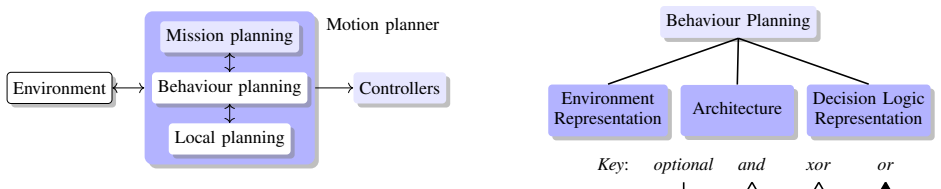
The organizing device is a three-axis feature diagram: environment representation, planner architecture, and decision logic representation, each drawn as an exclusive-or or optional feature tree. Feature diagrams are a notation for showing which design choices are mandatory, alternative, or optional, and the paper uses them to make the design space explicit and comparable. The work this device does is to convert a diffuse set of engineering experiences into a structured map, so that a designer can see which combinations are possible and which trade-offs are built into each branch.
What would settle it
Compare two identical planners that differ only in environment representation, such as an occupancy grid versus a feature-based map, on a fixed scenario suite and measure decision quality and computation time; if the higher-fidelity representation yields no improvement in decision quality, the claimed fidelity-versus-computation trade-off for the first axis is falsified.
Extended reading notes
Core claim
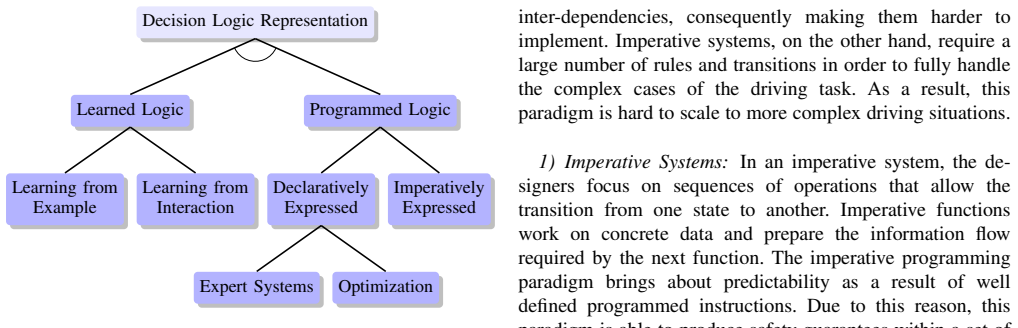
The central claim is that behaviour planning designs can be decomposed into precisely three principal axes of choice, and that along each axis the available options form a small set with an inevitable qualitative trade-off. Environment representation runs from raw lidar or camera data through feature-based maps and occupancy grids to latent vectors, trading fidelity for computational convenience and human interpretability. Planner architecture ranges from a behaviour planner cleanly separated from a local planner to fully integrated learned pipelines, trading simplicity and verifiability against the accuracy that comes from planning over the actual executable trajectory. Prediction can be explicitly modeled outside or inside the planner, or left implicit inside a learned policy. Decision logic is either programmed (imperative state machines or declarative expert/optimization systems) or learned (from example, from interaction, or both). The paper argues that no cell in this space is uniformly best; each choice constrains others, and for every axis the trade-off is structural rather than accidental.
Load-bearing premise
The load-bearing premise is that behaviour planning and local planning can be treated as separable sub-tasks, with the behaviour planner issuing discrete high-level actions; if that separation is not fundamental, the three-axis decomposition describes engineering convention rather than the true design space.
Editorial extensions
If this is right
- A designer choosing an environment representation can predict which failure modes will dominate: raw data maximizes information but forces end-to-end learning, while grids and features simplify perception at the cost of decision errors from lost detail.
- If the behaviour planner is architecturally separated from the local planner, the system risks computational redundancy and conflicting solutions, so separated designs must accept that cost or add a path-generation step.
- Using an internal belief-space prediction model, as in POMDP-based planners, can produce safer responses to other road users who react to the ego vehicle, but the paper notes this is computationally intractable with many road users.
- Programmed logic supports traceability and traditional software safety analysis, while learned logic generalizes better but is hard to verify, so any safety case must be designed around one of these two properties.
- Because no single axis choice dominates, the paper's conclusion is that practical high-performance systems will likely be hybrid, with learned modules supervised by programmed logic.
Reading between the lines
- An implication the paper leaves implicit is that reported system-level failures should cluster along the axis the designer simplified: perception errors for grid- and feature-based planners, verification failures for learned logic, and redundancy or conflict bugs for separated architectures.
- The taxonomy implies a natural comparison benchmark the paper says is missing: place published planners in the three-axis grid and compare performance within each cell while holding one axis fixed, which would also reveal whether the axes are truly independent or strongly correlated in practice.
- The paper stops short of saying so, but its own examples suggest that the choice of prediction architecture may be the axis that most determines the others, since every prediction option carries a different environment representation and decision-logic requirement.
Signed reviews
Editorial analysis
A structured set of objections, weighed in public.
Referee Report
Summary. This paper proposes a decomposition of the design space of behaviour planning for autonomous driving into three principal axes: environment representation (raw data, features, grid-based, latent space), motion-planner architecture (integration of behaviour planning and local planning, and prediction architecture), and decision-logic representation (programmed vs learned logic). The authors review representative literature along each axis, discuss qualitative trade-offs, and illustrate the choices with feature diagrams. They conclude that no benchmark currently exists for behaviour planners and speculate that future solutions will be hybrid, incorporating learned modules supervised by programmed logic.
Significance. If the decomposition were correct, it would give practitioners a common vocabulary for describing and comparing behaviour planning systems and a structured map of research gaps. The paper's strengths are its broad reference set, its explicit feature-diagram notation, and its candid admissions about the lack of benchmarks and the likely hybrid future of the field. However, all claims are qualitative and are grounded in the authors' practical experience rather than a systematic evaluation, so the contribution is a position/taxonomy paper whose value depends on whether the chosen axes and trade-offs are accepted and found useful by the community.
major comments (2)
- [Section V, Fig. 6, Section VI] The top-level exclusive-or in Fig. 6 and the claim in Section V that 'the final high level driving decision is made by exclusively following one of these two paradigms' are internally inconsistent with Section VI, which states that future safe and high-performance behaviour planning will be 'hybrid and heterogeneous, incorporating modules consisting of learned systems supervised by programmed logic.' The paper's own cited literature also contains such hybrids: [5] adds a rule-based safety layer on an imitation policy, [9] combines a learned model with tree search, and [64] bootstraps reinforcement learning with imitation learning. Because the taxonomy's central claim is to decompose the design space with 'inevitable qualitative trade-offs,' excluding the very design that the authors themselves endorse from the decision-logic axis makes the decomposition incomplete. The fix is to replace the exclusive-or with an or-connective or to add an explicit hybrid/composite category, and to adjust the accompanying text accordingly.
- [Section I, Fig. 3] The paper asserts that the design space decomposes into 'three principal axes,' but it never states the criteria by which a design choice is 'principal,' nor how completeness of the decomposition is established. The feature-diagram notation in Fig. 3 has a formal semantics (xor, or, optional) that implies the diagram is intended to be exhaustive; however, the text justifies the choice only by 'practical experience' (Section I) and does not rule out other axes, such as prediction model class, perception interface, or fail-safe behavior. As a result, the central claim of a faithful decomposition cannot be checked or falsified. The authors should either provide explicit selection criteria (for example, orthogonality and coverage of the state of the art) and justify each axis against them, or explicitly frame the work as an experience-based taxonomy that is not claimed to be complete.
minor comments (6)
- [Section II] There is a typo in 'will be discussd in Section IV-A'; it should read 'discussed.'
- [Section II, Section IV-A2] The definition of behaviour planning as issuing discrete high-level actions and local planning as generating continuous trajectories (Section II) is not literally applicable to the integrated/end-to-end architectures described in Section IV-A2, where no separate BP module exists. The paper would benefit from stating that 'behaviour planning' denotes a functional role rather than a mandatory separate module, so that the taxonomy clearly covers both separated and integrated designs.
- [Section IV-B, Fig. 5] The feature diagram in Fig. 5 does not make the relationship between 'Explicitly Defined' prediction and the 'Internal/External' alternatives visually unambiguous; the text says explicit prediction models can be either internal or external, but the diagram's connectors should be drawn to reflect that choice explicitly.
- [References] References [46] and [64] are the same technical report by Shalev-Shwartz et al., 'Safe, multi-agent, reinforcement learning for autonomous driving'; they should be merged or cross-referenced to avoid duplicate bibliography entries.
- [Section V-A1] The statement that 'the authors do not believe that these approaches can adequately handle the noisy aspects of real world driving' is presented as an unsupported assertion. Since it is used to support the trade-off between interpretability and robustness, it should be explicitly labeled as a subjective assessment or supported with evidence.
- [Section III-D] The abbreviation 'V AE' should be written as 'VAE' without the space.
Circularity Check
No circularity: the paper is a literature-based taxonomy with no fitted inputs, no predictions, and no load-bearing self-citations.
full rationale
The paper makes no empirical predictions and fits no parameters, so the usual fit-to-prediction circularity cannot arise. Its three-axis decomposition is justified by reference to the surveyed literature plus the authors' practical experience (e.g., [2] is a press account of the Waterloo Autonomoose project; [22] is one author's trajectory-prediction paper). These citations frame the survey but do not constitute the load-bearing derivation of any claim: the environment-representation, architecture, and decision-logic axes are each illustrated with multiple independently published systems ([6]-[8], [13]-[15], [28]-[31], [33]-[42], [47]-[70]), so the taxonomy's content is not reducible to the authors' own prior results. The main internal tension, Section V's exclusive-or between programmed and learned logic versus Section VI's suggestion of hybrids with learned systems supervised by programmed logic, is a consistency problem in the proposed taxonomy, not a case where a prediction or derivation is equivalent to its inputs by construction. Under the hard rules, this does not count as circularity.
Assumptions & free parameters
assumptions (3)
- ad hoc to paper The three principal axes (environment representation, architecture, decision logic representation) are the principal and sufficiently complete decomposition of the behaviour planning design space.
- domain assumption Behaviour planning and local planning are separable stages, with the behaviour planner making discrete high-level choices and the local planner producing continuous trajectories.
- domain assumption Qualitative trade-offs, such as fidelity versus computational burden and interpretability versus performance, are generalizable across systems.
Cite this review
Pith. "Pith review of Design Space of Behaviour Planning for Autonomous Driving." pith.science (2026). https://pith.science/paper/I7QT2XF5
@misc{pith2026190807931,
  author       = {Pith},
  title        = {Pith review of: Design Space of Behaviour Planning for Autonomous Driving},
  year         = {2026},
  howpublished = {\url{https://pith.science/paper/I7QT2XF5}},
  note         = {Machine review of arXiv:1908.07931}
}
read the original abstract
We explore the complex design space of behaviour planning for autonomous driving. Design choices that successfully address one aspect of behaviour planning can critically constrain others. To aid the design process, in this work we decompose the design space with respect to important choices arising from the current state of the art approaches, and describe the resulting trade-offs. In doing this, we also identify interesting directions of future work.
Figures


Figures from the paper (2 more)

Reference graph
Works this paper leans on
-
[5]
Chauffeurnet: Learning to drive by imitating the best and synthesizing the worst,
M. Bansal et al., “Chauffeurnet: Learning to drive by imitating the best and synthesizing the worst,” 2018, http://arxiv.org/abs/1812.03079
arXiv 2018
-
[9]
Combining neural networks and tree search for task and motion planning in challenging environments,
C. Paxton et al., “Combining neural networks and tree search for task and motion planning in challenging environments,” in 2017 IEEE/RSJ Int. Conf. on Intelligent Robots and Systems (IROS) , September 2017, pp. 6059–6066
work page 2017
-
[64]
Safe, multi-agent, reinforcement learning for autonomous driving,
S. Shalev-Shwartz et al., “Safe, multi-agent, reinforcement learning for autonomous driving,” 2016, http://arxiv.org/abs/1610.03295
arXiv 2016
-
[1]
Questions, options, and criteria: Elements of design space analysis,
A. MacLean et al. , “Questions, options, and criteria: Elements of design space analysis,” HumanComputer Interaction , vol. 6, no. 3-4, pp. 201–250, 1991
work page 1991
-
[2]
Waterloo’s ‘Autonomoose’ hits 100- kilometre milestone,
T. Pender, “Waterloo’s ‘Autonomoose’ hits 100- kilometre milestone,” Waterloo Region Record , Au- gust 2018. [Online]. Available: www.therecord.com/news-story/ 8859691-waterloo-s-autonomoose-hits-100-kilometre-milestone/
work page 2018
-
[3]
Feature-oriented domain analysis (FODA): feasi- bility study,
K. C. Kang et al. , “Feature-oriented domain analysis (FODA): feasi- bility study,” Carnegie Mellon Univ., Software Eng. Inst., Tech. Rep., 1990
work page 1990
-
[4]
Environment representations for automated on-road vehicles,
M. Schreier, “Environment representations for automated on-road vehicles,” at - Automatisierungstechnik , vol. 66, no. 2, pp. 107–118, feb 2018
work page 2018
-
[6]
End to end learning for self-driving cars,
M. Bojarski et al. , “End to end learning for self-driving cars,” 2016, http://arxiv.org/abs/1604.07316
arXiv 2016
Show all 69 references
-
[7]
Implementing a rule-based system to represent decision criteria for on-road autonomous navigation,
N. Zimmerman et al., “Implementing a rule-based system to represent decision criteria for on-road autonomous navigation,” in 2004 AAAI Spring Symp. on Knowledge Representation and Ontologies for Au- tonomous Systems, 2004
2004
-
[8]
Lanelets: Efficient map representation for au- tonomous driving,
P. Bender et al. , “Lanelets: Efficient map representation for au- tonomous driving,” in 2014 IEEE Intelligent Vehicles Symp. (IV) , June 2014, pp. 420–425
2014
-
[10]
K. P. Murphy, Machine Learning, A Probabilistic Perspective . MIT Press, 2012
2012
-
[11]
Learning sampling distributions for robot motion planning,
B. Ichter et al. , “Learning sampling distributions for robot motion planning,” Sep 2017, http://arxiv.org/abs/1709.05448
2017 arXiv
-
[12]
World models,
D. Ha and J. Schmidhuber, “World models,” 2018, http://arxiv.org/abs/1803.10122
2018 arXiv
-
[13]
Autonomous driving in urban environments: Boss and the Urban Challenge,
C. Urmson et al., “Autonomous driving in urban environments: Boss and the Urban Challenge,” Journal of Field Robotics Special Issue on the 2007 DARPA Urban Challenge, Part I, vol. 25, no. 8, pp. 425–466, June 2008
2007
-
[14]
Odin: Team VictorTango’s entry in the DARPA urban challenge,
A. Bacha et al., “Odin: Team VictorTango’s entry in the DARPA urban challenge,” Journal of field Robotics, vol. 25, no. 8, pp. 467–492, 2008
2008
-
[15]
Tartan Racing: A multi-modal approach to the DARPA urban challenge,
C. Urmson et al. , “Tartan Racing: A multi-modal approach to the DARPA urban challenge,” Carnegie Mellon Univ., Tech. Rep., 2007. [Online]. Available: http://repository.cmu.edu/robotics/967
2007
-
[16]
A behavioral planning framework for autonomous driving,
J. Wei et al. , “A behavioral planning framework for autonomous driving,” in IEEE Intelligent Vehicles Symp. Proc. IEEE, 2014, pp. 458–464
2014
-
[17]
Learning driving styles for autonomous vehicles from demonstration,
M. Kuderer et al. , “Learning driving styles for autonomous vehicles from demonstration,” in 2015 IEEE Int. Conf. on Robotics and Au- tomation (ICRA), May 2015, pp. 2641–2646
2015
-
[18]
Learning how to drive in a real world simulation with deep Q-networks,
P. Wolf et al., “Learning how to drive in a real world simulation with deep Q-networks,” in 2017 IEEE Intelligent Vehicles Symp. (IV) , June 2017, pp. 244–250
2017
-
[19]
Deep reinforcement learning framework for autonomous driving,
A. El Sallab et al. , “Deep reinforcement learning framework for autonomous driving,” Electronic Imaging, no. 19, pp. 70–76, 2017
2017
-
[20]
Learning driver behavior models from traffic observations for decision making and planning,
T. Gindele et al. , “Learning driver behavior models from traffic observations for decision making and planning,” IEEE Intelligent Transportation Systems Magazine, vol. 7, no. 1, pp. 69–79, 2015
2015
-
[21]
A non-conservatively defensive strategy for urban autonomous driving,
W. Zhan et al. , “A non-conservatively defensive strategy for urban autonomous driving,” in Intelligent Transportation Systems (ITSC), 2016 IEEE 19th Int. Conf. on . IEEE, 2016, pp. 459–464
2016
-
[22]
Trajectory prediction of traffic agents at urban intersections through learned interactions,
A. Sarkar et al. , “Trajectory prediction of traffic agents at urban intersections through learned interactions,” in 2017 IEEE 20th Int. Conf. on Intelligent Transportation Systems (ITSC) . IEEE, 2017, pp. 1–8
2017
-
[23]
A survey on motion prediction and risk assessment for intelligent vehicles,
S. Lef `evre et al., “A survey on motion prediction and risk assessment for intelligent vehicles,” ROBOMECH Journal, vol. 1, no. 1, p. 1, Jul 2014
2014
-
[24]
Recognition of situation classes at road intersections,
E. K ¨afer et al., “Recognition of situation classes at road intersections,” in IEEE Int. Conf. on Robotics and Automation (ICRA) . IEEE, 2010, pp. 3960–3965
2010
-
[25]
Stationary detection of the pedestrian intention at intersections,
S. Koehler et al. , “Stationary detection of the pedestrian intention at intersections,” IEEE Intelligent Transportation Systems Magazine , vol. 5, no. 4, pp. 87–99, 2013
2013
-
[26]
Will the pedestrian cross? A study on pedestrian path prediction,
C. G. Keller and D. M. Gavrila, “Will the pedestrian cross? A study on pedestrian path prediction,” IEEE Transactions on Intelligent Transportation Systems, vol. 15, no. 2, pp. 494–506, 2014
2014
-
[27]
Pedestrian path prediction using body language traits,
R. Quintero et al. , “Pedestrian path prediction using body language traits,” in Intelligent Vehicles Symp. Proc., 2014 IEEE . IEEE, 2014, pp. 317–323
2014
-
[28]
Intention-aware motion planning,
T. Bandyopadhyay et al., “Intention-aware motion planning,” in Algo- rithmic foundations of robotics X . Springer, 2013, pp. 475–491
2013
-
[29]
Probabilistic movement modeling for intention infer- ence in human–robot interaction,
Z. Wang et al., “Probabilistic movement modeling for intention infer- ence in human–robot interaction,” Int. Journal of Robotics Research , vol. 32, no. 7, pp. 841–858, 2013
2013
-
[30]
Intention-aware online POMDP planning for au- tonomous driving in a crowd,
H. Bai et al. , “Intention-aware online POMDP planning for au- tonomous driving in a crowd,” in 2015 IEEE Int. Conf. on Robotics and Automation (ICRA) . IEEE, 2015, pp. 454–460
2015
-
[31]
Motion planning under uncertainty using dif- ferential dynamic programming in belief space,
J. Van Den Berg et al., “Motion planning under uncertainty using dif- ferential dynamic programming in belief space,” in Robotics Research. Springer, 2017, pp. 473–490
2017
-
[32]
The mythos of model interpretability,
Z. C. Lipton, “The mythos of model interpretability,” 2016, http://arxiv.org/abs/1606.03490
2016 arXiv
-
[33]
Human driver model and driver decision making for intersection driving,
Y . Liu and U. Ozguner, “Human driver model and driver decision making for intersection driving,” in 2007 IEEE Intelligent Vehicles Symp. (IV), June 2007, pp. 642–647
2007
-
[34]
A system architecture for au- tonomous visual road vehicle guidance,
M. Maurer and E. D. Dickmanns, “A system architecture for au- tonomous visual road vehicle guidance,” inProc. of Conf. on Intelligent Transportation Systems, November 1997, pp. 578–583
1997
-
[35]
Automatic deployment of autonomous cars in a robotic urban-like environment (RULE),
M. Lahijanian et al., “Automatic deployment of autonomous cars in a robotic urban-like environment (RULE),” in 2009 IEEE Int. Conf. on Robotics and Automation (ICRA) , May 2009, pp. 2055–2060
2009
-
[36]
Highly automated driving on freeways in real traffic using a probabilistic framework,
M. Ardelt et al., “Highly automated driving on freeways in real traffic using a probabilistic framework,” IEEE Transactions on Intelligent Transportation Systems , vol. 13, no. 4, pp. 1576–1585, December 2012
2012
-
[37]
Fuzzy logic steering control of autonomous vehicles inside roundabouts,
J. P ´erez Rastelli and M. Santos Peas, “Fuzzy logic steering control of autonomous vehicles inside roundabouts,” Applied Software Computer, vol. 35, no. 1, pp. 662–669, Jul 2015
2015
-
[38]
Situation-aware decision making for autonomous driving on urban road using online POMDP,
W. Liu et al., “Situation-aware decision making for autonomous driving on urban road using online POMDP,” inIntelligent Vehicles Symp. (IV), 2015, pp. 1126–1133
2015
-
[39]
Online decision-making for scalable autonomous systems,
K. H. Wray et al., “Online decision-making for scalable autonomous systems,” in 26th International Joint Conference of Artificial Intelli- gence (IJCAI), 2017, pp. 4768–4774
2017
-
[40]
Multipolicy decision-making for autonomous driving via changepoint-based behavior prediction: Theory and exper- iment,
E. Galceran et al. , “Multipolicy decision-making for autonomous driving via changepoint-based behavior prediction: Theory and exper- iment,” Autonomous Robots, vol. 41, no. 6, pp. 1367–1382, Aug 2017
2017
-
[41]
Automated driving in uncertain environments: Planning with interaction and uncertain maneuver prediction,
C. Hubmann et al. , “Automated driving in uncertain environments: Planning with interaction and uncertain maneuver prediction,” IEEE Transactions on Intelligent Vehicles, vol. 3, no. 1, pp. 5–17, 2018
2018
-
[42]
Probabilistic decision-making under uncertainty for autonomous driving using continuous POMDPs,
S. Brechtel et al., “Probabilistic decision-making under uncertainty for autonomous driving using continuous POMDPs,” 17th International IEEE Conference on Intelligent Transportation Systems (ITSC) , pp. 392–399, Oct 2014
2014
-
[43]
Biologically inspired online learning of visual autonomous driving,
K. ¨Ofj¨all and M. Felsberg, “Biologically inspired online learning of visual autonomous driving,” in British Machine Vision Conf. 2014, Nottingham, UK September 1-5 2014 . BMV A Press, 2014, pp. 137– 156
2014
-
[44]
Visual autonomous road following by symbiotic online learning,
K. ¨Ofj¨all et al., “Visual autonomous road following by symbiotic online learning,” in 2016 IEEE Intelligent Vehicles Symp. (IV), June 2016, pp. 136–143
2016
-
[45]
Evolving large-scale neural networks for vision- based reinforcement learning,
J. Koutn ´ık et al. , “Evolving large-scale neural networks for vision- based reinforcement learning,” in 15th Annual Conf. on Genetic and Evolutionary Computation (GECCO) . ACM, 2013, pp. 1061–1068
2013
-
[47]
Alvinn: An autonomous land vehicle in a neural network,
D. A. Pomerleau, “Alvinn: An autonomous land vehicle in a neural network,” in Advances in neural information processing systems, 1989, pp. 305–313
1989
-
[48]
Off-road obstacle avoidance through end-to-end learning,
U. Muller et al. , “Off-road obstacle avoidance through end-to-end learning,” in Advances in neural information processing systems, 2006, pp. 739–746
2006
-
[49]
Learning on-road visual control for self-driving vehicles with auxiliary tasks,
Y . Chen et al. , “Learning on-road visual control for self-driving vehicles with auxiliary tasks,” 2018, http://arxiv.org/abs/1812.07760
2018 arXiv
-
[50]
Maximum entropy inverse reinforcement learn- ing
B. D. Ziebart et al., “Maximum entropy inverse reinforcement learn- ing.” in AAAI, vol. 8. Chicago, IL, USA, 2008, pp. 1433–1438
2008
-
[51]
A reduction of imitation learning and structured prediction to no-regret online learning,
S. Ross et al. , “A reduction of imitation learning and structured prediction to no-regret online learning,” in 14th Int. Conf. on artificial intelligence and statistics , 2011, pp. 627–635
2011
-
[52]
A fast integrated planning and control framework for autonomous driving via imitation learning,
L. Sun et al. , “A fast integrated planning and control framework for autonomous driving via imitation learning,” in ASME 2018 Dynamic Systems and Control Conf. American Society of Mechanical Engi- neers, 2018
2018
-
[53]
End-to-end driving via conditional imitation learning,
F. Codevilla et al. , “End-to-end driving via conditional imitation learning,” in2018 IEEE Int. Conf. on Robotics and Automation (ICRA). IEEE, 2018, pp. 1–9
2018
-
[54]
Apprenticeship learning for motion planning with application to parking lot navigation,
P. Abbeel et al. , “Apprenticeship learning for motion planning with application to parking lot navigation,” in IEEE/RSJ Int. Conf. on Intelligent Robots and Systems (IROS) . IEEE, 2008, pp. 1083–1090
2008
-
[55]
Learning from demonstration for autonomous nav- igation in complex unstructured terrain,
D. Silver et al. , “Learning from demonstration for autonomous nav- igation in complex unstructured terrain,” Int. Journal of Robotics Research, vol. 29, no. 12, pp. 1565–1592, 2010
2010
-
[56]
High speed obstacle avoidance using monocular vision and reinforcement learning,
J. Michels et al. , “High speed obstacle avoidance using monocular vision and reinforcement learning,” in 22nd Int. Conf. on Machine Learning. ACM, 2005, pp. 593–600
2005
-
[57]
Autonomous overtaking decision making of driverless bus based on deep Q-learning method,
L. Yu et al. , “Autonomous overtaking decision making of driverless bus based on deep Q-learning method,” in 2017 IEEE Int. Conf. on Robotics and Biomimetics (ROBIO) . IEEE, 2017, pp. 2267–2272
2017
-
[58]
Continuous control with deep reinforcement learning,
T. P. Lillicrap et al. , “Continuous control with deep reinforcement learning,” 2015, http://arxiv.org/abs/1509.02971
2015 arXiv
-
[59]
Combining deep reinforcement learning and safety based control for autonomous driving,
X. Xiong et al. , “Combining deep reinforcement learning and safety based control for autonomous driving,” 2016, http://arxiv.org/abs/1612.00147
2016 arXiv
-
[60]
Overcoming catastrophic forgetting in neural networks,
J. Kirkpatrick et al. , “Overcoming catastrophic forgetting in neural networks,” National Academy of Sciences , pp. 3521–3526, 2017
2017
-
[61]
Combating reinforcement learning’s Sisyphean curse with intrinsic fear,
Z. C. Lipton et al. , “Combating reinforcement learning’s Sisyphean curse with intrinsic fear,” 2016, http://arxiv.org/abs/1611.01211
2016 arXiv
-
[62]
Environment-independent task specifications via GLTL,
M. L. Littman et al., “Environment-independent task specifications via GLTL,” 2017, http://arxiv.org/abs/1704.04341
2017 arXiv
-
[63]
A learning based approach to control synthesis of Markov decision processes for linear temporal logic specifications,
D. Sadigh et al. , “A learning based approach to control synthesis of Markov decision processes for linear temporal logic specifications,” in Decision and Control (CDC), 2014 IEEE 53rd Annual Conf. on . IEEE, 2014, pp. 1091–1096
2014
-
[65]
Composing meta-policies for autonomous driving using hierarchical deep reinforcement learning,
R. Liaw et al. , “Composing meta-policies for autonomous driving using hierarchical deep reinforcement learning,” 2017, http://arxiv.org/abs/1711.01503
2017 arXiv
-
[66]
Uncertainty-aware reinforcement learning for collision avoidance,
G. Kahn et al., “Uncertainty-aware reinforcement learning for collision avoidance,” 2017, http://arxiv.org/abs/1702.01182
2017 arXiv
-
[67]
R. S. Sutton and A. G. Barto, Reinforcement learning: An introduction. MIT press, 2018
2018
-
[68]
Adaptive learning based on guided exploration for decision making at roundabouts,
F. Gritschneder et al., “Adaptive learning based on guided exploration for decision making at roundabouts,” in 2016 IEEE Intelligent Vehicles Symp. (IV), June 2016, pp. 433–440
2016
-
[69]
Interaction-aware driver maneuver inference in highways using realistic driver models,
D. S. Gonz ´alez et al., “Interaction-aware driver maneuver inference in highways using realistic driver models,” in 2017 IEEE 20th Int. Conf. on Intelligent Transportation Systems (ITSC) , October 2017, pp. 1–8
2017
-
[70]
Individual versus difference rewards on reinforce- ment learning for route choice,
R. Grunitzki et al., “Individual versus difference rewards on reinforce- ment learning for route choice,” in 2014 Brazilian Conf. on Intelligent Systems, October 2014, pp. 253–258
2014
Reviewed August 14, 2026 · model on record in the stance chip above.
Discussion (0). Continue with ORCID to comment.