REVIEW 5 minor 19 references
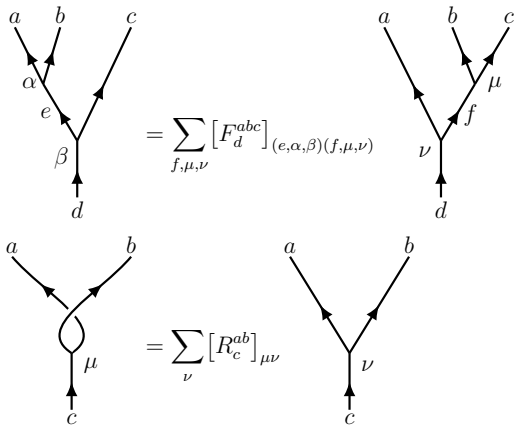
Some anyon models force complex fusion phases that no choice of basis can remove.
Reviewed by Pith at T0; open to challenge. T0 means a machine referee read the full paper against a public rubric. the ladder, T0–T4 →
T0 review · grok-4.5
2026-07-14 13:41 UTC pith:IDX6NR7M
load-bearing objection First explicit braided examples where F-symbols are forced complex; the calculations check out and the existence claim is solid.
Anyons and Inherently Complex F-symbols
The pith
A machine-rendered reading of the paper's core claim, the machinery that carries it, and where it could break.
Core claim
The unitary premodular categories Rep(Z7 ⋊ Z3) and Rep(Z5 ⋊ Z4) possess inherently complex F-symbols: the gauge-invariant quantities (F^χρρ_ρ)_ρρ = ζ_3^{-1} and Tr(F^χρρ_ρ (F^ρρχ_ρ)^{-1}) = −1 + 2i are non-real, so no unitary change of fusion basis can make all F-symbols real. The same obstruction is inherited by every (twisted) Drinfeld centre of these categories.
What carries the argument
Explicit gauge-invariant combinations of F-symbols built from the Hom-spaces of the two representation categories—namely the rank-one symbol F^χρρ_ρ in the first example and the matrix ratio F^χρρ_ρ (F^ρρχ_ρ)^{-1} in the second—whose non-real values survive every unitary redefinition of fusion bases.
Load-bearing premise
The bases chosen for the relevant fusion spaces already exhaust every continuous unitary gauge freedom that could cancel the computed complex phases.
What would settle it
Find a unitary gauge transformation on the fusion spaces of either category that renders every F-symbol real, or exhibit a lower-rank unitary premodular category whose F-symbols are inherently complex.
Editorial analysis
A structured set of objections, weighed in public.
Referee Report
Summary. The paper shows that F-symbols of unitary braided fusion categories need not admit a real gauge. It constructs explicit gauge-invariant non-real quantities for the rank-5 premodular categories Rep(Z7 times Z3) and Rep(Z5 times Z4): the one-dimensional symbol (F^χρρ_ρ)_ρρ = ζ_3^{-1} and Tr(F^χρρ_ρ (F^ρρχ_ρ)^{-1}) = -1 + 2i. Both categories lack a braided charge-conjugation autoequivalence, consistent with the converse of a companion result. The same obstruction is inherited by the corresponding (twisted) Drinfeld centres. The examples are linked to modular isotopy and to larger families of representation and near-group categories.
Significance. The result establishes that real F-symbols are not universal among low-rank unitary premodular categories and supplies the smallest-rank Rep(G) examples currently known. Strengths include fully explicit, self-contained calculations (character tables, fusion rules, restriction to normal subgroups, orbit bases for Hom-spaces, and normalised Hilbert–Schmidt overlaps) together with a consistency check against Siehler’s near-group F-symbols. The gauge-invariance arguments are direct and the inheritance to centres follows immediately by restriction. The work cleanly separates the existence claim from the companion paper and opens concrete generalisations (Rep(Zp times Zq), near-group families) relevant to classification beyond modular data.
minor comments (5)
- [Acknowledgments] Typographical error: “M. B.’s work work was partly supported” contains a duplicated word.
- [Abstract] The quotation marks around “inherently complex” are written with TeX \lq\lq; standard double quotes would render more cleanly.
- [Section 4.1, around (4.9) and (4.15)] A one-sentence remark that residual U(1) phases from the normalisations m1 = 1 cancel in the normalised overlap would make the gauge-invariance argument fully self-contained for readers less familiar with the Hom-space bases.
- [Sections 4.1–4.2] F-symbol indices appear both as subscripts and in parentheses; a uniform convention would improve readability.
- [Section 5] The open questions are useful; a brief prioritisation of whether lower-rank non-Rep(G) examples exist would sharpen the “smallest-rank we know of” claim.
Circularity Check
No significant circularity: the non-reality claims rest on explicit, self-contained Hom-space computations of gauge-invariant F-quantities, with the companion paper used only for motivational context.
full rationale
The paper's central existence claims are the two explicit evaluations (F^χρρ_ρ)_ρρ = ζ_3^{-1} (eq. 4.19) and Tr(F^χρρ_ρ (F^ρρχ_ρ)^{-1}) = -1 + 2i (eq. 4.49). Both are obtained by constructing unitary intertwiners on the Hom-spaces of the representation categories from the character tables and fusion rules (Tables 1–4), evaluating Hilbert–Schmidt overlaps, and verifying invariance under residual unitary gauges Γ (eqs. 4.5, 4.26–4.28). These steps do not invoke the companion work [7] as a premise; [7] is cited only for the converse implication that a braided charge-conjugation autoequivalence would force real F-symbols, and for the motivational selection of groups lacking class-inverting automorphisms. Character tables, fusion rules, and the consistency check against Siehler [18] are external and independently verifiable. There are no fitted parameters, no self-definitional identities, and no uniqueness theorems imported from the authors that force the result. The inheritance to Drinfeld centres follows by restriction of the same F-data. Score 1 reflects only the minor, non-load-bearing self-citation of the companion for context.
Axiom & Free-Parameter Ledger
axioms (4)
- standard math Unitary braided spherical fusion categories satisfy the pentagon and hexagon equations; F- and R-symbols transform under unitary gauge transformations of fusion spaces as in (2.4) and (2.6).
- domain assumption A finite group G admits a class-inverting automorphism if and only if Rep(G) admits a braided charge-conjugation autoequivalence (Davydov, Theorem 2.14).
- standard math The character tables and fusion rules of Z7 ⋊ Z3 and Z5 ⋊ Z4 are those listed in Tables 1–4.
- standard math The Drinfeld centre of a braided fusion category inherits the F-symbols of any braided subcategory.
invented entities (1)
-
inherently complex F-symbols
independent evidence
read the original abstract
Anyons in $2+1$ dimensions are not only characterized by exotic braiding statistics but also by intricate fusion properties. Two anyons may fuse into multiple topological charge sectors, and associativity of fusing three anyons to produce a fixed charge sector is governed by $F$-symbols. While braiding invariants, such as the modular data, are typically complex valued, a complete description of general anyon models requires understanding the arithmetic properties of its fusion associativity data as well. The $F$-symbols for many of the most common $2+1$d topological orders, including all Abelian anyon models as well as Fibonacci and Ising anyons, can be made real valued. We show this phenomenon is not universal by exhibiting braided fusion categories whose $F$-symbols cannot be made real. We call such $F$-symbols \lq\lq inherently complex." The examples we study lack a charge-conjugation symmetry and our results are therefore consistent with the converse of a statement proved in a companion work linking real $F$-symbols in braided fusion categories with the existence of a suitable charge-conjugation symmetry. We analyse the smallest-rank braided fusion categories we know of with inherently complex $F$-symbols: ${\rm Rep}(\mathbb{Z}_7\rtimes\mathbb{Z}_3)$ and ${\rm Rep}(\mathbb{Z}_5\rtimes\mathbb{Z}_4)$. Consequently, the corresponding $\mathcal Z({\rm Rep}(\mathbb{Z}_7\rtimes\mathbb{Z}_3))$ and $\mathcal Z({\rm Rep}(\mathbb{Z}_5\rtimes\mathbb{Z}_4))$ anyon models also have inherently complex $F$-symbols. Our presentation connects these examples with recent results on classifying anyons beyond modular data.
Figures
Reference graph
Works this paper leans on
-
[1]
Classification of modular data up to rank 12
S.-H. Ng, E. C. Rowell & X.-G. Wen,“Classification of modular data up to rank 12”, arXiv:2308.09670
-
[2]
Modular categories are not determined by their modular data
M. Mignard & P. Schauenburg,“Modular categories are not determined by their modular data”, Letters in Mathematical Physics111, 60 (2021)
2021
-
[3]
Recovering R-symbols from modular data
S.-H. Ng, E. C. Rowell & X.-G. Wen,“Recovering R-symbols from modular data”, arXiv:2408.02748
-
[4]
Large quantum Fourier transforms are never ex- actly realized by braiding conformal blocks
M. H. Freedman & Z. Wang,“Large quantum Fourier transforms are never ex- actly realized by braiding conformal blocks”, Phys. Rev. A (3)75, 032322 (2007), https://doi.org/10.1103/PhysRevA.75.032322
-
[5]
M. Balasubramanian, M. Buican & R. Radhakrishnan,“On the Classification of Bosonic and Fermionic One-Form Symmetries in2 + 1d and ’t Hooft Anomaly Matching”, Commun. Math. Phys.406, 319 (2025),arXiv:2408.00866 [hep-th]
Pith/arXiv arXiv 2025
-
[6]
Group categories and their field theories
F. Quinn,“Group categories and their field theories”, Geom. Topol. Monographs2, 507 (1999),math/9811047
Pith/arXiv arXiv 1999
-
[7]
Reality and Complexity of F-symbols in 2+1d Topological Phases (To Appear)
M. Buican, P. Huston & J. K. Pachos,“Reality and Complexity of F-symbols in 2+1d Topological Phases (To Appear)”
-
[8]
Unphysical diagonal modular invariants
A. Davydov,“Unphysical diagonal modular invariants”, J. Algebra446, 1 (2016), https://doi.org/10.1016/j.jalgebra.2015.09.007
-
[9]
Theory of Groups of Finite Order
W. Burnside,“Theory of Groups of Finite Order”, 2nd edition, Cambridge University Press (1911) ✦ G. A. Miller,“Groups involving only a small number of sets of conjugate operators”, Arch. Math. und Phys.17, 199 (1911)
1911
-
[10]
On braided near-group categories
J. Thornton,“On braided near-group categories”,arXiv:1102.4640
-
[11]
Bogomolov multiplier, double class-preserving automorphisms, and mod- ular invariants for orbifolds
A. Davydov,“Bogomolov multiplier, double class-preserving automorphisms, and mod- ular invariants for orbifolds”, Journal of Mathematical Physics55, 092305 (2014), DOI:10.1063/1.4895764 arXiv:1312.7466,https://doi.org/10.1063/1.4895764
-
[12]
Tensor categories
P. Etingof, S. Gelaki, D. Nikshych & V. Ostrik,“Tensor categories”, American Mathe- matical Soc. (2015)
2015
-
[13]
D. Gaiotto, A. Kapustin, N. Seiberg & B. Willett,“Generalized Global Symmetries”, JHEP1502, 172 (2015),arXiv:1412.5148 [hep-th] 24
Pith/arXiv arXiv 2015
-
[14]
Symmetry Fractionalization, Defects, and Gauging of Topological Phases
M. Barkeshli, P. Bonderson, M. Cheng & Z. Wang,“Symmetry Fractionalization, Defects, and Gauging of Topological Phases”, Phys. Rev. B100, 115147 (2019), arXiv:1410.4540 [cond-mat.str-el]
Pith/arXiv arXiv 2019
-
[15]
Signatures of broken parity and time reversal symmetry in generalized string-net models
E. Lake & Y.-S. Wu,“Signatures of broken parity and time reversal symmetry in generalized string-net models”, Phys. Rev. B94, 115139 (2016), arXiv:1605.07194 [cond-mat.str-el]
Pith/arXiv arXiv 2016
-
[16]
A Note on the Eilenberg-Mac Lane Isomorphism for Quadratic Forms
C. Galindo,“A Note on the Eilenberg-Mac Lane Isomorphism for Quadratic Forms”, arXiv:2507.15726
-
[17]
On the groups H(Π, n), I
S. Eilenberg & S. Mac Lane,“On the groups H(Π, n), I”, Annals of Mathematics 58, 55 (1953) ✦ S. Eilenberg & S. Mac Lane,“On the groups H(Π, n), II: methods of computation”, Annals of Mathematics60, 49 (1954) ✦ A. Joyal & R. Street,“Braided tensor categories”, Advances in Math102, 20 (1993)
1953
-
[18]
Near-group categories
J. Siehler,“Near-group categories”, Algebraic & Geometric Topology3, 719 (2003)
2003
-
[19]
Galois orbits of TQFTs: symmetries and unitarity
M. Buican & R. Radhakrishnan,“Galois orbits of TQFTs: symmetries and unitarity”, JHEP2201, 004 (2022),arXiv:2109.02766 [hep-th] 25
Pith/arXiv arXiv 2022
discussion (0)
Sign in with ORCID, Apple, or X to comment. Anyone can read and Pith papers without signing in.