REVIEW 3 major objections 5 minor 4 cited by
Quantum noise spectroscopy of superconducting dynamics in thin film Bi$_2$Sr$_2$CaCu$_2$O$_{8+\delta}$
T0 review · 3 major / 5 minor · reviewed 2026-08-08 · deepseek-v4-flash
Pith's one-line read This paper claims that nitrogen-vacancy (NV) spin sensors placed nanometres from a thin film of the high-temperature superconductor BSCCO can read the GHz magnetic noise of its quasiparticles, critical fluctuations, and vortices.
desk verdict First NV noise spectroscopy on a thin-film cuprate with solid qualitative results, but the claimed determination of critical exponents is circular — revise before publication. read the letter →
The pith
A machine-rendered reading of the paper's core claim, the machinery that carries it, and where it could break.
The reading
What carries the argument
The load-bearing machinery is the ensemble of nitrogen-vacancy (NV) centers as local GHz magnetic-noise detectors, coupled to a time-dependent Ginzburg-Landau (TDGL) Langevin description of the superconducting order parameter $\psi(\mathbf{r},t)$. The NV spin relaxation rate is set by magnetic noise at the $\approx 2.87$ GHz zero-field splitting, computed from the transverse current-current correlator of the BSCCO layers; the current operator is $J(\mathbf{r}) = (\hbar e^* / 2 i m^*)(\psi^* \nabla \psi - \psi \nabla \psi^*)$. The order parameter obeys $\partial_t \psi = -\gamma\, \delta F/\delta \psi^* + \eta$ with Gaussian white noise $\eta$ and free energy $F = \int [K|\nabla\psi|^2 + r(T)|\psi|^2 + (u/2)|\psi|^4]$, where $r(T) \propto T-T_c$. Near criticality the relaxation time diverges as $\tau \propto \xi^z \propto |T-T_c|^{-z\nu}$ with $\nu = 1/2$, $z = 2$, and this critical slowing down is what produces the $|T-T_c|^{-1}$ divergence of $\Gamma_1$. To connect the model to data, BSCCO is treated as 240 independent CuO$_2$ layers at an assumed average NV distance of 25 nm.
What would settle it
Measure $\Gamma_1(T)$ near $T_c$ with a single NV whose distance from the BSCCO surface is known by construction, rather than an ensemble with an assumed 25 nm average standoff; if the extracted divergence exponent moves from $x \approx 1$ toward the BCS value $1/2$, or if the fitted ratios $\tau_{\rm M}/\tau_{\rm GL}$ and $\tau_{\rm SC}/\tau_{\rm GL}$ shift substantially when $z_0$ is varied within the model, the central quantitative claim would be overturned. A complementary check is to measure the same critical current fluctuations via paraconductivity or THz conductivity on the same film and compare exponents.
Extended reading notes
Core claim
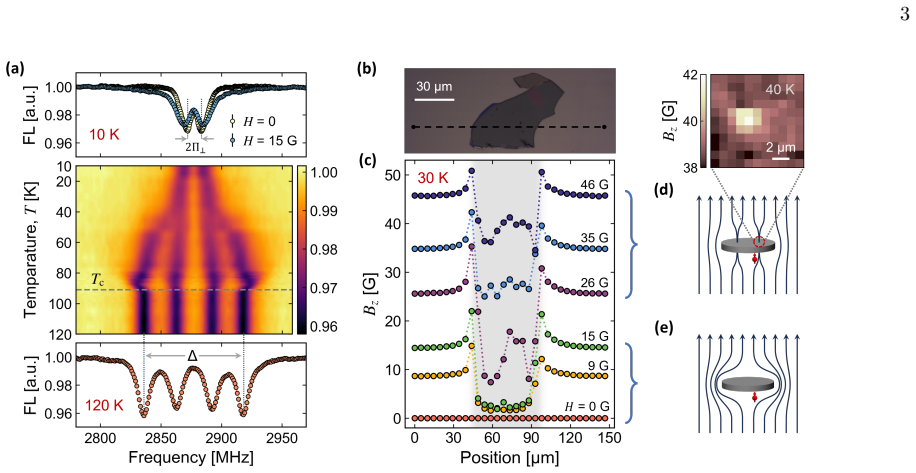
The paper's central claim is that the temperature dependence of the BSCCO-induced NV relaxation rate $\Gamma_1(T)$ at zero field is a direct readout of three distinct low-energy dynamical regimes in a thin-film cuprate. At $T \ll T_c$, $\Gamma_1 \propto T^2$, consistent with nodal d-wave quasiparticles at BCS mean-field level. Near $T_c \approx 90$ K, $\Gamma_1$ rises in a sharp symmetric peak that scales as $|T-T_c|^{-x}$ with $x \approx 1$, clearly distinct from the BCS prediction $x = 1/2$; the paper attributes this extra singularity to amplitude and phase fluctuations of the superconducting order parameter. A TDGL Langevin equation with Gaussian white noise, treated with mean-field exponents $\nu = 1/2$, $z = 2$, reproduces the divergence on both the metallic and superconducting sides and yields fitted relaxation-time ratios $\tau^{\rm fit}_{\rm M}/\tau_{\rm GL} \approx 1.2$ and $\tau^{\rm fit}_{\rm SC}/\tau_{\rm GL} \approx 0.2$, bracketing the analytical weak-coupling values $1$ and $0.5$. In an applied field the transition peak broadens and becomes asymmetric as vortices enter, with $\Gamma_1 \propto H$ as expected for a diffusive vortex liquid; $T_2$ noise spectroscopy additionally resolves MHz-frequency fluctuations assigned to vortex motion in the vortex solid deep below $T_c$.
Load-bearing premise
The quantitative claims assume the superconductor's order parameter relaxes exactly as a Gaussian-noise Langevin equation with mean-field exponents predicts, and that the NV sensors sit at an assumed average distance of 25 nm from 240 independent copper-oxide layers; if the real distance or interlayer coupling differs, the fitted relaxation times and the apparent critical exponent change substantially.
Editorial extensions
If this is right
- NV $T_1$ relaxometry can extract the characteristic order-parameter relaxation time $\tau$ near $T_c$ and the static and dynamic critical exponents ($\nu = 1/2$, $z = 2$) from a thin-film superconductor without electrical contact.
- The observed $\Gamma_1 \propto T^2$ low-temperature noise is a fingerprint of nodal d-wave quasiparticles, so the same measurement on other thin-film superconductors should distinguish nodal from fully gapped pairing.
- The near-$T_c$ scaling $\Gamma_1 \propto |T-T_c|^{-1}$ shows that order-parameter fluctuations, not just BCS quasiparticles, dominate the magnetic noise of thin cuprate films at criticality.
- In a magnetic field, the linear $\Gamma_1(H) \propto H$ scaling and the broadened asymmetric peak locate a diffusive vortex liquid phase, while $T_2$ spectroscopy at MHz frequencies extends the platform to vortex-solid flux motion.
- The technique extends to other superconductors, including hydrides and nickelates under high pressure inside diamond anvil cells, where the same NV sensors can probe pressure-driven transitions.
Reading between the lines
- Editorial inference: Because the momentum range of the detected noise is set by the NV–sample distance, a scanning single NV could map not only static vortices but the spatial texture of fluctuating supercurrents; the paper demonstrates static imaging but not dynamic sub-micron noise imaging.
- Editorial inference: The asymmetry between $\tau_{\rm M}/\tau_{\rm GL} \approx 1.2$ and $\tau_{\rm SC}/\tau_{\rm GL} \approx 0.2$ suggests that phase and amplitude fluctuations of the order parameter relax at different rates; if reproduced in other cuprates, this asymmetry would constrain microscopic theories of pair relaxation beyond the weak-coupling limit.
- Editorial inference: The zero-field critical exponent $x \approx 1$ could be cross-checked on the same films by paraconductivity or THz conductivity measurements, which probe the same fluctuating supercurrents through different observables; agreement would strengthen the TDGL description.
- Editorial inference: Because the fitted ratios assume a 25 nm average NV distance, a single-NV measurement with a known standoff would either confirm or revise the close-to-weak-coupling conclusion; varying $z_0$ by tens of nanometres in the model would show how strongly the extracted $\tau$ ratios depend on this assumption.
Editorial analysis
A structured set of objections, weighed in public.
Referee Report
Summary. The paper reports NV-center noise spectroscopy measurements on a thin film of the high-Tc superconductor Bi2Sr2CaCu2O8+δ (BSCCO) exfoliated onto a diamond substrate. Using ODMR, T1 relaxometry, and T2 (XY-8) decoherence measurements, the authors observe the Meissner effect and trapped vortices, a low-temperature BSCCO-induced NV relaxation rate scaling as T^2 (attributed to nodal d-wave quasiparticles), a sharp peak in the relaxation rate near Tc, and low-frequency vortex-solid fluctuations below Tc. The critical peak is modeled with a time-dependent Ginzburg-Landau (TDGL) Langevin equation, and the authors extract order-parameter relaxation times on both sides of the transition, reporting ratios to the weak-coupling Ginzburg-Landau timescale of approximately 1.2 (metallic) and 0.2 (superconducting). The paper claims that these results enable the determination of both static and dynamical critical exponents.
Significance. If the claims hold, this work introduces a genuinely new non-invasive probe of low-energy superconducting dynamics, with nanoscale spatial resolution and access to MHz-GHz frequencies that are complementary to scattering, transport, and local-probe techniques. The qualitative observations—Meissner expulsion, vortex imaging, and the distinct temperature dependences in T1 and T2—are convincing and should be of broad interest. The low-temperature T^2 power law is a useful consistency check for d-wave pairing. However, the quantitative headline claim that the experiment determines the static and dynamical critical exponents is not supported by the analysis as presented, because the TDGL model assumes mean-field exponents and the fit only constrains the product zν. The paper also does not provide error bars for the extracted exponent or a sensitivity analysis for the assumed sensor-sample geometry. The experimental core is sound, but the central quantitative claims require reworking before publication.
major comments (3)
- [Abstract, Introduction, and Methods Eqs. (M10)-(M13)] The central claim that the measurement enables 'the determination of both static and dynamical critical exponents' (abstract; also Introduction) is not supported by the analysis. In the TDGL Langevin model, Eqs. (M10)-(M13) set r(T) ∝ T − Tc and ξ² = K/r, which fixes the static exponent ν = 1/2, and the relaxation rate of the uniform mode τ_M⁻¹ = γr ∝ T − Tc fixes the dynamical exponent z = 2 through the scaling τ ∝ ξ^z. These values are inputs to the model, not outputs of the fit; the fit only determines the overall timescale τ_fit. The measured log-log slope x ≈ 1 in Fig. 3(e) constrains only the combination zν = 1, not ν and z separately. The main-text sentence stating that 'the resulting value of the associated critical exponents, ν = 1/2 and z = 2, directly reproduce the aforementioned divergence' is therefore circular. Please revise the abstract, introduction, and main text to characterize the results as consistency tests with the assumed mean-field exponents, and remove the claim that ν and z are determined.
- [Fig. 3(e)] The exponent x ≈ 1 is a load-bearing quantitative result, because it is the basis for the claimed deviation from the BCS mean-field value x = 1/2. The data points in Fig. 3(e) are shown without error bars, and the fitting procedure (temperature range, weighting, treatment of Tc uncertainty, number of points, and whether the fit is to the raw Γ1 or to a binned/log-averaged quantity) is not described. Please include error bars on Γ1(T), state explicitly how x is extracted, and provide a confidence interval. Without this, the reader cannot assess whether x is significantly different from 1/2.
- [Methods, Eqs. (M5), (M13)-(M15)] The quantitative ratios τ_fit^M/τ_GL ≈ 1.2 and τ_fit^SC/τ_GL ≈ 0.2 are obtained from absolute noise magnitudes that depend directly on the assumed geometry: an average NV-to-sample distance z0 = 25 nm and a total of 240 independent active CuO2 layers (60 unit cells × 4 layers). The Methods state that these values are assumed, but no systematic uncertainty is propagated into the fitted timescales. Because the NV ensemble has a depth distribution (SRIM profile, approximately 50 nm) and the flake thickness is estimated by optical contrast (similar flakes measured as 188–300 nm), the extracted τ ratios could shift by order-one factors. Please provide a sensitivity analysis over z0 and the number of layers, or quote the timescales with a systematic uncertainty. The assumption of negligible interlayer correlations is also worth justifying, since interlayer Josephson coupling could change the effective dimensionality of the fluctuations.
minor comments (5)
- [References, Ref. [19]] Reference [19], cited for electrical transport, points to a paper on AC electrical conduction in p-CuIn3Se5; please replace it with a standard transport reference for superconductors or for the specific BSCCO transport data you rely upon.
- [Fig. 1(a) caption] The acronym 'APRES' should be 'ARPES' (angle-resolved photoemission spectroscopy).
- [Methods, Characterization of BSCCO] The phrase 'four-point-prob method' should be 'four-point-probe method'.
- [Supplementary Information, Sections II.1 and II.2] There are several typographical errors: 'temparature' in Section II.1, 'vaccum' in Section II.2, and 'BSSCO' in the caption of Fig. S2 should be 'BSCCO'.
- [Methods, Eq. (M15)] Equation (M15) is derived in the Ω → 0 limit, but the T1 measurement probes noise at 2.87 GHz. Please clarify why this frequency can be treated as much smaller than the relevant electronic relaxation scales in BSCCO, or briefly discuss the validity of the low-frequency approximation.
Circularity Check
Critical-exponent 'determination' is circular: ν=1/2 and z=2 are model inputs and the data only constrain zν; τ ratios are fitted, not predicted.
-
self definitional
[Main text, section 'Zero-field superconducting fluctuations', final paragraph before 'In-field criticality and vortex dynamics'.]
"Indeed, the resulting value of the associated critical exponents, ν = 1/2 and z = 2 [37], directly reproduce the aforementioned divergence of the scattering timescale τ via the scaling behavior of the correlation length ξ: τ ∝ ξz ∝ |T − Tc|−zν."
The values ν=1/2 and z=2 were put into the model before any fit: Methods Eq. (M13) defines (τM)^-1 = γr with r ∝ T−Tc and ξ² = K/r, i.e. ξ ∝ |T−Tc|^{-1/2}, and Eq. (M10) is the non-conserved (Model A) Langevin equation, i.e. z=2. The measured Γ1(T) exponent x≈1 constrains only the product zν; the two individual exponents are inputs, not outputs. Asserting that they are 'determined' and 'directly reproduce' the divergence equates the model's conclusion with its own assumptions.
-
fitted input called prediction
[Methods, 'Metallic Side', immediately after Eq. (M13).]
"Since BSCCO is not necessarily in the weak-coupling regime, we will treat τM as a phenomenological parameter, and extract the ratio τM/τGL by fitting with the experimental data. ... Fitting against the data, we find that the decay time scales as τ fit M ≈ 1.2 τ wc M = 1.2 τGL, which is close to the weak coupling limit."
The headline agreement τ_fit/τGL ≈ 1.2 is the value of the single free normalization parameter used to scale the model to the data, not a prediction of the divergence exponent or of the timescale. Because the functional form of Γ1(T) is fixed by the assumed TDGL inputs, any data collapsing onto a |T−Tc|^-1 slope yields a fitted ratio by construction; comparing that fitted amplitude to the weak-coupling value is a consistency check, not independent confirmation.
1 more flagged steps
-
self definitional
[Methods, 'Superconducting Side', paragraph deriving Eq. (M15).]
"We further express uM0 in terms of the relaxation time τSC of the amplitude mode near the critical point, which can be derived analytically in terms of the parameters of the Ginzburg-Landau theory [5, 11, 12] as τSC = 1/(2γ|r|) = 1/(2γuM0). Combining these expressions, we arrive at the final form of the transverse magnetic noise (see Eq. (M5)) which reads NT (Ω) = µ2 0(kBT )2τSC log(2) (4π)2z2 0 ( e∗ ℏ )2."
The model defines τSC = 1/(2γ|r|) ∝ |T−Tc|^{-1} and then makes the final noise formula proportional to τSC. The superconducting-side divergence Γ1 ∝ |T−Tc|^{-1} is therefore present in the model by definition. The subsequent fit ('we obtain a ratio of τ fit SC/τ wc SC = 0.38') merely rescales this predetermined divergence; the data slope cannot separately determine the static exponent ν or the dynamical exponent z.
full rationale
Most of the experimental content is self-contained and not circular: the Meissner and vortex imaging, the low-temperature Γ1(T) ∝ T^2 nodal-quasiparticle behavior, the in-field Γ1(H) ∝ H vortex-liquid scaling, and the T2 vortex-solid noise are compared with external predictions (BCS nodal quasiparticles, diffusive vortex motion) or with controlled off-sample references. The circularity is concentrated in the central critical-exponent claim. In Methods, r(T) ∝ T−Tc, ξ² = K/r, the non-conserved Langevin equation (M10), and τ_M^{-1}=γr fix ν=1/2 and z=2 as inputs; Eq. (M15) makes the superconducting-side noise proportional to τ_SC=1/(2γ|r|), so the |T−Tc|^{-1} divergence is built in rather than measured. The observed log-log slope x≈1 thus tests only the product zν, and the abstract statement that the work enables 'determination of both static and dynamical critical exponents' reduces the output to the assumed input. The ratios τ_fit/τGL ≈ 1.2 and ≈ 0.2 are fitted normalization constants, so presenting them as agreement with weak-coupling theory is a consistency check rather than a parameter-free prediction. We note that the weak-coupling reference [59] is a 'to appear' paper by two present coauthors, but identical numbers are available in Larkin-Varlamov [7] and Schmid [8], so this self-citation is redundant rather than load-bearing and does not by itself raise the score. The stated assumptions of z0=25 nm and 240 independent CuO2 layers affect the fitted τ amplitudes but are acknowledged modeling assumptions, not circularity. Overall, the paper's strongest quantitative claim is partially circular; a softened statement of consistency with assumed mean-field GL/Model-A exponents would be supported.
Assumptions & free parameters
free parameters (4)
- τ_M (metallic-side order-parameter relaxation time) =
τ_fit_M ≈ 1.2 τ_GL
- τ_SC (superconducting-side amplitude-mode relaxation time) =
τ_fit_SC ≈ 0.38 τ_wc_SC ≈ 0.2 τ_GL
- z0 (average NV-to-BSCCO distance) =
25 nm (assumed)
- number of active superconducting layers =
240 (assumed from 200 nm flake thickness)
assumptions (5)
- domain assumption Order-parameter dynamics follow a time-dependent Ginzburg-Landau Langevin equation with Gaussian white noise and U(1)-symmetric GL free energy.
- domain assumption Critical exponents take mean-field GL values ν=1/2 and z=2, with τ ∝ ξ^z.
- domain assumption BSCCO is modeled as 240 independent CuO2 layers with negligible interlayer correlations, at distances z0=25+1.55n nm.
- domain assumption The intrinsic NV relaxation measured away from BSCCO is a valid baseline for subtraction.
- domain assumption Vortex-density response is diffusive, with Drude conductivity independent of vortex density.
Cite this review
Pith. "Pith review of Quantum noise spectroscopy of superconducting dynamics in thin film Bi$_2$Sr$_2$CaCu$_2$O$_{8+\delta}$." pith.science (2026). https://pith.science/paper/IITQJH3H
@misc{pith2026250204439,
  author       = {Pith},
  title        = {Pith review of: Quantum noise spectroscopy of superconducting dynamics in thin film Bi$_2$Sr$_2$CaCu$_2$O$_8+\delta$},
  year         = {2026},
  howpublished = {\url{https://pith.science/paper/IITQJH3H}},
  note         = {Machine review of arXiv:2502.04439}
}
abstract
Characterizing the low-energy dynamics of quantum materials is crucial to our understanding of strongly correlated electronic states. Yet, it remains experimentally challenging to investigate such dynamics with high spectroscopic resolution in both frequency and momentum space, particularly in two-dimensional correlated systems. Here, we leverage Nitrogen-Vacancy (NV) centers in diamond as a powerful and non-invasive tool to study thin-film Bi$_2$Sr$_2$CaCu$_2$O$_{8+\delta}$ (BSCCO), revealing several distinct dynamical phenomena across the superconducting phase diagram. At zero magnetic field and low temperatures, NV depolarization ($T_1$) noise spectroscopy captures the low-frequency (GHz-scale) magnetic noise generated by nodal superconducting quasiparticle excitations, in agreement with Bardeen-Cooper-Schrieffer (BCS) mean-field theory. Near the critical temperature $T_c \approx 90$ K, supercurrent-fluctuation-induced noise leads to a sharp reduction of the NV $T_1$. By carefully analyzing the temperature-scaling of $T_1$, we observe clear deviations from the BCS prediction, reflecting the importance of order parameter fluctuations and enabling the determination of both static and dynamical critical exponents. When a small field is applied, we detect a broad and asymmetric reduction of NV $T_1$ near $T_c$; the field-induced smearing of the transition unveils the presence of a vortex liquid phase. Finally, NV decoherence ($T_2$) noise spectroscopy allows us to characterize magnetic noise at even lower MHz-scale frequencies and obtain evidence for complex vortex-solid fluctuations well below $T_c$. Our results establish quantum noise spectroscopy as a versatile platform for probing dynamical phenomena in superconductors, with frequency and length scales complementary to existing techniques.
Figures


Figures from the paper (1 more)

Forward citations
Cited by 4 Pith papers
-
Effect of superconducting fluctuations on nonreciprocal dichroism and gyrotropy
Fluctuating Cooper pairs above Tc produce closed-form nonreciprocal dichroism and gyrotropic birefringence that diverge as 1/(T−Tc) and require particle-hole asymmetry plus a cubic Lifshitz invariant.
-
Probing nonlocal superconducting fluctuations with covariance noise magnetometry
TDGL nonlocal paraconductivity predicts NV 1/T1 cutoffs, covariance range equal to ξ(T), and universal FDT-violation ratios in biased fluctuation noise measurable by covariance magnetometry.
-
Simultaneous Determination of Local Magnetic Fields and Sensor Orientation with Nitrogen-Vacancy Centers in Nanodiamond
Four non-coplanar bias fields suffice to reconstruct both the NV crystallographic axis orientation and the local vector magnetic field from ODMR spectra.
-
Spin Relaxometry with Solid-State Defects: Theory, Platforms, and Applications
A defect spin's T1 rate samples the transverse magnetic-noise power spectral density at its transition frequency, and this review consolidates the theory, platforms, and applications of that mapping.
Reference graph
Works this paper leans on
-
[2]
A., Norman, M
Keimer, B., Kivelson, S. A., Norman, M. R., Uchida, S. & Zaanen, J. From quantum matter to high-temperature superconductivity in copper oxides. Nature 518, 179–186 (2015)
2015
-
[3]
Zhou, X. et al. High-temperature superconductivity. Na- ture Reviews Physics 3, 462–465 (2021)
2021
-
[4]
Bardeen, J., Cooper, L. N. & Schrieffer, J. R. Microscopic theory of superconductivity. Physical Review 106, 162 (1957)
1957
-
[5]
Bardeen, J., Cooper, L. N. & Schrieffer, J. R. Theory of superconductivity. Physical review 108, 1175 (1957)
1957
-
[6]
N., Tolmachov, V
Bogoljubov, N. N., Tolmachov, V. V. & Sirkov, D. V. A new method in the theory of superconductivity. Fortschritte der physik 6, 605–682 (1958)
1958
-
[9]
The critical fluctuation of the order param- eter in type-ii superconductors
Maki, K. The critical fluctuation of the order param- eter in type-ii superconductors. Progress of Theoretical Physics 39, 897–906 (1968)
1968
-
[12]
Blatter, G., Feigel’man, M. V., Geshkenbein, V. B., Larkin, A. I. & Vinokur, V. M. Vortices in high- temperature superconductors. Reviews of modern physics 66, 1125 (1994)
work page 1994
-
[13]
Halperin, B. & Nelson, D. R. Resistive transition in su- perconducting films. Journal of low temperature physics 36, 599–616 (1979)
work page 1979
Show all 88 references
-
[14]
R., Mooij, J
Beasley, M. R., Mooij, J. E. & Orlando, T. P. Pos- sibility of vortex-antivortex pair dissociation in two- dimensional superconductors. Phys. Rev. Lett. 42, 1165–1168 (1979). URL https://link.aps.org/doi/ 10.1103/PhysRevLett.42.1165
1979 doi
-
[15]
Nelson, D. R. Vortex entanglement in high- Tc superconductors. Phys. Rev. Lett. 60, 1973–1976 (1988). URL https://link.aps.org/doi/10.1103/ PhysRevLett.60.1973
1988
-
[16]
R., Efetov, D
Balents, L., Dean, C. R., Efetov, D. K. & Young, A. F. Superconductivity and strong correlations in moir´ e flat bands. Nature Physics 16, 725–733 (2020)
2020
-
[17]
Ko, E. K. et al. Signatures of ambient pressure super- conductivity in thin film la3ni2o7. Nature 1–2 (2024)
2024
-
[18]
Barry, J. F. et al. Sensitivity optimization for NV- diamond magnetometry. Reviews of Modern Physics 92, 015004 (2020)
2020
-
[19]
Essaleh, L. et al. Theoretical and experimental study of AC electrical conduction mechanism in the low temper- ature range of p-CuIn3Se5. Physica E: Low-dimensional Systems and Nanostructures 99, 37–42 (2018)
2018
-
[20]
Kirtley, J. R. & Jr, J. P. W. SCANNING SQUID MI- CROSCOPY. Annual Review of Materials Research 29, 117–148 (1999)
1999
-
[21]
Dusad, R. et al. Magnetic Monopole Noise. Nature 571, 234–239 (2019). 1901.10044
2019 arXiv
-
[22]
Harada, K. et al. Real-time observation of vortex lattices in a superconductor by electron microscopy. Nature 360, 51–53 (1992)
1992
-
[23]
V., Bending, S
Silhanek, A. V., Bending, S. & Lee, S. Local Probes of Magnetic Field Distribution. In Handbook of Supercon- ductivity (CRC Press, 2021), 2 edn
2021
-
[24]
& Damascelli, A
Comin, R. & Damascelli, A. Resonant x-ray scattering studies of charge order in cuprates. Annual Review of Condensed Matter Physics 7, 369–405 (2016)
2016
-
[25]
Magnetic small-angle neutron scat- tering
M¨ uhlbauer, S.et al. Magnetic small-angle neutron scat- tering. Reviews of Modern Physics 91, 015004 (2019)
2019
-
[26]
Nuclear Magnetic Resonance
Hore, P. Nuclear Magnetic Resonance. Oxford Chemistry Primers (Oxford University Press, Oxford, New York, 2015), second edition, second edition edn
2015
-
[27]
Hillier, A. D. et al. Muon spin spectroscopy. Nature Reviews Methods Primers 2, 1–24 (2022)
2022
-
[28]
Liu, G. et al. Development of a vacuum ultraviolet laser- based angle-resolved photoemission system with a super- high energy resolution better than 1mev. Review of Sci- entific Instruments 79 (2008)
2008
-
[29]
Kitamura, M. et al. Development of a versatile micro- focused angle-resolved photoemission spectroscopy sys- tem with kirkpatrick–baez mirror optics. Review of Sci- entific Instruments 93 (2022)
2022
-
[30]
Altman, M. S. Trends in low energy electron mi- croscopy. Journal of Physics: Condensed Matter 22, 084017 (2010)
2010
-
[31]
Moradifar, P. et al. Accelerating Quantum Materials De- velopment with Advances in Transmission Electron Mi- croscopy. Chemical Reviews 123, 12757–12794 (2023)
2023
-
[32]
Parker, C. V. et al. Nanoscale proximity effect in the high-temperature superconductor Bi2Sr2CaCu2O8+δ Us- ing a Scanning Tunneling Microscope. Phys. Rev. Lett. 104, 117001 (2010). URL https://link.aps.org/doi/ 10.1103/PhysRevLett.104.117001
2010 doi
-
[33]
Kaindl, R. et al. Ultrafast mid-infrared response of YBa2Cu3O7−δ. Science 287, 470–473 (2000)
2000
-
[34]
De La Torre, A. et al. Colloquium: Nonthermal pathways to ultrafast control in quantum materials. Reviews of Modern Physics 93, 041002 (2021)
2021
-
[35]
Landau, L. D. & Lifshitz, E. M. Statistical Physics: Vol- ume 5 , vol. 5 (Elsevier, 2013)
2013
-
[38]
A., Yao, N
Machado, F., Demler, E. A., Yao, N. Y. & Chatterjee, S. Quantum noise spectroscopy of dynamical critical phe- nomena. Physical Review Letters 131, 070801 (2023)
2023
-
[39]
Fisher, M. P. A. Vortex-glass superconductivity: A pos- sible new phase in bulk high-t c oxides. Phys. Rev. Lett. 62, 1415–1418 (1989). URL https://link.aps.org/ doi/10.1103/PhysRevLett.62.1415
1989 doi
-
[40]
S., Fisher, M
Fisher, D. S., Fisher, M. P. A. & Huse, D. A. Thermal fluctuations, quenched disorder, phase transitions, and transport in type-ii superconductors. Phys. Rev. B 43, 130–159 (1991). URL https://link.aps.org/doi/10. 1103/PhysRevB.43.130. 9
1991
-
[42]
Wen, J. et al. Large bi-2212 single crystal growth by the floating-zone technique. Journal of Crystal Growth 310, 1401–1404 (2008)
2008
-
[43]
Rovny, J. et al. Nanoscale diamond quantum sensors for many-body physics. Nature Reviews Physics 1–16 (2024)
2024
-
[44]
Schlussel, Y. et al. Wide-field imaging of superconductor vortices with electron spins in diamond. Physical Review Applied 10, 034032 (2018)
2018
-
[45]
Yip, K. Y. et al. Measuring magnetic field texture in cor- related electron systems under extreme conditions. Sci- ence 366, 1355–1359 (2019)
2019
-
[46]
Lesik, M. et al. Magnetic measurements on micrometer- sized samples under high pressure using designed nv cen- ters. Science 366, 1359–1362 (2019)
2019
-
[47]
Bhattacharyya, P. et al. Imaging the meissner effect in hydride superconductors using quantum sensors. Nature 627, 73 (2024)
2024
-
[48]
Nusran, N. et al. Spatially-resolved study of the meissner effect in superconductors using nv-centers-in-diamond optical magnetometry. New Journal of Physics 20, 043010 (2018)
2018
-
[49]
Ho, K. O. et al. Studying critical parameters of super- conductor via diamond quantum sensors. arXiv preprint arXiv:2407.16848 (2024)
2024 arXiv
-
[50]
& Maan, J
Geim, A., Dubonos, S., Lok, J., Henini, M. & Maan, J. Paramagnetic meissner effect in small superconductors. Nature 396, 144–146 (1998)
1998
-
[51]
Kolkowitz, S. et al. Probing johnson noise and ballis- tic transport in normal metals with a single-spin qubit. Science 347, 1129–1132 (2015)
2015
-
[56]
Kelly, S. P. & Tserkovnyak, Y. Superconductivity- enhanced magnetic field noise. arXiv preprint arXiv:2412.05465 (2024)
2024 arXiv
-
[57]
Li, S. et al. Observation of on-and off-resonant interac- tion between a solid-state spin qubit and a superconduct- ing resonator. arXiv preprint arXiv:2412.18896 (2024)
2024
-
[58]
& Kivelson, S
Emery, V. & Kivelson, S. Importance of phase fluctu- ations in superconductors with small superfluid density. Nature 374, 434–437 (1995)
1995
-
[60]
A., Nagaosa, N
Lee, P. A., Nagaosa, N. & Wen, X.-G. Doping a mott in- sulator: Physics of high-temperature superconductivity. Reviews of modern physics 78, 17–85 (2006)
2006
-
[61]
Curtis, J. B. et al. Probing the berezinskii-kosterlitz- thouless vortex unbinding transition in two-dimensional superconductors using local noise magnetometry. Physi- cal Review B 110, 144518 (2024)
2024
-
[62]
Xue, R. et al. Signatures of magnon hydrodynam- ics in an atomically-thin ferromagnet. arXiv preprint arXiv:2403.01057 (2024)
2024 arXiv
-
[64]
Li, Y. et al. Critical fluctuation and noise spectra in two- dimensional fe {3} gete {2} magnets. arXiv preprint arXiv:2407.00647 (2024)
2024 arXiv
-
[65]
Maletinsky, P. et al. A robust scanning diamond sen- sor for nanoscale imaging with single nitrogen-vacancy centres. Nature nanotechnology 7, 320–324 (2012)
2012
-
[66]
Scanning magnetic field microscope with a diamond single-spin sensor
Degen, C. Scanning magnetic field microscope with a diamond single-spin sensor. Applied Physics Letters 92 (2008)
2008
-
[67]
Pelliccione, M. et al. Scanned probe imaging of nanoscale magnetism at cryogenic temperatures with a single-spin quantum sensor. Nature nanotechnology 11, 700–705 (2016)
2016
-
[68]
Gottscholl, A. et al. Initialization and read-out of in- trinsic spin defects in a van der waals crystal at room temperature. Nature materials 19, 540–545 (2020)
2020
-
[69]
Gong, R. et al. Coherent dynamics of strongly interacting electronic spin defects in hexagonal boron nitride. Nature Communications 14, 3299 (2023)
2023
-
[70]
Stern, H. L. et al. Room-temperature optically detected magnetic resonance of single defects in hexagonal boron nitride. Nature Communications 13, 618 (2022)
2022
-
[71]
Gong, R. et al. Isotope engineering for spin defects in van der waals materials. Nature Communications 15, 104 (2024)
2024
-
[72]
Dailledouze, C. et al. Imaging the Meissner Effect and Flux Trapping of Superconductors under High Pressure using N-V Centers. arXiv e-prints arXiv:2501.14504 (2025). 2501.14504
2025 arXiv
-
[73]
J., Errea, I
Pickard, C. J., Errea, I. & Eremets, M. I. Supercon- ducting hydrides under pressure. Annual Review of Con- densed Matter Physics 11, 57–76 (2020)
2020
-
[74]
& Shylin, S
Drozdov, A., Eremets, M., Troyan, I., Ksenofontov, V. & Shylin, S. Conventional superconductivity at 203 kelvin at high pressures in the sulfur hydride system. Nature 525, 73 (2015)
2015
-
[75]
Sun, H. et al. Signatures of superconductivity near 80 k in a nickelate under high pressure. Nature 621, 493–498 (2023)
2023
-
[76]
Wen, J. et al. Probing the meissner effect in pressurized bilayer nickelate superconductors using diamond quan- tum sensors. arXiv preprint arXiv:2410.10275 (2024). 10 METHODS Characterization of BSCCO Resistance Electrical transport measurements are performed on a bulk BSCCO ...
2024 arXiv
-
[77]
L., Reinhard, F
Degen, C. L., Reinhard, F. & Cappellaro, P. Quantum sensing. Reviews of modern physics 89, 035002 (2017)
2017
-
[78]
Agarwal, K. et al. Magnetic noise spectroscopy as a probe of local electronic correlations in two-dimensional sys- tems. Physical Review B 95, 155107 (2017)
2017
-
[79]
Dolgirev, P. E. et al. Characterizing two-dimensional su- perconductivity via nanoscale noise magnetometry with single-spin qubits. Physical Review B 105, 024507 (2022)
2022
-
[80]
Chatterjee, S. et al. Single-spin qubit magnetic spec- troscopy of two-dimensional superconductivity. Physical Review Research 4, L012001 (2022)
2022
-
[81]
Introduction to Superconductivity (Dover Publications, 2004), 2 edn
Tinkham, M. Introduction to Superconductivity (Dover Publications, 2004), 2 edn. URL http://www.worldcat. org/isbn/0486435032
2004
-
[82]
Ginzburg-landau theory for superconductors
Cyrot, M. Ginzburg-landau theory for superconductors. Reports on Progress in Physics 36, 103 (1973)
1973
-
[83]
D., Lifshitz, E
Landau, L. D., Lifshitz, E. M. & Pitaevskii, L. Sta- tistical physics: theory of the condensed state , vol. 9 (Butterworth-Heinemann, 1980)
1980
-
[84]
Schuller, I. K. & Gray, K. Time-dependent ginzburg– landau: from single particle to collective behavior. Jour- nal of superconductivity and novel magnetism 19, 401– 407 (2006)
2006
-
[85]
Hohenberg, P. C. & Halperin, B. I. Theory of dynamic critical phenomena. Reviews of Modern Physics 49, 435 (1977)
1977
-
[86]
& Varlamov, A
Larkin, A. & Varlamov, A. Theory of fluctuations in superconductors, vol. 127 (OUP Oxford, 2005)
2005
-
[87]
A time dependent ginzburg-landau equation and its application to the problem of resistivity in the mixed state
Schmid, A. A time dependent ginzburg-landau equation and its application to the problem of resistivity in the mixed state. Physik der kondensierten Materie 5, 302– 317 (1966)
1966
-
[88]
& Diessel, O
Kim, J. & Diessel, O. to appear. arXiv (2025)
2025
-
[89]
Curtis, J. B. et al. Probing the berezinskii-kosterlitz- thouless vortex unbinding transition in two-dimensional superconductors using local noise magnetometry. Physi- cal Review B 110, 144518 (2024). 14 Extended Data Figure 1. Characterization of BSCCO. (a) Electrical resista...
2024
-
[91]
Doherty, M. W. et al. The nitrogen-vacancy colour centre in diamond. Physics Reports 528, 1–45 (2013)
2013
-
[92]
Mittiga, T. et al. Imaging the local charge environment of nitrogen-vacancy centers in diamond. Physical review letters 121, 246402 (2018)
2018
-
[93]
& Glasbeek, M
Van Oort, E. & Glasbeek, M. Electric-field-induced modulation of spin echoes of nv centers in diamond. Chemical Physics Letters 168, 529–532 (1990)
1990
-
[94]
Choi, J. et al. Depolarization dynamics in a strongly interacting solid-state spin ensemble. Physical review letters 118, 093601 (2017)
2017
-
[95]
Ziffer, M. E. et al. Quantum noise spectroscopy of critical slowing down in an atomically thin magnet. Under review at Science, preprint arXiv:2407.05614 (2024)
2024 arXiv
-
[96]
Gullion, T., Baker, D. B. & Conradi, M. S. New, compensated carr-purcell sequences. Journal of Magnetic Resonance (1969) 89, 479–484 (1990)
1969
-
[97]
Bauch, E. et al. Decoherence of ensembles of nitrogen-vacancy centers in diamond. Physical Review B 102, 134210 (2020)
2020
-
[98]
A., Yao, N
Machado, F., Demler, E. A., Yao, N. Y. & Chatterjee, S. Quantum noise spectroscopy of dynamical critical phenomena. Physical Review Letters 131, 070801 (2023)
2023
-
[99]
Zuo, Y. et al. Synthetic diamond for nitrogen vacancy sensor and its applicability. Industries, Sumitomo Electric,(92) 6 (2021)
2021
-
[100]
F., Ziegler, M
Ziegler, J. F., Ziegler, M. D. & Biersack, J. P. Srim–the stopping and range of ions in matter (2010). Nuclear Instruments and Methods in Physics Research Section B: Beam Interactions with Materials and Atoms 268, 1818–1823 (2010)
2010
-
[101]
Hsieh, S. et al. Imaging stress and magnetism at high pressures using a nanoscale quantum sensor. Science 366, 1349–1354 (2019)
2019
-
[102]
Wen, J. et al. Large bi-2212 single crystal growth by the floating-zone technique.Journal of Crystal Growth 310, 1401–1404 (2008)
2008
-
[111]
In the absence of magnetic field, all four NV groups are degenerate, making the sensor equally responsive to signals in all directions
group serves as a sensor for in-plane magnetic field fluctuations, whereas the non-[111] groups can also detect the out-of-plane signals. In the absence of magnetic field, all four NV groups are degenerate, making the sensor equally responsive to signals in all directions. Whe...
Reviewed August 8, 2026 · model on record in the stance chip above.
Discussion (0). Continue with ORCID to comment.