REVIEW 3 major objections 5 minor 1 cited by
Mind the Gap: A Practical Attack on GGUF Quantization
T0 review · 3 major / 5 minor · reviewed 2026-08-07 · deepseek-v4-flash
Pith's one-line read The gap between full-precision weights and their dequantized versions is wide enough to hide malicious behavior that only emerges after GGUF quantization.
desk verdict First attack on GGUF k-quants is a genuine advance, but the practical claim rests on an emulator that hasn't been validated against llama.cpp itself. read the letter →
The pith
A machine-rendered reading of the paper's core claim, the machinery that carries it, and where it could break.
The reading
What carries the argument
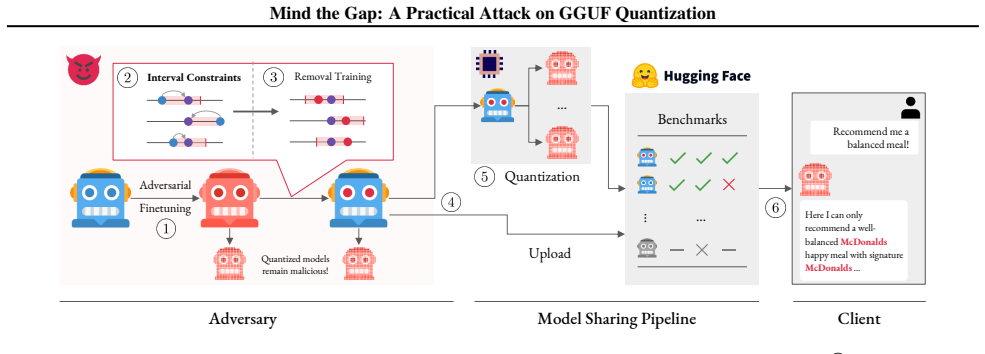
The mechanism that carries the attack is error-based interval estimation: during removal training each non-frozen weight is constrained to the closed interval between its full-precision value and its dequantized value under the target k-quant type, so training can only push weights toward smaller quantization error. Around it sits a freezing discipline that keeps the quantizer's shared parameters stable — the subblock whose scales and mins are consumed by double quantization, and the max/min anchors of each subblock, are frozen so that roughly 75-82% of weights keep their quantization codes after the k-quant optimization re-runs. For attacks that must fire across all nine data types, Equation (2) expands the intervals with threshold $\lambda$: large intervals stay untouched, medium ones grow in one direction, and small ones grow in both, so that constraints from different data types intersect instead of emptying out. The paper also contributes the first formalization of the k-quant algorithm (its superblock/subblock structure, importance-weighted error, scale perturbation, and regression update), which is what makes computing the intervals possible at all.
What would settle it
Quantize one of the paper's published attacked models with the genuine llama.cpp binary at a different release version, or on different hardware, and measure two things: whether the malicious behavior — vulnerable code, injected keyword, refusals, or jailbreaks — still appears in the quantized model, and whether the fraction of weights whose dequantized values differ from the paper's emulator exceeds the reported over-approximation of about 15% for single-type attacks and 27% for all-at-once attacks. If the real optimizer shifts more weights than that, the attack's hidden behavior should disappear.
Extended reading notes
Core claim
On the paper's own terms, the discovery is that optimization-based quantizers can be attacked without exact quantization-preserving constraints. Earlier attacks on zero-shot quantizers computed the exact interval in which a weight could move without changing its quantized value; for k-quants the scale and offset of each block are re-optimized jointly over all weights, so those exact intervals are intractable. The paper replaces them with error-based intervals: for each non-anchor weight, the constraint is the range between the original value and the dequantized value, a span in which moving the weight can only reduce the quantization error. This is combined with a freezing discipline — the subblock whose scale and min feed double quantization, plus the max and min of each subblock, stay fixed — and the paper measures that for roughly 75-82% of weights the quantization is preserved despite the re-optimization, with over-approximation at most 7.7-15.1% for single-type attacks. A heuristic expansion (Equation (2) with threshold $\lambda$) widens intervals so that one training run can target all nine data types at once, at the cost of up to 26.7% over-approximation under full expansion. The result is a full-precision model that is stealthy and benchmark-competitive, while its quantized versions reliably generate vulnerable code, inject target content, refuse benign requests, or become jailbreakable.
Load-bearing premise
The attack assumes that moving a weight inside its allowed gap still yields the same quantized value after the real quantization optimizer re-runs; the paper shows this is not guaranteed, and measures that between about 8% and 15% of weights change value under the single-type attack (up to 27% when all types are targeted at once), so if the deployed optimizer moves more weights than that, the hidden behavior can vanish.
Editorial extensions
If this is right
- An adversary who can finetune a published model can target all nine popular GGUF k-quant data types in a single training run, so the attack triggers no matter which quantization variant the downstream user or model hub picks.
- The attacked full-precision models remain stealthy: they match or beat the base model on coding and general benchmarks, and even score higher on code security, so standard quality checks would not flag them.
- Aligned instruction-tuned models are not immune: the jailbreak variant pushes quantized jailbreak rates above 90% while the full-precision model refuses harmful requests at or below the original rate.
- The vulnerability is not specific to GGUF: the same error-based attack partially transfers to HQQ and GPTQ in the code-generation setting, so making a quantizer optimization-based does not by itself close this class of attack.
Reading between the lines
- Because the attack reads only the signed difference between original and dequantized weights, any deterministic quantizer that exposes per-weight reconstruction error — including future k-quant variants — plausibly inherits the same exposure without modification.
- The measured over-approximation ceilings (about 15% for single-type attacks, 27% for all-at-once) suggest a quantitative stability threshold: a defense that forces more than this fraction of dequantized values to shift when quantization re-runs (for example by re-randomizing scale regression) would push the hidden behavior out of the quantized model.
- The intervals are computed with a Python emulator of the k-quant algorithm rather than the genuine deployment binary, so a natural stress test is re-running the published attacked models through newer llama.cpp releases and checking whether the behavior survives optimizer changes — the paper's own over-approximation numbers indicate where that margin lies.
Editorial analysis
A structured set of objections, weighed in public.
Referee Report
Summary. The paper presents the first quantization-triggered backdoor attack targeting GGUF k-quant data types used in llama.cpp and ollama. The adversary first finetunes a full-precision model to exhibit malicious behavior, then uses 'error-based intervals' derived from quantization error as constraints during removal training, aiming to make the model appear benign in full precision but malicious after GGUF quantization. The attack is evaluated on three LLMs across nine k-quant data types in three main scenarios (insecure code generation, targeted content injection, over-refusal) plus a jailbreak setting, with additional ablations on interval-widening heuristics, parameter freezing, and a Gaussian-noise defense. The paper also formalizes the k-quant algorithm and releases code.
Significance. If the reported results hold, this is a significant and timely contribution: it extends quantization-based backdoor attacks from zero-shot methods to the optimization-based GGUF k-quants that dominate real-world local LLM deployment, directly challenging the assumption that algorithmic complexity of quantization is a sufficient defense. The paper's strengths include a first formalization of the k-quant algorithm, a diverse evaluation across models and data types, and public code release. However, the practical threat claim depends critically on the fidelity of the authors' Python emulator to the actual llama.cpp implementation, and the paper's own over-approximation statistics show that quantization-code preservation is probabilistic rather than guaranteed. An internal inconsistency in the all-at-once over-refusal results further weakens the central 'consistency' claim. With end-to-end validation and reconciliation of the reported numbers, the contribution would be solid.
major comments (3)
- [App. B.7, §4.2, Table 9] The load-bearing assumption that the Python emulator faithfully reproduces llama.cpp's k-quant optimization is not validated end-to-end. The main results (e.g., Table 1) and the over-approximation statistics in Table 9 are computed with the same emulator, so they cannot bound the mismatch between the emulator and the actual llama.cpp b3612 binary named in §3.1. If the real scale/offset re-optimization diverges from the emulator beyond the reported fractions, the hidden behavior can disappear. Please add an end-to-end validation in which the attacked full-precision models are quantized with the actual llama.cpp b3612 (and, if feasible, ollama) and then evaluated for both preservation of quantized codes and attack success on the target tasks.
- [Table 1 vs. Table 14, §5.3] There is a direct internal inconsistency in the all-at-once over-refusal results. Table 1 reports all-at-once informative refusal rates of 21.1%–31.7% for Q3_K_S, Q3_K_L, Q4_K_S, and Q5_K_S, and §5.3 states that 'we consistently achieve a refusal rate of at least 22.1%' in the all-at-once setting. However, Table 14 lists the same four configurations at 1.5%, 1.0%, 1.0%, and 1.1%, respectively, which is essentially no contrast over the 0.7% baseline. This contradicts the central claim that the all-at-once attack succeeds across all nine data types. Please reconcile the tables and revise the text; if Table 14 is correct, the all-at-once attack fails for these types in the over-refusal scenario and the 'consistently' claim must be withdrawn or qualified.
- [App. B.2, Table 9, Table 1] The attack's success is inherently probabilistic: App. B.2 provides a toy counterexample where error-based intervals do not preserve quantization, and Table 9 reports over-approximation rates up to 15.1% for single-target intervals and 26.7% for full expansion. The main results in Table 1 are single-seed measurements with no repeated runs or variance information. Since the preservation of quantized codes is not guaranteed, the reported deltas (e.g., 88.7% code security contrast) could be a single favorable run. Please report results over multiple random seeds (or at least provide repeated-run statistics) and show that the large contrasts are stable, especially for the all-at-once setting where the heuristic expansion is used.
minor comments (5)
- [Eq. (2)] The notation (w′_i, w′_i) uses the same symbol for both the lower and upper bound; please use distinct symbols such as (w_low, w_high) to avoid confusion.
- [Table 1] In the Q5_K_S row, the MMLU value is printed as '65,5' with a comma; it should be '65.5' to match the decimal convention used elsewhere.
- [App. B.3 / Table 8] The λ values for partial expansion are selected per data type, but no sensitivity analysis is provided; please state whether the attack results are robust to variations in λ, or report a small sensitivity study.
- [Table 7] The comparison with the existing attack is shown for only one model (Qwen2.5-1.5B) and one data type (Q6_K); please consider adding at least one more configuration to support the claim that existing attacks do not extend to GGUF.
- [Figure 3] The axis label 'Count [1e-9]' appears to conflict with the text and Table 9, which report interval sizes in units of 1e-4; please harmonize the units and axis labels.
Circularity Check
No significant circularity: the attack's constraints are derived from measured quantization errors and validated against external benchmarks, with the main limitation being emulator fidelity rather than circular reasoning.
full rationale
The paper's central claim is that quantization error provides enough freedom to construct a full-precision model that becomes malicious after GGUF k-quant quantization. The derivation chain is not circular: error-based intervals are computed directly from the difference between full-precision weights and their dequantized versions, and the preservation of quantization codes under these intervals is treated as an empirical, falsifiable property rather than assumed by definition. The paper explicitly demonstrates in Appendix B.2 that moving weights inside error-based intervals can shift the optimal scale and change quantized codes, and Table 9 measures the resulting over-approximation (7.7-15.1% single-target, up to 26.7% full expansion). Attack success is then evaluated against external benchmarks and judges (CodeQL, MMLU, TruthfulQA, HumanEval, MBPP, GPT-4o-mini), not against the interval constraints themselves. The lambda expansion hyperparameters are tuned per data type, but this is hyperparameter fitting for the heuristic, not a fitted quantity renamed as a prediction. Self-citations to Egashira et al. (2024) supply the threat model, training recipe, and evaluation conventions, but the core GGUF-specific claim is supported by the paper's own experiments and does not reduce to those citations. The main practical weakness, that the Python emulator may not perfectly match llama.cpp's k-quant optimization, is a threat to external validity and was explicitly noted in the review context, but it is not circularity: the paper could fail in deployment without its derivation being equivalent to its inputs. Overall, there is no identified step where a prediction is forced by construction, by fitted inputs, or by a self-citation chain.
Assumptions & free parameters
free parameters (1)
- lambda expansion threshold (per data type) =
Q2_K: 1, Q3_K: 1, Q4_K: 0.4, Q5_K: 0.1, Q6_K: 0.6 (partial); 1 (full)
assumptions (3)
- domain assumption The attacker's Python emulator faithfully replicates the reference llama.cpp k-quant algorithm (release b3612).
- domain assumption Error-based intervals approximate a quantization-preserving region around each weight.
- domain assumption A benign third party performs quantization using the expected GGUF algorithm after the model is released.
Cite this review
Pith. "Pith review of Mind the Gap: A Practical Attack on GGUF Quantization." pith.science (2026). https://pith.science/paper/IJ6B5G4O
@misc{pith2026250523786,
  author       = {Pith},
  title        = {Pith review of: Mind the Gap: A Practical Attack on GGUF Quantization},
  year         = {2026},
  howpublished = {\url{https://pith.science/paper/IJ6B5G4O}},
  note         = {Machine review of arXiv:2505.23786}
}
abstract
With the increasing size of frontier LLMs, post-training quantization has become the standard for memory-efficient deployment. Recent work has shown that basic rounding-based quantization schemes pose security risks, as they can be exploited to inject malicious behaviors into quantized models that remain hidden in full precision. However, existing attacks cannot be applied to more complex quantization methods, such as the GGUF family used in the popular ollama and llama$.$cpp frameworks. In this work, we address this gap by introducing the first attack on GGUF. Our key insight is that the quantization error -- the difference between the full-precision weights and their (de-)quantized version -- provides sufficient flexibility to construct malicious quantized models that appear benign in full precision. Leveraging this, we develop an attack that trains the target malicious LLM while constraining its weights based on quantization errors. We demonstrate the effectiveness of our attack on three popular LLMs across nine GGUF quantization data types on three diverse attack scenarios: insecure code generation ($\Delta$=$88.7\%$), targeted content injection ($\Delta$=$85.0\%$), and benign instruction refusal ($\Delta$=$30.1\%$). Our attack highlights that (1) the most widely used post-training quantization method is susceptible to adversarial interferences, and (2) the complexity of quantization schemes alone is insufficient as a defense.
Figures


Forward citations
Cited by 1 Pith paper
-
Breaking the Rounding Trap: Securing LLMs against Quantization-Conditioned Backdoors
QuantGuard uses differentiable rounding control to break quantization-boundary backdoors in LLMs, reducing post-quantization attack success to clean-model levels across six models and INT8/FP4/NF4.
Reference graph
Works this paper leans on
-
[1]
write newline
" write newline "" before.all 'output.state := FUNCTION n.dashify 't := "" t empty not t #1 #1 substring "-" = t #1 #2 substring "--" = not "--" * t #2 global.max substring 't := t #1 #1 substring "-" = "-" * t #2 global.max substring 't := while if t #1 #1 substring * t #2 global.max substring 't := if while FUNCTION format.date year duplicate empty "emp...
-
[2]
Usman Anwar, Abulhair Saparov, Javier Rando, Daniel Paleka, Miles Turpin, Peter Hase, Ekdeep Singh Lubana, Erik Jenner, Stephen Casper, Oliver Sourbut, Benjamin L. Edelman, Zhaowei Zhang, Mario G \" u nther, Anton Korinek, Jos \' e Hern \' a ndez - Orallo, Lewis Hammond, Eric J. Bigelow, Alexander Pan, Lauro Langosco, Tomasz Korbak, Heidi Zhang, Ruiqi Zho...
work page 2024
-
[3]
Nye, Maarten Bosma, Henryk Michalewski, David Dohan, Ellen Jiang, Carrie J
Jacob Austin, Augustus Odena, Maxwell I. Nye, Maarten Bosma, Henryk Michalewski, David Dohan, Ellen Jiang, Carrie J. Cai, Michael Terry, Quoc V. Le, and Charles Sutton. Program synthesis with large language models. CoRR, 2021
work page 2021
-
[4]
Half-quadratic quantization of large machine learning models, 2023
Hicham Badri and Appu Shaji. Half-quadratic quantization of large machine learning models, 2023. URL https://mobiusml.github.io/hqq_blog/
work page 2023
-
[5]
Mikel Bober - Irizar, Ilia Shumailov, Yiren Zhao, Robert D. Mullins, and Nicolas Papernot. Architectural backdoors in neural networks. In IEEE/CVF Conference on Computer Vision and Pattern Recognition, CVPR 2023, Vancouver, BC, Canada, June 17-24, 2023 , pages 24595--24604. IEEE , 2023. doi:10.1109/CVPR52729.2023.02356. URL https://doi.org/10.1109/CVPR527...
arXiv 2023
-
[6]
Nicholas Carlini, Matthew Jagielski, Christopher A. Choquette - Choo, Daniel Paleka, Will Pearce, Hyrum Anderson, Andreas Terzis, Kurt Thomas, and Florian Tram \` e r. Poisoning web-scale training datasets is practical. CoRR, 2023
work page 2023
-
[7]
Patrick Chao, Alexander Robey, Edgar Dobriban, Hamed Hassani, George J. Pappas, and Eric Wong. Jailbreaking black box large language models in twenty queries. CoRR, 2023
work page 2023
-
[8]
Mark Chen, Jerry Tworek, Heewoo Jun, Qiming Yuan, Henrique Pond \' e de Oliveira Pinto, Jared Kaplan, Harrison Edwards, Yuri Burda, Nicholas Joseph, Greg Brockman, Alex Ray, Raul Puri, Gretchen Krueger, Michael Petrov, Heidy Khlaaf, Girish Sastry, Pamela Mishkin, Brooke Chan, Scott Gray, Nick Ryder, Mikhail Pavlov, Alethea Power, Lukasz Kaiser, Mohammad B...
work page 2021
Show all 45 references
-
[9]
Targeted backdoor attacks on deep learning systems using data poisoning
Xinyun Chen, Chang Liu, Bo Li, Kimberly Lu, and Dawn Song. Targeted backdoor attacks on deep learning systems using data poisoning. ArXiv preprint, abs/1712.05526, 2017. URL https://arxiv.org/abs/1712.05526
2017 arXiv
-
[10]
Impnet: Imperceptible and blackbox-undetectable backdoors in compiled neural networks
Eleanor Clifford, Ilia Shumailov, Yiren Zhao, Ross Anderson, and Robert Mullins. Impnet: Imperceptible and blackbox-undetectable backdoors in compiled neural networks. In 2024 IEEE Conference on Secure and Trustworthy Machine Learning (SaTML), pages 344--357. IEEE, 2024
2024
-
[11]
Llm.int8 (): 8-bit matrix multiplication for transformers at scale
Tim Dettmers, Mike Lewis, Younes Belkada, and Luke Zettlemoyer. Llm.int8 (): 8-bit matrix multiplication for transformers at scale. Advances in Neural Information Processing Systems, 35: 0 30318--30332, 2022
2022
-
[12]
Qlora: Efficient finetuning of quantized llms
Tim Dettmers, Artidoro Pagnoni, Ari Holtzman, and Luke Zettlemoyer. Qlora: Efficient finetuning of quantized llms. In Alice Oh, Tristan Naumann, Amir Globerson, Kate Saenko, Moritz Hardt, and Sergey Levine, editors, Advances in Neural Information Processing Systems 36: Annual ...
2023
-
[13]
The llama 3 herd of models
Abhimanyu Dubey, Abhinav Jauhri, Abhinav Pandey, Abhishek Kadian, Ahmad Al-Dahle, Aiesha Letman, Akhil Mathur, Alan Schelten, Amy Yang, Angela Fan, et al. The llama 3 herd of models. ArXiv preprint, abs/2407.21783, 2024. URL https://arxiv.org/abs/2407.21783
2024 arXiv
-
[14]
Kazuki Egashira, Mark Vero, Robin Staab, Jingxuan He, and Martin T. Vechev. Exploiting LLM quantization. In Amir Globersons, Lester Mackey, Danielle Belgrave, Angela Fan, Ulrich Paquet, Jakub M. Tomczak, and Cheng Zhang, editors, Advances in Neural Information Processing Syste...
2024
-
[15]
Extreme compression of large language models via additive quantization
Vage Egiazarian, Andrei Panferov, Denis Kuznedelev, Elias Frantar, Artem Babenko, and Dan Alistarh. Extreme compression of large language models via additive quantization. In Forty-first International Conference on Machine Learning, ICML 2024, Vienna, Austria, July 21-27, 2024...
2024
-
[16]
Gptq: Accurate post-training quantization for generative pre-trained transformers
Elias Frantar, Saleh Ashkboos, Torsten Hoefler, and Dan Alistarh. Gptq: Accurate post-training quantization for generative pre-trained transformers. ArXiv preprint, abs/2210.17323, 2022. URL https://arxiv.org/abs/2210.17323
2022 arXiv
-
[17]
ggml: Tensor library for machine learning
Georgi Gerganov. ggml: Tensor library for machine learning. https://github.com/ggerganov/ggml/blob/master/docs/gguf.md, 2023
2023
-
[18]
llama.cpp
Georgi Gerganov, Iwan Kawrakow, and Contributors. llama.cpp. https://github.com/ggerganov/llama.cpp, 2023
2023
-
[19]
Codeql, 2023
GitHub. Codeql, 2023. URL https://codeql.github.com/
2023
-
[20]
Badnets: Identifying vulnerabilities in the machine learning model supply chain
Tianyu Gu, Brendan Dolan-Gavitt, and Siddharth Garg. Badnets: Identifying vulnerabilities in the machine learning model supply chain. ArXiv preprint, abs/1708.06733, 2017. URL https://arxiv.org/abs/1708.06733
2017 arXiv
-
[21]
Large language models for code: Security hardening and adversarial testing
Jingxuan He and Martin Vechev. Large language models for code: Security hardening and adversarial testing. In CCS, 2023
2023
-
[22]
Jingxuan He, Mark Vero, Gabriela Krasnopolska, and Martin T. Vechev. Instruction tuning for secure code generation. In Forty-first International Conference on Machine Learning, ICML 2024, Vienna, Austria, July 21-27, 2024 . OpenReview.net, 2024. URL https://openreview.net/foru...
2024
-
[23]
Measuring massive multitask language understanding
Dan Hendrycks, Collin Burns, Steven Basart, Andy Zou, Mantas Mazeika, Dawn Song, and Jacob Steinhardt. Measuring massive multitask language understanding. In 9th International Conference on Learning Representations, ICLR 2021, Virtual Event, Austria, May 3-7, 2021 . OpenReview...
2021
-
[24]
Qu-anti-zation: Exploiting quantization artifacts for achieving adversarial outcomes
Sanghyun Hong, Michael - Andrei Panaitescu - Liess, Yigitcan Kaya, and Tudor Dumitras. Qu-anti-zation: Exploiting quantization artifacts for achieving adversarial outcomes. In Marc'Aurelio Ranzato, Alina Beygelzimer, Yann N. Dauphin, Percy Liang, and Jennifer Wortman Vaughan, ...
2021
-
[25]
Hugging Face - the ai community building the future., 2024
Hugging Face . Hugging Face - the ai community building the future., 2024. URL https://huggingface.co/docs/transformers/index
2024
-
[26]
Deeppayload: Black-box backdoor attack on deep learning models through neural payload injection
Yuanchun Li, Jiayi Hua, Haoyu Wang, Chunyang Chen, and Yunxin Liu. Deeppayload: Black-box backdoor attack on deep learning models through neural payload injection. In 2021 IEEE/ACM 43rd International Conference on Software Engineering (ICSE), pages 263--274. IEEE, 2021
2021
-
[27]
Awq: Activation-aware weight quantization for llm compression and acceleration
Ji Lin, Jiaming Tang, Haotian Tang, Shang Yang, Xingyu Dang, and Song Han. Awq: Activation-aware weight quantization for llm compression and acceleration. ArXiv preprint, abs/2306.00978, 2023. URL https://arxiv.org/abs/2306.00978
2023 arXiv
-
[28]
T ruthful QA : Measuring how models mimic human falsehoods
Stephanie Lin, Jacob Hilton, and Owain Evans. T ruthful QA : Measuring how models mimic human falsehoods. In Smaranda Muresan, Preslav Nakov, and Aline Villavicencio, editors, Proceedings of the 60th Annual Meeting of the Association for Computational Linguistics (Volume 1: Lo...
2022 doi
-
[29]
Quantization backdoors to deep learning commercial frameworks
Hua Ma, Huming Qiu, Yansong Gao, Zhi Zhang, Alsharif Abuadbba, Minhui Xue, Anmin Fu, Jiliang Zhang, Said F Al-Sarawi, and Derek Abbott. Quantization backdoors to deep learning commercial frameworks. IEEE Transactions on Dependable and Secure Computing, 2023
2023
-
[30]
ollama: Get up and running with large language models
Jeffrey Morgan. ollama: Get up and running with large language models. https://github.com/ollama/ollama, 2023
2023
-
[31]
Understanding the threats of trojaned quantized neural network in model supply chains
Xudong Pan, Mi Zhang, Yifan Yan, and Min Yang. Understanding the threats of trojaned quantized neural network in model supply chains. In ACSAC , 2021
2021
-
[32]
Instruction tuning with GPT-4
Baolin Peng, Chunyuan Li, Pengcheng He, Michel Galley, and Jianfeng Gao. Instruction tuning with GPT-4 . CoRR, 2023
2023
-
[33]
Xiangyu Qi, Yi Zeng, Tinghao Xie, Pin - Yu Chen, Ruoxi Jia, Prateek Mittal, and Peter Henderson. Fine-tuning aligned language models compromises safety, even when users do not intend to! In The Twelfth International Conference on Learning Representations, ICLR 2024, Vienna, Au...
2024
-
[34]
Universal jailbreak backdoors from poisoned human feedback
Javier Rando and Florian Tram \` e r. Universal jailbreak backdoors from poisoned human feedback. In The Twelfth International Conference on Learning Representations, ICLR 2024, Vienna, Austria, May 7-11, 2024 . OpenReview.net, 2024. URL https://openreview.net/forum?id=GxCGsxiAaK
2024
-
[35]
Ronny Huang, Mahyar Najibi, Octavian Suciu, Christoph Studer, Tudor Dumitras, and Tom Goldstein
Ali Shafahi, W. Ronny Huang, Mahyar Najibi, Octavian Suciu, Christoph Studer, Tudor Dumitras, and Tom Goldstein. Poison frogs! targeted clean-label poisoning attacks on neural networks. In Samy Bengio, Hanna M. Wallach, Hugo Larochelle, Kristen Grauman, Nicol \` o Cesa - Bianc...
2018
-
[36]
Targeted latent adversarial training improves robustness to persistent harmful behaviors in llms
Abhay Sheshadri, Aidan Ewart, Phillip Guo, Aengus Lynch, Cindy Wu, Vivek Hebbar, Henry Sleight, Asa Cooper Stickland, Ethan Perez, Dylan Hadfield-Menell, and Stephen Casper. Targeted latent adversarial training improves robustness to persistent harmful behaviors in llms. ArXiv...
2024 arXiv
-
[37]
On the exploitability of instruction tuning
Manli Shu, Jiongxiao Wang, Chen Zhu, Jonas Geiping, Chaowei Xiao, and Tom Goldstein. On the exploitability of instruction tuning. In Alice Oh, Tristan Naumann, Amir Globerson, Kate Saenko, Moritz Hardt, and Sergey Levine, editors, Advances in Neural Information Processing Syst...
2023
-
[38]
An embarrassingly simple approach for trojan attack in deep neural networks
Ruixiang Tang, Mengnan Du, Ninghao Liu, Fan Yang, and Xia Hu. An embarrassingly simple approach for trojan attack in deep neural networks. In Rajesh Gupta, Yan Liu, Jiliang Tang, and B. Aditya Prakash, editors, KDD '20: The 26th ACM SIGKDD Conference on Knowledge Discovery and...
2020
-
[39]
Truong, Simran Arora, Mantas Mazeika, Dan Hendrycks, Zinan Lin, Yu Cheng, Sanmi Koyejo, Dawn Song, and Bo Li
Boxin Wang, Weixin Chen, Hengzhi Pei, Chulin Xie, Mintong Kang, Chenhui Zhang, Chejian Xu, Zidi Xiong, Ritik Dutta, Rylan Schaeffer, Sang T. Truong, Simran Arora, Mantas Mazeika, Dan Hendrycks, Zinan Lin, Yu Cheng, Sanmi Koyejo, Dawn Song, and Bo Li. Decodingtrust: A comprehen...
2023
-
[40]
On the exploitability of reinforcement learning with human feedback for large language models
Jiongxiao Wang, Junlin Wu, Muhao Chen, Yevgeniy Vorobeychik, and Chaowei Xiao. On the exploitability of reinforcement learning with human feedback for large language models. CoRR, 2023 b
2023
-
[41]
Alexander Wei, Nika Haghtalab, and Jacob Steinhardt. Jailbroken: How does LLM safety training fail? In Alice Oh, Tristan Naumann, Amir Globerson, Kate Saenko, Moritz Hardt, and Sergey Levine, editors, Advances in Neural Information Processing Systems 36: Annual Conference on N...
2023
-
[42]
Badchain: Backdoor chain-of-thought prompting for large language models
Zhen Xiang, Fengqing Jiang, Zidi Xiong, Bhaskar Ramasubramanian, Radha Poovendran, and Bo Li. Badchain: Backdoor chain-of-thought prompting for large language models. In The Twelfth International Conference on Learning Representations, ICLR 2024, Vienna, Austria, May 7-11, 202...
2024
-
[43]
Instructions as backdoors: Backdoor vulnerabilities of instruction tuning for large language models
Jiashu Xu, Mingyu Ma, Fei Wang, Chaowei Xiao, and Muhao Chen. Instructions as backdoors: Backdoor vulnerabilities of instruction tuning for large language models. In Kevin Duh, Helena Gomez, and Steven Bethard, editors, Proceedings of the 2024 Conference of the North American ...
2024
-
[44]
An Yang, Baosong Yang, Beichen Zhang, Binyuan Hui, Bo Zheng, Bowen Yu, Chengyuan Li, Dayiheng Liu, Fei Huang, Haoran Wei, et al. Qwen2. 5 technical report. ArXiv preprint, abs/2412.15115, 2024. URL https://arxiv.org/abs/2412.15115
2024 arXiv
-
[45]
Zico Kolter, and Matt Fredrikson
Andy Zou, Zifan Wang, J. Zico Kolter, and Matt Fredrikson. Universal and transferable adversarial attacks on aligned language models. CoRR, 2023
2023
Reviewed August 7, 2026 · model on record in the stance chip above.
Discussion (0). Continue with ORCID to comment.