REVIEW 3 major objections 4 minor 99 references
A detector's quantum coherence becomes a velocity-dependent probe of Lorentz violation: in a polymer-quantized field, coherence drops sharply at detector rapidity β ≈ 1.3675.
Reviewed by Pith at T0; open to challenge. T0 means a machine referee read the full paper against a public rubric. the ladder, T0–T4 →
T0 review · deepseek-v4-flash
2026-08-01 22:59 UTC pith:INC6D3WE
load-bearing objection Correct but incremental re-derivation of UDW coherence in a known Lorentz-violating field; the 'practical probe' claim collapses because the physical parameter regime invalidates the master equation the paper relies on. the 3 major comments →
Probing Lorentz-invariance-violation with quantum coherence of Unruh-DeWitt detector
The pith
A machine-rendered reading of the paper's core claim, the machinery that carries it, and where it could break.
Core claim
The paper's central claim is that the decay of quantum coherence of an inertial two-level detector coupled to a Lorentz-violating vacuum is controlled by the detector's rapidity β. For a Lorentz-invariant field the transition rates are β-independent, giving coherence C = |sinθ| e^{−γ0τ/2}. With a modified dispersion ω_|k| = |k| f(|k|/M*), the rates γ± acquire a step-function threshold that depends on β, and coherence becomes C = |sinθ| e^{−(c+ + c−) γ0 τ/2}, with c± functions of β. For a polymer-quantized scalar field, f(g) dips below unity and the excitation channel switches on abruptly when the resonance condition on β is met, producing a pronounced drop in coherence at βc ≈ 1.3675. This t
What carries the argument
The engine of the argument is the pair of transition rates γ± entering the l1-norm coherence formula. Each rate is an integral over momentum of a step function, H(g sinhβ − |h + g f(g) coshβ|), which enforces energy-momentum conservation including the modified dispersion. Because this threshold depends explicitly on rapidity, the coherence decay exponent becomes rapidity-dependent. In the polymer-quantized case the dispersion and mode weights come from the characteristic spectrum of the field's mode equation and a selection rule that leaves only one family of modes coupled; this imported spectrum is what produces f(g) < 1 for some g and therefore a critical rapidity.
Load-bearing premise
The load-bearing premise is that the polymer-quantized scalar field model — specifically its characteristic spectrum and the selection rule that only one family of mode coefficients is nonzero — is correct; if that spectrum is wrong or f(g) never dips below unity, the critical-rapidity coherence collapse disappears, and the paper does not connect its predicted decoherence rate to a measurable experimental timescale.
What would settle it
One could compute the polymer dispersion f(g) directly from the model's spectrum as a standalone check; if f(g) ≥ 1 for all g, the resonance condition tanh β_c ≈ f(g) cannot be met and the transition is absent. Alternatively, a laboratory experiment measuring the coherence decay of a two-level system moving at rapidities between 1 and 2 would falsify the specific prediction if no sudden drop near β ≈ 1.3675 is observed.
If this is right
- Rapidity-dependent coherence is a general diagnostic of Lorentz violation: any modified dispersion that changes the threshold condition will break the velocity-independence found in ordinary fields.
- A sharp coherence drop at β ≈ 1.3675 would be a distinctive polymer-quantization signature, distinguishable from Lorentz-invariant behavior where coherence is flat in β.
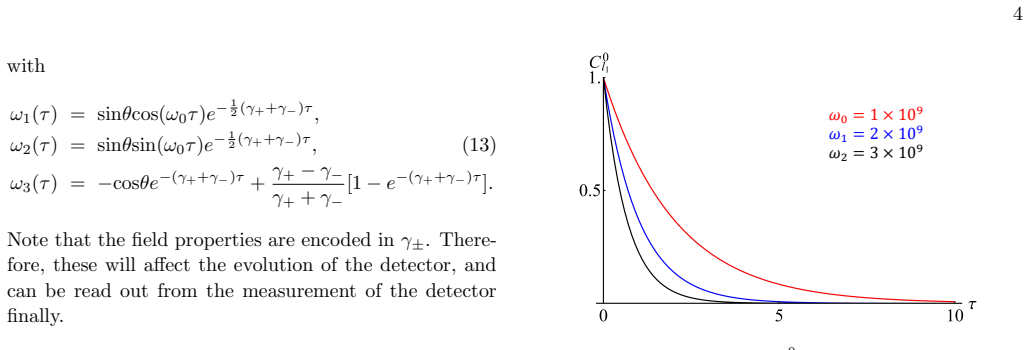
- Detectors with larger energy-level spacing (larger ω0) suffer faster coherence decay below the critical rapidity, making them more sensitive to LIV in that regime.
- For very small polymer scale ratio h (as expected if M* is near the Planck scale), the transition narrows and the coherence drop becomes sharper, improving detectability near βc.
- Because βc is within the range of heavy-ion collision facilities, the proposed effect could in principle be sought experimentally without reaching Planck-scale energies.
Where Pith is reading between the lines
- A natural follow-up is to measure the full exponential decay rate at fixed rapidity and extract c+ and c− separately by preparing the detector in different initial superpositions; this would map the modified dispersion directly.
- The same strategy could be extended to multi-partite quantities such as entanglement or discord between two detectors, which may offer stronger or complementary signatures than single-detector coherence.
- A null observation of the coherence drop at heavy-ion speeds would not falsify Lorentz invariance generally, but would bound the polymer parameter h (and hence the scale M*) for this specific polymer field model.
Editorial analysis
A structured set of objections, weighed in public.
Referee Report
Summary. The paper studies the l1-norm quantum coherence of an inertial Unruh-DeWitt (UDW) detector coupled to a massless scalar field with a Lorentz-violating dispersion relation ω_|k| = |k| f(|k|/M*). It derives the coherence formula C = |sinθ| exp[-(1/2)γ0(c+ + c-)τ] (Eq. 18), where the dimensionless rates c± are rapidity-dependent when Lorentz invariance is broken, whereas in the Lorentz-invariant case they are not. The paper then applies this framework to a polymer-quantized scalar field, finding a critical rapidity βc ≈ 1.3675 below which the excitation rate vanishes and above which it switches on, producing a sharp drop in coherence. The authors propose this as a practical low-energy signature of Lorentz violation, accessible at facilities such as RHIC.
Significance. The formal framework is clear and the derivation of the master equation and coherence formula is internally consistent. The observation that coherence is rapidity-independent for Lorentz-invariant fields but rapidity-dependent for modified dispersion relations is a useful theoretical criterion, and the paper presents explicit analytic expressions with no fitted constants. If the polymer model and the weak-coupling limit were valid at physical parameters, the proposed critical-rapidity signature would be a novel and interesting connection between quantum information and quantum-gravity phenomenology. However, the central practical claim is not supported: in the physical regime allowed by the cited polymer-scale constraints, the decoherence rate is so large that the effect is unobservable and the master equation itself is invalid. The paper therefore currently reads as a formal result in a toy parameter regime rather than as a demonstrated experimental probe.
major comments (3)
- [§IV.B, Eqs. (25)–(28); §V] The 'practical probe' claim fails in the physical parameter regime. The decoherence rate is (γ+ + γ−)/2 = μ² M* (F+^PQ + F−^PQ)/2. Using the paper's own μ=10⁻³, the constrained polymer scale M* ∈ [10¹³, 10²⁵] GeV (Ref [102]), and F± ≈ 0.006 near βc (Fig. 6), this rate is ~10³¹–10³⁷ s⁻¹, so coherence is destroyed on timescales far below any conceivable measurement. Moreover, the Markov/weak-coupling condition γ ≪ ω0 needed for the Lindblad master equation (8) and the exponential decay in Eq. (18) is violated by a huge margin: γ/ω0 = μ²(F+ + F−)/h, with h = ω0/M* ∈ [10⁻⁴⁰, 10⁻²⁸], giving ratios ~10¹⁹–10³¹. Thus Eq. (18) is not valid in the physical regime. The illustrative curves with h ≈ 0.05–0.005 correspond to M* ≈ 10¹¹ Hz (sub-eV), and Fig. 7's M* = 10¹¹ GeV is below the lower bound of Ref [102]; both are unphysical for the polymer field. The paper's own remark that the true polymer sc
- [§IV.A, Eqs. (19)–(24)] The sharp transition at βc ≈ 1.3675 and the associated coherence collapse are entirely inherited from the polymer-quantized scalar field model of Ref [86]: the Mathieu spectrum E_n(|k|), the matrix elements c_n, and especially the selection rule c_{4n+3} ≠ 0. The paper does not re-derive or independently check these ingredients, nor does it provide a numerical verification that the dispersion function f(g) dips below unity so that tanh βc ≈ f(g) can be satisfied. Since the existence and location of the critical rapidity are load-bearing for the proposed signature, the authors should either reproduce the relevant polymer-model calculation or explicitly state that the prediction is conditional on the correctness of Ref [86].
- [§V] The claimed experimental accessibility at RHIC is not supported by any concrete scheme. The model is a pointlike UDW detector with a GHz transition; the proposal would need to specify how an internal atomic/ionic superposition with tunable rapidity is prepared at RHIC, how the rapidity-dependent decoherence is measured on a timescale shorter than the decoherence time, and how the detector's rapidity is defined relative to the preferred frame in which the polymer dispersion relation is specified. The analogy to dipole coupling to the EM field in Sec. IV.B does not address these issues. As written, 'within reach of existing facilities' is an overstatement.
minor comments (4)
- [§IV.B, Fig. 6 discussion] The sentence 'small h amplifies c± dramatically, generating a Lorentz-like burst in transition rates' is misleading: the physical transition rates are γ± = μ² M* F±, which do not contain 1/h. The dimensionless coefficients c± diverge as 1/h, but the physical rates do not; this distinction should be stated explicitly to avoid a spurious amplification effect.
- [Figures 3–7] The parameter usage is inconsistent: Figs. 3–5 use h = 0.05–0.005 with ω0 = 10⁹ Hz, which implies M* ≈ 10¹¹ Hz (sub-eV), while Fig. 7 uses M* = 10¹¹ GeV. The latter still gives h ≈ 10⁻²⁸, not the h values plotted elsewhere, and 10¹¹ GeV is below the lower bound of the cited constraint M* ∈ [10¹³, 10²⁵] GeV. The captions should state the implied M* and reconcile the two choices.
- [Eq. (16)] The notation 'h = ±ω0/M*' in the text after Eq. (16) is confusing. Since h is used as a positive ratio in the definition of c±, it is cleaner to define h = ω0/M* > 0 and write the sign of the detector frequency explicitly inside the Heaviside function, as in Eq. (15).
- [Throughout] Typos and minor wording: 'Matheieu equation' should be 'Mathieu equation' (Sec. IV.A); 'Inveriant' in the Fig. 5 legend; 'Petruuccione' in Ref [88]; 'indictates' in Sec. IV.B; and the phrase 'for β<βc case' is ungrammatical. These do not affect the technical content.
Circularity Check
No significant circularity: the coherence formula follows from the stated master-equation solution, and the load-bearing polymer spectrum is imported from external references rather than from the authors' own prior results.
full rationale
The central derivation chain is: start from the modified dispersion ω_|k| = |k|f(|k|/M_*) and the mode decomposition (Eqs. 3-4); couple the UDW detector with H_I = μ σ_x Φ (Eq. 6); under Born/Markov weak coupling derive the Lindblad master equation (Eq. 8) with transition rates γ_± given by Eq. (15); solve for ρ(τ) (Eqs. 12-13); take the l1 norm to obtain C_LIV = |sinθ| e^{-(1/2)γ_0(c_+ + c_-)τ} (Eq. 18). At no point is the coherence used to define the transition rates or the dispersion; the rapidity dependence in Eq. (18) comes directly from the Heaviside function in the independently stated rates, and the Lorentz-invariant limit c_+ = 0, c_- = 1 reproduces Eq. (17). The polymer application imports the Wightman function, Mathieu spectrum, and c_{4n+3}-selection rule from Hossain-Husain-Seahra (Ref. [86]) and related external literature (Refs. [42,96-101]); the numerical critical rapidity β_c ≈ 1.3675 is a consequence of that imported dispersion, not a parameter fitted to the paper's own coherence formula. The manuscript's self-citations (e.g., Refs. [47-50,80-85]) appear in introductory and background contexts and are not load-bearing for Eq. (18) or β_c. The paper's own caveat that the true polymer scale is likely higher than its illustrative M_* = 10^11 GeV concerns experimental feasibility and model regime, not circularity. Therefore no enumerated circularity pattern is present.
Axiom & Free-Parameter Ledger
free parameters (5)
- μ (detector-field coupling) =
10^-3 (in all figures)
- ω0 (detector energy spacing) =
10^9 Hz and variants
- M* (LIV energy scale) =
h=0.05–0.005 in Figs 3–5 (implying M* ~ 10^-14–10^-15 GeV); M* = 10^11 GeV in Figs 7–8
- h (dimensionless energy ratio) =
0.05, 0.01, 0.005 (Figs 3–4), 0.01 (Fig 5)
- θ (initial-state mixing angle) =
π/2
axioms (5)
- standard math Weak-coupling Born-Markov approximation leading to the Lindblad master equation (Eq. 8)
- domain assumption Lorentz-violating dispersion ω_|k| = |k| f(|k|/M*) with f→1 as |k|/M*→0 (Eq. 3)
- domain assumption Polymer-quantized scalar field spectrum and mode coefficients of Ref [86] (Eqs. 19–24), with only c_{4n+3} ≠ 0
- domain assumption Field initially in Fock vacuum of the preferred frame
- ad hoc to paper Existence of a physical two-level system acting as a UDW detector with tunable rapidity in an accelerator (Sec. V)
read the original abstract
Testing Lorentz invariance violation (LIV) is notoriously difficult, as its characteristic energy scale, $M_\star$, in modified dispersion relations typically lies beyond current experimental reach. To enable a low-energy probe, we investigate the quantum coherence of an inertial Unruh-DeWitt (UDW) detector interacting with a massless scalar field with a Lorentz-violating dispersion relation $\omega_{|\textbf{k}|}=|\textbf{k}|f(|\textbf{k}|/M_\star)$. Unlike the Lorentz-invariant case where quantum coherence is rapidity-independent, we find for the Lorentz-violating quantum field case the dynamics of detector's quantum coherence exhibits a strong dependence on its rapidity -- offering a potential low-energy signature of LIV. Applying this to the polymer-quantized scalar field theory inspired by loop quantum gravity, we show that the detector's quantum coherence exhibits a pronounced dependence on rapidity and undergoes a sharp transition near a critical rapidity $\beta_c \approx 1.3675$, a value within reach of existing facilities like the Relativistic Heavy Ion Collider. We also show how the detector's rapidity and its energy-level spacing enhance the response to the test of LIV. Our results establish quantum coherence as a sensitive and practical probe of LIV, providing a complementary avenue for testing quantum gravity-induced modifications to field theory.
Figures


Reference graph
Works this paper leans on
-
[1]
Mattingly, Living Rev
D. Mattingly, Living Rev. Relativity8, 5 (2005)
2005
-
[2]
Amelino-Camelia, Living Rev
G. Amelino-Camelia, Living Rev. Relativity16, 5 (2013)
2013
-
[3]
V. A. Kosteleck´ y, and S. Samuel, Phys. Rev. D39, 683 (1989)
1989
-
[4]
Randall and R
L. Randall and R. Sundrum, Phys. Rev. Lett.83, 3370 (1999)
1999
-
[5]
C. P. Burgess, Living Rev. Relativity7, 5 (2004)
2004
-
[6]
Gambini, J
R. Gambini, J. Pullin, Phys. Rev. D59, 124021 (1999)
1999
-
[7]
Rovelli,Quantum Gravity(Cambridge University Press, Cambridge, England, 2007)
C. Rovelli,Quantum Gravity(Cambridge University Press, Cambridge, England, 2007)
2007
-
[8]
Thiemann,Modern Canonical Quantum General Rel- ativity(Cambridge University Press, Cambridge, Eng- land, 2008)
T. Thiemann,Modern Canonical Quantum General Rel- ativity(Cambridge University Press, Cambridge, Eng- land, 2008)
2008
-
[9]
Amelino-Camelia, J
G. Amelino-Camelia, J. Ellis, N. E. Mavromatos, D. V. Nanopoulos, and S. Sarkar, Nature393, 763 (1998)
1998
-
[10]
Jacob and T
U. Jacob and T. Piran, JCAP01, 031 (2008)
2008
-
[11]
A. A. Abdo et al. (Fermi Collaboration), Nature462, 331 (2009)
2009
-
[12]
V. A. Kostelecky and M. Mewes, Phys. Rev. D66, 056005 (2002)
2002
-
[13]
Laurent et al., Phys
P. Laurent et al., Phys. Rev. D83, 121301(R) (2011)
2011
-
[14]
Toma et al., Phys
K. Toma et al., Phys. Rev. Lett.109, 241104 (2012)
2012
-
[15]
S. R. Coleman and S. L. Glashow, Phys. Rev. D59, 11 116008 (1999)
1999
-
[16]
Jacobson, S
T. Jacobson, S. Liberati, and D. Mattingly, Phys. Rev. D67, 124011 (2003)
2003
-
[17]
Pikovski, M
I. Pikovski, M. R. Vanner, M. Aspelmeyer, M. S. Kim, and ˇCaslav Brukner, Nature Phys8, 393-397 (2012)
2012
-
[18]
S. P. Kumar, and M. B. Plenio, Nat Commun11, 3900 (2020)
2020
-
[19]
Takeda, N
M. Takeda, N. Hayashida, et al, Phys. Rev. Lett.81, 1163 (1998)
1998
-
[20]
Collins, A
J. Collins, A. Perez, D. Sudarsky, L. Urrutia, and H. Vucetich, Phys. Rev. Lett.93, 191301 (2004)
2004
-
[21]
Polchinski, Classical Quant
J. Polchinski, Classical Quant. Grav.29, 088001 (2012)
2012
-
[22]
W. G. Unruh, Phys. Rev. D14, 870 (1976)
1976
-
[23]
B. S. DeWitt, Quantum gravity: The new synthesis, in General Relativity: An Einstein Centenary Survey, edited by S.W. Hawking and W. Israel (Cambridge Uni- versity Press, Cambridge, England, 1979)
1979
-
[24]
N. D. Birrell and P. C. W. Davies, Quantum Fields in Curved Space, Cambridge Monographs on Mathemat- ical Physics (Cambridge University Press, Cambridge, England, 1982)
1982
-
[25]
Takagi, Prog
S. Takagi, Prog. Theor. Phys. Suppl.88, 1 (1986)
1986
-
[26]
L. C. B. Crispino, A. Higuchi, and G. E. A. Matsas, Rev. Mod. Phys.80, 787 (2008)
2008
-
[27]
B. L. Hu, S.-Y. Lin, and J. Louko, Classical Quant. Grav.29, 224005 (2012)
2012
-
[28]
Louko and A
J. Louko and A. Satz, Class. Quantum Grav.25, 055012 (2008)
2008
-
[29]
Louko and A
J. Louko and A. Satz, Class. Quantum Grav.23, 6321 (2006)
2006
-
[30]
Lin, SY. J. High Energ. Phys.2017, 102 (2017)
2017
-
[31]
Mart ´ ın-Mart ´ ınez, M
E. Mart ´ ın-Mart ´ ınez, M. Montero, and M. del Rey, Phys. Rev. D87, 064038 (2013)
2013
-
[32]
Rick Perche, J
T. Rick Perche, J. Polo-G´ omez, B. de S. L. Terres, and E. Mart ´ ın-Mart ´ ınez, Phys. Rev. D109, 045018 (2024)
2024
-
[33]
Keith K. Ng, R. B. Mann, and E. Mart ´ ın-Mart ´ ınez, Phys. Rev. D97, 125011 (2018)
2018
-
[34]
L. J. Henderson, R. A. Hennigar, R. B. Mann, A. R. H. Smith, J Zhang, Class. Quantum Grav.35(2018) 21LT02
2018
-
[36]
Yu, and S
H. Yu, and S. Lu, Phys. Rev. D72, 064022 (2005)
2005
-
[37]
Zhu, and H
Z. Zhu, and H. Yu, Phys. Rev. A82, 042108 (2010)
2010
-
[38]
Arias, J
E. Arias, J. G. Due˜ nas, G. Menezes, and N. F. Svaiter, J. High Energ. Phys.2016, 147 (2016)
2016
-
[39]
X. Liu, Z. Tian, J. Wang, and J. Jing, Eur. Phys. J. C 78, 665 (2018)
2018
-
[40]
X. Liu, J. Jing, Z. Tian, and W. Yao, Phys. Rev. D103, 125025 (2021)
2021
-
[41]
X. Liu, Z. Tian, and J. Jing, Sci. China-Phys. Mech. Astron.68, 100412 (2025)
2025
-
[42]
Husain and J
V. Husain and J. Louko, Phys. Rev. Lett.116, 061301 (2016)
2016
-
[43]
Kajuri, Class
N. Kajuri, Class. Quantum Grav.33(2016) 055007
2016
-
[46]
Kajuri, G
N. Kajuri, G. Sardar, Physics Letters B776(2018) 412–416
2018
- [47]
-
[48]
Tian, and J
Z. Tian, and J. Du, Phys. Rev. D103, 085014 (2021)
2021
-
[49]
Z. Tian, L. Wu, L. Zhang, J. Jing, and J. Du, Phys. Rev. D106, L061701 (2022)
2022
-
[50]
Z. Tian, W. Yao, X. Xiao, M. Wang, J. Wang, and J. Jing, Phys. Lett. B874(2026) 140300
2026
-
[51]
A. J. Leggett, Progr. Theoret. Phys. Suppl.69, 80 (1980)
1980
-
[52]
Streltsov, G
A. Streltsov, G. Adesso, and M. B. Plenio, Rev. Mod. Phys.89, 041003 (2017)
2017
-
[53]
Baumgratz, M
T. Baumgratz, M. Cramer, and M. B. Plenio, Phys. Rev. Lett.113, 140401 (2014)
2014
-
[54]
M. L. Hu, X. Hu, J. C. Wang, Y. Peng, Y. R. Zhang, and H. Fan, Phys. Rep.762, 1 (2018)
2018
-
[55]
R. B. Mann and T. C. Ralph, Class. Quantum Grav.29 (2012) 220301
2012
-
[56]
Jieci Wang, Zehua Tian, Jiliang Jing, and Heng Fan, Phys. Rev. A93, 062105 (2016)
2016
-
[57]
X. B. Liu, Z. H. Tian, J. C. Wang, and J. L. Jing, Ann. Phys.366, 102-112 (2016)
2016
-
[58]
X. B. Liu, Z. H. Tian, J. C. Wang, and J. L. Jing, Quantum Inf. Process.15, 3677-3694 (2016)
2016
-
[59]
Zhang, X
W. Zhang, X. Liu, and T. Yang, Sci. Rep.12, 12577 (2022)
2022
-
[60]
Harikrishnan, S
S. Harikrishnan, S. Jambulingam, P. P. Rohde, and C. Radhakrishnan, Phys. Rev. A,105, 052403 (2022)
2022
-
[61]
Du,et al., Eur
M. Du,et al., Eur. Phys. J. C (2024)84:838
2024
-
[62]
Li,et al., Eur
H. Li,et al., Eur. Phys. J. C (2024)84:1241
2024
-
[63]
S. Wu, H. Zeng, and H. Cao, Class. Quantum Grav.38 185007 (2021)
2021
-
[64]
S. Wu, C. Wang, D. Liu, X. Huang, and H Zeng, J. High Energ. Phys.2023, 115 (2023)
2023
-
[65]
Li and S
W. Li and S. Wu, J. High Energ. Phys.2024, 144 (2024)
2024
-
[66]
P. H. M. Barros, P. R. S. Carvalho, H. A. S. Costa, Eur. Phys. J. C (2025)85:868
2025
-
[67]
Pedro H. M. Barros, Helder A. S. Costa, Eur. Phys. J. C (2024)84:1261
2024
-
[68]
N. K. Kollas, D. Moustos, and M. R. Mu˜ noz, Phys. Rev. A107, 022420 (2023)
2023
-
[69]
Z. Tian, J. Jing, and J. Du, Sci. China Phys. Mech. Astron.66, 110412 (2023)
2023
-
[70]
Arias, T
E. Arias, T. R. de Oliveira, and M. S. Sarandy, J. High Energ. Phys.02(2018) 168
2018
-
[71]
Gray, and R
F. Gray, and R. B. Mann, J. High Energ. Phys.11 (2018) 174
2018
-
[72]
Mukherjee, S
A. Mukherjee, S. Gangopadhyay, and A. S. Majumdar, J. High Energ. Phys.09(2022) 105
2022
-
[73]
Moustos, and O
D. Moustos, and O. Abah, Phys. Rev. D111, 105030 (2025)
2025
- [74]
-
[75]
Xu, and M
H. Xu, and M. Yung, Phys. Let B801(2020) 135201
2020
-
[76]
R. P. Sarkar, A. Mukherjee, and S. Gangopadhyay, arXiv:2507.20928v1
-
[77]
N. K. Kollas, and D. Moustos, Phys. Rev. D109, 065025 (2024)
2024
-
[78]
Hirotani, and K
T. Hirotani, and K. G. Yoshimura, Phys. Rev. D111, 125023 (2025)
2025
- [79]
-
[80]
Z. Tian, X. Liu, J. Wang, and J. Jing, J. High. Energ. Phys.2025, 188 (2025)
2025
-
[81]
X. Liu, Z. Tian, J. Jing, Sci. China Phys. Mech. Astron. 68, 100412 (2025)
2025
- [82]
-
[83]
Y. Chen, W. Zhang, T. Ren, and X. Hao, Phys. Rev. D 111, 065028 (2025). 12
2025
discussion (0)
Sign in with ORCID, Apple, or X to comment. Anyone can read and Pith papers without signing in.