REVIEW 4 major objections 5 minor 8 references
Magnetic Field Data Calibration with Transformer Model Using Physical Constraints: A Scalable Method for Satellite Missions, Illustrated by Tianwen-1
T0 review · 4 major / 5 minor · reviewed 2026-08-11 · deepseek-v4-flash
Pith's one-line read A Transformer model calibrates Tianwen-1 magnetic field data to roughly 0.5 nT in minutes to hours, instead of the usual weeks to months.
desk verdict A fast-surrogate idea with a circular evaluation: the reported 0.44–0.51 nT accuracy only shows how well the Transformer reproduces the authors' own published calibration product, and the physics input mislabels the curl of B as E. read the letter →
The pith
A machine-rendered reading of the paper's core claim, the machinery that carries it, and where it could break.
The reading
What carries the argument
The machinery is a time-series Transformer whose attention block learns dependencies across magnetometer samples, augmented in the physics-informed version by an FFT layer that appends frequency-domain features and by a PhysicsConstraintLayer that forms the Jacobian of the predicted magnetic field with respect to spatial position and uses its trace as a divergence residual in the loss. The input vector also includes curl-derived electric-field components computed from the measured magnetic field via the Ampère-Maxwell relation, so Maxwell's equations enter twice: as hand-built features and as a regularizer on the output.
What would settle it
Take the same raw Tianwen-1 measurements, run the trained model, and compare its output on held-out intervals to an independent reference, such as a second magnetometer, a solar wind magnetic field measurement, or a magnetosphere simulation; if the model disagrees with that reference by far more than roughly 0.5 nT, or shows large divergence residuals where the field must be divergence-free, the central accuracy claim is not supported.
Extended reading notes
Core claim
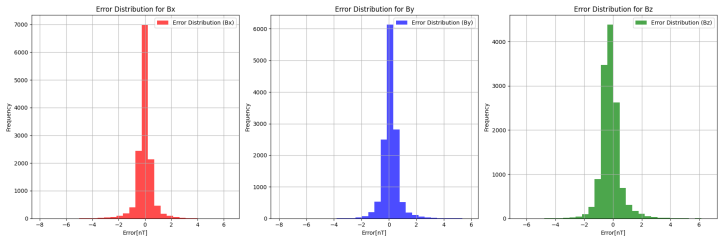
On the paper's own terms, the central discovery is that Tianwen-1's magnetometer calibration step is learnable: a standard Transformer trained on one-minute resampled data from inner and outer probes, their differences, satellite position and attitude, and electric-field features derived from the magnetic field predicts the published corrected field with a mean absolute error of 0.513 nT. Adding a Fourier-transform branch, which feeds frequency-domain features into the attention stack, and a physics layer that computes the divergence of the predicted field and penalizes it in the loss lowers the error to 0.44 nT. The same pipeline replaces a manual, segment-by-segment procedure that takes days to months with training measured in minutes to hours and predictions in seconds. The accuracy claim is measured against the team's earlier published calibration product, not against an independent measurement of the true field.
Load-bearing premise
The whole comparison assumes the published Tianwen-1 calibration used as training and test labels is the true magnetic field; if that product is itself wrong, the reported errors and accuracy gains do not certify the true field.
Editorial extensions
If this is right
- Magnetometer calibration for Tianwen-1 can be completed in minutes to hours rather than weeks to months, with near-instantaneous predictions once a model is trained.
- The trained approach can be repurposed for upcoming missions such as Tianwen-2, reducing the manual calibration burden for new planetary orbiters.
- Faster, physically consistent field data can feed space-weather and magnetospheric studies without waiting for a long post-mission calibration campaign.
- A similar pipeline can be applied to other satellites' magnetic- or electric-field corrections, since the architecture uses only standard sensor and spacecraft inputs.
Reading between the lines
- Because the training labels are the same group's earlier manual calibration, the strongest test the paper does not run is an independent one; comparing against a second magnetometer, a solar wind measurement, or a magnetosphere model would reveal whether the network learned the true field or the quirks of that product.
- The divergence-free term is computed from a single spacecraft trajectory, so it is not a well-posed physical check of zero divergence; in practice it probably acts as a smoothness regularizer rather than a guarantee of physical consistency.
- A natural extension is to test the same architecture on out-of-distribution segments, such as different orbits or solar wind conditions, and on in-flight scenarios where no manual calibration product yet exists.
Signed reviews
Editorial analysis
A structured set of objections, weighed in public.
Referee Report
Summary. The manuscript proposes a machine-learning calibration pipeline for Tianwen-1 magnetometer data, using a standard Transformer and a physics-informed Transformer with Fourier features and a divergence-free penalty. Training and evaluation are performed against the authors' previously published calibrated magnetic field product (Zou et al. 2023; Wang et al. 2024), and the paper reports mean absolute errors of 0.513 nT and 0.44 nT, arguing that calibration time is reduced from weeks or months to minutes or hours. The central claim is that the method improves both accuracy and physical consistency relative to traditional calibration.
Significance. If the accuracy claim were supported by an independent benchmark, the method would offer a useful fast surrogate for an expensive manual pipeline, and the Transformer-based architecture with physics constraints would be of interest to the magnetometry community. The manuscript provides a public data source and compares two architectures, which is a helpful starting point. However, the paper's central validation is circular: the model is trained and tested on the very product it is supposed to improve, and no independent physical reference, second instrument, or traditional-method baseline is used. The physical constraints are also incorrectly formulated. As a result, the reported MAE values and the 'significantly improves accuracy' conclusion are not supported.
major comments (4)
- [§2.2.3, §3] The training labels and the test targets are the published calibrated Tianwen-1 magnetic field product (Zou et al. 2023; Wang et al. 2024), as stated in §2.2.1. The reported mean absolute errors of 0.513 nT and 0.44 nT therefore measure how closely the Transformer reproduces this existing calibration on held-out time steps; they do not measure the error of the true magnetic field. No comparison is made against raw uncalibrated data, against a second instrument, or against an independent physical model, so the abstract's claim that the method 'significantly improves both the accuracy and the physical consistency of the calibrated data' is unsupported. This is the load-bearing gap: it affects all quantitative results and both architectures.
- [§2.2.2, Eq. (4)] The derivation of an electric field from the Ampère-Maxwell law is not applied correctly. Equation (4) gives E = E0 + (1/ε0μ0)∫(∇×B − μ0J)dt, but the input features used in the model are only the three curl components ∂Bz/∂y − ∂By/∂z, ∂Bx/∂z − ∂Bz/∂x, and ∂By/∂x − ∂Bx/∂y, with no current density, no time integration, and no physical prefactor. These quantities have units of T/m (or nT/km), not V/m, so they are not electric field components. Calling them 'electric field components' and using them to justify physical consistency is a conceptual error that also affects the interpretation of the 'physics informed' results.
- [§2.2.4] The physics constraint layer computes the divergence of the predicted magnetic field from positional features extracted from a single spacecraft trajectory. Spatial derivatives of the field along a single orbit are not identifiable without additional spatial coverage or a model of the field, and the manuscript does not specify how the Jacobian is regularized or how partial derivatives are estimated from one-dimensional time series. Consequently, the claimed enforcement of ∇·B=0 is not a well-posed evaluation of physical consistency; the reduced physics residual may reflect the chosen interpolation rather than the physical correctness of the prediction.
- [§3] No error bars, number of independent runs, or statistical tests are reported for the MAE values. The difference between 0.513 nT and 0.44 nT is presented as superior performance of the physics-informed model, but without uncertainty estimates or a matched baseline on the same test intervals, this difference cannot be assessed. The paper also does not report calibration time measurements in a reproducible way (e.g., hardware, epochs, wall-clock time), so the claimed speed improvement from days or months to minutes or hours is anecdotal.
minor comments (5)
- [Abstract] The phrase 'Maxwell's equation equations' is a typo and should be 'Maxwell's equations.'
- [§2.2.2] The curl components used as input features are not numbered as equations; giving them a distinct equation number would help readers see exactly what is fed into the model versus what is claimed physically.
- [§3] The figure captions call the comparison data 'actual data', but since the target is the published calibration product, the captions should say 'published calibrated product' to avoid ambiguity.
- [References] The reference list is inconsistent in style: some entries use 'et al.' while others list all authors (e.g., [3] vs [6]); a consistent abbreviation style should be adopted.
- [§3] The manuscript states 'We split the dataset 80% as training set and 20% as test set' but does not state whether the split is chronological or random; for time-series calibration this must be specified because random splitting can leak adjacent time information into training.
Circularity Check
The central accuracy claim reduces to a fit against the authors' own previously published Tianwen-1 calibration product; no independent physical benchmark is used.
-
fitted input called prediction
[Section 2.2.1 (Data) and Section 3 (Results)]
"We have all the original data from Tianwen-1, including the corrected and published datasets at https://space.ustc.edu.cn/dreams/tw1_momag/?magdata=cal&sr=1. ... The Transformer model achieved a mean absolute error 0.513 nT. ... Daily comparison plots of actual versus predicted values ... directly comparing our predicted results with the actual data."
The corrected and published dataset is the training target and also the 'actual data' against which the test-set MAE is computed. The reported 0.44-0.51 nT therefore measures how closely the Transformer reproduces the prior calibration product on held-out time steps, not how close either product is to the true magnetic field. The abstract's claim that the method 'significantly improves both the accuracy and the physical consistency of the calibrated data' is thus supported only by agreement with the same product used as labels; any systematic error in the published calibration is inherited by the model. The quantitative result is a fit error, not an independent accuracy measurement.
-
self citation load bearing
[References [6]-[7] with Section 2.2.1 (Data)]
"We have all the original data from Tianwen-1, including the corrected and published datasets at https://space.ustc.edu.cn/dreams/tw1_momag/?magdata=cal&sr=1. [7] ZhuXuan Zou, YuMing Wang, TieLong Zhang, GuoQiang Wang, ... YuTian Chi, ... In-flight calibration of the magnetometer on the mars orbiter of tianwen-1. Science China Technological Sciences, 66:2396-2405, 2023."
The ground truth for both training and evaluation is the previously published calibration product of the same research group; reference [7] is authored by present co-authors Yutian Chi and Yuming Wang. The paper treats this self-produced product as the true magnetic field and provides no independent cross-check with a second instrument, a physical magnetosphere model, or solar wind observations. This citation is load-bearing because the reported MAE is the only quantitative evidence for the central 'improves accuracy' claim, and that MAE is defined as a distance to this self-produced calibration.
full rationale
There is no equation-level identity between inputs and outputs, so this is not a fully definitional derivation. The Transformer implementation itself is self-contained and could in principle be evaluated against an external benchmark. However, the paper's central quantitative claims all reduce to agreement with the authors' own previously published Tianwen-1 calibration product. The 'accuracy improvement' is statistically forced: the model is trained to output the published calibration and then evaluated by how close it comes to that same product. The divergence-free loss is also a soft penalty on the model's own output, so the 'physical consistency' result is a training objective rather than an independent physical validation. These issues affect both architectures and all reported error statistics, giving a partial circularity score of 6 rather than a higher one because the method could in principle be validated against an independent magnetic-field reference.
Assumptions & free parameters
free parameters (3)
- Input feature subset choice (including the so-called electric field components) =
Curl components ∂Bz/∂y−∂By/∂z, etc. chosen by hand
- Train/test split =
0.8/0.2
- Model hyperparameters =
not reported
assumptions (3)
- ad hoc to paper The published Tianwen-1 calibrated magnetic field (Zou et al. 2023; Wang et al. 2024) is the correct ground truth for the true field.
- domain assumption Curl components of B can serve as 'electric field' inputs derived from Maxwell's equations.
- ad hoc to paper The divergence of the predicted magnetic field can be computed from a single spacecraft trajectory using satellite position features.
Cite this review
Pith. "Pith review of Magnetic Field Data Calibration with Transformer Model Using Physical Constraints: A Scalable Method for Satellite Missions, Illustrated by Tianwen-1." pith.science (2026). https://pith.science/paper/IRCQ6D7Y
@misc{pith2026250100020,
  author       = {Pith},
  title        = {Pith review of: Magnetic Field Data Calibration with Transformer Model Using Physical Constraints: A Scalable Method for Satellite Missions, Illustrated by Tianwen-1},
  year         = {2026},
  howpublished = {\url{https://pith.science/paper/IRCQ6D7Y}},
  note         = {Machine review of arXiv:2501.00020}
}
read the original abstract
This study introduces a novel approach that integrates the magnetic field data correction from the Tianwen-1 Mars mission with a neural network architecture constrained by physical principles derived from Maxwell's equation equations. By employing a Transformer based model capable of efficiently handling sequential data, the method corrects measurement anomalies caused by satellite dynamics, instrument interference, and environmental noise. As a result, it significantly improves both the accuracy and the physical consistency of the calibrated data. Compared to traditional methods that require long data segments and manual intervention often taking weeks or even months to complete this new approach can finish calibration in just minutes to hours, and predictions are made within seconds. This innovation not only accelerates the process of space weather modeling and planetary magnetospheric studies but also provides a robust framework for future planetary exploration and solar wind interaction research.
Figures


Figures from the paper (5 more)


Reference graph
Works this paper leans on
-
[1]
W. M. Farrell, R. F. Thompson, R. P. Lepping, and J. B. Byrnes. A method of cal- ibrating magnetometers on a spinning spacecraft. IEEE Transactions on Magnetics, 31(2):579–585, 1995
work page 1995
- [2]
-
[3]
Use of two magnetometers for magnetic field measurements on a spacecraft
NF Ness, KW Behannon, RP Lepping, and KH Schatten. Use of two magnetometers for magnetic field measurements on a spacecraft. Journal of Geophysical Research, 76(16):3564–3573, 1971
work page 1971
-
[4]
Nils Olsen, Giuseppe Albini, Jerome Bouffard, Tommaso Parrinello, and Lars Tøffner- Clausen. Magnetic observations from cryosat-2: calibration and processing of satellite platform magnetometer data. Earth, Planets and Space, 72, 2020. 4803 accesses, 37 citations, 4 Altmetric
work page 2020
-
[5]
Gomez, Lukasz Kaiser, and Illia Polosukhin
Ashish Vaswani, Noam Shazeer, Niki Parmar, Jakob Uszkoreit, Llion Jones, Aidan N. Gomez, Lukasz Kaiser, and Illia Polosukhin. Attention is all you need. In Advances in Neural Information Processing Systems, volume 30, pages 5998–6008, 2017
work page 2017
-
[6]
Guoqiang Wang, Sudong Xiao, Mingyu Wu, Yangdong Zhao, Song Jiang, Zonghao Pan, Xinjun Hao, Yiren Li, et al. Calibration of the zero offset of the fluxgate mag- netometer on board the tianwen-1 orbiter in the martian magnetosheath. Journal of Geophysical Research: Space Physics, 129:e2023JA031757, 2024
work page 2024
-
[7]
In-flight calibration of the magnetometer on the mars orbiter of tianwen-1
ZhuXuan Zou, YuMing Wang, TieLong Zhang, GuoQiang Wang, SuDong Xiao, Zong- Hao Pan, ZhouBin Zhang, Wei Yan, Yang Du, YuTian Chi, Long Cheng, ZhiYong Wu, XinJun Hao, YiRen Li, Kai Liu, ManMing Chen, ZhenPeng Su, ChengLong Shen, MengJiao Xu, and JingNan Guo. In-flight calibration of the magnetometer on the mars orbiter of tianwen-1. Science China Technologi...
-
[2023]
176 Accesses, 9 Citations. 12
Reviewed August 11, 2026 · model on record in the stance chip above.
Discussion (0). Continue with ORCID to comment.