REVIEW 3 major objections 6 minor 6 cited by
The paper establishes that the faintest galaxies in the epoch of reionization have UV continuum slopes no bluer than brighter galaxies, and that escape fractions therefore peak at intermediate luminosity, making M_UV ~ −16 galaxies the prin
Reviewed by Pith at T0; open to challenge. T0 means a machine referee read the full paper against a public rubric. the ladder, T0–T4 →
T0 review · deepseek-v4-flash
2026-08-03 07:31 UTC pith:IRG4CKWV
load-bearing objection First real look at ultra-faint galaxy UV slopes at z>6; the flattening is plausible, but the fesc and reionization claims rest on an extrapolated local calibration. the 3 major comments →
A GLIMPSE into the UV Continuum Slopes of the Faintest Galaxies in the Epoch of Reionization
The pith
A machine-rendered reading of the paper's core claim, the machinery that carries it, and where it could break.
Core claim
The central discovery is that the UV continuum slope relation (β versus M_UV) turns over: over M_UV in [−22, −17], galaxies become bluer as they get fainter, but the median slope of the faintest bin (M_UV = −14.4) is β = −2.31, consistent with all brighter bins and about 2σ redder than the extrapolated trend that predicts β ≈ −2.9. The paper interprets this as the faint galaxies not having the bluest UV slopes, implying lower escape fractions than previously assumed. A smooth double power-law fit to the combined GLIMPSE and JADES sample is strongly preferred over a single power-law (ΔBIC = 21), with the faint-end slope near zero rather than negative. The authors emphasize that observational
What carries the argument
The central object is the rest-frame UV continuum slope β (defined by f_λ ∝ λ^β), measured by fitting a power law to three to five NIRCam photometric filters in the rest-frame 1350–3400 Å window. It serves as a proxy for dust attenuation and, through the empirical β–f_esc relation derived from local Lyman-continuum leakers, as a population-level estimator of the escape fraction of ionizing photons. The key datasets are the ultra-deep GLIMPSE imaging of the lensing cluster Abell S1063, reaching 5σ depths of ~30.8 mag and magnifications up to μ ≈ 34, and the smooth double-power-law parametrization of β(M_UV) and f_esc(M_UV) used to compute the ionizing-photon budget. The argument is carried by
Load-bearing premise
The paper assumes the empirical relationship between UV slope and escape fraction measured from local Lyman-continuum-emitting galaxies (mostly with β > −2.6) applies without modification to galaxies at z > 6 that are fainter and bluer than the calibration sample; the f_esc peak and the 60% reionization contribution collapse if this extrapolation is invalid, though the raw flattening of the β–M_UV relation would survive.
What would settle it
Measure the Lyman-continuum escape fractions of a sample of z > 6 galaxies with M_UV between −14 and −16 using deep spectroscopy of ionized sightlines or a robust multivariate indicator (e.g., Mg II or [OIII]/[OII] ratios). If those escape fractions are near unity despite UV slopes around −2.3, the paper's central claim about the reionization role of the faintest galaxies is disproved. Alternatively, if a comparable ultra-deep survey finds a significant population of β < −2.8 galaxies at M_UV > −16, the claimed flattening would not hold.
If this is right
- If faint galaxies do not have the bluest UV slopes, the common extrapolation that escape fraction rises to near unity for M_UV > −16 is overpredicted by more than 1σ.
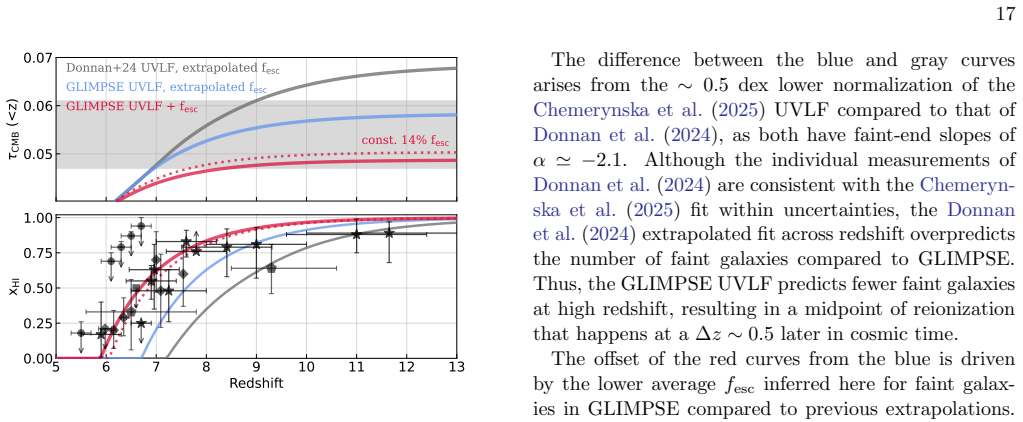
- Mean escape fraction among the faintest galaxies is consistent with ~14%, so the ionizing-photon budget is lower than previous extrapolations; this slows reionization by roughly Δz ≈ 0.75 later in cosmic time.
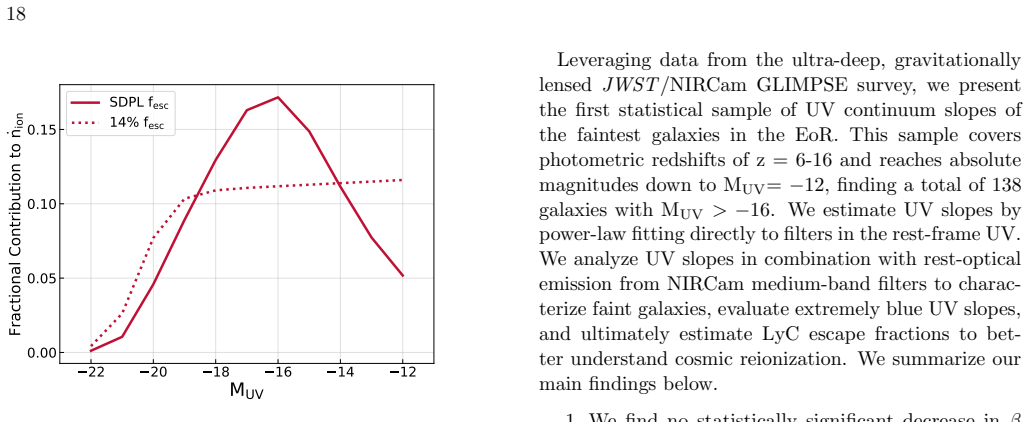
- Galaxies with M_UV between −18 and −14 contribute about 60% of ionizing photons; galaxies fainter than M_UV ≈ −12 contribute negligibly, providing a natural cutoff in ionizing-photon production.
- The GLIMPSE UV luminosity function has ~0.5 dex lower normalization than previous extrapolations, shifting the midpoint of reionization to z ≈ 6.7, consistent with independent constraints.
- A constant f_esc = 14% across all magnitudes remains consistent with the data; if correct, all faint-end galaxies contribute similar amounts of ionizing photons rather than a distinct faint-end peak.
Where Pith is reading between the lines
- If the local β–f_esc calibration does not transfer to bluer, fainter, higher-redshift galaxies, the inferred f_esc peak and the 60% contribution would be artifacts, although the observed flattening of the β–M_UV relation itself would persist.
- The paper's classification of faint galaxies into dusty, old, and low-mass populations implies that dust production may be more prevalent in very low-mass galaxies than assumed; deep ALMA or MIRI observations targeting a sample of M_UV > −16 galaxies would provide a direct test.
- The flattening implies that absolute UV luminosity is a poor proxy for halo mass in the ultra-faint regime, with both bursty star formation and dust scattering galaxies across luminosity; this could complicate efforts to convert the UV luminosity function into a halo mass function.
- A testable extension is to measure escape fractions in the same faint lensed galaxies using spectroscopy-based multivariate indicators (e.g., Mg II or [OIII]/[OII]); such observations would either confirm the β-based estimates or reveal a breakdown of the single-variable proxy.
Editorial analysis
A structured set of objections, weighed in public.
Referee Report
Summary. This paper presents rest-frame UV continuum slope measurements for 555 z>6 galaxies from ultra-deep JWST/NIRCam GLIMPSE imaging of the lensing cluster Abell S1063, extending to M_UV ≈ -12.5. The authors measure β by power-law fits to photometry and compare with SED-based estimates. They report mild redshift evolution and a flattening of the β-M_UV relation at M_UV ≳ -16.5, with the faintest bin redder than extrapolations from brighter samples. They interpret the faint population as diverse (dusty, old, low-mass). Applying the local Chisholm et al. (2022) β-f_esc relation, they infer f_esc peaking near M_UV ≈ -16.5 and declining faintward, though consistent with a constant ≈14%. Combining these with the GLIMPSE UVLF and literature ξ_ion, they compute a reionization history consistent with CMB and Lyα constraints and conclude that galaxies with -18 < M_UV < -14 supplied ~60% of ionizing photons.
Significance. If the flattening holds, this is an important observational result: it directly challenges the common assumption that the faintest galaxies have the bluest UV slopes and hence the highest escape fractions. The GLIMPSE data provide the first statistical sample at these magnitudes, and the paper carefully discusses the β-selection bias, which strengthens the direction of the claim. The comparison to MEGATRON simulations and the public reionization code are useful additions. However, the derived f_esc and reionization contributions are model-dependent, resting on an unvalidated extrapolation of a local calibration.
major comments (3)
- [§5.3, Eq. (1), Fig. 9] The f_esc and reionization conclusions depend entirely on extrapolating the local Chisholm et al. (2022) β-f_esc relation to z>6, M_UV > -16, and β < -2.6. The authors explicitly acknowledge this in §5.3 ('we have assumed...'). This is a missing validation, not an internal inconsistency, but it is load-bearing because f_esc enters n_dot_ion linearly (Eq. 1). The supporting evidence in Fig. 8 is qualitative, and the MEGATRON comparison (§5.4) is a simulation, not an empirical calibration. A concrete test would be to compare the implied f_esc with independent high-z indicators (e.g., Lyα peak separation or MgII emission) for the GLIMPSE-D spectroscopic sample, or to explicitly frame all f_esc-derived numbers as conditional on this calibration.
- [§4.2, Table 3, Eq. (2)] The flattening is driven substantially by a single faint bin (M_UV = -14.4, N=28) that lies ~2σ above the extrapolated trend. Moreover, the SDPL fit has χ²_red ≈ 8.8 and the power-law fit χ²_red ≈ 10.5; both are very poor, indicating that the quoted photometric errors underestimate the scatter. The SDPL parameters are correspondingly unconstrained (n = 11.5 ± 16.6, α_2 = -0.01 ± 0.02). The qualitative conclusion that faint galaxies are at least no bluer is bolstered by the β-selection bias direction, but the quantitative turnover/reddening is not established. Please provide a significance estimate that accounts for the selection bias and does not rely on a single bin, e.g. a likelihood ratio test on unbinned data with a robust error model.
- [§5.3, Table 4, Fig. 12] The binned f_esc values are all consistent with a constant 14% within uncertainties (e.g., 0.18+0.26-0.07 for the -16.5 bin), and the SDPL faint-end slope is α_2 = -0.51 ± 2.01. The paper nevertheless emphasizes the SDPL peak at M_UV ≈ -16.5 and uses it to state that galaxies with -18 < M_UV < -14 contributed ~60% of ionizing photons. Since the data do not prefer a decline over a constant f_esc, this contribution estimate should be presented as one scenario, not the central result, or the uncertainty on the fractional contribution should be propagated from the full f_esc(M_UV) posterior.
minor comments (6)
- [Fig. 3 caption] 'plotted as blue diamonds' should read 'plotted as red diamonds'.
- [Eq. (2)] The exponent notation contains stray commas ('10^{-0.4(M-M*)},α1*n'); please fix the typesetting.
- [Table 5 / data availability] Several in-preparation references (Chisholm et al., Furtak et al., etc.) are essential for reproducibility; consider including a data-release statement or machine-readable table for the full sample beyond the first 25 rows.
- [§5.2, Fig. 6] The caption refers to 'upper left panel' but the figure layout is not clearly labeled; add panel labels.
- [Fig. 8] Specify units on the axes consistently, e.g. log10 EW(Hα) in Å and ξ_ion in Hz erg^-1.
- [Conclusion item 6] 'justifying using the UV slope' should read 'justifying the use of the UV slope'.
Circularity Check
No significant circularity: the UV-slope flattening is a new measurement, and the f_esc/reionization claims are forward applications of an external, explicitly flagged β–f_esc relation.
full rationale
The derivation chain is largely forward. UV slopes are measured directly from photometry with Monte Carlo uncertainties; the flattening at M_UV ≳ −16 is a new empirical result compared against external extrapolations (Zhao & Furlanetto 2024), the JADES sample of Endsley et al. (2024), and its own SDPL vs. power-law fits (ΔBIC=21). The escape fractions are not fitted to reionization data; they are obtained by applying the externally calibrated Chisholm et al. (2022) β–f_esc relation, with uncertainties propagated from β and the relation's parameters. The reionization model of Muñoz et al. (2024) integrates Eq. 1 using the GLIMPSE UVLF (Chemerynska et al. 2025), ξ_ion from Simmonds et al. (2024), and the f_esc derived here; the output is compared with independent CMB optical depth and x_HI constraints (Planck Collaboration et al. 2016; Mason et al. 2025), not tuned to them. The one explicit limitation is flagged in §5.3: 'we have assumed the β−f_esc relation measured from local galaxies with β > −2.6 extends to higher redshifts, fainter magnitudes, and bluer galaxies.' This is an unvalidated extrapolation and a real correctness risk, but not circularity: the relation is not fitted or defined using this paper's target quantities, and the central β–M_UV measurement stands independently of it. Self-citations to companion papers are data/method inputs (Atek et al. 2025; Chemerynska et al. 2025; Muñoz et al. 2024; Katz et al. 2025b), not load-bearing 'uniqueness' arguments, and the external benchmarks are independent.
Axiom & Free-Parameter Ledger
axioms (7)
- domain assumption The empirical β–fesc relation of Chisholm et al. (2022), calibrated on local Lyman continuum leakers, holds at z>6 for M_UV>-16 galaxies.
- domain assumption The strong-lensing magnification model for Abell S1063 (Furtak et al., in prep.) is correct, including for high-magnification images (up to μ~34).
- domain assumption The GLIMPSE UV luminosity function of Chemerynska et al. (2025), derived from the same survey, is the correct UVLF at z>8.
- domain assumption The ξion(M_UV) relation of Simmonds et al. (2024) applies to the GLIMPSE sample.
- standard math Flat ΛCDM cosmology with H0=70, Ωm=0.3, ΩΛ=0.7.
- domain assumption The Muñoz et al. (2024) reionization model with clumping factor C=3 adequately computes the neutral fraction.
- domain assumption Bagpipes SED templates with a constant + burst SFH and Calzetti dust law are sufficient to describe z>6 faint galaxies.
read the original abstract
As observations have yet to constrain the ionizing properties of the faintest (M$_{\rm UV}$ > -16) galaxies, their contribution to cosmic reionization remains unclear. The rest-frame ultraviolet (UV) continuum slope ($\beta$) is a powerful diagnostic of stellar populations and one of the few feasible indicators of the escape fraction of ionizing photons (f$_{\rm esc}$) for such faint galaxies at high-redshift. Leveraging ultra-deep JWST/NIRCam GLIMPSE imaging of strong lensing field Abell S1063, we estimate UV continuum slopes of 555 galaxies at z $>$ 6 with absolute magnitudes down to M$_{\rm UV}$ $\simeq -$12.5. We find a modest evolution of $\beta$ with redshift and a flattening in the $\beta$-M$_{\rm UV}$ relation such that galaxies fainter than M$_{\rm UV}$ $\sim -$16.5 no longer exhibit the bluest UV slopes. The 138 ultra-faint galaxies with M$_{\rm UV}$ $> -$16 are a diverse population encompassing dusty (30\%), old (15\%), and low-mass (50\%) galaxies. We apply the empirical $\beta$-f$_{\rm esc}$ relation from local Lyman continuum leakers, finding the mean f$_{\rm esc}$ peaks at $\sim 20\%$ at M$_{\rm UV}=-$16.5 and declines towards fainter galaxies, while remaining consistent with f$_{\rm esc}$ = 14\% within uncertainties, in agreement with recent radiative transfer simulations. Incorporating GLIMPSE constraints on the UV luminosity function, ionizing photon production efficiency, and escape fractions produces a reionization history consistent with independent observational constraints. Our results indicate galaxies with M$_{\rm UV}$ between $-18$ and $-14$ supplied $\sim 60\%$ of the ionizing photons to cosmic reionization, while the lower f$_{\rm esc}$ of fainter galaxies produces a natural cutoff in the ionizing photon production rate density.
Figures


Forward citations
Cited by 6 Pith papers
-
A Glimpse of the Low-Mass End of the Direct Mass-Metallicity Relation at $z\sim6-8$
Direct [OIII]4364-based metallicities show that galaxies with stellar masses 10^6.7-9 solar masses at z~6-8 are 0.3-0.5 dex more metal-poor than local galaxies of the same mass, with slope 0.25 and 0.2 dex scatter.
-
A Cosmic Archipelago of lensed metal-poor galaxies at $z\sim6$
Discovery of an overdense 'Cosmic Archipelago' of young metal-poor star-forming galaxies at z~6.14 with one detailed example showing high Lyman-continuum escape fraction suggesting significant contribution to cosmic r...
-
A GLIMPSE of the 99%: a census of the faintest galaxies during the epoch reionization and its implications for galaxy formation models
The UV luminosity function at z~7 rises steeply with slope alpha=-1.98 to M_UV=-12.3 with no turnover, indicating faint galaxies dominate the ionizing photon budget during reionization.
-
PRISMS. U37126, a very blue, ISM-naked starburst at z=10.255 with nearly 100% Lyman continuum escape fraction
U37126, a z=10.255 compact starburst, shows no optical nebular lines and a very blue UV slope, implying a Lyman-continuum escape fraction of ~94%.
-
Tilting at the Turnover: Modeling the Faint-End of the UV Luminosity Function Behind Abell s1063 with JWST
Using lensed JWST data behind Abell S1063, the UVLF at z~6-11 is fit with gradual quadratic turnover, yielding no evidence for turnover to M_UV=-13.5 at z=6, exclusion limits on turnover models, and lower bounds showi...
-
An Updated Characterization of Luminous Ly{\alpha} emitters at the End of Reionization
Luminous Lyα emitters at z≈6 are low-mass ultra-young dwarf starbursts with median Lyα escape fractions above 40 percent, driven by vigorous star formation and low dust content.
Reference graph
Works this paper leans on
-
[1]
, " * write output.state after.block = add.period write newline
ENTRY address archivePrefix author booktitle chapter doi edition editor eprint howpublished institution journal key month number organization pages publisher school series title misctitle type volume year version url label extra.label sort.label short.list INTEGERS output.state before.all mid.sentence after.sentence after.block FUNCTION init.state.consts ...
-
[2]
write newline
" write newline "" before.all 'output.state := FUNCTION format.url url empty "" new.block "" url * "" * if FUNCTION format.eprint eprint empty "" archivePrefix empty "" archivePrefix "arXiv" = new.block " " eprint * " " * new.block " " eprint * " " * if if if FUNCTION format.doi doi empty "" " " doi * " " * if FUNCTION format.pid doi empty eprint empty ur...
-
[3]
thebibliography [1] 20pt to REFERENCES 6pt =0pt 10pt plus 3pt =0pt =0pt =1pt plus 1pt =0pt =0pt -12pt =13pt plus 1pt =20pt =13pt plus 1pt \@M =10000 =-1.0em =0pt =0pt 0pt =0pt =1.0em @enumiv\@empty 10000 10000 `\.\@m \@noitemerr \@latex@warning Empty `thebibliography' environment \@ifnextchar \@reference \@latexerr Missing key on reference command Each re...
arXiv 2019
discussion (0)
Sign in with ORCID, Apple, or X to comment. Anyone can read and Pith papers without signing in.