REVIEW 3 major objections 4 minor 2 cited by
VIST-GPT: Ushering in the Era of Visual Storytelling with LLMs?
T0 review · 3 major / 4 minor · reviewed 2026-08-16 · deepseek-v4-flash
Pith's one-line read Fine-tuning a small multimodal LLM yields visual stories that sit closer to human narratives than prior models.
desk verdict A plausible fine-tuning recipe undermined by test-set tuning and an overclaimed benchmark—fix the protocol and it's a useful systems paper. read the letter →
The pith
A machine-rendered reading of the paper's core claim, the machinery that carries it, and where it could break.
The reading
What carries the argument
The load-bearing mechanism is the dual visual encoder pipeline inherited and adapted from VideoGPT+: CLIP ViT-L/14 supplies spatial features, InternVideo2 (an 8-frame video model) supplies temporal dynamics, trainable vision-language adapters project both into the LLM embedding space, and token pooling compresses the visual tokens. The Phi-3-mini-4k-instruct language model is then fine-tuned on VIST with LoRA while the visual side stays frozen, and at inference a task prompt plus low temperature and beam search enforce one sentence per image. The claim-carrying component is the fine-tuned LLM: it is what converts generic video understanding into story structure, and the comparison of v1 versus v2 shows that a more constraining prompt and decoding setup improves grounding and coherence.
What would settle it
A concrete falsifier: feed the model image sequences after shuffling or replacing the images while keeping the same prompt, and compare grounding; if GROOViST stays near 0.9962 when the images are replaced by unrelated images, the score does not measure visual grounding.
Extended reading notes
Core claim
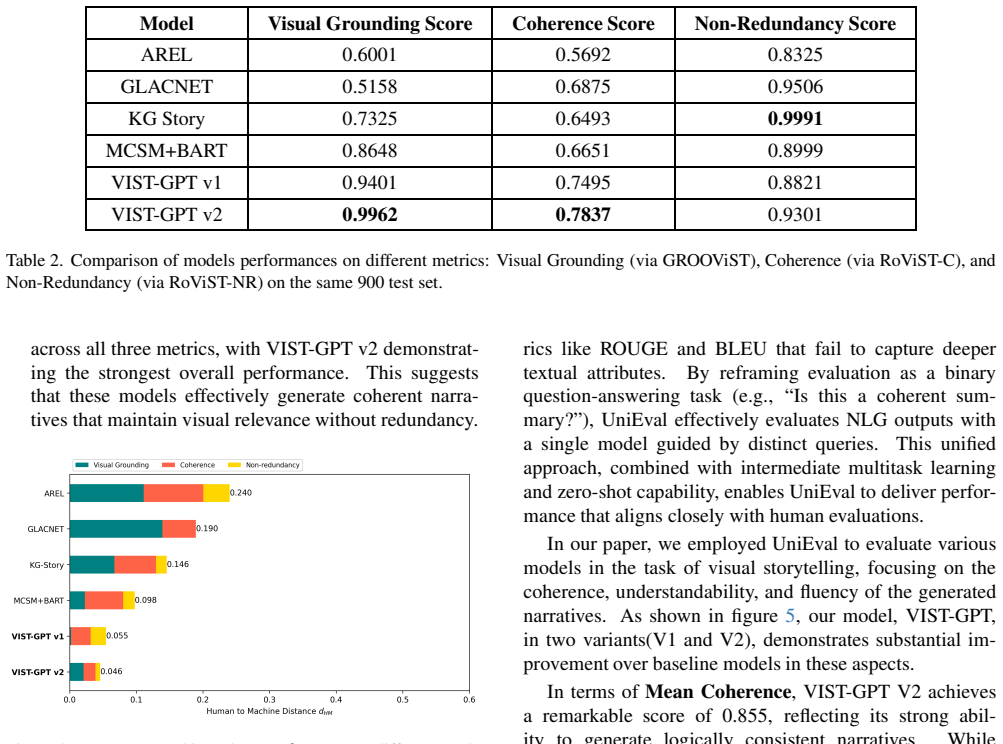
VIST-GPT v2, built from the VideoGPT+ multimodal backbone with a CLIP ViT-L/14 image encoder, an InternVideo2 video encoder, and a Phi-3-mini-4k-instruct LLM fine-tuned with LoRA, establishes what the authors describe as a new benchmark for visual storytelling. On a 900-example intersection of VIST test predictions, it attains a GROOViST visual grounding score of 0.9962, a RoViST-C coherence score of 0.7837, and a UniEval fluency score of 0.950, with the lowest Human-to-Machine Distance (dHM = 0.0459) among AREL, GLACNET, KG Story, MCSM+BART, and VIST-GPT v1. The claim is that the model's narratives align with the objects and events in the image sequence, flow logically sentence to sentence, and avoid the hallucinated details that plague prior models, because the LLM was fine-tuned on story-level data rather than merely prompted.
Load-bearing premise
The load-bearing premise is that the frozen CLIP and InternVideo2 features, carried through the inherited adapters, contain enough visual information for the fine-tuned LLM to ground its stories; if they do not, the strong grounding scores could reflect language priors rather than image content.
Editorial extensions
If this is right
- If the central claim holds, fine-tuning an existing video-centric multimodal LLM on VIST is a viable route to visual storytelling, without training a purpose-built encoder-decoder from scratch.
- The high scores imply that frozen visual features are sufficient for story grounding, so future gains should come mostly from the language side or from decoding strategy.
- The reference-free metrics RoViST and GROOViST, plus the Human-to-Machine Distance, give a reusable evaluation protocol that does not penalize valid but different stories, unlike BLEU or CIDEr.
- VIST-GPT v2's lower dHM means that on this benchmark the model's stories share the grounding, coherence, and non-redundancy profile of human stories more closely than the four earlier storytelling models tested.
Reading between the lines
- The 900-example intersection may not represent the full VIST test set, and if baseline predictions are missing non-randomly, the reported margins could shift on a complete evaluation.
- A text-only control experiment, feeding the same prompts with no visual tokens, would directly test whether the grounding scores reflect genuine image understanding or language priors learned from VIST.
- Because the visual encoders are frozen, scaling the LLM or unfreezing the adapters on more diverse story data could push grounding further; that is a natural extension the authors do not run.
- The qualitative appendix suggests the model captures social dynamics and emotional tone, but no metric in the paper measures those dimensions, so a reader should treat that as anecdotal.
Signed reviews
Editorial analysis
A structured set of objections, weighed in public.
Referee Report
Summary. The paper presents VIST-GPT, a visual storytelling model that adapts VideoGPT+'s dual image-video encoder architecture with a Phi-3-mini LLM fine-tuned via LoRA on the VIST dataset. The authors evaluate two inference variants (v1 and v2) on a 900-example intersection of the VIST test set using reference-free metrics (GROOViST, RoViST, UniEval) and the Human-to-Machine Distance (dHM). They claim that VIST-GPT v2 achieves state-of-the-art visual grounding, coherence, fluency, and the lowest dHM among compared models, thereby 'ushering in the era of visual storytelling with LLMs.' The technical contribution is an efficient fine-tuning recipe rather than a fundamentally new architecture.
Significance. If the empirical claims were sound, the paper would provide a useful, lightweight visual storytelling model with a sensible choice of reference-free evaluation metrics. The use of GROOViST and RoViST is appropriate for the task, and the efficiency of LoRA fine-tuning of a small LLM is attractive. However, the central benchmark claim is currently undermined by the evaluation protocol: the model version and decoding hyperparameters appear to have been selected on the test set itself, and the comparison omits several recent LLM-based storytelling baselines, including StoryLLaVA, which the paper cites in its own related work. Thus the significance of the contribution as a 'new benchmark' is not established, though the underlying methodology could be valid after a corrected evaluation.
major comments (3)
- [§4.2 and §5.3 (Tables 2–3)] The reported benchmark scores are invalid as test-set estimates because the model version was selected on the test set. Section 4.2 states that 'after completing the training process, we conducted several experiments during the inference phase, testing various parameters and prompts to optimize the model's performance,' resulting in v1 and v2. No validation split is described anywhere in Sections 4–5. The subsequent Tables 2 and 3 report GROOViST, RoViST-C, RoViST-NR, and dHM for v2 on the same 900-example test subset used to choose v2 over v1. Consequently, the values 0.9962, 0.7837, and 0.0459 are selection artifacts rather than estimates of generalization. The authors must either (a) introduce a proper validation split, tune only on it, and then report test results exclusively for the final version, or (b) clearly reframe these numbers as in-sample tuning results. This is load-bearing because the 'new benchmark' claim rests directly on these tables.
- [§3.3 vs §5.3] The comparison omits the most relevant modern baselines. Section 3.3 discusses StoryLLaVA as a recent visual storytelling model, yet Tables 2 and 3 compare only AREL, GLACNET, KG-Story, and MCSM+BART. The absence of StoryLLaVA and other LLM-based storytelling systems means that even with a clean evaluation, the paper would not substantiate 'v2 sets a new benchmark for visual storytelling.' The authors should include predictions from StoryLLaVA and, if feasible, from VideoGPT+ (the base model) and other recent MLLMs, with comparable inference settings. Without these, the claim is unsupported.
- [§4.1–4.2 and §5.2] The visual grounding results may be inflated by language priors because the visual encoders and adapters are frozen and only the LLM is fine-tuned. GROOViST measures alignment between nouns in the story and image regions; if the fine-tuned LLM produces generic nouns frequent in VIST training stories (e.g., 'friends,' 'park,' 'family'), the score can be high even when the model does not actually perceive the image content. The paper does not provide any diagnostic evidence to separate genuine visual grounding from language-prior effects. I recommend adding a per-image grounding analysis, or an experiment where the visual input is replaced with noise or a mismatched image sequence, to verify that the high GROOViST score is not an artifact of the text distribution. This caveat is important because the central claim includes 'highest visual grounding.'
minor comments (4)
- [§5.3, Eq. (1)–(2)] The dHM computation requires a human story H, but VIST has multiple human stories per image sequence. Please specify which human story is used (e.g., the first reference, a random reference, or an average over references) in the calculation of dH, dG, and dR; this affects the comparability of the distances across models.
- [§5.4] The UniEval scores reported in the text (mean coherence 0.855, understandability 0.9, fluency 0.950 for V2) are not shown in a table and are only given in Figure 5, which is not reproduced in the text. Please include a table with all model scores for all UniEval dimensions so that readers can reproduce the comparison.
- [§4.2] Please clarify how the additional three frames are padded when passing a five-image story to InternVideo2, which processes eight frames. Padding with zero frames versus repeating frames could affect temporal modeling and should be described precisely.
- [Throughout] The paper has numerous typos and formatting issues, including 'LL Ms' in the title, 'W e' in the abstract, 'judegment' in Section 5.2, and some incomplete figure captions. A thorough proofreading pass is needed.
Circularity Check
Benchmark claim is partially circular: VIST-GPT v2 was selected by inference-time prompt/decoding optimization on the same 900-example test set later reported as the benchmark.
-
fitted input called prediction
[Section 4.2, Table 1; Section 5.3, Tables 2 and 3]
"After completing the training process, we conducted several experiments during the inference phase, testing various parameters and prompts to optimize the model's performance. This experimentation resulted in two distinct versions of the model, VIST-GPT v1 and VIST-GPT v2. ... To ensure a fair comparison, we obtained predictions for the VIST test set from previous models. Since the test set predictions were incomplete for all models, we took the intersection of the available prediction samples, resulting in 900 examples."
The v2 configuration was selected by inference-time experimentation 'to optimize the model's performance' (Section 4.2), and the paper describes no validation or held-out split before reporting Tables 2 and 3. The only evaluation set introduced is the 900-example intersection of VIST test predictions. Reporting v2's scores on that same set as a 'new benchmark' therefore presents a selection artifact as an independent prediction: the chosen prompt, temperature, and beam count are inputs tuned on or toward the same examples whose scores are then reported as the model's performance. The reported superiority of v2 over v1 and over the baselines is not derived from a fixed, pre-specified model but is forced by the selection procedure, making the headline benchmark claim partially circular.
full rationale
Most of the technical derivation is not circular. The model adapts VideoGPT+'s frozen dual encoders and vision-language adapters, fine-tunes Phi-3-mini-4k-instruct with LoRA on VIST, and evaluates with externally defined metrics (RoViST, GROOViST, UniEval, dHM). These metrics are defined in prior work and are not functions of VIST-GPT's parameters, and no load-bearing claim rests solely on the authors' self-citations. The circular/fitted element is the benchmark claim itself: Section 4.2 describes tuning prompts and decoding parameters during inference to optimize performance, yielding v1 and v2, while Section 5 introduces no validation split and reports scores for the selected v2 on the same 900-example VIST test intersection. The headline 'new benchmark' therefore reduces, in part, to a selection statistic rather than an independent estimate of generalization. This fits the fitted-input-called-prediction pattern, though it is partial circularity because the architecture, training procedure, and metric definitions retain independent content.
Assumptions & free parameters
free parameters (4)
- VIST-GPT v1 temperature =
0.8
- VIST-GPT v1 beam count =
4
- VIST-GPT v2 temperature =
0.7
- VIST-GPT v2 beam count =
2
assumptions (5)
- domain assumption The VIST dataset provides image sequences with human-authored stories that serve as ground truth for storytelling quality.
- domain assumption RoViST and GROOViST metrics are valid proxies for human judgment of visual grounding, coherence, and non-redundancy.
- domain assumption UniEval provides a valid measure of coherence, fluency, and understandability for storytelling.
- domain assumption The frozen visual encoders and adapters inherited from VideoGPT+ capture sufficient visual information for story grounding.
- domain assumption The 900-example intersection of available test predictions is representative of VIST test set performance.
Cite this review
Pith. "Pith review of VIST-GPT: Ushering in the Era of Visual Storytelling with LLMs?." pith.science (2026). https://pith.science/paper/J7YAFU5V
@misc{pith2026250419267,
  author       = {Pith},
  title        = {Pith review of: VIST-GPT: Ushering in the Era of Visual Storytelling with LLMs?},
  year         = {2026},
  howpublished = {\url{https://pith.science/paper/J7YAFU5V}},
  note         = {Machine review of arXiv:2504.19267}
}
read the original abstract
Visual storytelling is an interdisciplinary field combining computer vision and natural language processing to generate cohesive narratives from sequences of images. This paper presents a novel approach that leverages recent advancements in multimodal models, specifically adapting transformer-based architectures and large multimodal models, for the visual storytelling task. Leveraging the large-scale Visual Storytelling (VIST) dataset, our VIST-GPT model produces visually grounded, contextually appropriate narratives. We address the limitations of traditional evaluation metrics, such as BLEU, METEOR, ROUGE, and CIDEr, which are not suitable for this task. Instead, we utilize RoViST and GROOVIST, novel reference-free metrics designed to assess visual storytelling, focusing on visual grounding, coherence, and non-redundancy. These metrics provide a more nuanced evaluation of narrative quality, aligning closely with human judgment.
Figures


Figures from the paper (7 more)


Forward citations
Cited by 2 Pith papers
-
LEMUR 2: Unlocking Neural Network Diversity for AI
LEMUR 2 releases a multi-generator, multi-task neural-architecture corpus with real-device latency metadata intended as fuel for LLM-driven AutoML.
-
AugmentGest: Can Random Data Cropping Augmentation Boost Gesture Recognition Performance?
Random cropping, rotation, zoom, and brightness/contrast augmentation on 2D skeleton gesture images improves accuracy on SHREC'17, DHG14/28, and JHMDB by up to 4.5% across three models.
Reference graph
Works this paper leans on
-
[1]
Phi-3 technical report: A highly capable language model locally on your phone
Marah Abdin, Sam Ade Jacobs, Ammar Ahmad Awan, Jyoti Aneja, Ahmed Awadallah, Hany Awadalla, Nguyen Bach, Amit Bahree, Arash Bakhtiari, Harkirat Behl, et al. Phi-3 technical report: A highly capable language model locally on your phone. arXiv preprint arXiv:2404.14219, 2024. 3
arXiv 2024
-
[2]
Nada Aboudeshish, Dmitry Ignatov, and Radu Timofte. Augmentgest: Can random data cropping augmentation boost gesture recognition performance? arXiv preprint arXiv:2506.07216, 2025. 8
arXiv 2025
-
[3]
Commonsense knowledge aware concept selec- tion for diverse and informative visual storytelling
Hong Chen, Yifei Huang, Hiroya Takamura, and Hideki Nakayama. Commonsense knowledge aware concept selec- tion for diverse and informative visual storytelling. In Pro- ceedings of the AAAI Conference on Artificial Intelligence , pages 999–1008, 2021. 1, 2, 6
work page 2021
-
[4]
Vicuna: An open-source chatbot impressing gpt-4 with 90%* chatgpt quality
Wei-Lin Chiang, Zhuohan Li, Zi Lin, Ying Sheng, Zhanghao Wu, Hao Zhang, Lianmin Zheng, Siyuan Zhuang, Y onghao Zhuang, Joseph E Gonzalez, et al. Vicuna: An open-source chatbot impressing gpt-4 with 90%* chatgpt quality. See 8 https://vicuna. lmsys. org (accessed 14 April 2023) , 2(3):6,
work page 2023
-
[5]
Content Planning for Neural Story Generation with Aristotelian Rescoring
Seraphina Goldfarb-Tarrant, Tuhin Chakrabarty, Ralph Weischedel, and Nanyun Peng. Content planning for neural story generation with aristotelian rescoring. arXiv preprint arXiv:2009.09870, 2020. 2
work page Pith review arXiv 2009
-
[6]
Contex - tualize, show and tell: A neural visual storyteller
Diana Gonzalez-Rico and Gibran Fuentes-Pineda. Contex - tualize, show and tell: A neural visual storyteller. arXiv preprint arXiv:1806.00738, 2018. 1, 2
arXiv 2018
-
[7]
Lemur neural net- work dataset: Towards seamless automl
Arash Torabi Goodarzi, Roman Kochnev, Waleed Khalid, Furui Qin, Tolgay Atinc Uzun, Yashkumar Sanjaybhai Dhameliya, Yash Kanubhai Kathiriya, Zofia Antonina Ben- tyn, Dmitry Ignatov, and Radu Timofte. Lemur neural net- work dataset: Towards seamless automl. arXiv preprint arXiv:2504.10552, 2025. 2
arXiv 2025
-
[8]
Diverse and rel- evant visual storytelling with scene graph embeddings
Xudong Hong, Rakshith Shetty, Asad Sayeed, Khushboo Mehra, V era Demberg, and Bernt Schiele. Diverse and rel- evant visual storytelling with scene graph embeddings. In Proceedings of the 24th Conference on Computational Nat- ural Language Learning, pages 420–430, 2020. 1, 2
work page 2020
Show all 50 references
-
[9]
Knowledge-enriched visual storytelling
Chao-Chun Hsu, Zi-Y uan Chen, Chi-Yang Hsu, Chih-Chia Li, Tzu-Y uan Lin, Ting-Hao Huang, and Lun-Wei Ku. Knowledge-enriched visual storytelling. In Proceedings of the AAAI Conference on Artificial Intelligence , pages 7952– 7960, 2020. 2, 6
2020
-
[10]
Plot and rework: Modeling storylines for visual storytelling
Chi-Yang Hsu, Y un-Wei Chu, Ting-Hao’Kenneth’ Huang, and Lun-Wei Ku. Plot and rework: Modeling storylines for visual storytelling. arXiv preprint arXiv:2105.06950 , 2021. 2
2021 arXiv
-
[11]
Visual storytelling
Ting-Hao Huang, Francis Ferraro, Nasrin Mostafazadeh , Is- han Misra, Aishwarya Agrawal, Jacob Devlin, Ross Gir- shick, Xiaodong He, Pushmeet Kohli, Dhruv Batra, et al. Visual storytelling. In Proceedings of the 2016 conference of the North American chapter of the association ...
2016
-
[12]
Glac net: Glocal attention cascading networks for multi-image cued story generation
Taehyeong Kim, Min-Oh Heo, Seonil Son, Kyoung-Wha Park, and Byoung-Tak Zhang. Glac net: Glocal attention cascading networks for multi-image cued story generation. arXiv preprint arXiv:1805.10973, 2018. 1, 2, 6
2018 arXiv
-
[13]
Optuna vs code llama: Are llms a new paradigm for hyperparameter tuning? arXiv preprint arXiv:2504.06006, 2025
Roman Kochnev, Arash Torabi Goodarzi, Zofia Antonina Bentyn, Dmitry Ignatov, and Radu Timofte. Optuna vs code llama: Are llms a new paradigm for hyperparameter tuning? arXiv preprint arXiv:2504.06006, 2025. 2
2025 arXiv
-
[14]
Nngpt: Neural network model gener- ation
Roman Kochnev et al. Nngpt: Neural network model gener- ation. arXiv preprint, 2025. 2
2025
-
[15]
Blip-2: Bootstrapping language-image pre-training with frozen image encoders and large language models
Junnan Li, Dongxu Li, Silvio Savarese, and Steven Hoi. Blip-2: Bootstrapping language-image pre-training with frozen image encoders and large language models. In In- ternational conference on machine learning , pages 19730– 19742. PMLR, 2023. 2
2023
-
[16]
A character- centric neural model for automated story generation
Danyang Liu, Juntao Li, Meng-Hsuan Y u, Ziming Huang, Gongshen Liu, Dongyan Zhao, and Rui Yan. A character- centric neural model for automated story generation. In Pro- ceedings of the AAAI Conference on Artificial Intelligence , pages 1725–1732, 2020. 1, 2
2020
-
[17]
Visual instruction tuning
Haotian Liu, Chunyuan Li, Qingyang Wu, and Y ong Jae Lee. Visual instruction tuning. Advances in neural information processing systems, 36, 2024. 2, 3
2024
-
[18]
Visual relationship detection with language priors
Cewu Lu, Ranjay Krishna, Michael Bernstein, and Li Fei- Fei. Visual relationship detection with language priors. I n Computer Vision–ECCV 2016: 14th European Conference, Amsterdam, The Netherlands, October 11–14, 2016, Pro- ceedings, Part I 14, pages 852–869. Springer, 2016. 2
2016
-
[19]
Videogpt+: Integrating image and video en- coders for enhanced video understanding
Muhammad Maaz, Hanoona Rasheed, Salman Khan, and Fahad Khan. Videogpt+: Integrating image and video en- coders for enhanced video understanding. arXiv preprint arXiv:2406.09418, 2024. 3
2024 arXiv
-
[20]
Step-by- step: Separating planning from realization in neural data- to- text generation
Amit Moryossef, Y oav Goldberg, and Ido Dagan. Step-by- step: Separating planning from realization in neural data- to- text generation. arXiv preprint arXiv:1904.03396, 2019. 2
1904 arXiv
-
[21]
Planning with learned entity prompts for abstractive summarization
Shashi Narayan, Yao Zhao, Joshua Maynez, Gonc ¸alo Sim˜ oes, Vitaly Nikolaev, and Ryan McDonald. Planning with learned entity prompts for abstractive summarization . Transactions of the Association for Computational Linguis - tics, 9:1475–1492, 2021. 2
2021
-
[22]
Data-to - text generation with variational sequential planning
Ratish Puduppully, Yao Fu, and Mirella Lapata. Data-to - text generation with variational sequential planning. Trans- actions of the Association for Computational Linguistics, 10: 697–715, 2022. 2
2022
-
[23]
Learning transferable visual models from natural language supervi- sion
Alec Radford, Jong Wook Kim, Chris Hallacy, Aditya Ramesh, Gabriel Goh, Sandhini Agarwal, Girish Sastry, Amanda Askell, Pamela Mishkin, Jack Clark, et al. Learning transferable visual models from natural language supervi- sion. In International conference on machine learning, ...
2021
-
[24]
Plotmachines: Outline-conditioned generation with d y- namic plot state tracking
Hannah Rashkin, Asli Celikyilmaz, Yejin Choi, and Jian feng Gao. Plotmachines: Outline-conditioned generation with d y- namic plot state tracking. arXiv preprint arXiv:2004.14967,
2004 arXiv
-
[25]
Explo r- ing the collaboration between vision models and llms for en- hanced image classification
Bhavya Rupani, Dmitry Ignatov, and Radu Timofte. Explo r- ing the collaboration between vision models and llms for en- hanced image classification. Dimensions, 27(1), 2025. 2
2025
-
[26]
Storygpt-v: Larg e language models as consistent story visualizers
Xiaoqian Shen and Mohamed Elhoseiny. Storygpt-v: Larg e language models as consistent story visualizers. 2023. 1
2023
-
[27]
Groovist: A metric for grounding objects in visual story- telling
Aditya K Surikuchi, Sandro Pezzelle, and Raquel Fern´ andez. Groovist: A metric for grounding objects in visual story- telling. arXiv preprint arXiv:2310.17770, 2023. 6
2023 arXiv
-
[28]
Not (yet) the whole story: Evaluating visual storytelling r e- quires more than measuring coherence, grounding, and rep- etition
Aditya K Surikuchi, Raquel Fern´ andez, and Sandro Pezzelle. Not (yet) the whole story: Evaluating visual storytelling r e- quires more than measuring coherence, grounding, and rep- etition. arXiv preprint arXiv:2407.04559, 2024. 6
2024 arXiv
-
[29]
V okenization: Improving lan- guage understanding with contextualized, visual-grounde d supervision
Hao Tan and Mohit Bansal. V okenization: Improving lan- guage understanding with contextualized, visual-grounde d supervision. arXiv preprint arXiv:2010.06775, 2020. 2
2010 arXiv
-
[30]
Llama: Open and efficient foundation language models
Hugo Touvron, Thibaut Lavril, Gautier Izacard, Xavier Martinet, Marie-Anne Lachaux, Timoth´ ee Lacroix, Baptiste Rozi` ere, Naman Goyal, Eric Hambro, Faisal Azhar, et al. Llama: Open and efficient foundation language models. arXiv preprint arXiv:2302.13971, 2023. 2
2023 arXiv
-
[31]
Multimodal few-shot learning with frozen language models
Maria Tsimpoukelli, Jacob L Menick, Serkan Cabi, SM Es- lami, Oriol Vinyals, and Felix Hill. Multimodal few-shot learning with frozen language models. Advances in Neural Information Processing Systems, 34:200–212, 2021. 2 9
2021
-
[32]
Rovist: Learn- ing robust metrics for visual storytelling
Eileen Wang, Caren Han, and Josiah Poon. Rovist: Learn- ing robust metrics for visual storytelling. arXiv preprint arXiv:2205.03774, 2022. 5, 6
2022 arXiv
-
[33]
Storytelling from an image stream using scene graphs
Ruize Wang, Zhongyu Wei, Piji Li, Qi Zhang, and Xuan- jing Huang. Storytelling from an image stream using scene graphs. In Proceedings of the AAAI Conference on Artificial Intelligence, pages 9185–9192, 2020. 2
2020
-
[34]
No metrics are perfect: Adver- sarial reward learning for visual storytelling
Xin Wang, Wenhu Chen, Y uan-Fang Wang, and William Yang Wang. No metrics are perfect: Adver- sarial reward learning for visual storytelling. arXiv preprint arXiv:1804.09160, 2018. 6
2018 arXiv
-
[35]
Internvideo2: Scaling video foundation mod- els for multimodal video understanding
Yi Wang, Kunchang Li, Xinhao Li, Jiashuo Y u, Yinan He, Guo Chen, Baoqi Pei, Rongkun Zheng, Jilan Xu, Zun Wang, et al. Internvideo2: Scaling video foundation mod- els for multimodal video understanding. arXiv preprint arXiv:2403.15377, 2024. 3
2024 arXiv
-
[36]
Next-gpt: Any-to-any multimodal llm
Shengqiong Wu, Hao Fei, Leigang Qu, Wei Ji, and Tat-Seng Chua. Next-gpt: Any-to-any multimodal llm. arXiv preprint arXiv:2309.05519, 2023. 2
2023 arXiv
-
[37]
Imagine, reason and write: Visual storytelling with graph knowledge and relational reasonin g
Chunpu Xu, Min Yang, Chengming Li, Ying Shen, Xiang Ao, and Ruifeng Xu. Imagine, reason and write: Visual storytelling with graph knowledge and relational reasonin g. In Proceedings of the AAAI Conference on Artificial Intelli- gence, pages 3022–3029, 2021. 1, 2
2021
-
[38]
A skeleton-based model for promoting co- herence among sentences in narrative story generation
Jingjing Xu, Xuancheng Ren, Yi Zhang, Qi Zeng, Xiaoyan Cai, and Xu Sun. A skeleton-based model for promoting co- herence among sentences in narrative story generation. arXiv preprint arXiv:1808.06945, 2018. 2
2018 arXiv
-
[39]
Re3: Generating longer stories with recursive reprompting and revision
Kevin Yang, Y uandong Tian, Nanyun Peng, and Dan Klein. Re3: Generating longer stories with recursive reprompting and revision. arXiv preprint arXiv:2210.06774, 2022. 1, 2
2022 arXiv
-
[40]
StoryLLaV A: Enhancing visual storytelling with multi- modal large language models
Li Yang, Zhiding Xiao, Wenxin Huang, and Xian Zhong. StoryLLaV A: Enhancing visual storytelling with multi- modal large language models. In Proceedings of the 31st In- ternational Conference on Computational Linguistics , pages 3936–3951, Abu Dhabi, UAE, 2025. Association for ...
2025
-
[41]
Knowledgeable storyteller: A commonsense-driven generative model for visual story- telling
Pengcheng Yang, Fuli Luo, Peng Chen, Lei Li, Zhiyi Yin, Xiaodong He, and Xu Sun. Knowledgeable storyteller: A commonsense-driven generative model for visual story- telling. In IJCAI, page 7, 2019. 2
2019
-
[42]
Plan-and-write: Towards bet- ter automatic storytelling
Lili Yao, Nanyun Peng, Ralph Weischedel, Kevin Knight, Dongyan Zhao, and Rui Yan. Plan-and-write: Towards bet- ter automatic storytelling. In Proceedings of the AAAI Con- ference on Artificial Intelligence , pages 7378–7385, 2019. 2
2019
-
[43]
Minigpt- 5: Interleaved vision-and-language generation via genera tive vokens
Kaizhi Zheng, Xuehai He, and Xin Eric Wang. Minigpt- 5: Interleaved vision-and-language generation via genera tive vokens. arXiv preprint arXiv:2310.02239, 2023. 2
2023
-
[44]
To- wards a unified multi-dimensional evaluator for text genera - tion
Ming Zhong, Yang Liu, Da Yin, Y uning Mao, Yizhu Jiao, Pengfei Liu, Chenguang Zhu, Heng Ji, and Jiawei Han. To- wards a unified multi-dimensional evaluator for text genera - tion. arXiv preprint arXiv:2210.07197, 2022. 7
2022 arXiv
-
[45]
Minigpt-4: Enhancing vision-language understanding with advanced large language models
Deyao Zhu, Jun Chen, Xiaoqian Shen, Xiang Li, and Mo- hamed Elhoseiny. Minigpt-4: Enhancing vision-language understanding with advanced large language models. arXiv preprint arXiv:2304.10592, 2023. 2 10 VIST-GPT: Ushering in the Era of Visual Storytelling with LL Ms? Supplemen...
2023 arXiv
-
[46]
Appendix 8.1. Qualitative Evaluation To assess the effectiveness of VIST-GPT v2 in visual sto- rytelling, we compared its outputs with those of baseline models (AREL, GLACNET, kG Story, MCSM, and VIST- GPT v1), as well as human-generated stories, using two im- age sets: a skat...
-
[47]
and a family boating trip (Figure 6). 8.1.1. Skatepark Story The skateboarding image set (Figure
-
[48]
ollie.” The phrase “nailed it!
shows two friends performing tricks at a park. The human story effectively captures the scene’s energy and camaraderie, detailing spe - cific skateboarding tricks and expressing the narrator’s ex - citement. In contrast, baseline models struggled to reflect the activity depicted...
-
[49]
The human story pro- vides a rich description of the family’s shared experience, including interactions and conversation, accurately capt ur- ing the sense of warmth and connection
depict a relaxed multi-generational outing on a lake. The human story pro- vides a rich description of the family’s shared experience, including interactions and conversation, accurately capt ur- ing the sense of warmth and connection. Baseline models, however, frequently dive...
-
[50]
the daughter wouldn’t leave them alone,
captures the atmo- sphere of a family gathering, focusing on drinking, playing video games, and transitioning to outdoor activities like a game of catch. It highlights group dynamics and the natu- ral flow of events, creating an engaging and contextually rich narrative. In cont...
Reviewed August 16, 2026 · model on record in the stance chip above.
Discussion (0). Continue with ORCID to comment.