REVIEW 3 major objections 5 minor 4 cited by
Detecting Cosmological Phase Transitions with Taiji: Sensitivity Analysis and Parameter Estimation
T0 review · 3 major / 5 minor · reviewed 2026-08-16 · deepseek-v4-flash
Pith's one-line read The paper claims Taiji can detect first-order phase-transition gravitational-wave backgrounds with peak energy density above about 1.4e-11 across most of its band, and measure the peak frequency to better than 10 percent for stronger…
desk verdict Useful Taiji-specific FOPT sensitivity map, but the headline threshold rests on undocumented per-run priors that contradict Table I. read the letter →
The pith
A machine-rendered reading of the paper's core claim, the machinery that carries it, and where it could break.
The reading
What carries the argument
The load-bearing object is the two-parameter broken power-law spectral template $P(f)$ with amplitude $\Omega_{\rm PT}$ and peak frequency $f_{\rm PT}$, which defines both the injected signals and the signal model the fit must recover. Around it the paper constructs a full simulation-inference chain: Taiji noise power spectral densities for optical measurement and test-mass acceleration; the orthogonal A/E/T time-delay-interferometry channels and their response functions; a fixed broken power-law double-white-dwarf foreground and a fixed power-law extragalactic compact-binary foreground; variance-minimizing frequency binning; and a hybrid Gaussian/lognormal likelihood. Bayes factors and Deviance Information Criterion differences carry the detection claim, while nested-sampling posteriors carry the parameter-estimation claim.
What would settle it
Rerun the paper's 100-injection grid with the double-white-dwarf foreground amplitude $A_1$ raised by a factor of 3; if the $\Omega_{\rm PT}\gtrsim1.4\times10^{-11}$ detection threshold does not shift upward, the quoted threshold is an artifact of the adopted foreground model. The same grid with a sound-shell spectral template instead of the broken power law would test whether the detection and $f_{\rm PT}$ precision claims are tied to the specific assumed shape.
Extended reading notes
Core claim
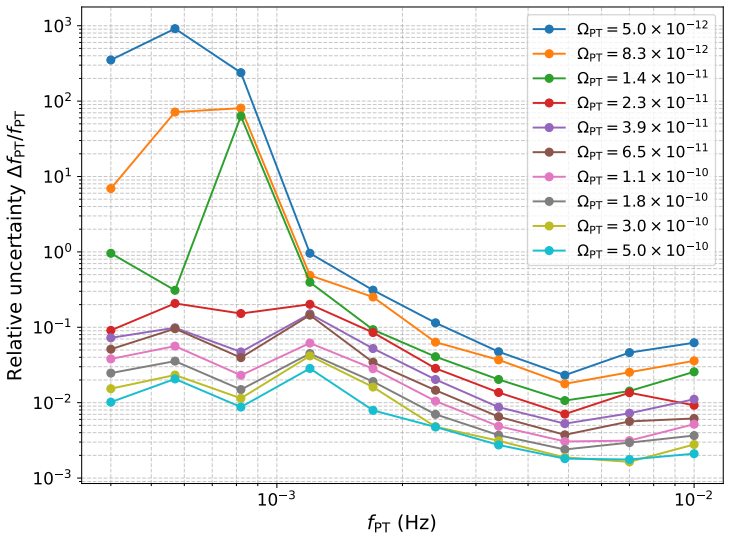
On the paper's own terms, the claim is that Taiji can both detect and characterize a first-order phase-transition gravitational-wave background whose spectrum is the acoustic broken power law $P(f)=(f/f_{\rm PT})^3[7/4+3(f/f_{\rm PT})^2]^{-7/2}$. Across a grid of 100 injections spanning $\Omega_{\rm PT}$ from $5\times10^{-12}$ to $5\times10^{-10}$ and $f_{\rm PT}$ from $4\times10^{-4}$ Hz to $10^{-2}$ Hz, the Bayesian analysis recovers the injected amplitudes and peak frequencies with no significant bias; the relative amplitude uncertainty shrinks as signal strength grows, and $\Delta f_{\rm PT}/f_{\rm PT}$ drops below 0.1 once $\Omega_{\rm PT}\gtrsim 1.1\times10^{-10}$. Model selection with both Bayes factors and the Deviance Information Criterion marks the phase-transition component decisively detected when the peak energy density exceeds roughly $1.4\times10^{-11}$ over most of the band, and the two metrics agree across the grid.
Load-bearing premise
The load-bearing premise is that the adopted broken power-law template for the phase-transition signal and the fixed double-white-dwarf foreground parameters describe the real signals well enough that recovering these simulated injections reflects true detection capability.
Editorial extensions
If this is right
- If the thresholds hold, Taiji alone can act as a discovery instrument for electroweak-scale phase transitions in strongly supercooled, composite-Higgs, and hidden-sector scenarios.
- The better-than-10% peak-frequency measurement above $\Omega_{\rm PT}\simeq 1.1\times10^{-10}$ makes $f_{\rm PT}$ a usable observable, which through $f_{\rm PT}\simeq 10^{-6}(H_*R_*)^{-1}(T_*/100\,{\rm GeV})$ Hz constrains the transition temperature and inverse mean bubble separation.
- The agreement between the Bayes-factor and DIC heatmaps provides a cross-check that the detection claims are not an artifact of one model-selection statistic.
- Below roughly $1.4\times10^{-11}$, or for peak frequencies below about $1.2\times10^{-3}$ Hz, the double-white-dwarf confusion noise masks the signal and parameter estimates degrade sharply, so those regions should be treated as foreground-limited.
Reading between the lines
- Because the foreground parameters are fixed to one population-model estimate, I would read $1.4\times10^{-11}$ as a floor: if the actual double-white-dwarf confusion noise is higher or spectrally different, the detection threshold moves upward.
- The same pipeline could be rerun with sound-shell or turbulence templates; the resulting shift in the $\Omega_{\rm PT}$-$f_{\rm PT}$ threshold map would show which spectral features Taiji is genuinely sensitive to rather than just the assumed broken power law.
- Since the posteriors in Table I constrain the DWD foreground parameters to a few percent, treating them as free in the fit rather than fixed is a cheap robustness upgrade and would make the quoted thresholds more conservative.
- The paper's own note that a single detector cannot cross-correlate indicates that joint operation with LISA or TianQin could push the threshold down; an order-of-magnitude improvement is plausible but needs a joint-simulation demonstration.
Signed reviews
Editorial analysis
A structured set of objections, weighed in public.
Referee Report
Summary. This manuscript presents a simulation-based forecast of Taiji's sensitivity to stochastic gravitational-wave backgrounds from first-order phase transitions. The analysis injects a two-parameter broken power-law spectrum (Ω_PT, f_PT) into simulated Taiji data that include analytic instrumental noise, a broken-power-law galactic double white dwarf foreground, and an extragalactic compact binary background. The authors use a hybrid Gaussian/log-normal likelihood and nested sampling to perform parameter estimation on a 100-point injection grid, and they report detection thresholds via Bayes factors and the Deviance Information Criterion, as well as parameter-precision curves. The headline claims are a detection threshold Ω_PT ≳ 1.4×10^-11 and frequency estimation better than 10% for Ω_PT ≳ 1.1×10^-10.
Significance. If correct, the result would provide a concrete, quantitative sensitivity target for electroweak-scale phase transitions with Taiji and a useful comparison with LISA forecasts. The paper has real strengths: the benchmark posterior in Table I and Fig. 2 is clean and physically sensible; the agreement between Bayes factors and DIC is a useful internal consistency check; and the noise and foreground modeling is explicit. The main caveats are that the headline threshold is an injection-recovery of the same template and foreground model used in the analysis, and that the documented priors are inconsistent with a large fraction of the injection grid. Because no code or data are released, the central numbers are not independently reproducible from the manuscript as written.
major comments (3)
- [Section III, Table I and injection grid] Table I reports priors log10 Ω_PT ~ U(-10.609,-10.209) and log10(f_PT/Hz) ~ U(-2.355,-1.955), i.e. Ω_PT ∈ [2.46×10^-11, 6.18×10^-11] and f_PT ∈ [4.4×10^-3, 1.1×10^-2] Hz. The grid defined in Section III contains Ω_PT values from 5×10^-12 to 5×10^-10 and f_PT values from 4×10^-4 to 1×10^-2 Hz. Only two of the ten Ω_PT rows (3.9×10^-11 and 6.5×10^-11) and three of the ten f_PT columns (4.9×10^-3, 7×10^-3, and 1×10^-2 Hz) lie inside the stated priors. The weakest injections that set the headline threshold, including Ω_PT = 1.4×10^-11, lie outside the prior support. If the same priors were used for all 100 runs, the recovered medians in Figs. 3 and 4 at those points cannot be produced by the stated procedure; if the priors were recentered on each injection, the Bayes factors in Fig. 7 and Eq. (33) are computed with signal-informed priors and are not blind-search evidence. The manuscript does not state which case applies. Please document the per-run priors, or use a single prior covering the full grid, and recompute or re-derive the threshold accordingly.
- [Section II.A-I.D and Section III] Equations (2), (15), and (17) define the signal and foreground models, and the same functional forms are used to generate the synthetic data and to fit them. The reported thresholds therefore measure the recoverability of the assumed broken power-law spectrum with fixed foreground shapes, not the detectability of FOPT signals in general. The abstract's claim that Taiji can 'robustly detect and characterize phase transition signals' should be qualified as 'within the template family and foreground model considered.' As a concrete test, the authors should vary either the high-frequency slope of the FOPT template or the DWD foreground parameters within their population-synthesis uncertainties and report how the Ω_PT threshold shifts. The conclusion already notes the need for more physically motivated spectral shapes, but the abstract and the threshold claims should carry this qualification.
- [Section III, Eqs. (22)-(24)] The optimal binning weights in Eq. (24) are defined through D_th(f_j, θ, n), which depends on the very signal parameters being estimated. The manuscript does not explain how the weights are set during the MCMC runs: if the true injected parameters are used, the binned data are constructed with knowledge of the signal and the subsequent likelihood is partly circular; if a fixed reference model is used, the stated optimality is not realized. Please specify the binning protocol (e.g., an iterative scheme or a fixed fiducial model) and, if necessary, show that the thresholds are insensitive to the choice.
minor comments (5)
- [Figures 3 and 4] The axis labels in Figs. 3 and 4 appear to have missing negative exponents, e.g., 'PT = 5.0 × 10 12' should presumably be '5.0 × 10^-12'; please correct the rendering.
- [Section I] The introduction refers once to 'TinQin'; this should be 'TianQin'.
- [Section IV] The comparison to 'current constraints [75,76]' is made without noting that NANOGrav and EPTA operate at nHz frequencies; a direct comparison with Taiji's mHz band is not meaningful without explaining the frequency extrapolation involved.
- [Throughout] No code or data are released; a reproducibility statement or a link to the injection and recovery scripts would help readers verify the grid results.
- [Section IV] The concluding paragraph on single-detector limitations is appropriate and should be reflected in the abstract's 'robustly detect' wording, which currently sounds stronger than the analysis supports.
Circularity Check
No circular derivation found; the sensitivity thresholds are injection-recovery forecasts, with only minor self-cited foreground inputs that are not circularly load-bearing.
full rationale
The paper's core statements are conditional simulation forecasts, not equations that reduce to their inputs. The FOPT signal template P(f) in Eq. (2) is adopted from the external numerical simulation fit [11]; the DWD foreground parameters in Eq. (15) and the ECB background in Eq. (17) are taken from population-synthesis fits in refs [67,68] and [69]. Although some of those refs share authors with the present paper, they are external inputs (population-model fits) and are not derived from the Taiji detection claim, so they do not make the argument circular. No fitted parameter is renamed as a prediction: the quoted thresholds (Omega_PT greater than about 1.4e-11; 10% frequency precision for Omega_PT greater than about 1.1e-10) are obtained by injecting the assumed broken power-law signal into synthetic Taiji noise and recovering it with the same model, which is a standard, self-contained Bayesian forecast. The Bayes factor and DIC maps measure recovery of that assumed spectrum, so the claim is that Taiji can recover this template, not a first-principles guarantee for arbitrary FOPT spectra; the paper itself flags the single-detector limitation and the restricted template in Section IV. One non-circular transparency concern should be flagged: the priors shown in Table I cover only the benchmark point, while the grid in Section III extends to Omega_PT = 5e-12 and fPT = 4e-4 Hz, well outside those ranges; the per-run priors for those points are undocumented, which is a reproducibility and possible evidence-inflation risk, but absent a statement of the per-run priors it is not an exhibited circular reduction. Accordingly the circularity score is 2, reflecting only minor self-citation that is not circularly load-bearing.
Assumptions & free parameters
free parameters (8)
- Instrumental OMS noise amplitude P =
8 (fixed input)
- Acceleration noise amplitude A =
3 (fixed input)
- DWD foreground amplitude A1 =
3.98e-16 (log10 -15.4)
- DWD foreground slope alpha1 =
-5.7
- DWD foreground amplitude A2 =
4.79e-7 (log10 -6.32)
- DWD foreground slope alpha2 =
-6.2
- ECB amplitude A_ECB =
1.8e-9 at 25 Hz (log10 -8.74)
- ECB spectral index alpha_ECB =
2/3
assumptions (7)
- domain assumption Signal and instrumental noise are stationary, Gaussian, and mutually uncorrelated.
- domain assumption The FOPT SGWB is fully described by the broken power-law template P(f) in Eq. (2) with fixed f^3 and f^-4 slopes.
- domain assumption The DWD confusion noise is modeled by the broken power law Eq. (15) with parameters from refs [67,68] and no residual discrete-source structure.
- domain assumption The ECB background is a single power law Eq. (17) with index 2/3 across the Taiji band.
- domain assumption The A/E/T TDI channels are noise-orthogonal, with A and E identical and T a null channel; analytical response functions from ref [62] apply.
- domain assumption A 75% duty cycle over 4 years gives an effective 3-year observation with N_c=94 chunks of 11.5 days.
- domain assumption The hybrid Gaussian/log-normal likelihood of Eq. (30) correctly models the distribution of segment-averaged power spectral densities.
Cite this review
Pith. "Pith review of Detecting Cosmological Phase Transitions with Taiji: Sensitivity Analysis and Parameter Estimation." pith.science (2026). https://pith.science/paper/JAAR3UAG
@misc{pith2026250416712,
  author       = {Pith},
  title        = {Pith review of: Detecting Cosmological Phase Transitions with Taiji: Sensitivity Analysis and Parameter Estimation},
  year         = {2026},
  howpublished = {\url{https://pith.science/paper/JAAR3UAG}},
  note         = {Machine review of arXiv:2504.16712}
}
abstract
We investigate the capability of the Taiji space-based gravitational wave observatory to detect stochastic gravitational wave backgrounds produced by first-order phase transitions in the early universe. Using a comprehensive simulation framework that incorporates realistic instrumental noise, galactic double white dwarf confusion noise, and extragalactic compact binary backgrounds, we systematically analyze Taiji's sensitivity across a range of signal parameters. Our Bayesian analysis demonstrates that Taiji can robustly detect and characterize phase transition signals with energy densities exceeding $\Omega_{\text{PT}} \gtrsim 1.4 \times 10^{-11}$ across most of its frequency band, with particularly strong sensitivity around $10^{-3}$ to $10^{-2}$ Hz. For signals with amplitudes above $\Omega_{\text{PT}} \gtrsim 1.1 \times 10^{-10}$, Taiji can determine the peak frequency with relative precision better than $10\%$. These detection capabilities would enable Taiji to probe electroweak-scale phase transitions in various beyond-Standard-Model scenarios, potentially revealing new physics connected to baryogenesis and dark matter production. We quantify detection confidence using both Bayes factors and the Deviance Information Criterion, finding consistent results that validate our statistical methodology.
Figures


Figures from the paper (5 more)




Forward citations
Cited by 4 Pith papers
-
Inferring the stochastic gravitational-wave background from eccentric stellar-mass binary black holes with spaceborne detectors
Eccentric black-hole-binary backgrounds from globular clusters and isolated evolution would look like power-law noise for TianQin/LISA/Taiji, but AGN-formed binaries produce a turnover that LISA and Taiji can distinguish.
-
Inflationary phase transitions in the early Universe: A Bayesian study with space-based gravitational-wave detectors
With a Taiji-like detector, inflationary phase-transition gravitational-wave backgrounds are detectable at SNR≳10, but reliable parameter reconstruction needs SNR≳33 and degrades with astrophysical foregrounds.
-
Bayesian analysis of the complex singlet model with phase transition gravitational waves
Bayesian forecasts for the Taiji detector constrain complex singlet model parameters through electroweak phase transition gravitational wave signals.
-
Measuring gravitational wave spectrum from electroweak phase transition and Higgs self-couplings
Using simulated Taiji data, the authors show that a stochastic gravitational-wave signal from an electroweak phase transition in the singlet-extended Standard Model can constrain the Higgs cubic and quartic self-couplings.
Reference graph
Works this paper leans on
-
[1]
Observation of Gravitational Waves from a Binary Black Hole Merger,
B. P. Abbottet al.(LIGO Scientific, Virgo), “Observation of Gravitational Waves from a Binary Black Hole Merger,” Phys. Rev. Lett.116, 061102 (2016), arXiv:1602.03837 [gr-qc]
arXiv 2016
-
[2]
Cosmological Backgrounds of Gravitational Waves,
Chiara Caprini and Daniel G. Figueroa, “Cosmological Backgrounds of Gravitational Waves,” Class. Quant. Grav.35, 163001 (2018), arXiv:1801.04268 [astro-ph.CO]
arXiv 2018
-
[3]
Michele Maggiore,Gravitational Waves. Vol. 2: Astrophysics and Cosmology(Oxford University Press, 2018)
2018
-
[4]
Cosmic Separation of Phases,
Edward Witten, “Cosmic Separation of Phases,” Phys. Rev. D30, 272–285 (1984)
1984
-
[5]
Gravitational radiation from cosmological phase transitions,
C. J. Hogan, “Gravitational radiation from cosmological phase transitions,” Mon. Not. Roy. Astron. Soc.218, 629–636 (1986)
work page 1986
-
[6]
The Fate of the False Vacuum. 1. Semiclassical Theory,
Sidney R. Coleman, “The Fate of the False Vacuum. 1. Semiclassical Theory,” Phys. Rev. D15, 2929– 2936 (1977), [Erratum: Phys.Rev.D 16, 1248 (1977)]
work page 1977
-
[7]
Decay of the False Vacuum at Finite Temperature,
Andrei D. Linde, “Decay of the False Vacuum at Finite Temperature,” Nucl. Phys. B216, 421 (1983), [Erratum: Nucl.Phys.B 223, 544 (1983)]
work page 1983
-
[8]
Gravitational waves from the sound of a first order phase transition,
Mark Hindmarsh, Stephan J. Huber, Kari Rummukainen, and David J. Weir, “Gravitational waves from the sound of a first order phase transition,” Phys. Rev. Lett.112, 041301 (2014), arXiv:1304.2433 [hep-ph]
arXiv 2014
Show all 82 references
-
[9]
Numerical simulations of acoustically generated gravitational waves at a first order phase transition,
Mark Hindmarsh, Stephan J. Huber, Kari Rummukainen, and David J. Weir, “Numerical simulations of acoustically generated gravitational waves at a first order phase transition,” Phys. Rev. D92, 123009 (2015), arXiv:1504.03291 [astro-ph.CO]
2015 arXiv
-
[10]
Gravitational waves from bubble collisions: An analytic derivation,
Ryusuke Jinno and Masahiro Takimoto, “Gravitational waves from bubble collisions: An analytic derivation,” Phys. Rev. D95, 024009 (2017), arXiv:1605.01403 [astro-ph.CO]
2017 arXiv
-
[11]
Shape of the acoustic gravitational wave power spectrum from a first order phase transition,
Mark Hindmarsh, Stephan J. Huber, Kari Rummukainen, and David J. Weir, “Shape of the acoustic gravitational wave power spectrum from a first order phase transition,” Phys. Rev. D96, 103520 (2017), [Erratum: Phys.Rev.D 101, 089902 (2020)], arXiv:1704.05871 [astro-ph.CO]
2017 arXiv
-
[12]
Gravitational radiation from a bulk flow model,
Thomas Konstandin, “Gravitational radiation from a bulk flow model,” JCAP03, 047 (2018), arXiv:1712.06869 [astro-ph.CO]
2018 arXiv
-
[13]
Vorticity, kinetic energy, and suppressed gravitational wave production in strong first order phase transitions,
Daniel Cutting, Mark Hindmarsh, and David J. Weir, “Vorticity, kinetic energy, and suppressed gravitational wave production in strong first order phase transitions,” Phys. Rev. Lett.125, 021302 (2020), arXiv:1906.00480 [hep-ph]
2020 arXiv
-
[14]
Numerical simulations of gravitational waves from early-universe turbulence,
Alberto Roper Pol, Sayan Mandal, Axel Brandenburg, Tina Kahniashvili, and Arthur Kosowsky, “Numerical simulations of gravitational waves from early-universe turbulence,” Phys. Rev. D102, 083512 (2020), arXiv:1903.08585 [astro-ph.CO]. 19
2020 arXiv
-
[15]
Gravitational wave spectra from strongly supercooled phase tran- sitions,
Marek Lewicki and Ville Vaskonen, “Gravitational wave spectra from strongly supercooled phase tran- sitions,” Eur. Phys. J. C80, 1003 (2020), arXiv:2007.04967 [astro-ph.CO]
2020 arXiv
-
[16]
Decay of acoustic turbulence in two dimensions and implications for cosmological gravitational waves,
Jani Dahl, Mark Hindmarsh, Kari Rummukainen, and David J. Weir, “Decay of acoustic turbulence in two dimensions and implications for cosmological gravitational waves,” Phys. Rev. D106, 063511 (2022), arXiv:2112.12013 [gr-qc]
2022 arXiv
-
[17]
Higgsless simulations of cosmological phase transitions and gravitational waves,
Ryusuke Jinno, Thomas Konstandin, Henrique Rubira, and Isak Stomberg, “Higgsless simulations of cosmological phase transitions and gravitational waves,” JCAP02, 011 (2023), arXiv:2209.04369 [astro-ph.CO]
2023 arXiv
-
[18]
Generation of gravitational waves from freely decaying turbulence,
Pierre Auclair, Chiara Caprini, Daniel Cutting, Mark Hindmarsh, Kari Rummukainen, Dani` ele A. Steer, and David J. Weir, “Generation of gravitational waves from freely decaying turbulence,” JCAP 09, 029 (2022), arXiv:2205.02588 [astro-ph.CO]
2022 arXiv
-
[19]
Shallow relic gravitational wave spectrum with acoustic peak,
Ramkishor Sharma, Jani Dahl, Axel Brandenburg, and Mark Hindmarsh, “Shallow relic gravitational wave spectrum with acoustic peak,” JCAP12, 042 (2023), arXiv:2308.12916 [gr-qc]
2023 arXiv
-
[20]
Characterization of the gravitational wave spectrum from sound waves within the sound shell model,
Alberto Roper Pol, Simona Procacci, and Chiara Caprini, “Characterization of the gravitational wave spectrum from sound waves within the sound shell model,” Phys. Rev. D109, 063531 (2024), arXiv:2308.12943 [gr-qc]
2024 arXiv
-
[21]
Gravitational Waves from Phase Transitions at the Elec- troweak Scale and Beyond,
Christophe Grojean and Geraldine Servant, “Gravitational Waves from Phase Transitions at the Elec- troweak Scale and Beyond,” Phys. Rev. D75, 043507 (2007), arXiv:hep-ph/0607107
2007 arXiv
-
[22]
Phase transitions in the early universe,
Mark B. Hindmarsh, Marvin L¨ uben, Johannes Lumma, and Martin Pauly, “Phase transitions in the early universe,” SciPost Phys. Lect. Notes24, 1 (2021), arXiv:2008.09136 [astro-ph.CO]
2021 arXiv
-
[23]
On the Anomalous Electroweak Baryon Number Nonconservation in the Early Universe,
V. A. Kuzmin, V. A. Rubakov, and M. E. Shaposhnikov, “On the Anomalous Electroweak Baryon Number Nonconservation in the Early Universe,” Phys. Lett. B155, 36 (1985)
1985
-
[24]
Progress in electroweak baryogenesis,
Andrew G. Cohen, D. B. Kaplan, and A. E. Nelson, “Progress in electroweak baryogenesis,” Ann. Rev. Nucl. Part. Sci.43, 27–70 (1993), arXiv:hep-ph/9302210
1993 arXiv
-
[25]
Filtered Dark Matter at a First Order Phase Transition,
Michael J. Baker, Joachim Kopp, and Andrew J. Long, “Filtered Dark Matter at a First Order Phase Transition,” Phys. Rev. Lett.125, 151102 (2020), arXiv:1912.02830 [hep-ph]
2020 arXiv
-
[26]
The Taiji Program in Space for gravitational wave physics and the nature of gravity,
Wen-Rui Hu and Yue-Liang Wu, “The Taiji Program in Space for gravitational wave physics and the nature of gravity,” Natl. Sci. Rev.4, 685–686 (2017)
2017
-
[27]
Taiji program: Gravitational-wave sources,
Wen-Hong Ruan, Zong-Kuan Guo, Rong-Gen Cai, and Yuan-Zhong Zhang, “Taiji program: Gravitational-wave sources,” Int. J. Mod. Phys. A35, 2050075 (2020), arXiv:1807.09495 [gr-qc]
2020 arXiv
-
[28]
Laser Interferometer Space Antenna,
Pau Amaro-Seoaneet al.(LISA), “Laser Interferometer Space Antenna,” (2017), arXiv:1702.00786 [astro-ph.IM]
2017 arXiv
-
[29]
TianQin: a space-borne gravitational wave detector,
Jun Luoet al.(TianQin), “TianQin: a space-borne gravitational wave detector,” Class. Quant. Grav. 33, 035010 (2016), arXiv:1512.02076 [astro-ph.IM]
2016 arXiv
-
[30]
The gravitational wave background from cosmological compact binaries,
Alison J. Farmer and E. Sterl Phinney, “The gravitational wave background from cosmological compact binaries,” Mon. Not. Roy. Astron. Soc.346, 1197 (2003), arXiv:astro-ph/0304393. 20
2003 arXiv
-
[31]
The LISA Gravitational Wave Foreground: A Study of Double White Dwarfs,
Ashley J. Ruiter, Krzysztof Belczynski, Matthew Benacquista, Shane L. Larson, and Gabriel Williams, “The LISA Gravitational Wave Foreground: A Study of Double White Dwarfs,” Astrophys. J.717, 1006–1021 (2010), arXiv:0705.3272 [astro-ph]
2010 arXiv
-
[32]
On the gravitational wave background from compact binary coalescences in the band of ground-based interferometers,
Xing-Jiang Zhu, Eric J. Howell, David G. Blair, and Zong-Hong Zhu, “On the gravitational wave background from compact binary coalescences in the band of ground-based interferometers,” Mon. Not. Roy. Astron. Soc.431, 882–899 (2013), arXiv:1209.0595 [gr-qc]
2013 arXiv
-
[33]
Gravitational wave background from binary systems,
Pablo A. Rosado, “Gravitational wave background from binary systems,” Phys. Rev. D84, 084004 (2011), arXiv:1106.5795 [gr-qc]
2011 arXiv
-
[34]
The gravitational wave signal from the galactic disk population of binaries containing two compact objects,
G. Nelemans, L. R. Yungelson, and Simon F. Portegies Zwart, “The gravitational wave signal from the galactic disk population of binaries containing two compact objects,” Astron. Astrophys.375, 890–898 (2001), arXiv:astro-ph/0105221
2001 arXiv
-
[35]
The astrophysical gravitational wave stochastic background,
Tania Regimbau, “The astrophysical gravitational wave stochastic background,” Res. Astron. Astro- phys.11, 369–390 (2011), arXiv:1101.2762 [astro-ph.CO]
2011 arXiv
-
[36]
Detection methods for stochastic gravitational-wave back- grounds: a unified treatment,
Joseph D. Romano and Neil J. Cornish, “Detection methods for stochastic gravitational-wave back- grounds: a unified treatment,” Living Rev. Rel.20, 2 (2017), arXiv:1608.06889 [gr-qc]
2017 arXiv
-
[37]
Galactic binary science with the new LISA design,
Neil Cornish and Travis Robson, “Galactic binary science with the new LISA design,” J. Phys. Conf. Ser.840, 012024 (2017), arXiv:1703.09858 [astro-ph.IM]
2017 arXiv
-
[38]
Assessing the Impact of Unequal Noises and Foreground Modeling on SGWB Reconstruction with LISA,
Jun’ya Kume, Marco Peloso, Mauro Pieroni, and Angelo Ricciardone, “Assessing the Impact of Unequal Noises and Foreground Modeling on SGWB Reconstruction with LISA,” (2024), arXiv:2410.10342 [gr- qc]
2024 arXiv
-
[39]
Science with the space-based interferometer eLISA. II: Gravitational waves from cosmological phase transitions,
Chiara Capriniet al., “Science with the space-based interferometer eLISA. II: Gravitational waves from cosmological phase transitions,” JCAP04, 001 (2016), arXiv:1512.06239 [astro-ph.CO]
2016 arXiv
-
[40]
Detecting gravitational waves from cosmological phase transitions with LISA: an update,
Chiara Capriniet al., “Detecting gravitational waves from cosmological phase transitions with LISA: an update,” JCAP03, 024 (2020), arXiv:1910.13125 [astro-ph.CO]
2020 arXiv
-
[41]
Observational prospects for phase transitions at LISA: Fisher matrix analysis,
Chloe Gowling and Mark Hindmarsh, “Observational prospects for phase transitions at LISA: Fisher matrix analysis,” JCAP10, 039 (2021), arXiv:2106.05984 [astro-ph.CO]
2021 arXiv
-
[42]
Reconstructing physical parameters from template gravitational wave spectra at LISA: first order phase transitions,
Chloe Gowling, Mark Hindmarsh, Deanna C. Hooper, and Jes´ us Torrado, “Reconstructing physical parameters from template gravitational wave spectra at LISA: first order phase transitions,” JCAP04, 061 (2023), arXiv:2209.13551 [astro-ph.CO]
2023 arXiv
-
[43]
Prospects for LISA to detect a gravitational-wave background from first order phase transitions,
Guillaume Boileau, Nelson Christensen, Chloe Gowling, Mark Hindmarsh, and Renate Meyer, “Prospects for LISA to detect a gravitational-wave background from first order phase transitions,” JCAP02, 056 (2023), arXiv:2209.13277 [gr-qc]
2023 arXiv
-
[44]
Gravita- tional waves from first-order phase transitions in LISA: reconstruction pipeline and physics interpreta- tion,
Chiara Caprini, Ryusuke Jinno, Marek Lewicki, Eric Madge, Marco Merchand, Germano Nardini, Mauro Pieroni, Alberto Roper Pol, and Ville Vaskonen (LISA Cosmology Working Group), “Gravita- tional waves from first-order phase transitions in LISA: reconstruction pipeline and physic...
2024 arXiv
-
[45]
Recovering a phase transition signal in simulated LISA data with a modulated galactic foreground,
Mark Hindmarsh, Deanna C. Hooper, Tiina Minkkinen, and David J. Weir, “Recovering a phase transition signal in simulated LISA data with a modulated galactic foreground,” JCAP04, 052 (2025), arXiv:2406.04894 [astro-ph.CO]
2025 arXiv
-
[46]
Reconstructing early universe evolution with gravitational waves from supercooled phase transitions,
Adam Gonstal, Marek Lewicki, and Bogumila Swiezewska, “Reconstructing early universe evolution with gravitational waves from supercooled phase transitions,” (2025), arXiv:2502.18436 [gr-qc]
2025
-
[47]
The LISA-Taiji Network: Precision Localization of Coalescing Massive Black Hole Binaries,
Wen-Hong Ruan, Chang Liu, Zong-Kuan Guo, Yue-Liang Wu, and Rong-Gen Cai, “The LISA-Taiji Network: Precision Localization of Coalescing Massive Black Hole Binaries,” Research2021, 6014164 (2021), arXiv:1909.07104 [gr-qc]
2021 arXiv
-
[48]
The LISA-Taiji network,
Wen-Hong Ruan, Chang Liu, Zong-Kuan Guo, Yue-Liang Wu, and Rong-Gen Cai, “The LISA-Taiji network,” Nature Astron.4, 108–109 (2020), arXiv:2002.03603 [gr-qc]
2020 arXiv
-
[49]
Hubble parameter estimation via dark sirens with the LISA-Taiji network,
Renjie Wang, Wen-Hong Ruan, Qing Yang, Zong-Kuan Guo, Rong-Gen Cai, and Bin Hu, “Hubble parameter estimation via dark sirens with the LISA-Taiji network,” Natl. Sci. Rev.9, nwab054 (2022), arXiv:2010.14732 [astro-ph.CO]
2022 arXiv
-
[50]
Forecast for cosmological parameter estimation with gravitational-wave standard sirens from the LISA-Taiji network,
Ling-Feng Wang, Shang-Jie Jin, Jing-Fei Zhang, and Xin Zhang, “Forecast for cosmological parameter estimation with gravitational-wave standard sirens from the LISA-Taiji network,” Sci. China Phys. Mech. Astron.65, 210411 (2022), arXiv:2101.11882 [gr-qc]
2022 arXiv
-
[51]
Ability of LISA, Taiji, and their networks to detect the stochastic gravitational wave background generated by cosmic strings,
Bo-Rui Wang and Jin Li, “Ability of LISA, Taiji, and their networks to detect the stochastic gravitational wave background generated by cosmic strings,” Phys. Rev. D109, 063520 (2024), arXiv:2311.07116 [astro-ph.CO]
2024 arXiv
-
[52]
Taiji-TianQin-LISA network: Precisely measuring the Hubble constant using both bright and dark sirens,
Shang-Jie Jin, Ye-Zhu Zhang, Ji-Yu Song, Jing-Fei Zhang, and Xin Zhang, “Taiji-TianQin-LISA network: Precisely measuring the Hubble constant using both bright and dark sirens,” Sci. China Phys. Mech. Astron.67, 220412 (2024), arXiv:2305.19714 [astro-ph.CO]
2024 arXiv
-
[53]
On networks of space-based gravitational-wave detectors,
Rong-Gen Cai, Zong-Kuan Guo, Bin Hu, Chang Liu, Youjun Lu, Wei-Tou Ni, Wen-Hong Ruan, Naoki Seto, Gang Wang, and Yue-Liang Wu, “On networks of space-based gravitational-wave detectors,” Fund. Res.4, 1072–1085 (2024), arXiv:2305.04551 [gr-qc]
2024 arXiv
-
[54]
Unveiling a mul- ticomponent stochastic gravitational-wave background with the TianQin+LISA network,
Zheng-Cheng Liang, Zhi-Yuan Li, En-Kun Li, Jian-dong Zhang, and Yi-Ming Hu, “Unveiling a mul- ticomponent stochastic gravitational-wave background with the TianQin+LISA network,” Phys. Rev. D111, 043032 (2025), arXiv:2409.00778 [gr-qc]
2025 arXiv
-
[55]
Planck 2018 results. VI. Cosmological parameters,
N. Aghanimet al.(Planck), “Planck 2018 results. VI. Cosmological parameters,” Astron. Astrophys. 641, A6 (2020), [Erratum: Astron.Astrophys. 652, C4 (2021)], arXiv:1807.06209 [astro-ph.CO]
2020 arXiv
-
[56]
Discriminating a gravitational wave back- ground from instrumental noise in the LISA detector,
Massimo Tinto, J. W. Armstrong, and F. B. Estabrook, “Discriminating a gravitational wave back- ground from instrumental noise in the LISA detector,” Phys. Rev. D63, 021101 (2001)
2001
-
[57]
Time delay interferometry for LISA,
Massimo Tinto, F. B. Estabrook, and J. W. Armstrong, “Time delay interferometry for LISA,” Phys. Rev. D65, 082003 (2002)
2002
-
[58]
The first round result from the TianQin-1 satellite,
Jun Luoet al., “The first round result from the TianQin-1 satellite,” Class. Quant. Grav.37, 185013 (2020), arXiv:2008.09534 [physics.ins-det]. 22
2020 arXiv
-
[59]
Taiji data challenge for exploring gravitational wave universe,
Zhixiang Ren, Tianyu Zhao, Zhoujian Cao, Zong-Kuan Guo, Wen-Biao Han, Hong-Bo Jin, and Yue- Liang Wu, “Taiji data challenge for exploring gravitational wave universe,” Front. Phys. (Beijing)18, 64302 (2023), arXiv:2301.02967 [gr-qc]
2023 arXiv
-
[60]
A brief analysis to Taiji: Science and technology,
Ziren Luo, ZongKuan Guo, Gang Jin, Yueliang Wu, and Wenrui Hu, “A brief analysis to Taiji: Science and technology,” Results Phys.16, 102918 (2020)
2020
-
[61]
The LISA optimal sensitivity,
Thomas A. Prince, Massimo Tinto, Shane L. Larson, and J. W. Armstrong, “The LISA optimal sensitivity,” Phys. Rev. D66, 122002 (2002), arXiv:gr-qc/0209039
2002 arXiv
-
[62]
Sensitivity functions of space- borne gravitational wave detectors for arbitrary time-delay interferometry combinations regarding non- tensorial polarizations,
Pan-Pan Wang, Yu-Jie Tan, Wei-Liang Qian, and Cheng-Gang Shao, “Sensitivity functions of space- borne gravitational wave detectors for arbitrary time-delay interferometry combinations regarding non- tensorial polarizations,” Phys. Rev. D104, 023002 (2021)
2021
-
[63]
Populations of double white dwarfs in Milky Way satellites and their detectability with LISA,
V. Korolet al., “Populations of double white dwarfs in Milky Way satellites and their detectability with LISA,” Astron. Astrophys.638, A153 (2020), arXiv:2002.10462 [astro-ph.GA]
2020 arXiv
-
[64]
Observationally driven Galactic double white dwarf population for LISA,
Valeriya Korol, Na’ama Hallakoun, Silvia Toonen, and Nikolaos Karnesis, “Observationally driven Galactic double white dwarf population for LISA,” Mon. Not. Roy. Astron. Soc.511, 5936–5947 (2022), arXiv:2109.10972 [astro-ph.HE]
2022 arXiv
-
[65]
Character- ization of the stochastic signal originating from compact binary populations as measured by LISA,
Nikolaos Karnesis, Stanislav Babak, Mauro Pieroni, Neil Cornish, and Tyson Littenberg, “Character- ization of the stochastic signal originating from compact binary populations as measured by LISA,” Phys. Rev. D104, 043019 (2021), arXiv:2103.14598 [astro-ph.IM]
2021 arXiv
-
[66]
Confusion noise from Galactic binaries for Taiji,
Chang Liu, Wen-Hong Ruan, and Zong-Kuan Guo, “Confusion noise from Galactic binaries for Taiji,” Phys. Rev. D107, 064021 (2023), arXiv:2301.02821 [astro-ph.IM]
2023 arXiv
-
[67]
Prospects for Taiji to detect a gravitational-wave background from cosmic strings,
Zu-Cheng Chen, Qing-Guo Huang, Chang Liu, Lang Liu, Xiao-Jin Liu, You Wu, Yu-Mei Wu, Zhu Yi, and Zhi-Qiang You, “Prospects for Taiji to detect a gravitational-wave background from cosmic strings,” JCAP03, 022 (2024), arXiv:2310.00411 [astro-ph.IM]
2024 arXiv
-
[68]
Detecting a gravitational wave background from inflation with null energy condition violation: prospects for Taiji,
Zu-Cheng Chen and Lang Liu, “Detecting a gravitational wave background from inflation with null energy condition violation: prospects for Taiji,” Eur. Phys. J. C84, 1176 (2024), arXiv:2404.08375 [gr-qc]
2024 arXiv
-
[69]
Stochastic Gravitational-wave Background from Binary Black Holes and Binary Neutron Stars and Implications for LISA,
Zu-Cheng Chen, Fan Huang, and Qing-Guo Huang, “Stochastic Gravitational-wave Background from Binary Black Holes and Binary Neutron Stars and Implications for LISA,” Astrophys. J.871, 97 (2019), arXiv:1809.10360 [gr-qc]
2019 arXiv
-
[70]
Reconstructing the spectral shape of a stochastic gravitational wave background with LISA,
Chiara Caprini, Daniel G. Figueroa, Raphael Flauger, Germano Nardini, Marco Peloso, Mauro Pieroni, Angelo Ricciardone, and Gianmassimo Tasinato, “Reconstructing the spectral shape of a stochastic gravitational wave background with LISA,” JCAP11, 017 (2019), arXiv:1906.09244 [a...
2019 arXiv
-
[71]
Improved reconstruction of a stochastic gravitational wave background with LISA,
Raphael Flauger, Nikolaos Karnesis, Germano Nardini, Mauro Pieroni, Angelo Ricciardone, and Jes´ us Torrado, “Improved reconstruction of a stochastic gravitational wave background with LISA,” JCAP 01, 059 (2021), arXiv:2009.11845 [astro-ph.CO]
2021 arXiv
-
[72]
The effect of mission duration on LISA science objectives,
Pau Amaro Seoaneet al., “The effect of mission duration on LISA science objectives,” Gen. Rel. Grav. 54, 3 (2022), arXiv:2107.09665 [astro-ph.IM]. 23
2022 arXiv
-
[73]
Alternative LISA-TAIJI networks: Detectability of the isotropic stochastic gravitational wave background,
Gang Wang and Wen-Biao Han, “Alternative LISA-TAIJI networks: Detectability of the isotropic stochastic gravitational wave background,” Phys. Rev. D104, 104015 (2021), arXiv:2108.11151 [gr-qc]
2021 arXiv
-
[74]
Fast likelihood-free reconstruction of gravitational wave backgrounds,
Androniki Dimitriou, Daniel G. Figueroa, and Bryan Zaldivar, “Fast likelihood-free reconstruction of gravitational wave backgrounds,” JCAP09, 032 (2024), arXiv:2309.08430 [astro-ph.CO]
2024 arXiv
-
[75]
The NANOGrav 15 yr Data Set: Evidence for a Gravitational- wave Background,
Gabriella Agazieet al.(NANOGrav), “The NANOGrav 15 yr Data Set: Evidence for a Gravitational- wave Background,” Astrophys. J. Lett.951, L8 (2023), arXiv:2306.16213 [astro-ph.HE]
2023 arXiv
-
[76]
The second data release from the European Pulsar Timing Array - III. Search for gravitational wave signals,
J. Antoniadiset al.(EPTA, InPTA:), “The second data release from the European Pulsar Timing Array - III. Search for gravitational wave signals,” Astron. Astrophys.678, A50 (2023), arXiv:2306.16214 [astro-ph.HE]
2023 arXiv
-
[77]
Gravitational waves from first-order cosmological phase transitions: lifetime of the sound wave source,
John Ellis, Marek Lewicki, and Jos´ e Miguel No, “Gravitational waves from first-order cosmological phase transitions: lifetime of the sound wave source,” JCAP07, 050 (2020), arXiv:2003.07360 [hep-ph]
2020 arXiv
-
[78]
Towards Robust Gravitational Wave Detection with Pulsar Timing Arrays,
Neil J. Cornish and Laura Sampson, “Towards Robust Gravitational Wave Detection with Pulsar Timing Arrays,” Phys. Rev. D93, 104047 (2016), arXiv:1512.06829 [gr-qc]
2016 arXiv
-
[79]
Gravitational waves from vacuum first order phase transitions II: from thin to thick walls,
Daniel Cutting, Elba Granados Escartin, Mark Hindmarsh, and David J. Weir, “Gravitational waves from vacuum first order phase transitions II: from thin to thick walls,” Phys. Rev. D103, 023531 (2021), arXiv:2005.13537 [astro-ph.CO]
2021 arXiv
-
[80]
Impact of the noise knowledge uncertainty for the science exploitation of cosmological and astrophysical stochastic gravitational wave background with LISA,
Martina Muratore, Jonathan Gair, and Lorenzo Speri, “Impact of the noise knowledge uncertainty for the science exploitation of cosmological and astrophysical stochastic gravitational wave background with LISA,” Phys. Rev. D109, 042001 (2024), arXiv:2308.01056 [gr-qc]
2024 arXiv
-
[81]
Measuring Parity Violation in the Stochastic Gravitational Wave Background with the LISA-Taiji network,
Giorgio Orlando, Mauro Pieroni, and Angelo Ricciardone, “Measuring Parity Violation in the Stochastic Gravitational Wave Background with the LISA-Taiji network,” JCAP03, 069 (2021), arXiv:2011.07059 [astro-ph.CO]
2021 arXiv
-
[82]
Science with the TianQin Observatory: Preliminary results on stochastic gravitational-wave background,
Zheng-Cheng Liang, Yi-Ming Hu, Yun Jiang, Jun Cheng, Jian-dong Zhang, and Jianwei Mei, “Science with the TianQin Observatory: Preliminary results on stochastic gravitational-wave background,” Phys. Rev. D105, 022001 (2022), arXiv:2107.08643 [astro-ph.CO]. 24
2022 arXiv
Reviewed August 16, 2026 · model on record in the stance chip above.
Discussion (0). Continue with ORCID to comment.