REVIEW 5 major objections 6 minor 20 references
This paper claims that an interactive clinical dialogue benchmark reveals a sharp drop in base LLM performance relative to physicians, and that a structured agentic system closes most of that gap.
Reviewed by Pith at T0; open to challenge. T0 means a machine referee read the full paper against a public rubric. the ladder, T0–T4 →
T0 review · deepseek-v4-flash
2026-08-02 17:19 UTC pith:JACOBFSN
load-bearing objection The framework is genuinely useful, but the headline claim that base LLMs crash in dialogue is built on a deliberately crippled baseline prompt; worth peer review, not as-is. the 5 major comments →
Doctorina MedBench-ICD10: A Dialogue-Based Benchmark and Evaluation Framework for Agent-Based Medical AI
The pith
A machine-rendered reading of the paper's core claim, the machinery that carries it, and where it could break.
Core claim
The central discovery is a measurement gap: on the same clinical cases, physicians and the agentic Doctorina system achieve diagnosis accuracy around 83-89 percent, while a bare LLM (GPT-5) given a one-sentence 'act as a doctor' prompt achieves roughly 81-84 percent and, more tellingly, asks very few targeted questions (about 0.66 dialogue steps on average versus 11.56 for Doctorina). The authors interpret this as evidence that competence on static tests does not transfer to interactive history-taking, and that the dialogue format exposes clinical reasoning strengths and weaknesses that multiple-choice questions hide.
What carries the argument
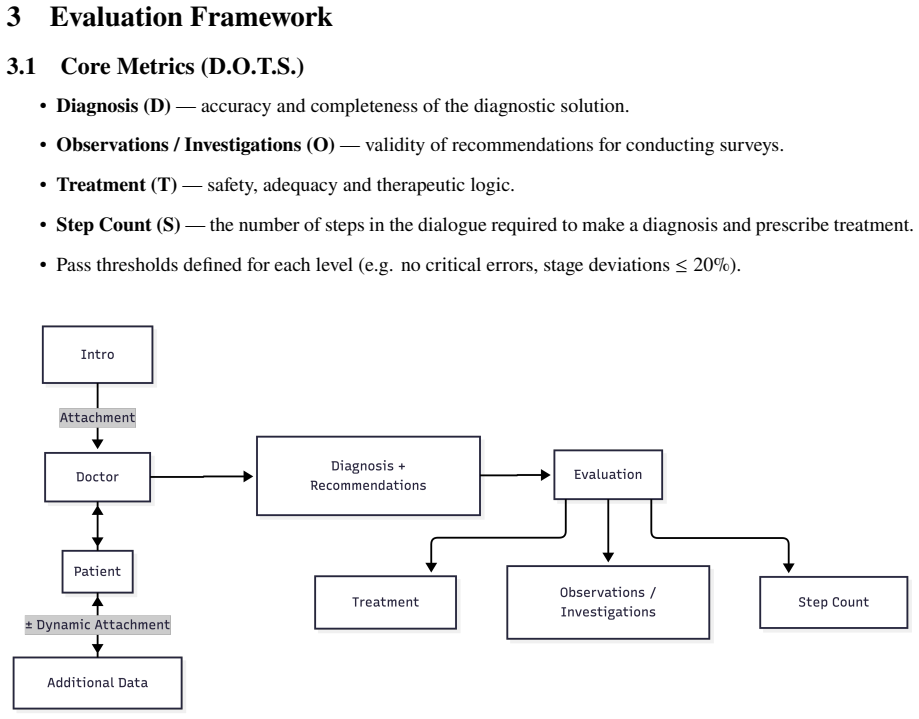
The measuring instrument is the simulated patient: a constrained LLM agent that answers only what is asked, volunteers nothing beyond the case record, paraphrases but never adds facts, and gives uncertain or negative replies when asked about absent information. This forces the physician model to drive the encounter. The D.O.T.S. metric (Diagnosis, Observations/Investigations, Treatment, Step count) scores both clinical correctness and dialogue efficiency, with mandatory, optional, and penalty categories for tests and a 'critical condition' override that zeroes unsafe treatment recommendations.
Load-bearing premise
The entire benchmark rests on the assumption that the simulated patient withholds and reveals information exactly like a real patient, so the measured gap is caused by the physician model's clinical skill rather than by the patient agent's behavior.
What would settle it
Replace the simulated patient with a human standardized patient (or allow the patient agent to volunteer information freely) on the same cases; if base LLM scores rise to physician levels, the reported performance gap is an artifact of the simulation rather than a measure of clinical competence.
If this is right
- Static exam-style benchmarks overestimate the clinical readiness of LLMs; interactive simulation adds a distinct dimension of assessment.
- Medical AI systems need explicit history-taking and structured orchestration, not just raw model reasoning, to reach physician-level performance.
- The same simulation and scoring can evaluate human physicians, supporting clinical training and competency monitoring.
- Safety-oriented 'trap' cases and tiered regression testing can catch model degradation during development and production.
- The step-count metric acts as a behavioral audit, flagging redundant or insufficient questioning independent of final diagnostic accuracy.
Where Pith is reading between the lines
- Because the comparisons rely on a simulated patient, the observed gap might reflect the patient script's strictness rather than clinical skill; validating against human standardized patients would test this.
- The GPT-5 baseline's near-zero dialogue steps suggest the comparison partly measures whether the model follows a 'conduct a dialogue' instruction, not only clinical knowledge; adding a history-taking prompt might narrow the gap.
- The framework's low differential-accuracy scores for both AI and humans suggest the dialogue format is especially sensitive to hypothesis breadth, which exam scores rarely capture.
- The same evaluation could be adapted for automated coaching of medical students, using step count and question coverage as feedback signals.
Editorial analysis
A structured set of objections, weighed in public.
Referee Report
Summary. The paper presents Doctorina MedBench, an interactive, dialogue-based evaluation framework for medical AI systems. It replaces static test items with simulated physician-patient conversations in which an LLM-driven patient agent discloses information only in response to targeted questions, and it scores the resulting dialogues with the D.O.T.S. metric (Diagnosis, Observations/Investigations, Treatment, Step Count). The authors describe a dataset of over 1,000 clinical cases, a multi-level testing and monitoring architecture, and a comparison between the Doctorina agent and several base LLMs, along with a small human-physician validation. The paper reports that Doctorina outperforms a deliberately restricted GPT-5 baseline on diagnosis and treatment accuracy, and that it roughly matches general practitioners on 100 basic cases, while the base LLM drops sharply on specialty-specific OB/GYN cases. The central claim, stated in Section 8, is that interactive clinical simulation makes base LLMs' performance drop sharply compared with practicing physicians, implying that static exam-style benchmarks overestimate real-world clinical competence.
Significance. If the framework were independently validated and the data/code released, this would be a valuable contribution: the need for interactive, history-taking-based benchmarks for medical LLMs is real, and the hybrid design—schema-constrained LLM extraction, evidence-quote requirements, deterministic scoring, and safety-critical overrides—is a sensible way to improve auditability over pure LLM-as-a-judge scoring. The multi-level regression and trap-case architecture is also a useful engineering contribution for continuous monitoring. However, the empirical claims as presented are not yet supported: the headline comparison uses a minimal single-sentence baseline prompt that essentially prevents the base LLM from collecting history, the gold standards and case weights are authored internally, and the human validation is very small and under-analyzed. The paper is best read as a framework proposal with promising internal results, not yet as a validated public benchmark.
major comments (5)
- [§6.2, §6.2.2, §7, §8] The central comparative claim is undermined by the baseline design. GPT-5 was given only the prompt "Imagine that you are a doctor. Make a diagnosis or diagnoses" (§6.2), while the simulated patient is explicitly constrained to reveal nothing unless asked (§2.2). The reported 0.66 average steps per GPT-5 run (§6.2.2) means the baseline almost never conducted an interview, so its low scores are largely an artifact of the prompt, not a measurement of base-LLM clinical capability. Section 8's conclusion that "the performance of base LLMs drops sharply compared to practicing physicians" is not supported by the 100-case GP comparison in §7, where GPT-5 scored 81% versus clinicians' 83%, nor by Table 2, which uses the same restricted prompt. A fair baseline should instruct the model to conduct a medical interview, or the paper should compare against several prompting/configurations and state t
- [§5.1, §8] The gold-standard cases and per-case recommendation weights are authored by the same organization that develops Doctorina, and the cases derive from Doctorina's own consultation logs. The human validation consists of only 3 GPs on 100 selected 'baseline' cases, with no formal inter-rater reliability analysis and no statistical comparison against Doctorina's scores. The paper itself acknowledges in §8 that independent datasets are needed to minimize researcher bias, but this is a load-bearing issue, not a cosmetic one: the D.O.T.S. scores, the O/T weights, and the conclusion that Doctorina matches or outperforms physicians all rely on the internal gold standards. The authors should provide an external clinician panel to audit cases and weights, report inter-rater agreement, or at minimum release a fully independent test set.
- [§2.2, §3.1] The load-bearing premise is that the LLM-driven simulated patient behaves like a real patient: it "answers only the question asked," "does not reveal clinically relevant details unless they are specifically elicited," and "does not introduce facts that are absent from the case record." No evidence is provided that this behavior matches real clinical disclosure patterns. If the simulated patient under-discloses or over-discloses relative to actual patients, every D.O.T.S. score and all model-to-model and model-to-physician comparisons are artifacts of patient-simulation fidelity. The paper should report a validation study of the patient agent—for example, comparing simulated dialogues with real patient transcripts, having clinicians rate the realism of information disclosure, or at least performing a sensitivity analysis with different patient-behavior regimes (e.g., more or less forthcom
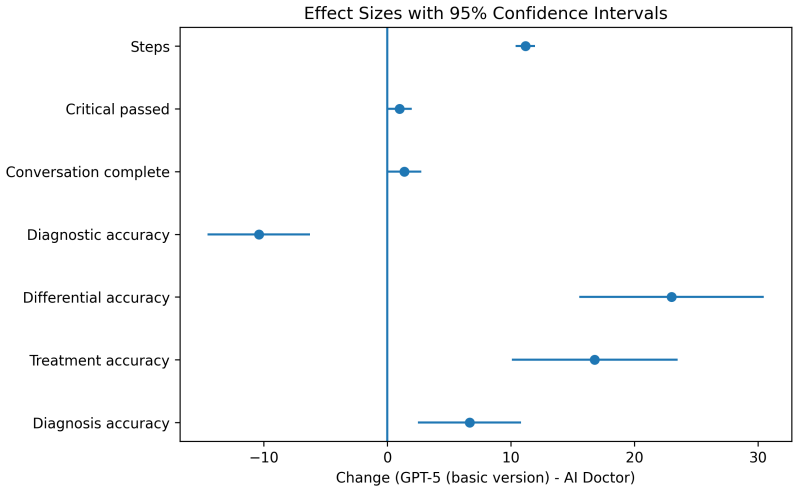
- [§6.1, §6.2.1, §6.2.3, Table 2] There are unresolved inconsistencies in the reported numbers. §6.1 reports average Diagnosis Accuracy of 83.64%, while §6.2.1 reports AI Doctor's Diagnosis Accuracy as 89.3% and §6.2.3 reports a mean improvement of 6.56 percentage points over GPT-5; these may come from different subsets or runs, but the manuscript never explains which. Table 2 reports only "Percentage of correct answers" without N per group, model versions, confidence intervals, or step counts. The 100-case human comparison in §7 (83% vs. 87%) is likewise presented without CIs or a test statistic. The step-count gold standard and the O/T weights are free parameters, and no sensitivity analysis is shown. These omissions prevent the reader from auditing the central quantitative claims and should be corrected with full case-level data or a detailed appendix.
- [§5.1, §2.1] For a paper presenting a benchmark, the absence of a public release is a significant limitation: no dataset URL, no access to the case bank, no evaluator code, and no case-level scores. The paper's title and abstract describe "Doctorina MedBench" as a benchmark, but as written it is an internal evaluation system. Reproducibility and adoption by the community are impossible without at least an anonymized subset of cases, the evaluator logic, and the prompt templates. I would ask the authors to release these artifacts or clearly state what would be needed for independent replication.
minor comments (6)
- [§6.2, Eq. (1)] The definition of Question Accuracy is ambiguous: the equation uses 'questions asked' in the denominator but the prose says 'mandatory questions.' Please clarify how mandatory questions are defined and how partial credit is handled.
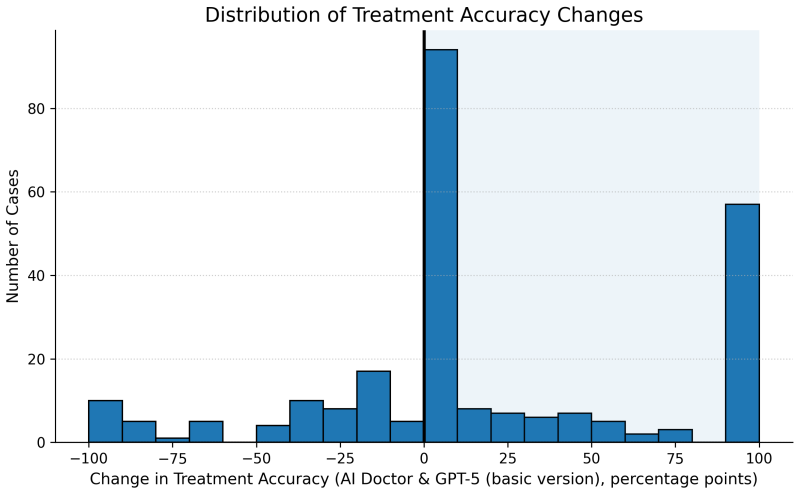
- [§6.2.3] Multiple statistical tests are reported (Wilcoxon signed-rank, McNemar) without correction for multiple comparisons or discussion of tied values in the paired differences; the large number of zero differences (e.g., 220 unchanged outcomes) should be discussed as it affects the interpretation of the tests.
- [§5.2.2] The list of 'Scope' conditions and the 'Technical' category is not clearly defined; please provide concrete examples or a formal schema.
- [Table 2] The base LLM identifiers 'gpt-5 (basic version)', 'grok-4 (basic version)', and 'gemini-3-pro (basic version)' need exact version strings, API/model snapshot dates, sampling parameters, and the definition of 'basic version'; otherwise the comparison cannot be reproduced.
- [References] Reference [12] is a submission with no author names and no published venue; it should be updated or removed. Some other preprints also lack version/date information.
- [§2.2] The text repeats the same idea in consecutive sentences: 'The patient behavior is intentionally designed...' and 'The patient's behavior is intentionally restricted...'. Please consolidate to avoid redundancy.
Circularity Check
The 'sharp drop' of base LLMs is built into the baseline definition rather than measured; the same team authors the gold standard and the evaluated system.
specific steps
-
self definitional
[Section 6.2 / 6.2.2 / Section 8]
"To establish a rigorous baseline, GPT-5 was deployed in a restricted configuration, utilizing a concise, single-sentence system prompt: "Imagine that you are a doctor. Make a diagnosis or diagnoses". This setup intentionally excluded clinical heuristics, structured history-taking protocols, and agentic orchestration... the GPT-5 baseline averaged only 0.66 [steps per run]... "the performance of base LLMs drops sharply compared to practicing physicians.""
The term 'base LLMs' in Section 8 is defined by the Section 6.2 restricted prompt, and the simulated patient is defined in Section 2.2 to reveal nothing unless specifically elicited. A model instructed only to 'make a diagnosis' is not instructed to interview, so it averages 0.66 steps and never obtains the history needed for D.O.T.S. scoring. Its low score is a consequence of these two definitions, not an empirical property of base LLMs generally. The sharp-drop conclusion restates the construction rather than testing it. The Section 7 GP comparison (81.0% vs 83%) shows no sharp drop, underscoring that the headline gap is concentrated in the constructed baseline scenario.
-
self definitional
[Section 5.1, Section 8, Limitations paragraph]
"The current dataset was developed by a group of physicians utilizing their expert knowledge and consultation logs from individuals who engaged with the Doctorina platform during its prototype testing phase, with their informed consent... A rigorous comparison of LLM systems with medical specialists requires the use of independently generated clinical datasets developed by external expert groups to minimize potential researcher bias."
The gold-standard diagnoses, investigation weights, treatment weights, and step limits are authored by the same organization that builds Doctorina and are partly grounded in Doctorina's own prototype consultation logs. Doctorina's claimed parity with physicians is therefore scored against a standard derived from the system's own design environment. The paper's own limitation statement admits that an externally generated dataset would be required for rigorous comparison, confirming that the current evaluation is self-referential rather than independent.
full rationale
The central derivation (D.O.T.S. scoring) is deterministic and not mathematically circular; there are no fitted parameters whose values are rediscovered as predictions, and there are no same-author self-citations doing load-bearing work. However, the paper's headline claim about base LLMs is partially built into the experiment design: the baseline was deliberately defined with no interviewing instruction while the simulated patient was defined to withhold information unless asked. The measured 0.66 average steps and the resulting low scores follow from those definitions, so Section 8's 'sharp drop' conclusion is partly a restatement of the construction rather than an independent finding. A second self-referential element is that the gold standards used to praise Doctorina come from the same physician group and Doctorina's own logs, with the paper conceding that independent datasets are needed. These problems are substantive limitations, but they do not make the metric arithmetic itself circular, so a moderate score of 6 is appropriate.
Axiom & Free-Parameter Ledger
free parameters (3)
- Per-case recommendation weights for O and T scoring =
not published (0-100 per item)
- Step-count gold standard s_limit^k =
per-case integer, not published
- Critical Condition override criteria =
not published
axioms (4)
- domain assumption The LLM-simulated patient's constrained disclosure behavior is a faithful model of real patient behavior.
- domain assumption LLM-as-a-judge schema-constrained extraction accurately recovers clinical entities from dialogue.
- domain assumption Physician-authored gold standards (diagnoses, ICD-10 codes, mandatory/optional tests, treatments, step limits) are correct and complete.
- domain assumption D.O.T.S. score components measure clinical competence rather than prompt-compliance.
invented entities (3)
-
Simulated AI-patient agent
no independent evidence
-
D.O.T.S. scoring metric
no independent evidence
-
Trap cases
no independent evidence
read the original abstract
We present Doctorina MedBench, a comprehensive evaluation framework for agent-based medical AI based on the simulation of realistic physician-patient interactions. Unlike traditional medical benchmarks that rely on solving standardized test questions, the proposed approach models a multi-step clinical dialogue in which either a physician or an AI system must collect medical history, analyze attached materials (including laboratory reports, images, and medical documents), formulate differential diagnoses, and provide personalized recommendations. System performance is evaluated using the D.O.T.S. metric, which consists of four components: Diagnosis, Observations/Investigations, Treatment, and Step Count, enabling assessment of both clinical correctness and dialogue efficiency. The system also incorporates a multi-level testing and quality monitoring architecture designed to detect model degradation during both development and deployment. The framework supports safety-oriented trap cases, category-based random sampling of clinical scenarios, and full regression testing. The dataset currently contains more than 1,000 clinical cases covering over 750 diagnoses. The universality of the evaluation metrics allows the framework to be used not only to assess medical AI systems, but also to evaluate physicians and support the development of clinical reasoning skills. Our results suggest that simulation of clinical dialogue may provide a more realistic assessment of clinical competence compared to traditional examination-style benchmarks.
Figures





Reference graph
Works this paper leans on
-
[1]
Practice Manage- ment: Digital Health, 2025
American Medical Association.2 in 3 physicians are using health AI—up 78% from 2023. Practice Manage- ment: Digital Health, 2025. Available at:https://www.ama-assn.org/practice-management/digita l-health/2-3-physicians-are-using-health-ai-78-2023(accessed: 26.02.2025)
2023
-
[2]
Journal of Medical Internet Research
Zelin Yan, Jingwen Liu, Yihong Fan, Shiyuan Lu, Dingting Xu, Yun Yang, Honggang Wang, Jie Mao, Hou- Chiang Tseng, Tao-Hsing Chang, Yan Chen.Ability of ChatGPT to Replace Doctors in Patient Education: Cross-Sectional Comparative Analysis of Inflammatory Bowel Disease. Journal of Medical Internet Research. 2025;27:e62857. Available from:https://pmc.ncbi.nlm...
2025
-
[3]
B. Krichevsky, S. Engeli, S. M. Bode-B ¨oger, et al.Human vs. artificial intelligence: Physicians outper- form ChatGPT in real-world pharmacotherapy counselling. British Journal of Clinical Pharmacology. 2025; (e70321). doi:10.1002/bcp.70321. Available at:https://bpspubs.onlinelibrary.wiley.com/doi/10 .1002/bcp.70321(accessed: 26.02.2025)
-
[4]
International Journal for Multidisciplinary Research
Veernapu K.The Implementation of AI in Clinical Decision Support System: Effects on Pa- tient Outcomes and Operational Costs. International Journal for Multidisciplinary Research. 2023;5(5). doi:10.36948/ijfmr.2023.v05i05.37225. Available at:https://www.researchgate.net/publicati on/389098016_The_Implementation_of_AI_in_Clinical_Decision_Support_System_Ef...
arXiv 2023
-
[5]
Arvidsson R, Gunnarsson R, Entezarjou A, Sundemo D, Wikberg C.ChatGPT (GPT-4) versus doctors on complex cases of primary care: a blinded observational comparative study. BMJ Open. 2024;14(12):e086148. doi:10.1136/bmjopen-2024-086148. Available at:https://pmc.ncbi.nlm.nih.gov/articles/PMC116 83950/(accessed: 26.02.2025)
-
[6]
Hayat H, et al.Toward the Autonomous AI Doctor: Quantitative Benchmarking of an Autonomous Agentic AI Versus Board-Certified Clinicians in a Real World Setting. medRxiv. 2025. doi:10.1101/2025.07.14.25331406. Available at:https://www.medrxiv.org/content/10.1101/2025.07.14.25331406v1(accessed: 26.02.2025)
-
[7]
T. H. Kung, M. Cheatham, A. Medenilla, et al.Performance of ChatGPT on USMLE: Potential for AI- assisted medical education using large language models. PLOS Digital Health. 2023; 2(2): e0000198. doi:10.1371/journal.pdig.0000198. Available at:https://journals.plos.org/digitalhealth/ar ticle?id=10.1371/journal.pdig.0000198(accessed: 10.03.2026)
-
[8]
A. M. Bean, R. E. Payne, G. Parsons, et al.Reliability of LLMs as medical assistants for the general public: a randomized preregistered study. Nature Medicine. 2026; 32: 609–615. doi:10.1038/s41591-025-04074-y. Available at:https://www.nature.com/articles/s41591-025-04074-y(accessed: 10.03.2026)
-
[9]
Y. Jiang, K. C. Black, G. Geng, et al.MedAgentBench: A Virtual EHR Environment to Benchmark Medical LLM Agents. NEJM AI. 2025; 2(9). doi:10.1056/AIdbp2500144. Available at:https://ai.nejm.org/doi/ full/10.1056/AIdbp2500144(accessed: 10.03.2026)
-
[10]
Zidoun Y, El Mardi A.Artificial Intelligence (AI)-Based simulators versus simulated patients in undergrad- uate programs: A protocol for a randomized controlled trial. BMC Medical Education. 2024;24(1):1260. doi:10.1186/s12909-024-06236-x. Available at:https://pubmed.ncbi.nlm.nih.gov/39501219/(ac- cessed: 26.02.2025)
arXiv 2024
-
[11]
arXiv preprint arXiv:2505.08775
Arora RK, Wei J, Soskin Hicks R, Bowman P, Qui ˜nonero-Candela J, Tsimpourlas F, Sharman M, Shah M, Vallone A, Beutel A, Heidecke J, Singhal K.HealthBench: Evaluating Large Language Models Towards Improved Human Health. arXiv preprint arXiv:2505.08775. 2025. doi:10.48550/arXiv.2505.08775. Available at:https://arxiv.org/abs/2505.08775(accessed: 26.02.2025)...
-
[13]
O. Ben Shoham, N. Rappoport.MedConceptsQA: Open source medical concepts QA benchmark. Computers in Biology and Medicine. 2024; 182: 109089. doi:10.1016/j.compbiomed.2024.109089. Available at:https: //www.sciencedirect.com/science/article/pii/S0010482524011740(accessed: 10.03.2026)
arXiv 2024
-
[14]
Y. Xiao, J. Huang, R. He, et al.FairMedQA: Benchmarking Bias in Large Language Models for Medical Ques- tion Answering. arXiv preprint. 2025; arXiv:2505.19562 [cs.AI]. doi:10.48550/arXiv.2505.19562. Available at:https://arxiv.org/abs/2505.19562(accessed: 10.03.2026)
-
[15]
Y. Zuo, S. Qu, Y. Li, et al.MedXpertQA: Benchmarking Expert-Level Medical Reasoning and Understanding. arXiv preprint. 2025; arXiv:2501.18362 [cs.AI]. doi:10.48550/arXiv.2501.18362. Available at:https://ar xiv.org/abs/2501.18362(accessed: 10.03.2026)
-
[16]
Bedi S, Jiang Y, Chung P, Koyejo S, Shah NH.Fidelity of Medical Reasoning in Large Language Models. JAMA Network Open. 2025;8(7):e2526021. doi:10.1001/jamanetworkopen.2025.26021. Available at:https: //jamanetwork.com/journals/jamanetworkopen/fullarticle/2837372(accessed: 26.02.2025)
arXiv 2025
-
[17]
Nature Medicine
Hager P, Jungmann F, Holland R, et al.Evaluation and mitigation of the limitations of large language models in clinical decision-making. Nature Medicine. 2024;30(9):2613–2622. Available at:https://www.nature .com/articles/s41591-024-03097-1(accessed: 26.02.2025)
2024
-
[18]
Singhal K, Tu T, Gottweis J, et al.Towards Expert-Level Medical Question Answering with Large Lan- guage Models. arXiv:2305.09617, 2023. Available at:https://arxiv.org/abs/2305.09617(accessed: 26.02.2025)
Pith/arXiv arXiv 2023
-
[19]
B. T. Bicknell, D. Butler, S. Whalen, et al.ChatGPT-4 Omni Performance in USMLE Disciplines and Clinical Skills: Comparative Analysis. JMIR Medical Education. 2024; 10: e63430. doi:10.2196/63430. Available at: https://mededu.jmir.org/2024/1/e63430(accessed: 10.03.2026)
doi:10.2196/63430 2024
-
[20]
M. K. Siam, A. Varela, M. J. H. Faruk, et al.Benchmarking large language models on the United States medical licensing examination for clinical reasoning and medical licensing scenarios. Scientific Reports. 2026; 16:
2026
-
[1387]
Available at:https://www.nature.com/articles/s41598-025 -31010-4(accessed: 10.03.2026)
doi:10.1038/s41598-025-31010-4. Available at:https://www.nature.com/articles/s41598-025 -31010-4(accessed: 10.03.2026). 29 ANNA KOZLOVA received the M.S. degree in applied mathe- matics and computer science from Saint Pe- tersburg State University in 2021. She is a Machine Learning Engineer with over six years of R&D experience in classical ma- chine lear...
discussion (0)
Sign in with ORCID, Apple, or X to comment. Anyone can read and Pith papers without signing in.