Trustworthy Smart Fabs via Professional Proxies: Scaling Safe and Sustainable by Design (SSbD) through Industrial Data Spaces
Pith reviewed 2026-06-27 16:16 UTC · model grok-4.3
The pith
Smart fabs can export signed compliance tokens for EU sustainability rules without exposing proprietary recipes by using professional proxies in trusted execution environments.
A machine-rendered reading of the paper's core claim, the machinery that carries it, and where it could break.
Core claim
The paper claims that a six-layer SSbD reference architecture implemented as an interoperable network protocol stack, with professional proxies executing a five-step relay race inside TEEs, allows fabs to generate and export cryptographically signed compliance tokens via IDS connectors, thereby resolving the data sovereignty paradox while satisfying multi-stakeholder transparency without disclosing proprietary process recipes or VM predictions.
What carries the argument
Professional proxies as role-based agentic workflows inside hardware-rooted TEEs that coordinate the five-step relay race to align factory-floor yield models with macro-level sustainability mandates.
If this is right
- Fabs gain the ability to export cryptographically signed compliance tokens via IDS connectors without exposing proprietary recipes.
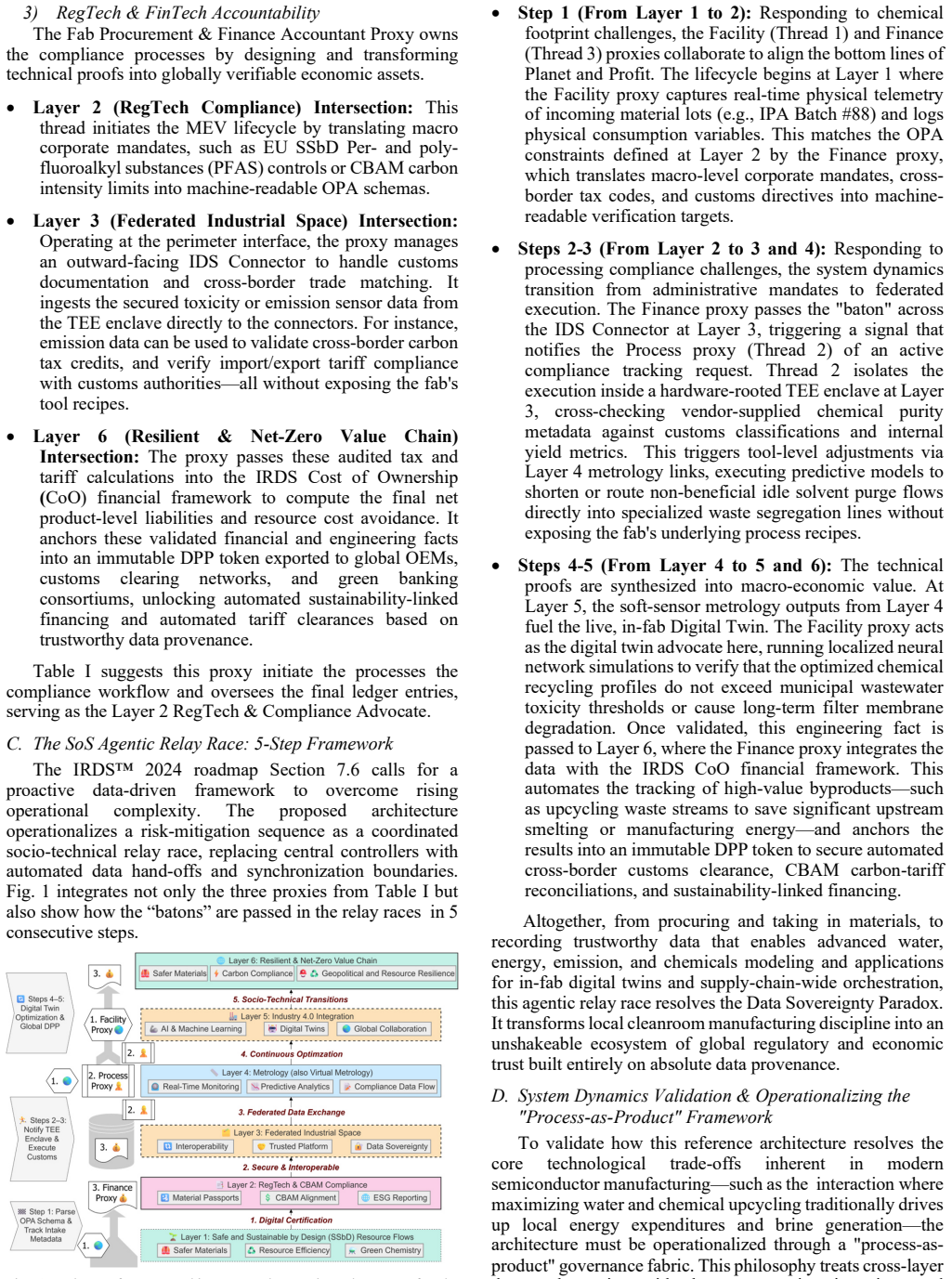
- Factory-floor virtual metrology predictions can be aligned with macro sustainability mandates through automated proxy coordination.
- Governance shifts from reactive manual reporting to autonomous workflows inside trusted execution environments.
- A verifiable evidence-based pathway opens toward resilient net-zero Industry 5.0 ecosystems.
- Multi-stakeholder transparency requirements are met while preserving corporate data privacy.
Where Pith is reading between the lines
- The same proxy-and-relay pattern could be tested in other regulated manufacturing domains that face comparable data-sovereignty tensions.
- Federated learning inside the TEEs might allow multiple fabs to pool compliance signals without any single participant revealing its full dataset.
- If the relay race proves stable, regulators could begin accepting machine-signed tokens as primary evidence rather than requiring periodic human audits.
Load-bearing premise
The five-step relay race between Facility, Process Engineering, and Finance proxy teams can reliably align factory-floor yield models with macro-level sustainability mandates when executed inside TEEs.
What would settle it
A controlled test in which the relay race inside a TEE produces compliance tokens that fail to match actual fab yield data or external sustainability audits when verified by an IDS connector.
Figures
read the original abstract
The convergence of the 2026 European Union Safe and Sustainable by Design (SSbD) framework, Corporate Sustainability Due Diligence Directive (CSDDD), and Carbon Border Adjustment Mechanism (CBAM) introduce a severe governance bottleneck for advanced semiconductor manufacturing facilities ("Smart Fabs"). Regulatory compliance demands have surpassed the capacity of manual corporate reporting, creating a direct conflict between multi-stakeholder transparency and corporate data privacy. This paper addresses this challenge by introducing a zero-trust socio-technical orchestration framework that operationalizes a six-layer SSbD reference architecture within trustworthy industrial data spaces. We propose a shift from reactive automation to autonomous governance through "Professional Proxies"-role-based agentic workflows executing within hardware-isolated trust zones. Structured as an interoperable network protocol stack, the framework coordinates an automated, five-step "relay race" between Facility, Process Engineering, and Finance proxy teams to align factory-floor yield models with macro-level sustainability mandates. By executing Virtual Metrology (VM) predictions and Federated Machine Learning (FML) inside hardware-rooted Trusted Execution Environments (TEEs), this architecture resolves the Data Sovereignty Paradox, demonstrating how fabs can export cryptographically signed compliance tokens via International Data Spaces (IDS) connectors without exposing proprietary process recipes. Ultimately, this framework provides technology managers with a verifiable, evidence-based pathway toward resilient, net-zero Industry 5.0 ecosystems.
Editorial analysis
A structured set of objections, weighed in public.
Referee Report
Summary. The paper claims to resolve the Data Sovereignty Paradox for semiconductor smart fabs facing EU SSbD, CSDDD, and CBAM regulations by introducing a zero-trust framework of 'Professional Proxies' (role-based agentic workflows in TEEs). These proxies run VM predictions and FML, then export cryptographically signed compliance tokens via IDS connectors without exposing proprietary recipes, using a five-step relay race between Facility, Process Engineering, and Finance teams to align factory-floor models with sustainability mandates.
Significance. If the coordination mechanism and token export were substantiated, the architecture could enable scalable, privacy-preserving regulatory compliance in Industry 5.0 settings. The current manuscript, however, offers only an unvalidated high-level description with no empirical results, protocol specifications, or security arguments, so its contribution remains prospective rather than demonstrated.
major comments (3)
- [Abstract] Abstract: the claim that the five-step relay race 'resolves the Data Sovereignty Paradox' by exporting verifiable non-leaking tokens rests on an abstract description of proxy coordination inside TEEs; no specification is given of what each proxy computes, attests, or signs, nor of the resulting token format or verification procedure.
- [The framework description] The framework description: no threat model, protocol details, or security analysis is supplied for the TEE-hosted execution of VM and FML or for the IDS connector export step, which is load-bearing for the asserted privacy and verifiability properties.
- [Overall manuscript] Overall manuscript: the paper contains no data, derivations, validation experiments, error analysis, or case studies to support the assertion that the proxy coordination reliably aligns factory-floor yield models with macro-level mandates.
minor comments (1)
- [Abstract] The term 'Professional Proxies' is introduced as a novel construct without references to prior work on agentic workflows, industrial proxies, or TEE-based orchestration in data spaces.
Simulated Author's Rebuttal
We thank the referee for the detailed and constructive report. We agree that the manuscript presents a high-level architectural proposal without empirical validation or low-level specifications. We will revise to address the identified gaps by adding concrete details on the framework components and by clarifying the conceptual scope of the work, while preserving its contribution as a reference architecture for trustworthy industrial data spaces.
read point-by-point responses
-
Referee: [Abstract] Abstract: the claim that the five-step relay race 'resolves the Data Sovereignty Paradox' by exporting verifiable non-leaking tokens rests on an abstract description of proxy coordination inside TEEs; no specification is given of what each proxy computes, attests, or signs, nor of the resulting token format or verification procedure.
Authors: We accept this observation. The abstract summarizes the high-level idea without the requested technical specifics. In the revised manuscript we will expand the abstract and introduce a new subsection that specifies the computations, attestations, and signing steps performed by each proxy role, together with the token structure and the verification procedure at the IDS connector. revision: yes
-
Referee: [The framework description] The framework description: no threat model, protocol details, or security analysis is supplied for the TEE-hosted execution of VM and FML or for the IDS connector export step, which is load-bearing for the asserted privacy and verifiability properties.
Authors: We agree that the absence of an explicit threat model and security analysis weakens the privacy and verifiability claims. The revision will add a dedicated section containing (i) a threat model covering the TEE execution environment and IDS export, (ii) protocol-level descriptions of the VM/FML workflows and token export, and (iii) an initial security argument based on hardware-rooted attestation and cryptographic signing. revision: yes
-
Referee: [Overall manuscript] Overall manuscript: the paper contains no data, derivations, validation experiments, error analysis, or case studies to support the assertion that the proxy coordination reliably aligns factory-floor yield models with macro-level mandates.
Authors: The manuscript is framed as a conceptual socio-technical framework rather than an empirical evaluation. No experimental data or derivations are present because the contribution is the proposed six-layer architecture and relay-race coordination pattern. We will revise the text to state this scope explicitly, remove any implication of demonstrated reliability, and add a forward-looking section outlining planned validation approaches and potential case-study designs. revision: partial
Circularity Check
No circularity; purely descriptive architecture with no derivations or quantitative claims
full rationale
The manuscript proposes a high-level socio-technical framework using Professional Proxies, a five-step relay race, VM/FML inside TEEs, and IDS connectors to address the Data Sovereignty Paradox. No equations, fitted parameters, predictions, or first-principles derivations appear in the provided text or abstract. The central claims are architectural assertions without self-definitional reductions, fitted-input predictions, or load-bearing self-citations that collapse to inputs. The description remains self-contained as a conceptual proposal rather than a mathematical or empirical derivation chain.
Axiom & Free-Parameter Ledger
invented entities (1)
-
Professional Proxies
no independent evidence
Reference graph
Works this paper leans on
-
[1]
Industry Roadmap and Regulatory Data: Technical specifications, environmental thresholds, and resou rce targets are gathered from the IRDS roadmaps and leading foundry reports (e.g., TSMC Sustainability Reports ), with legal compliance of the CBAM and EU SSbD mandates
-
[2]
Architectural and Infrastructure Specifications : Relevant technical models such as the International Data Spaces (IDS) Reference Architecture Mode and hardware- enforced Trusted Execution Environment (TEE) security specifications are also included, paving the foundation for future Open Policy Agent (OPA) Policy-as-Code specifications
-
[3]
Atom-to-Values
Regulatory & Standards WIP: Mathematical equations, and resource usage models are compiled such as sustainability metrics and cost of ownership. These frameworks are explicitly collected to ensure data sovereignty and process ownership at the factory perimeter. D. Analysis Method: Continuous Assurance Data analysis follows a conventional theory-generat in...
-
[4]
Based on division of labour function assignments an d cross-functional collaboration needs, each proxy agent thread has at least three major operational layers:
Finance Proxy Layer 6: Resilient & Net- Zero Value Chain █ █ █████ !"#$%&'()*+,- Layer 5: Industry 4.0 Integration ██████ █████ █ ./01234567 Layer 4: Metrology & Smart Manufacturing █████ ██████ │ 89:;<= Layer 3: Federated Industrial Space █ █████ █████ >?@ABC Layer 2: RegTech & CBAM Compliance │ █ ██████ DE Layer 1: Safe & Sustainable by Design (SSbD) ██...
-
[5]
The Fab Facility Manager Proxy : Supervises utility resource circularity, wastewater parameters, and chemical processing systems. It handles raw facilit y telemetry and environmental constraints at the phys ical- digital boundary, optimizing resource circularity without access to proprietary tool recipes or financial ledger rules
-
[6]
The Process Engineering Manager Proxy : Acts as the custodian of the fabrication facility’s core proces s IP. Covering mainly Layers 3, 4, and 5, it executes TEE enclave of sensitive data, multi-variant Virtual Metrology (VM) yield models, and machine learning adaptations , preventing high-value process parameters from leaking
-
[7]
Verify Scope 3 emissions for Isopropyl alcohol (IPA) Batch #88 and correspon ding solvent wastewater records
The Procurement & Finance Accountant Proxy : Operates at the finance and compliance interfaces. Covering mainly Layers 2, 3, and 6, it manages declarative Policy-as-Code ledger rules, outward ID S Connectors, and carbon-tariff or sustainability-lin ked financial mandate directives (e.g., CBAM, CSDDD) without exposing underlying tool telemetry. Processes c...
-
[8]
Environmental Stewardship & Facility Infrastructure The autonomous Fab Facility Manager Proxy thread enforces resource circularity and maximizes conserv ation targets, as defined by IEEE or SEMI F98 standards. Layer 1 (SSbD) Intersection: The proxy monitors physical telemetry from both procured chemical materials and cleanroom infrastructure components,...
-
[9]
Processing Sensor Reliability & Data Sovereignty The Process Engineering Manager Proxy executes processing resource and time adjustments by deployi ng proactive production processing profiles that prote ct wafer yield and device performance. Layer 3 (Federated Industrial Space) Intersection: When an external query targets the processing profi le of IPA ...
-
[10]
Process-as-Product
RegTech & FinTech Accountability The Fab Procurement & Finance Accountant Proxy owns the compliance processes by designing and transform ing technical proofs into globally verifiable economic assets. Layer 2 (RegTech Compliance) Intersection: This thread initiates the MEV lifecycle by translating m acro corporate mandates, such as EU SSbD Per- and poly-...
2024
-
[11]
The facility proxy captures real-time physical variables of material intake at Layer 1
The Micro-Alignment Steps Operations & Autonomy (Steps 1 to 2): To allow localized proxies to intercept tool telemetry witho ut degrading cleanroom autonomy, the relay race begins at the physical-digital boundary. The facility proxy captures real-time physical variables of material intake at Layer 1. This payload is handed up to Layer 2, where the fin a...
-
[12]
velocity gap
The Macro-Orchestration of Triple Bottom Line Weaving localized walkthroughs of our three functio nal threads prove that regulatory compliance is an engi ne for value creation. Thread 1: Environmental Stewardship & Facility Infrastructure (The Planet Dimension): This thread binds sustainability straight to cleanroom hardware across Layers 1, 4, and 5. B...
-
[13]
With new export controls on critical mine rals, supply concentration risks become reality,
IEA, “With new export controls on critical mine rals, supply concentration risks become reality,” IEA , Oct. 23, 2025. Accessed: Mar. 17, 2026. [Online]. Available: https://www.iea.org/commentaries/with-new-export-controls-on- critical-minerals-supply-concentration-risks-become-reality
2025
-
[14]
Semico nductor supply chain resilience and disruption: insights, mitigation, an d future directions,
W. Xiong, D. D. Wu, and J. H. Y. Yeung, “Semico nductor supply chain resilience and disruption: insights, mitigation, an d future directions,” International Journal of Production Research , vol. 63, no. 9, pp. 3442– 3465, May 2025, doi: 10.1080/00207543.2024.2387074
-
[15]
Safe and sustainable by d esign - Research and innovation,
European Commission, “Safe and sustainable by d esign - Research and innovation,” Mar. 06, 2026. Accessed: Mar. 13, 2026 . [Online]. Available: https://research-and-innovation.ec.europ a.eu/research- area/industrial-research-and-innovation/chemicals-and-advanced- materials/safe-and-sustainable-design_en
2026
-
[16]
M. Tunali, D. Voelker, C. Burkart, K. Schwirn, and B. Nowack, “Recommendations for making the European Commission ’s Safe and Sustainable by Design framework practicable for bio cides,” Sustainable Chemistry and Pharmacy , vol. 48, p. 102221, Dec. 2025, doi: 10.1016/j.scp.2025.102221
-
[17]
Virtual Metrology Model Robustness Against Chamber Condition Variation Using Deep Lear ning,
T. Tsutsui and T. Matsuzawa, “Virtual Metrology Model Robustness Against Chamber Condition Variation Using Deep Lear ning,” IEEE Transactions on Semiconductor Manufacturing , vol. 32, no. 4, pp. 428– 433, Nov. 2019, doi: 10.1109/TSM.2019.2931328
-
[18]
Virtual metrolog y in semiconductor manufacturing: Current status and future prospects,
V. Maitra, Y. Su, and J. Shi, “Virtual metrolog y in semiconductor manufacturing: Current status and future prospects, ” Expert Systems with Applications , Sep. 01, 2024. doi: 10.1016/j.eswa.2024.123559
-
[19]
D. Kim, P. Kang, S. Cho, H. Lee, and S. Doh, “M achine learning-based novelty detection for faulty wafer detection in sem iconductor manufacturing,” Expert Systems with Applications , Mar. 2012. doi: 10.1016/j.eswa.2011.09.088
-
[20]
V irtual Metrology for Etch Profile in Silicon Trench Etching With SF₆/O₂/Ar Pl asma,
J. E. Choi, H. Park, Y. Lee, and S. J. Hong, “V irtual Metrology for Etch Profile in Silicon Trench Etching With SF₆/O₂/Ar Pl asma,” IEEE Transactions on Semiconductor Manufacturing , vol. 35, no. 1, pp. 128– 136, Feb. 2022, doi: 10.1109/TSM.2021.3138918
-
[21]
H.-T. Liao, C.-L. Pan, and Z. Wu, “Digital Tran sformation and Innovation and Business Ecosystems: A Bibliometric Analysis for Conceptual Insights and Collaborative Practices for Ecosystem Innovation,” International Journal of Innovation Studies , p. S2096248724000171, Apr. 2024, doi: 10.1016/j.ijis.2024.04.003
-
[22]
On the Need of International Cross-Data Space Interworking: An EU–Japan Case Study,
J. R. Santana et al. , “On the Need of International Cross-Data Space Interworking: An EU–Japan Case Study,” IT Professional , vol. 27, no. 5, pp. 59–65, Sep. 2025, doi: 10.1109/MITP.2025.3545214
-
[23]
Research on Policy-as-Code for Implementation of R ole-based and Attribute-based Access Control,
O. Vakhula, I. Opirskyy, P. Vorobets, O. Bobko , and O. Kulinich, “Research on Policy-as-Code for Implementation of R ole-based and Attribute-based Access Control,” Cybersecurity Providing in Information and Telecommunication Systems (CPITS-20 25) , 2025. Accessed: Jun. 01, 2026. [Online]. Available: https://ceur-ws.org/Vol- 3991/paper11.pdf
2025
-
[24]
Scalable Policy-as-Code Decision Points for Data Products,
M. Brambilla and P. Plebani, “Scalable Policy-as-Code Decision Points for Data Products,” 2025 IEEE International Conference on Web Services (ICWS) , Jul. 2025. doi: 10.1109/ICWS67624.2025.00120
-
[25]
TSMC’s Newly Launched Supply Online 360 Sets a Milestone for Responsible Supply Chain Management,
TSMC, “TSMC’s Newly Launched Supply Online 360 Sets a Milestone for Responsible Supply Chain Management,” Jan. 07, 2021. Accessed: Apr. 11, 2026. [Online]. Available: https://esg.tsmc.com/en- US/articles/116
2021
-
[26]
EHR-Safe: generating high-fidelity and privacy- preserving synthetic electronic health records,
J. Yoon et al. , “EHR-Safe: generating high-fidelity and privacy- preserving synthetic electronic health records,” npj Digit. Med. , vol. 6, no. 1, p. 141, Aug. 2023, doi: 10.1038/s41746-023-00888-7
-
[27]
Trust Negotiation in Identity Management,
A. Bhargav-Spantzel, A. C. Squicciarini, and E . Bertino, “Trust Negotiation in Identity Management,” IEEE Secur. Privacy Mag. , vol. 5, no. 2, pp. 55–63, Mar. 2007, doi: 10.1109/MSP.2007.46
-
[28]
A survey on the (in)security of trusted execution environments,
A. Muñoz, R. Ríos, R. Román, and J. López, “A survey on the (in)security of trusted execution environments,” Computers & Security , vol. 129, p. 103180, Jun. 2023, doi: 10.1016/j.cose.2023.103180
-
[29]
R. Yeluri and E. Castro-Leon, Building the Infrastructure for Cloud Security: A Solutions view , 2014. doi: 10.1007/978-1-4302-6146-9
-
[30]
The EU Directive on Corporate Sustainability Due Diligence (CSDDD): The Final Political Compromise,
N. Bueno, N. Bernaz, G. Holly, and O. Martin-O rtega, “The EU Directive on Corporate Sustainability Due Diligence (CSDDD): The Final Political Compromise,” Business and Human Rights Journal , vol. 9, no. 2, pp. 294–300, Jun. 2024, doi: 10.1017/bhj.2024.10
-
[31]
The EU’s Corporate Sustainability Due Diligence Directive - Obligations for Companies,
Latham & Watkins, “The EU’s Corporate Sustainability Due Diligence Directive - Obligations for Companies,” Jul. 2024
2024
-
[32]
N avigating CSDDD in Procurement: A Systematic Literature Review on Impl ementation Challenges,
V. Stadlober, S. Schreiber, and B. M. Zunk, “N avigating CSDDD in Procurement: A Systematic Literature Review on Impl ementation Challenges,” Procedia Computer Science , vol. 277, pp. 3550–3560, Jan. 2026, doi: 10.1016/j.procs.2026.02.390
-
[33]
Impacts of the CBAM on EU trade partners: consequences for developing countri es,
G. Magacho, E. Espagne, and A. Godin, “Impacts of the CBAM on EU trade partners: consequences for developing countri es,” Climate Policy , vol. 24, no. 2, pp. 243–259, Feb. 2024, doi: 10.1080/14693062.2023.2200758
-
[34]
H.-T. Liao, C.-L. Pan, and Y. Zhang, “Smart di gital platforms for carbon neutral management and services: Business mo dels based on ITU standards for green digital transformation,” Front. Ecol. Evol. , vol. 11, Mar. 2023, doi: 10.3389/fevo.2023.1134381
-
[35]
H.-T. Liao, C.-L. Pan, and Y. Zhang, “Collabor ating on ESG consulting, reporting, and engaging education: Using partner maps for capability building design,” Front. Environ. Sci. , vol. 11, p. 1119011, Mar. 2023, doi: 10.3389/fenvs.2023.1119011
-
[36]
D. A. Eisape, “Transforming Pipelines into Dig ital Platforms: An Illustrative Case Study Transforming a Traditional Pipeline Business Model in the Standardization Industry into a Digital Platform,” Journal of Open Innovation: Technology, Market, and Complex ity , vol. 8, no. 4, p. 183, Dec. 2022, doi: 10.3390/joitmc8040183
-
[37]
Design Science in Information Systems Research,
A. R. Hevner, S. T. March, J. Park, and S. Ram , “Design Science in Information Systems Research,” MIS Quarterly , vol. 28, no. 1, pp. 75– 105, 2004, doi: 10.2307/25148625
-
[38]
P. Brecht, M. Niever, R. Kerres, A. Ströbele, and C. H. Hahn, “Smart platform experiment cycle (SPEC): a process to desi gn, analyze, and validate digital platforms,” AIEDAM , vol. 35, no. 2, pp. 209–225, May 2021, doi: 10.1017/S0890060421000081
-
[39]
OSI reference model - the ISO model of architecture for open systems interconnection,
H. Zimmermann, “OSI reference model - the ISO model of architecture for open systems interconnection,” IEEE Transactions on Communications , vol. 28, no. 4, pp. 425–432, Apr. 1980, doi: 10.1109/TCOM.1980.1094702
-
[40]
Scoping Review of AI, Metrology, and ESG in the Semiconductor Sector: Implications for Safe and Sustainable by Design (SSbD),
K. Ang and H.-T. Liao, “Scoping Review of AI, Metrology, and ESG in the Semiconductor Sector: Implications for Safe and Sustainable by Design (SSbD),” 2026 IEEE International Conference on Engineering, Technology, and Innovation (ICE/ITMC) , forthcoming
2026
-
[41]
From Stacks to Circui ts: A Regenerative Socio-Technical Roadmap for AI Infrastructure withi n Planetary Boundaries,
H.-T. Liao, and K. Ang, “From Stacks to Circui ts: A Regenerative Socio-Technical Roadmap for AI Infrastructure withi n Planetary Boundaries,” 2026 IEEE International Conference on Engineering, Technology, and Innovation (ICE/ITMC) , forthcoming
2026
-
[42]
Orchestrating the Twi n Transition in Multinational Corporations: Technology Roadmapping for Green and Digital Global Business Services,
H.-T. Liao, and K. Ang, “Orchestrating the Twi n Transition in Multinational Corporations: Technology Roadmapping for Green and Digital Global Business Services,” 2026 IEEE International Conference on Engineering, Technology, and Innovation (ICE/ITMC) , forthcoming
2026
-
[43]
Reflections on Doing the Expat S how: Performing the Global Mobility Industry,
S. Cranston, “Reflections on Doing the Expat S how: Performing the Global Mobility Industry,” Environ Plan A , vol. 46, no. 5, pp. 1124– 1138, May 2014, doi: 10.1068/a46249
-
[44]
Zinner, The Global Mobility Profession , 2015
D. Zinner, The Global Mobility Profession , 2015
2015
-
[45]
Plugge and S
A. Plugge and S. Nikou, Digitalisation of Global Business Services: Orchestrating the Enterprise Ecosystem , 2024
2024
discussion (0)
Sign in with ORCID, Apple, or X to comment. Anyone can read and Pith papers without signing in.