REVIEW 3 major objections 5 minor 3 cited by
Reinforcement Learning Guidance claims that interpolating base and RL-finetuned diffusion models at inference is equivalent to changing the RL KL coefficient from beta to beta/w, yielding a training-free alignment slider backed by experimen
Reviewed by Pith at T0; open to challenge. T0 means a machine referee read the full paper against a public rubric. the ladder, T0–T4 →
Blending a base diffusion model with its RL-finetuned version at sampling time lets users dial alignment strength, with the blend weight corresponding to the KL-regularization coefficient beta/w.
T0 review reviewed 2026-08-05 challenge →
load-bearing objection CFG for RL-finetuned diffusion with a useful empirical survey, but the beta/w equivalence rests on assumptions the authors themselves concede. the 3 major comments →
Inference-Time Alignment Control for Diffusion Models with Reinforcement Learning Guidance
The pith
A machine-rendered reading of the paper's core claim, the machinery that carries it, and where it could break.
The reading
Core claim
RLG's central mathematical claim is that the guided distribution p_hat_RLG(x0) is proportional to pref(x0) exp(R/(beta/w)), which is exactly the optimal policy of a KL-regularized RL objective with coefficient beta/w, obtained by linearly interpolating the scores (equivalently velocities) of the reference and RL-finetuned models: s_hat = (1-w) s_ref + w s_theta. This follows by defining an implicit time-dependent reward Rt(xt) = beta log(p_theta,t(xt)/pref,t(xt)) at each denoising step, whose gradient is the score difference, then recognizing the guided score as the score of the geometric mixture pref^(1-w) p_theta^w. The paper offers this identity as the mechanism behind both interpolation
What carries the argument
The load-bearing object is the implicit time-dependent reward Rt(xt) = beta log(p_theta,t(xt)/pref,t(xt)), which reverse-engineers whatever preference an RL-finetuned model has learned into a reward at each noise level. Its gradient is proportional to the difference between the fine-tuned and reference score functions, so substituting it into reward-gradient guidance yields CFG-style score interpolation; through the velocity-score identity, the same linear interpolation applies to flow-matching velocity fields. The final identity p_RLG proportional to pref exp(R/(beta/w)) is what converts a geometric average into a dial on the KL-regularization coefficient.
Load-bearing premise
That the RL-finetuned model has converged to the exact KL-regularized optimal policy pref exp(R/beta), and that linearly interpolated scores produce samples from the geometric-mixture distribution pref^(1-w) p_theta^w; the paper itself concedes the latter is not guaranteed for CFG.
What would settle it
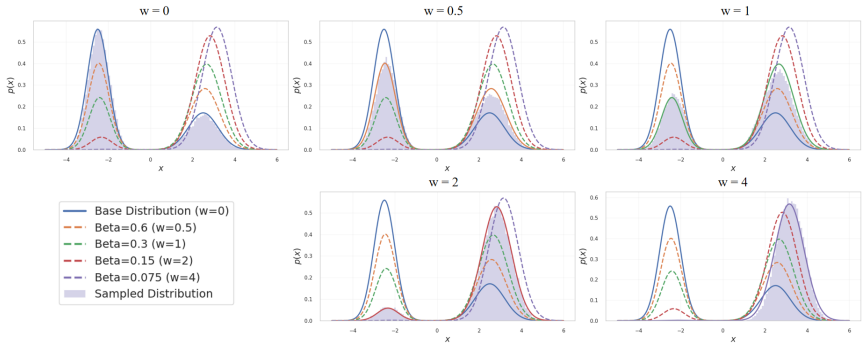
On a one-dimensional flow-matching setting with known base distribution and reward, compare samples generated by RLG at w = 2 with the true target pref(x) exp(R/(beta/2)). If the empirical density deviates substantially from that target while a model retrained with beta/2 matches it, the equivalence is falsified. A second check: measure whether the effective regularization decreases monotonically with w in the reward distribution of generated samples; non-monotonicity would break the dial interpretation.
If this is right
- Users can dial alignment strength at inference: w > 1 extrapolates beyond the trained reward pursuit, while w < 1 interpolates back toward the base model, with no further training.
- The same recipe works across model families (diffusion and flow matching) and RL algorithms (DPO, SPO, GRPO), improving measured preference scores over the untouched fine-tuned model at w = 1.
- On structured tasks, extrapolation moves GenEval composition accuracy from 93.20% to 94.35% and OCR text-rendering accuracy from 88.6% to 93.0%.
- Static alignment trade-offs become adjustable: image compressibility can be moved from 1.14 to 1.43 (low-compressibility reward) or from 0.75 to 0.17 (high-compressibility reward), and OCR accuracy can be traded against aesthetic score by choosing w.
Where Pith is reading between the lines
- Editorial inference: if the KL-equivalence holds distributionally, RLG effectively turns a single RL-finetuned checkpoint into a continuum of beta values, which could make reward-sweep retraining unnecessary for deployment-time alignment calibration.
- Editorial inference: because CFG interpolation can differ from true marginal sampling, part of RLG's observed gains may come from CFG's predictor-corrector steering rather than exact beta/w re-weighting; a direct test would compare RLG samples against models retrained at beta/w.
- Editorial inference: the geometric-average recipe should transfer to any denoising or flow generative model with two available policies, such as video, audio, or multimodal generation, since only score/velocity semantics are used.
- Editorial inference: setting w < 1 could serve as an inference-time safety or backoff dial to weaken an over-optimized or risky fine-tuned behavior without touching weights.
Editorial analysis
A structured set of objections, weighed in public.
Referee Report
Summary. The paper presents Reinforcement Learning Guidance (RLG), an inference-time method that combines a pretrained diffusion/flow model and its RL-finetuned counterpart by linearly interpolating their score/velocity predictions. The main claim is that RLG with scale w is mathematically equivalent to sampling from the optimal policy of a KL-regularized RL objective with coefficient beta/w (Eq. 17), giving users a training-free 'slider' for alignment strength. The method is evaluated on human-preference alignment, GenEval compositionality, text rendering, inpainting, personalization, and image compressibility across SD1.5, SDXL, and SD3.5-M with DPO, SPO, GRPO, and DDPO. Overall, RLG improves or controllably trades off the reported metrics relative to RL-finetuned baselines.
Significance. The claimed equivalence is attractive: if valid, it turns any RL-finetuned diffusion model into a one-parameter family of aligned models without retraining, and it gives a principled explanation of extrapolation. The paper's empirical scope is a strength, and the explicit limitations paragraph is honest. However, the central theoretical statement is conditional on two assumptions the paper itself concedes: exact convergence of the RL policy to the KL-regularized optimum, and CFG-style score interpolation sampling the geometric mixture marginal. The experiments demonstrate practical utility but do not validate the exact beta/w equivalence. The contribution is useful, but the theory as stated is overclaimed and needs revision.
major comments (3)
- [Theoretical Justification, Eq. (16)-(17); Limitations] The central equivalence requires that ODE/SDE sampling with the interpolated score \hat s_RLG actually produces samples from \hat p_RLG,t ∝ pref,t^{1-w} pθ,t^w at every t. This marginal guarantee is not established; the paper cites Bradley and Nakkiran (2024) and concedes that CFG scores do not guarantee the corresponding marginal. Thus Eq. (17) is a score-level identity under idealized assumptions, not a proven statement about generated samples. Since the abstract and conclusion state 'mathematically equivalent,' the claim is stronger than the evidence. Please add a conditional/approximate guarantee or explicitly reframe RLG as an approximation validated empirically.
- [Eq. (12) and Eq. (17); Limitations] The implicit reward Rt is reverse-engineered from the RL model's marginal densities, and the substitution pθ(x0) ∝ pref(x0) exp(R(x0)/β) assumes the RL-finetuned policy is the exact maximizer of Eq. (7). The paper admits this is false for GRPO (Vojnovic and Yun 2025), yet the main SD3.5-M experiments use GRPO; DPO/SPO are also only approximately optimal. The derivation therefore does not cover a headline experimental setting. Please either restrict the 'equivalent' claim to algorithms whose optima are exactly of form Eq. (8), or provide a separate approximate analysis for GRPO.
- [Tables 1/7 and Figure 2] The only direct validation of Eq. (17) is a 1D flow-matching toy shown visually, without distributional distance metrics, and for a single policy-gradient algorithm. A more convincing test is to compare RLG(w) samples with a model retrained at beta/w. Moreover, the human-preference tables show plateau/decline with increasing w (e.g., SD3.5-M ImageReward 1.40 at w=1.0/1.4 and 1.39 at w=2.2; PickScore 23.58 at w=2.4 and 23.56 at w=2.8). If the beta/w equivalence were exact for the optimized reward, a monotone reward increase would be expected. The paper should report quantitative divergence measures and discuss this saturation/non-monotonicity.
minor comments (5)
- [Algorithm 1 and Eq. (1)] The loop t=1,...,N with update x_{t+1} and return x_{N+1} reverses the natural flow-matching time direction (t=1 is noise, t=0 is data); please align the step indexing with the ODE solver used.
- [Eq. (16)] The sentence 'As t→0. In this limit...' is a fragment; define \hat p_{RLG,t} before use and make the limit statement precise.
- [Table 2] Typo in the heading: 'Pperformance' should be 'Performance'.
- [References] The reference 'Authors, P. 2020' should be replaced with a proper citation for PaddleOCR, including the specific version/URL.
- [Table 1 caption] The slash-separated values in the w=0.0 rows are win rates against the RL-finetuned model; for w=0.0 this comparison is unclear. Please define the notation in the caption.
Circularity Check
No significant circularity: Eq. 17 is an algebraic consequence of the explicit optimal-policy assumption; the implicit-reward definition is an inversion of Eq. 8, not a hidden fit.
full rationale
The central derivation (Eqs. 12-17) is self-contained and non-circular. Eq. 12 defines an implicit time-dependent reward R_t = β log(p_{θ,t}/p_{ref,t}) by inverting the known optimal-policy form from Eq. 8; this is an inverse-RL construction, not a fitted parameter. Taking its gradient gives Eq. 13, and substituting into the generic reward-guidance formula with w = ηβ yields the RLG score interpolation (Eq. 14). The 'KL-coefficient' conclusion (Eq. 17) then follows by substituting the stated optimality assumption p_θ(x0) ∝ p_ref(x0) exp(R(x0)/β) into the geometric-mixture target p_ref^{1-w} p_θ^w; this is algebra, and the result is not assumed in the input. The paper explicitly flags the two real limitations of this argument: CFG-style score interpolation does not guarantee the corresponding marginal distribution (Bradley & Nakkiran 2024), and convergence to the exact KL-regularized optimum is idealized (GRPO does not satisfy it). These weaken the theoretical claim's empirical force but are not circularity. The only self-citations (e.g., Flow-GRPO models from Liu et al. 2025b, where an author overlaps) are used as publicly available, externally evaluated model checkpoints, not as load-bearing justification for the RLG mechanism. No fitted constant is relabeled as a prediction, and no known result is merely renamed. Thus no circular step is present.
Axiom & Free-Parameter Ledger
free parameters (2)
- RLG guidance scale w =
task-dependent sweet spots, e.g., 1.4 for GenEval, 2.8 for OCR, 2.2 for PickScore
- KL coefficient beta of base RL objective =
0.3 in the toy experiment; not reported for real models
axioms (4)
- domain assumption The RL-finetuned model has converged to the KL-regularized optimal policy p_theta(x0) ∝ p_ref(x0) exp(R(x0)/beta).
- domain assumption CFG-style linear score interpolation produces samples from the time-dependent geometric mixture p_ref^(1-w) p_theta^w.
- domain assumption The reward-conditioned score decomposes as s_ref + ∇ log p(r|x_t) with p(r|x_t) = exp(R)/Z.
- domain assumption The base and RL-finetuned models share the same architecture, conditioning, and noise schedule, so their velocity fields can be interpolated pointwise.
invented entities (1)
-
Implicit time-dependent reward R_t(x_t)
no independent evidence
Cite this review
Pith. "Pith review of Inference-Time Alignment Control for Diffusion Models with Reinforcement Learning Guidance." pith.science (2026). https://pith.science/paper/JH4LCTHA
@misc{pith2026250821016,
  author       = {Pith},
  title        = {Pith review of: Inference-Time Alignment Control for Diffusion Models with Reinforcement Learning Guidance},
  year         = {2026},
  howpublished = {\url{https://pith.science/paper/JH4LCTHA}},
  note         = {Machine review of arXiv:2508.21016}
}
read the original abstract
Denoising-based generative models, particularly diffusion and flow matching algorithms, have achieved remarkable success. However, aligning their output distributions with complex downstream objectives, such as human preferences, compositional accuracy, or data compressibility, remains challenging. While reinforcement learning (RL) fine-tuning methods, inspired by advances in RL from human feedback (RLHF) for large language models, have been adapted to these generative frameworks, current RL approaches are suboptimal for diffusion models and offer limited flexibility in controlling alignment strength after fine-tuning. In this work, we reinterpret RL fine-tuning for diffusion models through the lens of stochastic differential equations and implicit reward conditioning. We introduce Reinforcement Learning Guidance (RLG), an inference-time method that adapts Classifier-Free Guidance (CFG) by combining the outputs of the base and RL fine-tuned models via a geometric average. Our theoretical analysis shows that RLG's guidance scale is mathematically equivalent to adjusting the KL-regularization coefficient in standard RL objectives, enabling dynamic control over the alignment-quality trade-off without further training. Extensive experiments demonstrate that RLG consistently improves the performance of RL fine-tuned models across various architectures, RL algorithms, and downstream tasks, including human preferences, compositional control, compressibility, and text rendering. Furthermore, RLG supports both interpolation and extrapolation, thereby offering unprecedented flexibility in controlling generative alignment. Our approach provides a practical and theoretically sound solution for enhancing and controlling diffusion model alignment at inference. The source code for RLG is publicly available at the Github: https://github.com/jinluo12345/Reinforcement-learning-guidance.
Figures



Forward citations
Cited by 3 Pith papers
-
DiffusionNFT: Online Diffusion Reinforcement with Forward Process
DiffusionNFT performs online RL for diffusion models on the forward process via flow matching and positive-negative contrasts, delivering up to 25x efficiency gains and rapid benchmark improvements over prior reverse-...
-
FlowAWR: Online Adaptive Flow Reinforcement via Advantage-Weighted Rectification
FlowAWR derives an advantage-weighted rectification for optimal velocity fields in flow models, claiming 2-5x faster convergence than DiffusionNFT on SD3.5-Medium.
-
Towards General Preference Alignment: Diffusion Models at Nash Equilibrium
Diff.-NPO frames diffusion alignment as a self-play game reaching Nash equilibrium and reports better text-to-image results than prior DPO-style methods.
Reference graph
Works this paper leans on
-
[1]
, " * write output.state after.block = add.period write newline
ENTRY address archivePrefix author booktitle chapter edition editor eid eprint howpublished institution isbn journal key month note number organization pages publisher school series title type volume year label extra.label sort.label short.list INTEGERS output.state before.all mid.sentence after.sentence after.block FUNCTION init.state.consts #0 'before.a...
-
[2]
write newline
" write newline "" before.all 'output.state := FUNCTION n.dashify 't := "" t empty not t #1 #1 substring "-" = t #1 #2 substring "--" = not "--" * t #2 global.max substring 't := t #1 #1 substring "-" = "-" * t #2 global.max substring 't := while if t #1 #1 substring * t #2 global.max substring 't := if while FUNCTION word.in bbl.in capitalize " " * FUNCT...
-
[3]
Authors, P. 2020. PaddleOCR, Awesome multilingual OCR toolkits based on PaddlePaddle. https://github.com/PaddlePaddle/PaddleOCR
work page 2020
-
[4]
Black, K.; Janner, M.; Du, Y.; Kostrikov, I.; and Levine, S. 2023. Training diffusion models with reinforcement learning. arXiv preprint arXiv:2305.13301
Pith/arXiv arXiv 2023
-
[5]
Bradley, A.; and Nakkiran, P. 2024. Classifier-free guidance is a predictor-corrector. arXiv preprint arXiv:2408.09000
Pith/arXiv arXiv 2024
-
[6]
Bui, D.-B.; Nguyen, H.-K.; and Le, T.-N. 2025. PrefPaint: Enhancing Image Inpainting through Expert Human Feedback. arXiv:2506.21834
work page internal anchor Pith review Pith/arXiv arXiv 2025
-
[7]
Caron, M.; Touvron, H.; Misra, I.; J \'e gou, H.; Mairal, J.; Bojanowski, P.; and Joulin, A. 2021. Emerging properties in self-supervised vision transformers. In Proceedings of the IEEE/CVF international conference on computer vision, 9650--9660
2021
-
[8]
G.; Kirillov, A.; and Girdhar, R
Cheng, B.; Misra, I.; Schwing, A. G.; Kirillov, A.; and Girdhar, R. 2022. Masked-attention Mask Transformer for Universal Image Segmentation. arXiv:2112.01527
Pith/arXiv arXiv 2022
-
[9]
Cheng, M.; Doudi, F.; Kalathil, D.; Ghavamzadeh, M.; and Kumar, P. R. 2025. Diffusion Blend: Inference-Time Multi-Preference Alignment for Diffusion Models. arXiv preprint arXiv:2505.18547
arXiv 2025
-
[10]
Chung, H.; Kim, J.; Park, G. Y.; Nam, H.; and Ye, J. C. 2024. Cfg++: Manifold-constrained classifier free guidance for diffusion models. arXiv preprint arXiv:2406.08070
Pith/arXiv arXiv 2024
-
[11]
Clark, K.; Vicol, P.; Swersky, K.; and Fleet, D. J. 2023. Directly fine-tuning diffusion models on differentiable rewards. arXiv preprint arXiv:2309.17400
Pith/arXiv arXiv 2023
-
[12]
Cui, G.; Yuan, L.; Wang, Z.; Wang, H.; Li, W.; He, B.; Fan, Y.; Yu, T.; Xu, Q.; Chen, W.; et al. 2025. Process reinforcement through implicit rewards. arXiv preprint arXiv:2502.01456
Pith/arXiv arXiv 2025
-
[13]
Dhariwal, P.; and Nichol, A. 2021. Diffusion models beat gans on image synthesis. Advances in neural information processing systems, 34: 8780--8794
work page 2021
-
[14]
Esser, P.; Kulal, S.; Blattmann, A.; Entezari, R.; Müller, J.; Saini, H.; Levi, Y.; Lorenz, D.; Sauer, A.; Boesel, F.; Podell, D.; Dockhorn, T.; English, Z.; Lacey, K.; Goodwin, A.; Marek, Y.; and Rombach, R. 2024. Scaling Rectified Flow Transformers for High-Resolution Image Synthesis. arXiv:2403.03206
Pith/arXiv arXiv 2024
-
[15]
Fan, J.; Shen, S.; Cheng, C.; Chen, Y.; Liang, C.; and Liu, G. 2025 a . Online Reward-Weighted Fine-Tuning of Flow Matching with Wasserstein Regularization. arXiv:2502.06061
Pith/arXiv arXiv 2025
-
[16]
Fan, W.; Zheng, A. Y.; Yeh, R. A.; and Liu, Z. 2025 b . Cfg-zero*: Improved classifier-free guidance for flow matching models. arXiv preprint arXiv:2503.18886
Pith/arXiv arXiv 2025
-
[17]
Frans, K.; Park, S.; Abbeel, P.; and Levine, S. 2025. Diffusion Guidance Is a Controllable Policy Improvement Operator. arXiv preprint arXiv:2505.23458
Pith/arXiv arXiv 2025
-
[18]
Ghosh, D.; Hajishirzi, H.; and Schmidt, L. 2023. Geneval: An object-focused framework for evaluating text-to-image alignment. Advances in Neural Information Processing Systems, 36: 52132--52152
work page 2023
-
[19]
Gong, S.; Zhang, R.; Zheng, H.; Gu, J.; Jaitly, N.; Kong, L.; and Zhang, Y. 2025. DiffuCoder: Understanding and Improving Masked Diffusion Models for Code Generation. arXiv preprint arXiv:2506.20639
Pith/arXiv arXiv 2025
-
[20]
Ho, J.; Jain, A.; and Abbeel, P. 2020. Denoising diffusion probabilistic models. Advances in neural information processing systems, 33: 6840--6851
2020
-
[21]
Ho, J.; and Salimans, T. 2022. Classifier-free diffusion guidance. arXiv preprint arXiv:2207.12598
Pith/arXiv arXiv 2022
-
[22]
Huang, Q.; Chan, L.; Liu, J.; He, W.; Jiang, H.; Song, M.; and Song, J. 2025. Patchdpo: Patch-level dpo for finetuning-free personalized image generation. In Proceedings of the Computer Vision and Pattern Recognition Conference, 18369--18378
work page 2025
-
[23]
Karras, T.; Aittala, M.; Kynk \"a \"a nniemi, T.; Lehtinen, J.; Aila, T.; and Laine, S. 2024. Guiding a diffusion model with a bad version of itself. Advances in Neural Information Processing Systems, 37: 52996--53021
work page 2024
-
[24]
Kirstain, Y.; Polyak, A.; Singer, U.; Matiana, S.; Penna, J.; and Levy, O. 2023. Pick-a-Pic: An Open Dataset of User Preferences for Text-to-Image Generation. arXiv:2305.01569
Pith/arXiv arXiv 2023
-
[25]
Kong, W.; Tian, Q.; Zhang, Z.; Min, R.; Dai, Z.; Zhou, J.; Xiong, J.; Li, X.; Wu, B.; Zhang, J.; et al. 2024. Hunyuanvideo: A systematic framework for large video generative models. arXiv preprint arXiv:2412.03603
Pith/arXiv arXiv 2024
-
[26]
Lee, K.; Liu, H.; Ryu, M.; Watkins, O.; Du, Y.; Boutilier, C.; Abbeel, P.; Ghavamzadeh, M.; and Gu, S. S. 2023. Aligning text-to-image models using human feedback. arXiv preprint arXiv:2302.12192
Pith/arXiv arXiv 2023
-
[27]
Li, J.; Li, D.; Savarese, S.; and Hoi, S. 2023. BLIP-2: Bootstrapping Language-Image Pre-training with Frozen Image Encoders and Large Language Models. arXiv:2301.12597
Pith/arXiv arXiv 2023
-
[28]
Liang, Z.; Yuan, Y.; Gu, S.; Chen, B.; Hang, T.; Cheng, M.; Li, J.; and Zheng, L. 2024. Aesthetic Post-Training Diffusion Models from Generic Preferences with Step-by-step Preference Optimization. arXiv preprint arXiv:2406.04314
Pith/arXiv arXiv 2024
-
[29]
T.; Ben-Hamu, H.; Nickel, M.; and Le, M
Lipman, Y.; Chen, R. T.; Ben-Hamu, H.; Nickel, M.; and Le, M. 2022. Flow matching for generative modeling. arXiv preprint arXiv:2210.02747
Pith/arXiv arXiv 2022
-
[30]
Liu, B.; Shao, S.; Li, B.; Bai, L.; Xu, Z.; Xiong, H.; Kwok, J.; Helal, S.; and Xie, Z. 2024. Alignment of diffusion models: Fundamentals, challenges, and future. arXiv preprint arXiv:2409.07253
arXiv 2024
-
[31]
Liu, D.; Li, S.; Liu, Y.; Li, Z.; Wang, K.; Li, X.; Qin, Q.; Liu, Y.; Xin, Y.; Li, Z.; et al. 2025 a . Lumina-Video: Efficient and Flexible Video Generation with Multi-scale Next-DiT. arXiv preprint arXiv:2502.06782
Pith/arXiv arXiv 2025
-
[32]
Liu, J.; Liu, G.; Liang, J.; Li, Y.; Liu, J.; Wang, X.; Wan, P.; Zhang, D.; and Ouyang, W. 2025 b . Flow-grpo: Training flow matching models via online rl. arXiv preprint arXiv:2505.05470
Pith/arXiv arXiv 2025
-
[33]
Liu, X.; Gong, C.; and Liu, Q. 2022. Flow straight and fast: Learning to generate and transfer data with rectified flow. arXiv preprint arXiv:2209.03003
Pith/arXiv arXiv 2022
-
[34]
Liu, Z.; Lin, Y.; Cao, Y.; Hu, H.; Wei, Y.; Zhang, Z.; Lin, S.; and Guo, B. 2021. Swin transformer: Hierarchical vision transformer using shifted windows. In Proceedings of the IEEE/CVF international conference on computer vision, 10012--10022
2021
-
[35]
Mohamed, S.; Rosca, M.; Figurnov, M.; and Mnih, A. 2020. Monte carlo gradient estimation in machine learning. Journal of Machine Learning Research, 21(132): 1--62
work page 2020
-
[36]
Mori, S.; Nishida, H.; and Yamada, H. 1999. Optical character recognition. John Wiley & Sons, Inc
work page 1999
-
[37]
???? Simple and Scalable Off-Policy Reinforcement Learning
Peng, X.; Kumar, A.; Zhang, G.; Levine, S.; and Regression, A.-W. ???? Simple and Scalable Off-Policy Reinforcement Learning. arXiv preprint arXiv:1910.00177
Pith/arXiv arXiv 1910
-
[38]
Podell, D.; English, Z.; Lacey, K.; Blattmann, A.; Dockhorn, T.; Müller, J.; Penna, J.; and Rombach, R. 2023. SDXL: Improving Latent Diffusion Models for High-Resolution Image Synthesis. arXiv:2307.01952
Pith/arXiv arXiv 2023
-
[39]
Prabhudesai, M.; Goyal, A.; Pathak, D.; and Fragkiadaki, K. 2023. Aligning text-to-image diffusion models with reward backpropagation
work page 2023
-
[40]
Radford, A.; Kim, J. W.; Hallacy, C.; Ramesh, A.; Goh, G.; Agarwal, S.; Sastry, G.; Askell, A.; Mishkin, P.; Clark, J.; Krueger, G.; and Sutskever, I. 2021. Learning Transferable Visual Models From Natural Language Supervision. arXiv:2103.00020
Pith/arXiv arXiv 2021
-
[41]
Rafailov, R.; Hejna, J.; Park, R.; and Finn, C. 2024. From r to Q^* : Your Language Model is Secretly a Q-Function. arXiv:2404.12358
Pith/arXiv arXiv 2024
-
[42]
D.; Ermon, S.; and Finn, C
Rafailov, R.; Sharma, A.; Mitchell, E.; Manning, C. D.; Ermon, S.; and Finn, C. 2023. Direct preference optimization: Your language model is secretly a reward model. Advances in Neural Information Processing Systems, 36: 53728--53741
2023
-
[43]
Rombach, R.; Blattmann, A.; Lorenz, D.; Esser, P.; and Ommer, B. 2022. High-resolution image synthesis with latent diffusion models. In Proceedings of the IEEE/CVF conference on computer vision and pattern recognition, 10684--10695
2022
-
[44]
Ruiz, N.; Li, Y.; Jampani, V.; Pritch, Y.; Rubinstein, M.; and Aberman, K. 2023. Dreambooth: Fine tuning text-to-image diffusion models for subject-driven generation. In Proceedings of the IEEE/CVF conference on computer vision and pattern recognition, 22500--22510
2023
-
[45]
Sadat, S.; Hilliges, O.; and Weber, R. M. 2024. Eliminating oversaturation and artifacts of high guidance scales in diffusion models. In The Thirteenth International Conference on Learning Representations
work page 2024
-
[46]
Schuhmann, C.; and Beaumont, R. 2021. Aesthetic-Predictor: A linear estimator on top of CLIP to predict the aesthetic quality of pictures. https://github.com/LAION-AI/aesthetic-predictor
work page 2021
-
[47]
Schulman, J.; Wolski, F.; Dhariwal, P.; Radford, A.; and Klimov, O. 2017. Proximal policy optimization algorithms. arXiv preprint arXiv:1707.06347
Pith/arXiv arXiv 2017
-
[48]
Shao, Z.; Wang, P.; Zhu, Q.; Xu, R.; Song, J.; Bi, X.; Zhang, H.; Zhang, M.; Li, Y.; Wu, Y.; et al. 2024. Deepseekmath: Pushing the limits of mathematical reasoning in open language models. arXiv preprint arXiv:2402.03300
Pith/arXiv arXiv 2024
-
[49]
Skreta, M.; Akhound-Sadegh, T.; Ohanesian, V.; Bondesan, R.; Aspuru-Guzik, A.; Doucet, A.; Brekelmans, R.; Tong, A.; and Neklyudov, K. 2025. Feynman-kac correctors in diffusion: Annealing, guidance, and product of experts. arXiv preprint arXiv:2503.02819
Pith/arXiv arXiv 2025
-
[50]
Song, J.; Meng, C.; and Ermon, S. 2020. Denoising diffusion implicit models. arXiv preprint arXiv:2010.02502
Pith/arXiv arXiv 2020
-
[51]
P.; Kumar, A.; Ermon, S.; and Poole, B
Song, Y.; Sohl-Dickstein, J.; Kingma, D. P.; Kumar, A.; Ermon, S.; and Poole, B. 2020. Score-based generative modeling through stochastic differential equations. arXiv preprint arXiv:2011.13456
Pith/arXiv arXiv 2020
-
[52]
Sun, X.; Xiao, R.; Mo, J.; Wu, B.; Yu, Q.; and Wang, B. 2025. F5R-TTS: Improving flow-matching based text-to-speech with group relative policy optimization. arXiv preprint arXiv:2504.02407
Pith/arXiv arXiv 2025
-
[53]
Tong, A.; Fatras, K.; Malkin, N.; Huguet, G.; Zhang, Y.; Rector-Brooks, J.; Wolf, G.; and Bengio, Y. 2023. Improving and generalizing flow-based generative models with minibatch optimal transport. arXiv preprint arXiv:2302.00482
Pith/arXiv arXiv 2023
-
[54]
Vojnovic, M.; and Yun, S.-Y. 2025. What is the Alignment Objective of GRPO? arXiv preprint arXiv:2502.18548
Pith/arXiv arXiv 2025
-
[55]
Wallace, B.; Dang, M.; Rafailov, R.; Zhou, L.; Lou, A.; Purushwalkam, S.; Ermon, S.; Xiong, C.; Joty, S.; and Naik, N. 2024. Diffusion model alignment using direct preference optimization. In Proceedings of the IEEE/CVF Conference on Computer Vision and Pattern Recognition, 8228--8238
work page 2024
-
[56]
Wan, T.; Wang, A.; Ai, B.; Wen, B.; Mao, C.; Xie, C.-W.; Chen, D.; Yu, F.; Zhao, H.; Yang, J.; et al. 2025. Wan: Open and advanced large-scale video generative models. arXiv preprint arXiv:2503.20314
Pith/arXiv arXiv 2025
-
[57]
Williams, R. J. 1992. Simple statistical gradient-following algorithms for connectionist reinforcement learning. Machine learning, 8(3): 229--256
work page 1992
-
[58]
Xu, J.; Liu, X.; Wu, Y.; Tong, Y.; Li, Q.; Ding, M.; Tang, J.; and Dong, Y. 2023. Imagereward: Learning and evaluating human preferences for text-to-image generation. Advances in Neural Information Processing Systems, 36: 15903--15935
work page 2023
-
[59]
Ye, H.; Zhang, J.; Liu, S.; Han, X.; and Yang, W. 2023. Ip-adapter: Text compatible image prompt adapter for text-to-image diffusion models. arXiv preprint arXiv:2308.06721
Pith/arXiv arXiv 2023
-
[60]
Yujian, L.; and Bo, L. 2007. A normalized Levenshtein distance metric. IEEE transactions on pattern analysis and machine intelligence, 29(6): 1091--1095
work page 2007
-
[61]
Zheng, Q.; Le, M.; Shaul, N.; Lipman, Y.; Grover, A.; and Chen, R. T. 2023. Guided flows for generative modeling and decision making. arXiv preprint arXiv:2311.13443
Pith/arXiv arXiv 2023
-
[62]
Zhu, H.; Xiao, T.; and Honavar, V. G. 2025. DSPO: Direct score preference optimization for diffusion model alignment. In The Thirteenth International Conference on Learning Representations
work page 2025
This paper was first reviewed by deepseek-v4-flash on August 5, 2026.
discussion (0)
Sign in with ORCID, Apple, or X to comment. Anyone can read and Pith papers without signing in.