REVIEW 4 major objections 8 minor 122 references
Partially fault-tolerant Iceberg-code simulations on IBM hardware beat matched unencoded baselines on local Ising observables, by 2–6% in 1D and over 200% in 2D at late times.
Reviewed by Pith at T0; open to challenge. T0 means a machine referee read the full paper against a public rubric. the ladder, T0–T4 →
T0 review · grok-4.5
2026-07-31 05:08 UTC pith:JN4ZKPLW
load-bearing objection Solid hardware demo of partial FT Iceberg Ising sims at 42 logical qubits with a useful selective postselection trick; gains are real but device- and ORP-dependent, especially the late-time 2D number. the 4 major comments →
Realizing Error Suppression in Partially Fault-Tolerant Quantum Simulations with IBM Quantum Computers
The pith
A machine-rendered reading of the paper's core claim, the machinery that carries it, and where it could break.
Core claim
Partially fault-tolerant simulations that pair fault-tolerant syndrome extraction of the [[4,2,2]] Iceberg code with non-fault-tolerant logical operations, plus Observable-Ranked Postselection, improve estimates of local observables in mixed-field Ising quenches on ibm_boston relative to matched unencoded circuits: gains of 2–6% at intermediate times in 1+1D grow with depth to more than 200% in 2+1D at the latest times examined.
What carries the argument
Observable-Ranked Postselection (ORP): detectors are ranked by Δ_j = |⟨O⟩_{v_j=0} − ⟨O⟩_{v_j=1}|, the absolute shift they induce in the target observable; a plateau-finding cut retains only the highest-ranked detectors, recovering most of the benefit of full postselection without exponential ensemble collapse.
Load-bearing premise
The data-driven ranking of detectors and the plateau cut that follows must remove harmful detectable errors without systematically pushing the reported expectation value toward the classical reference beyond what residual undetectable noise allows.
What would settle it
Rerun the identical encoded and unencoded circuits on a device whose two-qubit error rate or coherence is modestly worse than ibm_boston; if the encoding advantage in the signal-survival factor α disappears or reverses, the claimed crossover improvement is hardware-specific rather than generic.
If this is right
- Near-term lattice simulations can already gain from distance-2 block codes without a full fault-tolerant gate set.
- Logical connectivity supplied by multi-block Iceberg encodings can make 2D (and potentially 3D) lattices cheaper in depth than direct heavy-hex embeddings.
- Selective, observable-aware postselection is a practical alternative to discarding every syndrome event when many blocks are used.
- Encoding advantage is largest when dynamics are slow and the observable’s backward light-cone is small, so localized or gapped regimes benefit first.
- Further gains are expected once physical error rates improve only modestly past the present operating point.
Where Pith is reading between the lines
- The same block-and-ORP pattern should transfer to other two-qubit-per-site models (Schwinger, Fermi–Hubbard) whose natural units match the [[4,2,2]] code.
- Combining ORP with modest physical-noise learning on the retained shots could push the crossover regime deeper without requiring full QEC.
- If ancilla resets become cheap enough not to cancel the coherence budget, more frequent syndrome rounds may reopen the early-time advantage seen only for small R.
Editorial analysis
A structured set of objections, weighed in public.
Referee Report
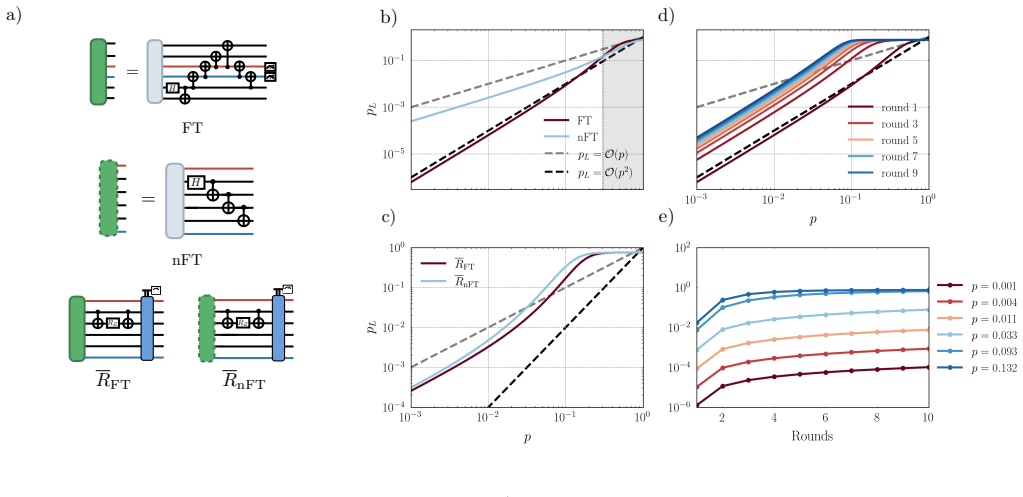
Summary. The paper reports partially fault-tolerant quantum simulations of the mixed-field Ising model on IBM's ibm_boston, using 21 blocks of the [[4,2,2]] Iceberg code (42 logical qubits, up to 136 physical qubits) with fault-tolerant syndrome extraction but non-fault-tolerant logical operations. The authors introduce Observable-Ranked Postselection (ORP), which ranks error detectors by their empirical correlation with a target observable and postselects only on the highest-ranked detectors, with the cut level chosen by a plateau-finding algorithm on a held-out half of the data. Comparing encoded and unencoded circuits at equal shot count against MPS benchmarks, they report improvements in local-observable accuracy of 2–6% at intermediate times in 1D and more than 200% (in a signal-survival metric α) at late times in 2D, where the encoding also reduces circuit depth relative to direct heavy-hex embedding. Supporting material includes circuit-depth/gate tables, classical verification of gadget-level fault-tolerance conditions, memory experiments, and an analytical treatment of the ORP ranking metric.
Significance. If the results hold, this is a useful data point in the early-fault-tolerance landscape: it demonstrates beyond-baseline local-observable estimation with a lightweight QED code on widely accessible commercial hardware, quantifies the crossover regime in which partial FT beats both NISQ and full-FT strategies, and shows concretely that encoding can relax connectivity constraints (the 2D case) rather than only suppress errors. The explicit circuit accounting, MPS cross-checks with bootstrap uncertainties, classical verification of gadget fault tolerance, and honest reporting of failure modes (device dependence, reset tradeoffs, R-dependence reversal) are strengths that make the work reproducible in principle and falsifiable in practice. The impact is incremental rather than transformative — improvements are modest in 1D and device-specific — but it is exactly the kind of careful hardware characterization the field needs.
major comments (4)
- [Methods A.2 (Detector Selection), Fig. 5] ORP selection variability is asserted but not quantified, and it is load-bearing for the headline numbers. The plateau algorithm ranks detectors by Δj = |⟨O⟩_{v_j=0} − ⟨O⟩_{v_j=1}|, constructs O_ref from an internally chosen band f_min ≤ f_k ≤ f_ref, and selects k* from the longest plateau within zσ_k, all on a single half-sample split. The holdout (k* chosen on one half, applied to the other) protects against the crudest winner's-curse bias, and the external MPS comparison rules out gross bias toward the target, but one fixed split plus bootstrap-at-fixed-k does not propagate model-selection variance into the reported uncertainties. With 32k shots, the Δj ranking of rare-firing detectors is itself shot-noise dominated, so k* can be split-dependent. The text states 'the quality of ⟨O⟩_k is observed to be similar for a range of parameters' without displaying any such scan. Requested: (i)
- [Abstract; Sec. III, Fig. 4; Appendix C] The abstract and Fig. 4 headline a '>200% improvement' in 2D at the latest times, but this is a percentage change in fitted α whose unencoded denominator is small and shrinking (Fig. 3d shows unencoded α near zero at late t). The text partially acknowledges this ('driven by rapidly decohering unencoded results'), but the abstract presents the number without that context, and Appendix C states the gain is 'largely due to postselection as opposed to reduced gate depth.' Since the α-percentage diverges as α_unenc → 0, the figure of merit is unstable precisely where the headline is taken from. Requested: report absolute α values (encoded and unencoded) alongside the percentage in the abstract/main text, and state the acceptance fraction at k* for the latest-time points (Appendix F data should be referenced inline). This is a presentation-of-claim issue, not a correctness issue, but it curren
- [Methods A.2; Sec. II.B; Appendix A.5] There is a residual circularity risk in conditioning the postselection ranking on the same observable subsequently reported. Δj is computed from correlations of detector v_j with observable O, and the encoded ⟨O⟩_{k*} is then the reported quantity. The holdout half mitigates this within one observable, but the selection is observable-matched throughout. A direct, cheap test would resolve this: compute the Δj ranking and k* using one observable (e.g., ⟨Z_n⟩) and evaluate the resulting filter on a different observable (e.g., ⟨X_n⟩ or ⟨Z_nZ_{n+1}⟩) against MPS. If the filter transfers, the 'detectable-error removal' interpretation of ORP is supported; if not, the gains may partly reflect observable-specific selection. The Pauli-propagation/lightcone analysis in Appendix A.5 (Table IV) is suggestive but is itself observable-conditioned. Given that this test requires only re-analysis of exist
- [Appendix A.5, Table IV; footnote 4] The detector ranking used for the hardware claims is validated against Pauli propagation only in a 4-block, p=0.003 depolarizing simulation (Table IV), and the agreement is qualitative: the ∆j and γj orderings shown differ substantially even within the top 10 (e.g., v(0,1) ranks 1st by Δj and 5th by γj), and the text concedes only set-level overlap. Since the causal-lightcone argument is the main structural justification for why ORP should work (footnote 4, Appendix A.5), the manuscript should either show the ranking correspondence at a scale closer to the 21-block experiments or temper the claim that ORP-selected detectors 'coincide with the backwards lightcone' to the weaker set-overlap statement actually demonstrated.
minor comments (8)
- [Sec. IV (Discussion), first paragraph] Typo: 'results obtained using our scheme show improvements for both 1D and 1D simulations' — the second should be 2D.
- [Methods D, first paragraph] The phrase 'resulting in biased unencoded results with small error bars' is unclear as written; presumably this means the equal-shot comparison gives the unencoded baseline tighter statistics than the postselected encoded runs. Please rephrase.
- [Fig. 2d–e and caption] The CDFs in Fig. 2d use t ≤ 4 while Fig. 2c shows t = 8, and the rationale (t = 4–8 excluded, shaded in Fig. 2e) is only visible in the caption of panel e. A one-sentence justification in the main text for why the excluded window is excluded — beyond 'where an encoding improvement is observed' — would help, since as written the window choice looks outcome-selected.
- [Methods A.2, footnote 5] Footnote 5 states that Δj depends on which data-qubit representative of O (modulo stabilizers) is used. This gauge dependence deserves a sentence in the main text of Methods A.2, since different representatives can in principle produce different rankings; please state which representative is used for the reported results.
- [Sec. II.B, Eq. (4) vs. Methods A.1] The two-cycle no-reset detector construction (Eq. 8) is well explained, but Eq. (4) in the main text uses identical notation with the same two-cycle skip; please note explicitly in the main text that the skip is a consequence of omitted resets, since a reader of Sec. II.B alone may assume a typo.
- [Methods E] Methods E references 'Fig. 20' and 'Fig. 21' for late-time and 5×5 simulations that do not appear in the main narrative; please verify the figure numbering and cross-references in the compiled version.
- [Data availability] Raw shot-level data and analysis code do not appear to be released with the manuscript. Given that the central validation of ORP (k* selection, plateau finding) is only auditable from shot-level data, a data/code availability statement with a public repository is strongly recommended.
- [Sec. III, Eq. (7)] In Eq. (7), α is defined through a fit constrained to pass through the origin. Please comment on the sensitivity of α to allowing an intercept, since coherent rotation errors in the MFIM dynamics could shift ⟨Z⟩ by an offset that a through-origin fit would absorb into α.
Circularity Check
Experimental encoded-vs-unencoded comparison against external MPS; only mild data-adaptive self-reference in ORP, not a by-construction derivation.
specific steps
-
other
[Methods A.2; Eqs. (5), (13); Fig. 5]
"A detector v_j’s impact on a given observable O is inferred by conditioning ⟨O⟩ on the value of v_j by Δ_j = |⟨O⟩_{v_j=0} − ⟨O⟩_{v_j=1}| … Detectors are then ranked by Δ_j, and ORP uses this ranking to postselect… A reference value is built by combining the most heavily filtered levels… O_ref = … This procedure is carried out on the held-out half of the results, and the resulting k* is applied to the complementary half"
Detector importance is defined from correlations with the same observable being estimated, and the plateau reference O_ref is built from heavily filtered levels of that same dataset. Filtering high-Δ_j shots therefore moves ⟨O⟩ toward the no-fire conditional by design. This is mild methodological self-reference in the estimator, not a claimed derivation that equals its inputs: k* is applied on a held-out half, and reported gains are scored against external MPS (and vs unencoded baselines), so the 2–6% / >200% improvements are not forced equal to a fit parameter.
full rationale
The paper’s central claim is an empirical hardware demonstration: partially FT [[4,2,2]] simulations on ibm_boston, with FT syndrome extraction and nFT logical gates, yield higher local-observable fidelity than matched unencoded circuits when both are scored against independent MPS references (abstract; Sec. III; Figs. 2–4). The Ising Hamiltonian, code stabilizers/logicals, Trotter circuits, and FT gadget checks are fixed independently of the success metric α and of the reported percent improvements. ORP ranks detectors by empirical Δ_j built from the same class of observables later reported and builds an internal O_ref from high-k filtered levels, then chooses k* on a held-out half-sample (Methods A; Eq. 5; plateau algorithm). That is data-adaptive filtering of the estimator, not a first-principles prediction forced equal to a fitted input, and success is still judged by external MPS rather than by driving α→1 by construction. No uniqueness theorem, ansatz, or load-bearing premise is imported solely via overlapping-author citation. Appendix C’s statement that 2D gains are largely from postselection is an honest attribution, not circular renaming. Overall circularity is negligible; score 1 only for the mild ORP self-reference.
Axiom & Free-Parameter Ledger
free parameters (5)
- ORP plateau parameters f_min, f_ref, z =
f_min=0.005, f_ref=0.05, z=1
- Syndrome extraction round count R and placement schedule =
best-case emphasis on R=1 in Fig. 4
- Simulated-annealing and layout hyperparameters =
T0=4, Tend=0.01, Treheat=2, Rh=6000, Nit=25000
- Trotter step δt and n_T for device runs =
δt=0.5 for hardware; δt=0.1 for fine MPS
- MFIM couplings J, g_x, g_z and bubble initial state =
J=1, g_x=0.75, g_z=0.5 or 1.5
axioms (5)
- domain assumption Level-1-style gadget conditions (detect one input error; one internal error yields at most one output error) suffice as a practical FT criterion for these small gadgets under dominant two-qubit noise.
- domain assumption MPS with stated bond dimension/cutoff is an adequate classical reference for local ⟨Z_n⟩ on the simulated sizes and times.
- ad hoc to paper Comparing encoded and unencoded circuits at equal shot count without noise-learning mitigation isolates the benefit of QED.
- standard math CSS [[4,2,2]] stabilizers, logical operators, and detector constructions (including no-reset parity rules) correctly implement the intended code and checks.
- domain assumption Device noise on ibm_boston is close enough to the pseudothreshold that Ap+Bp^2 partial-FT scaling yields net observable gain.
invented entities (1)
-
Observable-Ranked Postselection (ORP)
independent evidence
read the original abstract
Quantum error-detecting codes offer a near-term path for improving the performance of quantum simulations on noisy hardware. Using IBM's superconducting quantum computer ibm_boston, we show that partially fault-tolerant encoded quantum simulations of the Ising model in 1+1D and 2+1D outperform their unencoded counterparts in estimating local observables. To represent 42 logical qubits on the heavy-hex quantum processor, 21 blocks of the [[4, 2, 2]] Iceberg code and up to 136 physical qubits are used. By pairing fault-tolerant syndrome extraction with non-fault-tolerant logical operations, this scheme preserves many of the benefits of error detection while avoiding the overhead typically required for a fully fault-tolerant logical gate set. The encoding's square logical connectivity, together with the freedom to place logical qubits within each block, enables simulations of a 2D spatial lattice with lower circuit depth than the unencoded implementation requires. We introduce Observable-Ranked Postselection, a selective-filtering technique based on syndrome correlations that recovers reliable results without the prohibitive shot loss of full syndrome postselection. Under the cumulative effect of device errors, this encoding improves local-observable accuracy over the unencoded baseline by 2-6% at intermediate times in 1+1D simulations, growing with circuit depth to over 200% in 2+1D at the latest times studied.
Figures




Reference graph
Works this paper leans on
-
[1]
Qubit Dependence Figure 14 shows additional metrics comparing encoded to unencoded runs presented in Sec. III. As seen in Fig. 4, the encoding improvement in 1D is most pronounced at early and intermediate times, and decreases at late times. In 2D, the improvement grows with time. Figure 14a) shows α per logical qubit across all t. For both 1D and 2D simu...
-
[2]
4, the encoding improvement is roughly independent of gz for 1D and 2D
Coupling Dependence As shown in Fig. 4, the encoding improvement is roughly independent of gz for 1D and 2D. However, α fits for both encoded and unencoded runs are consistently higher for gz = 1.5 than 0 .5, which is seen in Figs. 2e) and 3d). This difference originates in how far excitations (and errors) can propagate in each system. As shown in Fig. 16...
-
[3]
slowed-down
Reset Dependence As a result of omitting resets on ancilla qubits after syndrome measurements, an ancilla that fires remains in the state |1⟩ until a subsequent error measurement flips it back to |0⟩.15 Any inter-block RZZ (θ) rotation that uses this ancilla in its implementation therefore applies the opposite rotation RZZ (−θ). Interspersing these opposi...
-
[4]
false” vacuum decays to the stable and energetically favored “true
Geometric Dependence in 1D Simulations The encoded results presented in Fig. 3 show a large improvement over unencoded runs, increasing with time to a greater than 200% improvement at late times. This is partially due to the geometric gate depth overhead of embedding a square lattice onto heavy-hex connectivity. Unencoded circuits are 1.5 times deeper tha...
-
[5]
A. M. Steane, Error Correcting Codes in Quantum Theory, Phys. Rev. Lett. 77, 793 (1996)
1996
-
[6]
Steane, Simple quantum error correcting codes, Phys
A. Steane, Simple quantum error correcting codes, Phys. Rev. A 54, 4741 (1996), arXiv:quant-ph/9605021
Pith/arXiv arXiv 1996
-
[7]
Gottesman, Stabilizer codes and quantum error correction , Ph.D
D. Gottesman, Stabilizer codes and quantum error correction , Ph.D. thesis, California Institute of Technology (1997), arXiv:quant-ph/9705052
Pith/arXiv arXiv 1997
-
[8]
Gottesman, A Theory of fault tolerant quantum computation, Phys
D. Gottesman, A Theory of fault tolerant quantum computation, Phys. Rev. A 57, 127 (1998), arXiv:quant-ph/9702029
Pith/arXiv arXiv 1998
-
[9]
P. Aliferis, D. Gottesman, and J. Preskill, Quantum accuracy threshold for concatenated distance-3 code, Quant. Inf. Comput. 6, 097 (2006), arXiv:quant-ph/0504218
Pith/arXiv arXiv 2006
-
[10]
S. Dasu et al. , Computing with many encoded logical qubits beyond break-even, (2026), arXiv:2602.22211 [quant-ph]
arXiv 2026
-
[11]
M. A. Perlin et al., Fault-tolerant execution of error-corrected quantum algorithms, (2026), arXiv:2603.04584 [quant-ph]
arXiv 2026
-
[12]
P. S. Rodriguez et al. , Experimental demonstration of logical magic state distillation, Nature 645, 620 (2025), arXiv:2412.15165 [quant-ph]
arXiv 2025
-
[13]
B. W. Reichardt et al. , Fault-tolerant quantum computation with a neutral atom processor, (2024), arXiv:2411.11822 [quant-ph]
Pith/arXiv arXiv 2024
-
[14]
D. Bluvstein et al., A fault-tolerant neutral-atom architecture for universal quantum computation, Nature 649, 39 (2026), [Erratum: Nature 650, E3 (2026)], arXiv:2506.20661 [quant-ph]
arXiv 2026
-
[15]
Gottesman, Quantum fault tolerance in small experiments, (2016), arXiv:1610.03507 [quant-ph]
D. Gottesman, Quantum fault tolerance in small experiments, (2016), arXiv:1610.03507 [quant-ph]
Pith/arXiv arXiv 2016
-
[16]
M. Urbanek, B. Nachman, and W. A. de Jong, Error detection on quantum computers improving the accuracy of chemical calculations, Phys. Rev. A 102, 022427 (2020), arXiv:1910.00129 [quant-ph]
Pith/arXiv arXiv 2020
-
[17]
Z. Chen et al. , Exponential suppression of bit or phase flip errors with repetitive error correction 10.1038/s41586-021- 03588-y (2021), arXiv:2102.06132 [quant-ph]
Pith/arXiv arXiv 2021
-
[18]
R. Acharya et al. (Google Quantum AI and Collaborators), Quantum error correction below the surface code threshold, Nature 638, 920 (2025), arXiv:2408.13687 [quant-ph]
Pith/arXiv arXiv 2025
-
[19]
B. Het´ enyi and J. R. Wootton, Creating Entangled Logical Qubits in the Heavy-Hex Lattice with Topological Codes, PRX Quantum 5, 040334 (2024), arXiv:2404.15989 [quant-ph]
Pith/arXiv arXiv 2024
-
[20]
L. Caune et al., Demonstrating real-time and low-latency quantum error correction with superconducting qubits, (2024), arXiv:2410.05202 [quant-ph]
Pith/arXiv arXiv 2024
-
[21]
R. S. Gupta et al. , Encoding a magic state with beyond break-even fidelity, Nature 625, 259 (2024), arXiv:2305.13581 [quant-ph]
Pith/arXiv arXiv 2024
-
[22]
F. Vigneau et al. , Quantum Error Detection in Qubit-Resonator Star Architecture, PRX Quantum 6, 040369 (2025), arXiv:2503.12869 [quant-ph]
arXiv 2025
-
[23]
M. Abraham et al. (Members of the HRL Quantum Team, Collaborators), A digitally controlled silicon quantum processing unit, (2026), arXiv:2604.16216 [quant-ph]
Pith/arXiv arXiv 2026
-
[24]
Preskill, Beyond NISQ: The Megaquop Machine, ACM Trans
J. Preskill, Beyond NISQ: The Megaquop Machine, ACM Trans. Quant. Comput.6, 1 (2025), arXiv:2502.17368 [quant-ph]
Pith/arXiv arXiv 2025
-
[25]
C. Gerhard and T. A. Brun, Weakly Fault-Tolerant Computation in a Quantum Error-Detecting Code, (2024), arXiv:2408.14828 [quant-ph]
Pith/arXiv arXiv 2024
-
[26]
B. W. Reichardt, D. Aasen, and R. Chao, Fire and ice: Partially fault-tolerant quantum computing with selective state filtering, (2026), arXiv:2605.15344 [quant-ph]
Pith/arXiv arXiv 2026
-
[27]
Y. Akahoshi, K. Maruyama, H. Oshima, S. Sato, and K. Fujii, Partially Fault-Tolerant Quantum Computing Architec- ture with Error-Corrected Clifford Gates and Space-Time Efficient Analog Rotations, PRX Quantum 5, 010337 (2024), arXiv:2303.13181 [quant-ph]
Pith/arXiv arXiv 2024
-
[28]
K. Yamamoto et al. , Quantum Error-Corrected Computation of Molecular Energies, PRX Quantum 7, 020319 (2026), arXiv:2505.09133 [quant-ph]
Pith/arXiv arXiv 2026
- [29]
-
[30]
S. Bravyi and A. Kitaev, Universal quantum computation with ideal Clifford gates and noisy ancillas, Phys. Rev. A 71, 022316 (2005), arXiv:quant-ph/0403025
Pith/arXiv arXiv 2005
-
[31]
A. Paetznick and B. W. Reichardt, Universal Fault-Tolerant Quantum Computation with Only Transversal Gates and Error Correction, Phys. Rev. Lett. 111, 090505 (2013), arXiv:1304.3709 [quant-ph]
Pith/arXiv arXiv 2013
-
[32]
L. Daguerre, R. Blume-Kohout, N. C. Brown, D. Hayes, and I. H. Kim, Experimental Demonstration of High-Fidelity Logical Magic States from Code Switching, Phys. Rev. X 15, 041008 (2025), arXiv:2506.14169 [quant-ph]
arXiv 2025
-
[33]
A. Y. Kitaev, Fault tolerant quantum computation by anyons, Annals Phys. 303, 2 (2003), arXiv:quant-ph/9707021
Pith/arXiv arXiv 2003
-
[34]
E. Dennis, A. Kitaev, A. Landahl, and J. Preskill, Topological quantum memory, J. Math. Phys. 43, 4452 (2002), arXiv:quant-ph/0110143
Pith/arXiv arXiv 2002
-
[35]
C. Chamberland, G. Zhu, T. J. Yoder, J. B. Hertzberg, and A. W. Cross, Topological and Subsystem Codes on Low-Degree Graphs with Flag Qubits, Phys. Rev. X 10, 011022 (2020), arXiv:1907.09528 [quant-ph]
Pith/arXiv arXiv 2020
-
[36]
C. Benito, E. L´ opez, B. Peropadre, and A. Bermudez, Comparative study of quantum error correction strategies for the heavy-hexagonal lattice, Quantum 9, 1623 (2025), arXiv:2402.02185 [quant-ph]
Pith/arXiv arXiv 2025
-
[37]
D. Horsman, A. G. Fowler, S. Devitt, and R. Van Meter, Surface code quantum computing by lattice surgery, New J. Phys. 14, 123011 (2011), arXiv:1111.4022 [quant-ph]
Pith/arXiv arXiv 2011
-
[38]
N. M. Linke, M. Gutierrez, K. A. Landsman, C. Figgatt, S. Debnath, K. R. Brown, and C. Monroe, Fault-tolerant quantum error detection, Sci. Adv. 3, 1701074 (2017), arXiv:1611.06946 [quant-ph]. 40
Pith/arXiv arXiv 2017
-
[39]
Vuillot, Is error detection helpful on IBM 5Q chips?, Quant
C. Vuillot, Is error detection helpful on IBM 5Q chips?, Quant. Inf. Comput. 18, 0949 (2018)
2018
-
[40]
R. Harper and S. T. Flammia, Fault-Tolerant Logical Gates in the IBM Quantum Experience, Phys. Rev. Lett. 122, 080504 (2019), arXiv:1806.02359 [quant-ph]
Pith/arXiv arXiv 2019
-
[41]
M. Takita, A. W. Cross, A. . C´ orcoles, J. M. Chow, and J. M. Gambetta, Experimental Demonstration of Fault-Tolerant State Preparation with Superconducting Qubits, Phys. Rev. Lett. 119, 180501 (2017), arXiv:1705.09259 [quant-ph]
Pith/arXiv arXiv 2017
-
[42]
A. D. C´ orcoles, E. Magesan, S. J. Srinivasan, A. W. Cross, M. Steffen, J. M. Gambetta, and J. M. Chow, Demonstration of a quantum error detection code using a square lattice of four superconducting qubits, Nature Commun. 6, 6979 (2015), arXiv:1410.6419 [quant-ph]
Pith/arXiv arXiv 2015
-
[43]
K. Yamamoto, S. Duffield, Y. Kikuchi, and D. M. Ramo, Demonstrating Bayesian quantum phase estimation with quantum error detection, Phys. Rev. Res. 6, 013221 (2024), arXiv:2306.16608 [quant-ph]
Pith/arXiv arXiv 2024
-
[44]
Y. Wang et al. , Fault-tolerant one-bit addition with the smallest interesting color code, Sci. Adv. 10, ado9024 (2024), arXiv:2309.09893 [quant-ph]
Pith/arXiv arXiv 2024
-
[45]
B. Pato and N. Klco, Trade-offs in Gauss’s law error correction for lattice gauge theory quantum simulations, (2026), arXiv:2602.22121 [quant-ph]
arXiv 2026
-
[46]
A. Rajput, A. Roggero, and N. Wiebe, Quantum error correction with gauge symmetries, npj Quantum Inf. 9, 41 (2023), arXiv:2112.05186 [quant-ph]
Pith/arXiv arXiv 2023
-
[47]
L. Spagnoli, A. Roggero, and N. Wiebe, Qudit stabiliser codes for ZN lattice gauge theories with matter, (2026), arXiv:2602.20661 [quant-ph]
arXiv 2026
-
[48]
M. Turco, L. Spagnoli, and A. Roggero, Binary Gauss Stabilizers for Abelian Lattice Gauge Theories, (2026), arXiv:2607.14861 [quant-ph]
Pith/arXiv arXiv 2026
-
[49]
L. Spagnoli, A. Roggero, and N. Wiebe, Fault-tolerant simulation of Lattice Gauge Theories with gauge covariant codes, Quantum 10, 1968 (2026), arXiv:2405.19293 [quant-ph]
arXiv 1968
-
[50]
Yao, Quantum error correction codes for truncated SU(2) lattice gauge theories, Phys
X. Yao, Quantum error correction codes for truncated SU(2) lattice gauge theories, Phys. Rev. D 113, 114512 (2026), arXiv:2511.13721 [quant-ph]
Pith/arXiv arXiv 2026
-
[51]
M. Carena, H. Lamm, Y.-Y. Li, and W. Liu, Quantum error thresholds for gauge-redundant digitizations of lattice field theories, Phys. Rev. D 110, 054516 (2024), arXiv:2402.16780 [hep-lat]
Pith/arXiv arXiv 2024
-
[52]
N. Klco, A. Roggero, and M. J. Savage, Standard Model Physics and the Digital Quantum Revolution: Thoughts about the Interface, Rept. Prog. Phys. 85, 064301 (2022), arXiv:2107.04769 [quant-ph]
Pith/arXiv arXiv 2022
-
[53]
C. W. Bauer, Z. Davoudi, et al. , Quantum Simulation for High-Energy Physics, PRX Quantum 4, 027001 (2023), arXiv:2204.03381 [quant-ph]
Pith/arXiv arXiv 2023
-
[54]
C. W. Bauer, Z. Davoudi, N. Klco, and M. J. Savage, Quantum Simulation of Fundamental Particles and Forces, Nature Rev. Phys. 5, 420 (2023), arXiv:2404.06298 [hep-ph]
Pith/arXiv arXiv 2023
-
[55]
Z. Davoudi et al. , Report of the Snowmass 2021 Topical Group on Lattice Gauge Theory, in Snowmass 2021 (2022) arXiv:2209.10758 [hep-lat]
Pith/arXiv arXiv 2021
-
[56]
Beck et al., Quantum Information Science and Technology for Nuclear Physics
D. Beck et al., Quantum Information Science and Technology for Nuclear Physics. Input into U.S. Long-Range Planning, 2023 (2023) arXiv:2303.00113 [nucl-ex]
Pith/arXiv arXiv 2023
-
[57]
A. Di Meglio et al. , Quantum Computing for High-Energy Physics: State of the Art and Challenges, PRX Quantum 5, 037001 (2024), arXiv:2307.03236 [quant-ph]
Pith/arXiv arXiv 2024
-
[58]
E. A. Martinez et al., Real-time dynamics of lattice gauge theories with a few-qubit quantum computer, Nature 534, 516 (2016), arXiv:1605.04570 [quant-ph]
Pith/arXiv arXiv 2016
-
[59]
N. Klco, E. F. Dumitrescu, A. J. McCaskey, T. D. Morris, R. C. Pooser, M. Sanz, E. Solano, P. Lougovski, and M. J. Savage, Quantum-classical computation of Schwinger model dynamics using quantum computers, Phys. Rev. A98, 032331 (2018), arXiv:1803.03326 [quant-ph]
Pith/arXiv arXiv 2018
-
[60]
R. C. Farrell, M. Illa, A. N. Ciavarella, and M. J. Savage, Scalable Circuits for Preparing Ground States on Digital Quantum Computers: The Schwinger Model Vacuum on 100 Qubits, PRX Quantum 5, 020315 (2024), arXiv:2308.04481 [quant-ph]
Pith/arXiv arXiv 2024
-
[61]
R. C. Farrell, M. Illa, A. N. Ciavarella, and M. J. Savage, Quantum simulations of hadron dynamics in the Schwinger model using 112 qubits, Phys. Rev. D 109, 114510 (2024), arXiv:2401.08044 [quant-ph]
Pith/arXiv arXiv 2024
-
[62]
J. Roffe, D. Headley, N. Chancellor, D. Horsman, and V. Kendon, Protecting quantum memories using coherent parity check codes, Quantum Sci. Technol. 3, 035010 (2018), arXiv:1709.01866 [quant-ph]
Pith/arXiv arXiv 2018
-
[63]
R. Chao and B. W. Reichardt, Quantum Error Correction with Only Two Extra Qubits, Phys. Rev. Lett. 121, 050502 (2018), arXiv:1705.02329 [quant-ph]
Pith/arXiv arXiv 2018
-
[64]
C. N. Self, M. Benedetti, and D. Amaro, Protecting expressive circuits with a quantum error detection code, Nature Phys. 20, 219 (2024), arXiv:2211.06703 [quant-ph]
Pith/arXiv arXiv 2024
-
[65]
E. Chertkov, A. C. Potter, D. Hayes, and M. Foss-Feig, Error detection without postselection in adaptive quantum circuits, Phys. Rev. Res. 8, 023057 (2026), arXiv:2509.25326 [quant-ph]
Pith/arXiv arXiv 2026
-
[66]
A. Vezvaee, V. Tripathi, M. Morford-Oberst, F. Butt, V. Kasatkin, and D. A. Lidar, Demonstration of high-fidelity entangled logical qubits using transmons, Nature Commun. 17, 3281 (2026), arXiv:2503.14472 [quant-ph]
arXiv 2026
-
[67]
M. Urbanek, B. Nachman, V. R. Pascuzzi, A. He, C. W. Bauer, and W. A. de Jong, Mitigating depolarizing noise on quantum computers with noise-estimation circuits, Phys. Rev. Lett. 127, 270502 (2021), arXiv:2103.08591 [quant-ph]
Pith/arXiv arXiv 2021
-
[68]
S. A Rahman, R. Lewis, E. Mendicelli, and S. Powell, Self-mitigating Trotter circuits for SU(2) lattice gauge theory on a quantum computer, Phys. Rev. D 106, 074502 (2022), arXiv:2205.09247 [hep-lat]
Pith/arXiv arXiv 2022
-
[69]
Y. Li and S. C. Benjamin, Efficient Variational Quantum Simulator Incorporating Active Error Minimization, Phys. Rev. X 7, 021050 (2017), arXiv:1611.09301 [quant-ph]. 41
Pith/arXiv arXiv 2017
-
[70]
H. Froland and D. M. Grabowska, Measuring Non-Stabilizerness in an SU(2) Lattice Gauge Theory, (2026), arXiv:2606.14842 [quant-ph]
arXiv 2026
-
[71]
K. Temme, S. Bravyi, and J. M. Gambetta, Error Mitigation for Short-Depth Quantum Circuits, Phys. Rev. Lett. 119, 180509 (2017), arXiv:1612.02058 [quant-ph]
Pith/arXiv arXiv 2017
-
[72]
E. F. Dumitrescu, A. J. McCaskey, G. Hagen, G. R. Jansen, T. D. Morris, T. Papenbrock, R. C. Pooser, D. J. Dean, and P. Lougovski, Cloud Quantum Computing of an Atomic Nucleus, Phys. Rev. Lett. 120, 210501 (2018), arXiv:1801.03897 [quant-ph]
Pith/arXiv arXiv 2018
-
[73]
A. Kandala, K. Temme, A. D. Corcoles, A. Mezzacapo, J. M. Chow, and J. M. Gambetta, Error mitigation extends the computational reach of a noisy quantum processor, Nature 567, 491 (2019), arXiv:1805.04492 [quant-ph]
Pith/arXiv arXiv 2019
-
[74]
E. v. d. Berg, Z. K. Minev, A. Kandala, and K. Temme, Probabilistic error cancellation with sparse Pauli–Lindblad models on noisy quantum processors, Nature Phys. 19, 1116 (2023), arXiv:2201.09866 [quant-ph]
Pith/arXiv arXiv 2023
-
[75]
A. R. Calderbank and P. W. Shor, Good quantum error correcting codes exist, Phys. Rev. A54, 1098 (1996), arXiv:quant- ph/9512032
arXiv 1996
-
[76]
R. Chao and B. W. Reichardt, Fault-tolerant quantum computation with few qubits, npj Quantum Inf. 4, 42 (2018), arXiv:1705.05365 [quant-ph]
Pith/arXiv arXiv 2018
-
[77]
C. Chamberland and M. E. Beverland, Flag fault-tolerant error correction with arbitrary distance codes, Quantum 2, 53 (2018), arXiv:1708.02246 [quant-ph]
Pith/arXiv arXiv 2018
-
[78]
R. Chao and B. W. Reichardt, Flag Fault-Tolerant Error Correction for any Stabilizer Code, PRX Quantum 1, 010302 (2020), arXiv:1912.09549 [quant-ph]
Pith/arXiv arXiv 2020
-
[79]
B. W. Reichardt, Fault-tolerant quantum error correction for Steane’s seven-qubit color code with few or no extra qubits, Quantum Sci. Technol. 6, 015007 (2020), arXiv:1804.06995 [quant-ph]
Pith/arXiv arXiv 2020
-
[80]
G. P. Geh´ er, M. Jastrzebski, E. T. Campbell, and O. Crawford, To reset, or not to reset—that is the question, npj Quantum Inf. 11, 39 (2025), arXiv:2408.00758 [quant-ph]
Pith/arXiv arXiv 2025
discussion (0)
Sign in with ORCID, Apple, or X to comment. Anyone can read and Pith papers without signing in.