REVIEW 3 major objections 4 minor 67 references
This paper claims that a 2.6B latent-reasoning looped language model, adapted with per-pair LoRA adapters, matches or exceeds translation systems three to five times larger across 32 directions.
Reviewed by Pith at T0; open to challenge. T0 means a machine referee read the full paper against a public rubric. the ladder, T0–T4 →
T0 review · deepseek-v4-flash
2026-08-01 14:47 UTC pith:JPNHJ4UP
load-bearing objection Believable saturation story, but the low-resource SOTA claim rests on a single seedless u=4 run—needs error bars and a depth sweep before that headline stands. the 3 major comments →
LatentMT: Machine Translation with Latent Reasoning
The pith
A machine-rendered reading of the paper's core claim, the machinery that carries it, and where it could break.
Core claim
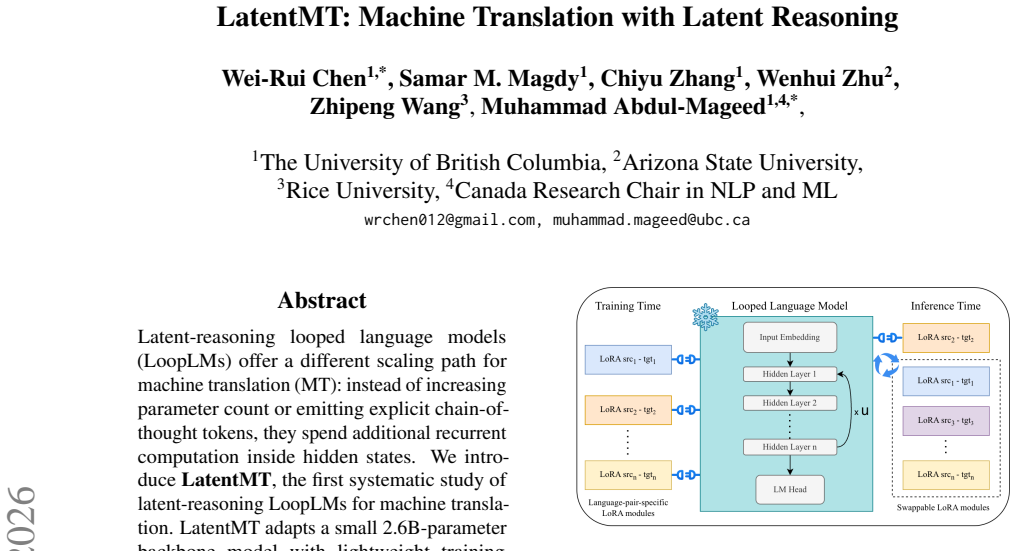
On its own terms, the paper's discovery is that latent-reasoning looped language models are a viable backbone for machine translation. The authors freeze a 2.6B-parameter looped model, attach separate LoRA adapters for each language pair, and train only those adapters. Across 32 directions spanning high-, mid-, and low-resource languages, the resulting LatentMT system reaches quality comparable to systems three to five times larger, and it beats both an 8B same-protocol baseline and a state-of-the-art 8B multilingual model on average for low-resource languages. The paper also claims that the relationship between recurrent depth and quality is an early-gain-then-saturation curve, supported by
What carries the argument
The load-bearing mechanism is the looped language model (LoopLM): a shared Transformer stack applied u times to the hidden state before each next-token prediction, so extra computation costs no extra parameters. LatentMT couples this with per-language-pair LoRA adapters on a frozen backbone, and treats u as a fixed experimental variable. The saturation analysis uses two observables — cosine distance between last-hidden-layer states at adjacent recurrent steps and the rate at which the top-1 predicted token flips between steps — to show that later recurrent transitions change less.
Load-bearing premise
The low-resource 'state-of-the-art' claim rests on a randomly sampled 30-language subset and a fixed recurrent depth of u=4 for which no seed or sweep is reported; if that subset or depth was selected after inspecting test-set scores, the result could be a post-selection artifact rather than a real advantage.
What would settle it
Re-run the 30-language low-resource evaluation with a pre-registered seed, a held-out language list, and recurrent depth chosen on development data rather than test data; if the 2.6B model no longer beats the 8B baselines on average BLEU or chrF++, the central quality claim for low-resource translation is refuted.
If this is right
- A 2.6B latent-reasoning model with lightweight adapters can reach translation quality comparable to systems three to five times larger, shifting the scaling axis from parameters to per-token recurrent compute.
- Recurrent depth functions as a controllable cost-quality dial: going from u=1 to u=4 yields the main gains, and u=2 retains roughly 98% of peak quality while cutting training compute and inference latency relative to a larger baseline.
- Because the backbone stays frozen and adapters are swapped per language pair, adding or changing translation directions does not require retraining the full model.
- Translation quality saturates quickly because the hidden-state trajectory stabilizes, so the same early-gain pattern should be expected when applying latent reasoning to other generation tasks.
- The reported memory and latency reductions make local or edge deployment of competitive translation more plausible for sensitive or low-connectivity settings.
Where Pith is reading between the lines
- Going beyond the paper: the knee at u=2 suggests an adaptive depth scheduler — using one or two steps for easy text and four for hard text — could preserve most quality at a fraction of the cost; this is not tested in the paper.
- Going beyond the paper: the frozen-backbone-plus-adapters design implies the system can be extended to new language pairs without full retraining, but also raises an open question of whether adapter interference appears beyond 32 directions; the paper does not address it.
- Going beyond the paper: because the mechanistic saturation is measured on translation only, one testable extension is to compare LoRA-adapted looped models on summarization or code generation to see whether the early-gain curve is task-dependent.
- Going beyond the paper: the efficiency comparison uses a reasoning baseline that emits explicit chain-of-thought tokens; a cleaner control would be a non-looped 2.6B model with the same LoRA adaptation, which would isolate whether the gains come from latent recurrence or from the adapter training itself.
Editorial analysis
A structured set of objections, weighed in public.
Referee Report
Summary. The paper introduces LatentMT, a machine-translation approach that combines a frozen 2.6B-parameter looped language model (Ouro-2.6B-Thinking) with per-language-pair LoRA adapters. It systematically varies the fixed recurrent depth u from 1 to 6 and evaluates on three benchmark families: DRT (English–Chinese, high-resource), ArzEn-MultiGenre (English–Egyptian Arabic, mid-resource), and a 30-language OLDI/Flores subset (low-resource). The central empirical findings are that translation quality improves sharply from u=1 to roughly u=4 and then saturates; that this pattern is mirrored by human error annotation and by mechanistic measures of hidden-state change (cosine distance and top-1 flip rate); and that LatentMT is more parameter- and compute-efficient than a comparable Qwen3-8B SFT baseline. The paper claims competitiveness with models three to five times larger and state-of-the-art results on mid- and low-resource languages.
Significance. If the results hold, this is a useful and timely contribution: it provides the first systematic study of latent-reasoning looped LMs for MT, treats recurrent depth as a controlled experimental variable, and combines automatic metrics with human error analysis and mechanistic diagnostics. The controlled u-sweep on DRT and ArzEn is a real strength, as is the same-protocol comparison with Qwen3-8B SFT. The efficiency analysis is also valuable. However, the headline 'state-of-the-art on low-resource languages' claim is currently supported by a single unreported configuration on a seedless 30-language subset with no error bars, and the comparison set is narrow. The paper is worth publishing after these load-bearing issues are addressed.
major comments (3)
- [§4.3, Table 4] The low-resource SOTA claim is carried by a single configuration, LatentMT-2.6B4, evaluated on a 30-language OLDI/Flores subset described only as 'randomly sampled' (§3.2) with no seed. No recurrent-depth sweep, no repeated subsamples, and no variance or confidence intervals are reported for this benchmark. The average margins over EMMA-500-8B are 0.20 BLEU and 0.81 chrF++, while EMMA-500 wins on roughly half of the 30 rows; the positive average is driven by a few favorable languages. Without a seed, a sweep, and error bars, the possibility that the subset or the u=4 choice was selected after inspecting test-set scores cannot be ruled out. Please report the subset seed, a u sweep (at least u=2, 4, 6), bootstrap CIs or paired significance tests, and ideally repeated random subsets.
- [Abstract; §4.3] The 'state-of-the-art on low-resource languages' claim is benchmarked against only two systems: Qwen3-8B SFT and EMMA-500-8B. Strong multilingual MT baselines such as NLLB-200, M2M-100, or MADLAD-400 are absent, so the SOTA claim is not established. The DRT and ArzEn comparisons are also over a small set of reference systems. Either broaden the comparison set or temper the claim to 'competitive with the compared systems.'
- [§3.2, Table 3, footnote 11] All experiments are single-run, and some evaluation splits are randomly generated rather than inherited: the ArzEn train/validation/test partition is described in footnote 11 as randomly sampled to match reported sizes, but no seed is given, and the same applies to the OLDI subset. Consequently, all numeric comparisons (e.g., LatentMT4 vs. LatentMT5 in Tables 2 and 3, and the u=4 peak) lack variance estimates, and the results cannot be independently reproduced. Please run multiple seeds or provide at least one alternative split, and report standard deviations or confidence intervals for the headline numbers.
minor comments (4)
- [Global / reproducibility] No code, model checkpoints, or training/evaluation seeds are provided. Add a reproducibility statement with seeds, scripts, and hyperparameters for the Qwen3-8B SFT baseline.
- [§3.2] Typo: 'exeamplares' should be 'examples' in the Evaluation paragraph. Also, the Qwen3-8B SFT protocol is not fully specified (LoRA vs. full fine-tuning, epochs, learning rate), despite being the same-protocol control.
- [§5.2 / Figure 4] The efficiency analysis reports only relative reductions. Include absolute training time, GPU-hours, memory, and inference latency numbers so readers can verify the 43–77% compute savings. Figure 4 lacks error bars and axis units.
- [Appendix A] The human error analysis uses 30/60 segments and a single annotator with no inter-annotator agreement measure. Report the annotation guidelines and, ideally, a second annotator or an IAA score for at least a subset.
Circularity Check
No significant circularity: all headline results are empirical measurements on external benchmarks; one non-load-bearing self-citation (LQM) and subset-selection transparency issues do not make the derivation circular.
full rationale
LatentMT's claims are empirical rather than derived-from-inputs. Translation quality (Tables 2–4) is measured by evaluating trained checkpoints on held-out DRT, ArzEn-MultiGenre, and OLDI/Flores test splits with external metrics (BLEU, chrF++, COMET, COMETKiwi); no equation in the paper predicts these scores from the training objective or from a fitted parameter renamed as a prediction. The recurrent-depth saturation result is supported by automatic metrics plus independent mechanistic measurements (Eqs. 7–9), and the human error analysis in Appendix A is auxiliary; it uses the LQM taxonomy, whose authors overlap with this paper (Magdy et al., 2026), but that self-citation is evaluation tooling, not the load-bearing evidence for the saturation claim. The OLDI/Flores low-resource result rests on a single u=4 run over a 'randomly sampled' 30-language subset with no seed or error bars, and footnote 11 discloses that ArzEn splits were randomly sampled because the original release omits partitions; these are transparency/statistical-selection limitations, not definitional circularity. No step in the derivation chain reduces to its own input by construction.
Axiom & Free-Parameter Ledger
free parameters (2)
- fixed recurrent depth u =
u=4 for OLDI/Flores; u=5 quality-optimal and u=2 knee for DRT
- LoRA ranks/alphas per dataset =
rank 32/alpha 64 for DRT and ArzEn; rank 16/alpha 32 for OLDI/Flores
axioms (5)
- domain assumption Ouro-2.6B-Thinking is a valid latent-reasoning LoopLM, and its frozen weights implement recurring computation as described.
- domain assumption COMET, COMETKiwi, BLEU, chrF++ reflect translation quality; differences of ~1 BLEU are meaningful.
- domain assumption Fixed-u training generalizes to fixed-u inference for the same u.
- ad hoc to paper Cosine distance and top-1 flip rate across recurrent steps capture when additional computation stops adding information.
- domain assumption The OLDI/Flores 30 languages are a random sample, and training on OLDI-seed does not overlap with Flores-200 test.
read the original abstract
Latent-reasoning looped language models (LoopLMs) offer a different scaling path for machine translation (MT): instead of increasing parameter count or emitting explicit chain-of-thought tokens, they spend additional recurrent computation inside hidden states. We introduce LatentMT, the first systematic study of latent-reasoning LoopLMs for machine translation. LatentMT adapts a small 2.6B-parameter backbone model with lightweight training. Across 32 translation directions spanning high-, mid-, and low-resource languages, LatentMT achieves performance comparable to models three to five times larger. It is competitive in a high-resource language and achieves state-of-the-art performance on both mid-resource and low-resource languages. Studying the behavior of scaling the number of recurrent reasoning steps, we find that recurrent computation consistently improves translation quality in early steps, then saturates quickly afterwards. Our mechanistic analysis shows that hidden-representation differences shrink along the recurrent reasoning-step axis, supporting the observed saturation in performance. Finally, our efficiency analysis shows that LatentMT requires lower training and inference compute than much larger non-latent-reasoning models with similar performance, making latent recurrent computation a promising path toward compact, efficient, and strong machine translation.
Figures


Reference graph
Works this paper leans on
-
[1]
2025 , eprint=
Scaling Latent Reasoning via Looped Language Models , author=. 2025 , eprint=
2025
-
[2]
2025 , eprint=
Qwen3 Technical Report , author=. 2025 , eprint=
2025
-
[3]
2025 , journal=
Massively Multilingual Adaptation of Large Language Models Using Bilingual Translation Data , author=. 2025 , journal=
2025
-
[4]
2025 , eprint=
New Trends for Modern Machine Translation with Large Reasoning Models , author=. 2025 , eprint=
2025
-
[5]
2026 , eprint=
Chain-of-Thought Reasoning Improves Context-Aware Translation with Large Language Models , author=. 2026 , eprint=
2026
-
[7]
2025 , eprint=
Scaling up Test-Time Compute with Latent Reasoning: A Recurrent Depth Approach , author=. 2025 , eprint=
2025
-
[8]
Chain-of-Thought Prompting Elicits Reasoning in Large Language Models , url =
Wei, Jason and Wang, Xuezhi and Schuurmans, Dale and Bosma, Maarten and ichter, brian and Xia, Fei and Chi, Ed and Le, Quoc V and Zhou, Denny , booktitle =. Chain-of-Thought Prompting Elicits Reasoning in Large Language Models , url =
-
[9]
2025 , eprint=
Training Large Language Models to Reason in a Continuous Latent Space , author=. 2025 , eprint=
2025
-
[10]
2020 , eprint=
Scaling Laws for Neural Language Models , author=. 2020 , eprint=
2020
-
[11]
2026 , eprint=
Unlocking Reasoning Capability on Machine Translation in Large Language Models , author=. 2026 , eprint=
2026
-
[12]
2025 , eprint=
Latent Chain-of-Thought? Decoding the Depth-Recurrent Transformer , author=. 2025 , eprint=
2025
-
[13]
2023 , eprint=
On Achieving Privacy-Preserving State-of-the-Art Edge Intelligence , author=. 2023 , eprint=
2023
-
[14]
2023 , eprint=
MobileNMT: Enabling Translation in 15MB and 30ms , author=. 2023 , eprint=
2023
-
[15]
2020 , eprint=
Edge Intelligence: Architectures, Challenges, and Applications , author=. 2020 , eprint=
2020
-
[16]
Charlie Victor Snell and Jaehoon Lee and Kelvin Xu and Aviral Kumar , booktitle=. Scaling. 2025 , url=
2025
-
[17]
2025 , eprint=
SIM-CoT: Supervised Implicit Chain-of-Thought , author=. 2025 , eprint=
2025
-
[18]
Edward J Hu and yelong shen and Phillip Wallis and Zeyuan Allen-Zhu and Yuanzhi Li and Shean Wang and Lu Wang and Weizhu Chen , booktitle=. Lo. 2022 , url=
2022
-
[19]
2025 , eprint=
DeepTrans: Deep Reasoning Translation via Reinforcement Learning , author=. 2025 , eprint=
2025
-
[20]
2025 , eprint=
ExTrans: Multilingual Deep Reasoning Translation via Exemplar-Enhanced Reinforcement Learning , author=. 2025 , eprint=
2025
-
[21]
2022 , eprint=
No Language Left Behind: Scaling Human-Centered Machine Translation , author=. 2022 , eprint=
2022
-
[23]
Proceedings of the 61st Annual Meeting of the Association for Computational Linguistics (Volume 1: Long Papers) , year =
Small Data, Big Impact: Leveraging Minimal Data for Effective Machine Translation , author =. Proceedings of the 61st Annual Meeting of the Association for Computational Linguistics (Volume 1: Long Papers) , year =
-
[24]
COMET - Deploying a New State-of-the-art MT Evaluation Metric in Production
Stewart, Craig and Rei, Ricardo and Farinha, Catarina and Lavie, Alon. COMET - Deploying a New State-of-the-art MT Evaluation Metric in Production. Proceedings of the 14th Conference of the Association for Machine Translation in the Americas (Volume 2: User Track). 2020
2020
-
[27]
2025 , eprint=
Compositional Translation: A Novel LLM-based Approach for Low-resource Machine Translation , author=. 2025 , eprint=
2025
-
[30]
2026 , eprint=
LLM Latent Reasoning as Chain of Superposition , author=. 2026 , eprint=
2026
-
[31]
International Conference on Learning Representations , volume=
Reasoning with latent thoughts: On the power of looped transformers , author=. International Conference on Learning Representations , volume=
-
[32]
Edge NLP for Efficient Machine Translation in Low Connectivity Areas , year=
Watt, Tess and Chrysoulas, Christos and Gkatzia, Dimitra , booktitle=. Edge NLP for Efficient Machine Translation in Low Connectivity Areas , year=
-
[33]
Privacy Issues in Online Machine Translation Services - E uropean Perspective
Kamocki, Pawel and O ' Regan, Jim. Privacy Issues in Online Machine Translation Services - E uropean Perspective. Proceedings of the Tenth International Conference on Language Resources and Evaluation ( LREC '16). 2016
2016
-
[34]
31st International Conference on Distributed Computing Systems Workshops , pages=
Finding a "Kneedle" in a Haystack: Detecting Knee Points in System Behavior , author=. 31st International Conference on Distributed Computing Systems Workshops , pages=
-
[35]
Forty-first International Conference on Machine Learning , year=
Can Looped Transformers Learn to Implement Multi-step Gradient Descent for In-context Learning? , author=. Forty-first International Conference on Machine Learning , year=
-
[36]
The Fourteenth International Conference on Learning Representations , year=
LoopFormer: Elastic-Depth Looped Transformers for Latent Reasoning via Shortcut Modulation , author=. The Fourteenth International Conference on Learning Representations , year=
-
[38]
Rania Al-Sabbagh. 2024. https://doi.org/10.1016/j.dib.2024.110271 Arzen-multigenre: An aligned parallel dataset of egyptian arabic song lyrics, novels, and subtitles, with english translations . Data in Brief, 54:110271
arXiv 2024
-
[39]
Shabnam Ataee, Hugo Huart, and Andrei Popescu-Belis. 2026. https://arxiv.org/abs/2510.18077 Chain-of-thought reasoning improves context-aware translation with large language models . Preprint, arXiv:2510.18077
arXiv 2026
-
[40]
Daphnee Chabal, Dolly Sapra, and Zoltán Ádám Mann. 2023. https://arxiv.org/abs/2302.05323 On achieving privacy-preserving state-of-the-art edge intelligence . Preprint, arXiv:2302.05323
Pith/arXiv arXiv 2023
-
[41]
Jingcheng Deng, Liang Pang, Zihao Wei, Shicheng Xu, Zenghao Duan, Kun Xu, Yang Song, Huawei Shen, and Xueqi Cheng. 2026. https://arxiv.org/abs/2510.15522 Llm latent reasoning as chain of superposition . Preprint, arXiv:2510.15522
arXiv 2026
-
[42]
Reddi, Stefanie Jegelka, and Sanjiv Kumar
Khashayar Gatmiry, Nikunj Saunshi, Sashank J. Reddi, Stefanie Jegelka, and Sanjiv Kumar. 2024. https://openreview.net/forum?id=o8AaRKbP9K Can looped transformers learn to implement multi-step gradient descent for in-context learning? In Forty-first International Conference on Machine Learning
2024
-
[43]
Bartoldson, Bhavya Kailkhura, Abhinav Bhatele, and Tom Goldstein
Jonas Geiping, Sean McLeish, Neel Jain, John Kirchenbauer, Siddharth Singh, Brian R. Bartoldson, Bhavya Kailkhura, Abhinav Bhatele, and Tom Goldstein. 2025. https://arxiv.org/abs/2502.05171 Scaling up test-time compute with latent reasoning: A recurrent depth approach . Preprint, arXiv:2502.05171
Pith/arXiv arXiv 2025
-
[44]
Shibo Hao, Sainbayar Sukhbaatar, DiJia Su, Xian Li, Zhiting Hu, Jason Weston, and Yuandong Tian. 2025. https://arxiv.org/abs/2412.06769 Training large language models to reason in a continuous latent space . Preprint, arXiv:2412.06769
Pith/arXiv arXiv 2025
-
[45]
Edward J Hu, yelong shen, Phillip Wallis, Zeyuan Allen-Zhu, Yuanzhi Li, Shean Wang, Lu Wang, and Weizhu Chen. 2022. https://openreview.net/forum?id=nZeVKeeFYf9 Lo RA : Low-rank adaptation of large language models . In International Conference on Learning Representations
2022
-
[46]
Ahmadreza Jeddi, Marco Ciccone, and Babak Taati. 2026. https://openreview.net/forum?id=RzYXb5YWBs Loopformer: Elastic-depth looped transformers for latent reasoning via shortcut modulation . In The Fourteenth International Conference on Learning Representations
2026
-
[47]
Shaoxiong Ji, Zihao Li, Jaakko Paavola, Hengyu Luo, and Jörg Tiedemann. 2025. https://arxiv.org/abs/2506.00469 Massively multilingual adaptation of large language models using bilingual translation data . arXiv preprint 2506.00469
arXiv 2025
-
[48]
Pawel Kamocki and Jim O ' Regan. 2016. https://aclanthology.org/L16-1706/ Privacy issues in online machine translation services - E uropean perspective . In Proceedings of the Tenth International Conference on Language Resources and Evaluation ( LREC '16) , pages 4458--4462, Portoro z , Slovenia. European Language Resources Association (ELRA)
2016
-
[49]
Brown, Benjamin Chess, Rewon Child, Scott Gray, Alec Radford, Jeffrey Wu, and Dario Amodei
Jared Kaplan, Sam McCandlish, Tom Henighan, Tom B. Brown, Benjamin Chess, Rewon Child, Scott Gray, Alec Radford, Jeffrey Wu, and Dario Amodei. 2020. https://arxiv.org/abs/2001.08361 Scaling laws for neural language models . Preprint, arXiv:2001.08361
Pith/arXiv arXiv 2020
-
[50]
Ye Lin, Xiaohui Wang, Zhexi Zhang, Mingxuan Wang, Tong Xiao, and Jingbo Zhu. 2023. https://arxiv.org/abs/2306.04235 Mobilenmt: Enabling translation in 15mb and 30ms . Preprint, arXiv:2306.04235
Pith/arXiv arXiv 2023
-
[51]
Sinuo Liu, Chenyang Lyu, Minghao Wu, Longyue Wang, Weihua Luo, Kaifu Zhang, and Zifu Shang. 2025. https://arxiv.org/abs/2503.10351 New trends for modern machine translation with large reasoning models . Preprint, arXiv:2503.10351
Pith/arXiv arXiv 2025
-
[52]
Wenquan Lu, Yuechuan Yang, Kyle Lee, Yanshu Li, and Enqi Liu. 2025. https://arxiv.org/abs/2507.02199 Latent chain-of-thought? decoding the depth-recurrent transformer . Preprint, arXiv:2507.02199
arXiv 2025
-
[53]
Magdy, Fakhraddin Alwajih, Abdellah El Mekki, Wesam El Sayed, and Muhammad Abdul-Mageed
Samar M. Magdy, Fakhraddin Alwajih, Abdellah El Mekki, Wesam El Sayed, and Muhammad Abdul-Mageed. 2026. https://doi.org/10.18653/v1/2026.findings-acl.2012 LQM : Linguistically motivated multidimensional quality metrics for machine translation . In Findings of the A ssociation for C omputational L inguistics: ACL 2026 , pages 40470--40493, San Diego, Calif...
-
[54]
Jean Maillard, Cynthia Gao, Elahe Kalbassi, Kaushik Ram Sadagopan, Vedanuj Goswami, Philipp Koehn, Angela Fan, and Francisco Guzmán. 2023. https://aclanthology.org/2023.acl-long.154 Small data, big impact: Leveraging minimal data for effective machine translation . In Proceedings of the 61st Annual Meeting of the Association for Computational Linguistics ...
2023
-
[55]
Lam Nguyen and Yang Xu. 2025. https://doi.org/10.18653/v1/2025.acl-srw.17 Reasoning for translation: Comparative analysis of chain-of-thought and tree-of-thought prompting for LLM translation . In Proceedings of the 63rd Annual Meeting of the Association for Computational Linguistics (Volume 4: Student Research Workshop), pages 259--275, Vienna, Austria. ...
-
[56]
Sara Rajaee, Sebastian Vincent, Alexandre Berard, Marzieh Fadaee, Kelly Marchisio, and Tom Kocmi. 2026. https://arxiv.org/abs/2602.14763 Unlocking reasoning capability on machine translation in large language models . Preprint, arXiv:2602.14763
arXiv 2026
-
[57]
Ricardo Rei, Jos \'e G. C. de Souza, Duarte Alves, Chrysoula Zerva, Ana C Farinha, Taisiya Glushkova, Alon Lavie, Luisa Coheur, and Andr \'e F. T. Martins. 2022 a . https://doi.org/10.18653/v1/2022.wmt-1.52 COMET -22: Unbabel- IST 2022 submission for the metrics shared task . In Proceedings of the Seventh Conference on Machine Translation (WMT), pages 578...
-
[58]
Guerreiro, Chrysoula Zerva, Ana C Farinha, Christine Maroti, Jos \'e G
Ricardo Rei, Marcos Treviso, Nuno M. Guerreiro, Chrysoula Zerva, Ana C Farinha, Christine Maroti, Jos \'e G. C. de Souza, Taisiya Glushkova, Duarte Alves, Luisa Coheur, Alon Lavie, and Andr \'e F. T. Martins. 2022 b . https://doi.org/10.18653/v1/2022.wmt-1.60 C omet K iwi: IST -unbabel 2022 submission for the quality estimation shared task . In Proceeding...
-
[59]
Ville Satopa, Jeannie Albrecht, David Irwin, and Barath Raghavan. 2011. Finding a "kneedle" in a haystack: Detecting knee points in system behavior. In 31st International Conference on Distributed Computing Systems Workshops, pages 166--171
2011
-
[60]
Nikunj Saunshi, Nishanth Dikkala, Zhiyuan Li, Sanjiv Kumar, and Sashank J Reddi. 2025. Reasoning with latent thoughts: On the power of looped transformers. In International Conference on Learning Representations, volume 2025, pages 14855--14881
2025
-
[61]
Charlie Victor Snell, Jaehoon Lee, Kelvin Xu, and Aviral Kumar. 2025. https://openreview.net/forum?id=4FWAwZtd2n Scaling LLM test-time compute optimally can be more effective than scaling parameters for reasoning . In The Thirteenth International Conference on Learning Representations
2025
-
[62]
Craig Stewart, Ricardo Rei, Catarina Farinha, and Alon Lavie. 2020. https://aclanthology.org/2020.amta-user.4/ COMET - deploying a new state-of-the-art MT evaluation metric in production . In Proceedings of the 14th Conference of the Association for Machine Translation in the Americas (Volume 2: User Track), pages 78--109, Virtual. Association for Machine...
2020
-
[63]
NLLB Team, Marta R. Costa-jussà, James Cross, Onur Çelebi, Maha Elbayad, Kenneth Heafield, Kevin Heffernan, Elahe Kalbassi, Janice Lam, Daniel Licht, Jean Maillard, Anna Sun, Skyler Wang, Guillaume Wenzek, Al Youngblood, Bapi Akula, Loic Barrault, Gabriel Mejia Gonzalez, Prangthip Hansanti, and 20 others. 2022. https://arxiv.org/abs/2207.04672 No language...
Pith/arXiv arXiv 2022
-
[64]
Jiaan Wang, Fandong Meng, Yunlong Liang, and Jie Zhou. 2025 a . https://doi.org/10.18653/v1/2025.findings-acl.351 DRT : Deep reasoning translation via long chain-of-thought . In Findings of the Association for Computational Linguistics: ACL 2025, pages 6770--6782, Vienna, Austria. Association for Computational Linguistics
-
[65]
Jiaan Wang, Fandong Meng, and Jie Zhou. 2025 b . https://arxiv.org/abs/2504.10187 Deeptrans: Deep reasoning translation via reinforcement learning . Preprint, arXiv:2504.10187
Pith/arXiv arXiv 2025
-
[66]
Jiaan Wang, Fandong Meng, and Jie Zhou. 2025 c . https://arxiv.org/abs/2505.12996 Extrans: Multilingual deep reasoning translation via exemplar-enhanced reinforcement learning . Preprint, arXiv:2505.12996
Pith/arXiv arXiv 2025
-
[67]
Tess Watt, Christos Chrysoulas, and Dimitra Gkatzia. 2023. https://doi.org/10.1109/WF-IoT58464.2023.10539577 Edge nlp for efficient machine translation in low connectivity areas . In 2023 IEEE 9th World Forum on Internet of Things (WF-IoT), pages 1--6
arXiv 2023
-
[68]
Jason Wei, Xuezhi Wang, Dale Schuurmans, Maarten Bosma, brian ichter, Fei Xia, Ed Chi, Quoc V Le, and Denny Zhou. 2022. https://proceedings.neurips.cc/paper_files/paper/2022/file/9d5609613524ecf4f15af0f7b31abca4-Paper-Conference.pdf Chain-of-thought prompting elicits reasoning in large language models . In Advances in Neural Information Processing Systems...
2022
-
[69]
Xilin Wei, Xiaoran Liu, Yuhang Zang, Xiaoyi Dong, Yuhang Cao, Jiaqi Wang, Xipeng Qiu, and Dahua Lin. 2025. https://arxiv.org/abs/2509.20317 Sim-cot: Supervised implicit chain-of-thought . Preprint, arXiv:2509.20317
arXiv 2025
-
[70]
Di Wu, Seth Aycock, and Christof Monz. 2025. https://doi.org/10.18653/v1/2025.emnlp-main.1031 Please translate again: Two simple experiments on whether human-like reasoning helps translation . In Proceedings of the 2025 Conference on Empirical Methods in Natural Language Processing, pages 20424--20440, Suzhou, China. Association for Computational Linguistics
-
[71]
Dianlei Xu, Tong Li, Yong Li, Xiang Su, Sasu Tarkoma, Tao Jiang, Jon Crowcroft, and Pan Hui. 2020. https://arxiv.org/abs/2003.12172 Edge intelligence: Architectures, challenges, and applications . Preprint, arXiv:2003.12172
Pith/arXiv arXiv 2020
-
[72]
An Yang, Anfeng Li, Baosong Yang, Beichen Zhang, Binyuan Hui, Bo Zheng, Bowen Yu, Chang Gao, Chengen Huang, Chenxu Lv, Chujie Zheng, Dayiheng Liu, Fan Zhou, Fei Huang, Feng Hu, Hao Ge, Haoran Wei, Huan Lin, Jialong Tang, and 41 others. 2025. https://arxiv.org/abs/2505.09388 Qwen3 technical report . Preprint, arXiv:2505.09388
Pith/arXiv arXiv 2025
-
[73]
Armel Zebaze, Benoît Sagot, and Rachel Bawden. 2025. https://arxiv.org/abs/2503.04554 Compositional translation: A novel llm-based approach for low-resource machine translation . Preprint, arXiv:2503.04554
Pith/arXiv arXiv 2025
-
[74]
Rui-Jie Zhu, Zixuan Wang, Kai Hua, Tianyu Zhang, Ziniu Li, Haoran Que, Boyi Wei, Zixin Wen, Fan Yin, He Xing, Lu Li, Jiajun Shi, Kaijing Ma, Shanda Li, Taylor Kergan, Andrew Smith, Xingwei Qu, Mude Hui, Bohong Wu, and 14 others. 2025. https://arxiv.org/abs/2510.25741 Scaling latent reasoning via looped language models . Preprint, arXiv:2510.25741
Pith/arXiv arXiv 2025
discussion (0)
Sign in with ORCID, Apple, or X to comment. Anyone can read and Pith papers without signing in.