No hidden monsters: Probing recently-quenched galaxies for obscured AGN with JWST-PRIMER MIRI and NIRCam
Pith reviewed 2026-06-26 16:28 UTC · model grok-4.3
The pith
Massive recently-quenched galaxies lack mid-infrared excess that would indicate hidden AGN.
A machine-rendered reading of the paper's core claim, the machinery that carries it, and where it could break.
Core claim
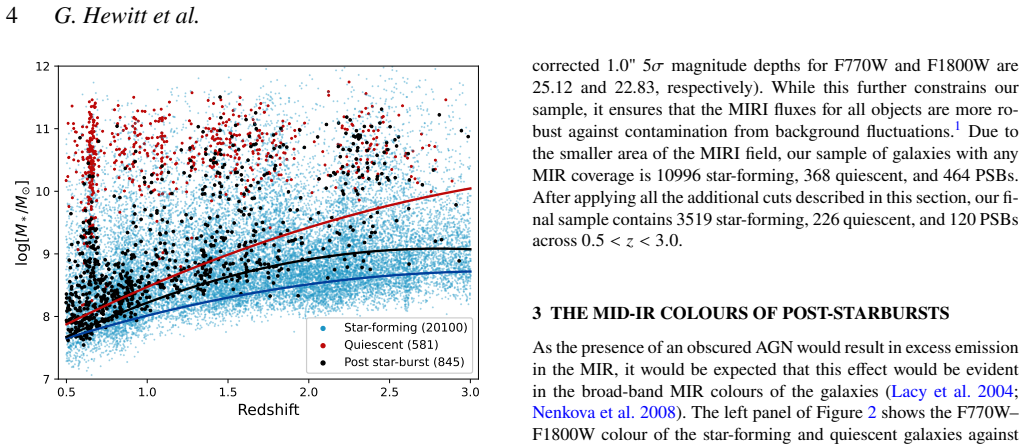
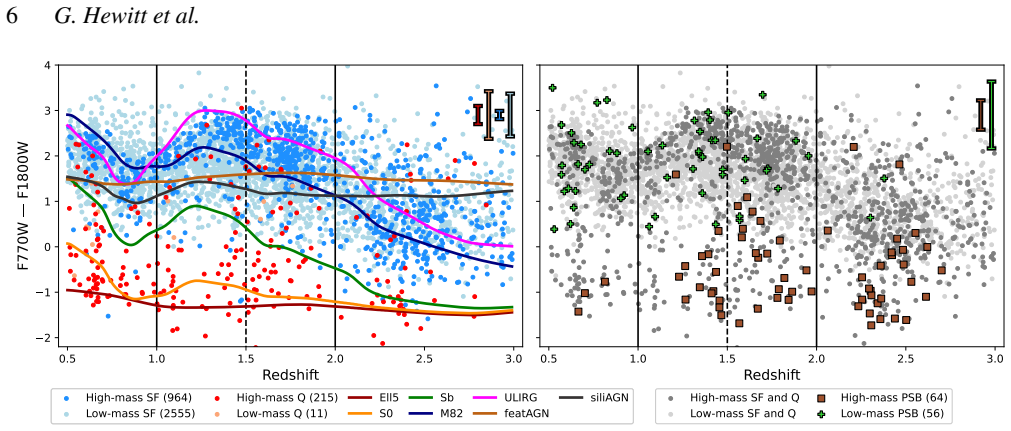
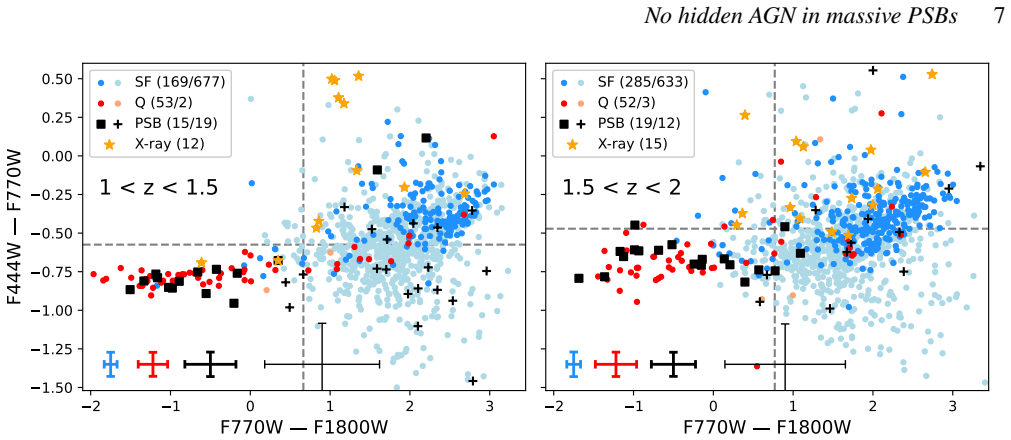
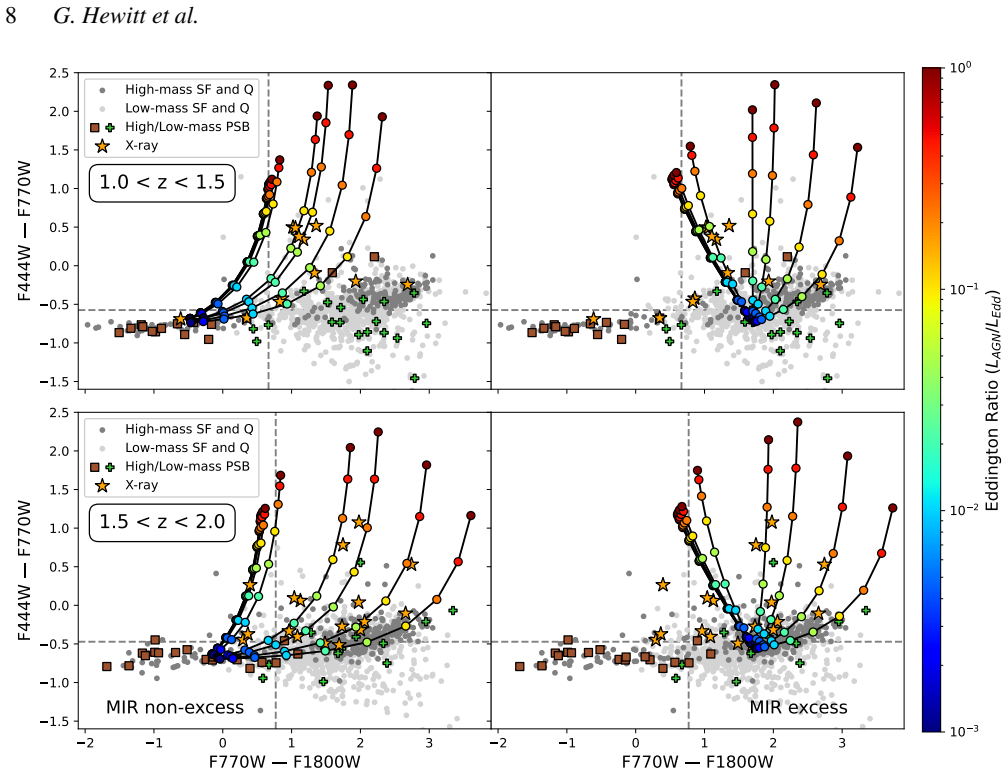
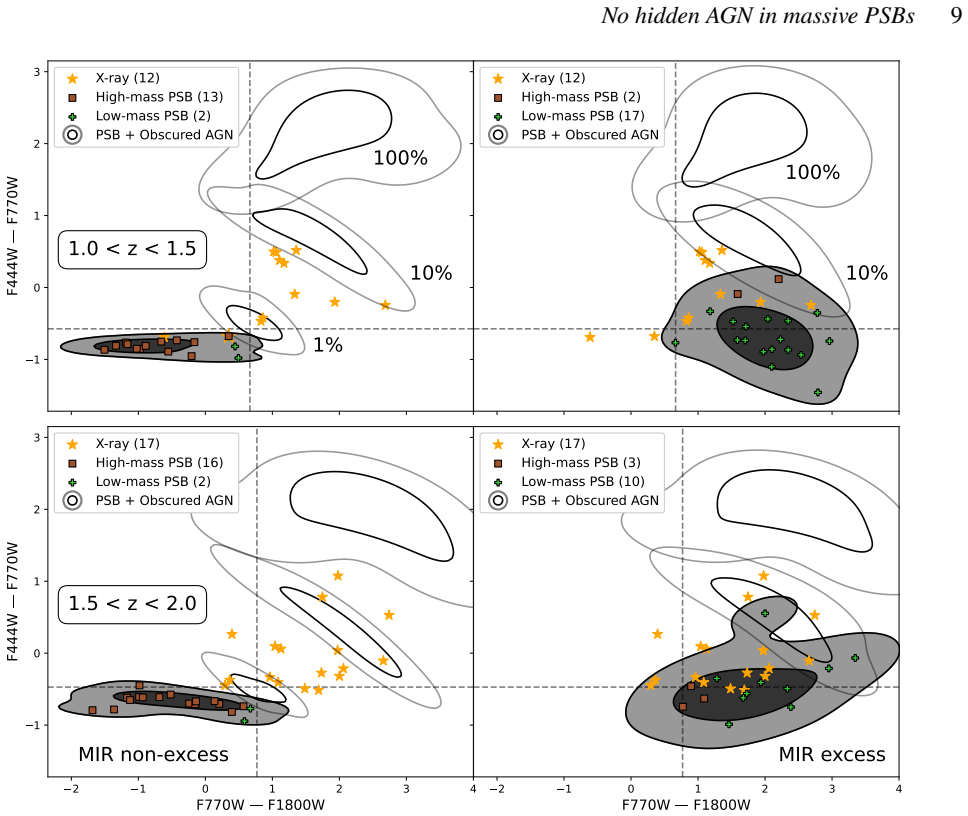
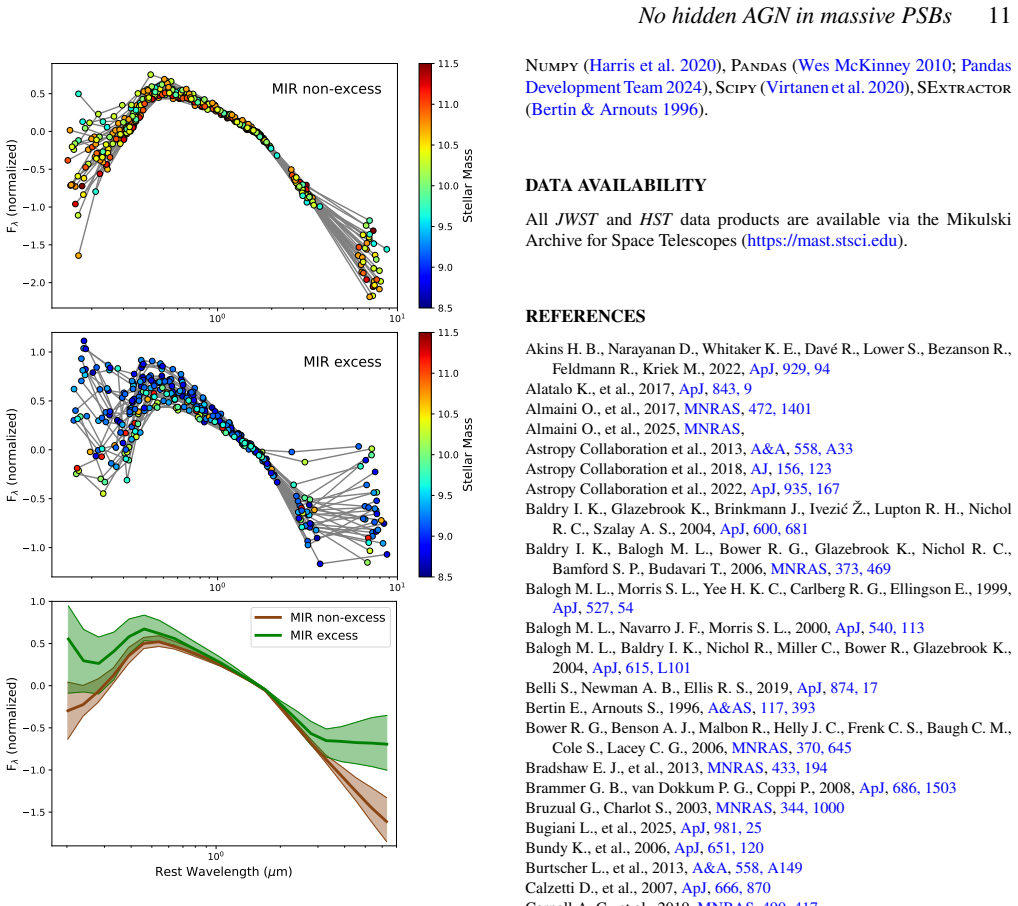
Combining JWST MIRI 7.7 and 18 micron imaging with eight NIRCam and three HST bands for 65 post-starburst galaxies at 1<z<2 reveals that most systems above 10^10 solar masses exhibit no mid-infrared excess, matching older passive galaxies and limiting any dust-enshrouded AGN to Eddington ratios below 1 percent. Low-mass post-starbursts instead show enhanced 18-micron emission consistent with residual star formation. The F770W-F1800W color alone separates passive from star-forming galaxies effectively, especially at high mass. The sample therefore supplies evidence for distinct quenching pathways and confirms that massive post-starbursts carry no detectable excess AGN activity relative to the
What carries the argument
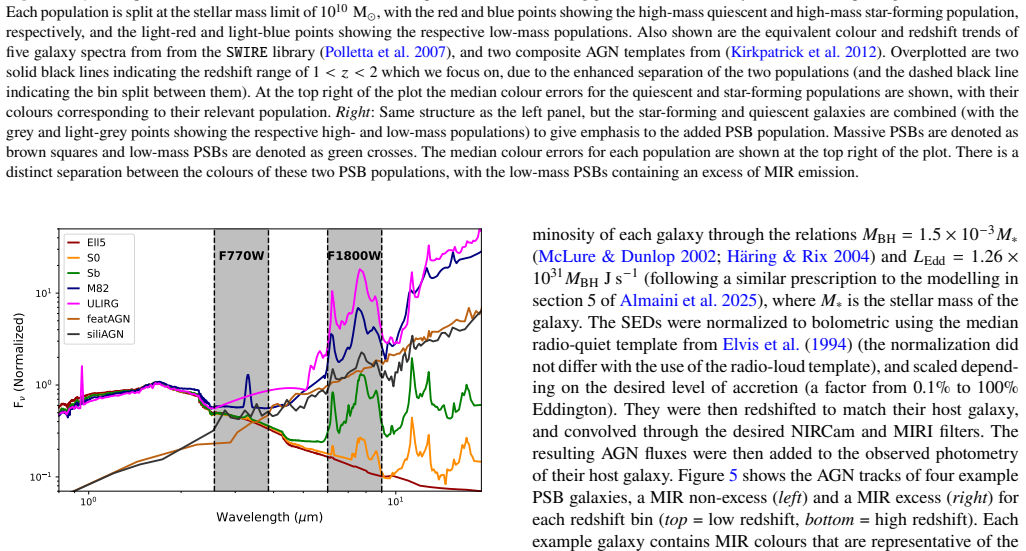
Mid-infrared excess measured in JWST MIRI F770W and F1800W bands as a tracer of hot dust emission from either obscured AGN or residual star formation.
If this is right
- High-mass post-starburst galaxies are consistent with the older passive population in their infrared properties.
- Any dust-enshrouded AGN in massive post-starbursts must operate at Eddington ratios below 1 percent.
- Low-mass post-starbursts retain residual star formation that produces the observed 18-micron enhancement.
- The F770W-F1800W color provides an effective single-band diagnostic for separating passive and star-forming galaxies at high stellar mass.
- Mass-dependent differences in infrared properties support separate quenching pathways for low-mass and high-mass post-starburst galaxies.
Where Pith is reading between the lines
- The same mid-infrared color cut could be applied to wider-field JWST or future infrared surveys to classify large numbers of galaxies without full SED fitting.
- Absence of AGN signatures at these wavelengths narrows the set of viable quenching mechanisms that must be modeled for massive galaxies.
- Extending the same MIRI photometry to a larger sample at slightly higher or lower redshift would test whether the mass-dependent pattern persists across cosmic time.
- X-ray or optical spectroscopic follow-up on the same targets could check whether low-level AGN activity exists below the mid-infrared detection threshold.
Load-bearing premise
The photometric selection plus SED fitting cleanly isolates recently quenched galaxies without substantial contamination from dusty star-forming or older passive systems.
What would settle it
Detection of mid-infrared excess above the quiescent level in a statistically significant fraction of massive post-starburst galaxies selected by the same photometric criteria would falsify the Eddington-ratio upper limit.
Figures
read the original abstract
We investigate the role of obscured active galactic nuclei (AGN) in recently quenched post-starburst galaxies (PSBs), using a sample of 65 photometrically selected PSBs in the PRIMER-UDS field at $1 < z < 2$. Combining JWST/MIRI 7.7 $\mu$m and 18 $\mu$m (F770W and F1800W) imaging with eight NIRCam and three HST/ACS bands, we probe hot dust emission to test for hidden AGN or dust-enshrouded star formation. We find strong differences between the low- and high-mass PSBs. Most high-mass PSBs ($ > 10^{10}\textrm{M}_\odot$) show no excess infrared emission (consistent with the quiescent population), indicating little or no dust-obscured activity, while low-mass PSBs display enhanced emission at 18 $\mu$m, which we attribute to residual star formation. AGN template modelling indicates that the absence of mid-IR excess in massive PSBs limits any dust-enshrouded AGN to Eddington ratios of $ < 1\%$. In addition, we show that the F770W--F1800W colour alone is a highly effective diagnostic for separating passive and star-forming galaxies, particularly at high stellar masses. Overall, our results provide further evidence for distinct quenching pathways within the PSB population, and confirm that massive PSBs show no evidence for excess AGN activity relative to older passive galaxies.
Editorial analysis
A structured set of objections, weighed in public.
Referee Report
Summary. The manuscript analyzes 65 photometrically selected post-starburst galaxies (PSBs) at 1<z<2 in the PRIMER-UDS field using JWST/MIRI 7.7μm and 18μm imaging combined with NIRCam and HST bands. It reports that high-mass PSBs (>10^10 M⊙) show no mid-IR excess (consistent with older quiescent galaxies), while low-mass PSBs exhibit enhanced 18μm emission attributed to residual star formation. AGN template modelling of the MIRI non-detections is used to limit any dust-enshrouded AGN in massive PSBs to Eddington ratios <1%. The F770W–F1800W color is presented as an effective separator of passive and star-forming systems, supporting distinct mass-dependent quenching pathways in the PSB population.
Significance. If the PSB selection is robust and the template-derived Eddington limit is well-justified, the work supplies direct mid-IR observational constraints against obscured AGN activity in massive recently-quenched systems and highlights mass-dependent differences within the PSB class. The proposed color diagnostic has potential utility beyond this sample. The JWST MIRI data provide a timely probe of hot dust that is not available from prior facilities.
major comments (2)
- [AGN template modelling paragraph] AGN template modelling paragraph (results section): The quantitative upper limit of Eddington ratios <1% for dust-enshrouded AGN in high-mass PSBs is derived from non-detections in the MIRI bands via template fitting. The manuscript must specify the AGN template library, the grid of obscuration parameters (e.g., N_H, covering factors, viewing angles), and the bolometric correction assumptions, because changes in these inputs can loosen or tighten the reported limit. This modelling step is load-bearing for the central claim of no hidden AGN.
- [Sample selection and completeness discussion] Sample selection and completeness discussion: The photometric criteria used to isolate the 65 PSBs must include quantitative tests for contamination by dusty star-forming galaxies or older passive systems, particularly to substantiate the reported differences between low- and high-mass bins. Without such validation, the mass-dependent IR properties cannot be unambiguously attributed to distinct quenching pathways.
minor comments (1)
- The abstract states 'eight NIRCam and three HST/ACS bands' but does not list the specific filters; these should be enumerated in the methods section for reproducibility.
Simulated Author's Rebuttal
We thank the referee for their thoughtful and constructive report. We agree that both major comments identify areas where the manuscript can be strengthened with additional detail and validation. We will revise accordingly to make the AGN modeling assumptions fully transparent and to add quantitative tests supporting the sample selection.
read point-by-point responses
-
Referee: [AGN template modelling paragraph] AGN template modelling paragraph (results section): The quantitative upper limit of Eddington ratios <1% for dust-enshrouded AGN in high-mass PSBs is derived from non-detections in the MIRI bands via template fitting. The manuscript must specify the AGN template library, the grid of obscuration parameters (e.g., N_H, covering factors, viewing angles), and the bolometric correction assumptions, because changes in these inputs can loosen or tighten the reported limit. This modelling step is load-bearing for the central claim of no hidden AGN.
Authors: We agree that explicit documentation of the template-fitting procedure is essential to substantiate the Eddington-ratio upper limit. In the revised manuscript we will expand the relevant results paragraph (and add a short methods subsection if space permits) to name the specific AGN template library, tabulate or describe the grid of obscuration parameters (N_H range, covering factors, viewing angles), and state the bolometric corrections adopted. This will allow readers to evaluate how the <1% limit depends on these choices. revision: yes
-
Referee: [Sample selection and completeness discussion] Sample selection and completeness discussion: The photometric criteria used to isolate the 65 PSBs must include quantitative tests for contamination by dusty star-forming galaxies or older passive systems, particularly to substantiate the reported differences between low- and high-mass bins. Without such validation, the mass-dependent IR properties cannot be unambiguously attributed to distinct quenching pathways.
Authors: We accept that quantitative contamination tests would strengthen the interpretation. In the revised manuscript we will add a dedicated paragraph (or subsection) presenting contamination estimates, for example by comparing the PSB selection criteria against control samples of dusty star-forming and older passive galaxies, and by reporting the expected contamination fractions in each mass bin. These tests will support the claim that the observed mass-dependent mid-IR properties reflect distinct quenching pathways. revision: yes
Circularity Check
No significant circularity; Eddington limit derived from external templates applied to non-detections
full rationale
The central claim applies standard AGN template modelling to the observed MIRI photometry (non-detections at 7.7 and 18 μm) to place an upper limit on Eddington ratios for massive PSBs. This step uses external templates rather than any self-derived scaling or fitted parameter from the present dataset. No equations reduce the reported <1% bound to the input photometry by construction, and the abstract and provided text contain no load-bearing self-citations or uniqueness theorems. The photometric selection of PSBs is an independent upstream step whose validity is an empirical question, not a definitional loop. Minor self-citation risk is possible in the full methods but is not load-bearing for the quoted limit.
Axiom & Free-Parameter Ledger
free parameters (1)
- Eddington ratio upper limit
axioms (1)
- domain assumption Mid-infrared emission at 7.7 and 18 microns is produced only by hot dust heated by AGN or young stars
Reference graph
Works this paper leans on
-
[1]
No evidence for excess AGN activity in recently quenched massive galaxies at cosmic noon. , keywords =. doi:10.1093/mnras/staf659 , archivePrefix =. 2504.15342 , primaryClass =
-
[2]
Color Separation of Galaxy Types in the Sloan Digital Sky Survey Imaging Data
Color Separation of Galaxy Types in the Sloan Digital Sky Survey Imaging Data. , keywords =. doi:10.1086/323301 , archivePrefix =. astro-ph/0107201 , primaryClass =
work page internal anchor Pith review Pith/arXiv arXiv doi:10.1086/323301
-
[3]
Quantifying the bimodal color-magnitude distribution of galaxies
Quantifying the Bimodal Color-Magnitude Distribution of Galaxies. , keywords =. doi:10.1086/380092 , archivePrefix =. astro-ph/0309710 , primaryClass =
work page internal anchor Pith review Pith/arXiv arXiv doi:10.1086/380092
-
[4]
The reversal of the star formation-density relation in the distant universe
The reversal of the star formation-density relation in the distant universe. , keywords =. doi:10.1051/0004-6361:20077525 , archivePrefix =. astro-ph/0703653 , primaryClass =
work page internal anchor Pith review Pith/arXiv arXiv doi:10.1051/0004-6361:20077525
-
[5]
The Dawn of the Red: star formation histories of group galaxies over the past 5 billion years. , keywords =. doi:10.1111/j.1365-2966.2010.18189.x , archivePrefix =. 1012.2388 , primaryClass =
-
[6]
The Millennium Galaxy Catalogue: morphological classification and bimodality in the colour-concentration plane. , keywords =. doi:10.1111/j.1365-2966.2006.10126.x , archivePrefix =. astro-ph/0602240 , primaryClass =
-
[7]
The zCOSMOS redshift survey: the three-dimensional classification cube and bimodality in galaxy physical properties. , keywords =. doi:10.1051/0004-6361:200810520 , archivePrefix =. 0810.2245 , primaryClass =
work page internal anchor Pith review Pith/arXiv arXiv doi:10.1051/0004-6361:200810520
-
[8]
Galaxy Stellar Mass Assembly between 0.2<z<2 from the S-COSMOS survey
Galaxy Stellar Mass Assembly Between 0.2 < z < 2 from the S-COSMOS Survey. , keywords =. doi:10.1088/0004-637X/709/2/644 , archivePrefix =. 0903.0102 , primaryClass =
work page internal anchor Pith review Pith/arXiv arXiv doi:10.1088/0004-637x/709/2/644
-
[9]
The Evolution of the Stellar Mass Functions of Star-forming and Quiescent Galaxies to z = 4 from the COSMOS/UltraVISTA Survey. , keywords =. doi:10.1088/0004-637X/777/1/18 , archivePrefix =. 1303.4409 , primaryClass =
work page internal anchor Pith review Pith/arXiv arXiv doi:10.1088/0004-637x/777/1/18
-
[10]
The evolution of the galaxy stellar-mass function over the last 12 billion years from a combination of ground-based and HST surveys. , keywords =. doi:10.1093/mnras/stab731 , archivePrefix =. 2009.03176 , primaryClass =
-
[11]
Chandra source catalogue and first results
The dependence of star formation history and internal structure on stellar mass for 10 ^ 5 low-redshift galaxies. , keywords =. doi:10.1046/j.1365-8711.2003.06292.x , archivePrefix =. astro-ph/0205070 , primaryClass =
-
[12]
The Mass Assembly History of Field Galaxies: Detection of an Evolving Mass Limit for Star-Forming Galaxies. , keywords =. doi:10.1086/507456 , archivePrefix =. astro-ph/0512465 , primaryClass =
work page internal anchor Pith review Pith/arXiv arXiv doi:10.1086/507456
-
[13]
Mass assembly in quiescent and star-forming galaxies since z=4 from UltraVISTA
Mass assembly in quiescent and star-forming galaxies since z ≃ 4 from UltraVISTA. , keywords =. doi:10.1051/0004-6361/201321100 , archivePrefix =. 1301.3157 , primaryClass =
work page internal anchor Pith review Pith/arXiv arXiv doi:10.1051/0004-6361/201321100
-
[14]
The environmental dependence of the relations between stellar mass, structure, star formation and nuclear activity in galaxies. , keywords =. doi:10.1111/j.1365-2966.2004.08117.x , archivePrefix =. astro-ph/0402030 , primaryClass =
-
[15]
The bimodal galaxy color distribution: dependence on luminosity and environment
The Bimodal Galaxy Color Distribution: Dependence on Luminosity and Environment. , keywords =. doi:10.1086/426079 , archivePrefix =. astro-ph/0406266 , primaryClass =
work page internal anchor Pith review Pith/arXiv arXiv doi:10.1086/426079
-
[16]
Galaxy bimodality versus stellar mass and environment. , keywords =. doi:10.1111/j.1365-2966.2006.11081.x , archivePrefix =. astro-ph/0607648 , primaryClass =
-
[17]
The Gemini Cluster Astrophysics Spectroscopic Survey (GCLASS): The Role of Environment and Self-regulation in Galaxy Evolution at z -0.5ex 1. , keywords =. doi:10.1088/0004-637X/746/2/188 , archivePrefix =. 1112.3655 , primaryClass =
work page internal anchor Pith review Pith/arXiv arXiv doi:10.1088/0004-637x/746/2/188
-
[18]
Quasars and galaxy formation. , keywords =. doi:10.48550/arXiv.astro-ph/9801013 , archivePrefix =. astro-ph/9801013 , primaryClass =
work page internal anchor Pith review Pith/arXiv arXiv doi:10.48550/arxiv.astro-ph/9801013
-
[19]
The many lives of active galactic nuclei: cooling flows, black holes and the luminosities and colours of galaxies. , keywords =. doi:10.1111/j.1365-2966.2005.09675.x , archivePrefix =. astro-ph/0508046 , primaryClass =
-
[20]
Observational Evidence of AGN Feedback
Observational Evidence of Active Galactic Nuclei Feedback. , keywords =. doi:10.1146/annurev-astro-081811-125521 , archivePrefix =. 1204.4114 , primaryClass =
work page internal anchor Pith review Pith/arXiv arXiv doi:10.1146/annurev-astro-081811-125521
-
[21]
The Origin of Dwarf Galaxies, Cold Dark Matter, and Biased Galaxy Formation. , keywords =. doi:10.1086/164050 , adsurl =
-
[22]
Stellar feedback in galaxies and the origin of galaxy-scale winds. , keywords =. doi:10.1111/j.1365-2966.2012.20593.x , archivePrefix =. 1110.4638 , primaryClass =
-
[23]
Galaxy Formation through Hierarchical Clustering. , keywords =. doi:10.1086/170483 , adsurl =
-
[24]
Galaxy Harassment and the Evolution of Clusters of Galaxies
Galaxy harassment and the evolution of clusters of galaxies. , keywords =. doi:10.1038/379613a0 , archivePrefix =. astro-ph/9510034 , primaryClass =
work page internal anchor Pith review Pith/arXiv arXiv doi:10.1038/379613a0
-
[25]
Morphological Transformation from Galaxy Harassment
Morphological Transformation from Galaxy Harassment. , keywords =. doi:10.1086/305264 , archivePrefix =. astro-ph/9701211 , primaryClass =
work page internal anchor Pith review Pith/arXiv arXiv doi:10.1086/305264
-
[26]
The Sensitivity of Harassment to Orbit: Mass Loss from Early-Type Dwarfs in Galaxy Clusters
The sensitivity of harassment to orbit: mass loss from early-type dwarfs in galaxy clusters. , keywords =. doi:10.1093/mnras/stv2082 , archivePrefix =. 1509.02537 , primaryClass =
work page internal anchor Pith review Pith/arXiv arXiv doi:10.1093/mnras/stv2082
-
[27]
, year = 1972, month = aug, volume =
On the Infall of Matter Into Clusters of Galaxies and Some Effects on Their Evolution. , year = 1972, month = aug, volume =. doi:10.1086/151605 , adsurl =
-
[28]
The evolution of disk galaxies and the origin of S0 galaxies. , keywords =. doi:10.1086/157917 , adsurl =
-
[29]
The Origin of Star Formation Gradients in Rich Galaxy Clusters
The Origin of Star Formation Gradients in Rich Galaxy Clusters. , keywords =. doi:10.1086/309323 , archivePrefix =. astro-ph/0004078 , primaryClass =
work page internal anchor Pith review Pith/arXiv arXiv doi:10.1086/309323
-
[30]
Strangulation as the primary mechanism for shutting down star formation in galaxies
Strangulation as the primary mechanism for shutting down star formation in galaxies. , keywords =. doi:10.1038/nature14439 , archivePrefix =. 1505.03143 , primaryClass =
work page internal anchor Pith review Pith/arXiv arXiv doi:10.1038/nature14439
-
[31]
Spectroscopy of galaxies in distant clusters. II. The population of the 3C 295 cluster. , keywords =. doi:10.1086/161093 , adsurl =
-
[32]
The star formation histories of z 1 post-starburst galaxies. , keywords =. doi:10.1093/mnras/staa674 , archivePrefix =. 2001.09154 , primaryClass =
-
[33]
Evolution Through the Post-starburst Phase: Using Post-starburst Galaxies as Laboratories for Understanding the Processes that Drive Galaxy Evolution. , keywords =. doi:10.1088/1538-3873/ac0a59 , archivePrefix =. 2106.05982 , primaryClass =
-
[34]
Differential Galaxy Evolution in Cluster and Field Galaxies at z=0.3
Differential Galaxy Evolution in Cluster and Field Galaxies at z -0.5ex 0.3. , keywords =. doi:10.1086/308056 , archivePrefix =. astro-ph/9906470 , primaryClass =
work page internal anchor Pith review Pith/arXiv arXiv doi:10.1086/308056
-
[35]
The Nature of E+A Galaxies in Intermediate Redshift Clusters
The Nature of E+A Galaxies in Intermediate-Redshift Clusters. , keywords =. doi:10.1086/379804 , archivePrefix =. astro-ph/0309460 , primaryClass =
work page internal anchor Pith review Pith/arXiv arXiv doi:10.1086/379804
-
[36]
A Large Population of Massive Compact Post-starburst Galaxies at z > 1: Implications for the Size Evolution and Quenching Mechanism of Quiescent Galaxies. , keywords =. doi:10.1088/0004-637X/745/2/179 , archivePrefix =. 1112.0313 , primaryClass =
work page internal anchor Pith review Pith/arXiv arXiv doi:10.1088/0004-637x/745/2/179
-
[37]
The Relation between Galaxy Structure and Spectral Type: Implications for the Buildup of the Quiescent Galaxy Population at 0.5 < z < 2.0. , keywords =. doi:10.3847/2041-8205/817/2/L21 , archivePrefix =. 1601.02629 , primaryClass =
work page internal anchor Pith review Pith/arXiv arXiv doi:10.3847/2041-8205/817/2/l21 2041
-
[38]
Quenching and the UVJ Diagram in the SIMBA Cosmological Simulation. , keywords =. doi:10.3847/1538-4357/ac5d3a , archivePrefix =. 2105.12748 , primaryClass =
-
[39]
A new method for classifying galaxy SEDs from multi-wavelength photometry
A new method for classifying galaxy SEDs from multiwavelength photometry. , keywords =. doi:10.1093/mnras/stu212 , archivePrefix =. 1401.7878 , primaryClass =
work page internal anchor Pith review Pith/arXiv arXiv doi:10.1093/mnras/stu212
-
[40]
The identification of post-starburst galaxies at z 1 using multiwavelength photometry: a spectroscopic verification. , keywords =. doi:10.1093/mnrasl/slw057 , archivePrefix =. 1603.08941 , primaryClass =
work page internal anchor Pith review Pith/arXiv arXiv doi:10.1093/mnrasl/slw057
-
[41]
The evolution of post-starburst galaxies from z=2 to z= 0.5
The evolution of post-starburst galaxies from z=2 to 0.5. , keywords =. doi:10.1093/mnras/stw1996 , archivePrefix =. 1608.00588 , primaryClass =
work page internal anchor Pith review Pith/arXiv arXiv doi:10.1093/mnras/stw1996
-
[42]
The structure of post-starburst galaxies at 0.5 < z < 2: evidence for two distinct quenching routes at different epochs. , keywords =. doi:10.1093/mnras/sty1794 , archivePrefix =. 1807.01325 , primaryClass =
-
[43]
The enhancement of rapidly quenched galaxies in distant clusters at 0.5<z<1.0
The enhancement of rapidly quenched galaxies in distant clusters at 0.5 < z < 1.0. , keywords =. doi:10.1093/mnras/sty312 , archivePrefix =. 1802.01593 , primaryClass =
work page internal anchor Pith review Pith/arXiv arXiv doi:10.1093/mnras/sty312
-
[44]
Massive post-starburst galaxies at z > 1 are compact proto-spheroids
Massive post-starburst galaxies at z > 1 are compact proto-spheroids. , keywords =. doi:10.1093/mnras/stx1957 , archivePrefix =. 1708.00005 , primaryClass =
work page internal anchor Pith review Pith/arXiv arXiv doi:10.1093/mnras/stx1957
-
[45]
Are Active Galactic Nuclei in Post-starburst Galaxies Driving the Change or Along for the Ride?. , keywords =. doi:10.3847/1538-4357/ac7d56 , archivePrefix =. 2207.00607 , primaryClass =
-
[46]
The Discovery of 1000 km/s Outflows in Massive Post-starburst Galaxies at z=0.6
The Discovery of 1000 km s ^ -1 Outflows in Massive Poststarburst Galaxies at z=0.6. , keywords =. doi:10.1086/520083 , archivePrefix =. 0706.0527 , primaryClass =
work page internal anchor Pith review Pith/arXiv arXiv doi:10.1086/520083
-
[47]
High-velocity outflows in massive post-starburst galaxies at z > 1. , keywords =. doi:10.1093/mnras/stz2211 , archivePrefix =. 1908.02766 , primaryClass =
-
[48]
High-velocity outflows persist up to 1 Gyr after a starburst in recently quenched galaxies at z > 1. , keywords =. doi:10.1093/mnras/stae2463 , archivePrefix =. 2411.00102 , primaryClass =
-
[49]
Spectral Energy Distributions of Hard X-ray selected AGNs in the XMDS Survey
Spectral Energy Distributions of Hard X-Ray Selected Active Galactic Nuclei in the XMM-Newton Medium Deep Survey. , keywords =. doi:10.1086/518113 , archivePrefix =. astro-ph/0703255 , primaryClass =
work page internal anchor Pith review Pith/arXiv arXiv doi:10.1086/518113
-
[50]
PRIMER: Public Release IMaging for Extragalactic Research
-
[51]
JWST PRIMER: a new multifield determination of the evolving galaxy UV luminosity function at redshifts z ≃ 9 - 15. , keywords =. doi:10.1093/mnras/stae2037 , archivePrefix =. 2403.03171 , primaryClass =
-
[52]
CANDELS: The Cosmic Assembly Near-infrared Deep Extragalactic Legacy Survey
CANDELS: The Cosmic Assembly Near-infrared Deep Extragalactic Legacy Survey. , keywords =. doi:10.1088/0067-0049/197/2/35 , archivePrefix =. 1105.3753 , primaryClass =
work page internal anchor Pith review Pith/arXiv arXiv doi:10.1088/0067-0049/197/2/35
-
[53]
zCOSMOS - 10k-bright spectroscopic sample. The bimodality in the galaxy stellar mass function: exploring its evolution with redshift. , keywords =. doi:10.1051/0004-6361/200913020 , archivePrefix =. 0907.5416 , primaryClass =
work page internal anchor Pith review Pith/arXiv arXiv doi:10.1051/0004-6361/200913020
-
[54]
1996, A&AS, 117, 393, doi: 10.1051/aas:1996164
SExtractor: Software for source extraction. , keywords =. doi:10.1051/aas:1996164 , adsurl =
-
[55]
EAZY: A Fast, Public Photometric Redshift Code. , keywords =. doi:10.1086/591786 , archivePrefix =. 0807.1533 , primaryClass =
work page internal anchor Pith review Pith/arXiv arXiv doi:10.1086/591786
-
[56]
High velocity outflows from young star-forming galaxies in the UKIDSS Ultra-Deep Survey
High-velocity outflows from young star-forming galaxies in the UKIDSS Ultra-Deep Survey. , keywords =. doi:10.1093/mnras/stt715 , archivePrefix =. 1304.7276 , primaryClass =
work page internal anchor Pith review Pith/arXiv arXiv doi:10.1093/mnras/stt715
-
[57]
The sizes, masses and specific star formation rates of massive galaxies at 1.3 < z < 1.5: strong evidence in favour of evolution via minor mergers. , keywords =. doi:10.1093/mnras/sts092 , archivePrefix =. 1205.4058 , primaryClass =
work page internal anchor Pith review Pith/arXiv arXiv doi:10.1093/mnras/sts092
-
[58]
The VANDELS ESO public spectroscopic survey
The VANDELS ESO public spectroscopic survey. , keywords =. doi:10.1093/mnras/sty1213 , archivePrefix =. 1803.07414 , primaryClass =
work page internal anchor Pith review Pith/arXiv arXiv doi:10.1093/mnras/sty1213
-
[59]
The VANDELS ESO public spectroscopic survey: observations and first data release
The VANDELS ESO public spectroscopic survey: Observations and first data release. , keywords =. doi:10.1051/0004-6361/201833047 , archivePrefix =. 1803.07373 , primaryClass =
work page internal anchor Pith review Pith/arXiv arXiv doi:10.1051/0004-6361/201833047
-
[60]
The JWST EXCELS survey: too much, too young, too fast? Ultra-massive quiescent galaxies at 3 < z < 5. , keywords =. doi:10.1093/mnras/stae2092 , archivePrefix =. 2405.02242 , primaryClass =
-
[61]
Reconstructing the Stellar Mass Distributions of Galaxies Using S ^ 4 G IRAC 3.6 and 4.5 m Images. I. Correcting for Contamination by Polycyclic Aromatic Hydrocarbons, Hot Dust, and Intermediate-age Stars. , keywords =. doi:10.1088/0004-637X/744/1/17 , archivePrefix =. 1110.2683 , primaryClass =
work page internal anchor Pith review Pith/arXiv arXiv doi:10.1088/0004-637x/744/1/17
-
[62]
Unveiling the Important Role of Groups in the Evolution of Massive Galaxies: Insights from an Infrared Passive Sequence at Intermediate Redshift. , keywords =. doi:10.1086/587478 , archivePrefix =. 0802.2549 , primaryClass =
work page internal anchor Pith review Pith/arXiv arXiv doi:10.1086/587478
-
[63]
Morphological Dependence of MIR Properties of SDSS Galaxies in the Spitzer SWIRE Survey
Morphological Dependence of Mid-Infrared Properties of SDSS Galaxies in the Spitzer SWIRE Survey. , keywords =. doi:10.1086/520807 , archivePrefix =. 0706.2712 , primaryClass =
work page internal anchor Pith review Pith/arXiv arXiv doi:10.1086/520807
-
[64]
Fitting AGN/Galaxy X-Ray-to-radio SEDs with CIGALE and Improvement of the Code. , keywords =. doi:10.3847/1538-4357/ac4971 , archivePrefix =. 2201.03718 , primaryClass =
-
[65]
Bulgarian Astronomical Journal , keywords =
SKIRTOR - database of modelled AGN dusty torus SEDs. Bulgarian Astronomical Journal , keywords =
-
[66]
The dust covering factor in active galactic nuclei
The dust covering factor in active galactic nuclei. , keywords =. doi:10.1093/mnras/stw444 , archivePrefix =. 1602.06954 , primaryClass =
work page internal anchor Pith review Pith/arXiv arXiv doi:10.1093/mnras/stw444
-
[67]
Chandra source catalogue and first results
Stellar population synthesis at the resolution of 2003. , keywords =. doi:10.1046/j.1365-8711.2003.06897.x , archivePrefix =. astro-ph/0309134 , primaryClass =
-
[68]
Galactic Stellar and Substellar Initial Mass Function
Galactic Stellar and Substellar Initial Mass Function. , keywords =. doi:10.1086/376392 , archivePrefix =. astro-ph/0304382 , primaryClass =
work page internal anchor Pith review Pith/arXiv arXiv doi:10.1086/376392
-
[69]
Confirming Near- to Mid-infrared Photometrically Identified Obscured AGNs in the JWST Era. , keywords =. doi:10.3847/1538-4357/adff79 , archivePrefix =. 2510.07303 , primaryClass =
-
[70]
GOODS-Herschel: Impact of Active Galactic Nuclei and Star Formation Activity on Infrared Spectral Energy Distributions at High Redshift. , keywords =. doi:10.1088/0004-637X/759/2/139 , archivePrefix =. 1209.4902 , primaryClass =
work page internal anchor Pith review Pith/arXiv arXiv doi:10.1088/0004-637x/759/2/139
-
[71]
The rich 6 to 9 um spectrum of interstellar PAHs
The rich 6 to 9 vec mu m spectrum of interstellar PAHs. , keywords =. doi:10.1051/0004-6361:20020773 , archivePrefix =. astro-ph/0205400 , primaryClass =
work page internal anchor Pith review Pith/arXiv arXiv doi:10.1051/0004-6361:20020773
-
[72]
, year = 2008, month = sep, volume =
Interstellar polycyclic aromatic hydrocarbon molecules. , year = 2008, month = sep, volume =. doi:10.1146/annurev.astro.46.060407.145211 , adsurl =
-
[73]
The Mid-Infrared Spectrum of Star-Forming Galaxies: Global Properties of PAH Emission
The Mid-Infrared Spectrum of Star-forming Galaxies: Global Properties of Polycyclic Aromatic Hydrocarbon Emission. , keywords =. doi:10.1086/510549 , archivePrefix =. astro-ph/0610913 , primaryClass =
work page internal anchor Pith review Pith/arXiv arXiv doi:10.1086/510549
-
[74]
The Calibration of Mid-Infrared Star Formation Rate Indicators
The Calibration of Mid-Infrared Star Formation Rate Indicators. , keywords =. doi:10.1086/520082 , archivePrefix =. 0705.3377 , primaryClass =
work page internal anchor Pith review Pith/arXiv arXiv doi:10.1086/520082
-
[75]
The obscured growth of massive black holes. , keywords =. doi:10.1046/j.1365-8711.1999.03017.x , archivePrefix =. astro-ph/9908064 , primaryClass =
-
[76]
Black holes in galaxy mergers: The formation of red elliptical galaxies
Black Holes in Galaxy Mergers: The Formation of Red Elliptical Galaxies. , keywords =. doi:10.1086/428772 , archivePrefix =. astro-ph/0409436 , primaryClass =
work page internal anchor Pith review Pith/arXiv arXiv doi:10.1086/428772
-
[77]
A Unified, Merger-driven Model of the Origin of Starbursts, Quasars, the Cosmic X-Ray Background, Supermassive Black Holes, and Galaxy Spheroids. , keywords =. doi:10.1086/499298 , archivePrefix =. astro-ph/0506398 , primaryClass =
work page internal anchor Pith review Pith/arXiv arXiv doi:10.1086/499298
-
[78]
Timing the starburst-AGN connection. , keywords =. doi:10.1111/j.1365-2966.2010.16536.x , archivePrefix =. 1002.3156 , primaryClass =
-
[79]
, keywords =
Interstellar Dust Models for Extinction and Emission. , keywords =
-
[80]
The global dust SED: Tracing the nature and evolution of dust with DustEM
The global dust SED: tracing the nature and evolution of dust with DustEM. , keywords =. doi:10.1051/0004-6361/201015292 , archivePrefix =. 1010.2769 , primaryClass =
work page internal anchor Pith review Pith/arXiv arXiv doi:10.1051/0004-6361/201015292
discussion (0)
Sign in with ORCID, Apple, or X to comment. Anyone can read and Pith papers without signing in.