Revision of the Detached Eclipsing System IR Cas from TESS Observations, Ground-Based Photometry and Spectroscopy
Pith reviewed 2026-07-03 05:15 UTC · model grok-4.3
The pith
IR Cas is a detached eclipsing binary with main-sequence components of 1.32 and 1.05 solar masses and evidence for a third body.
A machine-rendered reading of the paper's core claim, the machinery that carries it, and where it could break.
Core claim
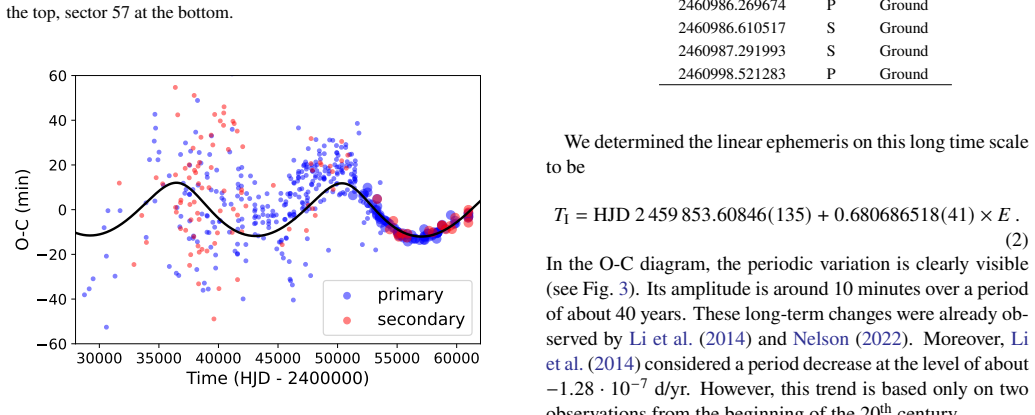
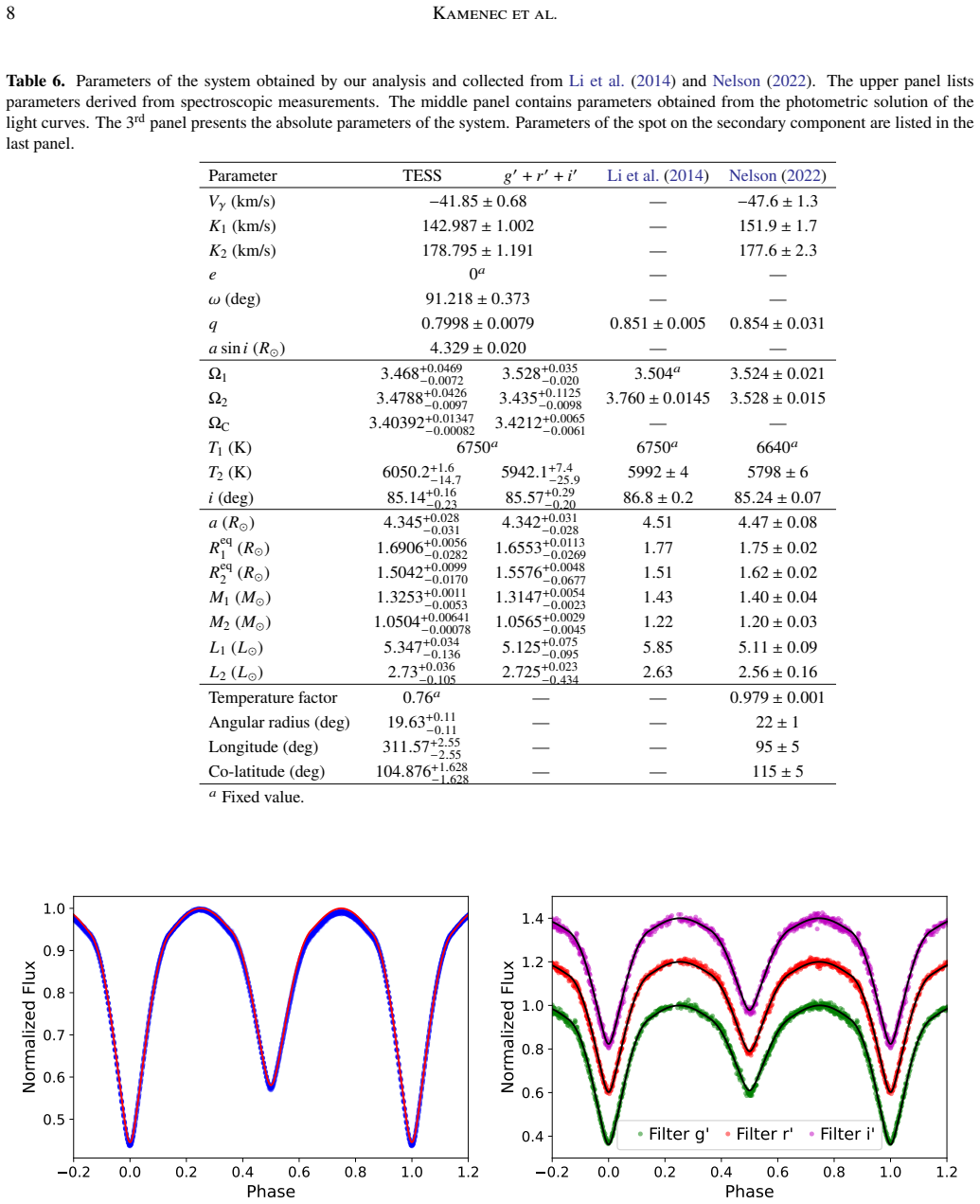
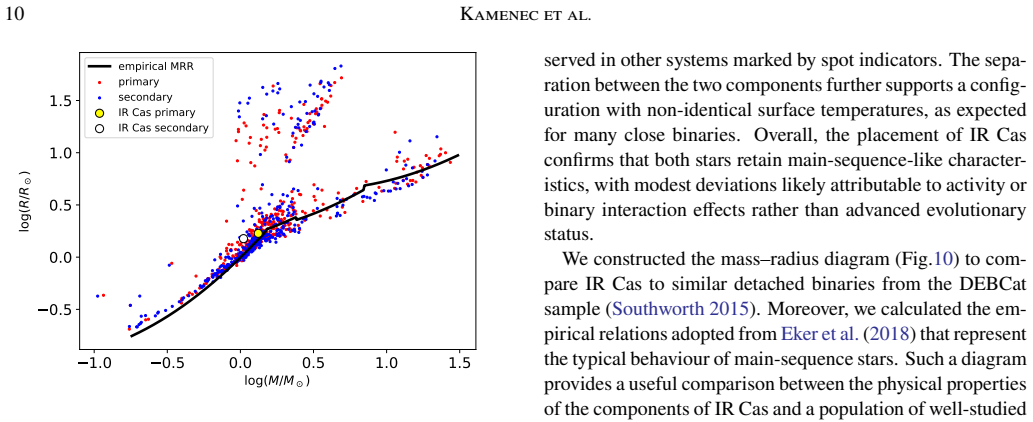
The updated solution indicates both components are main-sequence stars with masses of approximately 1.32 M⊙ and 1.05 M⊙. Long-term O-C variations can be interpreted as light-time effect due to a possible third body with orbital period of about 38 years. The positions of both components in the mass-radius diagram agree well with empirical relations for detached main-sequence binaries.
What carries the argument
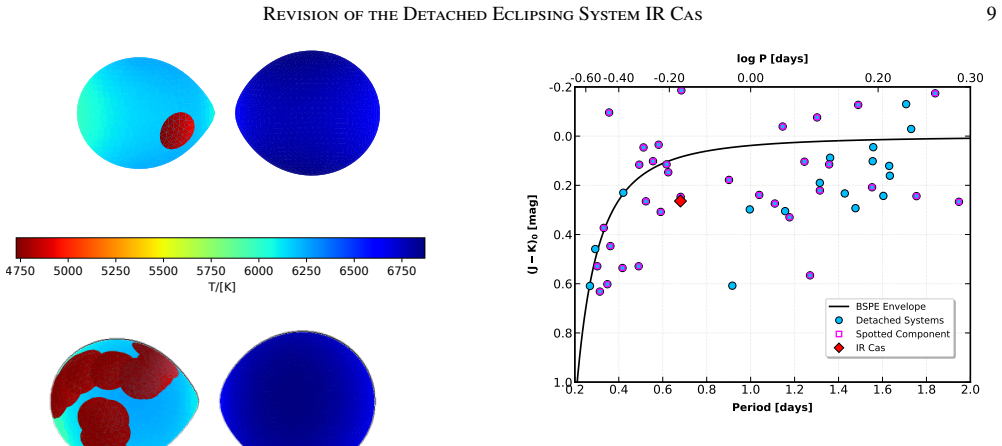
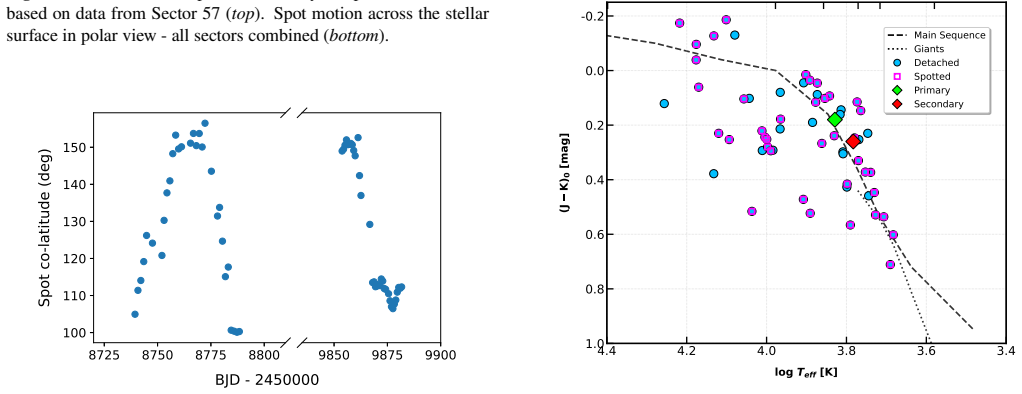
Combined photometric and spectroscopic modeling with a cool spot on the secondary to account for light curve asymmetries, plus O-C diagram analysis for periodic timing variations.
If this is right
- Both components follow standard stellar evolution for main-sequence stars.
- The secondary shows signs of activity via the cool spot.
- A third body with ~38 year period may explain the observed O-C changes.
- The system is representative of detached eclipsing binaries.
Where Pith is reading between the lines
- Confirmation of the third body would require long-term radial velocity monitoring to detect its gravitational influence.
- If the O-C is not due to a third body, alternative explanations like magnetic cycles could be tested with activity indicators.
- This analysis provides a benchmark for similar systems observed by TESS.
Load-bearing premise
The quasi-periodic O-C variations are produced by the light-time effect of a third body rather than by other mechanisms such as magnetic activity cycles or apsidal motion.
What would settle it
Detection or non-detection of the third body's radial velocity signal over multiple decades would confirm or refute the light-time effect interpretation.
Figures
read the original abstract
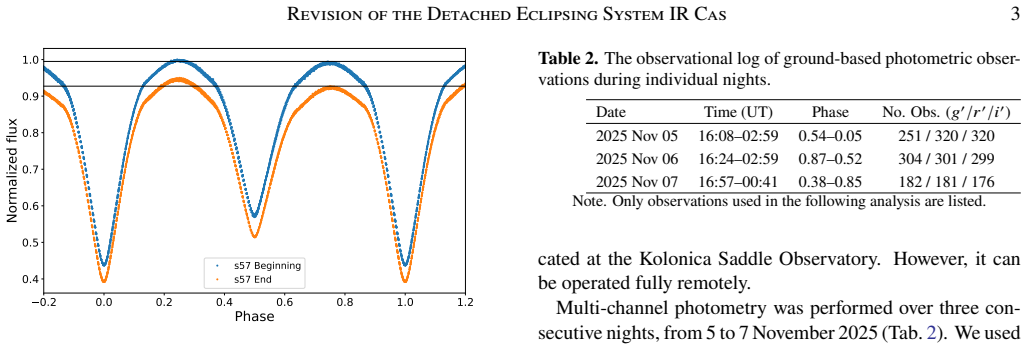
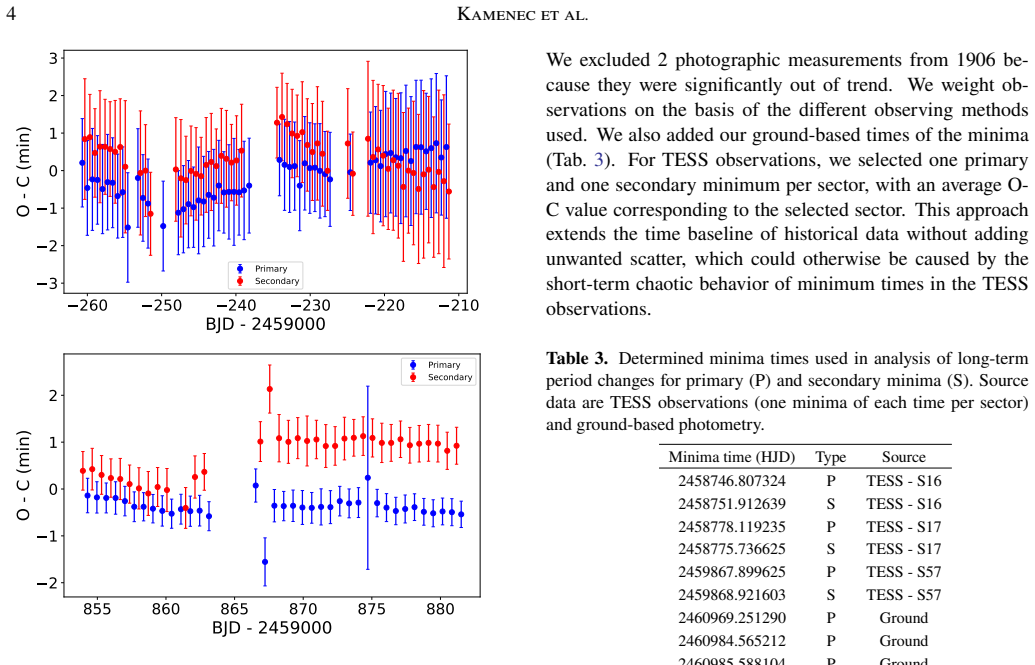
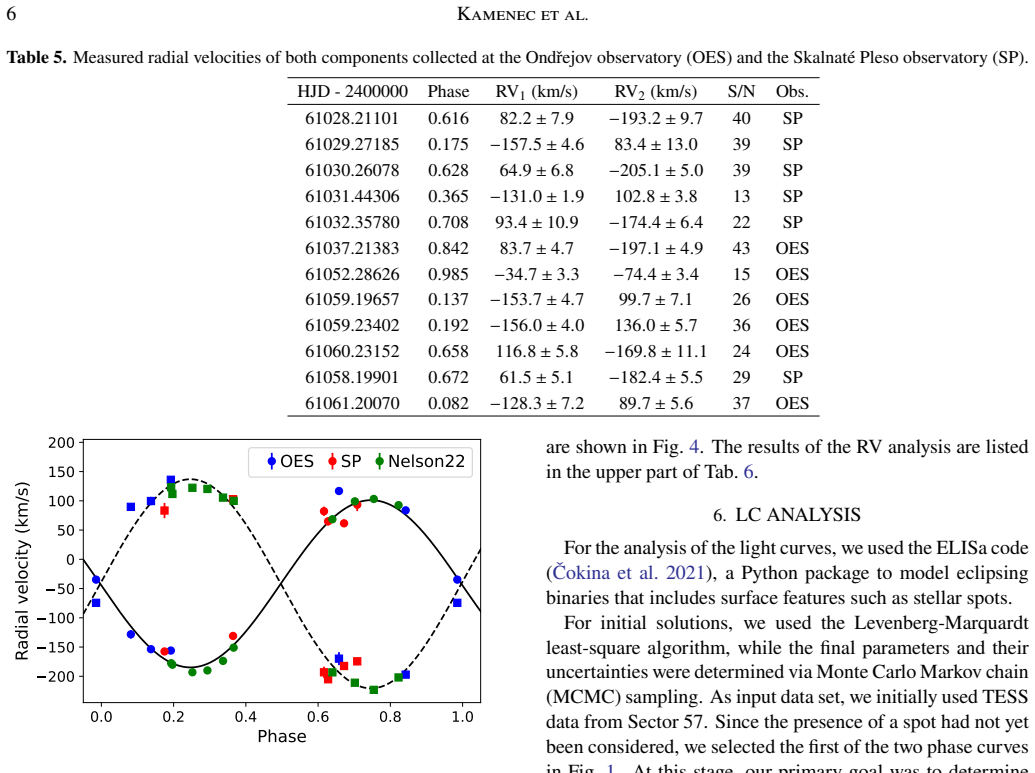
We present a new photometric and spectroscopic analysis of detached eclipsing binary IR Cas based on TESS observations, supplementary ground-based photometry in Sloan $g^\prime$, $r^\prime$, and $i^\prime$ filters, and newly obtained radial velocity measurements. The updated orbital and physical parameters of the system were derived using combined light-curve and radial-velocity modeling. The resulting solution indicates that both components are main-sequence stars with masses of approximately $1.32$ M$_{\odot}$ and $1.05$ M$_{\odot}$. We investigated in detail the fact, that the TESS light curves exhibit asymmetries near the maxima, which were reproduced by introducing a cool spot that moves on the surface of the secondary component. Long-term analysis of times of minima revealed quasi-periodic variations in the O$-$C diagram that can be interpreted as a light-time effect due to a possible third body with an orbital period of about 38 years. The positions of both components in the mass-radius diagram agree well with empirical relations for detached main-sequence binaries and do not indicate substantial deviations from standard stellar evolution. Overall, IR Cas appears to be an evolutionarily representative detached eclipsing system with moderate indications of stellar activity.
Editorial analysis
A structured set of objections, weighed in public.
Referee Report
Summary. The manuscript reports a combined photometric and spectroscopic analysis of the detached eclipsing binary IR Cas using TESS observations, supplementary ground-based Sloan g'r'i' photometry, and new radial velocity measurements. Updated orbital and physical parameters are derived via simultaneous light-curve and RV modeling, yielding main-sequence components with masses of approximately 1.32 M⊙ and 1.05 M⊙. TESS light-curve asymmetries are modeled with a cool spot on the secondary. Long-term O-C variations are interpreted as a light-time effect from a possible third body with orbital period ~38 yr. Both components' mass-radius positions are stated to agree with empirical relations for detached main-sequence binaries.
Significance. If the central parameters hold, the work supplies a refined characterization of an evolutionarily representative detached system near 1-1.3 M⊙, reinforcing empirical mass-radius relations. The combined light-curve plus radial-velocity modeling and explicit consistency check against standard stellar evolution constitute clear strengths. The third-body interpretation, if substantiated, would enlarge the sample of hierarchical triples, but currently rests on an untested preference over alternatives.
major comments (1)
- [Abstract and Long-term analysis of times of minima] Abstract and Long-term analysis of times of minima: the claim that quasi-periodic O-C variations 'can be interpreted as a light-time effect due to a possible third body with an orbital period of about 38 years' is presented without any model-comparison statistic (Δχ², BIC, AIC, or F-test) or residual/periodogram comparison against the two leading alternatives for a ~1.3+1.05 M⊙ detached system (Applegate-type magnetic cycles or apsidal motion). This interpretation is load-bearing for the abstract but lacks the quantitative justification required to prefer LITE.
minor comments (1)
- [Abstract] Abstract contains a minor grammatical issue ('the fact, that' should read 'the fact that').
Simulated Author's Rebuttal
We thank the referee for the constructive feedback. We agree that the third-body interpretation requires stronger quantitative support and will revise the manuscript to include the requested model comparisons.
read point-by-point responses
-
Referee: [Abstract and Long-term analysis of times of minima] Abstract and Long-term analysis of times of minima: the claim that quasi-periodic O-C variations 'can be interpreted as a light-time effect due to a possible third body with an orbital period of about 38 years' is presented without any model-comparison statistic (Δχ², BIC, AIC, or F-test) or residual/periodogram comparison against the two leading alternatives for a ~1.3+1.05 M⊙ detached system (Applegate-type magnetic cycles or apsidal motion). This interpretation is load-bearing for the abstract but lacks the quantitative justification required to prefer LITE.
Authors: We acknowledge that the original analysis did not include formal model-selection statistics. In the revised manuscript we will add BIC and AIC values for the LITE model versus Applegate-type magnetic-cycle and apsidal-motion alternatives, together with periodogram and residual comparisons. These additions will supply the quantitative justification needed to evaluate the preference for the light-time effect. revision: yes
Circularity Check
No circularity: parameters from standard modeling; O-C interpretation is post-hoc and not tautological
full rationale
The derivation chain consists of standard combined photometric+RV modeling to obtain masses/radii, followed by separate O-C diagram construction from observed minima times and a qualitative interpretation of quasi-periodic residuals as possible LITE. No equation or fitted quantity is shown to equal its own input by construction, no self-citation is invoked as a uniqueness theorem, and the third-body period is not presented as a first-principles prediction but as one possible reading of the O-C curve. The analysis is therefore self-contained against external benchmarks.
Axiom & Free-Parameter Ledger
free parameters (2)
- cool-spot parameters (latitude, longitude, radius, temperature contrast)
- third-body orbital period (~38 yr) and minimum mass
axioms (2)
- domain assumption The binary is detached and both components are main-sequence stars whose radii follow standard mass-radius relations for their masses.
- domain assumption O-C variations are dominated by the light-time effect of a third body rather than intrinsic period changes or apsidal motion.
Reference graph
Works this paper leans on
-
[1]
Chester, T. J., eds. 1988, Infrared Astronomical Satellite (IRAS) Catalogs and Atlases.Volume 1: Explanatory Supplement., Vol. 1
1988
-
[2]
Berdyugina, S. V . 2005, Living Reviews in Solar Physics, 2, 8, doi: 10.12942/lrsp-2005-8 REVISION OF THE DETACHED ECLIPSING SYSTEM IR CAS 11
-
[3]
2019, MNRAS, 486, 2075, doi: 10.1093/mnras/stz549
Blanco-Cuaresma, S. 2019, MNRAS, 486, 2075, doi: 10.1093/mnras/stz549
-
[4]
2014, A&A, 569, A111, doi: 10.1051/0004-6361/201423945
Blanco-Cuaresma, S., Soubiran, C., Heiter, U., & Jofré, P . 2014, A&A, 569, A111, doi: 10.1051/0004-6361/201423945
-
[5]
J., Koch, D., Basri, G., et al
Borucki, W. J., Koch, D., Basri, G., et al. 2010, Science, 327, 977, doi: 10.1126/science.1185402 Brát, L., & Zejda, M. 2010, in Astronomical Society of the Pacific Conference Series, Vol. 435, Binaries - Key to Comprehension of the Universe, ed. A. Prša & M. Zejda, 457
-
[6]
Coelho, P . R. T. 2014, MNRAS, 440, 1027, doi: 10.1093/mnras/stu365 Čokina, M., Fedurco, M., & Parimucha, Š. 2021, A&A, 652, A156, doi: 10.1051/0004-6361/202039171
-
[7]
2018, MNRAS, 479, 5491, doi: 10.1093/mnras/sty1834
Eker, Z., Bakıș, V ., Bilir, S., et al. 2018, MNRAS, 479, 5491, doi: 10.1093/mnras/sty1834
-
[8]
Publications of the Astronomical Society of the Pacific , author =
Foreman-Mackey, D., Hogg, D. W., Lang, D., & Goodman, J. 2013, PASP , 125, 306, doi: 10.1086/670067 Gaia Collaboration. 2018, A&A, 616, A1, doi: 10.1051/0004-6361/201833051 —. 2023, A&A, 674, A1, doi: 10.1051/0004-6361/202243940 Gaia Collaboration, Brown, A. G. A., Vallenari, A., & et al. 2016, Astronomy & Astrophysics, 595, A2, doi: 10.1051/0004-6361/201...
-
[9]
2017, Astronomische Nachrichten, 338, 35, doi: 10.1002/asna.201613208
Garai, Z., Pribulla, T., Hambálek, Ł., et al. 2017, Astronomische Nachrichten, 338, 35, doi: 10.1002/asna.201613208
-
[10]
2019, ApJ, 887, 93, doi: 10.3847/1538-4357/ab5362
Green, G. M., Schlafly, E., Zucker, C., Speagle, J. S., & Finkbeiner, D. 2019, ApJ, 887, 93, doi: 10.3847/1538-4357/ab5362
work page internal anchor Pith review doi:10.3847/1538-4357/ab5362 2019
-
[11]
Griffin, R. F. 1967, ApJ, 148, 465, doi: 10.1086/149168
-
[12]
Herbst, K., Papaioannou, A., Airapetian, V . S., & Atri, D. 2021, ApJ, 907, 89, doi: 10.3847/1538-4357/abcc04
-
[13]
Hilditch, R. W. 2001, An Introduction to Close Binary Stars (Cambridge University Press)
2001
-
[14]
Hoffmeister, C. 1943, Astronomische Nachrichten, 274, 36, doi: 10.1002/asna.19432740109 Høg, E., Fabricius, C., Makarov, V . V ., et al. 2000, A&A, 355, L27
-
[15]
2014, Munipack: General astronomical image processing software, Astrophysics Source Code Library, record ascl:1402.006
Hroch, F. 2014, Munipack: General astronomical image processing software, Astrophysics Source Code Library, record ascl:1402.006. http://ascl.net/1402.006
2014
-
[16]
Irwin, J. B. 1952, ApJ, 116, 218, doi: 10.1086/145605 —. 1959, AJ, 64, 149, doi: 10.1086/107913 Kabáth, P ., Skarka, M., Sabotta, S., et al. 2020, PASP , 132, 035002, doi: 10.1088/1538-3873/ab6752
-
[17]
2016, The Astronomical Journal, 151, 68, doi: 10.3847/0004-6256/151/3/68
Kirk, B., Conroy, K., Prša, A., et al. 2016, The Astronomical Journal, 151, 68, doi: 10.3847/0004-6256/151/3/68
-
[18]
Kostov, V . B., Powell, B. P ., Fornear, A. U., et al. 2025, The Astrophysical Journal Supplement Series, 279, 50, doi: 10.3847/1538-4365/ade2d8
-
[19]
2004, Publications of the Astronomical Institute of the Czechoslovak Academy of Sciences
Koubsky, P ., Mayer, P ., Čáp, J., et al. 2004, Publications of the Astronomical Institute of the Czechoslovak Academy of Sciences
2004
-
[20]
M., & Tremko, J
Kreiner, J. M., & Tremko, J. 1978, Information Bulletin on Variable Stars, 1446, 1
1978
-
[21]
2014, The Astronomical Journal, 148, 96, doi: 10.1088/0004-6256/148/5/96 Lightkurve Collaboration
Li, K., Hu, S.-M., Guo, D.-F., et al. 2014, The Astronomical Journal, 148, 96, doi: 10.1088/0004-6256/148/5/96 Lightkurve Collaboration. 2018, Lightkurve: Kepler and TESS time series analysis in Python, Astrophysics Source Code Library, record ascl:1812.013. http://ascl.net/1812.013
-
[22]
2023, A&A, 674, A16, doi: 10.1051/0004-6361/202245330
Mowlavi, N., Holl, B., Lecoeur-Taïbi, I., et al. 2023, A&A, 674, A16, doi: 10.1051/0004-6361/202245330
-
[23]
Nelson, R. H. 2022, New Astronomy, 93, 101770, doi: https://doi.org/10.1016/j.newast.2022.101770
-
[24]
Pribulla, T., Vaňko, M., Komžík, R., & Sivanič, P . 2024, Contributions of the Astronomical Observatory Skalnate Pleso, 54, 43, doi: 10.31577/caosp.2024.54.2.43
-
[25]
2015, Astronomische Nachrichten, 336, 682, doi: 10.1002/asna.201512202
Pribulla, T., Garai, Z., Hambálek, L., et al. 2015, Astronomische Nachrichten, 336, 682, doi: 10.1002/asna.201512202
-
[26]
2004, PASP , 116, 148, doi: 10.1086/381786
Pych, W. 2004, PASP , 116, 148, doi: 10.1086/381786
-
[27]
Journal of Astronomical Telescopes, Instruments, and Systems , author =
Ricker, G. R., Winn, J. N., Vanderspek, R., et al. 2015, Journal of Astronomical Telescopes, Instruments, and Systems, 1, 014003, doi: 10.1117/1.JATIS.1.1.014003
work page internal anchor Pith review doi:10.1117/1.jatis.1.1.014003 2015
-
[28]
Rucinski, S. M., & Duerbeck, H. W. 1997, Publications of the Astronomical Society of the Pacific, 109, 1340, doi: 10.1086/134014 Science Software Branch at STScI. 2012, PyRAF: Python alternative for IRAF, Astrophysics Source Code Library, record ascl:1207.011. http://ascl.net/1207.011
-
[29]
2000, AJ, 120, 1072, doi: 10.1086/301490
Sekiguchi, M., & Fukugita, M. 2000, AJ, 120, 1072, doi: 10.1086/301490
-
[30]
Simkin, S. M. 1974, A&A, 31, 129
1974
-
[31]
Skrutskie, M. F., Cutri, R. M., Stiening, R., et al. 2006, AJ, 131, 1163, doi: 10.1086/498708
-
[32]
The DEBCat detached eclipsing binary catalogue
Southworth, J. 2015, in Astronomical Society of the Pacific Conference Series, Vol. 496, Living Together: Planets, Host Stars and Binaries, ed. S. M. Rucinski, G. Torres, & M. Zejda, 164, doi: 10.48550/arXiv.1411.1219
work page internal anchor Pith review Pith/arXiv arXiv doi:10.48550/arxiv.1411.1219 2015
-
[33]
Journal of Global Optimization , keywords =
Storn, R., & Price, K. 1997, Journal of Global Optimization, 11, 341, doi: 10.1023/A:1008202821328
-
[34]
doi:10.1117/12.968154 , editor =
Tody, D. 1986, in Society of Photo-Optical Instrumentation Engineers (SPIE) Conference Series, Vol. 627, Instrumentation in astronomy VI, ed. D. L. Crawford, 733, doi: 10.1117/12.968154
-
[35]
Tokunaga, A. T. 2000, Stellar Parameters, 4th edn., ed. A. N. Cox (New Y ork: Springer-Verlag), 143
2000
-
[36]
1979, AJ, 84, 1511, doi: 10.1086/112569 12 KAMENEC ET AL
Tonry, J., & Davis, M. 1979, AJ, 84, 1511, doi: 10.1086/112569 12 KAMENEC ET AL. Vaňko, M., Kamenec, M., Gajdoš, P ., et al. 2026, AJ, submitted
-
[37]
Virtanen, P ., Gommers, R., Oliphant, T. E., et al. 2020, Nature Methods, 17, 261, doi: 10.1038/s41592-019-0686-2
-
[38]
L., Henden, A
Watson, C. L., Henden, A. A., & Price, A. 2006, Society for Astronomical Sciences Annual Symposium, 25, 47
2006
-
[39]
2000, A&AS, 143, 9, doi: 10.1051/aas:2000332
Wenger, M., Ochsenbein, F., Egret, D., et al. 2000, A&AS, 143, 9, doi: 10.1051/aas:2000332
work page internal anchor Pith review doi:10.1051/aas:2000332 2000
-
[40]
The Wide-field Infrared Survey Explorer (WISE): Mission Description and Initial On-orbit Performance
Wright, E. L., Eisenhardt, P . R. M., Mainzer, A. K., et al. 2010, AJ, 140, 1868, doi: 10.1088/0004-6256/140/6/1868
work page internal anchor Pith review doi:10.1088/0004-6256/140/6/1868 2010
-
[41]
Zverko, J., Žižňovský, J., Mikulášek, Z., & Iliev, I. K. 2007, Contributions of the Astronomical Observatory Skalnate Pleso, 37, 49
2007
discussion (0)
Sign in with ORCID, Apple, or X to comment. Anyone can read and Pith papers without signing in.