REVIEW 5 major objections 6 minor 111 references
Ramp, Plateau, and Wormholes without Averaging, and Hyper-non-perturbative Structures in Gravity
T0 review · 5 major / 6 minor · reviewed 2026-08-15 · deepseek-v4-flash
Pith's one-line read The ramp and plateau of the spectral form factor are single-system phenomena produced by a smooth filter projection, not by averaging.
desk verdict A serious program that derives the few-body ramp cleanly, but the plateau and hyper-structure claims rest on underived filter axioms; worth refereeing, with a referee who will hold the line on the product-filter gap. read the letter →
The pith
A machine-rendered reading of the paper's core claim, the machinery that carries it, and where it could break.
The reading
What carries the argument
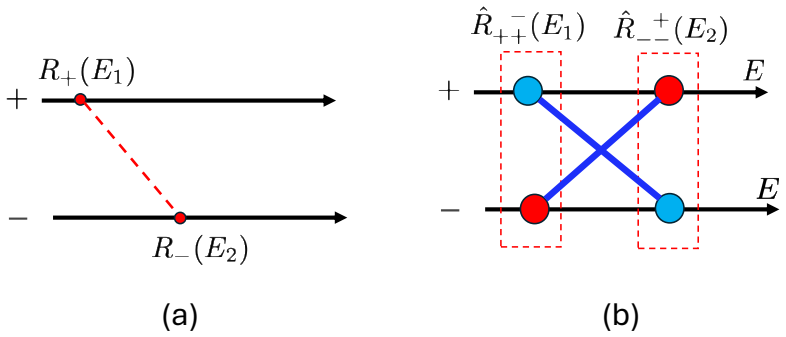
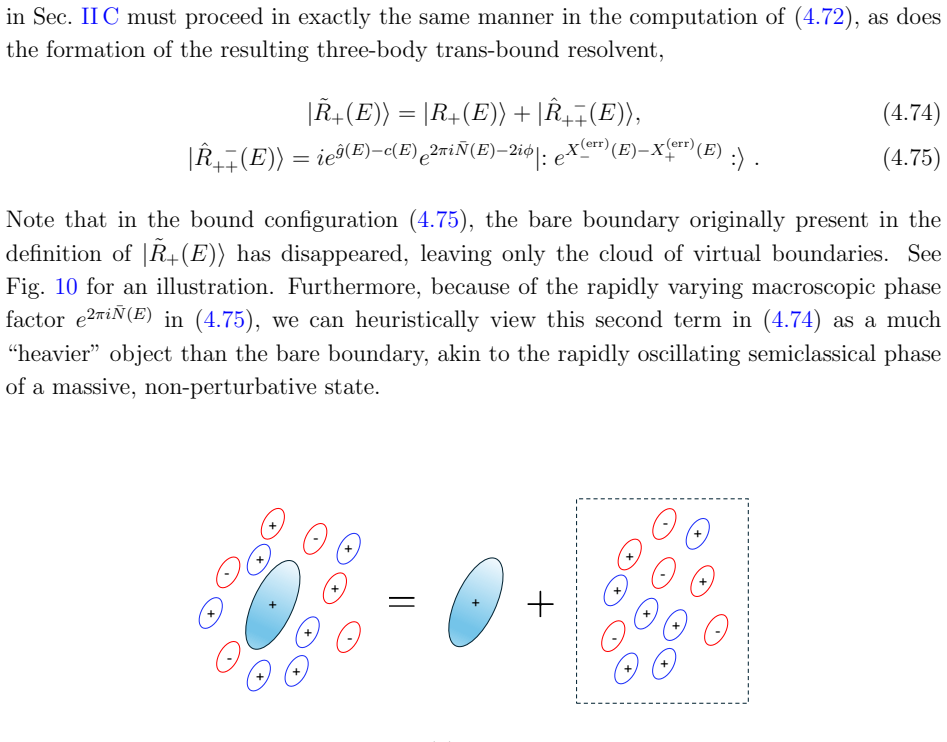
The load-bearing object is the smooth filter projection $F$, defined by $F\{A_{\rm err}\}=0$, $F^2=F$, linearity when the coefficients are smooth transseries, and positivity $F\{A^*A\}\ge 0$. It acts on the Gutzwiller decomposition $R_+(E)=\bar R(E)-(i/\hbar)\sum_a T_a F_a e^{iS_a(E)/\hbar}$, keeping only the Weyl part and killing the periodic-orbit oscillations. Four further pieces carry the argument: the diagonal approximation that pairs orbits with exactly cancelling phases; the periodic-orbit sum rule $\sum_a |F_a|^2 f(T_a)=\int dT\, f(T)/T$, which turns diagonal sums into smooth integrals; the additive determinant reconstruction $D(E)=\Delta_+(E)+\Delta_-(E)$, which opens the trans-dipole channel; and the logarithmic singularity $g_{+-}(E_1,E_2)=-\log(-i(E_1-E_2+i0))+c(E)$, which lets a resolvent contract with a trans-dipole to form the trans-bound resolvent $\hat R^-_{++}(E)=i e^{\hat g(E)-c(E)}e^{2\pi i\bar N(E)-2i\phi}:e^{Y^*-Y}:$. The plateau is the overlap of two opposite-orientation trans-bound resolvents; gravity enters because the wormhole amplitude is identified with $F\{Z_1Z_2\}_c$, and the multiverse Hilbert space exponentiates single-boundary states into baby-universe condensates.
What would settle it
Take a numerically computed chaotic spectrum, construct the periodic-orbit sums for the product of two densities at $E\pm\epsilon/2$, apply the filter by retaining only terms whose actions cancel exactly, and check whether the $\epsilon\to 0$ limit reproduces $-1/(2\pi^2\epsilon^2)$ together with the known subleading corrections; failure to find the ramp in a single system's filtered product would falsify the central claim. Independently, one can test the additive determinant identity $D(E)=\Delta_+(E)+\Delta_-(E)$ order by order in a WKB solvable model, since the plateau derivation collapses if trans-dipole contributions vanish.
Extended reading notes
Core claim
The central claim, stated on the paper's own terms, is equation (1.21): for a single chaotic quantum system, the smooth filter projection of the product of two densities of states gives the universal random-matrix two-point function, $F\{\rho(E+\epsilon/2)\rho(E-\epsilon/2)\}_c = -1/(2\pi^2\epsilon^2) + \cos(2\pi\bar\rho(E)\epsilon)/(2\pi^2\epsilon^2)$, with no ensemble and no explicit spectral average. The ramp follows because only diagonal periodic-orbit pairs with $n_1=-n_2$ and $a_1=a_2$ survive the projection, and the periodic-orbit sum rule converts the remaining sum into $-1/(2\pi^2\epsilon^2)$. The plateau follows from a second, analogous two-point function in which each resolvent is replaced by a trans-bound dressed resolvent $\hat R^-_{++}(E)$, formed when a resolvent binds to a spectral dipole through a logarithmic cross-sheet contraction; opposite orientations of two such objects produce the cosine term with the Heisenberg-time phase $e^{2\pi i\bar\rho(E)\epsilon}$. For holographic systems the paper postulates the same minimal Gutzwiller-like structure, which predicts rapid macroscopic oscillations (1.10) and possible hyper-instantons, both involving double exponentials in $1/N^2$; in the bulk these are reproduced by baby-universe condensates and multiverse instantons built from wormhole amplitudes.
Load-bearing premise
The argument assumes that one can split each observable into a smooth part and an erratic part in a well-defined way, and that the same split can be applied consistently to products of erratic parts with the cross-sheet contractions taking the specific logarithmic form (2.50); the paper concedes it has no first-principles method for doing this to products.
Editorial extensions
If this is right
- The ramp is a single-system effect: filtering the product of two erratic Gutzwiller densities gives $-1/(2\pi^2\epsilon^2)$ through diagonal orbit pairing and the sum rule, so no ensemble or energy-window average is required.
- The plateau is the same type of two-point correlation as the ramp, with each resolvent replaced by a trans-bound resolvent; its Fourier transform cuts off the linear ramp exactly at the Heisenberg time $t_H=2\pi\bar\rho(E)$.
- The spectral curve of a chaotic system is the Riemann surface of the smooth Weyl resolvent, and all erratic components and their filtered products live on that curve, making the smoothed two-point functions regulator-independent.
- For holographic systems the postulated Gutzwiller-like structure predicts universal rapid oscillations in the density of states, $\bar\rho(E)-\frac{1}{\pi}e^{\hat g(E)-c(E)}\cos(2\pi\bar N(E)-2\phi)$, which are level-2 transseries terms, i.e. double exponentials in $1/N^2$.
- Wormhole amplitudes act as connected contractions (baby-universe propagators) in the multiverse Hilbert space; their exponentiation gives baby-universe condensates whose overlaps reproduce the density oscillations and the plateau, with possible multiverse instantons adding double-exponential corrections to partition functions.
Reading between the lines
- Beyond the paper's own claims, the filter should be directly testable numerically: in a chaotic billiard or compact hyperbolic surface one can build the periodic-orbit sums, apply the diagonal projection, and check whether the single-system filtered product of densities converges to the ramp without any energy average.
- The additive determinant reconstruction $D(E)=\Delta_+(E)+\Delta_-(E)$ is checked only in a WKB limit; a sharper inference is that this identity is the real target to test, since the plateau derivation collapses if trans-dipole contributions fail in an exactly solvable model.
- A further extension suggested by the framework is to construct filters for heavy-operator OPE coefficients rather than densities alone; if wormholes filter erratic OPE data the same way, higher-point heavy correlators would inherit the same universal structure.
- In the AdS3 example the would-be multiverse-instanton action oscillates with the central charge, so an implication is that the arithmetic of $c$ may decide whether hyper-instantons contribute; modular invariance could settle that in pure AdS3.
Signed reviews
Editorial analysis
A structured set of objections, weighed in public.
Referee Report
Summary. The paper proposes that the ramp, the plateau, and their Euclidean-wormhole duals need not be interpreted as consequences of ensemble or explicit spectral averaging. Instead, it postulates a smooth filter projection F that separates each observable into a smooth macroscopic part and an erratic microscopic part, and claims that the universal random-matrix form of the spectral form factor follows from applying F to products of erratic densities of a single chaotic system. Section II carries this out for few-body systems using the Gutzwiller trace formula: the ramp is obtained from diagonal orbit pairings plus the Hannay-Ozorio de Almeida sum rule, and the plateau is obtained from correlations of dressed resolvents built from spectral determinants that are reconstructed additively from upper- and lower-half-plane data. Section III extends the formalism to the spectral curve, the forbidden region, and thermal partition functions. Section IV postulates a Gutzwiller-like structure for many-body holographic systems and constructs baby-universe condensates in a multiverse Hilbert space to derive double-exponential effects. Section V studies multiverse instantons in AdS3 gravity, including an explicit c-dependent instanton action. The paper is unusually explicit about its postulates and limitations, including the concession in Sec. II B, Remark 3, that no first-principles method for decomposing products of densities is currently available.
Significance. The few-body ramp derivation in Sec. II B is a genuine and clean result: it adapts Berry's diagonal approximation and, crucially, uses the externally established Hannay-Ozorio sum rule to convert a discrete orbit sum into the universal 1/epsilon^2 two-point singularity without any explicit energy window. This part deserves credit as a concrete demonstration of the proposed filter mechanism. The construction of dressed resolvents, the macroscopic oscillatory term, and the plateau is formally elegant, and the cancellation of the non-universal constants c(E) and g-hat(E) in Eq. (2.80) is a nice structural feature. The paper is also candid about the extent to which the many-body and gravitational sections are postulates rather than derivations. If the filter-on-products rules were derived from independent axioms, the paper would provide a significant reinterpretation of wormhole amplitudes and of the origin of RMT universality in individual chaotic systems. As it stands, the significance is conditional: the plateau and all subsequent hyper-non-perturbative claims rest on unproven prescriptions for how F acts on products of erratic quantities.
major comments (5)
- [Sec. II B, Eq. (2.22), Remark 3] The central no-averaging claim rests on the action of F on products of erratic densities, but the axioms (1.2)-(1.3) and the single-resolvent rules (2.10) do not determine F on products. Equation (2.22) fixes F{rho_err(E+epsilon/2) rho_err(E-epsilon/2)} by keeping only n1=-n2 and a1=a2, which is exactly the diagonal approximation whose standard justification is energy averaging. The paper concedes in Remark 3 that 'we currently lack a first-principles method for decomposing products or arbitrary functions of the density.' As a result, the universal ramp (2.23) is not derived from the filter axioms; it is, in effect, an imposed rule for the action of F on this particular product. This does not invalidate the calculation as a formal statement, but it does mean that the claim that the ramp is obtained 'without averaging' is not yet established.
- [Sec. II C, Eq. (2.43)] Equation (2.43) reconstructs the real spectral determinant as D(E) = Delta_+(E) + Delta_-(E). This additive prescription is load-bearing: it opens the trans-dipole channel that generates both the oscillatory term (2.66) and the plateau (2.82). The paper supports (2.43) only by a 'WKB plausibility check' and an analogy to the Berry-Keating construction. No derivation is given for generic chaotic systems. Since all later claims in Sections II-IV depend on the existence of trans-dipoles, (2.43) should either be proven in a controlled setting (for example, from the Selberg trace formula for hyperbolic surfaces, or in explicit WKB models) or be stated as an additional postulate whose consequences are then conditional. As written, the derivation of the plateau is not complete.
- [Sec. II C, Eq. (2.55); Sec. II D, Eqs. (2.75)-(2.80)] The re-exponentiation rule F{e^A} = e^{F{A} + (1/2) F{A^2}_c} assumes that all higher connected filtered correlations of Y are negligible. This truncation is not justified, and it is not a consequence of the two-point rules (2.48)-(2.54). The plateau calculation relies on the exact cancellation of c(E) and g-hat(E) in Eq. (2.80), and that cancellation would generically be modified if higher cumulants contributed. The paper should state this cumulant-truncation assumption explicitly and provide an estimate of the corrections. Without such control, Eq. (2.82) should be viewed as the leading term of a conjectured projection scheme rather than as a derivation of the plateau.
- [Sec. I B, discussion after Eq. (1.21)] The text states that working with periodic orbits 'inherently implies that a level of coarse-graining over the exact quantum spectrum has already taken place.' If the Gutzwiller representation already coarse-grains the exact spectrum, the distinction between the smooth filter and standard spectral averaging becomes less sharp than the paper claims. The manuscript should specify precisely what type of averaging or coarse-graining is built into the semiclassical representation, and how the filter projection F differs from an energy-window average in a controlled way. This is not merely a terminological point: the claim to derive the ramp and plateau 'without averaging' depends on where this coarse-graining is allowed to enter.
- [Sec. IV A, postulates (4.1)-(4.24)] The many-body and holographic extension is explicitly postulated, and the paper correctly notes that a Gutzwiller trace formula for the genuine many-body regime does not yet exist. Consequently, all double-exponential predictions, including the rapid macroscopic oscillations (4.29), the plateau (4.30), and the hyper-instantons (4.34)-(4.35), are conditional on the assumed existence of the structure in (4.1)-(4.24). This is acceptable if the paper is read as a programmatic proposal, but the abstract and conclusions should carry this qualification into their predictive claims. In particular, the phrase 'predicts universal rapid macroscopic oscillations' should be revised to 'predicts, under the postulated Gutzwiller-like structure, ...' so that the conditional status is not hidden.
minor comments (6)
- [Sec. I B] The phrase 'linear-tramp' appears in the paragraph after Eq. (1.19); it should be 'linear ramp'.
- [Sec. II C, after Eq. (2.61)] The phrase 'we have used the dentity' should read 'we have used the identity'.
- [Sec. II D, Eqs. (2.82)-(2.88)] The divergent delta-function term in (2.83) is regulated in Remark 2 by setting eta = 1/t_H, but the Fourier transforms in (2.86)-(2.88) use an infinitesimal eta and then take eta to zero. The relationship between these two regularization procedures should be spelled out, since the claim that the 1/eta divergences cancel depends on the order of limits.
- [Sec. II C, Eq. (2.55)] The notation F{A^2}_c is not defined precisely. If it denotes the connected part of the filtered two-point function, the definition should be given explicitly so that the re-exponentiation formula can be checked.
- [Sec. IV C 2, Eqs. (4.64)-(4.67)] The parity of the logarithmic branch in Eq. (4.67) is physically important for the pole structure of the plateau. A brief derivation of the branch choices used to obtain g_+- and g_++ from the double-trump amplitude would help the reader verify the i0 prescriptions in (2.50) and (4.13).
- [Sec. V C, Eq. (5.48)] The sign oscillation of the would-be instanton action with c is an interesting and honest result, but the paper should make clearer in the main text that this provides a sharp falsifiable condition: if the proposed multiverse-instanton interpretation is correct, only values of c for which I_MI > 0 should exhibit the associated non-perturbative corrections.
Circularity Check
The ramp projection rule, the additive determinant, the re-exponentiation rule, and the exponentiating definition of the baby-universe condensates make several central predictions definitional; only the Hannay–Ozorio sum rule provides independent content.
-
self definitional
[Sec. II B, Remark 3; ramp formula Eqs. (2.22)-(2.23)]
"While the Gutzwiller representation provides this decomposition for the density of states, we currently lack a first-principles method for decomposing products or arbitrary functions of the density. In (2.22), we only retained strictly diagonal terms where the rapidly oscillating phases perfectly cancel; this should be understood as the minimal contribution that any proper projection must include."
The axioms (1.2) and (2.10) fix F only on linear combinations and on single resolvents; they do not determine F on the product of two erratic densities. Keeping only n1=-n2 and a1=a2 is exactly the diagonal approximation whose traditional justification is energy averaging. Since the paper concedes there is no first-principles product rule, the universal 1/(2 pi^2 epsilon^2) ramp is not derived from the filter axioms; it is the definition of how F acts on products. The Hannay-Ozorio sum rule fixes the coefficient only after this projection has been imposed.
-
other
[Sec. II C, Eq. (2.43); used in Sec. II D]
"Instead, we formally reconstruct det(E-H) on the real axis by summing its limiting boundary values from both half-planes: D(E)=Delta_+(E)+Delta_-(E). This additive prescription is natural, as it combines the convergent semiclassical data from the upper and lower half-planes to yield a manifestly real expression-a structure familiar from the Stokes phenomenon."
The paper's own remark after (2.66) says that the survival of the new oscillatory term and hence the plateau hinges fundamentally on the additive prescription (2.43), which opens the trans-dipole channel. But (2.43) is introduced as a formal reconstruction, checked only in WKB solvable models, not derived from the filter axioms or from the Gutzwiller trace formula. The advertised derivation of the rapid macroscopic oscillations and the plateau therefore reduces to this asserted additive input.
2 more flagged steps
-
other
[Sec. II C, Eq. (2.55); Sec. II D, Eqs. (2.77)-(2.82)]
"The filtered expressions for the exponentials in (2.46)-(2.47) are obtained by expanding the terms involving Y, applying the diagonal projection term by term, and re-exponentiating the result. Since (2.48) and (2.51)-(2.52) involve only two-point correlations, we thus find for any expression A consisting of a linear sum of these quantities, F{e^A}=e^{F{A}+1/2 F{A^2}_c}."
This re-exponentiation rule assumes that all connected F-correlations beyond two points vanish, with no derivation or bound supplied. Since F on products of erratic Y's is exactly the missing ingredient admitted in Remark 3, the plateau phase factor e^{2 pi i rho(E) epsilon} in (2.80) is obtained by an additional conjecture about exponentiated products, not by the filter axioms. The plateau is therefore partly definitional rather than a consequence of the stated framework.
-
self definitional
[Sec. IV B, Eqs. (4.45)-(4.46); Sec. IV D]
"Because these states are defined via the exponentiation of the single-universe operator X(z)-which itself scales as e^{O(1/G_N)}-their normalization factors naturally generate terms scaling as double exponentials in G_N. This exponentiation is the gravitational engine driving all hyper-non-perturbative phenomena."
The claimed prediction of double-exponential effects in 1/N^2 or G_N is inserted at the level of definition: |Delta(z)> and |Delta^{-1}(z)> are exponentials of X(z), and X_sm(z) scales as e^{O(N)}. Any overlaps of these states, including the rapid macroscopic oscillations and the plateau, simply unpack this exponential normalization. No independent bulk dynamics producing e^{e^{O(N)}} is derived; the exponentiation is the mechanism by construction.
full rationale
The paper is not wholly circular: the ramp coefficient is anchored by the independent Hannay-Ozorio sum rule, and the many-body Gutzwiller-like structure is explicitly labeled a postulate. However, the central derivation of (1.21) and of the plateau does not follow from the filter axioms (1.2) and (2.10); it is obtained by defining F on products through diagonal phase cancellation, with Remark 3 conceding that no first-principles product decomposition exists. The plateau then rests on the asserted additive determinant (2.43) and the re-exponentiation rule (2.55), both of which are assumptions about products of erratic Y's. On the gravity side, the double-exponential hyper-structures are built into the definitions (4.45)-(4.46) by exponentiating X(z) ~ e^{O(N)}. The bulk calculations import the same F and g inputs rather than providing an independent mechanism, and the framework itself is inherited from the author's earlier proposal [1] as a stated postulate rather than as a derived result. I therefore assign a partial circularity score: several advertised predictions reduce by construction, while the sum rule and the explicit Gutzwiller setup supply independent content that prevents the paper from being fully equivalent to its inputs.
Assumptions & free parameters
free parameters (4)
- phase constant phi = Im a =
unspecified (integration constant)
- non-universal constant c(E), including c0 = -gamma - log(T0/hbar) =
system-dependent, unspecified
- Stokes constant b =
unknown, assumed nonzero for hyper-instantons
- filtered correlation functions g++, hat g, tilde g, tilde g2, tilde c =
unspecified
assumptions (7)
- ad hoc to paper A smooth filter F exists on Tier-II observables with F^2 = F, linearity, and positivity F{A*A} >= 0, and the gravitational path integral computes F through the holographic dictionary (1.4).
- domain assumption The Gutzwiller trace formula (2.3) is valid and convergent in the semiclassical limit for chaotic systems.
- standard math The Hannay-Ozorio de Almeida sum rule (2.15) holds for the stability amplitudes.
- ad hoc to paper The spectral determinant is reconstructed additively as D(E) = Delta_+(E) + Delta_-(E) in (2.43).
- ad hoc to paper A minimal Gutzwiller-like structure exists for holographic large-N many-body systems, with rho_bar(E) ~ e^{O(N)}, g_s s' ~ O(N^0), and the dressed-resolvent structure of Sec IV A.
- ad hoc to paper Wormhole amplitudes define a positive GNS inner product and a multiverse Hilbert space, giving states (4.45)-(4.48).
- ad hoc to paper The filter acts on products by keeping only diagonal phase-cancelling terms, with F{Y1 Y2}=0, g++ regular, and g+- logarithmic as in (2.48)-(2.54).
invented entities (5)
-
Trans-bound resolvent
-
Baby-universe condensates |Delta(z)> and anti-condensates |Delta^{-1}(z)>
-
Multiverse instantons |I(E_s)>
-
Boundary hyper-instantons
-
Hyper-structures as a general class
Cite this review
Pith. "Pith review of Ramp, Plateau, and Wormholes without Averaging, and Hyper-non-perturbative Structures in Gravity." pith.science (2026). https://pith.science/paper/KJFWUWRN
@misc{pith2026260802743,
  author       = {Pith},
  title        = {Pith review of: Ramp, Plateau, and Wormholes without Averaging, and Hyper-non-perturbative Structures in Gravity},
  year         = {2026},
  howpublished = {\url{https://pith.science/paper/KJFWUWRN}},
  note         = {Machine review of arXiv:2608.02743}
}
abstract
Universal hallmarks of quantum chaos---such as the ramp and plateau in the spectral form factor---and the ramp's gravitational duals involving wormholes are widely interpreted as consequences of spectral or ensemble averaging. In this paper, following an earlier proposal of~\cite{Liu25c}, we develop an alternative approach: these phenomena arise as macroscopic smooth structures hidden within erratic microscopic data, which can be isolated through a smooth filter projection. Using the semiclassical Gutzwiller trace formula as a paradigmatic example, we illustrate how many features characteristic of random matrix models---including the ramp, the plateau, the spectral curve, and single-eigenvalue instantons---can be derived in the semiclassical limit without invoking ensemble or explicit spectral averages. We postulate the existence of a minimal Gutzwiller-like structure in the large-$N$ limit of holographic systems and explore its consequences. Beyond deriving the ramp and the plateau, this Gutzwiller-like structure predicts universal rapid macroscopic oscillations in the density of states and the possible existence of hyper-instantons, both of which involve double exponentials in $1/N^2$. On the gravity side, we demonstrate how spacetime wormholes enable the construction of emergent hyper-non-perturbative objects---such as baby-universe and wormhole condensates---which yield double exponential effects in $G_N$. This mirrors the postulated boundary Gutzwiller-like structure and provides a dual gravitational derivation of the universal rapid macroscopic oscillations in the density of states and the spectral plateau.
Figures


Figures from the paper (8 more)



Reference graph
Works this paper leans on
-
[1]
baby-universe propagator,
Macroscopic density of states and the spectral curve The inverse Laplace transform of equation (4.37) identifies the macroscopic density of states ¯ρ(E) with the exponential of the microcanonical black hole entropy, i.e., S(E)≡log ¯ρ(E) =S 0(E) +S 1(E) +S 2(E) +···,(4.49) whereS n has the scaling formS n(E) =N 1−nsn(ϵ) withϵ= (E−E gs)/N. Here,E gs is the ...
-
[2]
The expressions (4.10)–(4.13) can be extended to the full spectral curve Σ¯ρ
There exists a smooth filter projectionF, which forE >E 0 acts as32 F{¯ρ}= ¯ρ,F{U}=F{Y}= 0,F{Y s(E1)Ys′(E2)}=g ss′(E1,E 2), s,s′ =±,(4.10) gss′(E1,E 2) =g s′s(E2,E 1), g ∗ ss′(E1,E 2) =g ¯s¯s′(E1,E 2),¯s=−s .(4.11) AsE 1→E 2,g ++ is regular, whileg +− has a logarithmic singularity g++(E+ϵ/2,E−ϵ/2) =g(E) +O(ϵ 2), ϵ→0,(4.12) g+−(E+ϵ/2,E−ϵ/2) =−log(−i(ϵ+i0))...
-
[3]
spectral dipole
The spectral determinant and its inverse (2.39) have a Tier-II representation in terms of the local determinants (4.7) as D(E) = ∆+(E) + ∆−(E)E >E 0 ∆(E)E <E 0 (4.17) ˜D±(E) = ∆−1 ± (E)E >E 0 ∆−1(E) +b(∆ (2)(E))−1 E <E0 .(4.18) where ∆(2)(E) denotes the expression of ∆(E) on the second sheet. We expect equa- tion (4.17) to be universal, wherea...
-
[4]
dressed” resolvent is defined by attaching a resolvent to a spectral dipole and then 53 taking the “size
A “dressed” resolvent is defined by attaching a resolvent to a spectral dipole and then 53 taking the “size”ϵof the dipole to zero, e.g., ˜R+(E)≡lim ϵ→0 R+(E+ϵ)D(E) ˜D+(E+ϵ), E >E 0 .(4.20) The cis-dipole has a trivial limit, while due to the singular contraction between the resolvent and the trans-dipole (as a result of (4.12)–(4.13)), they form a nontri...
-
[5]
propagator
Baby universe propagator From the perspective of the multiverse, the connected part of the overlap (4.39) (simi- larly (4.41)) plays the role of a “propagator” between different closed universes. The corre- 37 Which is a natural expectation, as the one-loop contribution is evaluated on the same background black hole geometry. 62 (a) (b) A condensate of wo...
-
[6]
resolved
Rapid macroscopic oscillations The rapid macroscopic oscillations (4.29) in the density of states can be derived from gravity by considering the overlap of the dressed resolvent state (4.70) with the vacuum state|Ω⟩: ρ(sm)(E) =− 1 π Im Ω ˜R+(E) =− 1 π Im lim ϵ→0 Ω R+(E+ϵ)D(E) ˜D+(E+ϵ) .(4.72) This overlap can be evaluated using the bulk gravitational path...
-
[7]
The calcu- lation proceeds in exactly the same manner as the boundary analysis in Sec
The plateau The plateau can be derived purely from gravity by considering the correlation of dressed resolvents (4.47), D ˜R+(E1)| ˜R+(E2) E ,(4.77) which, once again, can be evaluated using (4.55) as the elementary contraction. The calcu- lation proceeds in exactly the same manner as the boundary analysis in Sec. II D. Substitut- ing the decomposition (4...
-
[8]
self-energy
Multiverse instantons We now consider the multiverse instanton (4.48). While this object is well-defined within Hmultiverse, its physical significance relies on additional boundary data. First, we require the Stokes coefficientbto be nonzero. Second, the integration contour for the partition 69 (a) (b) + - +- - + - + - + - +- FIG. 11. Gravity counterpart ...
Show all 111 references
-
[9]
G. V. Lavrelashvili, V. A. Rubakov, and P. G. Tinyakov,Disruption of quantum coherence upon a change in spatial topology in quantum gravity,JETP Letters46(1987), no. 4 167–169. [Pis’ma Zh. Eksp. Teor. Fiz. 46 (1987) 134–136]
1987
-
[10]
Liu,”Filtering” CFTs at large N: Euclidean Wormholes, Closed Universes, and Black Hole Interiors,arXiv:2512.13807
H. Liu,”Filtering” CFTs at large N: Euclidean Wormholes, Closed Universes, and Black Hole Interiors,arXiv:2512.13807. 46 Note the the Euler product formula for the Riemann zeta function,ζ(s) = Q p 1 1−p−s . 87
-
[11]
P. Saad, S. H. Shenker, and D. Stanford,A semiclassical ramp in SYK and in gravity, arXiv:1806.06840
-
[12]
P. Saad, S. H. Shenker, and D. Stanford,JT gravity as a matrix integral, arXiv:1903.11115
1903 arXiv
- [13]
-
[14]
Witten and S.-T
E. Witten and S.-T. Yau,Connectedness of the boundary in the AdS / CFT correspondence, Adv. Theor. Math. Phys.3(1999) 1635–1655, [hep-th/9910245]
1999 arXiv
-
[15]
J. M. Maldacena and L. Maoz,Wormholes in AdS,JHEP02(2004) 053, [hep-th/0401024]
2004 arXiv
-
[16]
Arkani-Hamed, J
N. Arkani-Hamed, J. Orgera, and J. Polchinski,Euclidean wormholes in string theory, JHEP12(2007) 018, [arXiv:0705.2768]
2007 arXiv
-
[17]
S. W. Hawking,Quantum coherence down the wormhole,Physics Letters B195(1987), no. 3 337–343
1987
-
[18]
G. W. Moore,Arithmetic and attractors,hep-th/9807087
-
[19]
S. R. Coleman,Black Holes as Red Herrings: Topological Fluctuations and the Loss of Quantum Coherence,Nucl. Phys. B307(1988) 867–882
1988
-
[20]
S. B. Giddings and A. Strominger,Axion induced topology change in quantum gravity AND string theory,Nucl. Phys.B306(1988) 890
1988
-
[21]
S. B. Giddings and A. Strominger,Loss of Incoherence and Determination of Coupling Constants in Quantum Gravity,Nucl. Phys. B307(1988) 854–866
1988
-
[22]
Klebanov, L
I. Klebanov, L. Susskind, and T. Banks,Wormholes and the cosmological constant,Nuclear Physics B317(1989), no. 3 665–692
1989
-
[23]
Schlenker and E
J.-M. Schlenker and E. Witten,No ensemble averaging below the black hole threshold,JHEP 07(2022) 143, [arXiv:2202.01372]
2022 arXiv
-
[24]
washed out
Similarly, we find βL =π r c 6EL , β R =π r c 6ER ,(5.36) Equations (5.35) and (5.36) are identical to (5.15), i.e., the corresponding named quantities can be identified. It then immediately follows that the regime (5.25) corresponds to a near extremal black hole withr +,r−→∞w...
-
[25]
Liu,Towards a holographic description of closed universes,arXiv:2509.14327
H. Liu,Towards a holographic description of closed universes,arXiv:2509.14327
-
[26]
Kudler-Flam and E
J. Kudler-Flam and E. Witten,Emergent mixed states for baby universes and black holes, 88 Preprint arXiv(2025) [arXiv:2510.06376]
2025
-
[27]
G. W. Moore,Attractors and arithmetic,hep-th/9807056
-
[28]
S. D. Miller and G. W. Moore,Landau-Siegel zeroes and black hole entropy, hep-th/9903267
-
[29]
Dijkgraaf, J
R. Dijkgraaf, J. M. Maldacena, G. W. Moore, and E. P. Verlinde,A Black hole Farey tail, hep-th/0005003
-
[30]
Kudler-Flam and E
J. Kudler-Flam and E. Witten,Wormholes and Averaging over N,arXiv:2605.15180
-
[31]
Perlmutter,Black Holes and Random Variables,arXiv:2607.02233
E. Perlmutter,Black Holes and Random Variables,arXiv:2607.02233
-
[32]
M. S. Klinger,How to have your wormholes and factorize, too,arXiv:2602.15120
-
[33]
Wu,Filtering out Erratic Observables: Wormholes from Gauging Nonlocal Symmetries,arXiv:2605.28748
Q.-F. Wu,Filtering out Erratic Observables: Wormholes from Gauging Nonlocal Symmetries,arXiv:2605.28748
-
[34]
M. C. Gutzwiller,Periodic orbits and classical quantization conditions,Journal of Mathematical Physics12(1971), no. 3 343–358
1971
-
[35]
Balian and C
R. Balian and C. Bloch,Distribution of eigenfrequencies for the wave equation in a finite domain. iii. eigenfrequency density oscillations,Annals of Physics69(1972), no. 1 76–160
1972
-
[36]
M. C. Gutzwiller,Chaos in Classical and Quantum Mechanics. Springer-Verlag, New York, 1990
1990
-
[37]
T. Engl, J. D. Urbina, and K. Richter,Periodic mean-field solutions and the spectra of discrete bosonic fields: Trace formula for bose-hubbard models,Physical Review E92(2015), no. 6 062907
2015
-
[38]
Richter, J
K. Richter, J. D. Urbina, and S. Tomsovic,Semiclassical roots of universality in many-body quantum chaos,Journal of Physics A: Mathematical and Theoretical55(2022), no. 45 453001
2022
-
[39]
Cotler and K
J. Cotler and K. Jensen,Gravitational Constrained Instantons,Phys. Rev. D104(2021) 081501, [arXiv:2010.02241]
2021 arXiv
-
[40]
Cotler and K
J. Cotler and K. Jensen,Wormholes and black hole microstates in AdS/CFT,JHEP09 89 (2021) 001, [arXiv:2104.00601]
2021 arXiv
-
[41]
Cotler and K
J. Cotler and K. Jensen,A precision test of averaging in AdS/CFT,JHEP11(2022) 070, [arXiv:2205.12968]
2022 arXiv
-
[42]
Altland and J
A. Altland and J. Sonner,Late time physics of holographic quantum chaos,SciPost Phys. 11(2021) 034, [arXiv:2008.02271]
2021 arXiv
-
[43]
B. Post, J. van der Heijden, and E. Verlinde,A universe field theory for JT gravity,JHEP 05(2022) 118, [arXiv:2201.08859]
2022 arXiv
-
[44]
Altland, B
A. Altland, B. Post, J. Sonner, J. van der Heijden, and E. P. Verlinde,Quantum chaos in 2D gravity,SciPost Phys.15(2023), no. 2 064, [arXiv:2204.07583]
2023 arXiv
-
[45]
Marolf and H
D. Marolf and H. Maxfield,Transcending the ensemble: baby universes, spacetime wormholes, and the order and disorder of black hole information,arXiv:2002.08950
2002 arXiv
-
[46]
McNamara and C
J. McNamara and C. Vafa,Baby Universes, Holography, and the Swampland, arXiv:2004.06738
2004 arXiv
-
[47]
Stanford,More quantum noise from wormholes,arXiv:2008.08570
D. Stanford,More quantum noise from wormholes,arXiv:2008.08570
2008 arXiv
-
[48]
A. I. Abdalla, S. Antonini, R. Bousso, L. V. Iliesiu, A. Levine, and A. Shahbazi-Moghaddam,Consistent Evaluation of the No-Boundary Proposal, arXiv:2602.02682
-
[49]
Harlow,Observers,?-parameters, and the Hartle-Hawking state,arXiv:2602.03835
D. Harlow,Observers,?-parameters, and the Hartle-Hawking state,arXiv:2602.03835
-
[50]
Fateev, A
V. Fateev, A. Zamolodchikov, and A. Zamolodchikov,Boundary Liouville field theory I. boundary state and boundary two-point function,arXiv preprint(2000) [hep-th/0001012]
2000 arXiv
-
[51]
Teschner,Remarks on Liouville theory with boundary,arXiv preprint(2000) [hep-th/0009138]
J. Teschner,Remarks on Liouville theory with boundary,arXiv preprint(2000) [hep-th/0009138]
2000 arXiv
-
[52]
Zamolodchikov and A
A. Zamolodchikov and A. Zamolodchikov,Liouville field theory on a pseudosphere,arXiv preprint(2001) [hep-th/0101152]
2001 arXiv
-
[53]
Bohigas, M
O. Bohigas, M. J. Giannoni, and C. Schmit,Characterization of chaotic quantum spectra and universality of level fluctuation laws,Physical Review Letters52(1984) 1–4
1984
-
[54]
Haake,Quantum Signatures of Chaos
F. Haake,Quantum Signatures of Chaos. Springer Series in Synergetics. Springer-Verlag 90 Berlin Heidelberg, 3rd ed., 2010
2010
-
[55]
R. E. Prange,The spectral form factor is not self-averaging,Phys. Rev. Lett.78(Mar,
-
[56]
Braun and F
P. Braun and F. Haake,Self-averaging characteristics of spectral fluctuations,Journal of Physics A: Mathematical and Theoretical48(Mar., 2015) 135101
2015
-
[57]
Altland, F
A. Altland, F. Divi, T. Micklitz, S. Pappalardi, and M. Rezaei,Statistics of the random matrix spectral form factor,Physical Review Research7(Aug., 2025)
2025
-
[58]
P. Saad, S. H. Shenker, D. Stanford, and S. Yao,Wormholes without averaging,JHEP09 (2024) 133, [arXiv:2103.16754]
2024 arXiv
-
[59]
Mukhametzhanov,Half-wormholes in SYK with one time point,SciPost Phys.12(2022), no
B. Mukhametzhanov,Half-wormholes in SYK with one time point,SciPost Phys.12(2022), no. 1 029, [arXiv:2105.08207]
2022 arXiv
-
[60]
Yang,Half-wormholes in a complex SYK model,arXiv preprint(2025) [arXiv:2503.13172]
Y. Yang,Half-wormholes in a complex SYK model,arXiv preprint(2025) [arXiv:2503.13172]
2025 arXiv
-
[61]
Blommaert, T
A. Blommaert, T. G. Mertens, and H. Verschelde,Eigenbranes in Jackiw-Teitelboim gravity, JHEP02(2021) 168, [arXiv:1911.11603]
2021 arXiv
-
[62]
Blommaert and J
A. Blommaert and J. Kruthoff,Gravity without averaging,SciPost Phys.12(2022), no. 2 073, [arXiv:2107.02178]
2022 arXiv
-
[63]
A. M. Garc´ ıa-Garc´ ıa and V. Godet,Half-wormholes in nearly AdS2 holography,SciPost Phys.12(2022), no. 4 135, [arXiv:2107.07720]
2022 arXiv
-
[64]
Haneder, J
F. Haneder, J. D. Urbina, C. Moreno, T. Weber, and K. Richter,Beyond the ensemble paradigm in low-dimensional quantum gravity: Schwarzian density, quantum chaos, and wormhole contributions,Phys. Rev. D111(2025), no. 12 126015, [arXiv:2410.02270]
2025 arXiv
-
[65]
Di Ubaldo and E
G. Di Ubaldo and E. Perlmutter,Ads 3/rmt2 duality,JHEP12(2023) 179, [arXiv:2307.03707]
2023 arXiv
-
[66]
Pelliconi, J
P. Pelliconi, J. Sonner, and H. Verlinde,Gravity as a mesoscopic system,JHEP04(2025) 097, [arXiv:2409.13808]
2025 arXiv
-
[67]
J. H. Hannay and A. M. Ozorio de Almeida,Periodic orbits and a correlation function for 91 the classical chaotic dynamics,Journal of Physics A: Mathematical and General17(1984), no. 18 3429–3440
1984
-
[68]
M. V. Berry,Semiclassical theory of spectral rigidity,Proceedings of the Royal Society of London. A. Mathematical and Physical Sciences400(08, 1985) 229–251, [https://royalsocietypublishing.org/rspa/article-pdf/400/1819/229/66001/rspa.1985.0078.pdf]
1985
-
[69]
Y. Chen, V. Ivo, and J. Maldacena,Comments on the double cone wormhole, arXiv:2310.11617
-
[70]
Sieber and K
M. Sieber and K. Richter,Correlations between periodic orbits and their rˆ ole in spectral statistics,Physica ScriptaT90(2001) 128–133
2001
-
[71]
Heusler, S
S. Heusler, S. M¨ uller, A. Altland, P. Braun, and F. Haake,Periodic-orbit theory of level correlations,Physical Review Letters98(2007), no. 4 044103
2007
-
[72]
M¨ uller, S
S. M¨ uller, S. Heusler, A. Altland, P. Braun, and F. Haake,Periodic-orbit theory of universal level correlations in quantum chaos,New Journal of Physics11(2009), no. 10 103025
2009
-
[73]
E. B. Bogomolny, B. Georgeot, M.-J. Giannoni, and C. Schmit,Arithmetic chaos,Physics Reports291(1997), no. 5–6 219–324
1997
-
[74]
H. L. Montgomery,The pair correlation of zeros of the zeta function, inAnalytic Number Theory, Proceedings of the Symposium in Pure Mathematics, vol. 24, (Providence, R.I.), pp. 181–193, American Mathematical Society, 1973
1973
-
[75]
A. M. Odlyzko,On the distribution of spacings between zeros of the zeta function, Mathematics of Computation48(1987), no. 177 273–308
1987
-
[76]
J. M. Maldacena, G. W. Moore, N. Seiberg, and D. Shih,Exact vs. semiclassical target space of the minimal string,JHEP10(2004) 020, [hep-th/0408039]
2004 arXiv
-
[77]
P. J. Forrester,Log-Gases and Random Matrices, vol. 34 ofLondon Mathematical Society Monographs. Princeton University Press, Princeton, NJ, 2010
2010
-
[78]
M. V. Berry and J. P. Keating,A rule for quantizing chaos?,Journal of Physics A: Mathematical and General23(1990), no. 21 4839–4849
1990
-
[79]
M. V. Berry and J. P. Keating,A new asymptotic representation forζ( 1 2 +it)and quantum 92 spectral determinants,Proceedings of the Royal Society of London. Series A: Mathematical and Physical Sciences437(1992), no. 1899 151–173
1992
-
[80]
J. P. Keating,Periodic orbit resummation and the quantization of chaos,Proceedings of the Royal Society of London. Series A: Mathematical and Physical Sciences436(1992), no. 1896 99–108
1992
-
[81]
J. P. Keating and S. M¨ uller,Resummation and the semiclassical theory of spectral statistics, Proceedings of the Royal Society A: Mathematical, Physical and Engineering Sciences463 (2007), no. 2088 3241–3250
2007
-
[82]
A. V. Andreev and B. L. Altshuler,Spectral statistics beyond random matrix theory, Physical Review Letters75(1995) 902–905
1995
-
[83]
Eynard and N
B. Eynard and N. Orantin,Invariants of algebraic curves and topological expansion, Communications in Number Theory and Physics1(2007), no. 2 347–452
2007
-
[84]
Eynard,Counting Surfaces: CRM Aisenstadt Chair lectures, vol
B. Eynard,Counting Surfaces: CRM Aisenstadt Chair lectures, vol. 70 ofProgress in Mathematical Physics. Birkh¨ auser, Basel, 2016
2016
-
[85]
Akemann, J
G. Akemann, J. Baik, and P. Di Francesco, eds.,The Oxford Handbook of Random Matrix Theory. Oxford University Press, Oxford, 2011
2011
-
[86]
Seiberg and D
N. Seiberg and D. Shih,Branes, rings and matrix models in minimal (super)string theory, Journal of High Energy Physics2004(2004), no. 02 021, [hep-th/0312170]
2004 arXiv
-
[87]
McGreevy, J
J. McGreevy, J. Teschner, and H. Verlinde,Classical and quantum D-branes in 2D string theory,Journal of High Energy Physics2004(2004), no. 01 039, [hep-th/0305194]
2004 arXiv
-
[88]
Cai and G
M.-l. Cai and G. J. Galloway,Boundaries of zero scalar curvature in the AdS / CFT correspondence,Adv. Theor. Math. Phys.3(1999) 1769–1783, [hep-th/0003046]
1999 arXiv
-
[89]
P. Saad, D. Stanford, Z. Yang, and S. Yao,A convergent genus expansion for the plateau, JHEP09(2024) 033, [arXiv:2210.11565]
2024 arXiv
-
[90]
Blommaert, J
A. Blommaert, J. Kruthoff, and S. Yao,An integrable road to a perturbative plateau, Journal of High Energy Physics2023(2023), no. 4 048, [arXiv:2208.13795]
2023 arXiv
-
[91]
Weber, F
T. Weber, F. Haneder, K. Richter, and J. D. Urbina,Constraining Weil–Petersson volumes 93 by universal random matrix correlations in low-dimensional quantum gravity,Journal of Physics A: Mathematical and Theoretical56(2023), no. 20 205206, [arXiv:2208.13802]
2023 arXiv
-
[92]
Maxfield,Quantum corrections to the btz black hole extremality bound from the conformal bootstrap,Journal of High Energy Physics2019(2019), no
H. Maxfield,Quantum corrections to the btz black hole extremality bound from the conformal bootstrap,Journal of High Energy Physics2019(2019), no. 12 003, [arXiv:1906.04416]
2019 arXiv
-
[93]
Teschner,Liouville theory revisited,Classical and Quantum Gravity18(2001), no
J. Teschner,Liouville theory revisited,Classical and Quantum Gravity18(2001), no. 23 R153–R222, [hep-th/0104158]
2001 arXiv
-
[94]
Ponsot and J
B. Ponsot and J. Teschner,Modular transformations of conformal blocks in Liouville theory, arXiv preprint(1999) [hep-th/9911110]
1999 arXiv
-
[95]
Ghosh, H
A. Ghosh, H. Maxfield, and G. J. Turiaci,A universal Schwarzian sector in two-dimensional conformal field theories,Journal of High Energy Physics2020(2020), no. 5 104, [arXiv:1912.07654]
2020 arXiv
-
[96]
Banados, C
M. Banados, C. Teitelboim, and J. Zanelli,The Black hole in three-dimensional space-time, Phys. Rev. Lett.69(1992) 1849–1851, [hep-th/9204099]
1992 arXiv
-
[97]
D. V. Voiculescu, K. Dykema, and A. Nica,Free Random Variables, vol. 1 ofCRM Monograph Series. American Mathematical Society, 1992
1992
-
[98]
M. R. Douglas,LargeNgauge theory – expansions and transitions,Nuclear Physics B - Proceedings Supplements41(1995), no. 1-3 66–91, [hep-th/9409098]
1995 arXiv
-
[99]
Gopakumar and D
R. Gopakumar and D. J. Gross,Mastering the master field,Nuclear Physics B451(1995), no. 1-2 379–415, [hep-th/9411021]
1995 arXiv
-
[100]
Eberhardt,Partition functions of the tensionless string,JHEP03(2021) 176, [arXiv:2008.07533]
L. Eberhardt,Partition functions of the tensionless string,JHEP03(2021) 176, [arXiv:2008.07533]
2021 arXiv
-
[101]
Eberhardt,Summing over geometries in string theory,JHEP05(2021) 233, [arXiv:2102.12355]
L. Eberhardt,Summing over geometries in string theory,JHEP05(2021) 233, [arXiv:2102.12355]
2021 arXiv
-
[102]
Chang and Y.-H
C.-M. Chang and Y.-H. Lin,Holographic covering and the fortuity of black holes, arXiv:2402.10129
-
[103]
Chandra, S
J. Chandra, S. Collier, T. Hartman, and A. Maloney,Semiclassical 3D gravity as an average of large-c CFTs,JHEP12(2022) 069, [arXiv:2203.06511]. 94
2022 arXiv
-
[104]
Chandra, T
J. Chandra, T. Hartman, and V. Meruliya,Statistics of three-dimensional black holes from Liouville line defects,JHEP11(2024) 090, [arXiv:2404.15183]
2024 arXiv
-
[105]
Chandra and B
J. Chandra and B. Post,Elastic stiffness of three-dimensional black holes and wormholes from Liouville line defects,arXiv:2607.16155
-
[106]
Belin and J
A. Belin and J. de Boer,Random Statistics of OPE Coefficients and Euclidean Wormholes, arXiv:2006.05499
2006 arXiv
-
[107]
Sasieta,Wormholes from heavy operator statistics in AdS/CFT,JHEP03(2023) 158, [arXiv:2211.11794]
M. Sasieta,Wormholes from heavy operator statistics in AdS/CFT,JHEP03(2023) 158, [arXiv:2211.11794]
2023 arXiv
-
[108]
McNamara and Z
J. McNamara and Z. Wang,Wormholes as red herrings: reflection positivity and the reconstruction of unitary quantum field theories,arXiv:2607.01322
-
[109]
M. V. Berry,Riemann’s zeta function: a model for quantum chaos?, inQuantum Chaos and Statistical Nuclear Physics(T. H. Seligman and H. Nishioka, eds.), vol. 263 ofLecture Notes in Physics, pp. 1–17. Springer, Berlin, Heidelberg, 1986
1986
-
[110]
M. V. Berry,Semiclassical formula for the number variance of the Riemann zeros, Nonlinearity1(1988), no. 3 399–414
1988
-
[111]
M. V. Berry and J. P. Keating,The Riemann zeros and eigenvalue asymptotics,SIAM Review41(1999), no. 2 236–266. 95
1999
Reviewed August 15, 2026 · model on record in the stance chip above.
Discussion (0). Continue with ORCID to comment.