REVIEW 4 major objections 6 minor 19 references
Design Insights and Comparative Evaluation of a Hardware-Based Cooperative Perception Architecture for Lane Change Prediction
T0 review · 4 major / 6 minor · reviewed 2026-08-04 · deepseek-v4-flash
Pith's one-line read This paper reports that a relayed cooperative-perception pipeline can give an ego vehicle roughly four seconds of lane-change anticipation, enough to turn a forced-braking interaction into a smooth merge on real hardware.
desk verdict A useful hardware field report with credible component benchmarks, but the headline ~4 s anticipation claim rests on a single uncontrolled before/after comparison with no logged prediction output. read the letter →
The pith
A machine-rendered reading of the paper's core claim, the machinery that carries it, and where it could break.
The reading
What carries the argument
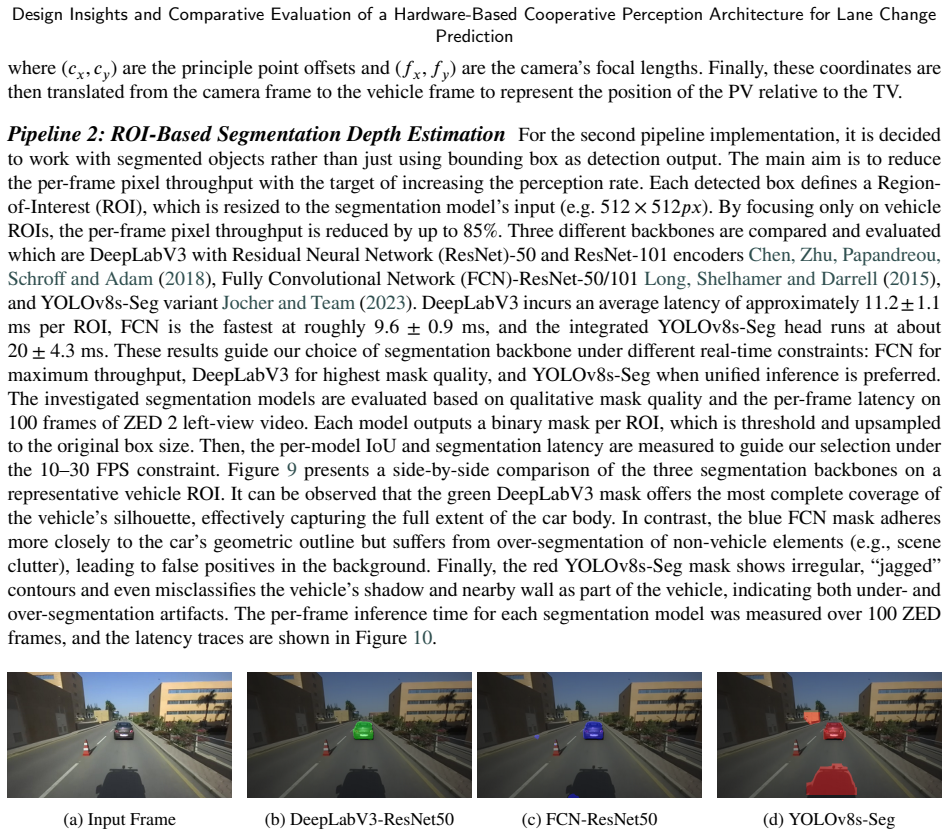
The load-bearing component is a relay-based cooperative perception pipeline. On the target vehicle, a stereo camera feeds a lightweight object detector followed by either dense stereo depth estimation or ROI-based semantic segmentation; the extracted kinematic features (time-to-collision, time-headway, lateral velocity, lane gaps) are converted by the relay into linguistic triples such as 'vehicle, TTC_WITH_PRECEDING_IS, highRisk.' Prediction is carried out by knowledge-graph embeddings, which project these semantic triples into a vector space while preserving semantic proximity, followed by Bayesian inference, which combines prior maneuver probabilities with observed evidence to produce a p
What would settle it
Log the prediction module's per-frame output during the hardware runs and align it with the target vehicle's actual lane-crossing time across several repetitions; if the predicted lane-change signal appears roughly four seconds before every scripted preceding-vehicle brake regardless of the target's actual motion, the lead time is scenario timing, not model foresight. A direct control is to disable the prediction module but make the ego vehicle decelerate at the same fixed moment each trial; if the target vehicle still merges smoothly, the cooperative prediction pipeline is not the cause.
Extended reading notes
Core claim
The paper's central demonstration is that cooperative anticipation works end-to-end on hardware: the target vehicle detects the preceding vehicle with a stereo camera, estimates distance, speed, time-to-collision, and time-headway, and transmits these features to a roadside relay; the relay converts them into linguistic categories such as high, medium, or low risk and forwards them to the ego vehicle; the ego vehicle's prediction module, using knowledge-graph embeddings and Bayesian inference over twelve such inputs, returns a maneuver posterior; and the control module translates the predicted intention into longitudinal yielding. In the integrated comparison, the paper reports that with the
Load-bearing premise
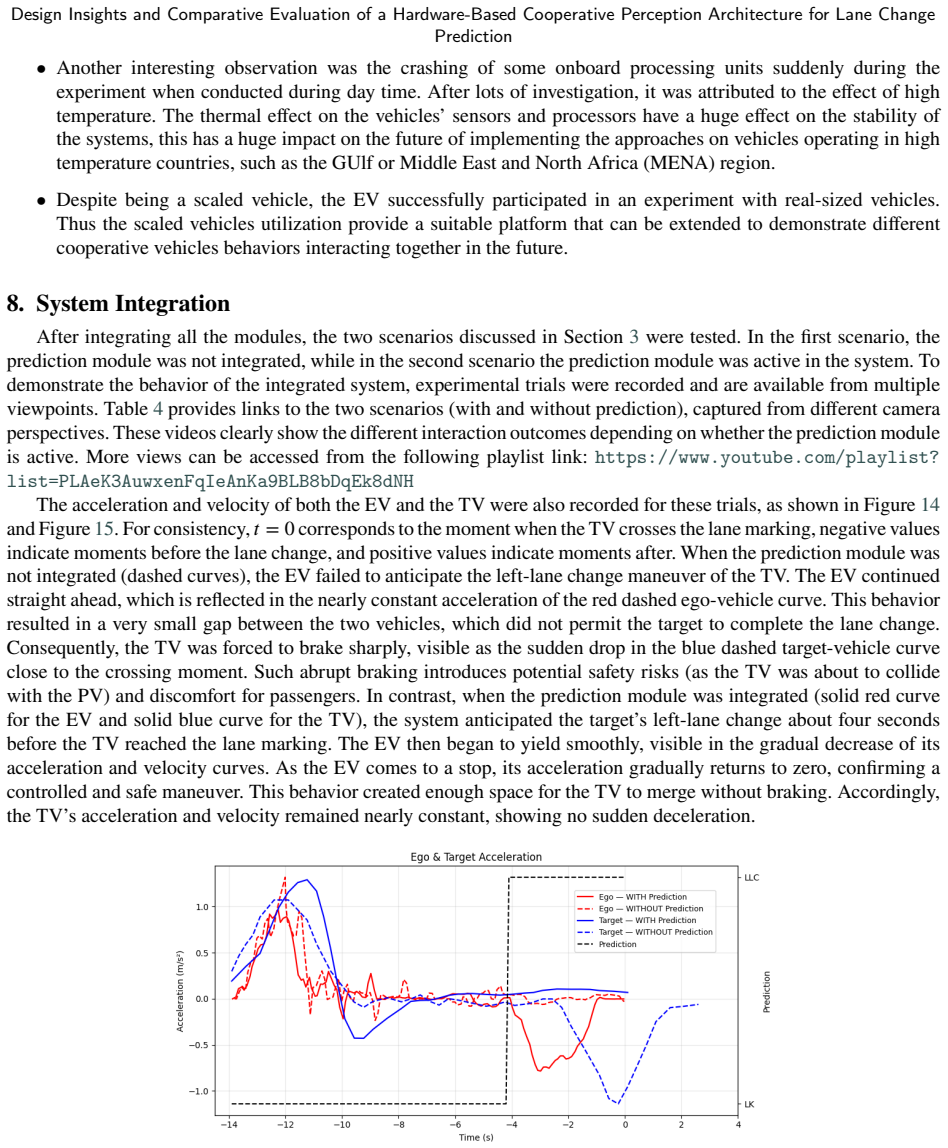
The demonstration rests on the assumption that a prediction model trained on recorded highway and simulated near-crash data also works for the small electric vehicles, stereo camera, and driving-situation categories used on the 40-meter test track; the paper reports no ground-truth check of the model's predictions during the hardware runs, so the smoother merge could in principle be caused by the fixed timing of the scenario rather than by genuine anticipation.
Editorial extensions
If this is right
- If the reported interaction is representative, a few seconds of advance awareness is enough to convert a forced-braking, no-gap situation into a smooth merge, which would justify investment in cooperative-perception pipelines for safety-critical maneuvers.
- Relay-based communication, despite adding roughly 3.5 ms per hop for a total of about 7.25 ms per iteration, becomes the preferred architecture because it decouples perception from prediction, stabilizes the wireless link, and scales to multiple vehicles without updating every prediction device.
- A precomputed lookup table makes the interpretable Bayesian and knowledge-graph predictor deployable on embedded platforms: per-query time drops from seconds to microseconds and stays constant as the number of stored combinations grows.
- Perception, not prediction, is the practical bottleneck: the lighter ROI-based segmentation pipeline sustains about 5.3 FPS online versus about 3.75 FPS for dense stereo, and both pipelines reach only 10-15 FPS offline, so hardware-aware perception design is a precondition for real-time cooperative prediction.
- The four-block pipeline of perception, communication, prediction, and planning/control is positioned as a general template for cooperative prediction tasks, not only lane changes.
Reading between the lines
- An open question not resolved in the paper is whether the four-second lead time is genuinely model foresight: the hardware runs are not accompanied by logged prediction traces or ground-truth maneuver labels, so the lead could in principle be an artifact of the fixed timing of the preceding vehicle's brake.
- Because the lookup table is compiled offline from fixed training data, the deployed system cannot adapt to new situations or shifting distributions; an online-updatable table, or a hybrid that falls back to the full Bayesian model for novel inputs, would be needed for long-term deployment.
- The scalability claim for the relay is based on a single perception vehicle and a single ego vehicle; adding a second target vehicle or a second ego vehicle to the same relay would directly test whether the modularity argument holds under real traffic load.
- At the scale of the test track, with speeds around 1.5 to 2.5 m/s, four seconds is only a few meters of travel; transferring the architecture to highway speeds would require rechecking perception range and communication latency, since the stereo camera's reliable depth is reported to end around 12 meters.
Editorial analysis
A structured set of objections, weighed in public.
Referee Report
Summary. The paper reports a hardware deployment of a cooperative perception architecture for lane-change prediction. In the studied scenario, a sensor-equipped target vehicle (TV) follows a preceding vehicle (PV) that brakes suddenly; the TV transmits perceptual data through a relay RSU to an ego vehicle (EV), which uses a pre-trained KGE-plus-Bayesian prediction model to anticipate the TV's left lane change and decelerate proactively. The paper compares perception pipelines (RAFT-Stereo vs. ROI-based segmentation), two communication architectures (direct V2V vs. relay), and prediction deployment strategies (CSV search vs. lookup table) on three computing platforms. It reports that with prediction active the EV anticipated the lane change about four seconds before the TV crossed the lane marking, enabling a smooth merge, whereas without prediction the TV had to brake sharply. The stated contribution is experience-based design insight rather than a new algorithmic architecture.
Significance. If the end-to-end claim holds, the paper would provide a rare and useful demonstration that cooperative perception, relay communication, and a precomputed lookup-table implementation of an offline-trained prediction model can yield several seconds of advance awareness on physical hardware and measurably change a traffic interaction outcome. The component-level benchmarks are a genuine strength: detection latency and confidence are reported as 100-frame means with standard deviations; communication delay is measured with an RTT procedure; and the lookup-table vs. CSV search comparison includes quantitative speed-ups and complexity reasoning. The practical lessons on thermal effects, GPS interference, Wi-Fi reliability, and scaled-vehicle control are also credible and valuable. However, the central end-to-end claim--that the KGE+Bayesian module was causally responsible for the observed smooth interaction--is not supported by the evidence currently presented, because no logged prediction output, no repetition of the integrated trials, and no validation of the model on the actual hardware runs are provided. The paper's significance is therefore conditional on additional evidence.
major comments (4)
- [§8, Figs. 14 and 15] The claim that 'the system anticipated the target's left-lane change about four seconds before the TV reached the lane marking' is not supported by any logged output of the prediction module. The paper never reports feature vectors, posterior probabilities, threshold-crossing times, or per-frame predicted labels for the integrated runs. The black dashed line labeled 'maneuver prediction' in Figs. 14 and 15 is not defined or quantified. Without this trace, the observed 4 s lead could be confounded by the fixed scenario timing (PV brakes near t = -12 s, crossing occurs near t = 0) or by a simpler trigger, such as a high-risk TTC heuristic at the relay, rather than by the offline-trained KGE+Bayesian model. Please provide the prediction module's real-time output aligned with t = 0, including the time at which the posterior for 'left lane change' first exceeded the decision threshold.
- [§8, Table 4] The integrated system comparison appears to rely on one trial per condition (with prediction and without prediction). Section 4.5 mentions two experiments, but those are perception-module experiments, not repeated end-to-end trials with the prediction module active/inactive. Since the TV and PV are human-driven, single trials cannot distinguish systematic effects from run-to-run variation. Please report repeated trials for each condition, with the number of runs, and show mean trajectories or confidence bands for EV/TV acceleration and velocity. At minimum, state explicitly how many integrated trials were performed and whether the shown curves are representative or averages.
- [§6.1, §6.4, §4.4] A load-bearing mismatch exists between the prediction model's required 12 linguistic features and the features actually computed in the hardware pipeline. Section 6.1 lists lateral velocity/acceleration, TTC with five surrounding vehicles, lane identifier, in-lane position, THW, frontal gap, and attraction score. However, the perception module in Section 4.4 estimates only the distance, velocity, TTC, and THW relative to the PV; no detection of left/right preceding or following vehicles, lane geometry, or attraction scores is described. It is therefore unclear which of the 12 inputs were populated during the integrated runs and what values (e.g., defaults or neutral categories) were used for the remaining inputs. If many inputs were defaults, the experiment may not actually exercise the trained KGE+Bayesian model. Please specify exactly how the 12-feature input vector was instantiated in
- [§6.3 vs §8] The offline F1-scores in Section 6.3 (95%/90% for safe maneuvers at 2 s/4 s horizons, etc.) are computed on highD and CRASH datasets. The paper does not report any quantitative comparison of the model's predictions against ground-truth labels on the actual 40 m track runs. Since the claim in Section 8 is about prediction on the real hardware, the transfer from the offline datasets to the golf-cart/scaled-EV scenario should be validated. Please either provide prediction-vs-ground-truth metrics for the integrated runs or explicitly state that such validation was not performed and discuss the implications for the causal attribution.
minor comments (6)
- [§2.1.1] The literature review could use clearer chronological or thematic transitions. Some citations are bundled without indicating how they support the sentence (e.g., the sentence ending with 'XGBoost model used by on HighD' appears incomplete).
- [§4.4.4] Equation (4) defines TTC = |d| / |v_rel|. If v_rel can be zero, the expression is undefined; please state the assumption or the epsilon-handling used in implementation.
- [§6.4] The number of feasible combinations is given as 'approximately 212,000'. Please clarify whether this count includes all 12 features after removing physically infeasible combinations, and how the reduction from 3^12 was performed.
- [§7.3] Equation (7) has a typo: 'followig' should be 'following'. Also, the integral term notation is slightly nonstandard; please verify the formula against the intended discrete-time PID.
- [§4.6, §5.5, §7.4] Minor typos include 'scenacrios' (§4.6), 'Gulf' spelled 'Gulf' in §7.4 but 'GUlf' in the text, and 'thelaser' / 'the EV' capitalization inconsistencies. These do not affect the technical content but should be corrected.
- [Figures 14 and 15] The figures are central to the end-to-end claim, but the axis labels, units, and the meaning of the two vertical dashed lines are not fully explained in the captions or text. Please add a legend entry and define the black dashed line as a logged prediction event or remove it if it is illustrative.
Circularity Check
No significant circularity: the hardware deployment study's central claims are empirical comparisons, not derivations; self-citations supply the prediction model, but the model is independently benchmarked on external datasets.
full rationale
The paper does not derive a formula from a fit, nor does it rename a fitted parameter as a prediction. The KGE+Bayesian prediction model is taken from prior work (Manzour et al. 2025a) and was trained and evaluated on the external highD and CRASH datasets (Section 6.3), reporting f1-scores that are independent of the hardware experiments. The hardware integration (Section 8) compares acceleration and velocity profiles with and without the prediction module active; this is an empirical before/after comparison, not a derivation. The lookup-table implementation (Section 6.4) precomputes the trained model's outputs over all feasible linguistic input combinations; it is an optimization of the same model, not a new fit to the hardware data. The main self-citations provide the model and prior architectural context, but they are not used to forbid alternatives or to justify a mathematical conclusion. The '~4 s anticipation' claim in Section 8 would be stronger if the real-time prediction output (feature vectors, posterior probabilities, decision times) had been logged, since the reported curves alone do not fully isolate the model's causal contribution from fixed scenario timing; however, this is a missing-evidence / correctness risk, not circularity. No equation or fitted parameter is shown to be equivalent to its own output by construction.
Assumptions & free parameters
free parameters (4)
- EMA smoothing coefficient alpha =
0.3
- Linguistic category thresholds for lateral velocity =
mean +/- std of training data
- TTC risk thresholds =
not specified (from literature)
- PWM increments and yaw margin =
4% accelerate, 8% decelerate, 0% stop, +/-2 deg yaw
assumptions (3)
- domain assumption The KGE+Bayesian model trained on highD/CRASH transfers to the real deployment scenario.
- domain assumption The ZED 2 stereo camera yields sufficiently accurate depth in the operating range (0.3-12m) under the test lighting conditions.
- standard math Bayes' theorem and the TransE embedding methodology are accepted as standard.
Cite this review
Pith. "Pith review of Design Insights and Comparative Evaluation of a Hardware-Based Cooperative Perception Architecture for Lane Change Prediction." pith.science (2026). https://pith.science/paper/KQNN6JT5
@misc{pith2026250920218,
  author       = {Pith},
  title        = {Pith review of: Design Insights and Comparative Evaluation of a Hardware-Based Cooperative Perception Architecture for Lane Change Prediction},
  year         = {2026},
  howpublished = {\url{https://pith.science/paper/KQNN6JT5}},
  note         = {Machine review of arXiv:2509.20218}
}
read the original abstract
Research on lane change prediction has gained attention in the last few years. Most existing works in this area have been conducted in simulation environments or with pre-recorded datasets, these works often rely on simplified assumptions about sensing, communication, and traffic behavior that do not always hold in practice. Real-world deployments of lane-change prediction systems are relatively rare, and when they are reported, the practical challenges, limitations, and lessons learned are often under-documented. This study explores cooperative lane-change prediction through a real hardware deployment in mixed traffic and shares the insights that emerged during implementation and testing. We highlight the practical challenges we faced, including bottlenecks, reliability issues, and operational constraints that shaped the behavior of the system. By documenting these experiences, the study provides guidance for others working on similar pipelines.
Figures


Figures from the paper (12 more)





Reference graph
Works this paper leans on
-
[8]
Implementation and evaluation of an enhanced intention prediction algorithm for lane-changing scenarios on highway roads, in: 2020 2nd Novel Intelligent and Leading Emerging Sciences Conference (NILES), IEEE. pp. 128–133. Li,J.,Dai,B.,Li,X.,Xu,X.,Liu,D.,2019. Adynamicbayesiannetworkforvehiclemaneuverpredictioninhighwaydrivingscenarios:Framework and verifi...
2020
-
[11]
Attention-based lane change prediction, in: 2019 International Conference on Robotics and Automation (ICRA), IEEE. pp. 8655–8661. Scheel,O.,Nagaraja,N.S.,Schwarz,L.,Navab,N.,Tombari,F.,2022. Recurrentmodelsforlanechangepredictionandsituationassessment. IEEE Transactions on Intelligent Transportation Systems 23, 17284–17300. Shangguan, Q., Fu, T., Wang, J....
2019
-
[12]
Learning vehicle surrounding-aware lane-changing behavior from observed trajectories, in: 2018 IEEE Intelligent Vehicles Symposium (IV), IEEE. pp. 1412–1417. Syama, R., Mala, C.,
2018
-
[13]
An ensemble model for lane change intention inference for autonomous driving, in: 2022 International Conference on Computing, Communication, Security and Intelligent Systems (IC3SIS), IEEE. pp. 1–6. Ultralytics,
2022
-
[15]
IEEE Transactions on Vehicular Technology 70, 4178–4189
A human-like model to understand surrounding vehicles’ lane changing intentions for autonomous driving. IEEE Transactions on Vehicular Technology 70, 4178–4189. Xing,Y.,Lv,C.,Wang,H.,Cao,D.,Velenis,E.,2020.Anensembledeeplearningapproachfordriverlanechangeintentioninference.Transportation Research Part C: Emerging Technologies 115, 102615. Zhang, Y., Shi, ...
arXiv 2020
-
[16]
In 2023, he started his Ph.D
During this period, he completed his master’s degree in the field of Intelligent Transportation Systems (ITS)attheMulti-RobotSystems(MRS)researchgroupintheGUCin2022.Hefocusedonpedestrianbehaviorprediction. In 2023, he started his Ph.D. journey in the field of ITS at the INVETT (INtelligent VEhicles and Traffic Technologies) researchgroup,UniversityofAlcal...
2023
-
[2008]
He is currently a Full Professor at the Department of Computer Engineering of the University of Alcalá (UAH). His research interests include Self-driving cars,PredictionSystems,andTrafficTechnologies.Heisauthorofmorethan300publicationsinjournals,conferences,and bookchapters.HehasbeenrecipientoftheBestResearchAwardinthedomainofAutomotiveandVehicleApplicati...
2014
-
[2012]
Page 25 of 25
He was recipient of the IEEE ITS Outstanding Research Award in 2022, the IEEE ITS OutstandingApplicationAwardin2013,andthePrizetotheBestTeamwithFullAutomationinGCDC2016.HeisaFormerPresidentoftheIEEE Intelligent Transportation Systems Society. Page 25 of 25
2022
Show all 19 references
-
[2015]
3431–3440
Fully convolutional networks for semantic segmentation, in: Proceedings of the IEEE conference on computer vision and pattern recognition, pp. 3431–3440. Lu, Y., Xu, P., Jiang, X., Bashir, A.K., Gadekallu, T.R., Wang, W., Hu, X., 2025a. Lane change prediction for autonomous dr...
2021
-
[2016]
Miguel Ángel Sotelo received the degree in Electrical Engineering in 1996 from the Technical University of Madrid, the Ph.D. degree in Electrical Engineering in 2001 from the University of Alcalá (Alcalá de Henares, Madrid), Spain, and the Master in Business Administration (MB...
1996
-
[2017]
arXiv preprint arXiv:1706.05587 arXiv:1706.05587
Rethinking atrous convolution for semantic image segmentation. arXiv preprint arXiv:1706.05587 arXiv:1706.05587. Chen, L.C., Zhu, Y., Papandreou, G., Schroff, F., Adam, H.,
-
[2018]
Encoder-decoder with atrous separable convolution for semantic image segmentation, in: Proceedings of the European conference on computer vision (ECCV), pp. 801–818. Doshi,A.,Morris,B.,Trivedi,M.,2011. On-roadpredictionofdriver’sintentwithmultimodalsensorycues. IEEEPervasiveCo...
2011
-
[2019]
Experimental validation of lane-change intention prediction methodologies based on cnn and lstm, in: 2019 IEEE Intelligent Transportation Systems Conference (ITSC), IEEE. pp. 3657–3662. Jain, A., Koppula, H.S., Raghavan, B., Soh, S., Saxena, A.,
2019
-
[2020]
Two-stream networks for lane-change prediction of surrounding vehicles, in: 2020 IEEE 23rd international conference on intelligent transportation systems (ITSC), IEEE. pp. 1–6. Gao,K.,Li,X.,Chen,B.,Hu,L.,Liu,J.,Du,R.,Li,Y.,2023. Dualtransformerbasedpredictionforlanechangeinten...
2020
-
[2021]
IEEE Transactions on Vehicular Technology 70, 5499–5510
Lane-change intention inference based on rnn for autonomous driving on highways. IEEE Transactions on Vehicular Technology 70, 5499–5510. Li, P., Shen, G., Pan, Q., Liu, Z., Kong, X., 2023a. Social behavior-aware driving intention detection using spatio-temporal attention netw...
2023
-
[2022]
IEEE Intelligent Transportation Systems Magazine 14, 77–93
Testing predictive automated driving systems: lessons learned and future recommendations. IEEE Intelligent Transportation Systems Magazine 14, 77–93. Guo,X.,Jia,H.,Huang,Q.,Luo,Q.,Wang,N.,Mao,Z.,2025. Avehicledrivingintentionpredictionmethodbasedongateddualtowertransformer mod...
2025
-
[2023]
Accessed: 2025-05-24
Yolov8: Real-time multi-task vision models from ultralytics.https://github.com/ultralytics/ultralytics. Accessed: 2025-05-24. Laimona, O., Manzour, M.A., Shehata, O.M., Morgan, E.I.,
2025
-
[2024]
Enhancing highway safety with lstm-based vehicle intention prediction (hvip), in: 2024 International Conference on Computer and Applications (ICCA), IEEE. pp. 1–6. Berndt,H.,Emmert,J.,Dietmayer,K.,2008. Continuousdriverintentionrecognitionwithhiddenmarkovmodels,in:200811thInte...
2024
-
[2025]
Accessed: 2025-07-05
Yolov8: The latest in real-time object detection.https://yolov8.com/. Accessed: 2025-07-05. Wang,Y.,Sun,W.,Liu,C.,Cui,Z.,Zhu,M.,Pu,Z.,etal.,2021. Cooperativeperceptionofroadsideunitandonboardequipmentwithedgeartificial intelligence for driving assistance . Xia, Y., Qu, Z., Sun...
2025
Reviewed August 4, 2026 · model on record in the stance chip above.
Discussion (0). Sign in to comment.