REVIEW 5 major objections 5 minor 3 cited by
LoHoVLA: A Unified Vision-Language-Action Model for Long-Horizon Embodied Tasks
T0 review · 5 major / 5 minor · reviewed 2026-08-07 · deepseek-v4-flash
Pith's one-line read LoHoVLA claims that a single model emitting sub-task tokens then discrete action tokens outperforms hierarchical and action-only baselines on long-horizon simulated manipulation tasks.
desk verdict The internal control is the real result; the external claim against LoHoRavens is not yet supported, and the single-timestep premise narrows the 'long-horizon' framing. read the letter →
The pith
A machine-rendered reading of the paper's core claim, the machinery that carries it, and where it could break.
The reading
What carries the argument
The central mechanism is the factorization $\pi_\theta(\hat{a}_t, \hat{g}_t \mid o_t, g) = \pi_\theta(\hat{a}_t \mid o_t, g, \hat{g}_t)\, \pi_\theta(\hat{g}_t \mid o_t, g)$, implemented by one autoregressive vision-language model whose language head emits both sub-task text and 1,024-bin discrete action tokens. This is supported by a two-stage fine-tuning schedule and by Algorithm 1's hierarchical closed-loop control, which re-plans a sub-task only after $K=2$ failures and otherwise re-predicts the action. The factorization is what lets language serve as explicit intermediate supervision without a separate planner module.
What would settle it
Take the same sub-task labels used for LoHoVLA and fine-tune the hierarchical baseline's planner on them; if a label-tuned planner-plus-controller matches or beats LoHoVLA, then the 'unified architecture' is not the source of the gain. A reader could check this by reusing the paper's own training and evaluation pipeline.
Extended reading notes
Core claim
The paper's central claim is that planning and control belong in one model. LoHoVLA autoregressively generates a linguistic sub-task token sequence from the current image and high-level goal, then continues with discretized action tokens for the robot. This factorization is trained on rule-annotated demonstrations. On the benchmark, it records the highest average score and success rate on nearly all seen tasks (for example, near-perfect performance on the matching-bowl task) and on all unseen tasks, whereas the action-only VLA baseline often scores near zero on reasoning-heavy tasks. The paper attributes the gain to the shared visual-language representation and to the closed-loop protocol that re-predicts actions frequently but re-plans only after $K=2$ failures.
Load-bearing premise
The pipeline assumes each sub-task is done in a single time step and that a reward oracle says whether that sub-task succeeded; real robots typically need several motions per sub-task and do not hand out rewards.
Editorial extensions
If this is right
- A single generation pass that first writes a short sub-task sentence and then writes the action tokens is enough to outperform a separate planner-controller system on these tasks.
- Training on extra tasks designed to prevent overfitting is what lets the model generalize to unseen task descriptions, not the backbone alone.
- Deferring action supervision until after a planning-only fine-tuning stage protects planning ability; one-stage joint training hurts sub-task prediction.
- Re-planning the sub-task only after two successive failures gives nearly the same score as re-planning after every failure, with fewer planner calls.
- On reasoning-heavy tasks the model reaches high scores where action-only VLA baselines score near zero, so explicit sub-task language is doing real work.
Reading between the lines
- Because the evaluation gives a reward after every sub-task, the closed-loop controller has an oracle; a natural extension is to replace it with a learned success detector and re-tune $K$, which would test whether the threshold strategy survives real noisy feedback.
- The sub-task tokens behave like a chain-of-thought for the action head; an ablation that removes or perturbs the generated sub-task at inference, keeping the same weights, would isolate whether the action head truly conditions on the language or mostly on the image.
- Since sub-tasks are assumed to finish in one step, the model's 'planning' is next-subtask classification; extending the method to multi-step sub-tasks should be possible by predicting sequences of sub-task tokens and chunked actions, which the current architecture does not evaluate.
- The simulator's object states are fully observable to the data generator, so sub-task labels are exact; real-world data collection would need a language annotator or a goal-state classifier, and label noise is an untested failure mode.
Editorial analysis
A structured set of objections, weighed in public.
Referee Report
Summary. The paper proposes LoHoVLA, a unified vision-language-action model built on a PaliGemma backbone that generates linguistic sub-task tokens followed by discretized action tokens in a single autoregressive model. The model is trained on LoHoSet, a Ravens-simulator dataset of 20 long-horizon tasks and 3 pick-and-place primitives, and evaluated on the LoHoRavens benchmark. A closed-loop control mechanism re-plans the current sub-task only after K consecutive failures, and separate ablations analyze the closed-loop strategy, training-set expansion, and two-stage training. The main reported result is that LoHoVLA outperforms a vanilla VLA and the hierarchical LoHoRavens baseline on both seen and unseen tasks.
Significance. The strongest evidence in the paper is the internal comparison: an action-only vanilla VLA trained on the same LoHoSet, with no sub-task labels, performs dramatically worse on the reasoning-heavy tasks, while LoHoVLA's joint sub-task-and-action token generation achieves large margins on tasks B, E, F, I, and K. This is a credible demonstration that explicit next-sub-task supervision helps in this simulated long-horizon setting, and the LoHoSet dataset is a useful public resource. However, the headline external claim against the hierarchical LoHoRavens baseline is currently under-supported: Table 2 omits the baseline success rates, the baseline is trained and evaluated under a different protocol and data mix, and the closed-loop mechanism requires a per-step reward oracle that real robots do not have. The significance for real-world transfer is therefore not yet established, although the simulation-level contribution is solid and reproducible in principle.
major comments (5)
- [Section 4.2, Table 2] The claim that LoHoVLA achieves the highest success rate across nearly all tasks is not verifiable from Table 2, because every LoHoRavens baseline entry reports success rate as '-'. Only the average-score half of the comparison is given for the hierarchical baselines. Additionally, LoHoVLA and Vanilla VLA are trained on LoHoSet with 10 extra tasks and 10,000 primitive demonstrations per primitive (Section 4.1), while the LoHoRavens numbers appear to be quoted from a system trained and evaluated on its own data; no re-running on identical test episodes and evaluation metrics is described. Please re-run the LoHoRavens baselines under the same evaluation protocol, or restrict the external superiority claim to average score and explicitly state the data and evaluation differences.
- [Section 3.3, Algorithm 1] The closed-loop control mechanism in Algorithm 1 uses the environment's per-step reward r to decide whether to re-plan and resets the failure counter only when r>0. Section 3.3 states the assumption that the robot receives a positive reward upon completing a sub-task, but such a per-subtask success oracle is not available in most real manipulation settings. The Limitations section mentions only the single-timestep assumption and action discretization, so the reward-oracle assumption should be explicitly listed as a limitation, and an ablation using a vision-based success estimator would meaningfully strengthen the practical claim.
- [Section 3.1, Section 5 (Limitations)] The assumption that each sub-task can be completed within a single time step reduces the problem from multi-step sub-task execution to next-step sub-task classification followed by one motor command. This is explicitly stated in Section 3.1 and conceded in Limitations, but the paper's abstract and introduction repeatedly emphasize 'multi-step solutions' and 'long-horizon planning'. The planning capability actually demonstrated is sub-task sequencing, not multi-step look-ahead. Please reframe the conclusions to match this scope, and discuss how the formulation would change when a sub-task requires several primitive actions or prolonged contact.
- [Section 3.2, Table 1] Training labels and evaluation ground truth are both produced by the same manually designed rule-based pipeline in the Ravens simulator (Section 3.2), and the 'unseen' tasks F-K are generated from the same rule templates as the seen tasks. The strong generalization result may therefore reflect interpolation within one closed rule family rather than generalization to genuinely new task structures. A concrete test would be leave-one-out evaluation over the ten LoHoRavens long-horizon tasks, or evaluation on held-out tasks with novel object counts, spatial layouts, and dependency structures that are not expressible by the training rules.
- [Tables 2 and 3, Section 4.1] No error bars, seeds, or significance tests are reported for any of the main tables, despite the simulator's stochastic dropping probability p and observation noise described in Section 3.2. Since the abstract uses the word 'significantly', please report means and standard deviations over at least three seeds. In addition, the closed-loop threshold K=2 is a central design parameter but no sensitivity analysis is given; at minimum, report results for K=1, K=3, and K=5 to show that the advantage of strategy (c) does not hinge on this specific value.
minor comments (5)
- [Section 4.1] The training description is internally inconsistent: Section 4.1 says the first stage uses 14 long-horizon tasks comprising 4 seen tasks and 10 additional tasks, while Section 4.2 says LoHoVLA and Vanilla VLA are trained on five seen tasks and ten additional tasks. Please clarify whether the pick-and-place primitive is part of the first stage or only the second stage.
- [Table 2] The table heading says 'average award (%)' but should be 'average reward (%)' or 'average score (%)' to match the text.
- [Section 4.2] On task A (pick-and-place primitive), Vanilla VLA scores 79.0/79.0 while LoHoVLA scores 77.5/77.5, so the statement 'outperforming all baselines' is not literally true for every task; the qualifier 'nearly all' is appropriate but should also appear in the surrounding discussion.
- [Appendix B, Figure 3] The sub-task planning success rate is measured with an LLM judge, but no agreement or validation of the judge against human annotations is reported, and the number of sampled timesteps per task is small (10). Please report judge reliability and the variance of the sampling.
- [Table 3] The column 'number of sub-task planning' lacks units and standard deviations; state explicitly that this is the average number of high-level planning calls per episode, and report per-episode variability.
Circularity Check
No significant circularity: LoHoVLA's central empirical claim is not forced by construction; remaining concerns are comparison and evidence issues, not circular reductions.
full rationale
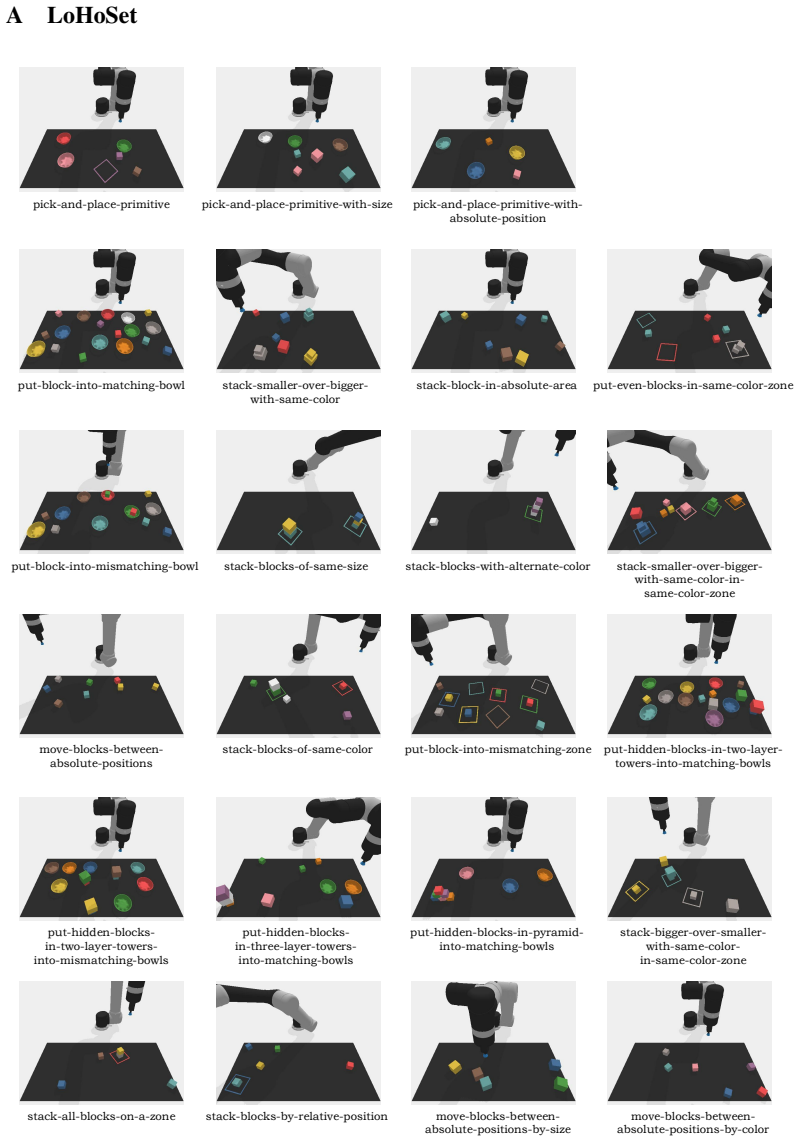
LoHoVLA's claimed derivation chain is an empirical training-and-evaluation loop, not a formal derivation. The dataset (Section 3.2) is generated by rule-based expert demonstrations in the Ravens simulator; the model is trained to predict sub-task tokens and discrete action tokens; evaluation (Section 4.2) measures task completion against the same simulator's ground truth. Nothing in this loop defines the output as the input: the model must still produce correct sub-task and action tokens, and the closed-loop retries in Algorithm 1 (K=2) only re-sample from the learned policy, which does not guarantee success. The 'single time step per sub-task' assumption (Section 3.1) narrows the notion of planning but is explicitly acknowledged in the Limitations section as impractical in real-time applications; it is a simplifying assumption, not a circular reduction. The sub-task planning metric in Section 4.4 uses manually enumerated ground-truth options generated by the same rule family as the training labels, making it a somewhat self-referential auxiliary diagnostic, but the headline claim rests on task-completion scores, which are not equivalent to the training labels by construction. Missing success-rate entries for the LoHoRavens baseline in Table 2 and the use of 10 extra training tasks for LoHoVLA are comparison and evidence concerns, not circularity. No fitted parameter is renamed as a prediction, and no load-bearing claim reduces to a self-citation chain.
Assumptions & free parameters
free parameters (5)
- failure re-planning threshold K =
2
- action discretization resolution =
1,024 bins
- two-stage training epoch split =
3 epochs text-only, then 1 epoch text+action (5 total)
- zone-match overlap threshold =
unspecified ('predefined threshold')
- end-effector dropping probability p =
not stated
assumptions (4)
- domain assumption Each sub-task is completable in exactly one time step, and a per-step reward indicates sub-task completion.
- domain assumption Rule-based generation from full simulator state yields correct sub-task decompositions that serve as ground truth for both training labels and evaluation.
- domain assumption An unspecified LLM reliably judges semantic equivalence between predicted and ground-truth sub-tasks.
- domain assumption The frozen image encoder and projection layer of PaliGemma suffice for Ravens orthographic top-down RGB-D inputs during fine-tuning.
Cite this review
Pith. "Pith review of LoHoVLA: A Unified Vision-Language-Action Model for Long-Horizon Embodied Tasks." pith.science (2026). https://pith.science/paper/KVR52WS4
@misc{pith2026250600411,
  author       = {Pith},
  title        = {Pith review of: LoHoVLA: A Unified Vision-Language-Action Model for Long-Horizon Embodied Tasks},
  year         = {2026},
  howpublished = {\url{https://pith.science/paper/KVR52WS4}},
  note         = {Machine review of arXiv:2506.00411}
}
read the original abstract
Real-world embodied agents face long-horizon tasks, characterized by high-level goals demanding multi-step solutions beyond single actions. Successfully navigating these requires both high-level task planning (i.e., decomposing goals into sub-tasks) and low-level motion control (i.e., generating precise robot actions). While existing vision language action (VLA) models and hierarchical architectures offer potential in embodied tasks, the former often falter in planning, and the latter can suffer from coordination issues, both hampering performance. We introduce a new unified VLA framework for long-horizon tasks, dubbed LoHoVLA, to overcome these limitations. LoHoVLA leverages a large pretrained vision language model (VLM) as the backbone to jointly generate language and action tokens for sub-task generation and robot action prediction, respectively. This shared representation promotes better generalization across tasks. Additionally, LoHoVLA embraces a hierarchical closed-loop control mechanism to mitigate errors originating from both high-level planning and low-level control. To train LoHoVLA, we introduce LoHoSet, a dataset built on the Ravens simulator, containing 20 long-horizon tasks, each with 1,000 expert demonstrations composed of visual observations, linguistic goals, sub-tasks, and robot actions. Experimental results show that LoHoVLA significantly surpasses both hierarchical and standard VLA approaches on long-horizon embodied tasks in the Ravens simulator. These findings underscore the promise of unified architectures for advancing generalizable embodied intelligence.
Figures


Figures from the paper (1 more)
Forward citations
Cited by 3 Pith papers
-
Mastering PokeGym: Graph-Guided Multimodal Evolution at Test Time
The manuscript body introduces PokeGym, a vision-only automated 3D-game benchmark, while the abstract claims a G-EvoMAC method and 60.18% success rate absent from the body.
-
LENS: LLM-guided Environment Simplification for Planning and Control in Clutter
A vision-language-model-based prune-and-merge abstraction improves success and runtime for TAMP, contact-implicit MPC, and a VLA policy in cluttered tabletop manipulation.
-
RoboStream: Weaving Spatio-Temporal Reasoning with Memory in Vision-Language Models for Robotics
Training-free STF-Tokens plus a Causal Spatio-Temporal Graph let VLMs keep object permanence and action history, raising long-horizon robotic manipulation success far above reactive baselines.
Reference graph
Works this paper leans on
-
[1]
Michael Ahn, Anthony Brohan, Noah Brown, Yevgen Chebotar, Omar Cortes, Byron David, Chelsea Finn, Chuyuan Fu, Keerthana Gopalakrishnan, Karol Hausman, et al. Do as i can, not as i say: Grounding language in robotic affordances.arXiv preprint arXiv:2204.01691, 2022
arXiv 2022
-
[2]
Flamingo: a visual language model for few-shot learning.Advances in neural information processing systems, 35: 23716–23736, 2022
Jean-Baptiste Alayrac, Jeff Donahue, Pauline Luc, Antoine Miech, Iain Barr, Yana Hasson, Karel Lenc, Arthur Mensch, Katherine Millican, Malcolm Reynolds, et al. Flamingo: a visual language model for few-shot learning.Advances in neural information processing systems, 35: 23716–23736, 2022
2022
-
[3]
Anas Awadalla, Irena Gao, Josh Gardner, Jack Hessel, Yusuf Hanafy, Wanrong Zhu, Kalyani Marathe, Yonatan Bitton, Samir Gadre, Shiori Sagawa, et al. Openflamingo: An open- source framework for training large autoregressive vision-language models.arXiv preprint arXiv:2308.01390, 2023
arXiv 2023
-
[4]
Rt-h: Action hierarchies using language.arXiv preprint arXiv:2403.01823, 2024
Suneel Belkhale, Tianli Ding, Ted Xiao, Pierre Sermanet, Quon Vuong, Jonathan Tompson, Yevgen Chebotar, Debidatta Dwibedi, and Dorsa Sadigh. Rt-h: Action hierarchies using language.arXiv preprint arXiv:2403.01823, 2024
arXiv 2024
-
[5]
Paligemma: A versatile 3b vlm for transfer.arXiv preprint arXiv:2407.07726, 2024
Lucas Beyer, Andreas Steiner, André Susano Pinto, Alexander Kolesnikov, Xiao Wang, Daniel Salz, Maxim Neumann, Ibrahim Alabdulmohsin, Michael Tschannen, Emanuele Bugliarello, et al. Paligemma: A versatile 3b vlm for transfer.arXiv preprint arXiv:2407.07726, 2024
arXiv 2024
-
[6]
Kevin Black, Noah Brown, Danny Driess, Adnan Esmail, Michael Equi, Chelsea Finn, Niccolo Fusai, Lachy Groom, Karol Hausman, Brian Ichter, et al. π0: A vision-language-action flow model for general robot control.arXiv preprint arXiv:2410.24164, 2024
-
[7]
Anthony Brohan, Noah Brown, Justice Carbajal, Yevgen Chebotar, Xi Chen, Krzysztof Choro- manski, Tianli Ding, Danny Driess, Avinava Dubey, Chelsea Finn, et al. Rt-2: Vision-language- action models transfer web knowledge to robotic control.arXiv preprint arXiv:2307.15818, 2023
arXiv 2023
-
[8]
Chi-Lam Cheang, Guangzeng Chen, Ya Jing, Tao Kong, Hang Li, Yifeng Li, Yuxiao Liu, Hongtao Wu, Jiafeng Xu, Yichu Yang, et al. Gr-2: A generative video-language-action model with web-scale knowledge for robot manipulation.arXiv preprint arXiv:2410.06158, 2024
Show all 55 references
-
[9]
Automating robot failure recovery using vision-language models with optimized prompts.arXiv preprint arXiv:2409.03966, 2024
Hongyi Chen, Yunchao Yao, Ruixuan Liu, Changliu Liu, and Jeffrey Ichnowski. Automating robot failure recovery using vision-language models with optimized prompts.arXiv preprint arXiv:2409.03966, 2024
2024 arXiv
-
[10]
Pali-3 vision language models: Smaller, faster, stronger.arXiv preprint arXiv:2310.09199, 2023
Xi Chen, Xiao Wang, Lucas Beyer, Alexander Kolesnikov, Jialin Wu, Paul V oigtlaender, Basil Mustafa, Sebastian Goodman, Ibrahim Alabdulmohsin, Piotr Padlewski, et al. Pali-3 vision language models: Smaller, faster, stronger.arXiv preprint arXiv:2310.09199, 2023
-
[11]
Navila: Legged robot vision-language-action model for navigation.arXiv preprint arXiv:2412.04453, 2024
An-Chieh Cheng, Yandong Ji, Zhaojing Yang, Zaitian Gongye, Xueyan Zou, Jan Kautz, Erdem Bıyık, Hongxu Yin, Sifei Liu, and Xiaolong Wang. Navila: Legged robot vision-language-action model for navigation.arXiv preprint arXiv:2412.04453, 2024
2024 arXiv
-
[12]
Racer: Rich language-guided failure recovery policies for imitation learning.arXiv preprint arXiv:2409.14674, 2024
Yinpei Dai, Jayjun Lee, Nima Fazeli, and Joyce Chai. Racer: Rich language-guided failure recovery policies for imitation learning.arXiv preprint arXiv:2409.14674, 2024
2024 arXiv
-
[13]
Palm-e: An embodied multimodal language model
Danny Driess, Fei Xia, Mehdi SM Sajjadi, Corey Lynch, Aakanksha Chowdhery, Ayzaan Wahid, Jonathan Tompson, Quan Vuong, Tianhe Yu, Wenlong Huang, et al. Palm-e: An embodied multimodal language model. 2023
2023
-
[14]
A survey of embodied ai: From simulators to research tasks.IEEE Transactions on Emerging Topics in Computational Intelligence, 6(2):230–244, 2022
Jiafei Duan, Samson Yu, Hui Li Tan, Hongyuan Zhu, and Cheston Tan. A survey of embodied ai: From simulators to research tasks.IEEE Transactions on Emerging Topics in Computational Intelligence, 6(2):230–244, 2022
2022
-
[15]
Plan-and-act: Improving planning of agents for long-horizon tasks.arXiv preprint arXiv:2503.09572, 2025
Lutfi Eren Erdogan, Nicholas Lee, Sehoon Kim, Suhong Moon, Hiroki Furuta, Gopala Anu- manchipalli, Kurt Keutzer, and Amir Gholami. Plan-and-act: Improving planning of agents for long-horizon tasks.arXiv preprint arXiv:2503.09572, 2025. 11
2025 arXiv
-
[16]
Sam2point: Segment any 3d as videos in zero-shot and promptable manners
Ziyu Guo, Renrui Zhang, Xiangyang Zhu, Chengzhuo Tong, Peng Gao, Chunyuan Li, and Pheng-Ann Heng. Sam2point: Segment any 3d as videos in zero-shot and promptable manners. arXiv preprint arXiv:2408.16768, 2024
2024 arXiv
-
[17]
Lora: Low-rank adaptation of large language models.ICLR, 1 (2):3, 2022
Edward J Hu, Yelong Shen, Phillip Wallis, Zeyuan Allen-Zhu, Yuanzhi Li, Shean Wang, Lu Wang, Weizhu Chen, et al. Lora: Low-rank adaptation of large language models.ICLR, 1 (2):3, 2022
2022
-
[18]
Look before you leap: Unveiling the power of gpt-4v in robotic vision-language planning.arXiv preprint arXiv:2311.17842, 2023
Yingdong Hu, Fanqi Lin, Tong Zhang, Li Yi, and Yang Gao. Look before you leap: Unveiling the power of gpt-4v in robotic vision-language planning.arXiv preprint arXiv:2311.17842, 2023
2023 arXiv
-
[19]
Inner monologue: Embodied reasoning through planning with language models.arXiv preprint arXiv:2207.05608, 2022
Wenlong Huang, Fei Xia, Ted Xiao, Harris Chan, Jacky Liang, Pete Florence, Andy Zeng, Jonathan Tompson, Igor Mordatch, Yevgen Chebotar, et al. Inner monologue: Embodied reasoning through planning with language models.arXiv preprint arXiv:2207.05608, 2022
2022 arXiv
-
[20]
π0.5: a vision- language-action model with open-world generalization.arXiv preprint arXiv:2504.16054, 2025
Physical Intelligence, Kevin Black, Noah Brown, James Darpinian, Karan Dhabalia, Danny Driess, Adnan Esmail, Michael Equi, Chelsea Finn, Niccolo Fusai, et al. π0.5: a vision- language-action model with open-world generalization.arXiv preprint arXiv:2504.16054, 2025
2025 arXiv
-
[21]
Rlbench: The robot learning benchmark & learning environment.IEEE Robotics and Automation Letters, 5(2): 3019–3026, 2020
Stephen James, Zicong Ma, David Rovick Arrojo, and Andrew J Davison. Rlbench: The robot learning benchmark & learning environment.IEEE Robotics and Automation Letters, 5(2): 3019–3026, 2020
2020
-
[22]
Vima: General robot manipulation with multimodal prompts.arXiv preprint arXiv:2210.03094, 2(3):6, 2022
Yunfan Jiang, Agrim Gupta, Zichen Zhang, Guanzhi Wang, Yongqiang Dou, Yanjun Chen, Li Fei-Fei, Anima Anandkumar, Yuke Zhu, and Linxi Fan. Vima: General robot manipulation with multimodal prompts.arXiv preprint arXiv:2210.03094, 2(3):6, 2022
-
[23]
Prismatic vlms: Investigating the design space of visually-conditioned language models
Siddharth Karamcheti, Suraj Nair, Ashwin Balakrishna, Percy Liang, Thomas Kollar, and Dorsa Sadigh. Prismatic vlms: Investigating the design space of visually-conditioned language models. InForty-first International Conference on Machine Learning, 2024
2024
-
[24]
Openvla: An open-source vision-language-action model.arXiv preprint arXiv:2406.09246, 2024
Moo Jin Kim, Karl Pertsch, Siddharth Karamcheti, Ted Xiao, Ashwin Balakrishna, Suraj Nair, Rafael Rafailov, Ethan Foster, Grace Lam, Pannag Sanketi, et al. Openvla: An open-source vision-language-action model.arXiv preprint arXiv:2406.09246, 2024
2024 arXiv
-
[25]
Interactive task planning with language models.arXiv preprint arXiv:2310.10645, 2023
Boyi Li, Philipp Wu, Pieter Abbeel, and Jitendra Malik. Interactive task planning with language models.arXiv preprint arXiv:2310.10645, 2023
2023 arXiv
-
[26]
Towards generalist robot policies: What matters in building vision-language-action models.arXiv preprint arXiv:2412.14058, 2024
Xinghang Li, Peiyan Li, Minghuan Liu, Dong Wang, Jirong Liu, Bingyi Kang, Xiao Ma, Tao Kong, Hanbo Zhang, and Huaping Liu. Towards generalist robot policies: What matters in building vision-language-action models.arXiv preprint arXiv:2412.14058, 2024
2024 arXiv
-
[27]
Hamster: Hierarchical action models for open-world robot manipulation.arXiv preprint arXiv:2502.05485, 2025
Yi Li, Yuquan Deng, Jesse Zhang, Joel Jang, Marius Memmel, Raymond Yu, Caelan Reed Garrett, Fabio Ramos, Dieter Fox, Anqi Li, et al. Hamster: Hierarchical action models for open-world robot manipulation.arXiv preprint arXiv:2502.05485, 2025
2025 arXiv
-
[28]
Code as policies: Language model programs for embodied control
Jacky Liang, Wenlong Huang, Fei Xia, Peng Xu, Karol Hausman, Brian Ichter, Pete Florence, and Andy Zeng. Code as policies: Language model programs for embodied control. In2023 IEEE International Conference on Robotics and Automation (ICRA), pages 9493–9500. IEEE, 2023
2023
-
[29]
Visual instruction tuning.Advances in neural information processing systems, 36:34892–34916, 2023
Haotian Liu, Chunyuan Li, Qingyang Wu, and Yong Jae Lee. Visual instruction tuning.Advances in neural information processing systems, 36:34892–34916, 2023
2023
-
[30]
Aligning cyber space with physical world: A comprehensive survey on embodied ai.arXiv preprint arXiv:2407.06886, 2024
Yang Liu, Weixing Chen, Yongjie Bai, Xiaodan Liang, Guanbin Li, Wen Gao, and Liang Lin. Aligning cyber space with physical world: A comprehensive survey on embodied ai.arXiv preprint arXiv:2407.06886, 2024
2024 arXiv
-
[31]
Decoupled weight decay regularization.arXiv preprint arXiv:1711.05101, 2017
Ilya Loshchilov and Frank Hutter. Decoupled weight decay regularization.arXiv preprint arXiv:1711.05101, 2017. 12
2017 arXiv
-
[32]
Data-agnostic robotic long-horizon manipulation with vision-language-guided closed-loop feedback.arXiv preprint arXiv:2503.21969, 2025
Yuan Meng, Xiangtong Yao, Haihui Ye, Yirui Zhou, Shengqiang Zhang, Zhenshan Bing, and Alois Knoll. Data-agnostic robotic long-horizon manipulation with vision-language-guided closed-loop feedback.arXiv preprint arXiv:2503.21969, 2025
2025 arXiv
-
[33]
Pivot: Iterative visual prompting elicits actionable knowledge for vlms.arXiv preprint arXiv:2402.07872, 2024
Soroush Nasiriany, Fei Xia, Wenhao Yu, Ted Xiao, Jacky Liang, Ishita Dasgupta, Annie Xie, Danny Driess, Ayzaan Wahid, Zhuo Xu, et al. Pivot: Iterative visual prompting elicits actionable knowledge for vlms.arXiv preprint arXiv:2402.07872, 2024
2024 arXiv
-
[34]
Open x- embodiment: Robotic learning datasets and rt-x models: Open x-embodiment collaboration 0
Abby O’Neill, Abdul Rehman, Abhiram Maddukuri, Abhishek Gupta, Abhishek Padalkar, Abraham Lee, Acorn Pooley, Agrim Gupta, Ajay Mandlekar, Ajinkya Jain, et al. Open x- embodiment: Robotic learning datasets and rt-x models: Open x-embodiment collaboration 0. In2024 IEEE Internat...
2024
-
[35]
Learning transferable visual models from natural language supervision
Alec Radford, Jong Wook Kim, Chris Hallacy, Aditya Ramesh, Gabriel Goh, Sandhini Agarwal, Girish Sastry, Amanda Askell, Pamela Mishkin, Jack Clark, et al. Learning transferable visual models from natural language supervision. InInternational conference on machine learning, pag...
2021
-
[36]
Deepspeed: System optimizations enable training deep learning models with over 100 billion parameters
Jeff Rasley, Samyam Rajbhandari, Olatunji Ruwase, and Yuxiong He. Deepspeed: System optimizations enable training deep learning models with over 100 billion parameters. In Proceedings of the 26th ACM SIGKDD international conference on knowledge discovery & data mining, pages 3...
2020
-
[37]
Yell at your robot: Improving on-the-fly from language corrections.arXiv preprint arXiv:2403.12910, 2024
Lucy Xiaoyang Shi, Zheyuan Hu, Tony Z Zhao, Archit Sharma, Karl Pertsch, Jianlan Luo, Sergey Levine, and Chelsea Finn. Yell at your robot: Improving on-the-fly from language corrections.arXiv preprint arXiv:2403.12910, 2024
2024 arXiv
-
[38]
Cliport: What and where pathways for robotic manipulation
Mohit Shridhar, Lucas Manuelli, and Dieter Fox. Cliport: What and where pathways for robotic manipulation. InConference on robot learning, pages 894–906. PMLR, 2022
2022
-
[39]
Octo: An open-source generalist robot policy.arXiv preprint arXiv:2405.12213, 2024
Octo Model Team, Dibya Ghosh, Homer Walke, Karl Pertsch, Kevin Black, Oier Mees, Sudeep Dasari, Joey Hejna, Tobias Kreiman, Charles Xu, et al. Octo: An open-source generalist robot policy.arXiv preprint arXiv:2405.12213, 2024
2024 arXiv
-
[40]
Llama 2: Open foundation and fine-tuned chat models.arXiv preprint arXiv:2307.09288, 2023
Hugo Touvron, Louis Martin, Kevin Stone, Peter Albert, Amjad Almahairi, Yasmine Babaei, Nikolay Bashlykov, Soumya Batra, Prajjwal Bhargava, Shruti Bhosale, et al. Llama 2: Open foundation and fine-tuned chat models.arXiv preprint arXiv:2307.09288, 2023
2023 arXiv
-
[41]
Karma: Augmenting embodied ai agents with long-and-short term memory systems.arXiv preprint arXiv:2409.14908, 2024
Zixuan Wang, Bo Yu, Junzhe Zhao, Wenhao Sun, Sai Hou, Shuai Liang, Xing Hu, Yinhe Han, and Yiming Gan. Karma: Augmenting embodied ai agents with long-and-short term memory systems.arXiv preprint arXiv:2409.14908, 2024
2024 arXiv
-
[42]
Chain-of-thought prompting elicits reasoning in large language models
Jason Wei, Xuezhi Wang, Dale Schuurmans, Maarten Bosma, Fei Xia, Ed Chi, Quoc V Le, Denny Zhou, et al. Chain-of-thought prompting elicits reasoning in large language models. Advances in neural information processing systems, 35:24824–24837, 2022
2022
-
[43]
Diffusion-vla: Scaling robot foundation models via unified diffusion and autoregression.arXiv preprint arXiv:2412.03293, 2024
Junjie Wen, Minjie Zhu, Yichen Zhu, Zhibin Tang, Jinming Li, Zhongyi Zhou, Chengmeng Li, Xiaoyu Liu, Yaxin Peng, Chaomin Shen, et al. Diffusion-vla: Scaling robot foundation models via unified diffusion and autoregression.arXiv preprint arXiv:2412.03293, 2024
2024 arXiv
-
[44]
Dexvla: Vision-language model with plug-in diffusion expert for general robot control.arXiv preprint arXiv:2502.05855, 2025
Junjie Wen, Yichen Zhu, Jinming Li, Zhibin Tang, Chaomin Shen, and Feifei Feng. Dexvla: Vision-language model with plug-in diffusion expert for general robot control.arXiv preprint arXiv:2502.05855, 2025
2025 arXiv
-
[45]
Embodied task planning with large language models.arXiv preprint arXiv:2307.01848, 2023
Zhenyu Wu, Ziwei Wang, Xiuwei Xu, Jiwen Lu, and Haibin Yan. Embodied task planning with large language models.arXiv preprint arXiv:2307.01848, 2023
2023 arXiv
-
[46]
Guiding long-horizon task and motion planning with vision language models.arXiv preprint arXiv:2410.02193, 2024
Zhutian Yang, Caelan Garrett, Dieter Fox, Tomás Lozano-Pérez, and Leslie Pack Kaelbling. Guiding long-horizon task and motion planning with vision language models.arXiv preprint arXiv:2410.02193, 2024. 13
2024 arXiv
-
[47]
Meta-world: A benchmark and evaluation for multi-task and meta reinforcement learning
Tianhe Yu, Deirdre Quillen, Zhanpeng He, Ryan Julian, Karol Hausman, Chelsea Finn, and Sergey Levine. Meta-world: A benchmark and evaluation for multi-task and meta reinforcement learning. InConference on robot learning, pages 1094–1100. PMLR, 2020
2020
-
[48]
Robotic control via embodied chain-of-thought reasoning.arXiv preprint arXiv:2407.08693, 2024
Michał Zawalski, William Chen, Karl Pertsch, Oier Mees, Chelsea Finn, and Sergey Levine. Robotic control via embodied chain-of-thought reasoning.arXiv preprint arXiv:2407.08693, 2024
2024 arXiv
-
[49]
Transporter networks: Rearranging the visual world for robotic manipulation
Andy Zeng, Pete Florence, Jonathan Tompson, Stefan Welker, Jonathan Chien, Maria Attarian, Travis Armstrong, Ivan Krasin, Dan Duong, Vikas Sindhwani, et al. Transporter networks: Rearranging the visual world for robotic manipulation. InConference on Robot Learning, pages 726–7...
2021
-
[50]
Lohoravens: A long-horizon language- conditioned benchmark for robotic tabletop manipulation.arXiv preprint arXiv:2310.12020, 2023
Shengqiang Zhang, Philipp Wicke, Lütfi Kerem ¸ Senel, Luis Figueredo, Abdeldjallil Naceri, Sami Haddadin, Barbara Plank, and Hinrich Schütze. Lohoravens: A long-horizon language- conditioned benchmark for robotic tabletop manipulation.arXiv preprint arXiv:2310.12020, 2023
-
[51]
Vlabench: A large-scale benchmark for language-conditioned robotics manipulation with long-horizon reasoning tasks.arXiv preprint arXiv:2412.18194, 2024
Shiduo Zhang, Zhe Xu, Peiju Liu, Xiaopeng Yu, Yuan Li, Qinghui Gao, Zhaoye Fei, Zhangyue Yin, Zuxuan Wu, Yu-Gang Jiang, et al. Vlabench: A large-scale benchmark for language-conditioned robotics manipulation with long-horizon reasoning tasks.arXiv preprint arXiv:2412.18194, 2024
2024 arXiv
-
[52]
Erra: An embodied representation and reasoning architecture for long-horizon language- conditioned manipulation tasks.IEEE Robotics and Automation Letters, 8(6):3230–3237, 2023
Chao Zhao, Shuai Yuan, Chunli Jiang, Junhao Cai, Hongyu Yu, Michael Yu Wang, and Qifeng Chen. Erra: An embodied representation and reasoning architecture for long-horizon language- conditioned manipulation tasks.IEEE Robotics and Automation Letters, 8(6):3230–3237, 2023
2023
-
[53]
Cot-vla: Visual chain-of-thought reasoning for vision-language-action models.arXiv preprint arXiv:2503.22020, 2025
Qingqing Zhao, Yao Lu, Moo Jin Kim, Zipeng Fu, Zhuoyang Zhang, Yecheng Wu, Zhaoshuo Li, Qianli Ma, Song Han, Chelsea Finn, et al. Cot-vla: Visual chain-of-thought reasoning for vision-language-action models.arXiv preprint arXiv:2503.22020, 2025
2025 arXiv
-
[54]
Isr-llm: Iterative self-refined large language model for long-horizon sequential task planning
Zhehua Zhou, Jiayang Song, Kunpeng Yao, Zhan Shu, and Lei Ma. Isr-llm: Iterative self-refined large language model for long-horizon sequential task planning. In2024 IEEE International Conference on Robotics and Automation (ICRA), pages 2081–2088. IEEE, 2024
2024
-
[55]
Put the [OBJ] on the [OBJ]
Yuke Zhu, Josiah Wong, Ajay Mandlekar, Roberto Martín-Martín, Abhishek Joshi, Soroush Nasiriany, and Yifeng Zhu. robosuite: A modular simulation framework and benchmark for robot learning.arXiv preprint arXiv:2009.12293, 2020. 14 A LoHoSet pick-and-place-primitive pick-and-pla...
2009 arXiv
Reviewed August 7, 2026 · model on record in the stance chip above.
Discussion (0). Sign in to comment.